| Conflict | South African War |
| Nursing Service | Princess Christian’s Army Nursing Service Reserve |
| Units/Hospitals | No. 3 General Hospital, Green Point Military Hospital, No. 19 General Hospital, No. 11 General Hospital |
| Overseas Service | Cape Colony & Transvaal |
| Final Service No. | |
| Final Rank | Sister |
FAMILY BACKGROUND
Beatrice Huston, sometimes known as Beattie and Bea, was born on 27 December 1878 at St. Lawrence, 130 kilometres north of Rockhampton in Queensland. She was the daughter of Bessie McCann (c. 1845–1906) and Robert Huston (c. 1840–1882).
Bessie McCann was from Ballygowan in the north of Ireland. She was the youngest daughter of Mr. T. McCann (possibly Thomas) and migrated to Australia in the early 1860s with a number of brothers. On 2 February 1865 Bessie married Robert Huston in Sydney. Robert was also from the north of Ireland and appears to have arrived in Australia at around the same time as Bessie.
After their marriage, Bessie and Robert moved to Queensland and by November 1865 were living at Fortitude Valley in Brisbane. On 27 November Robert gave notice of his intention to apply for a publican’s licence for the sale of alcohol in a rented house situated at the corner of Wickham and Brunswick Streets in Fortitude Valley, which he intended to keep as the ‘Hibernian Hotel.’
In the event, Robert did not establish the Hibernian Hotel but instead became licensee of the Caledonian Hotel on Ann Street in Fortitude Valley. He also had a cab business. He became heavily indebted and in April 1866, with the bailiff threatening to sell off his and Bessie’s furniture, transferred his publican’s licence to a Donald McIvor, sold his cab business, and prepared to return to Sydney.
On 21 May, after boarding the steamer Cawarra, Robert was taken off again by an agent of a man named Bartley, whom he owed £35. Bartley’s agent detained Robert at the wharf while awaiting the bailiff, and in the meantime the Cawarra steamed away. However, the bailiff did not turn up, and the man had no choice but to let Robert go. It is not clear whether Bessie was with him; she may have remained on the steamer, or perhaps she had left earlier.
One way or another, Bessie and Robert got back to Sydney and remained there for the next few years. In September 1866 their first child was born – a boy, James. Winifred Lydia, known as Lydia, was born next, in June 1867. By then the family was living in the suburb of Redfern. In 1868 the Hustons’ third child, William John, was born.
The Hustons returned to Queensland sometime after the birth of William, and in July 1871 Maud Mary was born. Bessie’s and Robert’s fifth child, Gertrude Florence, sometimes known as Gerty, was born in January 1874, by which time the family was living in the town of St. Lawrence, 130 kilometres north of Rockhampton, and Robert was working as a carrier (also known as a teamster).
Two more children were born at St. Lawrence, Robert Ernest, sometimes known as Bob, in October 1876, and Beatrice in December 1878.
On 6 March 1879 Robert was indicted in the Rockhampton Central District Court for having, on 8 November 1878, at St. Lawrence, stolen 13 tomahawks and two bottles of fruit, valued at £2 18s. 6d., from the store of Thomas Hatfield. He was at that time undergoing a sentence of six months for illegally using a horse, three months of which had passed. He was sentenced to 12 months’ imprisonment with hard labour, to be served concurrently with the term of six months. He would, in other words, remain in prison until the end of 1879.
Following Robert’s release, the Hustons moved to Clermont, 200 kilometres west of St. Lawrence, where Robert continued to work as a carrier. Three kilometres south of Clermont lay the small town of Copperfield. Here lived a certain Thomas Huston and his family. He was a storekeeper and publican – and possibly Robert’s brother.
Four of Thomas Huston’s children, Charles, Mary, Annie and Patrick, had begun attending Clermont State School in November 1879. They were joined there by Bessie’s and Robert’s children. William (then aged 11), Maud (eight) and Gertrude (five) began in May 1880, while James (14) started in March 1881, Lydia (11) in April 1881, and Robert (five) in October 1881.
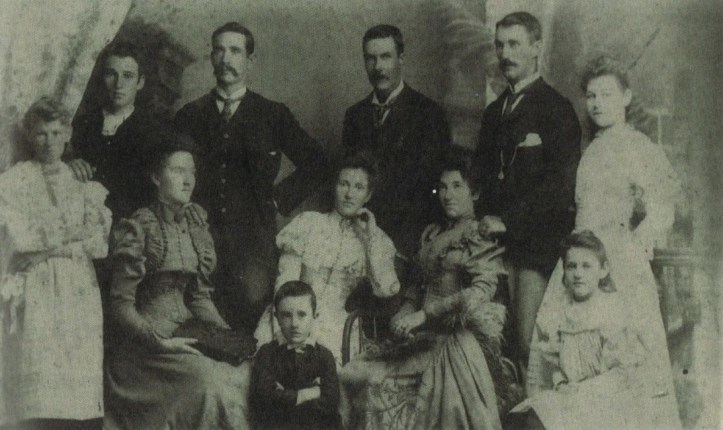
Ten months earlier, on 22 December 1880, Bessie’s and Robert’s eighth and final child was born – another girl, Grace Edith.
TRAGEDY AT CLERMONT
In January 1882, John Swan, the licensee of the 32-room Prince of Wales Hotel on Drummond Street, the largest hotel in Clermont, became insolvent, and the business was put to auction – the unexpired term of lease on the building, the publican’s licence, the hotel’s goodwill, stock-in-trade, furniture etc. Bessie Huston became the new proprietor. The timing could hardly have been worse.
On the afternoon of 3 March 1882 rain began to fall over Clermont. It continued intermittently for the next five days, with nearly eight inches falling, and soon after 2.00 am on the morning of 8 March the Sandy Creek, which bounded the town on its western and northern sides, began to rise. In the early afternoon, with rain continuing to pelt down, the creek spilled its banks, and water began to stream across the flat towards Drummond Street, the town’s main street, on which the Prince of Wales Hotel stood. It entered the street on the western side and for the next few hours rose gradually. By 6.00 pm the water was a foot deep on the highest part of Drummond Street and two feet deep in the gutters. As night came on, the water deepened, reaching its peak at 2.00 am on 9 March. Thereafter, it fell rapidly, and by morning Drummond Street was safe to walk along.
The town had suffered considerable damage. Streets were strewn with detritus of all sorts – clothing, boxes, plants, dead animals; fences were carried away; slabs of asphalt were ripped up from Drummond Street; and shops and businesses were filled with mud. The damage to the Prince of Wales Hotel was considerable, amounting to £250 in total.
On Friday 17 March, only a week after the flood, Robert Huston set out on his horse towards Emerald, 100 kilometres southeast of Clermont. At around midday he reached Theresa Creek. The creek was swollen; the water was 10 to 12 feet deep and running with great force. Finding that the chairlift was on the Emerald side of the creek, Robert signalled his intention to cross on horseback. Asked by a bystander if he could swim, he replied that he could not. Almost defiantly he plunged in, and he and his horse immediately went under. He came up once and then disappeared, never to be seen alive again. His body was found two kilometres downstream at around 4.00 pm the following day wedged in tree limbs in the middle of the creek. After being identified by a man named Burns, Robert was buried on Sunday, near where he was found.
Following this tragedy, a bereaved Bessie wrote to the Peak Downs Telegram and Queensland Mining Record in response to the newspaper’s coverage of Robert’s drowning. Her letter was printed on 1 April 1882, as follows:
“Sir, – In the last issue of your paper you gave credit to the Emerald police for their exertions in finding the body of my late husband, Robert Huston. Since I have been informed of the inhuman and unchristian manner of his burial, I cannot thank the police or anyone concerned. His remains were found on the 18th, at four in the afternoon, and were left unburied till Sunday morning. Was there not ample time to have got a coffin made. I remember that my husband once, when a boy died on the road, took the bottom boards from his waggon to make the deceased lad a coffin. My husband was well known to be the possessor of means: his horses and waggon were there to show it; and it was known that I was on the road to see him decently buried. I sent my son on with Burns when I was too exhausted to proceed, and was myself provided with money to pay funeral expenses. A railway camp was close handy, where materials for a coffin and men to make it, could have been procured, yet no effort that I have heard of was made to carry out my wish. Could I but have completed my journey, he would have had decent burial. What then was to hinder the same being done in my absence. I have no wish to drag my grief before the public without a cause, but I will leave it to any woman whose unhappy case may be mine – though God forbid – whether she would feel satisfied at the prospect of her husband’s remains being buried in so disgraceful a manner.
I am, &c.,
BESSIE HUSTON.
March 28,1882”
Soon afterwards, Bessie reopened the Prince of Wales Hotel.
GROWING UP
On 21 January 1884 Beatrice, now five years old, started school, joining Maud, Gertrude and Robert. By then, James, William and Lydia had finished. On 11 August that year Beatrice was joined in First Class by five-year-old Ethel Huston, later known as Ethel Leonard – her newly adopted sister. Ethel’s mother, a woman by the name of Kate Leonard, had died on 3 August 1884. When Kate’s husband, George Leonard, a publican at Miclere, 30 kilometres north of Clermont, made it known that he was going to send Ethel and her three-year old sister, Ada, to the orphanage, Bessie Huston offered to adopt Ethel. A woman by the name of Mrs. Hall adopted Ada. Ethel remained with the Huston family until her marriage in December 1900.
Beatrice was evidently a bright pupil. In the third term of 1891, when she was in Fourth Class, she achieved the highest marks among the girls of her class. She was a handy embroiderer too. At the prize ceremony marking the end of 1892, she was awarded first prize in Fifth Class for sewing. On the same occasion her sister Grace, who had begun school on 18 January 1886, came second in sewing in Fourth Class B.
Beatrice also demonstrated an aptitude for performance. At the school concert held at the Town Hall in December 1893 – her final year, in which she completed Sixth Class – Beatrice recited ‘Papa’s Letter.’ According to the Peak Downs Telegram and Queensland Mining Record (16 December 1893), she delivered it “with her usual cleverness,” though at times her voice was partially drowned by the noise of the other children.
Like the majority of children living in rural Queensland at this time, after completing Sixth Class Beatrice did not go on to high school. In the absence at this time of state high schools in Queensland, she would have had to board at a church grammar school in Rockhampton – something that was financially out of the question.
Instead, Beatrice occupied herself with other things. She continued to perform, and on 17 August 1894 took part in a concert at the Town Hall in aid of the school’s water fund. She acted in the farcical comedy ‘Moike.’ Playing Carrie Plumsey, she “made the most of a trying part,” enthused the Peak Downs Telegram and Queensland Mining Record (25 August 1894).
“This young lady gives promise of becoming of great assistance in future amateur performances. She acts in an extremely self-possessed manner and speaks her lines clearly and correctly.”
In February 1895 Beatrice featured in a variety performance held at the Town Hall to raise funds for the Anglican Church. She acted in the farce ‘Borrowed Plumes,’ attracting a somewhat ambivalent review in the Peak Downs Telegram (2 March 1895):
“Miss Beatrice Huston, a young, though very promising amateur … had an arduous part in Violet, daughter of Mr. Botherby Bibbens, and though at times her voice was rather indistinct, still, by her self-possessed manner and graceful acting and appearance, she won her way into the good graces of the audience.”
No doubt Beatrice also helped her mother at the Prince of Wales Hotel. By then Bessie Huston had become Bessie Finn, having married Mr. Frank Finn on 19 February 1891. Frank was born on 26 July 1859 in Kent, England and in the 1860s migrated with his family to the South Island of New Zealand. In 1890 he moved to the Rockhampton district after (possibly) arriving in Sydney aboard the Te Anau in June 1886.
Following the death of Robert Huston, Bessie, with eight children to feed – and then nine – had had to forge ahead in business, whatever the risks. In July 1883 she had opened a coffee room within the Prince of Wales Hotel and in August 1884, while still running the hotel, had opened a drapery, millinery and dressmaking shop on Drummond Street.
In May 1885 Bessie became proprietor of the Terminus Hotel, near Clermont railway station, transferring her licence for the Prince of Wales Hotel to Mr. Anker Christensen. The Terminus Hotel was made entirely of pine and had been built a year earlier by Mr. W. K. Higson, who had then sold the building and land to Bessie.
Soon fortune dealt Bessie another heavy blow. On the evening of Sunday 16 May 1886, while the church bells were pealing, a fire broke out in the Terminus Hotel. It burned to the ground, fortunately with no loss of life. The building was valued at £2,000 and was only insured for £600, so although Bessie had managed to save her cash box, the loss was a serious one. In June she closed her drapery shop and put the contents to auction, and in July she was adjudicated insolvent.
Bessie picked herself up and carried on. In July 1887 she was granted a certificate of discharge and in September that year once again became licensee for the new Prince of Wales Hotel. After Mr. Christensen had become insolvent, the original building was torn down and rebuilt by its owner, Mr. A. B. MacDonald. Bessie remained at the hotel for the next 15 years.
THE SOUTH AFRICAN WAR
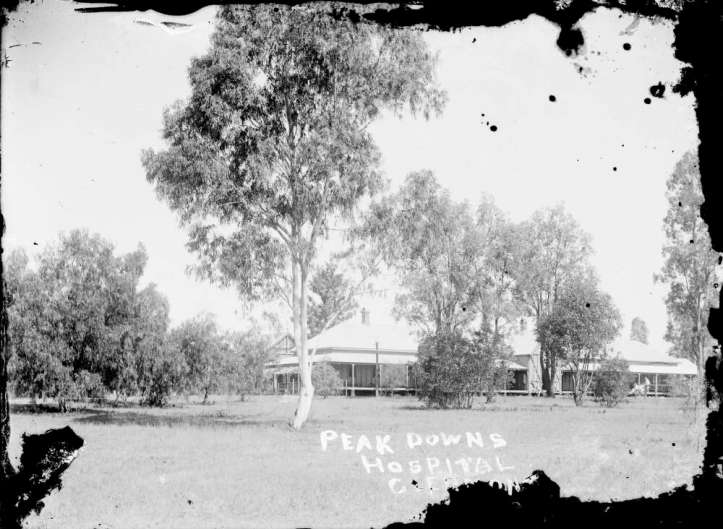
In due course, Beatrice decided to become a nurse, and in March 1899 she and two other women, Miss Small and Miss Adam, were appointed to the Peak Downs Hospital in Clermont as probationers. Beatrice had not been nursing long when a war broke out in which she and two of her brothers would serve – the Second Boer War, known at the time as the South African War. The war, which was fought predominantly in South Africa but also in southern Rhodesia (Zimbabwe) and Bechuanaland (Botswana), pitted the British Empire and the colonies of Cape Colony and Natal against the Boer republics of the Transvaal and the Orange Free State.
Tensions between the Boer republics and British imperial and colonial interests had been simmering long before hostilities broke out on 11 October 1899. The discovery of gold on the Witwatersrand in 1886 had drawn thousands of ‘Uitlanders’ (‘Outlanders’) from across the British Empire into the Transvaal, and by the early 1890s they outnumbered the Boer population. The Uitlanders, heavily taxed yet excluded from political representation, began to agitate for reform. In December 1895 Cecil Rhodes, the prime minister of Cape Colony directed the British colonial administrator Leander Starr Jameson to mount an armed incursion into the Transvaal from Bechuanaland. Intended to trigger an uprising by the Uitlanders, the Jameson Raid was botched and no such uprising occurred. Instead, President Paul Kruger of the Transvaal began to import large quantities of European ordnance and established a defensive alliance with the Orange Free State. Anglo-Transvaal relations progressively deteriorated and by mid-1899 it was clear that war was imminent.
In September the Boer republics and Cape Colony and Natal began to mobilise in earnest. At the same time, the Australian colonies began recruitment drives in support of the British cause.
On 9 October the Transvaal, supported by the Orange Free State, issued an ultimatum to Britain, demanding that British troops be withdrawn from their borders and no further reinforcements be sent. Britain rejected the demand, and on 11 October the Boers considered themselves at war. On 12 October General Piet Joubert, commandant-general of the Transvaal Boers, crossed into Natal and began to advance south towards Ladysmith. On the same day the forces of General Piet Cronje, commander of the western Transvaal Boers, crossed into Cape Colony and by 13 October Mafeking was under siege. Meanwhile, the Free State Boers under Chief Commandant C. J. Wessels also crossed into Cape Colony and on 14 October began progressively to isolate Kimberley.
By then the first contingent of Australian troops, a squadron of New South Wales Lancers who had been training at Aldershot in England, was on its way to South Africa. Departing London on the Nineveh on 10 October, the men arrived at Cape Town on 2 November and were immediately marched to the railway station and sent to the front in northern Cape Colony. That same day, General Joubert besieged Ladysmith.
In Australia, meanwhile, contingents of troops from Victoria and South Australia had embarked for Cape Town on the Medic. They were joined at Albany on 5 November by the first contingent of Western Australian troops. At around the same time, Queensland troops departed on the Cornwall and New South Wales troops on the Aberdeen.
On 15 December the commander-in-chief of British forces in South Africa, General Sir Redvers Buller, while advancing to the relief of Ladysmith, was defeated by a Boer force under General Louis Botha at Colenso in Natal. It was the third British defeat in five days, a period that became known as ‘Black Week,’ and precipitated Buller’s replacement as commander-in-chief by Field Marshal Lord Roberts. Roberts arrived at Cape Town on 10 January 1900 accompanied by Herbert Kitchener, his chief of staff.
After building up his forces, in early February Roberts shifted his base of operations from Cape Town to the Modder River in northern Cape Colony and launched an offensive into the Orange Free State, allowing Major-General John French’s cavalry division to relieve Kimberley on 15 February. On 27 February Roberts took the surrender of General Cronje and 4,000 of his men following the Battle of Paardeberg and on 13 March entered Bloemfontein, the capital of the Orange Free State.
TO THE TRANSVAAL
Whether motivated by a desire for adventure or loyalty to the Empire – likely a combination of both – Beatrice resolved to travel to the Transvaal to offer her services as a nurse. Exactly when she came to this decision is not known, but by 2 February 1900 a fund had been initiated by the people of Clermont for the purpose of assisting her passage. She had undertaken to travel independently, as Queensland military authorities were not interested in forming or sponsoring a Queensland nursing contingent for South Africa; nor was there any determined civic movement to raise and fund a nursing contingent.
In January or early February Beatrice submitted a resignation letter to the Peak Downs Hospital. The letter was read out at the monthly meeting of the hospital committee on 8 February, as was an accompanying note from the surgeon. It stated that Beatrice had been a diligent and painstaking pupil and wished to go to the Transvaal. Her resignation was accepted with regret.
With her expenses defrayed, Beatrice was ready to set out on her journey. On Saturday evening 10 February a few of her friends assembled at the Prince of Wales Hotel to bid her farewell and present her with a purse of sovereigns. The following evening she departed Clermont by train for Rockhampton, accompanied by her sister Lydia (who was now Mrs. W. L. Kilpatrick, widow of John Kilpatrick).
Beatrice and Lydia arrived at Rockhampton on 13 February and that night departed for Brisbane aboard the Wodonga. Beatrice remained in Brisbane for three weeks, staying with Mrs. J. M. Cross, the wife of Mr. J. M. Cross, at one time the member for Clermont.
It was presumably while in Brisbane that Beatrice organised her passage to Cape Town. Through Dalgety & Co., the agents for Aberdeen White Star, she booked a berth on the Salamis, which was due to leave from Sydney on 7 March and sail via Hobart, Melbourne, Albany and Durban to Cape Town. Since by then all berths in saloon class had been booked out (regardless of whether she could in any case have afforded one), Beatrice took a berth in the steerage.
Beatrice also called in to the Brisbane office of The Queenslander, a weekly newspaper. She promised ‘Delphia,’ the editor of the newspaper’s ‘Ladies Columns,’ that she would send her any interesting news from South Africa.
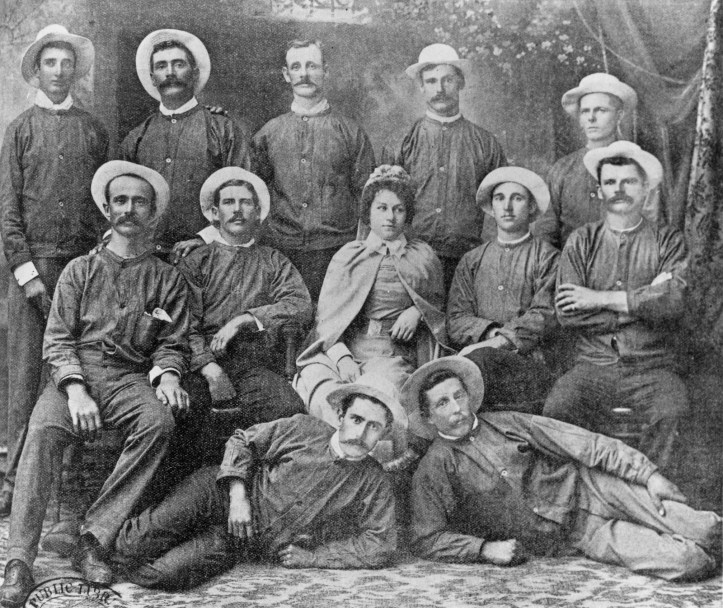
With her departure imminent, on 2 March Beatrice was given a send-off at the kiosk in the Botanic Gardens Beatrice by a group of supporters. She was to be given another send-off the following day by 11 of the Clermont volunteers for the Third Queensland Contingent, then in camp in Brisbane.
On Sunday morning 4 March, carrying letters of introduction for presentation to military authorities in Cape Town, given to her by the Queensland premier, Robert Philp, Beatrice entrained for Sydney, arriving around 36 hours later. On 7 March she made her way to the Dalgety & Co. wharf at Miller’s Point on Sydney Harbour and boarded the Salamis. Due to the demand for berths, the steerage had been considerably enlarged.
THE SALAMIS
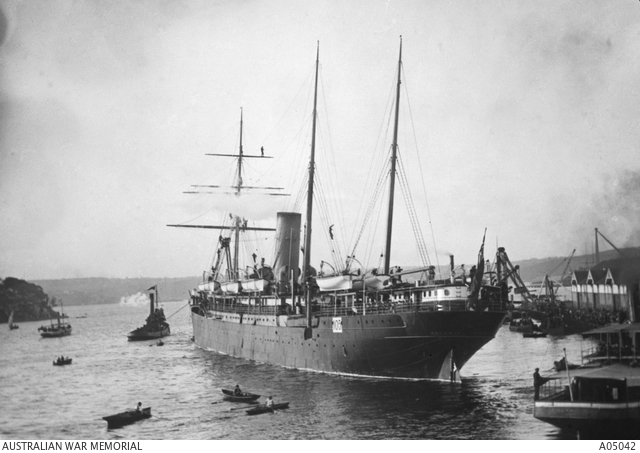
The Salamis departed that afternoon and late on 9 March arrived at Hobart, where some 12,000 crates of apples were loaded on. The following night the ship left for Melbourne, arriving on 12 March. Among those boarding in the southern capital were eight nurses bound for South Africa, seven New Zealanders and a Victorian.
The seven New Zealanders – Isabella Campbell, Dora Louisa Harris, Elizabeth Rennie Hay, Ellen Maria Monson, Agnes Dora Peiper, Sarah Jane Ross and Janet Wyse Mackie Williamson, their lady superintendent – had been outfitted and equipped by the Otago and Southland Nurses’ Committee and funded through public subscription. Departing from Dunedin on 5 March, they had sailed to Melbourne on the Talune via Invercargill.
The Victorian nurse was Janey Lempriere. Born around 1872, Nurse Lempriere was from the Melbourne suburb of Balaclava and had trained at the Children’s Hospital in Carlton. She was paying for her own passage and was carrying a letter of introduction from Donald Melville, the Victorian Minister of Defence.
The eight nurses joined Beatrice in the steerage, where there were now 120 passengers, and on 14 March the Salamis departed Melbourne for Albany. After a rough passage across the Bight, the ship arrived in the Western Australian port town on the morning of 21 March, and Beatrice and the other nurses disembarked. They were met on the wharf by a party of Western Australian nurses, who presented Nurse Williamson of the New Zealand contingent with a basket of fruit and invited the newly arrived nurses to lunch at the Freemason’s Hotel.
The Western Australian nurses were members of an 11-strong nursing contingent that had been raised for service in South Africa by a committee of prominent Perth citizens and funded by public subscription. They had been booked to sail on the Salamis and would join the others in the steerage. Making up the Western Australian contingent were Nurses Susannah Armstrong, Elizabeth Bole, Beatrice Brooks, Bessie Milne, L. A. Naylor, Miriam Plover, Louisa Rogers, Louisa Speers and Isabella Tchan, with Sister Mary Nicolay as superintendent.
After an evening meal at the Freemasons’ Hotel, the 20 nurses returned to the ship by the 8.00 pm tender, and at around 9.00 pm on 21 March 1900 the Salamis steamed out of Princess Royal Harbour, bound for Durban. Beatrice would not return to Australia for two and a half years.
DURBAN
At around 5.00 pm on 6 April land was sighted. An hour later the lights of Durban appeared, and at 8.00 pm the Salamis stopped in the roadstead outside the harbour. Numerous vessels lay at anchor, among them several hospital ships. The nurses spent the night on board, and at around 8.00 am next morning a tender came out to take them to shore.
It had been a dreadful voyage. The steerage, in which passengers were accommodated in ten-berth cabins – reportedly with no sheets or pillow slips – was overcrowded, and the food was bad. Beatrice described the voyage in a letter to Mrs. J. M. Cross written from South Africa soon after her arrival and paraphrased in the Brisbane Courier on 12 May 1900:
“Owing to the full passenger list, all the nurses were compelled to travel third class. They slept in the hold, and there were three basins for eighty women and children to wash in. The food was often sour, the bread mouldy, and the meat very often bad. The ship was three weeks at sea without sighting land. Nurse Huston never expected to arrive at Durban. Her cheeks (well-rounded when in Queensland) became hollow, the eyes sunken, and she had lost 22lb in a fortnight.”
In a letter to Mrs. G. F. Harvey, printed in the West Australian on 22 May 1900, Sister Nicolay was similarly damning:
“This has been a dreadful voyage. There are 200 passengers in steerage – 90 more than are allowed. They had to knock up temporary cabins in the hatchways, and only fancy! The New Zealand nurses are down there. They are so exhausted that the captain has allowed them to sleep on deck this last week, as it is so hot! The poor things…. We have no water after 11.30 a.m., until the next day, and never can wash all day. One gets so grimy that we actually steal water out of the filter to rinse our hands in. I have had no bath, and only a pint of water to wash in each morning…. We are all looking thin and haggard for want of food, and the privations in every way have told upon us.”
Since the sea was too rough to permit the lowering of the Salamis’s gangway to the tender, the nurses were slung across to it five or six at a time in a basket attached to the ship’s cargo derrick. Half an hour later they arrived at the wharf. In all directions, soldiers lay on stretchers, some wounded, some with fever, but all worn and thin. They had come from Ladysmith, which had finally been relieved by General Buller on 28 February after Lord Roberts’s offensive into the Orange Free State had drawn Boer strength away from Natal.
Some of the sick and wounded men were brought on board the Salamis to be transported to Cape Town for a month’s rest. Since the lifting of the siege, Ladysmith had become a major base for British operations against the Boers further north.
The 20 nurses found a hotel and had a decent wash and a square meal. They then took rickshaw rides around Durban – “a picturesque place, and full of stir and excitement,” according to Beatrice as paraphrased by the Courier. At one point they stopped at a fruit market. The nurses returned to the Salamis in the mid-afternoon and at around 5.30 pm the ship departed for Cape Town.
CAPE TOWN AND IMPERIAL SERVICE
After a rough voyage from Durban, the Salamis arrived safely at Cape Town on Tuesday 10 April 1900. As there was no berth available at the wharf, the ship anchored in Table Bay at around midday. However, the port’s tenders were all engaged with other vessels, and it was not until 4.00 pm that one came alongside the Salamis. By the time the nurses arrived at the wharf, it was after 6.00 pm and nearly dark. There was no one to meet them.
Sister Nicolay and one of the New Zealand nurses (presumably Janet Williamson, their superintendent), accompanied by Nurse Lempriere, took a Hansom cab to the main barracks, known as the ‘Castle,’ a 17th-century fort, to report to Surgeon-General Sir William Deane Wilson, Principal Medical Officer (PMO) for the Royal Army Medical Corps. Meanwhile, Beatrice and some of the other nurses went to look for lodgings. Their cab was stopped every hundred metres by a sentry, who would just look in and let them pass. The remaining nurses went to the nearby Custom House with all the luggage.
At the Castle, Sister Nicolay and Nurses Williamson and Lempriere found quite a crowd of soldiers and nurses. Some of the nurses belonged to the Army Nursing Service, who were sometimes known as the ‘Netley Sisters,’ after their training hospital at Netley, near Southampton in England. Others belonged to the Army Nursing Service Reserve, known as Princess Christian’s Army Nursing Service Reserve (PCANSR), since it was run by a committee chaired by Princess Christian of Schleswig-Holstein (the fifth child of Queen Victoria and Prince Albert, born Princess Helena). The regulars wore dark blue dresses, with scarlet shoulder capes (known as tippets) and blue bonnets without veils. The reserves wore a similar uniform, and each had a silver badge on her tippet.
The three nurses were directed to the office of General Wilson, who agreed to take Nurse Lempriere, the Western Australians, and the New Zealanders into Imperial service. Sister Nicolay would be paid at a rate equal to that of a PCANSR superintendent, £60 per annum plus extras, while each of the other nurses would be paid at a rate equal to that of a PCANSR nursing sister, £40 per annum plus extras.
Following their meeting with General Wilson, Superintendent Nicolay and Sisters Lempriere and Williamson (as we will now refer to them) returned to the wharf, where they found the others waiting at the Custom House. No other accommodation had been found, so Beatrice, Janey Lempriere and the seven New Zealanders spent the night in rooms of uncertain comfort at the Custom House, while the 11 Western Australians were taken aboard the RMS Tantallon Castle.
The next morning, Wednesday 11 April, Beatrice went to the PMO’s office at the Castle with Sisters Lempriere and Williamson (and possibly the Western Australians and the other New Zealanders) and was taken into Imperial service. Effective 14 April, she was detailed for duty with Sisters Monson and Hay at No. 3 General Hospital (GH) in Rondebosch, eight kilometres south of Cape Town’s port. On the same date, Sisters Williamson, Peiper and Campbell would be posted to No. 1 GH at Wynberg, five kilometres south of Rondebosch, and Sisters Lempriere, Harris and Ross to No. 2 GH at Wynberg (located next to No. 1 GH). The Western Australian nurses would return to Durban, from where they would entrain for Ladysmith.
For the next three days the 20 nurses explored Cape Town. Beatrice briefly described her activities in a letter written around 10 weeks later to Delphia, the editor of the ‘Letters from a Mother’ column in the Queenslander, and printed in that newspaper on 1 September 1900:
“Went out to Maitland camp, and met Mr. Hiburg [Private Heize Heiburg of the Second Queensland Mounted Infantry Contingent], from Clermont, who had been wounded at the front. He has gone up again; also a Mr. Maxwell, who has gone home. It is a pretty camp. Next day we went over Cecil Rhodes house and grounds. They were beautiful; and he has quite a menagerie – lions, and beautiful birds.”
On Saturday 14 April the nurses were separated. Beatrice, Sister Lempriere and the New Zealanders reported to their respective hospitals, while the Western Australians embarked with 1,400 troops and 50 officers on the Pavonia for Durban.
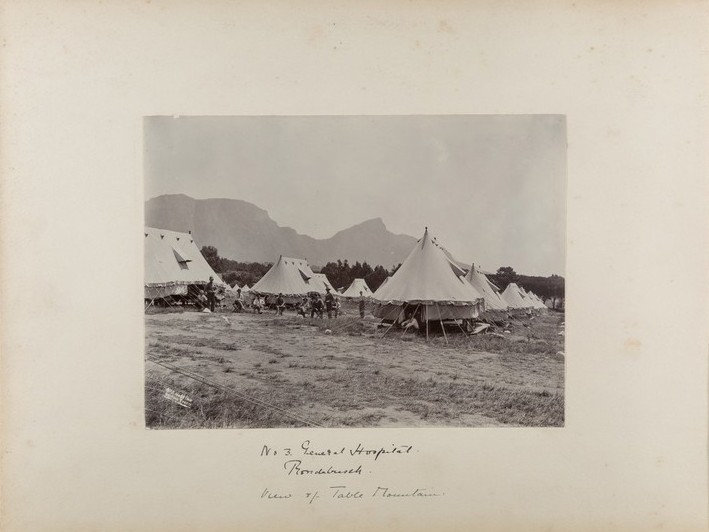
NO. 3 GENERAL HOSPITAL, RONDEBOSCH
Around 25 April Beatrice wrote to Mrs. J. M. Cross with some descriptive words about her (brief) time at Rondebosch. Her letter was printed in the Brisbane Evening Observer on 8 June 1900, as follows:
“You will have heard all about my trip, so I will begin about the hospital at Rondebosch. We have 500 patients, nearly all ‘Tommies,’ not many officers, only about 100, and 23 sisters – three from New Zealand, who wear khaki uniforms, white sailor hats, red cross on arm and hat; four from Canada, khaki uniforms, gold buttons, white hats, red thistle in front; 15 English nurses, who wear a bluey grey dress, little red caps, and white hats; and my blue, with red cross on arm, white hats, red cross; and we all wear ‘Florence Nightingale’ caps for dinner and night duty.
“There are large marquees, eight patients in each, and we have six tents to look after. There are spring stretchers and lockers. We have marquees to sleep in, boxes for washstands, nice jug and basin, waterbottle, and a large bath in each tent. The orderlies fill them every night. There are three maids to make our beds and lay our table in the mess-tent. We have a piano, large pots of ferns and flowers – our table looks so nice when laid. We have very good food, as the people round send us extras, also the patients wines, puddings, eggs, and so on. Breakfast at 7.30 a.m., duty 8 a.m., lunch 1 p.m., and duty 2 till 3, then we are off till 6 (except once a-week). Tea at 5 o’clock, go on duty from 6 till 8, and then come off to dinner at 8.15. Cold bath and bed, sometimes music. Thursdays the nurses are allowed visitors, and ask them to tea. Tuesdays and Sundays visitors for patients, who bring lovely flowers, and we do up the tents with them, and they look so nice. We have a lovely girl here, she is Colonel Trotter’s daughter, who has offered her services; she is very nice. The band comes out and plays, and we have concerts in the grounds. There are an English Church and a Roman Catholic Church not far away. There are only three R.C.’s, one Canadian, one English, and myself. Everybody is so happy and jolly. We have one orderly to every three tents.”
GREEN POINT PRISONER OF WAR CAMP
After a week at No. 3 GH, Beatrice and another nurse were transferred to the Boer prisoner-of-war camp at Green Point Common to nurse the prisoners, among whom must have been some who had surrendered to Lord Roberts following the Battle of Paardeberg. Green Point Common lay immediately west of Cape Town’s port and was home to the city’s first racecourse.
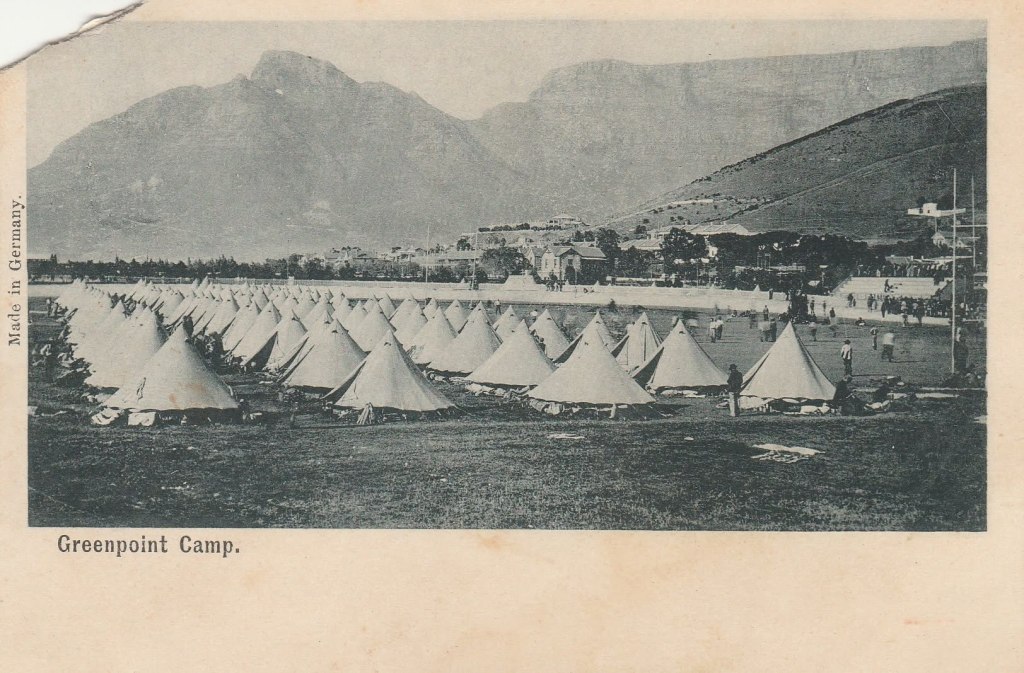
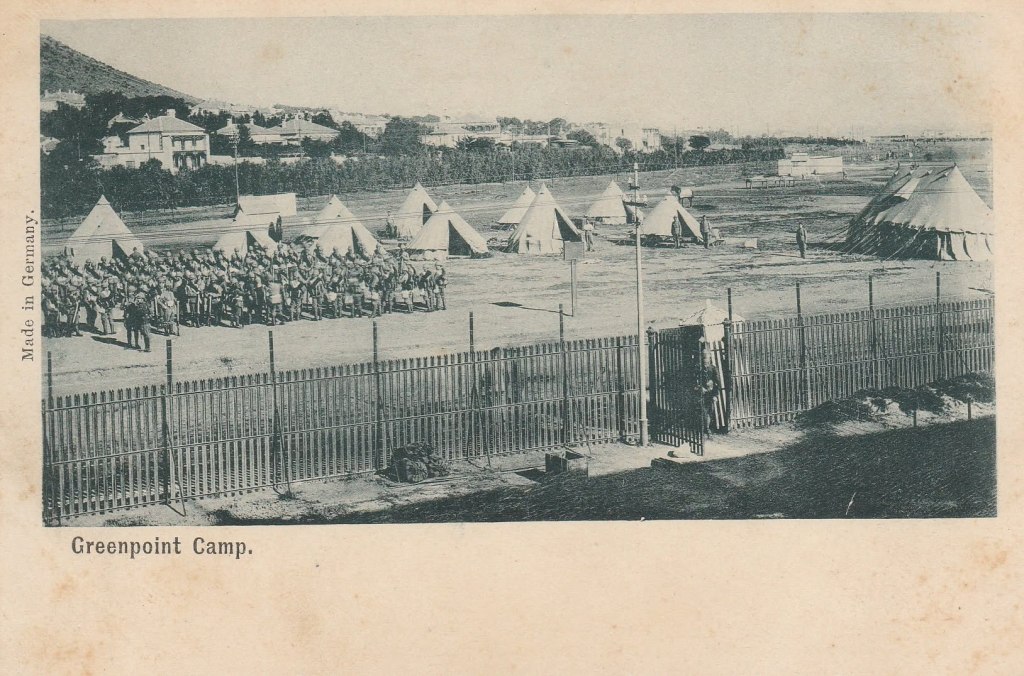
In her letter to Mrs. J. M. Cross, Beatrice writes about her first days at the camp:
“We always have to be prepared to be sent away. The day before yesterday the Sisters’ Superintendent said to me: ‘Dearie, I want you and Sister Paul to go to Greenpoint and nurse the Boer prisoners, who are dying fast from fever and all kinds of sickness.’ That was 8 a.m., and we were driving away at 10, and here we are doing night duty with 80 Boer patients. And the dirt and filth of them! Bedsores as large as saucers, and sores also on their faces from neglect. There are two nurses in the daytime, and we sleep and have our meals at the New Somerset Hospital, about 15 minutes’ walk from camp. There is an orderly in each tent to help us, and it takes us all our time to keep the delirious cases in bed. There are three doctors, and not far off there is a building full of sick soldiers (British). There is one very bad, and we are helping to look after him at night. He was all through the siege of Ladysmith, and almost starved to death, but we are pulling him through. It is raining, and we have to wear goloshes and mackintoshes walking from tent to tent. It is terribly cold at night and hot in the day-time. I had to buy such a lot of warm clothes, as I kept catching cold, and if we don’t look after ourselves we catch the diseases so easily. One of the nurses died the other day from fever, and there is another very bad.”
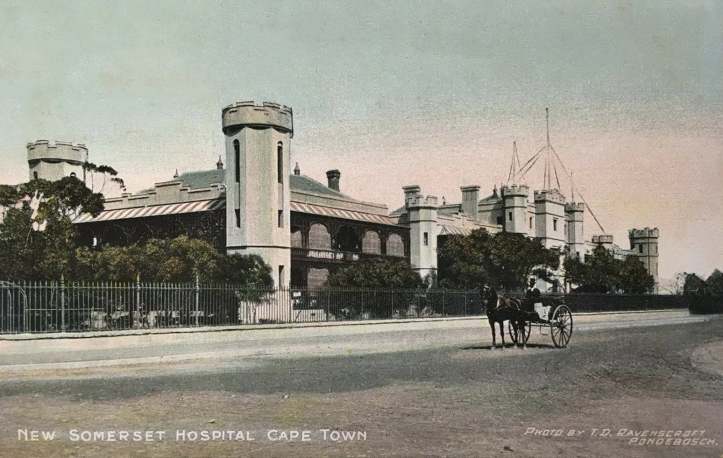
Beatrice recounts further experiences at Green Point in her letter to Delphia of The Queenslander (1 September 1900):
“The Boer prisoners … were in tents, in a filthy state, and very ill…. We had to go from tent to tent with a lantern, and many a fall we got over the ropes and in the little gullies. There are sentries all around us, and the track where the Boer prisoners are enclosed is quite near – 1800 of them, with an iron fence around them, and barb wire at the top; and every ten yards around there are sentries on high stands. At night they have to call out every half-hour their number, and if all well, and the sentries around the tents called out, ‘Halt!’ in a loud voice to every one that passes. Many a time on a foggy night, he called out to us, and we had to answer ‘Friend.’
“It rains very often here, and many a night we have walked about in water, and been very wet until morning. The Boers were very dirty; they did not like being washed, or to take their clothes off, or boots, but get into bed with them all on. We nursed them for three weeks, but the rain was too often, and they built tin huts, and I was nursing (I had forty-five patients at night – Boers) in them for three weeks; and one night I went to church and fainted; was brought home and put to bed for a week. In the same enclosure where the Boer patients are in huts there are 300 Tommies camped, nearly all sick; and there is a hospital that was built for infectious cases, that is not quite finished, and was given to the military to use. I was then sent to the New Somerset Hospital to be nursed.”
In a letter to a friend in Rockhampton (printed in the Daily Record on 18 July 1900), Beatrice relates that it was on Ascension Night, 24 May, that she had fainted, and that she believed that she had become run down due to inadequate food and the constant rain.
GREEN POINT MILITARY HOSPITAL
After recovering, Beatrice was discharged from the New Somerset Hospital and detailed for duty at the infectious diseases hospital that she refers to in her letter to Delphia. This was the City Hospital, so named only on 30 March 1900 after its completion in February 1900 and prior to its acquisition by the military authorities. Comprising an administrative block and a medical block, each made of stone, with a number of temporary wood and iron blocks added to the existing wards, the hospital for the next two years would be known as the Green Point Military Hospital.
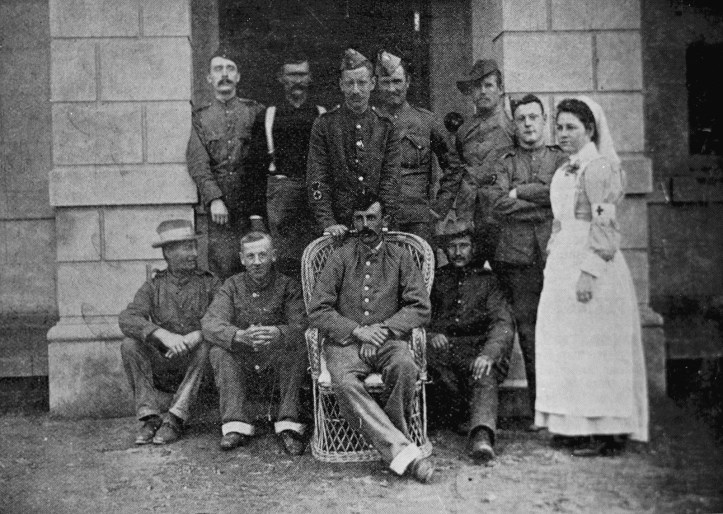
Beatrice was happy once again to be treating British sick and wounded, as she explains in her letter to Delphia:
“When I was better I was put on day duty with the Tommies in the building. I had twelve wards, with forty-five patients, to look after, and four orderlies to help me. Some had enteric fever, dysentery, pneumonia, diphtheria, jaundice, rheumatics, fractures of different limbs, bullet wounds, consumption, and numerous other diseases.
“I am very happy at my work, as it is so interesting, and we are kept very busy – very often on till 9.30 p.m. from 7 a.m. Not a great many of the Boers speak English, so we had a hard time to understand them. They were very grateful as patients, but very untidy. They are very well looked after indeed, and their wards are very nice. The Tommies are such good fellows – they are so grateful, and help one another so much, and always anxious to help the sisters as soon as they are convalescent. The Cape Garrison Artillery are camped quite near, and have a lovely band, which plays every evening. There were four Boers shot dead at different times trying to escape. We had an old man, a patient, 84 years old; also a little boy, 9 years old, who was Cronje’s servant, and used to look after his horses for him.
“The suburbs of Capetown are lovely; the hedges and trees are beautiful. Table Mountain is a lovely sight when the white clouds rest on it like a tablecloth, and the reflection of the sunsets, which are very beautiful over here. I have had a piece of ribbon given to me that was tied on the keys from Bloemfontein that were handed to Lord Roberts. The wild flowers are very pretty, and such a variety.
“It is very sad to hear some of the sufferings these poor men have gone through. I went to Woodstock [immediately south of the port, where No. 5 GH was located] the other day, and met a Mr. Evans, from Brisbane First Contingent, and knew a lot of his relations in Clermont – the Chalks; also, a Mr. Conroy. I heard they were ill, and went to see them. I am sending you some views, if you will kindly send them to Nurse Durdin [until November 1899 head nurse at Peak Downs Hospital]. We often do thirty-six hours without changing our clothes.
“We live in a tin hut, and had an orderly to cook for us; no maid, so a lady kindly offered to housekeep for us and look after us. Her husband is in Sydney – a Mrs. Rutherford; she is like a mother to us, so good and kind. We also have a Mrs. Sim, a general’s wife who came out from England to help; she is a sweet woman, and a great help. The doctors are very nice, and the Major is very kind. One of the sisters was taken away in an ambulance to a hospital, with enteric fever; she was very delirious. The ladies here are very kind, and sometimes come and take us for an hour’s drive. We have Dr. Miller, Lord Roberts’s nephew, here doing duty.
“There is a Mr. Pilcher, a New Zealand gentleman, and his wife, who have been very kind, and looking me up. I have met very few Australians as yet. This is a great experience for me. I have not heard of my brother [Robert] except that he has arrived at Beira. The Australian Bushmen are greatly admired over here, and the warm clothes are very much appreciated here. We have great trouble about our letters. I have not had one since I arrived, nor a paper. Excuse this writing, as I sit up in bed and write. We are so tired of a night. I am very happy to think I am helping these brave boys, and I have had a letter to be prepared to go up country any day. Goodbye. – Yours sincerely, BEA. HUSTON.
“P.S. – The Queensland Imperial Bushmen arrived, my brother amongst them. I went to meet them, and was delighted to see them. They were sent to Maitland camp three days, and then up to Kroonstad, near Pretoria. I think they will have some fighting to do.”
Robert Huston was a member of the Fourth (Queensland Imperial Bushmen) Contingent. The Bushmen had arrived at Beira in Portuguese East Africa (today Mozambique) on 14 June 1900 and then sailed to Cape Town via Port Elizabeth, arriving on 22 June and disembarking the following day. Maitland Camp was situated near Cape Town’s Observatory, a few kilometres south of the port. Beatrice must have seen her brother around 24 June. Kroonstad lay 1,400 kilometres northeast of Cape Town in the Orange Free State, while Pretoria, the capital of the Transvaal, was 250 kilometres northeast of Kroonstad. After being forced to remain in Bloemfontein for six weeks following a devastating outbreak of enteric (typhoid), Lord Roberts had taken Kroonstad on 12 May, Johannesburg on 31 May and Pretoria on 5 June. President Kruger had retired to Machadodorp in eastern Transvaal.
The Transvaal Boers under General Louis Botha, commandant-general since the death of General Joubert in March, were now in a state of demoralisation. In the Orange Free State, however, General Christiaan de Wet, commander-in-chief since February, had begun to employ the guerrilla tactics with which the Boers of both republics would fight long after Roberts had returned to England.
Meanwhile, General Buller, having consolidated his forces at Ladysmith, had advanced northwards along the railway corridor towards the Natal–Transvaal frontier, and after outflanking the Boers in the Drakensberg mountains, had crossed into the Transvaal. He advanced northwestwards along the railway corridor towards Pretoria and in early July encountered Lord Roberts’s army near Balfour.
Beatrice’s letter to Delphia concludes:
“I tried to get up with them, but they are not sending sisters up very far now, as they are dying off – twenty-one in two months in one place (Bloemfontein); they call it the white man’s graveyard. Thirty die in a day of enteric. I am to be sent as soon as the line is opened. The wet season is setting in, and we are having a time. We have to wade ankle-deep in water over to our wards.”
The enteric epidemic in Bloemfontein did not ease until June. Some 5,000 cases were recorded, with 1,000 deaths. During the entire war, enteric killed more British and colonial troops than the fighting itself. According to Simpson (1911), of 567,670 officers and men exposed to risk during the war, there were 59,750 cases of enteric, leading to 8,227 deaths. By contrast, according to Maurice (1910) 7,582 officers and men were killed or died of wounds.
A LETTER TO BEATRICE’S BROTHER
In September 1900 Beatrice wrote to her brother William from Green Point Military Hospital, as reported in the Evening Observer on 23 October 1900. She told William that Colonel Robert Baden-Powell, who had successfully defended Mafeking against the Boer besiegers until its relief on 17 May 1900, had recently visited Cape Town and had received a splendid reception. Beatrice mentioned that there was some talk of sending the Australians home, as they were too expensive, and that she had the first lot that came to the hospital under her care.
Beatrice also recounted the story of a poor Boer soldier who became infatuated with her. She had been making her rounds one night when she encountered a particularly bad case. It was thought that he would be dead by morning, and she wanted to make him as comfortable as possible before his departure to the next world. He at once fell in love with her and said that if she came to see him every day, he would soon get better. Contrary to expectations, the man did not die, and, as he had taken such a liking to Beatrice, and was so emphatic that he would get better if she attended him, she was asked to look after him during his illness. Sure enough, he recovered and afterwards offered 10s. for a photograph of her.
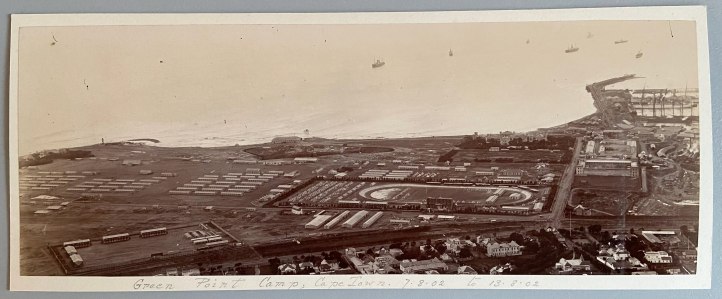
Sometime after September 1900 Beatrice was posted to No. 19 GH at Pretoria. She had got her wish at last: she was now close to the front (or at least closer) and furthermore had (seemingly) joined Princess Christian’s Army Nursing Service Reserve.
By this time, the forces of Lord Roberts and General Buller, having combined at Belfast, 200 kilometres east of Pretoria, had begun to advance eastwards along the Delagoa Bay Railway corridor towards the Portuguese East Africa frontier, forcing General Botha to withdraw before them. President Kruger, meanwhile, having decamped from Machadodorp, had crossed to the Portuguese side of the frontier. On 24 September the combined Imperial forces captured Komatipoort, the last town on the Transvaal side of the frontier. As far as Roberts and Buller were concerned, the war was effectively over. Buller returned to England in October and Roberts followed in December, having handed over supreme command to Lord Kitchener on 29 November.
However, the Boers were far from beaten. Already during his retreat into eastern Transvaal, General Botha had begun to reorganise his commandos. They progressively withdrew from the railway corridor and dispersed into the vast spaces of the Transvaal bushveld, each commando taking charge of an area of operation. By December 1900 Botha’s reorganisation was complete. He himself took charge of eastern Transvaal south of the railway corridor, while General Ben Viljoen took the area north of the railway. General Christiaan Botha was given command of the southeast, General Christiaan Beyers oversaw northern Transvaal, and General Koos de la Rey commanded the west.
The war now took on a terrible new complexion. The Transvaal commandos attacked railways and communications and harried British columns. In the Orange Free State, meanwhile, the forces of General de Wet carried out their own guerrilla operations. Kitchener responded with a brutal scorched-earth campaign. He broke up his larger formations into smaller, mobile columns of mounted infantry, similar in some respects to the Boer commandos; greatly expanded the building of blockhouses and barbed-wire fences; burned thousands of Boer farms; and interned tens of thousands of women, children and men in concentration camps.
PRETORIA
In early 1901, Beatrice, having been engaged at No. 19 GH mostly in treating cases of enteric, contracted the disease herself – like so many other nurses. In a letter to Delphia of the Queenslander written on 10 October 1901 (and printed on 30 November 1901), she explained that she had become run down:
“The food was so bad, trek ox in particular; and, fancy, we were paying 12s. dozen for eggs, to say nothing of the exorbitant prices for other extras, so that one very soon got run down and much more susceptible to fever.”
For nine weeks Beatrice was laid up:
“The sisters that nursed me were very kind indeed. One had nursed Prince Christian at the Yeomanry Hospital, where he died. Fancy, he was buried in Kruger’s coffin, as it seems a custom of the Boers to always have one in readiness. Miss Gould [Nellie Gould of the New South Wales Army Nursing Service] was very kind to me when I was in Johannesburg, as we were detained there a week owing to the bridge at Irene [just north of Johannesburg] being washed away; also when I was ill she came down to Pretoria to see me.”
After Beatrice recovered, she was given the option of returning to Australia or being invalided to England. She chose the latter, and around March set out for Cape Town:
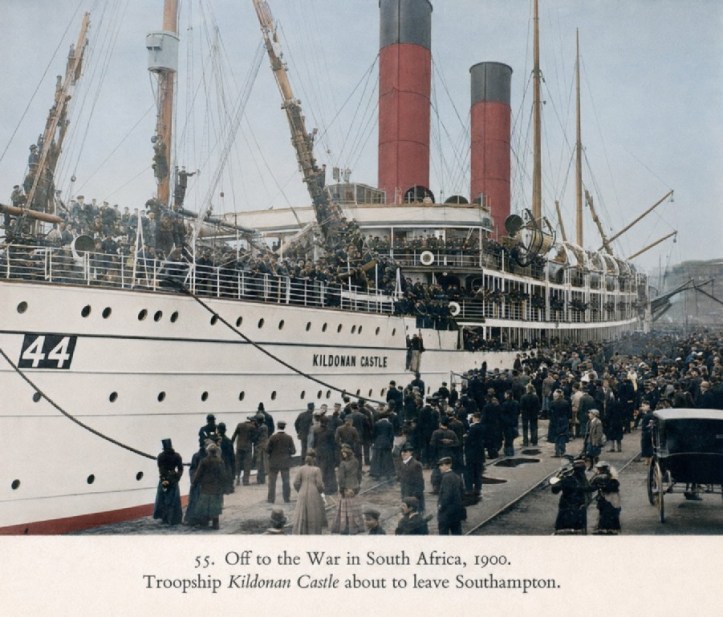
“Two sisters and myself started down to Capetown by the mail, and we were seven days before arriving. At Naupoort [Naauwpoort, Cape Colony, roughly halfway between Pretoria and Cape Town] our C.O. heard the line had been ripped up, so he sent a duplicate goods train on ahead; it had only got about four miles when the Boers started firing, and the driver put on full speed (just what they wanted him to do), and, of course, in a few minutes the whole train was turned over down the side, one Yeoman killed and three [K——]. It seems the Boers had ripped up the line and tied the bars of iron across. It had been meant for the mail train, and the next night there was an engagement six miles from the line, so we were allowed no lights on the train, we could not travel, and we had a very heavy guard on all around us. Next day we had an armoured train in front and one behind, but we arrived safely in Capetown, where I waited six weeks, and then went to England by the Kildonan Castle, a lovely, large boat.”
TO ENGLAND – AND SCOTLAND AND FRANCE
Beatrice departed Cape Town around the end of April 1901 and arrived at Southampton on 18 May. She and the nurses she was travelling with were met by a military official and given to understand that they were to be the guests of the Countess of Dudley (Georgina Elizabeth Ward) at 14 Oxford Terrace in London. Lady Dudley was renowned for the hospitality she offered to invalided nurses.
Beatrice told Delphia (The Queenslander, 30 Nov 1901) that she enjoyed her visit to England very much:
“Lady Dudley was extremely kind, and took quite an interest in me. She sent me to Bridlington (a seaside resort near Scarborough) for a month, and from there I went to Edinburgh (a most beautiful city), and then on to the Glasgow Exhibition, and was delighted to see that Queensland had such a splendid show, amongst which was a model battery working all day, around which were crowds of people. The scenery in Scotland is lovely, and then England was looking its best, fields of poppies, daisies, buttercups, and primroses, to say nothing of the lilac, hawthorn, and chestnuts, which were all in bloom.”
Beatrice returned to London sometime in June and stayed with some Australian friends at Richmond, and then at Highgate. On 27 July she wrote to her sister Lydia (Mrs. W. L. Kilpatrick). After first appearing in the Peak Downs Telegram, Beatrice’s letter was reprinted in the Rockhampton Daily Record on 26 September 1901, as follows:
“I have been in England nine weeks now and went before a medical board, but they do not think that I am fit to return to duty yet, so must remain here till the 1st September. Just received a letter to say that the King will give me and others our medals [the Queen’s South Africa Medal] at Marlborough House on Monday [29 July 1901]. I have been with Lady Dudley and am doing a lot of sight seeing. I was up to Shakespeare’s county and sat in the courtship chair, and went through Marie Corelli’s home, also to St. Albans to see the old Roman wall, built in the 3rd century; also to Epping Forest to see Queen Elizabeth’s hunting lodge, the Tower of London, and Westminster Abbey. I saw Big Ben. I have been to several theatres [courtesy of Miss Gertrude Kingston, the secretary of the British actors’ and actresses’ ward at Green Point Military Hospital], and saw Edna May in the Belle of New York. I have also seen Ellen Terry, Mrs. Langtry, Sarah Bernhardt, Cyril Maud, and also the Chinese opera ‘Tan Loy.’ I have been to Crystal Palace and saw the balloon that was used at Ladysmith and beautiful fireworks, and went up a tower and could see eight counties; also went to Earl’s Court and went round the largest wheel in the world, and was also on a switch-back railway, and on the lake in a motor launch.
“Last Monday [29 July] 100 nurses, including myself, went first to St. James’s Palace, where the Duke of York lived, and then marched into Marlborough grounds, where the King and Queen live. There were 100 men, 8 officers, and a West African regiment of black men present. I received the medal here. There was a red silk canopy with gold poles, under which the Royal Family stood. Sir Evelyn Wood handed the medal to Major-General Trotter, and he handed it to the King and the King to us as we marched past. We had been arranged previously alphabetically. We took our medals in the right hand, then curtseyed to the King and then to the Queen, who was on his Majesty’s right side, and as I passed Lord Roberts, who stood next, he said, ‘Oh, Australia,’ so, of course, that meant another curtesy [sic] for me. Princess Victoria and the little York children were present. The Queen is very lovely and the King most gracious. Our medals are the same as the boys. Amongst the number of officers was the Duke of Norfolk and Winston Churchill.”
The Queen’s Medal was awarded to all military and certain civilian personnel serving in South Africa for any length of time between 11 October 1899 and 31 May 1902. Every nurse, military and civilian, was entitled to it. Beatrice also became entitled to the King’s South Africa Medal, which was awarded to military and certain civilian personnel who were serving in South Africa on or after 1 January 1902 and had by 1 June 1902 completed 18 months’ continuous or non-continuous service.
Beatrice’s letter to Lydia continues:
“William Earl, of Yaccamunda Station, is now in London, and my friends have had him staying with them. They have given me a large picnic and are to give another tomorrow, real Australian lunch under the trees, which is an unheard of thing in England. Yesterday we went through Kensington Palace, where the Queen was born, and last night to a Japanese theatre, and this morning (6 a.m.) we were out on Parliament Hill, and at 2 p.m. we went to Covent Gardens.
“August 9th. – Still in England, and the Medical Board will not let me return to duty for another six weeks. I am enjoying my holiday very much, but shall be glad to be back on duty again. Yesterday we went up the river to Hampton Court, and the scenery was simply lovely. I may state that the English are a nice, sociable people, and that they have made my sojourn in England agreeably welcome and enjoyable.”
KIMBERLEY
Finally Beatrice was allowed to return to South Africa, and on 4 September 1901 she departed from Southampton for Cape Town on the hospital ship Orcana. After calling at Las Palmas in the Canary Islands, the ship arrived around 25 September.
Beatrice was posted to No. 11 GH at Kimberley in the northern Cape, 1,000 kilometres from Cape Town on the railway line to Bulawayo in Rhodesia. The town was famous for its diamonds; in a neat coincidence, one of the stones that began the 1871 rush to the area, the Star of South Africa, was owned by Lady Dudley.
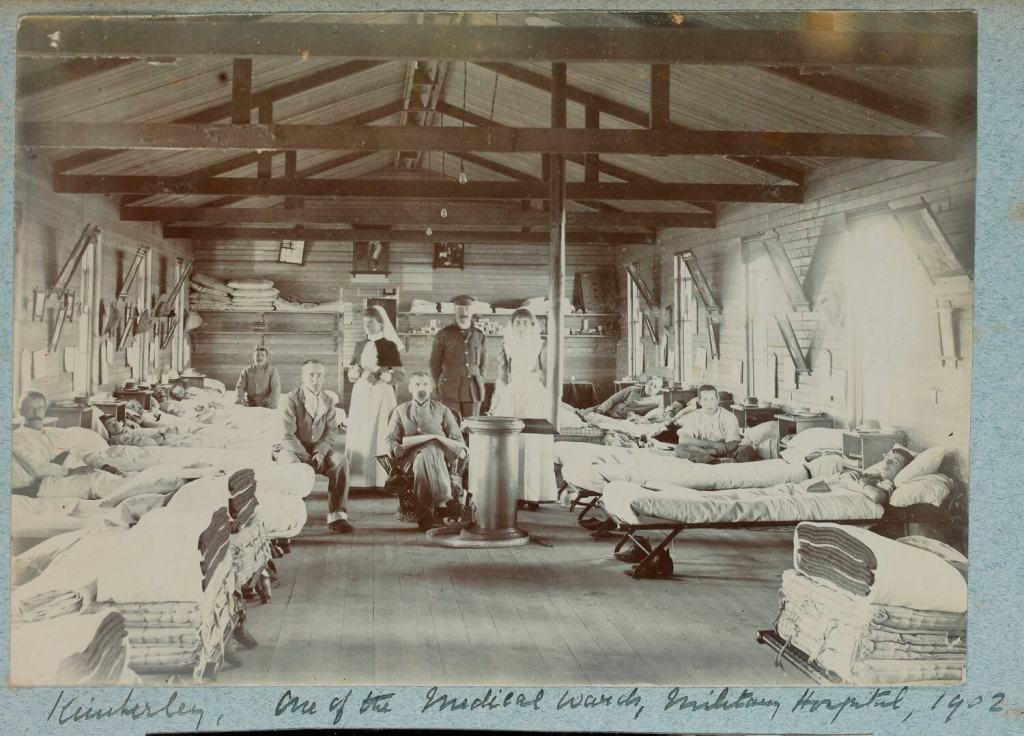
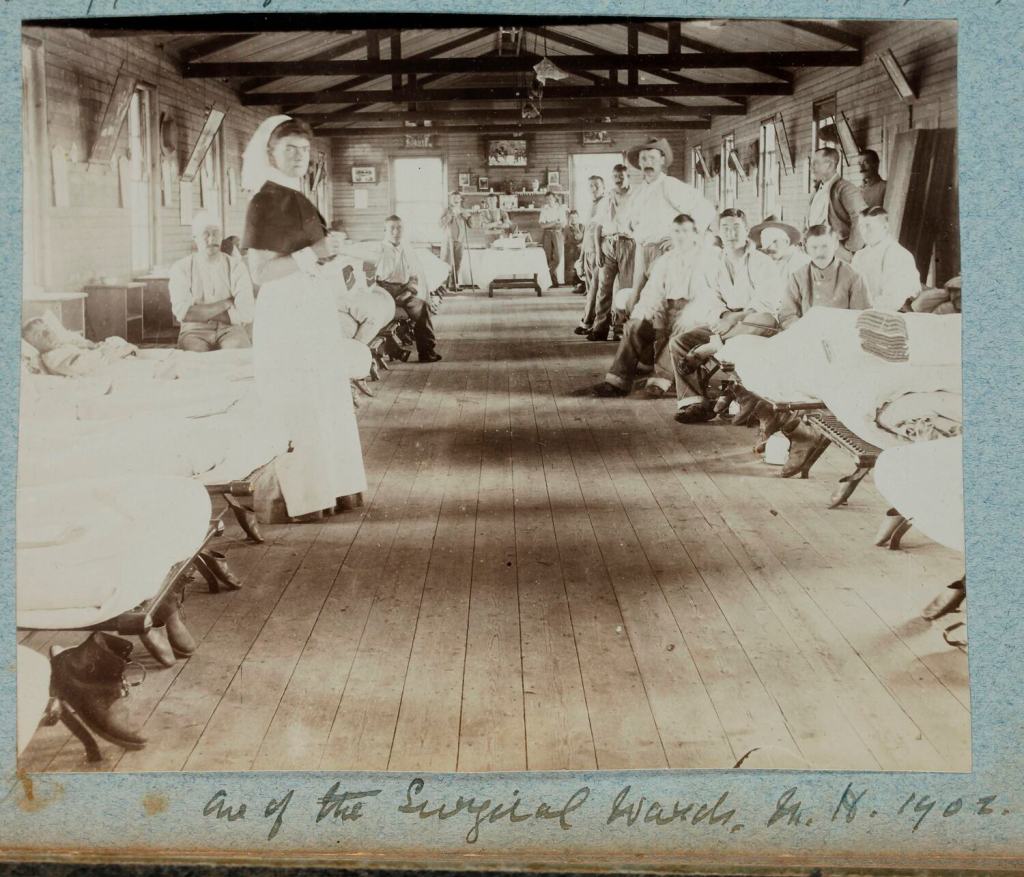
On 10 October, soon after her arrival, Beatrice wrote to Delphia of The Queenslander. We have already seen most of the letter, but the opening section relates her first impressions of Kimberley and outlines her train journey from Cape Town. Of particular interest is the reference to Kitchener’s extensive blockhouse-and-fence construction program, part of his scorched earth campaign.
“Dear Delphia, – I ought to have written before, but kept putting it off from time to time, so at last I have made another attempt. We are under canvas here, and not much heavy work just now. The camp is situated three miles out of town, and when we want to go in we have to walk, which, needless to say, is not very often. I am very glad to be back amongst the dear old Tommies; it is indeed a great pleasure to nurse them. There is a Mr. Lake, from Toowoomba, here; he has been very ill, poor boy, but hopes to be going out soon. It is terrible to see the different places that have been shelled here during the siege, but interesting to see the redoubts or shelters where the people took refuge when the shelling was worst. So far I like Kimberley very much, and am very happy. The trip up from Capetown was very interesting. We came by a hospital train, which was very comfortable. All the way have been built new block-houses, very high, and made of stone, with a small garrison at each to guard the line; they are within sight of one another, and between these, on the fence, are spring guns, with a dry bush tied over them, and hung on the wire, so that if any one touches the wire the guns go off and make a large light, as the bush catches, and enables our men to locate the Boers. It is very funny to see all the dummy sentries at each block-house. We pass Belmont, Sunnyside (where the Queenslanders were first in action), Grasspan, Modder River, Orange River, and cross the only bridge that was not destroyed by the Boers, as it had been paid half by Transvaalers and half by Free Staters, so that it was left, and Magersfontein battle-fields. It is terrible to see the number of graves.”
Beatrice concludes her letter on a note of uncertainty:
“I do not know when I shall return [to Australia], as I would very much like to stay as long as there are any nurses wanted for our brave fellows. I hope you will excuse the scribble and spelling. I will try and send you some snapshots of Kimberley later on, as I am going to try and go down the diamond mines. Trusting you are quite well, – I am, yours sincerely, BEA. HUSTON”
VRYBURG
After six months at Kimberley, Beatrice was posted to Vryburg, 200 kilometres to the north. The town was the chief British garrison after Klerksdorp for the southwestern Transvaal and had become the forward operating base of General Lord Methuen in his campaign against General de la Rey’s commando units, which had recently ambushed a British supply convoy at Ysterspruit, west of Klerksdorp.
Beatrice spoke of her time in Vryburg when she was interviewed by a reporter following her return to Brisbane on 18 September 1902. The reporter’s story appeared the following day in the Evening Observer. Whether through Beatrice’s misapprehension, or the reporter’s misunderstanding, or a transcription error, the number of troops said to have been in the vicinity of Vryburg is 15–20 times greater than it would actually have been.
“[Beatrice] was sent to Vryburg, where the final British drive was made, and where there were 75,000 troops within five miles of the hospital. This was the nearest point Miss Heuston [sic] got to the front. She had a very exciting time, and on one occasion witnessed a slight skirmish between British and Boer forces. On another occasion, at night, an alarm was received that a fight had taken place. The Ambulance had to be got ready, and instructions were received at the hospital to prepare for a hundred wounded. Miss Heuston and two other sisters worked all night preparing bandages, &c.; but only about twenty wounded were brought to the hospital. This was after the action in which Lord Methuen was captured by General Delarey [de la Rey] when marching from Vryburg towards Lichtenburg.”
Having set out from Vryburg on 2 March, Lord Methuen was captured at Tweebosch on 7 March after De la Rey’s men swooped down upon the rear of his column. Methuen had fallen off his horse after being shot in the thigh during the fighting and sustained a fractured leg when his horse, also shot, rolled onto him. He was treated on the field and then released by De la Rey due to the severity of his injury. He was then transported to a British hospital in Klerksdorp for proper medical attention. Following this set back, Kitchener sent General Sir Ian Hamilton to take charge of western Transvaal with heavy reinforcements and at the same time began serious negotiations with the Boer leaders. On 31 May 1902 the Treaty of Vereeniging was signed, and the war was over.
RETURN TO AUSTRALIA
On 25 August 1902, Beatrice, having finished her service, departed Cape Town on the RMS Athenic with Sisters Watts, Garden and Chatfield; several dozen Australian and New Zealand troops; and several New Zealand nurses. The Athenic reached Hobart on the afternoon of 12 September and the following day passengers for Melbourne transshipped to the Waihora, passengers for Sydney transshipped to the Tambo. The Athenic, meanwhile, had continued to Wellington, New Zealand. Beatrice and Sisters Garden and Chatfield were aboard the Tambo and arrived in Sydney on 16 September. After sending a telegram to Mrs. J. M. Cross, Beatrice, along with Sister Chatfield, departed Sydney the same day aboard the Arawatta for Brisbane.
After negotiating Kangaroo Point and ploughing its way upstream, the Arawatta arrived at the Australasian United Steam Navigation Company’s Mary Street Wharf at about 1.00 pm on Thursday 18 September 1902. As the ship came abreast of the wharf, Beatrice, wearing her gray uniform and engaged in conversation with several soldiers, was recognised by her waiting friends. No sooner was the Arawatta tied up than Beatrice disembarked and a few minutes later was driven to the South Brisbane home of her old friend Mrs. J. M. Cross. It was apparently there that she was interviewed by the reporter whose story appeared in the Evening Observer (as referred to earlier).
At the end of the interview, Beatrice told the reporter that she intended staying a few days at Yeronga Station, Brisbane, the residence of her brother-in-law, William English. Beatrice’s sister Maud, who had married William in 1894, had died only four months earlier, on 20 May 1902. From Yeronga Beatrice would travel to Clermont. Then, she told the reporter,
“perhaps I will return to South Africa, as I have two brothers over there [Robert and William]. Since I left Queensland my father [her stepfather Frank Finn] and a sister have died. At present I have not quite made up my mind, but I think I will return.”
Beatrice was evidently unaware that her brother William was back in Australia. As a member of ‘D’ Company, Third Battalion, Australian Commonwealth Horse, he had departed Brisbane on 25 March 1902, arriving at Durban on 10 May. ‘D’ Company proceeded to Newcastle in northern Natal and joined the rest of the Third Battalion. Following the declaration of peace, the battalion entrained for Durban and on 11 July embarked for Australia. William arrived at Brisbane on 13 August and returned to Clermont.
Robert, for his part, having arrived back in Brisbane with the 4th Queensland Imperial Bushmen on 5 August 1901, had returned to South Africa.
On 29 September 1902 Beatrice arrived back in Clermont on the morning train. Aside from the death of her sister, much had happened since Beatrice’s departure for South Africa. Her stepfather, Frank Finn, had died on 27 July 1900, either following a paralytic seizure or having succumbed to heart disease, after which her mother had fallen into debt. By January 1902 Bessie Finn owed £703 and was obliged to come to an arrangement with her creditors that involved, among other conditions, the disinheritance of her children. In April 1902 Bessie transferred her licence for the Prince of Wales Hotel to her daughter-in-law, Frances Emma Huston, James’s wife. Incredibly, the Prince of Wales Hotel burnt down on the night of 3 August.
On the night of 3 October the citizens of Clermont held a welcome-home social for Beatrice at the Town Hall. The event also raised funds for the Peak Downs Hospital. The night was a great success, with food, music and dancing until 1.30 am.
Beatrice renewed the acquaintance of many old friends on the night of her welcome-home social, but she would soon be bidding them farewell again, for she had made up her mind to return to South Africa – this time with members of her family.
RETURN TO SOUTH AFRICA
On Monday 13 October 1902 Beatrice, her mother, her sister Grace, her brother William and her nephew Jack Kilpatrick – one of Lydia’s boys –departed Clermont for Rockhampton by train. They were all going to join Robert, who was working for the Government Stock Department in Johannesburg.
The following day the family boarded the Burwah at Rockhampton and departed for Brisbane, arriving on 16 October. From Brisbane they travelled to Sydney, and at 11.00 am on 25 October they departed from Circular Quay aboard the Persic bound for Cape Town, arriving on 28 November 1902.
From now on, news of Beatrice and her family is scarce. By June 1903 William Huston was working for the Railway Department in Johannesburg, and by May 1904, when his fiancée, Miss May Comley, embarked for South Africa to marry him, he was in charge of a railway station outside Johannesburg. Jack Kilpatrick was also employed by the Railway Department and working with William.
In April 1904 Lydia Kilpatrick received a letter from Beatrice, which was summarised in the Peak Downs Telegram and Queensland Mining Record on 23 April 1904, as follows:
“Nurse Huston’s many friends in Clermont will be interested to know that she is at present in London, and has visited many notable personages, among whom are mentioned Lord and Lady Harris and Lady Craig. Nurse Huston intends undergoing a course of training for a maternity nurse, and this will mean her doing slum work in the East End of London. After this course has been finished, Nurse Huston will be ranked as a first-class certificated nurse, and she will then return to South Africa to follow her noble vocation.”
In the same edition of the Peak Downs Telegram and Queensland Mining Record it was reported that Bessie Finn was doing well in Johannesburg and was intending to apply for a hotelier’s licence.
In October 1905 Grace Huston married Mr. Alfred Long of The Springs, 40 kilometres east of Johannesburg. In December 1905 Bessie Finn returned to Australia, accompanied by her grandson, Jack Kilpatrick. After staying with her daughter Florence (Mrs. W. T. Eyles) in Mackay, Bessie returned to Clermont, intending to spend her remaining days there. When she arrived by train on 29 August 1906, she was met at the station by her daughter Lydia and daughter-in-law Frances, who drove her to ‘Redfern,’ Lydia’s house. An hour after her arrival, Bessie suffered a stroke and became unconscious. She remained alive for 10 days but died on 7 September surrounded by her family. She was buried at Clermont Cemetery next to Robert Huston.
In May 1907 Grace Long returned to Clermont from South Africa to stay for three months with Lydia, who had become a nurse.
In 1911 Beatrice married Thomas Joseph Mary Black. Thomas was born in Islington, London in 1881, and in 1901 was a draughtsman. He later became an agent, possibly for an oil company.
Around March 1913 Beatrice gave birth to a boy, William St. Leger Black. On 11 May 1916 she and William embarked from Cape Town for Plymouth, England aboard the RMS Saxon. On the ship’s manifest Beatrice is listed as a housewife, so appears to have given up nursing.
Thomas Black spent a considerable time away on business. For instance, on 10 September 1918 he sailed from Surabaya, Netherlands East Indies to San Francisco aboard the SS Rembrandt, arriving on 1 November 1918. At the time Surabaya was a logistical hub for the oil industry in the Netherlands East Indies. On 6 March 1919 Thomas departed from Birkenhead, England for Cape Town aboard the Malatian. Twenty years later, on 28 October 1939, he departed England for Cape Town on the City of Nagpur.
Thomas died on 12 June 1942 of a fractured skull after falling from a bus in Cape Town. Beatrice died six weeks later, on 24 July 1942, at the Transvaal Provincial Home in Germiston. She was 63 years old.
We will not forget her.
SOURCES
- Ancestry.
- Barnard, C. J., ‘Studies in the Generalship of the Boer Commanders,’ Military History Journal (Vol. 2, No. 5, Jun 1973), The South African Military History Society.
- Cirillo, V. J., ‘Arthur Conan Doyle (1859–1930): Physician during the typhoid epidemic in the Anglo-Boer War (1899–1902),’ Journal of Medical Biography (Vol. 22, Issue 1, Feb 2014).
- Donald, P. R., ‘The City Hospital for Infectious Diseases – Conception and First Years,’ SA Medical Journal (21 Oct 1978, pp. 713–16).
- The Hospital (30 Jan 1915, pp. 397–98), ‘War and Disease: The Russo-Japanese and South African Campaigns,’ via PubMed Central, National Library of Medicine.
- Maurice, F. (1910), History of the War in South Africa 1899–1902 (Vol. 4), Hurst and Blackett Ltd.
- McCleland, D. ‘A.J. Montgomery: Part 9 – Through the Cape Colony Hunting the Cape Rebels,’ The Casual Observer (21 Sept 2018).
- Murray, P. L. (c. 1911), Official Records of the Australian Contingents to the War in South Africa, Dept. of Defence.
- The National Archives (UK), War Office: Campaign Medal and Award Rolls, King’s South Africa Medal, Nurses, WO 100/353.
- The National Archives (UK), War Office: Campaign Medal and Award Rolls, Queen’s South Africa Medal, Nurses, WO 100/229.
- National Archives of Australia.
- Queensland State Archives, Admission Register – Clermont State School (21 Oct 1871–28 Jan 1905), ITM612736.
- Simpson, R. J. S. (1911), The Medical History of the War in South Africa: an Epidemiological Essay, His Majesty’s Stationery Office.
- Streeter, E. W. (1882), The Great Diamonds of the World, George Bell & Sons.
- Wikipedia, ‘Georgina Ward, Countess of Dudley.’
- Wikipedia, ‘Second Boer War.’
- Wikipedia, ‘Siege of Kimberley.’
SOURCES: NEWSPAPERS
- Adelaide Observer (6 Dec 1902, p. 17), ‘Shipping.’
- The Brisbane Courier (28 Nov 1865, p. 1), ‘Classified Advertising.’
- The Brisbane Courier (6 Mar 1866, p. 6), ‘Classified Advertising.’
- The Brisbane Courier (25 Apr 1866, p. 3), ‘Annual Licensing Meeting.’
- The Brisbane Courier (3 Feb 1900, p. 8), ‘Horses from Clermont.’
- The Brisbane Courier (3 Mar 1900, p. 6), ‘Albion Park Races.’
- The Brisbane Courier (Qld., 12 May 1900, p. 10), ‘A Clermont Nurse at Rondebosch.’
- The Capricornian (Rockhampton, Qld., 21 Jul 1900, p. 33), ‘Rockhampton Licensing Authority.’
- Daily Commercial News and Shipping List (Sydney, 7 Mar 1900, p. 5), ‘Shipping Items.’
- The Daily Northern Argus (Rockhampton, Qld., 7 Mar 1879, p. 2), ‘District Court.’
- The Daily Record (Rockhampton, Qld., 14 Feb 1900, p. 3), ‘Clermont Nurse Volunteers.’
- The Daily Record (Rockhampton, Qld., 18 Jul 1900, p. 4), ‘The South African War. Interesting Letter from Nurse Huston.’
- The Daily Record (Rockhampton, Qld., 26 Sept 1901, p. 4), ‘Letter from Nurse Huston. Her Stay in England.’
- The Daily Record (Rockhampton, Qld., 6 Oct 1902, p. 3), ‘Clermont Notes.’
- The Daily Record (Rockhampton, Qld., 15 Oct 1902, p. 2), ‘Shipping.’
- The Daily Telegraph (Sydney, 25 Oct 1902, p. 11), ‘Shipping.’
- Evening Observer (Brisbane, 8 Jun 1900, p. 3, ‘A Base Hospital. With the Wounded at Rondobosch [sic]. Walking the Wards.’
- Evening Observer (Brisbane, 23 Oct 1900, p. 5), ‘Letter from Nurse Huston.’
- Evening Observer (Brisbane, 17 Sept 1902, p. 4), ‘A Nurse’s Return.’
- Evening Observer (Brisbane, 18 Sept 1902, p. 5), ‘Nurse Huston’s Return.’
- Evening Observer (Brisbane, 19 Sept 1902, p. 6), ‘Nurse Heuston [sic].’
- The Guardian (Brisbane, 11 Oct 1866, p. 4), ‘The Sheriff’s Department.’
- The Mercury (Hobart, 10 Mar 1900, p. 2), ‘The Fruit Steamers.’
- The Mercury (Hobart, 12 Mar 1900, p. 2), ‘The Fruit Shipments.’
- The Mercury (Hobart, 13 Sept 1902, p. 4), ‘Shipping.’
- The Mercury (Hobart, 15 Sept 1902, p. 4), ‘Shipping.’
- The Morning Bulletin (Rockhampton, Qld., 7 Mar 1879, p. 2), ‘Central District Court.’
- The Morning Bulletin (Rockhampton, Qld., 8 Jul 1886, p. 5), ‘Queensland News.’
- The Morning Bulletin (Rockhampton, Qld., 13 Mar 1899, p. 3), ‘Clermont.’
- The Morning Bulletin (Rockhampton, Qld., 9 Feb 1900, p. 3), ‘Clermont.’
- The Morning Bulletin (Rockhampton, Qld., 14 Feb 1900, p. 4), ‘The Queensland Contingents.’
- The Morning Bulletin (Rockhampton, Qld., 17 Feb 1900, p. 4), ‘Clermont.’
- Peak Downs Telegram and Queensland Mining Record (Qld., 11 Mar 1882, p. 2), ‘The Flood.’
- Peak Downs Telegram and Queensland Mining Record (Qld., 1 Apr 1882, p. 2), ‘The Late Drowning Case. To the Editor.’
- Peak Downs Telegram and Queensland Mining Record (Qld., 13 May 1882, p. 2) ‘No Title.’
- Peak Downs Telegram and Queensland Mining Record (Qld., 15 Jul 1882, p. 3), ‘Advertising.’
- Peak Downs Telegram and Queensland Mining Record (Qld., 26 Jan 1883, p. 1), ‘Advertising.’
- Peak Downs Telegram and Queensland Mining Record (Qld., 20 Apr 1883, p. 3), ‘The Peak Downs Telegram.’
- Peak Downs Telegram and Queensland Mining Record (Qld., 30 Aug 1884, p. 3), ‘Advertising.’
- Peak Downs Telegram and Queensland Mining Record (Qld., 20 May 1885, p. 1), ‘Advertising.’
- Peak Downs Telegram and Queensland Mining Record (Qld., 17 Jun 1885, p. 3), ‘Advertising.’
- Peak Downs Telegram and Queensland Mining Record (Qld., 19 May 1886, p. 2), ‘Fire in Clermont.’
- Peak Downs Telegram and Queensland Mining Record (Qld., 21 Sept 1887, p. 3), ‘Advertising.’
- Peak Downs Telegram and Queensland Mining Record (Qld., 15 Oct 1887, p. 2), ‘The Prince of Wales Hotel.’
- Peak Downs Telegram and Queensland Mining Record (Qld., 24 Nov 1888, p. 2), ‘Another Clermont Sensation: a Child Lost in the Bush.’
- Peak Downs Telegram and Queensland Mining Record (Qld., 10 Oct 1891, p. 3), ‘Clermont State School.’
- Peak Downs Telegram and Queensland Mining Record (Qld., 17 Dec 1892, p. 2), ‘Sporting.’
- Peak Downs Telegram and Queensland Mining Record (Qld., 25 Aug 1894, p. 2), ‘Local and General.’
- Peak Downs Telegram and Queensland Mining Record (Qld., 2 Mar 1895, p. 2), ‘Musical and Dramatic Entertainment.’
- Peak Downs Telegram and Queensland Mining Record (Qld., 2 Aug 1898, p. 2), ‘Death of Mr John Kilpatrick.’
- Peak Downs Telegram and Queensland Mining Record (Qld., 15 Jan 1902, p. 2), ‘Local and General.’
- Peak Downs Telegram and Queensland Mining Record (Qld., 25 Jan 1902, p. 2), ‘The Estate of Bessie Finn.’
- Peak Downs Telegram and Queensland Mining Record (Qld., 12 Feb 1902, p. 2), ‘Local and General.’
- Peak Downs Telegram and Queensland Mining Record (Qld., 15 Mar 1902, p. 2), ‘Local and General.’
- Peak Downs Telegram and Queensland Mining Record (Qld., 24 Sept 1902, p. 2), ‘Local and General.’
- Peak Downs Telegram and Queensland Mining Record (Qld., 27 Sept 1902, p. 3), ‘Queensland Nurses.’
- Peak Downs Telegram and Queensland Mining Record (Qld., 4 Oct 1902, p. 2), ‘Local and General.’
- Peak Downs Telegram and Queensland Mining Record (Qld., 11 Oct 1902, p. 2), ‘Local and General.’
- Peak Downs Telegram and Queensland Mining Record (Qld., 23 Apr 1904, p. 2), ‘Personal Pars.’
- Peak Downs Telegram and Queensland Mining Record (Qld., 14 Oct 1905, p. 3), ‘Pars about People.’
- Peak Downs Telegram and Queensland Mining Record (Qld., 1 Sept 1906, p. 2), ‘Pars about People.’
- Peak Downs Telegram and Queensland Mining Record (Qld., 15 Sept 1906, p. 2), ‘Local News. Death Of Mrs. B. Finn.’
- The Queenslander (Brisbane, 10 Mar 1900, p. 460), ‘Letters from a Mother.’
- The Queenslander (Brisbane, 1 Sept 1900, p. 498), ‘Hospital Work in South Africa: a Letter from Nurse Huston.’
- The Queenslander (Brisbane, 30 Nov 1901, p. 1046), ‘A Letter from Kimberley. Nurse Huston’s Experiences.’
- The Telegraph (Brisbane, 13 Jul 1887, p. 5), ‘Supreme Court.’
- The West Australian (Perth, 22 May 1900, p. 5), ‘The War.’

