| Conflict | Second World War |
| Nursing Service | Australian Army Nursing Service |
| Unit | 2/4th Casualty Clearing Station |
| Overseas Service | Malaya |
| Final Service No. | SX10595 |
| Final Rank | Captain |
Early Years
Ellen Mavis Hannah was born on 12 October 1910 in Claremont, now a suburb of Perth. She was the eldest of three children born to Louisa Jessie Ellen Maloan (1888–1971) and Charles Edward Hannah (1880–1961).
Louisa was the only living child of Louisa Maria Maloan (née Woodcock), who had migrated from England to Queensland in 1886 with her husband Edward Hoare. After Edward died in 1892, Louisa married William Lennox. When William died, Louisa married Thomas Maloan. They moved from New South Wales to Perth.
Charles was born in Adelaide. He was the eldest son of Mary Ann Brady and Robert James Hannah, a mason who migrated from Scotland to South Australia in 1878. Later the family moved to Highgate Hill in Perth.
Louisa and Charles were married on 4 December 1909 at the Roman Catholic Cathedral in Perth by the Rev. Father Sheridan. The following year Ellen – or Mavis, as she is better known – was born. Around 1911 the Hannahs moved to Adelaide, where Charles worked as a bricklayer. They may have been accompanied by Louisa’s mother, who in September 1906 had obtained a separation order from Thomas Maloan after repeated episodes of violence. Maloan eventually followed his wife to Adelaide and died there in 1915.
Charles, Louisa and baby Mavis settled into their new home at 3 Essex Street in Goodwood West, and in September 1912 Colin Edward was born. Evelyn Louise followed in 1915.
Soon Mavis was old enough to go to school, and she began attending Goodwood State School. When she finished at Goodwood, she attended Unley High School. By then the family had moved south on Essex Street to no. 27.
From the time that she was very small, Mavis had wanted to be a nurse. After finishing school, however, she was considered unfit for nursing and practised dispensing at Friendly Societies Chemist Shops instead. In 1934 she was finally able to begin her nurses’ training at Adelaide Hospital under Matron Lucy Daw. Mavis thoroughly enjoyed her training, and finished in 1939, having spent her final year as a staff nurse in charge of the blood transfusion bank.
Enlistment
When the Second World War broke out in 1939, Mavis decided to join the army. She was appointed to the Australian Army Nursing Service (AANS), Australian Military Forces (AMF) and posted to Woodside Camp (outside Adelaide).
On 9 August 1940 Mavis was seconded to the Second Australian Imperial Force (2nd AIF). She had been earmarked for an overseas posting – destination unknown – but in the meantime remained at Woodside.
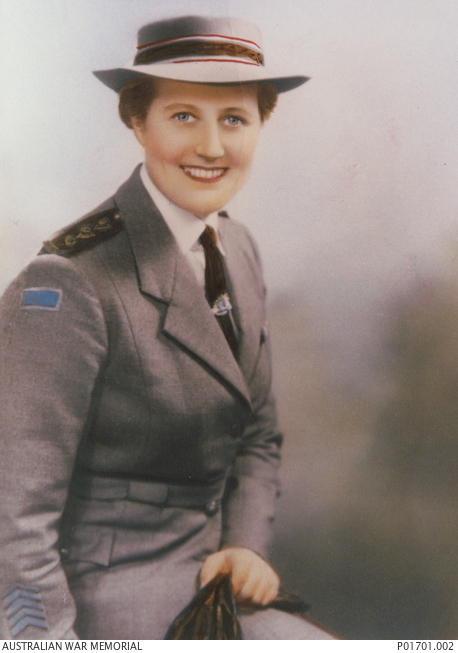
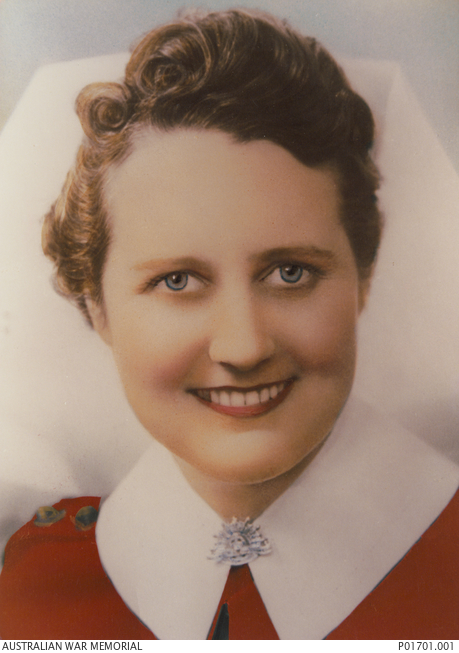
Joining Mavis at Woodside were AANS nurses Irene Drummond and Millie Dorsch, both from Adelaide. On 8 November Mavis, Irene and Millie were appointed to the 2/4th Casualty Clearing Station (CCS). So was Elaine Balfour Ogilvy, from a prominent Renmark family, who would join them at Woodside on 25 November. Mavis and Irene were appointed to the rank of Sister – Irene the more senior – and Millie and Elaine to the rank of Staff Nurse.
All four nurses stayed at Woodside until 8 January 1941. The following day they were called up for duty with the 2/4th CCS, which had been raised in Hobart in December 1940 under the command of Colonel Thomas Hamilton. In battle, a CCS is the closest medical unit with surgical facilities to the front line and cares for casualties until they can be evacuated by ambulance train to a military hospital. In view of this, many of the staff recruited by Col. Hamilton to the unit had surgical experience, including several of the AANS nurses.
A week later, Mavis, Irene, Millie and Elaine were granted pre-embarkation leave and on 23 January were guests at a morning tea given by the president and members of the Commercial Travellers’ Club in Adelaide. The four were among a group of 20 or so AANS nurses and physiotherapists being farewelled prior to their departure for overseas. Most were set for service in the Middle East.
On 30 January the four South Australian nurses entrained for Melbourne, where they met two more 2/4th CCS nurses, Staff Nurses Shirley Gardam and Wilhelmina ‘Mina’ Raymont. Shirley, from Launceston, and Mina, originally from Adelaide, had sailed from Tasmania on 25 January, presumably with the main elements of the unit.
Queen Mary
On 1 February Mavis, Irene, Millie, Elaine, Shirley and Mina entrained for Sydney. Two days later they travelled to Darling Harbour and were taken by ferry to Bradley’s Point, where the famous passenger liner turned troopship Queen Mary was in the process of embarking the 22nd Brigade, 8th Division, known as ‘Elbow Force.’
Elbow Force was sailing to Malaya – although the troops did not yet know this – where it would join British and Indian formations in garrisoning the British colonial possession against possible Japanese aggression. Travelling with Elbow Force were several medical units, principally the 2/10th Australian General Hospital, 2/9th Field Ambulance – and the 2/4th CCS.
There was another ship embarking Australian soldiers in Sydney Harbour that day – the Aquitania. That venerable ship was set to carry around 3,300 troops to Bombay, where they would transship for the Middle East. Another ship, the Nieuw Amsterdam, was due to arrive later that day from Wellington with around 3,800 New Zealand troops. They too would transship at Bombay for the Middle East. The Queen Mary, the Aquitania and the Nieuw Amsterdam would depart together the following day and sail in convoy.
Mavis and her colleagues joined the scrum and boarded the Queen Mary. After finding their cabins, meeting their 43 peers from the 2/10th AGH, and otherwise getting organised, the 2/4th CCS nurses proceeded to establish a dressing station on the 16th deck, where they would treat the troops’ minor injuries and ailments. More serious cases would be sent to the 2/10th AGH, which had set up an operating theatre and a ward.
On 4 February, a beautiful blue day, the Queen Mary was ready to leave. The troops had completed their embarkation, and countless crates of equipment and supplies had been loaded – some marked ‘Elbow Force, Singapore,’ which somewhat undermined the secrecy surrounding the ship’s destination. In the early afternoon, to the cheers of thousands of well-wishers on land and in boats, the Queen Mary, the Aquitania and the Nieuw Amsterdam set off under the escort of HMAS Hobart.
The convoy was joined by the Mauretania in the Great Australian Bight and on 10 February arrived at Fremantle. When Staff Nurses Peggy Farmaner and Bessie Wilmott boarded the Queen Mary, the 2/4th CCS’s nursing establishment was complete. The departure of the ships on 12 February marked the last time Mavis would see Australia for nearly five years. She was the only nurse of her unit to return.
On 16 February 1941, when the convoy was immediately south of Sunda Strait and the troops of Elbow Force had finally learned of their destination, the Queen Mary broke away from the other ships and steamed off towards Singapore Island. Two days later, Mavis and the others arrived at Sembawang Naval Base on the island’s north coast, just across Johor Strait from the Malay Peninsula.
Port Dickson
The nurses disembarked and were taken to adjacent railway sidings. They gave their names and addresses, were issued with rations, and then entrained for the Malay Peninsula. The 2/10th AGH nurses alighted at Tampin, from where they were driven to the Malacca General Hospital. The 2/4th CCS nurses, apart from Mina, were not yet required by their unit and had been detached to the 2/9th Field Ambulance. They alighted at Seremban, further up the line from Tampin, and were driven to Port Dickson, where the 2/9th Field Ambulance would be based. The other staff of the 2/4th CCS continued to Kuala Lumpur and subsequently moved south to Kajang, where they established a hospital in a high school. After a week at Kajang, Mina joined her AANS colleagues at Port Dickson.
At Port Dickson Mavis and the others helped to establish a 50-bed dressing station for the 22nd Brigade troops, whose three battalions, the 2/18th, 2/19th and 2/20th, were based at different camps within the Port Dickson–Seremban area. The dressing station served as a first-aid post, where brigade personnel could receive attention in the event of minor injury or tropical ailment. In more serious cases, they would be transported to the 2/4th CCS at Kajang or the 2/10th AGH at Malacca.
Mavis enjoyed her time at Port Dickson. The nurses had plenty to do, were very keen in their work, and did not mind long hours and the discomforts that invariably go with active service conditions. They had been supplied with cooks and domestic helpers.
Kajang
On 4 June 1941, after three-and-a-half months at Port Dickson, Mavis rejoined the 2/4th CCS at Kajang. Millie and Shirley had rejoined on 7 May, while Irene, Elaine and Mina rejoined on 19 July. Bessie and Peggy stayed at Port Dickson until 20 August, shortly before the redeployment of the 22nd Brigade to the east coast of the Malay Peninsula.
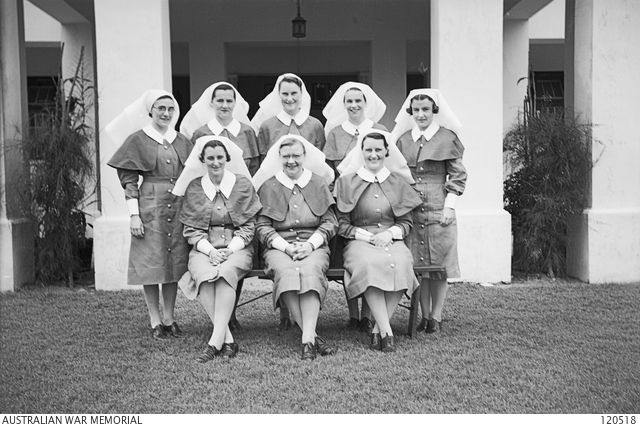
From 12 to 16 June Mavis was granted leave and travelled with Millie and one or two others to Fraser’s Hill, a charming cool-climate hill station to the north of Kuala Lumpur. During the day the nurses could go for long walks and play tennis or golf, or just relax with a book. In the evenings, when the weather was cool enough for a sweater or cardigan, they could go out for dinner and to the local club.
Only four days after returning from Fraser’s Hill, Mavis was granted leave to Singapore from 20 to 23 June. This time she travelled with Shirley and one or two others. The famous city on the island was a favoured destination of the AANS nurses. They often went to Raffles, sometimes as guests of well-connected locals. They were given privileged access to the exclusive Singapore Swimming Club, with its many facilities. They could visit the Singapore Botanic Gardens and the beautiful Chinese Garden. They might be taken for drives and or out to dinner, followed by dancing or a cabaret. Sometimes they simply went to the cinema. And, of course, the shopping was marvellous.
More leave was granted from 14 to 22 July, and Mavis returned to Fraser’s Hill. And from 11 to 16 September, she spent more time in Singapore, this time with Elaine, Mina and Bessie.
Meanwhile on 15 September the 2/13th AGH arrived on Singapore Island aboard the AHS Wanganella. The unit had been raised in Melbourne in early August following intelligence reports suggesting the possibility of a Japanese invasion of Malaya and followed the arrival of the 27th Brigade a month earlier. The 2/13th AGH had a staff of 49 AANS nurses and around 175 officers and men and was temporarily billeted at St. Patrick’s School in Katong, on the south coast of the island.
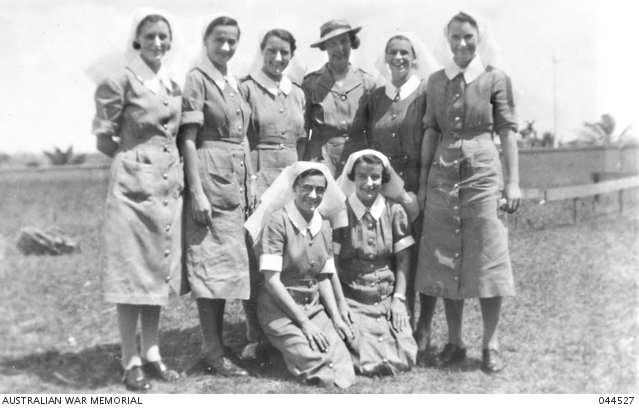
Towards the end of September, the 2/4th CCS moved to Tampoi in Johore Bahru, where it set up a small hospital of 150–200 beds in an unfinished psychiatric hospital. Kathleen Kinsella had joined the unit as sister in charge, replacing Irene Drummond, who was transferred to the 2/13th AGH at the rank of Matron. On 23 November the 2/4th CCS moved from Tampoi to Kluang, and the 2/13th AGH took over the running of the Tampoi site.
War
On 8 December 1941 Japan invaded Malaya. Over the next two months Japanese forces moved relentlessly down the Malay Peninsula, eventually pushing British, Indian and Australian troops and their respective medical units onto Singapore Island. Then on 8 February Japanese soldiers crossed over onto the island itself.
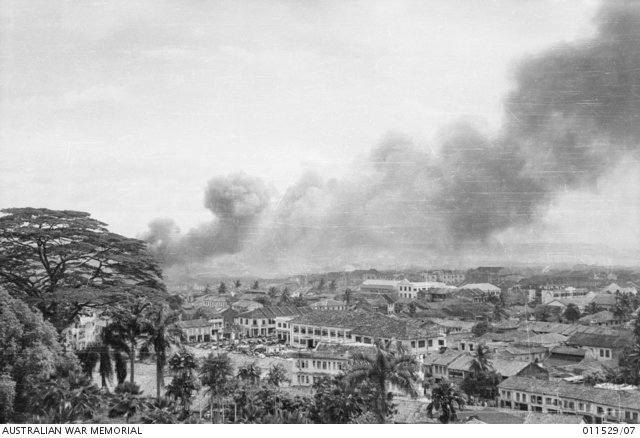
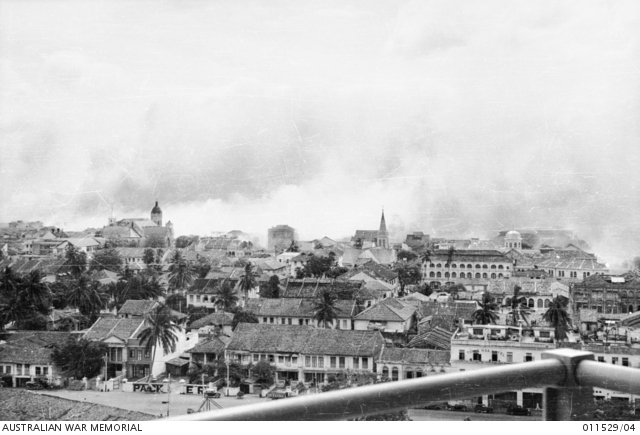
By now the decision had been taken to evacuate the 130 AANS nurses. On 10 February, six nurses departed aboard the hospital ship Wusueh. The following day, 60 more left on the Empire Star. Finally, on 12 February the order was given for the remaining 65 AANS nurses to leave Singapore.
Later that day, the nurses were driven through the burning city to the wharves, sheltering on the way at St. Andrew’s Cathedral during an air raid. At the wharves there was chaos, with hundreds of people trying to leave Singapore. Here Mavis happened to run into an acquaintance, a certain Marjorie Allgrove, who was being evacuated aboard the Giang Bee, a Chinese-owned coastal steamer requisitioned for civilian evacuation. Marjorie hoped that she and Mavis might go together, but it was not to be. Instead, Mavis and her 64 colleagues were ferried out to their evacuation ship, the Vyner Brooke, singing ‘Wish Me Good Luck as You Wave Me Goodbye’ as they went. From their respective ships Mavis and Marjorie waved goodbye to each other. The Giang Bee left Singapore Harbour at around 9.00 or 10.00 pm that night – a little earlier than the Vyner Brooke. The next day it was bombed by Japanese aircraft and later in the evening shelled and sunk by a Japanese destroyer. Marjorie was injured in the attack and drowned. Through a quirk of fate, Mavis would end up marrying her bereaved husband, Joseph.
Vyner Brooke
The Vyner Brooke was chock-a-block with evacuees. There was barely room to move. The passengers were made up of civilian women and children, and elderly, infirm and injured men. Apart from the crew and the nurses themselves, there were no military personnel aboard. The ship was equipped with six lifeboats, three on either side, as well as rafts arrayed in stacks, each meant for two people.
The Vyner Brooke moved out of Singapore Harbour late Thursday night or very early in the morning of Friday 13 February. That day and throughout the next night, the ship crept through the small islands that lined the passage between Singapore and Batavia, the ship’s destination. Then, at about 1.00 pm on Saturday 14 February, Japanese dive-bombers suddenly attacked. Captain Borton took evasive action and began zigzagging, but eventually the ship received three direct hits and began to list to starboard. It was around 15 kilometres from Bangka Island.
As the stricken ship listed ever more alarmingly to starboard, Mavis was in the process of escaping down a rope ladder. She became stuck, however, behind a certain Mrs. Brown, whose daughter, Sheila, was in the water, but who had been paralysed with uncertainty. Mavis discussed the events many years later when she was interviewed by Amy McGrath for the National Library of Australia’s Oral History Program:
Mrs. Brown was coming down this ladder, and she was in front of me. And of course, we had no time, we had a very, very short time to get off that ship and get away before it sank.… And so Sheila was singing out, ‘Where’s my darling mother?’ And mother was saying, ‘Oh Sheila, Sheila, where’s my Sheila?’… And I saw Sheila in the bottom, and I remember giving Mrs. Brown a shove and saying to Sheila, ‘Here comes your darling mother.’ And she went into the water, and we’ve laughed and laughed since.
Having thus expedited Mrs. Brown’s entry into the water, Mavis followed suit by jumping the rest of the way. Once in the water she managed to get hold of an oar that was floating by. Chris Oxley from the 2/10th AGH, who was given to prayer, grabbed it too. “There was Chrissy,” Mavis told Amy McGrath,
looking the most dreadful, forlorn poor little thing. And she was saying, ‘Holy Mary, Mother of God, pray for us.’… And I said to her, ‘Shut up Chris, stop saying your prayers! Grab this oar with me and get away from the ship, then you can say your prayers!’… And we’ve laughed about that too.
All around them, there were
thousands of dead fish, there were dead bodies, there were people in the water, there were oil drums, there were bits of wood, there were oars, there were boats sinking.… There were all kinds of things in the water.
Soon after that Mavis heard her 2/4th CCS colleague Elaine Balfour Ogilvy call to her from near one of the lifeboats, but as Mavis could not swim, she couldn’t reach the lifeboat.
And that saved my life, because had I done so I would’ve been shot on the beach. Because Drummond was in the boat, and Farmaner and Wilmot [and] Lainey.… Well those were the sisters with wounded people who were shot on the beach.
Adrift
Eventually Mavis found a raft to cling to, one of a number that had slid off the deck and into the water as the Vyner Brooke listed. As two-person rafts, however, they were too small for more than that number to sit on, so passengers clung to the rope around their sides. Mavis’s raft eventually had 16 or so people clinging to it, including Vi McElnea and Val Smith of the 2/13th AGH.
During the night we could see the light … from the lighthouse very well. And we tried to push to make for that lighthouse. But the tide kept on carrying us out.
At one point they even touched the stonework on which the lighthouse was mounted but could not find a handhold.
The dawn that greeted the raft’s occupants on Sunday 15 February 1942 belied the gravity of their situation. “It was a beautiful morning,” Mavis said.
If you’ve ever seen the sunrises in the east, the skies are almost like rainbows. Beautiful colours with violets and pinks.… And the sea was just like glass. And there were a few flying fish around.
Having come close enough to shore, the others around the raft decided to swim in, and having reached the beach they encouraged Mavis to follow. She was frightened when she left the raft and was eventually rescued by a local fisherman who towed her ashore on his small canoe. She gave him all the money she had, two Malayan dollars.
Bangka Island
Sunday was spent in hiding. Mavis argued that her group should give themselves up to the Japanese authorities – whose invasion fleet the survivors had seen arriving during the night – and that it was pointless to adopt any other course of action. She eventually won the argument, and on Sunday evening the group walked into the nearby town of Muntok and were eventually taken to the town’s customs house.
On Tuesday 17 February 1942 they were taken from the customs house to the town cinema and were interned with up to 1,000 others, survivors of the dozens of ships that had left Singapore over the past few days only to be sunk in Bangka Strait. In the cinema Mavis met other AANS survivors of the Vyner Brooke. Two days or so after that the internees were taken to the Public Works Department (PWD) lines on the edge of town, known as the ‘coolie lines.’
While Mavis was at the PWD lines, helping to run a makeshift dressing station, she was told by a sailor that he had just buried bodies on a beach dressed in nursing uniforms like hers. A week later, Vivian Bullwinkel of the 2/13th AGH came into camp and confirmed the story. She had been the only survivor of a massacre.
Prisoners of Japan
Under these tragic circumstances the AANS nurses, now numbering 32, together with hundreds of civilian women and children, began a three-and-a-half-year period of captivity. Over this time Mavis and the nurses were held in nine different locations. They were moved eight times and spent the bulk of their internment in six camps on Bangka Island and in southern Sumatra – according to Mavis each one worse than the previous.
In early March 1942 they were taken by barge across Bangka Strait to Sumatra, then up the Musi River to Palembang. They were driven to the outskirts of town and spent the night in a school. The next day they were marched to houses in the Bukit Besar (‘Big Hill’) district of Palembang that soon came to be referred to by the nurses as ‘Lavender Street’, after an unsavoury thoroughfare in Singapore, due to the attempts by certain Japanese officers to press the nurses into service as comfort women. By “the grace of God and our own resourcefulness we were spared this final humiliation,” Mavis stated, but the experience was nonetheless strongly traumatising for many of the nurses.
In early April 1942 the nurses and civilian women and children – including Dutch now – were moved again, this time to the Talang Semut district of Palembang, a few kilometres east of Bukit Besar, to a camp that became known as ‘Irenelaan’, where they stayed until September 1943. It was here, in March 1943, that Mavis and the others were able to write home for the first and only time. Her mother received her letter six months later. The nurses themselves received no mail until the very end of their captivity, at which time letters that had been kept for years by the camp authorities were discovered.
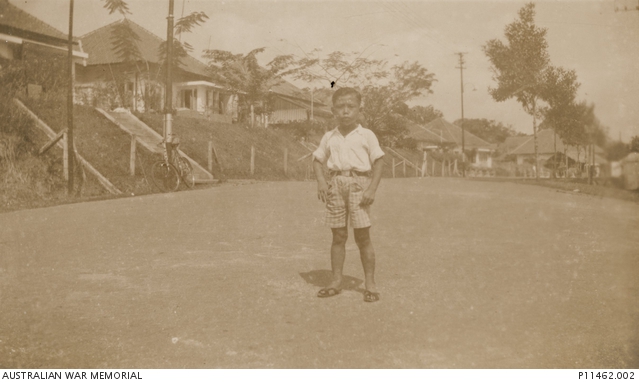
In September 1943 the internees were moved to the ‘New Atap Camp’ at Puncak Sekuning, around two kilometres from Irenelaan. The Atap camp had previously been occupied by male internees, who, upon being told they were moving out and believing that the Japanese themselves were moving in, had caused considerable damage. It was at this camp that the famous Vocal Orchestra was established by Margaret Dryburgh and Norah Chambers.
In November 1944 the internees were taken back up the Musi River and across Bangka Strait to Muntok. Four months later, in March 1945, they were brought back to Sumatra, to a camp at Belalau rubber plantation, near Loebok Linggau, some 250 kilometres west of Palembang. Many internees died en route. These final camps were marked by malnutrition, disease and death.
Burying the dead became the most dreadful thing Mavis and the others had to do. They would make a coffin out of an old box, set it on two bamboo poles, and carry it one or two kilometres from camp.
Sometimes – towards the end – we used to have 12, 13 deaths a day [Mavis told Amy McGrath]. And of course people had to be buried immediately. And it meant that we were out on these [burial] parties for ages…. And you couldn’t dig the holes very big, so the coffins were more or less just stuck underneath, that was all. And I made up my mind I was not going to die under those circumstances.
A funeral service was held for the deceased, and a wooden cross placed on the grave with the person’s name burned into it with a hot wire.
The Camps Take Their Terrible Toll
The nurses were becoming desperately ill, and on 8 February 1945, at Muntok camp, they lost their first colleague when Mina Raymont died of malaria. Her death was particularly distressing for Mavis.
I begged the Japanese, I’d have done anything they asked me to do, for medicine for Raymont. She had cerebral malaria, and they wouldn’t give me a thing. And she was raving mad with it.
On 20 February Rene Singleton died of beri-beri. On 19 March Blanche Hempsted died. Shirley Gardam followed on 4 April.
At Loebok Linggau Mavis’s comrades continued to die: Gladys Hughes on 31 May, Winnie May Davis on 19 July, Dot Freeman on 8 August, and Pearl Mittelheuser on 18 August – three days after Japan had formally surrendered. Rumours that the war was over had reached the internees’ ears, but no one knew what to believe.
On 24 August 1945, the commandant of the camp announced through an interpreter – a Dutch internee who had spent time in Japan – that the war was over. At this time Mavis had malaria and didn’t feel like celebrating. Incredibly, the commandant hoped that the internees would forgive their Japanese captors and be friends.
Rescue
On 15 September 1945, the 24 surviving AANS nurses were told to be ready to leave the camp at 4.00 am the next day. Australian war correspondent Haydon Lennard, together with Flying Officer Ken Brown and Flight Sister Beryl Chandler of the RAAF, had been searching for them for two weeks, and had arranged for two planes to meet a total of 60 internees, the 24 surviving nurses along with 36 ill civilian women and children, at Lahat.
Early in the morning on 16 September, the 60 women and children left the camp for the last time in open trucks headed for Loebok Linggau station, from where they took a train to Lahat. They arrived around midday and waited for the planes to arrive. At around 4.00 pm, only one plane landed; the other had been delayed in Singapore and would come the next day. The 24 nurses and six others boarded the plane and flew to Singapore – and freedom.
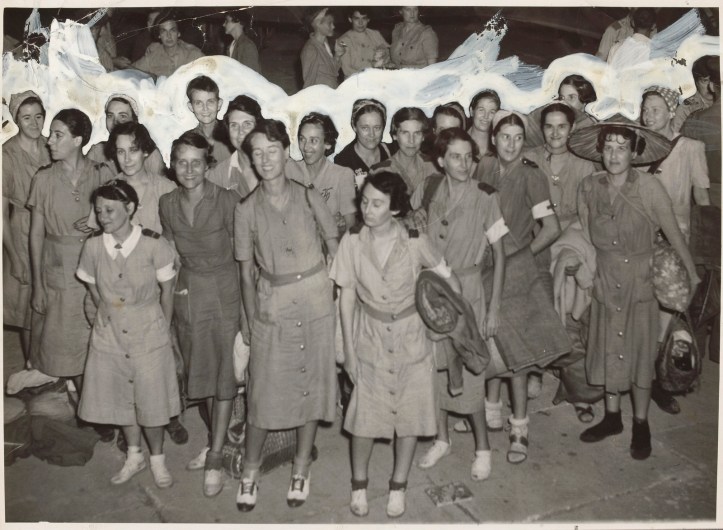
On 5 October, after a period of recuperation, Mavis and the other 23 AANS survivors boarded the hospital ship Manunda and departed the city from which they had been so chaotically evacuated three and a half years earlier. The ship arrived in Fremantle on 18 October, and the nurses were given a grand reception by the staff of the 110th Perth Military Hospital, also known as the Hollywood Military Hospital. At the reception Mavis spent time with some of the mothers whose daughters did not come home.
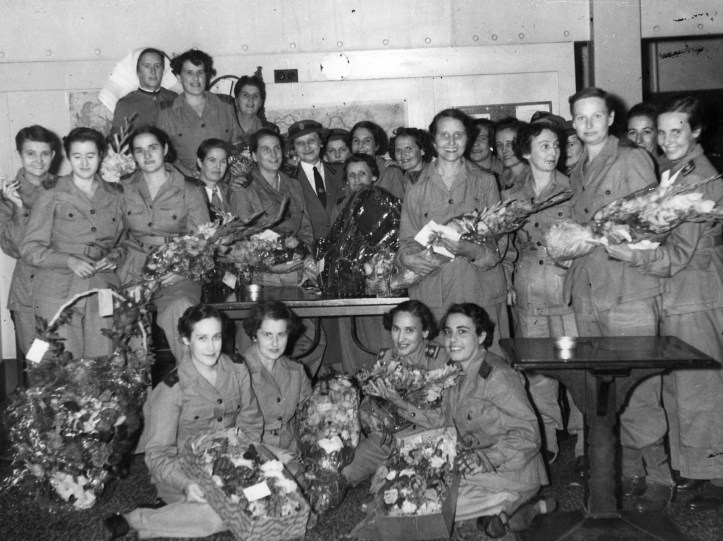
On 19 October the Manunda continued on its way east and on 24 October arrived at Port Melbourne, where the Victorian, Tasmanian and South Australian nurses – Mavis and Jean Ashton – disembarked. A band played ‘The Rose of No Man’s Land’ as they walked down the gangway, and a bus took them to Heidelberg Military Hospital, where another grand reception awaited them. Later, Mavis and her best friend in camp, Elizabeth Simons, managed to squeeze in a social visit with the Lowes, friends of Elizabeth’s.
Home
On 27 October 1945 Mavis and Jean Ashton arrived in Adelaide.
We had a marvellous welcome. The bands played and the traffic was all stopped. And we had a royal procession through the streets, and we were taken to the Town Hall. And we received a check, I think it was £100 each we got. And all sorts of things, they made a tremendous fuss about us.
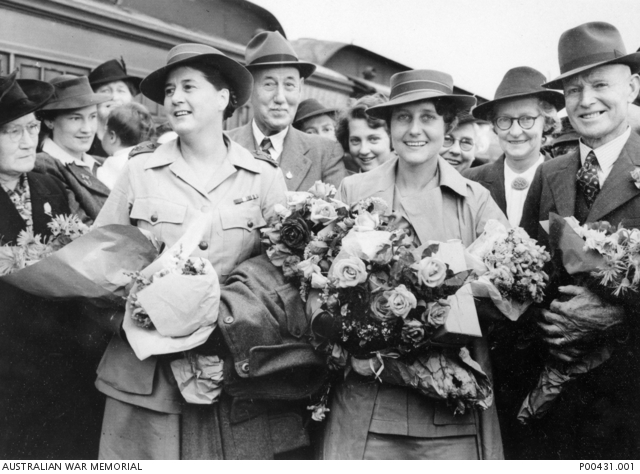
Mavis spent the next six months recovering at the 105th Adelaide Military Hospital, Springbank, interspersed with periods of work at the Recruit Reception and General Details Depot at Wayville. In May 1946 she was posted, at her request, to the 110th Perth Military Hospital.
While Mavis was in Perth she met up with her husband-to-be, Captain Joseph (‘Joe’) Allgrove, whom she had got to know while they were both prisoners of war in Sumatra – and whose wife had perished in the sinking of the Giang Bee. Joe was returning to Malaya, where he worked for Thomas Barlow & Brother Ltd managing a rubber plantation. Mavis and he decided to get married. After securing her discharge from the army on 2 December, Mavis embarked from Fremantle on 4 December aboard the SS Charon. She arrived in Singapore on 13 December, and she and Joe were married three days later at St. Andrew’s Cathedral.
Return to Malaya
After her marriage, Mavis – known as ‘Nell’ to Joe – moved into the Muar River rubber plantation, in Batu Anam, Johore, in up-country Malaya. While Joe managed the plantation, Mavis worked in the plantation’s medical clinic. They had three children, the eldest of whom, Jeremy, born in 1948, became a well-known paediatric endocrinologist. Jessica was born in 1950, and Jeffrey early in 1953. Joe already had five children from his marriage to Marjorie, including one, John Allgrove, who became Australian Trade Commissioner in Taipei and Jakarta, among many other places.
During this period Mavis and Joe were confronted with a guerrilla war that threatened not only their livelihood but their very lives. Fought between communist pro-independence fighters and military forces aligned with the British Empire, the so-called Malayan Emergency began on 17 June 1948, after Britain declared a state of emergency in Malaya following attacks on plantations. Mavis and Joe installed barbed wire fencing, travelled in armoured cars, and took to carrying firearms.
England
Eventually Mavis’s “second war” was too much for her, and in 1952 she and Joe moved to England, to Grove Hill House in the village of Dedham, outside Colchester in Essex. For the next 25 years Joe regularly visited Malaya as Visiting Agent or Director of Estate Companies.
Every Anzac Day, Mavis travelled into London to the Cenotaph and placed a wreath in remembrance of her fallen comrades.
Joe died on 9 February 1984 in Dedham.
In March 1993 Mavis, together with Jean Ashton, Pat Darling (née Gunther), Vivian Statham (née Bullwinkel), Wilma Young (née Oram), Joyce Tweddell and Florence Syer (née Trotter) returned to Bangka Island to dedicate a memorial to their 21 comrades murdered on 16 February 1942 by Japanese soldiers. The seven women then travelled to Jakarta to pay tribute to their 12 comrades lost at sea following the sinking of the Vyner Brooke and to the eight who died in the camps and now lie in the Jakarta War Cemetery.
On 29 October 1993 Mavis died after a long and eventful life. She was 83.
We will remember her.
SOURCES
- Ancestry.
- Arthurson, L., ‘The Story of the 13th Australian General Hospital, 8th Division AIF, Malaya’ (edited by P. Winstanley, 2009).
- BirtwistleWiki, ‘110th Australian Base Hospital.’
- Cambridge University, Centre of South Asian Studies, ‘Allgrove Papers.’
- National Archives of Australia.
- National Library of Australia, Oral History Program, ‘Mavis Hannah interviewed by Amy McGrath,’ interview conducted at Grove Hill House, Dedham, Colchester on 13 July 1981, transcript and audio.
- Roll of Honour: Britain at War (website), ‘HMS Giang Bee History’.
- Simons, J. E. (1956), While History Passed, William Heinemann Ltd.
- State Library of South Australia, Almanacs and Directories.
- Walker, A. B. (1962), Australia in the War of 1939–1945, Series 5 – Medical, Vol. II – Middle East and Far East, Part II, Chap. 23 – Malayan Campaign (pp. 492–522), Australian War Memorial.
- WikiTree, ‘Ellen Mavis (Hannah) Allgrove (1910–1994).’
- WikiTree, ‘Joseph William Allgrove (1900–1984).’
SOURCES: NEWSPAPERS
- The Daily News (Perth, 3 Dec 1946, p. 1), ‘POW Nurse To Wed.’
- The Herald (Melbourne, 28 Jun 1944, p. 7), ‘News of War Prisoners.’
- Saturday Journal (Adelaide, 22 Jan 1927, p. 30), ‘Family Notices.’
- South Australian Register (Adelaide, 27 Jul 1878, p. 1), ‘Board of Management, Adelaide Hospital.’
- The Telegraph (Brisbane, 9 Dec 1946, p. 5), ‘Sailing to Be Married.’
- Townsville Daily Bulletin (13 Nov 1945, p. 1), ‘Guard of Honour for Army Sister.’
- The West Australian (Perth, 17 Jan 1910, p. 1), ‘Family Notices.’
- The West Australian (Perth, 23 Sep 1911, p. 10), ‘Shipping.’
- The West Australian (24 Nov 1948, p. 1), ‘Family Notices.’

