AANS │ Staff Nurse │ First World War │ Australia & France │ No. 17 Australian Auxiliary Hospital (Torrens Park), No. 7 Australian General Hospital (Keswick) & No. 7 General Hospital (Saint-Omer, France)
FROM ENGLAND TO ADELAIDE
Elfrida Jane May Lapidge was born on 17 May 1882 in the town of Unley, three kilometres south of the city of Adelaide. At the time surrounded by farmland, Unley developed rapidly and in 1906 became the third city of South Australia, behind Adelaide and Port Adelaide, with a population of 20,000. Today the City of Unley comprises a number of inner suburbs of Adelaide.
Elfrida’s parents were Mary Jane Ivey Opie and John Thomas Lapidge. Mary Opie was born on 17 November 1846 in Chatham, Kent and arrived with her parents in South Australia on the Sir Edward Perry on 25 March 1854 after departing London on 20 December 1853. After a few weeks in Adelaide the family travelled in bullock drays to Goolwa, 70 kilometres south of Adelaide near the mouth of the River Murray. Mary got to know the local Goolwa people, who called her “little Missy” and at one time ushered her to safety when, in search of flour, she accidently wandered into the midst of a fight between Goolwa and neighbouring Coorong. In the early 1860s the Opies moved back to Adelaide, and on 19 October 1867 Mary married John Thomas Lapidge.
John Lapidge was born on 9 October 1842 in Plymouth, Devon. After an apprenticeship with a firm of hydraulic engineers and a term of employment at the Naval Dockyards, he left on a 22-week voyage to South Australia on the Clara, stating his occupation as plumber. He arrived at Port Adelaide in April 1865 and moved to Freeling, 60 kilometres to the north, where he kept a general store selling ironmongery, crockery, drapery etc. and was also the postmaster. John’s brother William Jones Lapidge had arrived in Adelaide around May 1864 as a waggoner and later became a clerk. Another brother, Charles Edward Lapidge, a tinsmith, arrived in March 1876.
MELBOURNE
Mary joined John at Freeling after their marriage, and in 1869 their first child, John Edward Freeling Opie, was born. Owing to a drought, however, the general store became unsuccessful, and in June 1870 John auctioned off his stock and the freehold shop and land, subject to a mortgage of £160. John, Mary and little John then moved to Melbourne, where they lived at 87 Smith Street in the working-class inner suburb of Fitzroy.
In early 1871 John tendered for the manufacture of 12 copper lanterns for St. Kilda Council, and in April it was accepted. He was paid more than £15 for his work. Meanwhile, back in Adelaide, a further sale of John’s stock-in-trade as a tinsmith and plumber had taken place on 4 March 1871. Being auctioned was tinware, an iron tank, flour bins and spouting, household furniture and effects, and various other items. On 15 March the allotment of land with the shop and dwelling on it was put to auction again, evidently not selling in June 1870.
In September 1871 Mary, still in Melbourne, gave birth to the family’s second child, Ernest William Ivey. Baby Ernest died three months later. On 1 January 1873 Blanche Elizabeth Maud was born. She too lived for only three months. Mary’s and John’s fourth child, Beatrice Caroline Maude, was born in March 1874, and lived to the age of 79.
UNLEY
Following Beatrice’s birth, the Lapidges returned to Adelaide and by September 1875 were living on Strangways Terrace in North Adelaide. John was working as a labourer but in February 1876 won the tender from the Adelaide City Council to manufacture 20 galvanised iron lamps for £16. In April that year the family’s fifth child, Ernest Charles Arthur, was born.
By June 1877 John and Mary had moved from Strangways Terrace to a shop and dwelling on Kate Street in central Adelaide – where, on 18 June, they became involved in a fracas with a certain Elizabeth and Charles Barnett and wound up in police court the following day.
Two more children were born while the family was living on Kate Street. Horace Victor Henry was born in July 1878 but died in May 1879. Ethelbert Sydney, known as Bert, was born in March 1880.
By January 1881 John had acquired a shop and dwelling on the west side of King William Road (formerly West Street and also West Row) in Unley, between Bloomsbury and Boffa Streets and close to the three-way boundary between Unley, Hyde Park and Goodwood. Here he opened an ironmonger’s shop and set up a tinsmithing workshop. It is not known when the family moved into the attached dwelling but in April 1882 John advertised the Kate Street property to let.
In May 1882 Elfrida was born. She was followed by Hilda Augusta Ivey, who was born in August 1884 and like Elfrida became a nurse. Two years later Mary Lapidge gave birth to twins, Edgiva Priscilla and Edgar Percy. Edgiva died just three months later, becoming the fourth Lapidge child to die an infant. Mary’s and John’s twelfth and last child, Cyril Olive Argent, was born in May 1888.
Among John’s hobbies was mineralogy, and around 1886, in the vicinity of Blackwood in the Adelaide Hills, and near Willunga further south, John had discovered deposits of natural mineral dry colours – or ochres, coloured earths etc. Deriving a dozen different shades from the earths, he began to make paints with them and in October 1887 was awarded a prize at the Jubilee Exhibition in Adelaide. (At the same exhibition, 11-year-old Ernest and seven-year-old Bert Lapidge won a prize for their mineralogical collection in the ‘Schoolwork – For juveniles under 14 years of age’ category.) By January 1889, a company had been formed to work the mineral deposits, though John appears to have had no commercial interest in the company.
Another of John’s strong interests was the affairs and politics of South Australia. He was fond of writing letters to the newspapers – for instance urging the government to take a greater interest in the colony’s mineral resources – and in November 1887 stood for local council, contesting Unley Ward within the City of Unley. He was unsuccessful but stood again in November 1888 and this time was voted in. In April 1890 John decided to contest the South Australian colonial election and nominated for the House of Assembly district of Sturt, which encompassed Unley and surrounding suburbs. Unfortunately he polled rather poorly. Undaunted, he stood again for Unley Ward in November 1890 and retained his seat on council.
MYLOR
In May 1891 the South Australian government proclaimed the boundaries of a new town in the Adelaide Hills, Mylor, named by the colony’s acting governor, Sir James Boucaut, after his birthplace in Cornwall. The town was established to meet the needs of the settlers of the surrounding countryside, who had begun to arrive in 1885 under the Working Men’s Blocks Scheme.
With Mylor now officially gazetted, on 11 June 1891 allotments within the town boundaries were offered for sale by the government. Among the purchasers was Mary Lapidge, who bought two adjoining quarter-acre allotments, nos. 7 and 10, for £3 each. They were located at the northern end of South Eastern Main Road (today Strathalbyn Road), adjacent to three allotments reserved for a state school.
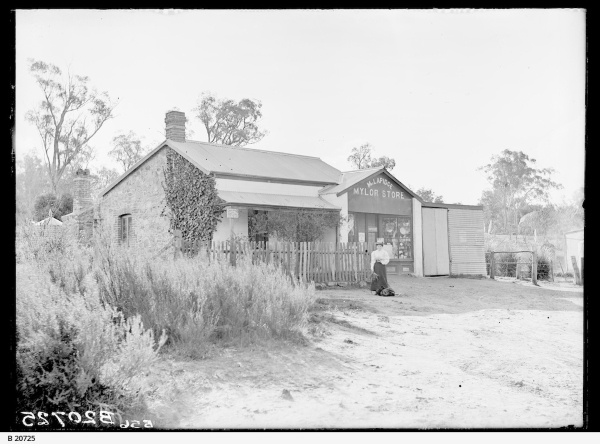
In March 1892 John was granted permission to clear the scrub on the Mylor allotments, and as the year progressed, a house and shopfront were built. In October that year John purchased more land in Mylor, allotment 1034, located around two kilometres southwest of the township.
By December 1892 Mary was the Mylor agent for the South Australian Chronicle. She had evidently relocated to the town and had opened a general store – reputedly the first shop to open in Mylor. Over the coming years she developed a reputation for scrupulous honesty and fair dealing. The children moved with her, with the exception of John Edward, the eldest, who had bought land in Freeling in 1891.
FIRE IN UNLEY
Meanwhile, John Lapidge remained in Unley. He was busy with his council business, having successfully renominated in November 1892, and with his ironmongery and tinsmithing workshop on King William Road. He appears to have been living in the premises, as the attached house had been let to the Carter family. Nevertheless, John regularly commuted the 20 kilometres to the property in Mylor, which he and Mary eventually named Mannamead, after a district of Plymouth.
On 25 February 1894, while John was at Mylor, John Edward was looking after the shop on King William Road when he accidentally set fire to it. The shop, the workshop and the upper floor were destroyed, but the house was saved, and the Carters were uninjured, as was John Edward. However, the loss to John Lapidge of stock, tools, equipment and furniture, as well as two years’ worth of cash savings, was serious and only partly covered by insurance.
Using scorched iron and wood, presumably from his King William Road premises, by May 1894 John had built an unsightly structure on an allotment of land on the corner of Unley Road and Marion Street in Parkside, a little over a kilometre from his late premises. The makeshift workshop attracted a great many complaints to council from ratepayers – and from other councillors – and one hopes that by 1895 John’s new metalworking business, Lapidge Manufacturing Co., was operating out of a more visually appealing workshop.
In Mylor, meanwhile, Mary was persevering with her store. The town was growing apace and by 1895 had two churches, a smithy, a carpenter’s shop, a lecture room and two stores. Mylor Public School had opened in November 1894, and land had been purchased for a memorial hall.
Aside from running the store – and looking after the children – Mary tended the orchard that she and John had planted, either behind the store or on their other allotment – or both. Orcharding was one of the main sources of income for the ‘Blockers,’ as the working families who had come to Mylor were known, and thousands of fruit trees were planted in the district. At the conclusion of John’s stint on Unley council at the end of 1894, he was perhaps able to spend more time in Mylor helping Mary.
SCHOOL AND NURSING
Not a lot is known of Elfrida’s early life. She possibly attended Unley Public School (where her brother Ernest was a pupil in 1889) and became a pupil at Mylor Public School as soon as it opened in November 1894.
In March 1897, at the age of 14, Elfrida was appointed by the Education Department as an unpaid monitor at Mylor Public School. Monitors were older pupils who assisted head teachers, usually in crowded classrooms. Elfrida had evidently considered becoming a teacher herself and in April 1897 passed the Class II, Division B pupil-teacher examination. As of March 1898 she remained an unpaid monitor but in July 1899 was appointed as a (paid) monitor at Mylor.
Oddly, according to the South Australian Register of 5 November 1898, Elfrida’s younger siblings Hilda, then 14 years old, and Cyril, 10, were pupils at Echunga Goldfields School, located at Biggs Flat, four kilometres from Mylor. Later, in November 1899, Cyril and his brother Edgar, then 13, were reported as attending Mylor Public School.
Perhaps realising that teaching was not for her, in 1900 Elfrida took her first steps towards a career in nursing when she joined a women’s nursing class run by the St. John Ambulance Association. After completing a course of lectures under Dr. John B. Gunson, on 29 November 1900 she and 17 other candidates successfully sat an examination conducted by Dr A. A. Hamilton. Elfrida and seven other candidates sat another examination conducted by Dr Hamilton in May 1903 – demonstrating, according to the good doctor, creditable knowledge of their work.
Elfrida had occasion to practise her learning on 11 January 1904, when, in company with Constable Schumann, she tried to revive a boy who had fallen into the Onkaparinga River at Mylor. Sadly, the poor lad had been in the water for too long.
In 1905 Elfrida applied to the Adelaide Children’s Hospital, on King William Road in North Adelaide, for a position as a trainee nurse. She was accepted and began her training in June that year.
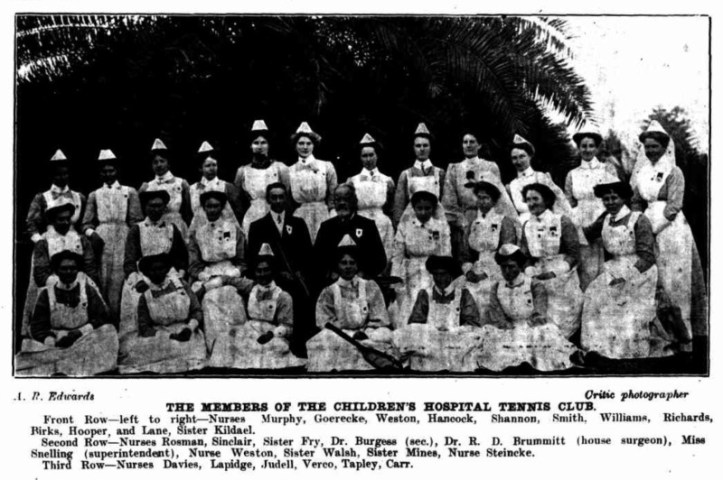
Elfrida must have been a handy tennis player – or at least a determined one – as during her training she became a member of the Adelaide Children’s Hospital Tennis Club. The members’ photograph appeared in the Adelaide Critic on 26 September 1906.
In 1908 Elfrida took classes in Invalid Cookery at the School of Mines and Industries in Adelaide and achieved a first-class pass in the examination held in June. This marked the completion of Elfrida’s training, and she thereafter began a six-month spell of private nursing. In November she was presented with her graduation medal and on 17 December became registered with the Australasian Trained Nurses’ Association.
From January to July 1909 Elfrida trained in midwifery at the Queen’s Home in Rose Park, an inner eastern suburb of Adelaide. In December that year she gained her midwifery registration, having returned to private nursing at the completion of her training. She spent time as a relieving charge nurse at Burra Hospital, 140 kilometres north of Adelaide, and as a relieving matron at Yorketown Hospital, on the Yorke Peninsula.
In November 1910 Elfrida was appointed matron of the Strathalbyn Hospital, a private hospital in the attractive town of Strathalbyn, 30 kilometres south of Mylor. In May 1911 she joined the State Children’s Department as an inspector and at one time had responsibility for licensed foster mothers and lying-in homes.
THE AUSTRALIAN ARMY NURSING SERVICE
On 5 August 1914 Australia went to war, and thousands of Australian women and men began to volunteer – the men to fight with the Australian Imperial Force (AIF), and the women to nurse with the Australian Army Nursing Service (AANS).
Elfrida was one of those early volunteers. On 11 August, while still employed by the State Children’s Department, she filled out an AANS ‘Questions to be answered by Candidates prior to Enrolment’ form. At this stage army authorities were unsure whether to take any nurses at all but eventually decided to accept applications only from members of the AANS Reserve. Elfrida, not being a member of the Reserve, was deemed ineligible, and continued her work for the State Children’s Department.
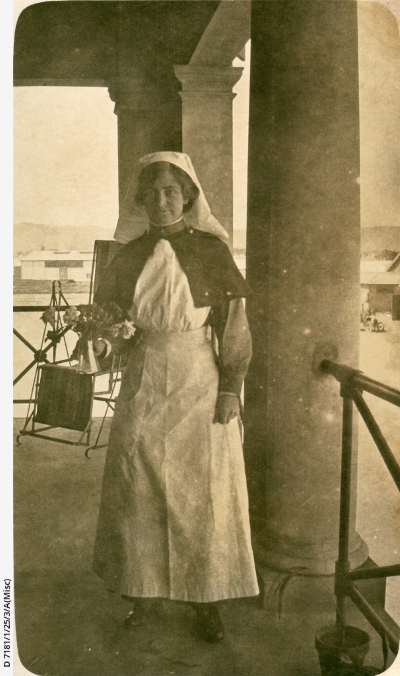
On 27 August 1915 Elfrida completed another AANS candidates’ questionnaire, and this time was accepted into the AANS. Nearly a year later, on 1 July 1916, she filled out her attestation paper for service abroad with the AIF.
However, by now Australian army authorities preferred that AANS nurses complete a period of home service before serving abroad with the AIF. Elfrida was placed in a pool of general reinforcements and posted as a staff nurse to No. 17 Australian Auxiliary Hospital (AAH), a convalescent hospital for sick and wounded AIF men based at Torrens Park in Mitcham, around four kilometres south of Unley. By 20 September she had transferred to No. 7 Australian General Hospital (AGH) in Keswick, on the city fringes two kilometres west of Unley.
In November, at the request of the (British) War Office, the director of the AIF’s medical services, Surgeon-General Neville Howse, sent a cable from London (where he was based) to the Defence Department in Australia, which read as follows (as quoted in Butler, p. 540):
200 nurses urgently required. Can you send 100 equipped for service. Have arranged with War Office that they will be enrolled in A.I.F. and on arrival will be lent to the War Office. A.I.F. will pay them but War Office guarantee repayment of all expenses connected with them if claimed by Commonwealth. First 100 will be employed in France.
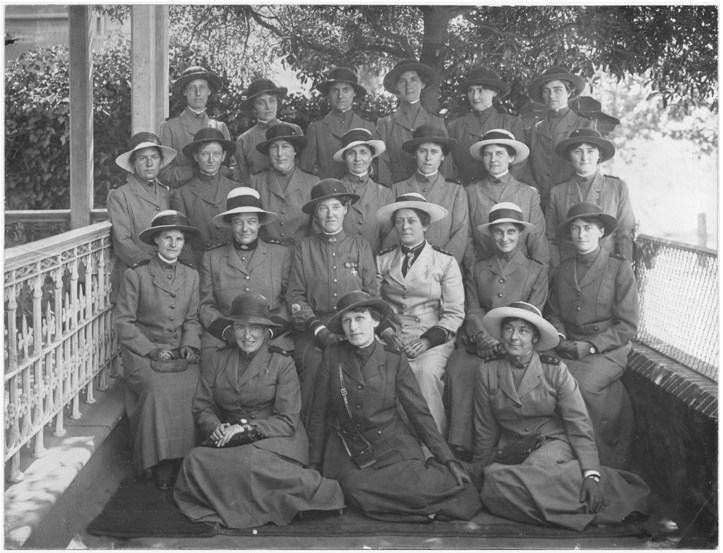
Elfrida was one of 20 South Australian nurses chosen to go. On the afternoon of 20 December 1916 she and her new colleagues – Staff Nurses Doris Barry, Dora Birks, Sarah Copley, Elizabeth Dailey, Edith Faulkner, Alice Fricker, Erica Giles, Doris Gordon, Florence Laity, Ethel Lang, Sarah Lord, Vera Moyes, Ivy Rodgers, Rosetta Rushton, Mary Smith, Elsie Steadman, Florence Tabor, Kathleen Taylor and Daisy Wright – were given a farewell party by the committee of the Army Nurses’ Club at the Liberal Union Tearooms in Adelaide. Also being farewelled were Staff Nurse Helen Gordon, Staff Nurse Agnes Love and Sister Edith Menhennett ARRC, who had been attached to No. 1 Section, Sea Transport Staff and were due to sail on the Orontes from Melbourne in two days’ time. Among the well-wishers were Matron Ethel Uren, the principal matron for the 4th Military District (South Australia); and Colonel H. H. E. Russell, the principal medical officer for the state.
HMAT THEMISTOCLES
On 26 December – Boxing Day – the 20 South Australian nurses entrained for Melbourne and then for Sydney. They arrived at Central Station and proceeded to Miller’s Point on Sydney Harbour, where HMAT Themistocles was berthed. They embarked and were joined on board by 19 Queensland staff nurses, among whom was a nurse by the name of Pearl Goodman, originally from Millthorpe in New South Wales. On 29 December the Themistocles departed, bound for Plymouth, England. On this day Elfrida and her colleagues were formally enlisted in the AIF.
The bulk of the 200 nurses had left earlier on three ships – the Orsova and the Mooltan, carrying mainly Victorian nurses, and the Kaiser-I-Hind, carrying Western Australian and New South Wales nurses.
After crossing the Indian Ocean, the Themistocles arrived at Durban and then sailed to Cape Town, where British officers invalided from German East Africa were embarked. The ship then joined a convoy and sailed under blackout conditions to Sierra Leone in West Africa. Here the nurses were granted shore leave for a few hours. On 3 March 1917, after an uneventful voyage, the Themistocles arrived in Plymouth.
FRANCE
On 12 March 1917, after nine days’ furlough, Elfrida and the other nurses from the Themistocles proceeded to France, where they were split up and sent to various (British) Royal Army Medical Corps (RAMC) hospitals.
Elfrida, Pearl Goodman and four other nurses were posted to No. 7 General Hospital (GH) at Longuenesse, Saint-Omer, 45 kilometres east of Boulogne, and arrived on 13 March. The hospital was housed in La Malassise, a former Benedictine monastery and had been operated by the British Red Cross before being taken over by the RAMC.
At the time of the Australian nurses’ arrival, the hospital was dealing with large outbreaks of mumps and German measles (rubella). On the wards were 675 cases of the former and 293 of the latter. To meet the challenge of so many infectious cases, the hospital was undergoing a ‘crisis’ expansion, and by 1 April had grown to 1,540 beds – the new ‘normal’ number of beds. Five-hundred and fifty beds had been added during the period of expansion.
On 27 April Elfrida complained of a sore throat and hoarseness. She was hospitalised on 29 April after developing a temperature, and over the next 10 days experienced a range of symptoms. Her neck glands became swollen and her left cheek sore, she had difficulty breathing and swallowing, she experienced nasal discharge, and she perspired freely. On 16 May, complaining of pain around her chest and still running a temperature, she was sent to a convalescent home, possibly at Hardelot, eight kilometres south of Boulogne, 50 kilometres west of Saint-Omer. Two days later, after experiencing severe pain on the left side of her body, which left her speech impaired, she was transferred to No. 14 GH at Wimereux, just north of Boulogne.
On 5 June Elfrida was evacuated to London aboard the Jan Breydel and admitted to the Vincent Square Hospital (as the Grosvenor Hospital for Women was known during the war). Her left foot, her left shoulder, and the left side of her neck had become paralysed, and for two weeks she was treated with bromide and ammonia. On 2 July she was transferred to Southwell Gardens Hospital in South Kensington, otherwise known as the Mrs. T. S. Hall Hospital for Australian Nurses – and by 9 July, when a medical board discussed her case, a neurological condition known as pseudobulbar paralysis had been diagnosed. Elfrida was found to be permanently unfit for service, and it was decided that she should be invalided to Australia.
RETURN TO AUSTRALIA
On 16 July 1917 Elfrida departed England aboard No. 2 AHS Kanowna with other wounded and invalid personnel. The Kanowna arrived at Port Adelaide on 7 September, and Elfrida and the other South Australians entrained for Adelaide Railway Station, where they were met by a large crowd of relatives and friends. Along with a number of the other returnees, Elfrida was taken to Keswick Military Hospital, as No. 7 AGH was more commonly known, and admitted.
Elfrida remained hospitalised for some time and was unable to attend a welcome home social held in Mylor for her and Lance-Corporal Blaser on 15 September. She was presented with an inscribed locket in absentia.
Although her condition had largely cleared up, and she was suffering from not much more than general debility, on 28 November 1917 Elfrida was discharged from the AIF as medically unfit. For better or for worse, her army career was over.
HILDA LAPIDGE IN INDIA
On the other hand, the army career of Elfrida’s sister Hilda was just beginning. Like Elfrida, Hilda had trained as a nurse at the Adelaide Children’s Hospital, finishing in 1915 with a first-class certificate. She joined the AANS in June 1917 and was posted to Keswick on 30 August – a week before Elfrida’s return. In October she enlisted in the AIF at the rank of staff nurse and was chosen for service in India.
Hilda departed Adelaide on 14 November 1917 aboard the SS Canberra for Bombay. Among the AANS nurses on board for India were Emily Clare and Irene McPhail. The Canberra arrived in Bombay and on 11 December Hilda disembarked. She was placed in quarantine until 9 January 1918 and then posted to No. 44 General Hospital (GH), an RAMC hospital at Deolali, 160 kilometres northeast of Bombay.
On 14 August 1918 Hilda was transferred from No. 44 GH to nearby No. 34 Welsh GH. In September Emily Clare was transferred here too. Emily became ill with an early strain of pneumonic influenza – the Spanish flu – and died at No. 34 Welsh GH on 17 October.
Hilda witnessed Emily’s funeral on 18 October and wrote to Elfrida the following day. Her letter, in which she provides possibly the most poignant description of a military funeral one is ever likely to read, was printed in the Adelaide Register on 9 December 1918, as follows:
“By the time you get this, you will know that we have lost one of our girls. She took ‘flu, and pneumonia supervened. The pneumonia they are getting is not ordinary, but is sort of plague-infected, and it does not matter how hard we fight, it generally beats us. This girl came out on our boat, and has only recently come up to No. 34 General Hospital; and less than a week ago she was doing nights in the busiest ward here. I will tell you all about the funeral, because, although so heartbreaking, it was grand and impressive.
“At 5.30 [pm] her body was taken into the Roman Catholic Church, where a short service was held, and was then carried by three R.A.M.C. and three garrison officers and placed on a guncarriage. The carriage was covered with the Union Jack, and her hat and cape placed on the top. The Convalescent Band went ahead and played ‘Go bury thy sorrow.’ Then came we girls, in mess dress with black arm bands, then the officers (even the Hindu officers were there), then the R.A.M.C., the Depot, the Convalescent, No. 6 Camp, No. 4 Camp, the 44th Orderlies, and so on. Truly, I never thought there were so many troops in Deolali.
“The road was lined most of the way with troops and hundreds of patients. An ‘Aussie’ boy, who is a patient here, went with we girls, and also the padre, the only two ‘Aussie’ men here. Just as the sun was setting, they lowered her into her flower-lined grave. One girl placed a crown of tuber roses on her coffin, and surely it was a fitting symbol of the crown of life which is hers, and as the rifles fired and the bugle sounded ‘The Last Post’ the rays of the setting sun caught on the Crucifix, and seemed to cast a radiance around, and the sky reflected the glory also, for it had the most beautiful pink and golden shades. And as it went, so the moon rose, and gave just that touch of peace over everything, that made it all seem just the time and place where we should leave her to rest.
“And I am convinced of this, that no statesman has ever had a more fitting farewell than that accorded to our ‘Aussie’ sister by these Englishmen and native officers. I believe that this is the second Australian sister to die in India.”
Hilda was transferred again on 10 March 1919 to the Station Hospital at Bangalore in the south and on 13 November 1919 to the Station Hospital at Gharial in the foothills of the Himalayas in the far north. By now she had been appointed to the rank of sister.
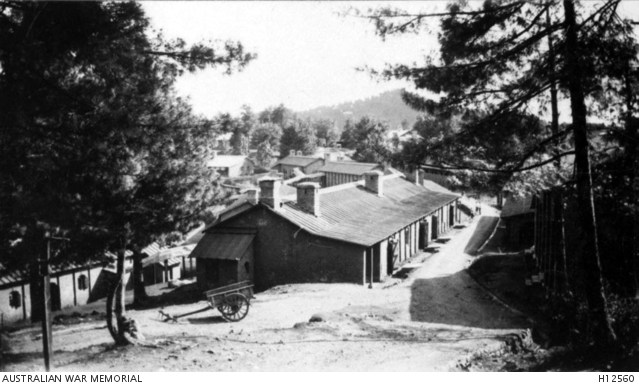
By now, Hilda’s time in India was nearly at an end. After returning to Bombay she travelled to Calcutta and on 8 December 1919 embarked on the SS Janus for Australia. She disembarked in Adelaide on 5 January 1920 and was discharged from the AANS on 6 February.
LIFE AFTER WARTIME
Little enough is known of Elfrida’s life following her discharge. By October 1919 she had returned to the State Children’s Department as an inspector. In this capacity she and her colleague Mr Kearney represented the department on 22 May 1920 at a sitting of the Children’s Court in the town of Millicent, south of Adelaide. A number of tragic cases involving poverty and neglect were heard, in the first of which the four children of a single mother were committed to state care. In the second case, the parents of five children were warned to keep their house clean or risk losing their children. In the third case, the most awful of all, a mother lost her six children to state care after trying to protect them from her husband’s brother. Dealing with cases like these must have been as emotionally wrenching for Elfrida as treating the broken bodies of soldiers.
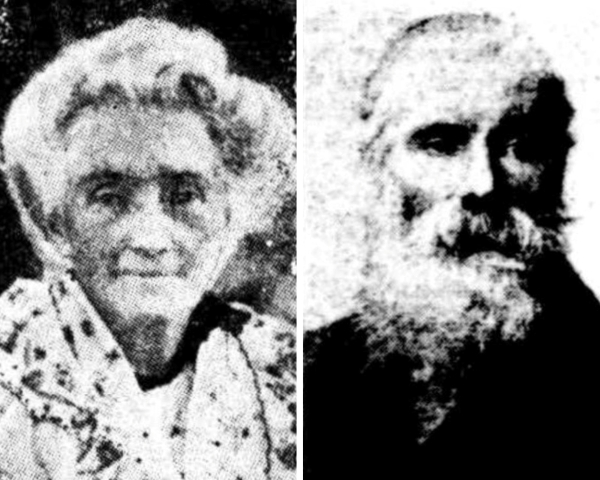
The year 1927 was a notable year for Elfrida. On 19 March her father died at his home on King William Road at the age of 85. He was buried at West Terrace Cemetery. On a much happier note, at some point during the year Elfrida married Thomas William Archer Breynard, a joiner from Millswood, Adelaide. Prior to her marriage she had resigned from the State Children’s Department.
Thomas was born on 4 February 1881 in Maitland on the Yorke Peninsula. In 1906 he travelled to the United States and at one time was working as a pattern maker in the steel mills of Homestead, Pennsylvania. He had returned to Australia by August 1912.
After their marriage Elfrida and Thomas lived in the suburb of Mornington, five kilometres southwest of central Adelaide and now part of the suburb of Plympton. Elfrida’s mother came to live with them sometime after John Lapidge’s death – from which, it was said, Mary Lapidge had never really recovered. On 12 March 1929 Mary died at Mornington. She was 84 years old.
By 1936 Elfrida and Thomas were living at 10 Thomas Street in Unley. Hilda Lapidge had come to live with them. On 4 June that year all three embarked on a round-the-world voyage. From Adelaide they sailed on the Narkunda to London, arriving on 10 July. After touring Britain (and possibly the Continent), on 2 October they departed for New York, sailing from Liverpool aboard the Carinthia. After visiting Thomas’s aunt in Pittsburgh, Pennsylvania, they departed New York on 22 October aboard the SS President Cleveland bound for San Pedro, Los Angeles. After four days in California they began their journey home on the SS Mariposa, sailing via the Panama Canal.
THE FINAL YEARS
By October 1947 Elfrida and Thomas were living on Main Road in Aldgate, near Mylor, and it would appear that Hilda was still living with them. They had a number of fields and grew several species of grasses and numerous fruit trees. In February 1948 a bushfire passed within 350 metres of their homestead.
From Aldgate the Breynards and Hilda returned to Adelaide, settling in the inner suburb of Eastwood, close to Unley.
Elfrida died in Eastwood on 14 August 1958. She was 76 years old. She was laid to rest in the grave of Thomas’s mother and sister at St. Mary’s Cemetery, Edwardstown, in the southern suburbs of Adelaide. Thomas died exactly one month later, on 14 September 1958, and was interred in the family plot with Elfrida.
Hilda died on 10 March 1970. She was buried with her sister in the Breynard family grave.
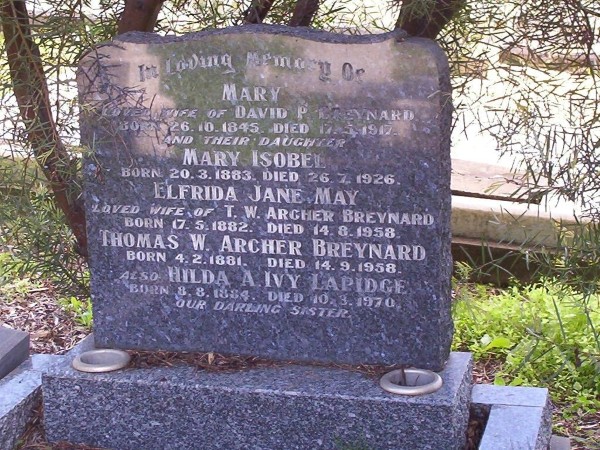
In memory of Elfrida and Hilda.
SOURCES
- Ancestry.
- Australian War Memorial, Australian Imperial Force, Nominal Roll, Nurses, 26/100/1.
- Australian War Memorial, Records of Arthur G. Butler, AANS nurses interviewed by Matron Kellett AWM41 1072, Miss M. M. Homewood.
- Australian War Memorial, Records of Arthur G. Butler, AANS nurses interviewed by Matron Kellett AWM41 1072, Miss S. A. Lord.
- British Journal of Nursing (Vol. 53, p. 320, 24 Oct 1914).
- Butler, A. G. (1943), Official History of the Australian Army Medical Services, 1914–1918, Vol. III – Special Problems and Services, Section III – The Technical Specialties, Ch. XI – The Australian Army Nursing Service (pp. 527–89), Australian War Memorial.
- Genealogy SA.
- Find a Grave, St. Marys Anglican Church Cemetery Memorials.
- McDougall & Vines (Conservation and Heritage Consultants), ‘Unley Heritage Research Study for the City of Unley Vol. 1 2006.”
- Mylor History Group, ‘Two Walks in and around Mylor’ (Nov 2015).
- The National Archives (UK), Lines of Communication Troops, 7 General Hospital (Jan 1917–Dec 1919), WO 95/4078/3.
- National Archives of Australia.
- Payne, G. B. & Cosh, E., History of Unley 1871–1971, The Corporation of the City of Unley.
SOURCES: NEWSPAPERS
- Adelaide Observer (15 Jul 1854, p. 6), ‘Advertising.’
- Adelaide Observer (9 May 1891, p. 29), ‘Government Gazette.’
- Adelaide Observer (SA, 10 Nov 1894, p. 41), ‘General News.’
- Adelaide Observer (SA, 19 Mar 1898, p. 31), ‘Education – Appointments.’
- Adelaide Observer (16 Jan 1904, p. 1), ‘Drowning Accident.’
- The Advertiser (Adelaide, 17 Apr 1890, p. 6), ‘General Elections.’
- The Advertiser (Adelaide, 18 Sept 1891, p. 3), ‘Advertising.’
- The Advertiser (Adelaide, 24 Nov 1892, p. 6), ‘The Municipal Elections.’
- The Advertiser (Adelaide, 6 Dec 1893, p. 4), ‘General News.’
- The Advertiser (Adelaide, 28 Dec 1893, p. 6), ‘Mylor School. To The Editor.’
- The Advertiser (Adelaide, 28 Dec 1893, p. 6), ‘Mylor School.’
- The Advertiser (Adelaide, 9 May 1903, p. 9), ‘St John Ambulance Association.’
- The Advertiser (Adelaide, 12 Dec 1908, p. 14), ‘School of Mines and Industries.’
- The Advertiser (Adelaide, 9 Oct 1911, p. 9), ‘Manufacturers’ Week.’
- The Advertiser (Adelaide, 19 Sept 1917, p. 7), ‘The Roll of Honor.’
- The Advertiser (Adelaide, 11 Oct 1919, p. 9), ‘Personal.’
- The Argus (Melbourne, 3 Jul 1871, p. 2), ‘Advertising.’
- The Chronicle (Adelaide, 16 Mar 1929, p. 58), ‘Miss Lapidge.’
- Daily Commercial News and Shipping List (Sydney, 27 Dec 1916, p. 8), ‘Vessels in Port at Sydney.’
- Daily Herald (Adelaide, 25 Sept 1917, p. 6), ‘Welcome at Mylor.’
- Evening Journal (Adelaide, 3 Mar 1871, p. 4), ‘Advertising.’
- Evening Journal (Adelaide, 19 Jun 1877, p. 2), ‘Law and Criminal Courts.’
- Evening Journal (Adelaide, 27 Oct 1882, p. 3), ‘St. Augustine’s Sunday-School.’
- Evening Journal (Adelaide, 26 Feb 1894, p. 4), ‘Fire at Hyde Park.’
- Evening Journal (Adelaide, 8 May 1894, p. 3), ‘Municipal Corporations.’
- Evening Journal (Adelaide, 22 Mar 1897, p. 2), ‘The Education Department.’
- Evening Journal (Adelaide, 4 Dec 1900, p. 2), ‘St. John Ambulance Association.’
- The Express and Telegraph (Adelaide, 22 Oct 1867, p. 2), ‘Family Notices.’
- The Express and Telegraph (Adelaide, 28 Sept 1875, p. 1), ‘Advertising.’
- The Express and Telegraph (Adelaide, 31 Mar 1876, p. 3), ‘Arrival of the Golden Sea with Immigrants.’
- The Express and Telegraph (Adelaide, 5 Jan 1881, p. 3), ‘Unley Corporation.’
- The Express and Telegraph (Adelaide, 28 Jan 1889, p. 2), ‘Discovery of Deposits of Natural Dry Colors.’
- Kapunda Herald and Northern Intelligencer (SA, 10 Mar 1871, p. 2), ‘Advertising.’
- Kapunda Herald (SA, 25 Apr 1890, p. 3), ‘The General Elections.’
- The Mount Barker Courier and Onkaparinga and Gumeracha Advertiser (SA, 11 Mar 1892, p. 4), ‘Stirling, March 2.’
- The Mount Barker Courier and Onkaparinga and Gumeracha Advertiser (SA, 28 May 1897, p. 2), ‘General News.’
- The Mount Barker Courier and Onkaparinga and Gumeracha Advertiser (SA, 28 Jul 1899, p. 3), ‘The Southern Districts.’
- The News (Adelaide, 25 Aug 1939, p. 6), ‘Nurses’ Cheery Dinner–Old Times Lived Over Again.’
- The News (Adelaide, 12 Feb 1948, p. 1), ‘1 Dead, 2 Injured as Fire Rages.’
- Observer (Adelaide, 7 Nov 1908, p. 50), ‘Adelaide Children’s Hospital. Annual Meeting of Subscribers.’
- Observer (Adelaide, 15 Sept 1917, p. 38), ‘Arrival of a Transport.’
- The Register (Adelaide, 29 Jun 1905, p. 3), ‘The Law Courts.’
- The Register (Adelaide, 31 Aug 1912, p. 20), ‘Advertising.’
- The Register (Adelaide, 9 Dec 1918, p. 8), ‘How an Australian Nurse Was Buried in India.’
- The Register (Adelaide, 18 Mar 1927, p. 11), ‘Obituary.’
- Saturday Mail (Adelaide, 23 Dec 1916, p. 2), ‘Hats off to the Army Nurses!’
- The South Australian Advertiser (Adelaide, 8 Feb 1876, p. 6), ‘Adelaide Corporation.’
- The South Australian Advertiser (Adelaide, 7 Jan 1887, p. 6), ‘Chamber of Manufactures.’
- The South Australian Advertiser (Adelaide, 26 Nov 1888, p. 7), ‘Unley.’
- The South Australian Advertiser (Adelaide, 3 Dec 1888, p. 6), ‘Unley.’
- South Australian Chronicle (Adelaide, 7 Mar 1891, p. 22), ‘Land Board Allotments.’
- South Australian Chronicle (Adelaide, 17 Dec 1892, p. 4), ‘Advertising.’
- South Australian Register (Adelaide, 19 Apr 1865, p. 4), ‘Immigrants per Clara.’
- South Australian Register (Adelaide, 1 Jun 1870, p. 8), ‘Advertising.’
- South Australian Register (Adelaide, 1 Oct 1887, p. 6), ‘Industrial Exhibition.’
- South Australian Register (Adelaide, 4 Oct 1887, p. 6), ‘Awards.’
- South Australian Register (Adelaide, 29 Sept 1888, p. 7), ‘Paint Mines.’
- South Australian Register (Adelaide, 16 Nov 1889, p. 5), ‘The Railway Traffic.’
- South Australian Register (Adelaide, 12 Jun 1891, p. 5), ‘Government Land Sales.’
- South Australian Register (Adelaide, 15 Apr 1882, p. 7), ‘Advertising.’
- South Australian Register (Adelaide, 22 Oct 1892, p. 7), ‘Land Board Allotments.’
- South Australian Register (Adelaide, 3 Nov 1894, p. 7), ‘The Public Schools’ Floral and Industrial Society.’
- South Australian Register (Adelaide, 5 Nov 1898, p. 9), ‘Public Schools’ Show.’
- The South Eastern Times (Millicent, SA, 25 May 1920, p. 3), ‘Neglected Children.’
- The Telegraph, St Kilda, Prahran and South Yarra Guardian (Vic., 22 Apr 1871, p. 3), ‘Municipal.’

