| Conflict | Second World War |
| Nursing Service | Australian Army Nursing Service |
| Units | 102nd, 2/5th & 113th Australian General Hospitals |
| Overseas Service | New Guinea |
| Final Service No. | NX112316 |
| Final Rank | Lieutenant |
Family Background
Clarice Jean Smithenbecker, known as Jean, was born on 3 September 1917 in Albury, a large town in the Riverina region of New South Wales. She was the second child of Clarice May Hancock (1888–1965) and John Peter Smithenbecker (1884–1935).
Clarice Hancock was born in Burrowa (now known as Boorowa), 290 kilometres northeast of Albury, to Elizabeth Weekes (from Campbelltown, southwest of Sydney) and Allen Hancock (from the United States), who was at one time mayor of Burrowa. Clarice had eight siblings – one of whom was her twin sister, Alma – and at least seven half-siblings from her father’s first marriage, to Olive Gaze.
John Smithenbecker, known as Jack, was born in Newtown (Thurgoona) on the northeastern outskirts of Albury. His parents were John Smithenbecker, born in Campbelltown, and Barbara Deidrich, born in Albury. All four of Jack’s grandparents had migrated from Germany.
In 1907 Jack acquired farmland at Bowna, 30 kilometres northeast of Thurgoona, where his father was proprietor of the Ivy Hotel. By 1909 he held some 330 acres in the wider district, on which he raised cattle and sheep. In April 1911 Jack was appointed a Justice of the Peace and in July that year was appointed inspector in the southern districts of New South Wales for the Guardian Fire Assurance Company of Sydney. In this capacity he gained a wide knowledge of pastoral and agricultural affairs in the Riverina.
By April 1913 Jack was residing at Mullengandra, near Bowna. In August that year he was appointed chief inspector for New South Wales for the Federal Mutual Insurance Company of Australia. In January 1914 Jack stood successfully for C Riding in the Hume Shire Council elections.
By then it would seem that Clarice Hancock was living in the town of Lockhart, 100 kilometres north of Albury, where she sang in the choir of St. Aidan’s Church of England.
Both Clarice and Jack were present at the wedding of Sarah Westman of Lockhart and William Howard of Cootamundra, which was held on 10 June 1914 at the Lockhart Methodist Church. Whether they already knew each other is unknown. Regardless, on 4 November 1914 they were married at Clarice’s parents’ Burrowa residence, ‘Cedarville.’ Alma Hancock was bridesmaid, and Clarice’s brother Garfield Hancock was best man. Jack gave Clarice a motor car, and Clarice gave Jack a gentleman’s dressing case. They honeymooned in the Blue Mountains and then settled in Thurgoona. In 1916 their first child, Allen John, was born.
While Clarice was busy with baby Allen, Jack’s civic and business careers were flourishing. In February 1917 his fellow councillors elected him president of the Hume Shire Council and in August that year he was appointed Albury manager and auctioneer for the Victorian Producers’ Co-operative Co. Ltd. Shortly afterwards Jean was born.
The Smithenbeckers’ third child, Geoffrey Clive, was born in 1921. In that same red-letter year Jack was elected major of Albury and established Smithenbecker, Nagle & Co., stock agents and auctioneers, with John Flood Nagle (a recipient of the Distinguished Conduct Medal in the Great War).
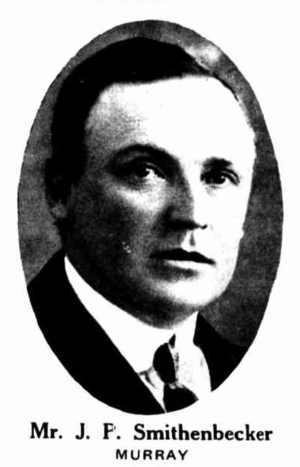
Clarice’s and Jack’s fourth child, Audrey Noelle, was born in 1924. The family was now complete.
All the while, Jack’s property holdings had been growing, and by June 1929 the family was living at ‘Eversleigh,’ a 1066-acre freehold property situated on the Murray River, eight kilometres from Howlong and 18 kilometres from Corowa.
On 3 April 1935, at the age of only 50, Jack Smithenbecker died at Albury. He had been in uncertain health for some years and was hospitalised for two weeks before his death. Over the next few years Clarice, in conjunction with two other executors, auctioned off her husband’s many properties. Eversleigh was auctioned on 16 September 1938 and in October 1939 more than 40 properties in Albury were put up for sale. By this time Clarice and the children had moved to Albury.
NURSING
Five months after her father’s death, and just on her 18th birthday, Jean began training as a probationer nurse at the Corowa Hospital. Starting at the same time as Jean was a nurse by the name of Dorothy Gwendoline Elmes, who was known to her friends as Buddy. Buddy was born in Armadale in Melbourne and as a child moved around Victoria with her family, finally settling in Cheshunt in the King Valley in the state’s northeast. Even though Buddy was three years older than Jean – or Smithy, as Buddy called her – the two became close friends.
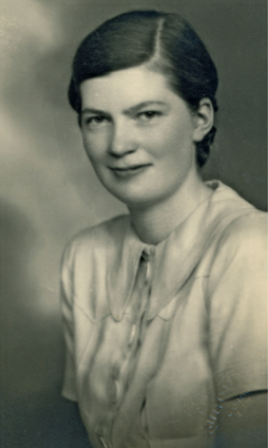
In their first year Jean and Buddy passed their Anatomy and Physiology examination with honours. In their second year they passed their Hygiene examination. In May 1939 they passed their final examination, and on 14 December that year both became registered in general nursing with the New South Wales Nurses’ Registration Board.
By then Australia was at war.
THE AUSTRALIAN ARMY NURSING SERVICE
It is my melancholy duty to inform you officially that in consequence of a persistence by Germany in her invasion of Poland, Great Britain has declared war upon her and that, as a result, Australia is also at war.
So stated Prime Minister Robert Menzies on the evening of 3 September 1939 in a message broadcast to the nation. Soon, thousands of Australian women and men had volunteered to serve.
Hundreds of nurses were among the volunteers. Even before the declaration of war, articles had appeared in Sydney newspapers advising nurses desiring to enlist in the Australian Army Nursing Service (AANS) that application forms were obtainable from Victoria Barracks in Paddington and the Australasian Trained Nurses’ Association (ATNA) on Elizabeth Street. Applicants had to be fully trained and registered, aged between 22 and 40, and single. By 6 September, 400 nurses had applied in New South Wales alone – so many, in fact, that enlistments had to be closed.
On the night of 15 September Prime Minister Menzies announced that a force of one division and auxiliary units would be created – 20,000 personnel in all – for service either at home or abroad as circumstances required. The force was named the 2nd Australian Imperial Force (AIF) to continue the legacy of the original AIF, while the division became the 6th Division – again, continuing the legacy of the five Australian divisions of the Great War (the 6th Division was raised but did not see combat).
In late September nurses across the country began to enlist in the 2nd AIF. By 16 December, two weeks after the announcement that the force would go abroad, 650 had been accepted. Enlisted nurses had to be members of the AANS, aged between 25 and 40, medically fit, and of good character. Those with training in x-ray, blood transfusion, ophthalmic surgery, general surgery, laboratory work and plastic work were favoured over those with general nursing only.
Of the 650 enlisted, 138 were chosen to travel with the 6th Division, 2nd AIF to the Middle East. The first contingent departed from Melbourne on the Empress of Japan on 11 January 1940.
ENLISTMENT
On 17 December 1940, after five years together at Corowa, Jean and Buddy were separated when Buddy enlisted in the 2nd AIF. She was taken on strength of the AANS and posted to the camp hospital at the Royal Agricultural Society Showground in Sydney. Six weeks later, on 4 February 1941, Buddy embarked for Malaya with the 2/10th Australian General Hospital (AGH), a medical unit of the 8th Division, 2nd AIF.
Buddy and Jean immediately began to correspond by mail. As the letters of military personnel were subject to censorship, Buddy was constrained in what she could say but still managed to write once a week. She told Jean about the weather, the hospital, Malacca, the landscape, what she had eaten, her attempts to learn Malay, etc. Jean replied almost as often. She told Buddy about goings on at Corowa Hospital, her family, their mutual friends – and about her fiancé, Corporal Harold Morris Carrigg. Morris (as he was known) was from Corowa and had joined the Citizen Military Forces in April 1940. He and Jean had been engaged since December 1940.
Jean also told Buddy about her wish to join the AANS and serve overseas. Even though she was still only 23 years old, around April 1941 she wrote to Matron Elizabeth Kearey, the principal matron of the AANS in New South Wales, seemingly to request an interview. It would appear that Morris was not happy with Jean’s plans. “Sorry Morris doesn’t approve of your army career,” wrote Buddy on 27 May, “so won’t offer any advice one way or the other.” In the event, Matron Keary declined to interview Jean, and for the time being she was stuck at Corowa.
Jean was disconsolate at the news. “Sorry about the general depression,” wrote Buddy in her letter of 21 June, “but … why not try for home defence you might land up as far as Darwin which would be a change.”
Jean remained despondent into September but by the end of that month had made up her mind to approach Matron Kearey again. On 26 October Buddy asked her how she had got on with her interview. “Don’t suppose they will mind if you are only 24 as they seem to take them younger now,” she wrote. “Gosh wouldn’t it be a thrill if you got over here as a reinforcement.”
Jean had got on very well indeed and on 12 November was appointed to the AANS as a staff nurse. Buddy was thrilled. “Gosh I am glad that you have been accepted,” she wrote on 26 November. “Glad it doesn’t matter about the age.” Not everyone was thrilled. “Sorry Morris doesn’t approve,” wrote Buddy in the same letter.
I can understand his point of view but still don’t see why you can’t go away as it’s a chance of a lifetime, anyway you may do a spot of home service for a bit most of the girls seem to do several months camp life now.
As things turned out, Jean did do “a spot of home service” before being posted overseas. After enlisting in the Australian Military Forces on 19 December, she was attached to the dressing station at Narellan Army Camp on the southwestern fringes of Sydney and arrived there on 20 December.
By then Japan had invaded Malaya. “Suppose by now you have read the papers,” wrote Buddy on 10 December. “We are well in the fun now.” Over the course of the next seven weeks the Japanese 25th Army advanced from northern Malaya to Johor Strait, forcing Australian, British and Indian combat and ancillary units to fall back to Singapore Island. By early February 1942 Japanese forces had reached the northern shore of the strait. They were briefly halted by a stretch of water no wider than a kilometre.
BUDDY’S LAST LETTER
On the evening of 8 February 1942, Buddy wrote to Jean from either Oldham Hall or Manor House, the 2/10th AGH’s main hospital buildings on Singapore Island. It was her last letter. That day, from their positions opposite the island, Japanese forces had concentrated heavy artillery fire on Singapore’s northwestern defence sector, severely disrupting the field communications of the Australian troops defending the area. That night, Japanese assault troops began to land on the island. Singapore was doomed.
NX70526 S/N G. Elmes
10th A.G.H
A.I.F
Abroad
8.2.42
Dear Old Smithy,
No news and no letters haven’t had any from home for a month & from you for a fortnight. Sorry if these are so uninteresting but there is a lot of news but can’t tell you at the moment; anyway the papers seem to put most of it in print. At the moment am on night duty first night on. We do a fortnight on day duty & fortnight on night only catch don’t get any days off. Worked till 2 pm & went on again at seven; but managed to get about an hour & halfs sleep this afternoon, anyway hope for a snooze later as two of us do theatre & we aren’t admitting tonight so things should be pretty peaceful as far as that is concerned. At the moment we are sitting round the theatre both writing [with] two hurricane lanterns wrapped round [with] blue paper as its supposed to be a black out. The orderlies have scrounged us a pretty good supper from the Q.M. store so it looks as though we are going to have good food on night duty. Hope you can read this on this dark paper but it shows too much on the other side.
Have you heard anything of Skeet [Staff Nurse Lorna Whyte, who had trained with Jean and Buddy at Corowa] or is she still in New Guinea
No news
Cheerio
Bud
Just days after writing the letter, Buddy and 64 of her AANS colleagues were evacuated from Singapore aboard the Vyner Brooke. The ship was sunk by Japanese aircraft on 14 February and two days later Buddy and 20 other nurses were executed by Japanese soldiers on Bangka Island in the Netherlands East Indies.
Buddy’s letter, addressed to “S/N. J. Smithenbecker, AANS, Narellan Camp, New South Wales,” arrived at Narellan on 6 March, but Jean was no longer there. On 4 February she had been attached to the 113th AGH at Concord in Sydney and on 22 February to the 102nd AGH at Tamworth in northern New South Wales, where the letter eventually reached her.
Jean did not learn definitively of Buddy’s fate until September 1945, when the 24 AANS survivors from the Vyner Brooke were rescued from captivity on Sumatra.
NEW GUINEA
On 4 September 1942, having turned 25 the previous day, Jean enlisted in the 2nd AIF. She was allocated service number NX112316 and appointed to the rank of sister group 2 – and although she might now be posted overseas, for the time being she remained at Tamworth. On 19 December, a year after commencing full-time duty, she was appointed to the rank of sister group 1.
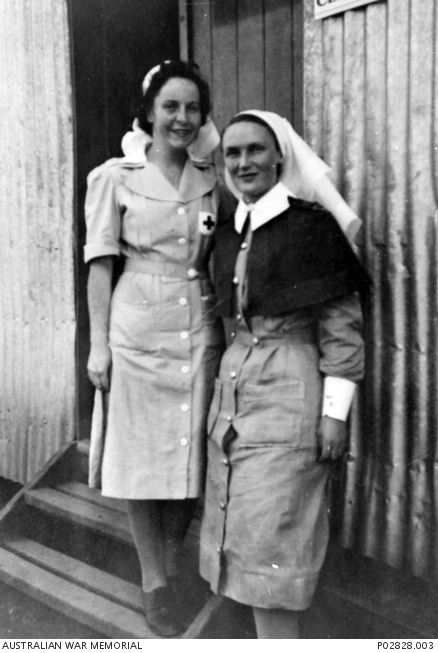
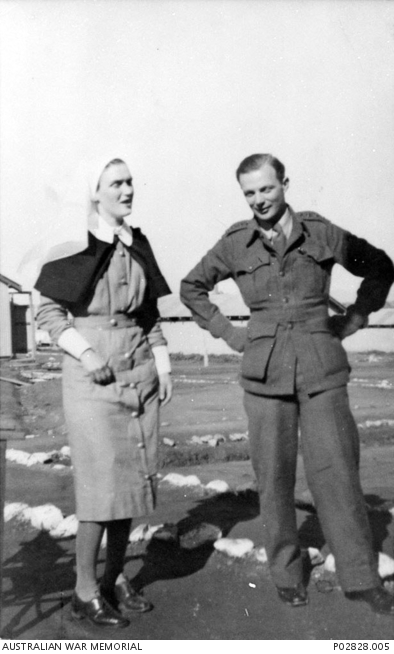
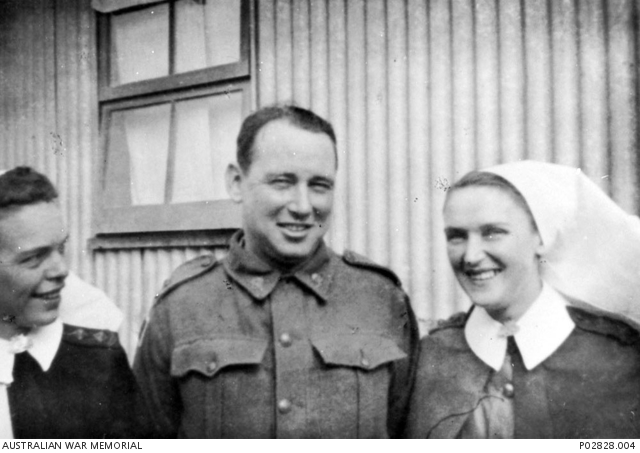
Among the patients at the 102nd AGH were Australian troops who had fought against the Japanese in New Guinea.
Japanese troops had been on the islands around New Guinea since January 1942, when an invasion force landed at Rabaul on New Britain. In March 1942 Japanese forces gained their first foothold on the New Guinea mainland, landing at Lae, the new capital of the Territory of New Guinea, and at Salamaua, 35 kilometres to the south.
In May a Japanese naval force attempted to land at Port Moresby, the capital of the Territory of Papua, located on the south coast of the long Papuan Peninsula. After the landing force was repulsed by combined American and Australian operations in the Coral Sea, Japanese authorities began to plan an overland assault on Port Moresby via a rough trail that ran over the Owen Stanley Range from the village of Kokoda. The Kokoda Trail campaign began in July when Tomitarō Horii’s South Seas Detachment landed on the north coast of the Papuan Peninsula and established beachheads at Gona, Buna and Sanananda. After heading inland, the Japanese took Kokoda despite stiff Australian resistance and marched southwards along the trail. By late September they had advanced to within 40 kilometres of Port Moresby but were withdrawn when Japanese forces on Guadalcanal came under intense Allied pressure.
Australian troops now took the offensive and followed the Japanese troops northwards along the trail. They recaptured Kokoda and its airstrip in early November and by the end of that month were attacking Gona. In December the Australians joined an American assault on Buna and in January 1943 the Allies recaptured Sanananda.
The Allied victory in the ‘Battle of the Beachheads’ ended Japan’s campaign in the Territory of Papua. However, it had come at an enormous cost, with between 6,000 and 8,000 Australians and Americans killed and wounded.
Between April and August 1943 the Allies moved steadily towards Salamaua and Lae, which fell to them on 11 and 16 September respectively. The campaign claimed around 500 Australian lives and left another 1,500 wounded.
2/5TH AUSTRALIAN GENERAL HOSPITAL
Eight days after the recapture of Lae, Jean departed the 102nd AGH for Sydney. After 19 months at Tamworth, she had been allotted to the 2/5th AGH as a reinforcement and was shortly to embark for New Guinea. Here finally was her opportunity to serve overseas.
The 2/5th AGH had been raised in May 1940 at Greta army camp in New South Wales and had served in Egypt, Palestine, Greece, Crete and Eritrea before returning to Australia in March 1942. In January 1943 the unit was posted to New Guinea and established its hospital at Bootless Bay on the eastern outskirts of Port Moresby. It had arrived at a time when the other Australian medical units based in the Port Moresby area – the 46th Camp Hospital at King’s Hollow, 30 kilometres up the Laloki River from Port Moresby; the 2/9th AGH and the 5th Casualty Clearing Station (CCS) at Seventeen Mile, 26 kilometres (17 miles) up the Laloki (where Rocky Hill Park is located today); and the 2/2nd CCS at Koitaki plantation, near the southern end of the Kokoda Trail – were bursting at the seams with surgical and medical patients.
In Sydney Jean assembled with other AANS nurses allotted to the 2/5th AGH as reinforcements. Among them were Lieutenant Margaret Leys, who had served with Jean at the 102nd AGH and had travelled with her to Sydney; Lieutenants Vera Cooke, Margaret Rohan and Merlie Smith, who had served with the 113th AGH at Concord; and Lieutenant Vera Coonan, who had served with the 103rd AGH at Baulkham Hills.
In due course the contingent of reinforcement nurses travelled to Townsville in northern Queensland and on 10 October embarked on the SS Canberra for New Guinea. The Canberra arrived at Port Moresby on 14 October, and Jean and her new colleagues were marched in to the 2/5th AGH.
Shortly after the reinforcements’ arrival at Bootless Bay, Merlie Smith wrote to her mother and sister. Excerpts of her letter were printed in the Singleton Argus on 27 October, as follows:
We are now becoming established slowly in our new abode. Really, we do not have time to think of being a long way from home – everything is so new; and you would be surprised at the events that keep us so occupied. The original matron of this unit is still here; also our chief has been to see us. Two sweeter women one could not meet. They are most understanding and encouraging in enjoyment and hectic working hours. It’s a wonderful thrill to be able to help the lads. You don’t know just how proud we are of them.
The views around are marvellous. The hills are beautifully shaded, and there is a stretch of water in the distance, which lends itself to every humour of the weather. Don’t say Singleton is hot, because I know different. Guess we will all wilt as time marches on. We were surprised to see what the climate has done to the girls here. However, they do not want to go back, as they just love the life, which makes one feel at least we are doing a little.
The night of our arrival my girl friend was very mosquito conscious, and was sure she would be seized with the malaria before long. This called for some talk, and after convincing her such a thing would not be possible under our conditions she finally decided there was some logic in my words. However, she crept into bed weary and tired, and after a brief pause said, ‘Oh, there’s something crawling on me.’ As we had previously witnessed many species of creeping and crawling life, I thought possibly she was correct. However, I continued to lecture, but this time she persisted.
Upon examination of the bed we found millions of little black ants. They were everywhere, including her hair. One other bed was swamped with them in our tent, and this girl was much later getting into bed.
One hears quick rustling movements in the grass at times, and it might be anything from a beetle to a frilled lizard. We have adopted an attitude of live and let live in all things that crawl.
The Australian Comforts Fund has been good to us. Fruit drinks are plentiful here, and cordials are also supplied at the mess. Cosmetics are of no use, so we have put those aside for the duration.
On one part of our trip the Americans looked after us. We were longing for supper, and asked the orderly would it be possible. He said it was, and came back with a box of biscuits and black tea. After consuming the biscuits we they had been sent to him by his mother. We felt dreadful and made up for it in a gift to him, which he received with embarrassment. The biscuits were made of cereal with lumps of chocolate (about a quarter inch in size), and I don’t know what bound them together. Guess it was something that would not take too much cooking. We thought they were delicious.
Life is full of interest these days. The spirit among the girls is marvellous, and we all feel there is a job here.
CHRISTMAS 1943
There was indeed a job to do. Following the capture of Salamaua and Lae, Australian attention had turned to the Huon Peninsula immediately north of Lae. Finschhafen was taken on 24 October 1943, and after heavy fighting the high ground around Sattelberg was secured in late November. Meanwhile, Australian troops were advancing along the Markham and Ramu Valleys towards the Finisterre Range. The campaign was a tough one, and many wounded men were admitted to the 2/5th AGH. Many more were admitted with malaria. There were also numerous cases of dysentery and diarrhoea, skin infections, ulcers, and a dangerous disease transmitted through the bites of chiggers (larval mites) known as scrub typhus. By Christmas Day 1943 more than 2,000 patients were crammed into the hospital.
Some of the walking patients had decorated the wards for the occasion and, despite the circumstances, had done very well – as Lieutenant Margaret Lewis noted in a letter to the Sunshine Advocate printed in January 1944. “Though materials were limited,” she wrote, “their ingenuity was not, and they made a very effective job of it. We had Christmas trees and lots of presents and fun, and all enjoyed it immensely.”
There was another reason for the patients of the 2/5th AGH to be happy that Christmas, even if they did not know it: penicillin had just come into use. Since the 1930s sulfanilamides had been used to treat infection, but their effectiveness was limited, and by May 1943 penicillin was being tested by the US Army. In mid-year the Australian War Cabinet sent a team to investigate, and within a few months the wonder drug was being produced at the Commonwealth Serum Laboratories in Melbourne. It was then adopted by the Australian army and sent to New Guinea in December, where it was initially administered via a drip.
HOME
Towards the end of April 1944 the town of Madang was captured by the Allies. The Huon Peninsula was thereby secured and for now Australia’s offensive role was over. The focus of Australian medical care was shifting to Lae, and the hospitals based around Port Moresby were being sent back to Australia. The 2/9th AGH at Seventeen Mile had embarked in March, the 2/1st AGH (based at Bootless Bay since September 1943) would begin to return in June, and on 4 May staff of the 2/5th AGH, including many of the nurses, embarked for Townsville on the Taroona.
However, other 2/5th AGH nurses, including Jean, were staying – at least for the moment. On 27 April Jean was among a contingent detached to the 128th AGH, which until May 1943 had been known as the 46th Camp Hospital (which in turn had begun as the hospital at Murray Barracks in Port Moresby). Whether or not it was still based at King’s Hollow is unknown.
After spending two months with the 128th AGH, on 24 June Jean embarked from Port Moresby on the Ormiston with staff of the 2/1st AGH. She was returning to Australia to get married.
On 6 February 1944 a certain Captain Raymond Neal had been evacuated to the 2/5th AGH with a fever of unknown origin. He was diagnosed with dengue and remained in hospital until 14 February, when he was discharged to his unit. On 19 February he was readmitted to the 2/5th AGH with malaria and was not discharged again until 7 March. He arrived back at his unit on 9 March. While in hospital he had encountered Jean, and they had evidently hit it off.
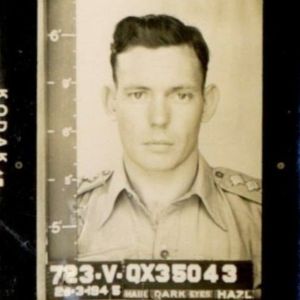
Raymond was from Maryborough in Queensland. He enlisted in the Citizen Military Forces (CMF) on 30 May 1940 at the age of 18 and was attached to the 122nd Heavy Battery Royal Australian Artillery (RAA). He was promoted to the rank of lieutenant in June 1941 while serving in Brisbane. In December 1941 Raymond embarked for New Guinea with the CMF and on 16 June 1942, while serving with the Paga Battery, RAA at Port Moresby, transferred to the 2nd AIF. On 26 July 1943 he was appointed to the rank of captain.
Jean arrived in Townsville on 27 June, four days after Raymond had flown in from Port Moresby.
MARRIAGE
On 8 July 1944 Jean and Raymond were married at St. Basil’s Church of England in Artarmon, Sydney. Jean, wearing her AANS uniform, entered the church with her maternal uncle George W. Hancock, of ‘Belong,’ Artarmon. She was attended by her sister, Audrey, who was frocked in royal blue crepe with trimmings of gold. Raymond, also in uniform, was attended by Mr. W. Hancock, another of Jean’s maternal uncles (possibly Will). As the couple left the church, a guard of honour was formed by AANS colleagues from New Guinea and Tamworth.
After their wedding, Jean and Raymond each returned to service. On 8 August Raymond rejoined his unit, ‘R’ Australian Heavy Battery, at Lytton, Brisbane, while on 14 August Jean was attached to the 113th AGH at Concord (where she had briefly served in February 1942).
Jean remained at Concord for nine months – surprising perhaps, given that many AANS nurses retired immediately after marriage. Nevertheless, on 17 May 1945 she was placed on the Regimental Supernumerary List (Officers) and on 12 June transferred to the Reserve of Officers (AANS). Finally, on 25 September 1946 Jean’s name was added to the Retired List.
Raymond remained in the army until his discharge on 17 August 1945. He later returned to his trade as a mechanic.
By 29 September 1945 Jean and Raymond had moved to 55 The Parapet in Castlecrag on Sydney’s Lower North Shore. They remained in Castlecrag for the next 65 years, moving to The Bulwark and then to Tower Reserve.
FINAL YEARS
In May 1994 Jean wrote a letter to the Australian Army requesting Buddy Elmes’s Record of Service. She had been asked by the Corowa Historical Society to write a resume of Buddy’s career. In the same letter Jean mentioned that she had sent all of Buddy’s letters to the Australian War Memorial.
After a long and interesting life, Jean died on 29 March 2010 at Castlecrag. Raymond died 18 months later, on 29 November 2011, at Castlecrag Private Hospital.
We will not forget them.
SOURCES
- 2/33rd Australian Infantry Battalion AIF Association, ‘Liberator Crash Remembered.’
- Ancestry.
- Australian War Memorial, Wallet 1 of 1 – Letters from Sister Dorothy Gwendoline Howard Elmes, 1941–1942, AWM2020.22.162.
- Banks, G. (2023), Back to Bangka: Searching for the truth about a wartime massacre, Penguin Random House Australia (Kindle Edition).
- BirtwistleWiki, ‘128th Australian General Hospital.’
- Critch, M. (1981), Our Kind of War: The History of the VAD/AAMWS, Artlook Books Trust.
- Crouch, J. (1986), A Special Kind of service: The Story of the 2/9 Australian General Hospital 1940–46, Alternative Publishing Co-operative Ltd.
- Department of Veterans’ Affairs, Anzac Portal, ‘Australians at the Battle of the Beachheads 1942 to 1943.’
- Department of Veterans’ Affairs, Anzac Portal, ‘Australians in the Kokoda Track Campaign 21 July to 16 November 1942.’
- Goodman, R. (1988), Our War Nurses: The History of the Royal Australian Army Nursing Corps 1902–1988, Boolarong Publications.
- Goodman, R. (1985), Queensland Nurses Boer War to Vietnam, Boolarong Press.
- Long, G. M. (1961), Australia in the War of 1939–1945, Series 1 – Army, Vol. I – To Benghazi, Chap. 2 – A Second AIF (pp. 33–53), Australian War Memorial.
- Menzies Virtual Museum, ‘1939 Declaration of War.’
- National Archives of Australia.
- Naval Historical Society of Australia, ‘Occasional Paper 40: Secret History of the First Australian to be Given Penicillin.’
- Walker, A. S. (1961), Australia in the War of 1939–1945, Series 5 – Medical, Vol. IV – Medical Services of the Royal Australian Navy and Royal Australian Air Force with a section on women in the Army Medical Services, Part III – Women in the Army Medical Services, Chap. 36 – The Australian Army Nursing Service (pp. 428–76), Australian War Memorial.
- Wikipedia, ‘Huon Peninsula Campaign.’
- Wikipedia, ‘Markham, Ramu and Finisterre Campaigns.’
SOURCES: NEWSPAPERS AND GAZETTES
- The Albury Banner and Wodonga Express (NSW, 26 Oct 1906, p. 46), ‘Peculiar Small Debts Case.’
- The Albury Banner and Wodonga Express (NSW, Jul 1908, p. 28), ‘Local Option Court.’
- The Albury Banner and Wodonga Express (NSW, 25 Apr 1913, p. 23), ‘The Fire at Thurgoona.’
- The Albury Banner and Wodonga Express (NSW, 18 Dec 1914, p. 1), ‘Advertising.’
- The Albury Banner and Wodonga Express (NSW, 16 Feb 1917, p. 46), ‘Hume Shire Council.’
- The Albury Banner and Wodonga Express (NSW, 3 Aug 1917, p. 28), ‘New Auctioneering Firm.’
- The Albury Banner and Wodonga Express (NSW, 30 Nov 1917, p. 27), ‘Notes on Current Events.’
- The Australian Women’s Weekly (23 Sept 1939, p. 45), ‘What Women Are Doing.’
- The Border Morning Mail (Albury, NSW, Thu 4 Apr 1935, p. 2), ‘About People.’
- The Border Morning Mail (Albury, NSW, 28 Sept 1935, p. 2), ‘What People Are Doing.’
- The Border Morning Mail (Albury, NSW, 13 Aug 1938, p. 5), ‘Advertising.’
- The Border Morning Mail (Albury, NSW, 4 Apr 1939, p. 4), ‘Family Notices.’
- The Border Morning Mail (Albury, NSW, 23 Jun 1939, p. 6), ‘District Nurses Who Passed Their Examination.’
- The Border Morning Mail (Albury, NSW, 20 Oct 1939, p. 4), ‘Advertising.’
- The Border Morning Mail (Albury, NSW, 31 Oct 1939, p. 2), ‘Advertising.’
- The Border Morning Mail (Albury, NSW, 19 Feb 1942, p. 4), ‘What People Are Doing.’
- The Border Morning Mail (Albury, NSW, 4 Sept 1943, p. 4), ‘What People Are Doing.’
- The Border Morning Mail (Albury, NSW, 5 Aug 1944, p. 4), ‘Neal–Smithenbecker.’
- The Border Morning Mail and Riverina Times (Albury, NSW, 3 Dec 1907, p. 2), ‘Items of News.’
- The Border Morning Mail and Riverina Times (Albury, NSW, 3 Aug 1911, p. 3), ‘Advertising.’
- The Border Morning Mail and Riverina Times (Albury, NSW, 13 Aug 1913, p. 5), ‘Advertising.’
- The Burrowa News (NSW, 13 Nov 1914, p. 2), ‘Wedding.’
- The Burrowa News (NSW, 29 Oct 1937, p. 8), ‘Obituary.’
- The Corowa Free Press (NSW, 21 Aug 1936, p. 4), ‘Advertising.’
- The Corowa Free Press (NSW, 13 Aug 1937, p. 7), ‘Advertising.’
- The Corowa Free Press (NSW, 29 Sept 1939, p. 4), ‘Advertising.’
- The Daily Telegraph (Sydney, 23 Sept 1939, p. 2), ‘S.A. Contingent.’
- Dun’s Gazette for New South Wales (Vol. 26 No. 4 (8 Aug 1921).
- Government Gazette of the State of New South Wales (Sydney, 24 Nov 1919 [Issue No.262 (Supplement)], p. 6572, ‘Government Gazette Appointments and Employment.’
- The Herald (Melbourne, 7 Oct 1939, p. 3), ‘Sixth Division Will Be “Second A.I.F.”’
- The Herald (Melbourne, 16 Dec 1939, p. 3), ‘650 Nurses Volunteer for 2nd A.I.F.’
- The Land (Sydney, NSW, 3 Mar 1922, p. 4), ‘Mr. J. P. Smithenbecker.’
- The Lockhart Review and Oaklands Advertiser (NSW, 23 Oct 1912, p. 4), ‘Lockhart Choral Society.’
- The Lockhart Review and Oaklands Advertiser (NSW, 17 Jun 1914, p. 2), ‘Interesting Wedding in Lockhart.’
- The Mercury (Hobart, 23 Sept 1939, p. 2), ‘Tasmanian Activity Recruiting Of Other Ranks.’
- Rutherglen Sun and Chiltern Valley Advertiser (Vic., 10 Dec 1940, p. 2), ‘Personal.’
- Singleton Argus (NSW, 27 Oct 1943, p. 2), ‘Nursing Sister’s Experience: “Life Full of Interest These Days.”’
- Smith’s Weekly (Sydney, 25 Nov 1939, p. 12), ‘Nurses for Army Service.’
- The Sun (Sydney, 27 Aug 1939, p. 6), ‘Nurses’ Application for Enlistment.’
- The Sun (Sydney, 6 Sept 1939, p. 4), ‘Australia at War.’
- Sunday Times (Sydney, 1 Feb 1914, p. 9), ‘The Shires.’
- Sunshine Advocate (Vic., 21 Jan 1944, p. 4), ‘A.C.F. Parcels Received.’
- The Sydney Morning Herald (14 May 1855, p. 10), ‘Family Notices.’
- The Sydney Morning Herald (13 Sept 1939, p. 5), ‘Nurses Volunteer.’
- The Sydney Morning Herald (18 Dec 1939, p. 13), ‘Nurses with A.I.F.’
- The Sydney Morning Herald (23 Jan 1942, p. 7), ‘History of Rabaul Former German Port.’
- The Telegraph (Brisbane, 3 Oct 1939, p. 4), ‘Pruning of A.I.F. Volunteers to Make up Queensland Quota Is now in Progress.’
- The Telegraph (Brisbane, 5 Oct 1939, p. 13), ‘Queensland’s First War Nurse Recruits Offer Their Services.’

