| Conflict | Second World War |
| Nursing Service | Australian Army Nursing Service |
| Units | 2/10th Australian General Hospital |
| Overseas Service | Malaya |
| Final Service No. | NX70527 |
| Final Rank | Lieutenant |
Family Background
Kathleen Margaret Neuss, known as Kath, was born on 16 October 1911 at Mollongghip, a locality near Ballarat in Victoria. She was the second of six children born to Mary Catherine Robertson Perry (1880–1952) and John Henry Neuss (1882–1950).
Mary was born in Rocky Lead, a small mining and farming settlement in the Wombat Ranges between Creswick and Daylesford, around 25 kilometres northeast of Ballarat. She was the daughter of Samuel Perry, who had migrated from Gloucestershire in England and fought in the Eureka Stockade in 1854.
John was born in Happy Valley, a former gold mining town around 30 kilometres southwest of Ballarat. His father had migrated from Hessen in Germany.
In 1908 John was working as a storekeeper in Mollongghip. A year later he inherited some money following the sale of his late father’s property, and on 7 June 1909 he and Mary were married at Rocky Lead by the Rev. O. E. Snell. After the ceremony, a wedding breakfast was held in the hall, after which the happy couple left by the evening train, amid showers of rice and confetti, for Bendigo.
Mary and John settled in Mollongghip and in July 1910 their first child, Jessie Bennett Milne, was born. Kath followed the next year.
Early Life
In 1913, the Neuss family moved to northern New South Wales. With their possessions in tow, they travelled by boat to Sydney, then to Glen Innes by train, and finally by Cobb & Co coach to uncleared land around 25 kilometres northwest of Inverell and just to the west of Bannockburn.
John Neuss worked the land, planted wheat and built a house of three rooms with an iron roof and walls lined with hessian and papered with wallpaper. Water came from a 500-gallon tank at the side of the house and had to be carried inside by bucket. Kath’s parents called their new home ‘Kalimna’ after the coastal town in Gippsland, Victoria.
In 1914 John Samuel (Jack) was born. The following year the region suffered a severe drought, and Jess and Kath returned to Mollongghip to live with their grandparents. They returned to Kalimna around 18 months later and started going to Bannockburn Public School. John took Jess and Kath to school on his horse and each afternoon the girls would walk six kilometres home.
As time passed the family became well established in the district. Another three children were born, Marjorie Emily (Marge) (1917), William George (Will) (1919), and Robert Bruce Perry (Bob) (1924). They went to school with their elder siblings, sometimes on horseback, sometimes by sulky, driven by Jess.
In 1926 Kath completed her schooling at Bannockburn Public School and successfully sat the State Scholarship Examination, entitling her to attend any government high school in the state for two years. She chose Inverell High School and in 1927 and 1928 boarded with an Inverell family during the week and returned home each weekend, travelling by horse and sulky.
Nursing
After finishing school Kath wanted to be a schoolteacher but did not pass the teachers’ entrance examination. Instead, she followed her sister Jessie into nursing. Like Jessie, she trained at the Royal Prince Alfred Hospital in Camperdown, Sydney, where she manifested considerable capacity and interest in her profession. Her bright disposition and ever-willing desire to help earned her the esteem and gratitude of all the patients with whom she came into contact. She graduated in 1939 and worked for a time at Craignish Private Hospital.
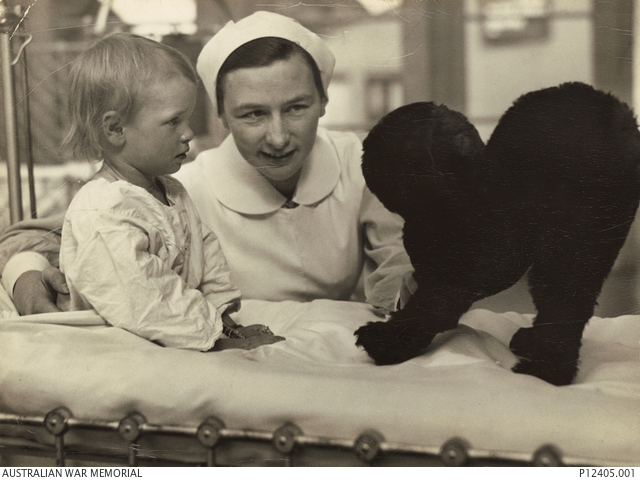
At Royal Prince Alfred Kath had become good friends with a nurse four years her junior, Philippa Sanders. In October 1940 Kath and Philippa were living in a flat in Darlinghurst, Sydney, when Kath’s younger brother William came to say goodbye to his sister. He had joined the Second Australian Imperial Force (2nd AIF) and was about to depart for the Middle East with the 9th Division. Kath was not home at the time, but Philippa was. She and William hit it off, and when he returned from the Middle East in late February 1943 they were married.
Enlistment
Meanwhile, Kath volunteered for service with the Australian Army Nursing Service (AANS). Her application was accepted and on 17 December 1940 she was appointed to the 2nd AIF at the rank of Staff Nurse, attached to the Emergency Unit and posted to the army hospital at Sydney Showgrounds. She was advised that she had been allotted to a unit and to prepare herself for an overseas posting – destination unknown – and was then sent on pre-embarkation leave.
On the evening of 20 January 1941 Kath was given a farewell party in the Oakwood Hall, near her parents’ home. It would be the final time that many of her friends and acquaintances would see her.
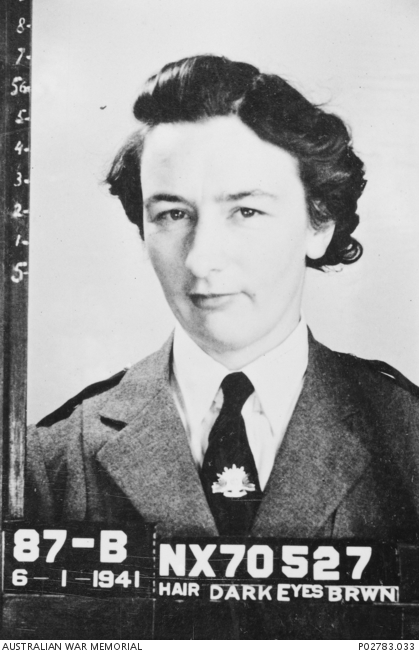
Kath returned from leave and on 31 January was attached to the 2/10th Australian General Hospital (AGH). The 2/10th AGH was being raised at Sydney Showgrounds and along with the 2/4th Casualty Clearing Station (CCS), the 2/9th Field Ambulance, and other, smaller medical units, would very soon accompany the 22nd Brigade of the 8th Division to Malaya.
Four days later Kath departed Sydney aboard the Queen Mary with her 2/10th AGH colleagues. She shared a double cabin with her good friend Pat Gunther. The ship’s destination was classified, but when it left its convoy in the vicinity of the Sunda Strait it became obvious that the 8th Division was headed for Malaya.
Malaya
Kath, Pat and their colleagues reached Singapore on 18 February 1941. They entrained for Malacca, located on the Malay Peninsula around 200 kilometres northwest of Singapore Island, where the 2/10th AGH was to be based. The unit treated mainly tropical-disease cases, and staff were busy without being overwhelmed. Kath and the other nurses enjoyed such recreational activities as swimming, golf and tennis, dinners and dances, and shopping. Kath enjoyed periods of leave on Singapore Island and at the colonial hill station of Fraser’s Hill.
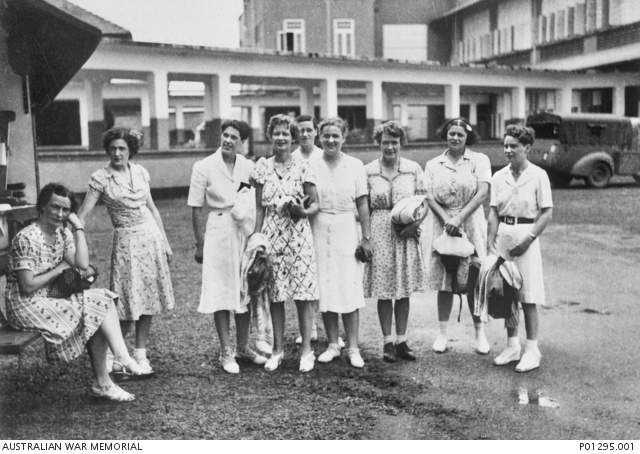
On 12 June Kath, like other 2/10th nurses, was detached to the 2/4th CCS, based at Kajang to the north of Malacca. She returned to her unit on 19 July. On 30 September she was hospitalised with a wrist fracture.
All the while, Kath had been writing home regularly. In a letter dated 5 October 1941 (quoted on the ‘Muntok Nurses and Internees’ Facebook page on 6 February 2020 and at other times), Kath refers playfully to RAAF personnel based on Singapore Island as wannabe sophisticates. “Most of them have been here over 12 months,” she says, “and most of the time in Singapore which is certainly a very artificial city. And naturally they adopt some of its atmosphere and some of its eastern flourish. The right wine with right soup and the right soup with the right fish and at the right time.”
In a letter dated 2 November Kath complains about missing her friends’ weddings. “Can’t bear to think of many more weddings over there without me being present,” she writes. “You had better wait or there will be a fuss.” In the same letter Kath tells of her “very gay weekend. The Air Force lads who passed through here the previous weekend on the way to Frasers Hill arrived back on Thursday. Bleating that it was too lonely up there. So Pat and I had the job of comforting them.”
Invasion
Life for Kath and her colleagues changed dramatically when the Imperial Japanese Army invaded Malaya on 8 December and began to advance southwards. The 2/10th AGH was considered vulnerable in Malacca and by late December had begun the slow process of relocating to Singapore Island. A number of its nurses were detached to either the 2/4th CCS or the 2/13th AGH, which had arrived in September – including Kath, who was detached on 29 December to the 2/13th in Tampoi. Kath’s friend Jock Pringle of the 2/18th Battalion had also moved that day, as Kath notes in a letter home dated 2 January 1942. “Jock is still at the Convalescent Depot and hating it,” she says. “He too had a move on Monday [29 December]. I spoke to him on Sunday evening and he was very miserable. Said the medical unit were worse than the police to get out of their clutches.”
On 1 January 1942 Japanese forces landed on the west coast of the peninsula, and by 7 January the position of the 2/10th AGH was completely untenable, as it was now virtually in the front line. By 10 January all patients had been relocated to the 2/13th AGH and staff detached to the 2/13th AGH or 2/4th CCS. By mid-January the 2/10th had relocated to Oldham Hall and Manor House on Singapore Island and by 25 January the 2/13th AGH had also relocated to Singapore, returning to St Patrick’s School in Katong, where the unit was originally based.
Singapore was now under constant bombardment from aircraft and heavy artillery, and fires burned across the island. Kath responded with typical dry wit in her letter of 6 February. “Guess you will be thinking I’ve gone up in smoke,” she quipped. “There is plenty of it about.”
Japanese forces landed on Singapore Island itself on the night of 8 February, and by 10 February working conditions for the nurses of the 2/10th AGH were almost impossible. The hospital had taken over surrounding houses and even erected tents to accommodate more than 700 patients. Ever since Australian troops had engaged in combat for the first time in mid-January, casualties had been pouring in. Air raids were continuous, and sometimes shells fell in and around the hospital area; on 7 February two staff members had been killed. Across the island, sanitary services had failed, and civil labour had virtually disappeared.
On 10 February the first six AANS nurses were evacuated aboard the Wusueh, and the following day 60 more, 30 from each of the AGHs, departed aboard the Empire Star.
Vyner Brooke
On Thursday 12 February the last 65 AANS nurses in Malaya left Singapore aboard the SS Vyner Brooke, a requisitioned coastal steamer. On board Kath stuck with her New South Wales colleagues Pat Gunther, Pat Blake, Win Davis and Jess Doyle. Late on Thursday night the ship steamed out of Keppel Harbour with anywhere between 200 and 300 people aboard.
On Friday 13 February the Vyner Brooke steamed slowly southeastwards among the multitude of small islands that lined the passage between Singapore and Batavia, the ship’s destination. During the day Matron Paschke of the 2/10th AGH, the most senior AANS nurse aboard, addressed the nurses, laying out a plan of action in the probable event the ship should be attacked. The nurses were assigned areas of duty and were instructed to look after passengers in their respective areas before attending to themselves. The cautious approach was maintained during Friday night, with periods spent at anchor.
On Saturday 14 February, at around 11.00 am, the Vyner Brooke was strafed by a Japanese plane. Then at around 2.00 pm another plane approached before flying off again. Captain Borton, suspecting that Japanese bombers would soon arrive, sounded the ship’s siren and commenced a run through open water for a large island not too far away.
Sure enough, Japanese dive-bombers soon appeared on the horizon, and Borton commenced evasive manoeuvres. While the initial waves of attacks missed, inevitably the bombers found their targets, and three bombs struck home. One of the bombs destroyed the two-inch gun in the forward deck and killed its crew. Another fell down the funnel and destroyed the engine room. A third tore a hole in the side of the ship. The Vyner Brooke, which had reached Bangka Strait and was not far from the northwestern end of Bangka Island, almost immediately listed to starboard. After the nurses helped the passengers to evacuate, Matron Paschke gave the order to abandon ship.
Kath had been injured in the attack and Pat Gunther helped her into one of the three viable lifeboats. Pat gave Kath her tin hat in case she needed it to bail water, told her she would see her on the beach, and then she and Winnie May Davis went over the side while Kath remained in the lifeboat with other injured and elderly passengers, including several other nurses.
Bangka Island
Sometime that night the lifeboat reached Bangka Island, and Kath ended up in the company of a large group of AANS nurses, soldiers, sailors and civilians gathered around a bonfire on the beach. The group grew in number during Saturday night and Sunday as it was joined by survivors of other ships sunk in Bangka Strait by Japanese forces, which were at that very moment invading Sumatra.
On Monday the group decided to surrender en masse to Japanese authorities, and a deputation left for the nearest large town – Muntok – to negotiate this. A short while later all the civilian women and children of the group followed behind – save one, Mrs. Betteridge, a British woman whose husband lay among the injured on the beach.
Around mid-morning the deputation returned with a number of Japanese soldiers. The soldiers separated the survivors into three groups and proceeded to shoot or bayonet them in cold blood.
Kath died on Bangka Island on 16 February 1942, alongside 20 AANS colleagues. They were shot while standing in the sea. One colleague, Vivian Bullwinkel, survived.
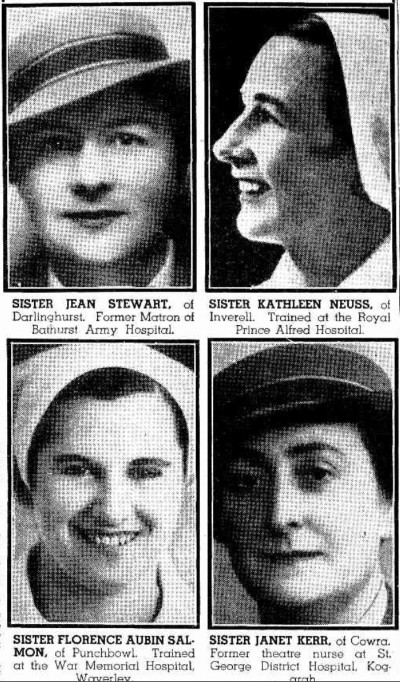
In June 1944 Kath’s parents were notified by the Army that Kath was missing, believed killed, but no doubt still harboured hope that she might be alive. However, when the 24 surviving AANS nurses were finally rescued in September 1945, they learned definitively of their daughter’s terrible fate.
In memory of Kath.
SOURCES
- Australian War Memorial, ‘The Last Post Ceremony commemorating the service of (NFX70527) Sister Kathleen Margaret Neuss, Royal Australian Army Nursing Service, Second World War.’ Film and transcript, 7 Apr 2018.
- Hunter, C. (2018), ‘Guess you will be thinking I’ve gone up in smoke,’ Australian War Memorial (20 Jun 2018, updated 2021).
- Muntok Nurses and Internees (Facebook page).
- Shaw, I. W. (2010), On Radji Beach, Pan Macmillan Australia.
- University of NSW Canberra, Australians at War Film Archive, Pat Darling (née Gunther), interviewed on 2 May 2003, audio and transcript.
- WikiTree, ‘Kathleen Margaret Neuss (1911–1942).’
SOURCES: Newspapers
- The Ballarat Star (3 Jul 1909, p. 2), ‘Weddings.’
- The Inverell Times (10 Nov 1930, p. 7), ‘Crop Competitions.’
- The Inverell Times (20 Jan 1941, p. 3), ‘About People.’
- The Inverell Times (26 Jun 1944, p. 2), ‘Roll of Honor.’

