| Conflict | Second World War |
| Nursing Service | Australian Army Nursing Service |
| Units | CDS Bathurst, 113th AGH (Concord) & 2/10th AGH |
| Overseas Service | Malaya |
| Final Service No. | NFX70936 |
| Final Rank | Lieutenant |
Family Background
Esther Sarah Jean Stewart, known as Jean, was born on 15 October 1904 at New Farm, Brisbane. She was the daughter of Sarah May Jean Mann (1880–1959) and Charles Lloyd Stewart (1875–1938). Sarah married Charles, who worked as a clerk for the railways, on 22 August 1904 in Brisbane, and Jean was born soon after.
School and Nursing
Jean attended New Farm State School and then Roma State School, and after finishing her schooling decided to become a nurse. She began her training in Toowoomba and continued at the Diamantina Hospital in Brisbane. She then moved to Sydney, where she trained at the Royal Prince Alfred Hospital and the Crown Street Women’s Hospital. Jean passed her Nurses’ Registration Board examination in November 1932 but was not formally registered until 12 May 1938.
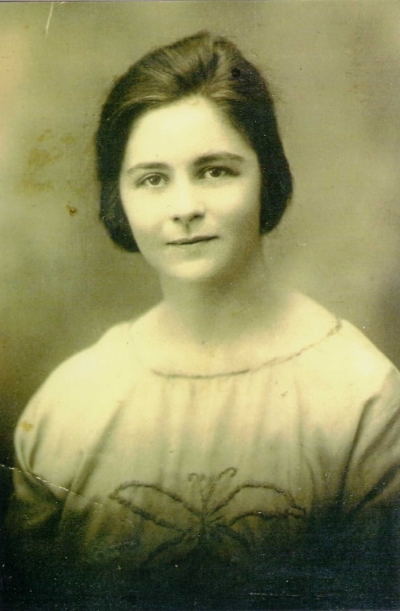
A short time before this, on 14 February 1938, Charles Stewart died at Mater Public Hospital in Brisbane. He was buried at Toowong Cemetery.
Enlistment
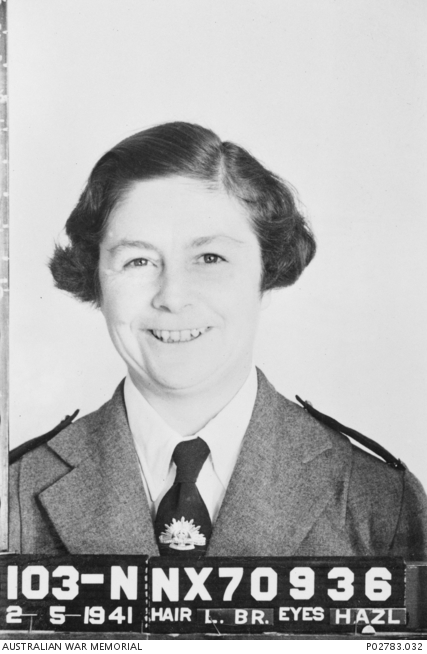
In 1940, with war raging in Europe, Jean volunteered for service with the Australian Army Nursing Service (AANS). Her application was accepted, and on 16 December 1940, while living at Greenholme Nurses’ Home, at 209 Victoria Street in Darlinghurst, she was appointed to the Second Australian Imperial Force (2nd AIF) at the rank of staff nurse and attached to the Emergency Unit of the AANS. Jean was under consideration for service overseas but in the meantime was posted to the dressing station at Bathurst Army Camp.
Unfortunately, Jean did not receive an overseas posting and her appointment to the 2nd AIF was terminated effective 20 February 1941. The following day she was appointed to the Australian Military Forces (AMF) for domestic service with the AANS and remained at the camp dressing station at Bathurst.
2/10th Australian General Hospital
Nonetheless, another opportunity arose soon enough for Jean, and on 25 April she was appointed once again to the 2nd AIF and attached to the 2/10th Australian General Hospital (AGH) as a reinforcement. The 2/10th AGH had been raised in Sydney in January that year, and along with the 2/4th Casualty Clearing Station (CCS), the 2/9th Field Ambulance, and other, smaller medical units, had accompanied the 22nd Brigade, 8th Division to Malaya. The 2/10th AGH had established its hospital at the Colonial Service Hospital in Malacca.
Following pre-embarkation leave, Jean returned to the camp dressing station at Bathurst. On 17 May she was posted to the 113th AGH in Concord, Sydney at the rank of sister, where she joined fellow 2/10th AGH reinforcement nurse Jenny Greer. On 19 May Jean and Jenny departed Sydney on HMAT Zealandia.
The Zealandia was carrying around 1,200 reinforcements for the 8th Division. When the ship stopped in Melbourne on 22 May, more 2/10th AGH reinforcement nurses boarded, including Nell Keats from South Australia and Beryl Woodbridge and Betty Jeffrey from Victoria. The Zealandia set out again the following day and arrived in Singapore on 9 June. Jean and her new colleagues entrained for Malacca.
For six months Jean had a very pleasant time in Malaya. The nurses were busy but not overworked. They treated various tropical maladies, mainly skin and ear infections, but also cases of malaria and other insect-borne viruses. They also treated injuries caused by training accidents and assisted at routine operations. The nurses enjoyed plenty of recreational time and were granted generous periods of leave, during which they travelled in groups to Singapore, Kuala Lumpur and Fraser’s Hill, a cool retreat in the hills north of Kuala Lumpur.
Japanese Invasion
All this changed on 8 December, when Lieutenant-General Tomoyuki Yamashita’s 25th Army invaded Malaya. Effectively unopposed, Japanese forces surged down the Malay Peninsula, pushing British and Indian troops before them.
Before Christmas Jean wrote a letter to Matron Ormerod of the Greenholme Nurses’ Home. According to Matron Ormerod (The Daily Telegraph, 23 September 1945), Jean had told her that “the boys were getting worried because the Japanese were getting so close, but said none of the sisters were worrying about it as they were too busy making Christmas arrangements for the men in hospital…. I’ll never forget the way she wrote saying the nurses were determined to make the Christmas a happy one for the men, because they might not have another for a long while.”
By 29 December 1941 it had become clear that the 2/10th AGH would have to relocate from Malacca, which was now in the direct path of the Japanese advance, and by mid-January 1942 the hospital had moved to Oldham Hall and Manor House on Singapore Island. Ten days later the 2/13th AGH, which had arrived at Singapore in September, followed the 2/10th AGH back to the island. A few days after that the 2/4th CCS followed suit. By the end of January 1942 all Commonwealth troops had been forced onto the island. They were trapped like rats.
Working conditions for Jean and her 2/10th AGH colleagues became more and more difficult. The unit had taken over surrounding houses and even erected tents to accommodate more than 700 patients, but even so the hospital was crowded with casualties. Air raids were continuous, and shells sometimes fell perilously close to the hospital. Across the island, sanitary services had failed, the water supply was imperilled, and civil labour had virtually disappeared. Most alarmingly, the Japanese were closing in.
Towards the End
On 8 February 1942 Jean wrote to Sister Florence Jarman of Greenholme, her official next-of-kin. “In the last letter I got from her, written on February 8, she told me not to expect many more because she was so busy,” Florence later told The Daily Telegraph (23 September 1945). Florence noted that Jean had told her she had not been keen to go to Singapore because she thought there would not be much fighting there. “Jean said she wanted to go where she could do the most good.”
That night Japanese forces began to cross onto Singapore Island, and by the end of 9 February, despite furious Australian, British and Indian resistance, the game was effectively up. On 10 February six of Jean’s AANS colleagues from the 2/10th AGH were evacuated from Singapore aboard the Wusueh. The following day 60 more, 30 from each of the AGHs, departed on the Empire Star. Sixty-five nurses remained, Jean among them. Florence Jarman told the Daily Telegraph that “one of the nurses who got out of Singapore a few days before it fell saw her there and told me she was very pleased to know she was to be left behind.”
Vyner Brooke
Nevertheless, Jean and her 64 colleagues had to go too, and on Thursday 12 February 1942 they left Singapore aboard the SS Vyner Brooke. The small ship steamed south towards Jakarta, seeking the cover of islands, avoiding open water. On 14 February, in the early afternoon, the Vyner Brooke was located by a Japanese spotter plane, and soon dive-bombers appeared on the horizon. Captain Borton engaged evasive manoeuvres, but to no avail. Within an hour or so the ship had received three direct hits and had begun to sink close to Bangka Island.
Putting into effect a plan devised the previous day, the AANS nurses first helped the passengers to leave the stricken vessel, then evacuated themselves. Some boarded lifeboats, while others jumped into the water and clung to rafts and even pieces of flotsam. Some simply floated in their lifebelts.
Bangka Island
Jean appears to have been in one of two lifeboats that came ashore two kilometres apart along a stretch of coastline on northwestern Bangka Island. She joined a large group of AANS nurses and civilians around a bonfire on the beach. As Saturday night became Sunday more people joined, including British sailors and soldiers, many injured, whose ships had been similarly sunk in the vicinity of Bangka Island.
On Monday 16 February a decision was taken to surrender en masse to Japanese authorities, and a deputation left for the nearest large town – Muntok – to negotiate this. A short while later all the civilian women and children of the group followed behind – save one, Mrs Betteridge, a British woman whose husband lay among the injured on the beach.
Around mid-morning the deputation returned with perhaps a dozen Japanese soldiers. The soldiers separated the survivors into three groups and proceeded to shoot or bayonet them in cold blood.
Jean and 20 colleagues died on Radji Beach that day. They were shot while standing in the water. Another 12 nurses were lost at sea. The remaining 32 were captured by Japanese soldiers and imprisoned for three-and-a-half years, and it was only when the surviving 24 were finally released in September 1945 that definitive news of their fallen colleagues’ fate reached their families in Australia.
On 22 September 1945 Sarah Stewart, by then living in Coolangatta, published an elegy in the Tweed Daily for her beloved daughter.
A beautiful memory left behind
Of a dear daughter true and kind;
One of the best the world contained.
Beautiful thoughts of you I’ll keep
As long as my heart is beating;
As long as my eyes hold tears
I’ll love you, dear, as always
Throughout the lonely years.
Many a silent tear is shed
While others are asleep;
No one could never take your place;
No one ever will.
For as long as my life and memory last
I keep you forever in my heart.
Im memory of Jean.
SOURCES
Ancestry Library Edition.
The Courier-Mail (Brisbane, 29 Jan 1946, p. 1), ‘Mother Perpetuates Memory of Heroic Army Nurse Shot by Japs’.
The Daily Telegraph (Sydney, 23 Sep 1945, p. 5), ‘Memorial for Murdered Nurses’.
Museums of History New South Wales, ‘Esther Sarah Jean Stewart’.
National Archives of Australia.
The Sydney Morning Herald (9 Dec 1932, p.  , ‘Nurses Registration Examination’.
Truth (9 Apr 1939, p. 24), ‘Family Notices’.
Tweed Daily (22 Sep 1945, p. 2), ‘Roll of Honour’.
Tweed Daily (21 Apr 1948, p. 2), ‘Coolangatta War Memorial to Be Unveiled on Sunday’.
WikiTree, ‘Esther Sarah Jean Stewart (1904–1942)’.

