FREE AT LAST
Early on Thursday evening, 18 October 1945, the Australian hospital ship Manunda arrived at Fremantle. On board were nearly 400 liberated prisoners of war, who had embarked from Singapore on 5 October.
Among the freed POWs were 24 nurses of the Australian Army Nursing Service (AANS). The nurses had survived the bombing of the Vyner Brooke and three and a half years of imprisonment in Japanese camps on Bangka Island and Sumatra. One of the nurses, Lieutenant Vivian Bullwinkel, had survived the infamous Bangka Island massacre.
The 24 nurses had been picked up from Lahat in southern Sumatra on 16 September and flown to Singapore in a Douglas C-47 Dakota piloted by Fred Madsen and Ken Brown. Aboard the plane were Haydon Lennard, an Australian Broadcasting Commission correspondent, and Sister Beryl Chandler of the RAAF’s Medical Air Evacuation Transport Unit, who had known several of the nurses from her days at Brisbane General Hospital. Lennard and Sister Chandler had helped to locate the nurses. The plane touched down at Kallang Airport, and the 24 nurses were taken to the 2/14th Australian General Hospital (AGH) at St. Patrick’s School, where some of them had served with the 2/13th AGH prior to the fall of Singapore in February 1942.
SINGAPORE
The 24 nurses spent nearly three weeks recuperating at St. Patrick’s School. They had a steady stream of visitors – former POWs, journalists, society people, including Lady Mountbatten and Lady Blamey – and received quantities of mail. They ate exceedingly well. They put on weight and began to regain their physical fitness.
On Monday 1 October all but five of the nurses, who remained weaker than the others and needed to stay in bed, were permitted to leave the hospital to go shopping for a party they were giving the following day for the hospital staff. Among the goods they bought were Chinese silks to wear to the party. Later on Monday Gracie Fields visited the hospital and sang for the nurses. The following day those nurses who were well enough visited Changi to see her perform for the men.
On Tuesday evening the nurses held their sherry party to thank the nurses, medical officers and other staff of the 2/14th AGH. In attendance also were Ken Brown, Fred Madsen, Haydon Lennard and Beryl Chandler. The nurses wore their Chinese silks as well as make-up given to them by Colonel Annie Sage, Matron-in-Chief AANS, who had known what a morale-boosting effect such a gift would have. Colonel Sage had been aboard the Dakota when the plane touched down at Lahat to collect the nurses but had not accompanied them back to Singapore.
ARRIVAL AT FREMANTLE
As the Manunda drew slowly into the wharf at Victoria Quay shortly after 6.00 pm (as reported in The West Australian on 19 October), “emotion silenced the crowd. Suddenly the Western Command Band struck up the popular tune of a few years ago, ‘Nursie!,’ which acted as a signal for the waiting people to break through the barriers and, with coo-ees and cries of recognition, surge alongside the incoming ship.”
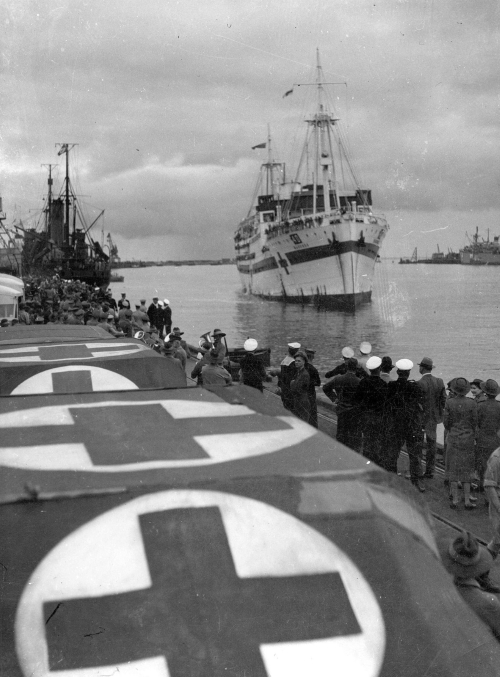
“In their tropical uniform of grey tunic and trousers,” The West Australian continued, “the nurses were easily distinguishable among the crowds of servicemen in khaki or hospital blues, who lined the rails and crowded every vantage point. Honour of being first aboard went to the small red-headed son of one of the returning men who was passed up to his father by a stalwart sailor.
“Officially, the first up the gang-way was the G.O.C. Western Command (Major-General A. J. Boase), followed by the Principal Matron of the A.A.N.S. (Col A. M. Sage) and the Principal Matron in Western Australia (Lt-Col E. V. Joubert). Then came Red Cross workers, their arms laden with baskets of flowers and fruit for the sisters and comforts for the men. [Among the flowers were 24 bouquets sent by Major Bruce Hunt, himself a recently returned prisoner of war, who had worked with some of the nurses at the 2/13th AGH.]
“Seen in the lounge a few moments after the ship berthed, the sisters, who are gaining weight rapidly and look surprisingly fit, were so excited they found it difficult to tell a coherent tale. Mail from home held them engrossed and, asked what had been their main thoughts since their release, one and all answered, ‘Getting home.’
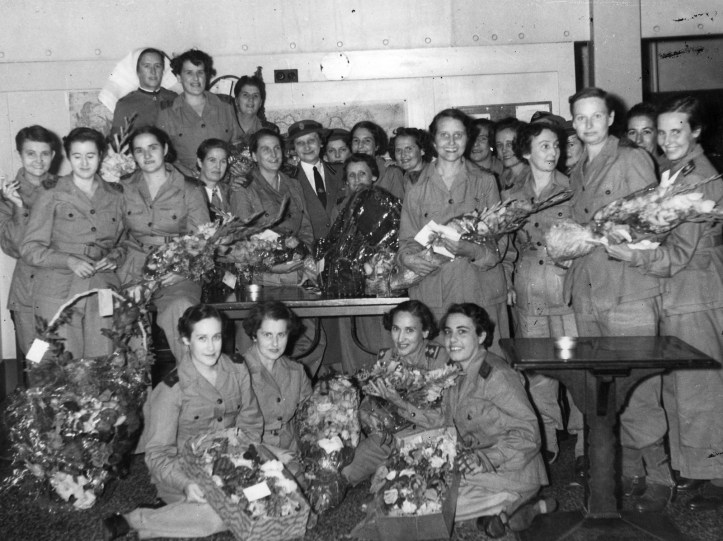
“‘It is like a dream, being in Australia at last,’ said Sister [Florence] Trotter of Queensland, who had been the camp’s ‘hairdresser’ and responsible for the neat appearance of their hair. ‘Even on the trip home we expected to wake up and find ourselves back in Sumatra,’ she added.
“Tributes to the Red Cross were paid by the sisters. ‘They have looked after us wonderfully ever since we arrived in Singapore,’ they said. ‘But our most wonderful moment was to see Col Sage step out of the plane which landed in Sumatra to take us to Singapore. We often tried to imagine what the moment when we were free would be like, but we never imagined anything quite so marvellous. It was grand to see her – and Sister Floyd, and Major Windsor, both of whom were with us before Singapore fell. And we’ll never forget the kindness of Sister Chandler, the R.A.A.F. flying nurse and our pilots, F/O’s Brown and P. Madison [sic] or the reception the boys gave us when we reached the hospital in Singapore – or this…’
“The only West Australian among the group was Lieut Iole Harper, of Guildford, who was met by her family and who has already gained 2½ stone, the first 10 lb of which she put on in the first two days. Also well known in this state is Lt A. Syer, who enlisted in Western Australia, although her home is in the East.
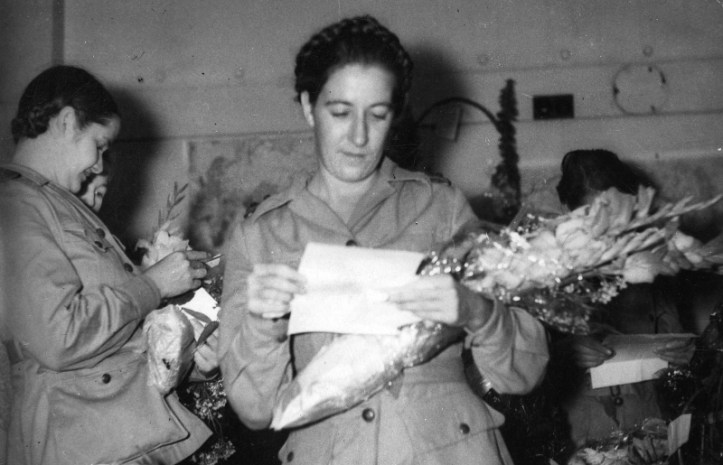
“One of the most excited was Lt B. J. Greer, of N.S.W., whose brother, a member of the Eighth Division, was also a prisoner of war. ‘He was waiting to greet me on the aerodrome at Singapore when we arrived,’ she said, ‘and has now arrived home.’
“Smallest of the nurses is Sister N. James, of Shepperton, Victoria, who was Second in Command of the 2/10th A.G.H, and was in charge of the nurses during their internment. The only ‘casualty’ was Sister Joyce Tweddell, who had the misfortune to slip on board ship yesterday and injure a wrist.
“The crowd waiting on the wharf gave the sisters a tumultuous welcome as they came down the gangway and the progress of Sister V. Bullwinkel, of South Australia, only survivor of the massacre of nurses on the beach of Banka Island, was almost like a royal procession. She was met by an old friend, Mrs A. James, of Mt Hawthorn.”
After disembarking from the Manunda the nurses were driven 12 kilometres to the Hollywood Military Hospital (also known as the 110th Perth Military Hospital) in the Perth suburb of Nedlands. Lining the route from the wharf to the hospital were crowds of cheering onlookers, many of whom were weeping for joy. After arriving, the nurses were taken to the hospital’s nurses’ quarters, and at 8.30 pm a gala reception was held for them.
MASSES OF BLOOMS
The nurses’ quarters had been decorated with thousands of flowers – kangaroo paws, leschenaultia, deep pink flowering peach, roses, gladioli, poppies, carnations, sweet peas, and many others besides. On Monday 15 October hospital staff had appealed to the public for wildflowers and garden flowers. The appeal was carried in the newspapers and on the radio, and on Wednesday flowers from all over Perth began to arrive at the matron’s office. They came from florists all over Perth. They came from sub-branches of the RSL – so many were collected by the Midland RSL that they filled an ambulance. They came from the Western Australian branch of the Prisoner of War Relatives’ Association, from members of the Nurses’ Association, and from staff of other hospitals. They were brought in women, men and children of all ages. They were brought in by school children from East Fremantle, Inglewood, Subiaco, and other parts of the Perth metropolitan area. Women arrived with three and four bouquets, which they had collected from their neighbours.
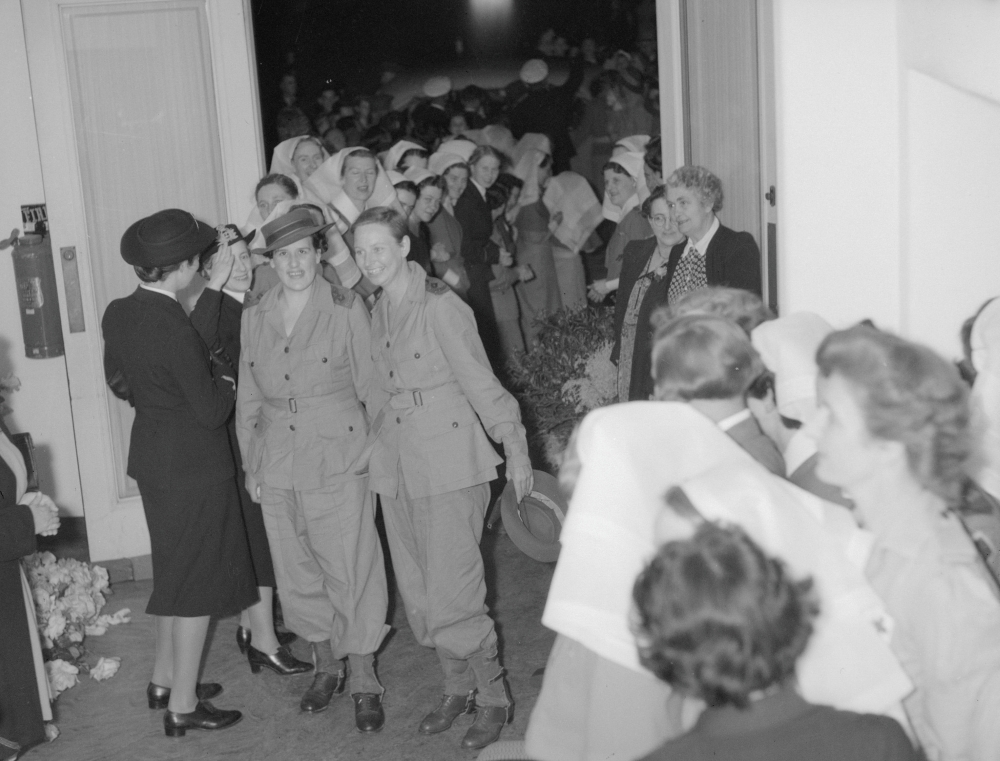
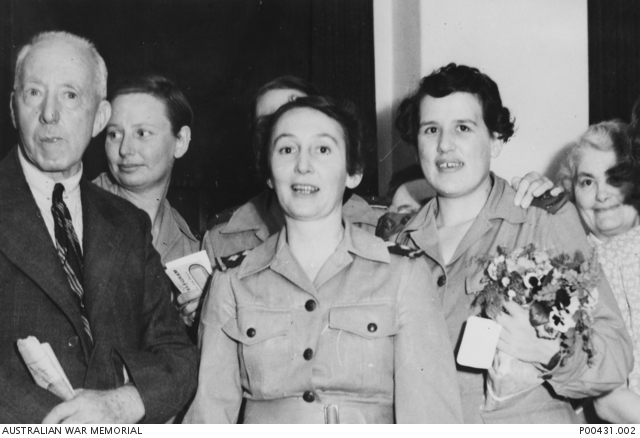
By the late morning of Thursday 18 October masses of blooms had been delivered to the hospital – so many, in fact, that ambulance stretchers were used to carry them from the matron’s office to the nurses’ quarters. They were arranged by eight nurses, with the help of some of the hospital’s patients, and eventually the walls and ceiling of the nurses’ sitting room were covered. Poignantly, Flora Farmaner, the mother of Peggy Farmaner, one of the 21 nurses to die in the Bangka Island massacre, had made 24 posies from flowers in her garden, one for each nurse. She remained for the reception and talked to her daughter’s comrades.
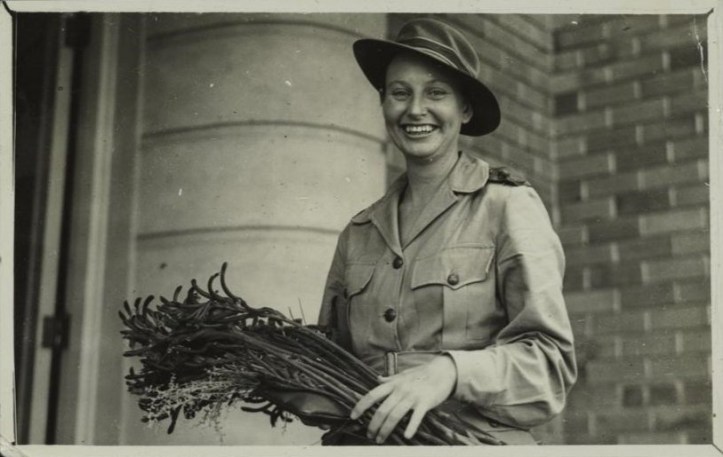
A WELCOME HOME LUNCH
The following day, 19 October, the nurses attended a lunch put on in their honour by the Western Australian Trotting Association in conjunction with the Western Australian Sportsmen’s Council and held at Gloucester Park. They arrived in field-grey summer uniform, having been kitted out at Hollywood Military Hospital during the morning.
Present at the lunch were Colonel Sage, who gave a fine speech in praise of the nurses; Lieutenant-Colonel Joubert; Sir James Mitchell (the lieutenant-governor of Western Australia) and Lady Mitchell; representatives of the Government and the Opposition; and representatives of business and civil society.
Although tired after the excitement of the previous day, the nurses nevertheless managed, in the words of The West Australian (20 October 1945), to do “full justice to the excellent meal provided, paying rather special attention to cakes, which vanished like magic and the ice-cream served with trifle.” Fresh fruit was still a novelty, as was chocolate.
During lunch each nurse was given a presentation copy of West Australian Wild Flowers on which her name had been inscribed in gold letters. The books were greatly appreciated by the nurses, many of whom had seen Western Australian wildflowers for the first time at the reception.
At the conclusion of the lunch, the nurses stood for a while in the sun outside the pavilion, chatting with friends and playing with a puppy named Montgomery. Twenty-two of the nurses were then taken back to the Manunda to continue their journey to the eastern states. Two remained in Perth – Lieutenant Iole Harper, a Western Australian native, and Lieutenant Ada Syer, who had spent some time in the state prior to her war service and was to be admitted to Hollywood for further treatment.
Sometime before returning to the ship, Captain Nesta James, the senior nurse among the 24, sent a message of thanks to the people of Western Australia. It was printed in The West Australian on 20 October, as follows: “I desire to thank the people of Western Australia on behalf of the ex-P.O.W. nurses for the glorious flowers which they sent us. We are told they have been sent from all over Western Australia. I can assure everyone we were overwhelmed with the welcome we received at Hollywood.”
MELBOURNE
On the afternoon of 19 October the 22 nurses departed Fremantle. Five days later, late in the evening of Wednesday 24 October, they arrived at Port Melbourne. Waiting for the nurses at Station Pier were Lieutenant Colonel Lydia Shaw, Principal Matron Victoria; Colonel Sage; Major General Burston, Deputy Director of Medical Services; and Lady Dugan, president of the Victorian Division, Australian Red Cross Society. When the Manunda berthed they went aboard and chatted with the nurses, presenting each with a bouquet and a shoulder spray.
With a band playing ‘The Rose of No Man’s Land,’ and heavy rain spattering in their faces, the nurses disembarked onto Station Pier in their summer uniforms, passing through a guard of honour composed of 40–50 members of the AANS. They were rushed by five nurses with whom some of them had served in Malaya – Margaret Anderson, Veronica Dwyer, Mary Holden, Elsie Little and Dorothy Sturgess.
On the pier the 22 nurses boarded a bus, and as it set out for Heidelberg Military Hospital at the head of a line of buses filled with nearly 200 POWs from the Manunda, crowds of people cheered. The procession stopped at Melbourne Town Hall, where a big crowd stood in the rain. After Mayor Connelly officially welcomed the nurses to Melbourne, the procession of buses continued to Heidelberg.
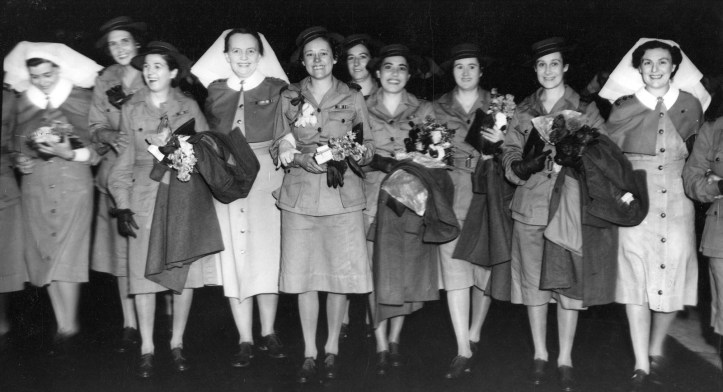
Upon arrival at Heidelberg the nurses were given a quick medical examination, and then the Victorians – Nesta James, Betty Jeffrey, Wilma Oram, Beryl Woodbridge and Vivian Bullwinkel (who, though a South Australian, had enlisted in Victoria) – were taken to No. 1 Nurses’ Home to meet their relatives, while the interstate nurses went to No. 2 for a reception by Matron Jean Oddie, which was later attended by the Victorians and their relatives.
At the reception, reporters spoke to the nurses. “The sisters looked surprisingly well after their long internment, and were very happy and excited” reported The Age the following day (25 October 1945).
“One of the jolliest was Sister Vivian Bullwinkel, sole survivor of the Banka Island massacre, whose mother, Mrs. E. Bullwinkel, had come from Adelaide to meet her. Sister Bullwinkel, who enlisted in Victoria, is staying with Mr. and Mrs. Harvey, of Surrey Hills.
[…]
“Sister C. J. Ashton, of Unley (S.A.), looking very fit, said most of the nurses lost between three and four stone, but it did not take long to pick up once they had some food. Most of them kept fit until towards the end, when they were at a low ebb. They were in a camp of 700 women and children, and the whole camp was moved several times, finishing at Loebach Linngua [Lubuklinggau, south Sumatra]. So many people began to get ill that the Japanese established a large hospital under the charge of Dutch nuns, and 14 of the sisters did the nursing in the last 12 or 14 months, while the others did ‘district nursing’ in the camp. The Japanese did ‘a little bit of punching’ at one stage, but seldom beat the women, though sometimes they stood them in the sun for not bowing.
“When peace came the Japanese released a quantity of goods, and these the prisoners traded with the natives for food, and the camp every day was like a market. ‘A pair of old shorts would buy us half a dozen eggs, and a metre of material was worth four or five fowls,’ she said. That food, with quantities dropped by parachute, helped the sisters to gain condition rapidly.
“Sister A. B. Jeffrey, of East Malvern, spoke of the tremendous welcome they received in Perth, where they were laden with flowers. Sister Mavis Hannah, of Adelaide, said everyone had been so marvellous to them, that they could not help but get fit and well. She said food had been their greatest problem, and they were always hungry.”
The following morning, Thursday 25 October, the New South Wales nurses – Pat Blake, Veronica Clancy (who was originally a South Australian), Pat Gunther, Jess Doyle and Jenny Greer – and the Queenslanders – Jessie Blanch, Cecilia Delforce, Vi McElnea, Sylvia Muir, Chris Oxley, Eileen Short, Valrie Smith, Florence Trotter and Joyce Tweddell – having spent the night at Heidelberg, returned to Port Melbourne and embarked on the Manunda for Sydney with around 200 other ex-POWs.
ADELAIDE
While the New South Wales and Queensland nurses were en route for Sydney, Mavis Hannah and Jean Ashton entrained for Adelaide. They arrived on Saturday 27 October and were given a hero’s welcome.
“Looking fit but still thin following their imprisonment by the Japanese,” reported The Mail (27 October 1945), “Sisters Carrie Jean Ashton, of Mary Street, Unley, and Ellen Mavis Hannah, of Essex Street, Goodwood Park, arrived home today.
“Adelaide’s welcome rain did not spoil the enthusiasm with which [the two nurses] were greeted at the railway station and the town hall, where they were accorded a civic reception. With a military band playing appropriate tunes, such as ‘Waltzing Matilda’ and ‘Nursie!,’ they were met by happy, excited relatives when the train pulled in.
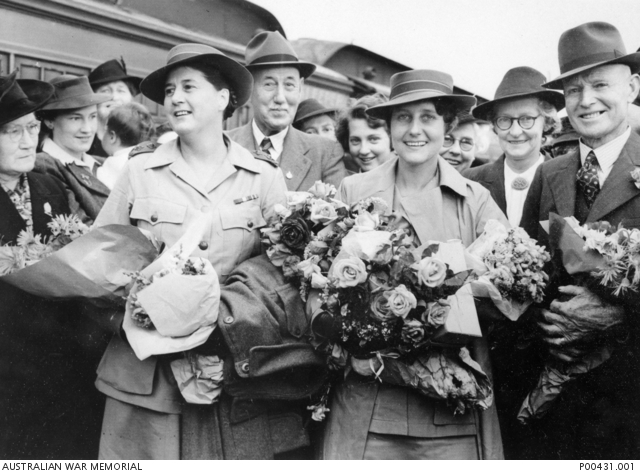
“Among the welcomers was Major A. F. Hobbs, of Payneham, who was Sister Hannah’s commanding officer at the 2/4 Casualty Clearing Station in Malaya [in fact Lieutenant Colonel Tom Hamilton was commanding officer]. He also returned from captivity recently.
“Loaded with huge armfuls of flowers, the two nurses were taken with relatives to Wayville for breakfast. Clapping and cheering marked their walk to the waiting cars.
“Town hall bells pealed as the girls were driven through the streets to the town hall, where they were met by the Lord Mayor, who welcomed them on behalf of the City of Adelaide. The Lady Mayoress (Mrs. Walker) was also present.”
SYDNEY…
On the same day that Mavis Hannah and Jean Ashton were being feted in Adelaide, Elizabeth Simons, a Tasmanian, flew from Melbourne to Launceston, and the Manunda arrived at Woolloomooloo in Sydney.
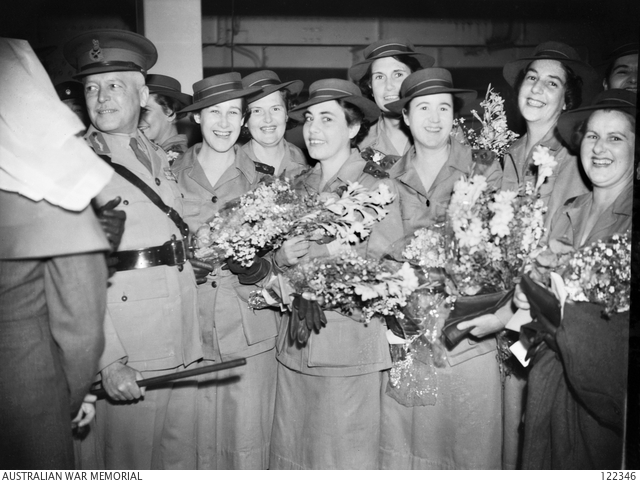
Among those awaiting the arrival of the ship was Lieutenant General H. Gordon Bennett, the commander-in-chief of the 2nd Australian Imperial Force in Malaya, who had managed to escape from Singapore shortly before the Allies’ capitulation to the Japanese. With him was Major General Eric Plant, General Officer Commanding, New South Wales Lines of Communication. The men boarded the Manunda and welcomed the 14 New South Wales and Queensland nurses.
After disembarking, the nurses were taken to the 3rd Australian Women’s Hospital (AWH) at Concord for observation and tests. The Queensland nurses were considered fit to continue their journey home – all except Eileen Short, who stayed at Concord until 6 November – and late on Sunday 28 October, having bidden farewell to their New South Wales comrades, boarded a hospital train for Brisbane.
…AND BRISBANE
On the morning of Tuesday 30 October, after a journey of some 30 hours, Jessie Blanch, Cecilia Delforce, Vi McElnea, Sylvia Muir, Chris Oxley, Valrie Smith, Flo Trotter and Joyce Tweddell, along with five civilian nurses freed from internment in Totsuka, Japan, and around 80 other Queensland POWs, arrived at Clapham Junction (as Moorooka Railway Station was familiarly called), where they were met by family and friends. From the station the nurses were driven in cars to the 2nd AWH at Yeronga, passing through streets lined with cheering and clapping crowds.
“On arrival,” reported The Courier-Mail (31 October 1945), “the eight Sisters were welcomed by the 4th Aust. Armoured Brigade Band playing ‘We’re Far Better off in a Home,’ and were in the arms of their relatives and friends almost before the cars had stopped.
“‘We’ve had wonderful welcomes everywhere, but Brisbane has broken all records,’ said Sister J. J. Blanch (Alstonville, N.S.W.).”
“They exchanged enthusiastic hugs with Sister Beryl Chandler (Longreach), the R.A.A.F. nursing Sister who had been a member of the party that flew into Sumatra to find the nurses when they were in the Japanese camp at Loeboeklinggau (Sumatra).
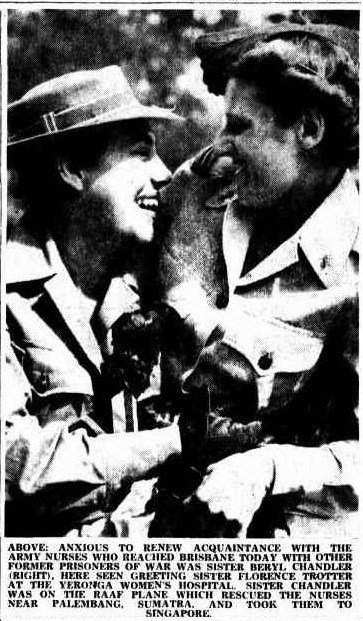
“Relatives were delighted to see how well the Sisters looked after their voyage from Singapore.
“Most of the Sisters’ time was spent in Palembang. There they earned money to buy food by working for wealthy Dutch women who were interned in the camp. They also did some nursing, helping the Catholic Sisters who had a hospital in Palembang, but lack of equipment prevented them from doing much more than feeding the patients on rice and keeping them as comfortable as possible.
“‘The hungrier we got, the more we talked recipes,’ said Sister Trotter. There were women of 27 nationalities in the camp, and they all swapped recipes. Sister S. J. M. Muir (formerly of Longreach and Rockhampton) has brought back about 500 recipes.”
“Sister C. S. M. Oxley (Eagle Junction) told how the girls, using bicycle wheel spokes as needles, knitted themselves garments out of thick string bought from an Indian merchant.
“Sister Blanch recalled the cardigans they made when they found and unravelled long woollen underpants knitted by the Australian Red Cross for sailors. ‘The weather was never really very cold,’ she added, ‘but when it is wet and windy, and you are hungry, you feel cold.’
“In camp the girls wore wooden clogs, which had cost 10 cents a pair when they were first taken prisoners of war, but which rocketted to 250 cents by the end of three years. ‘I took size 3½ in shoes before I was a P.O.W.,’ said Sister Trotter. ‘When I was being re-equipped in Singapore, I found I needed a size 5½, but I’ve got back to 4 now.’
“The first thing Sister Muir wants to buy when she goes shopping is a ‘nice black afternoon frock.’ She bought the jewellery for it in Singapore, just before coming home. All the girls are looking forward to their first day’s shopping here, and were thrilled with the £100 cheques they all received yesterday as a gift from the 2nd A.I.F. Nurses’ Fund.”
FRIENDS FOREVER
After spending so long living so close to one another in such cruel circumstances, it must have felt strange as the group of 24 became progressively smaller as each nurse departed for her home suburb or town. The nurses got on with their individual lives but stayed in touch over the coming decades. The last of the 24, Cecilia Delforce, who became Cecilia McPhee, died on 5 March 2011 at the extraordinary age of 98.
Sources
- The Age (Melbourne, 25 Oct 1945, p. 3), ‘Australian Welcome To P.O.W. Nurses. Survivors Arrive from Sumatra.’
- The Argus (Melbourne, 25 Oct 1945, p. 20), ‘Sisters from Sumatra Arrive.’
- The Courier-Mail (Brisbane, 31 Oct 1945, p. 2), ‘Nurses Kept Party Spirit Alive in Prison.’
- Daily Mirror (Sydney, 27 Oct 1945, p. 5), ‘Floral Welcome.’
- The Daily News (Perth, 2 Oct 1945, p. 1), ‘Freed Nurses to Come Here.’
- The Daily News (Perth, 15 Oct 1945, p. 9), ‘Hollywood Wants Flowers to Welcome POW Nurses.’
- The Daily News (Perth, 18 Oct 1945, p. 15), ‘Bower of Flowers for P.O.W. Nurses.’
- Kalgoorlie Miner (WA, 4 Oct 1945, p. 2), ‘Liberated Sisters Rapidly Regaining Health.’
- The Mail (Adelaide, 27 Oct 1945, p. 4), ‘Great Welcome for P.O.W. Nurses.’
- The Telegraph (Brisbane, 29 Oct 1945, p. 3), ‘Q’ld. Nurse Stayed at Jap Hotel.’
- The West Australian (Perth, 19 Oct 1945, p. 8), ‘Nurses Return.’
- The West Australian (Perth, 19 Oct 1945, p. 8), ‘A Welcome Home.’
- The West Australian (Perth, 19 Oct 1945, p. 9), ‘Nurses Welcomed: Say It with Flowers.’
- The West Australian (Perth, 19 Oct 1945, p. 6), ‘News and Notes.’
- The West Australian (Perth, 20 Oct 1945, p. 6), ‘News and Notes: Thanks from P.O.W. Nurses.’
- The West Australian (Perth, 20 Oct 1945, p. 8), ‘“A Job Well Done.” Praise of P.O.W. Nurses.’

