AANS │ Captain │ Second World War │ Malaya
FAMILY BACKGROUND
Winnie May Davis was born on 7 July 1915 at Cowper, on the Clarence River in New South Wales. She was the daughter of Laura Ellen Lattimore (1881–1970), from Lower Coldstream, and James (Jim) Davis (1874–1948), from nearby Taloumbi.
James was one of thirteen children and came to Lower Coldstream around 1903 to assist in the construction of the Lower Coldstream bridge. Here he met Laura, who was from a highly esteemed local family, and they were married on 30 March 1904 at Laura’s family home.
The newly married couple settled on nearby Broadmouth Creek on a farm owned by Mrs. Elizabeth Young, of Cowper. Here their first child, Evelyn Gladys Davis, known as Gladys, was born in 1905. Lyle William Davis followed in 1909.
In 1910 Laura and James moved to Mrs. Young’s farm at Cowper, where they were tenants for another 12 years. Winnie was born here in 1915, and her younger sister Doris Dulcie Davis followed in 1918.
James Davis was an excellent farmer, and a very industrious man, sometimes growing a thousand bags of corn. He was also interested in horse-breeding and dairying and was a good carpenter. Although self-taught, he built a lot of houses, with Mr. Charles Firth, of Ulmarra, and his activities continued right up till the time of his death.
After leaving Mrs. Young’s farm at Cowper in 1922 the family purchased a property on Coldstream Road, Ulmarra, and here the family lived for many years. When James retired, he and Laura moved into the town of Ulmarra and established another comfortable home.
Winnie and Doris attended Ulmarra Public School. At the end of 1927 and again at the end of 1928 Winnie passed her Permit-to-Enrol examination and started at Grafton High School in 1929. In 1930 she finished fifth in her class, 2C.
NURSING
After finishing school, Winnie travelled to Sydney and was employed in a dental surgery before deciding upon a career in nursing. She began her training in 1934 at the War Memorial Hospital in Waverley. The hospital was owned by the Methodist Church of New South Wales and was dedicated to men and women of the eastern suburbs of Sydney who died in service during World War One. Starting at the same time as Winnie was a young woman from Punchbowl three months her junior by the name of Florence Aubin Salmon. She would later serve with Winnie in Malaya.
Winnie and Florence passed their final examination in May 1938 and gained their diplomas. Winnie’s success was reported in the Grafton Daily Examiner of 9 July, which noted her “bright and happy disposition, and general efficiency” and suggested that she “should succeed in attaining the highest ranks in her nursing career.” She became registered in general nursing on 4 August, and in November she and Florence were each presented with a graduate brooch at the hospital’s annual Armistice Day Awards ceremony.
Upon attaining her registration in general nursing, Winnie undertook obstetrics training at the Royal Hospital for Women, in Paddington, Sydney. She then returned to the War Memorial Hospital in Waverley as a staff sister.
On 22 June 1940 Winnie was bridesmaid at the wedding of her sister Doris Dulcie and Ivo Amos of Ulmarra at the Wesley Church, in Hamilton, New South Wales. Winnie’s blue taffeta frock featured a square-draped neckline, lull skirt and bustle-effect back. She carried a muff to match with red roses and mignonette. Her over-the-face tulle veil was held in place with a topknot to match, and a pair of lace mittens completed her toilette.
ENLISTMENT
By now war had broken out in Europe, and Winnie, like so many of her peers, decided to volunteer to serve in the Australian Army Nursing Service (AANS). In July 1940 she had her medical, and towards the end of the year received her call up.
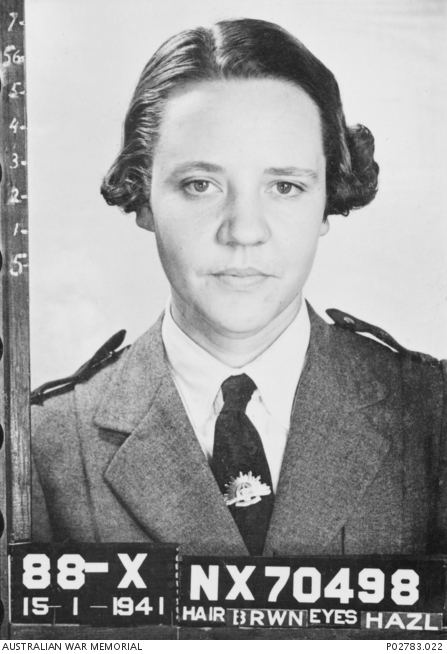
On 10 December Winnie attended Victoria Barracks in Sydney and enlisted in the Second Australian Imperial Force (2nd AIF). She was attached to the AANS Emergency Unit. Also enlisting that day was fellow New South Wales nurse Jess Doyle, of Potts Point, Sydney. Winnie and Jess were both posted to the camp dressing station at Greta Camp, in the Hunter Valley, New South Wales. In January 1941 they were each advised by the Army that they would soon be attached to a medical unit for overseas service.
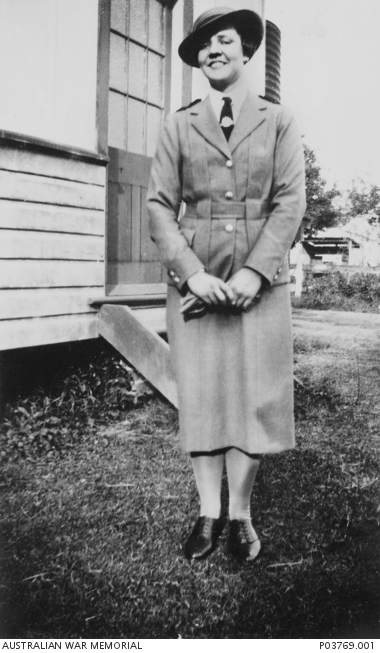
In January Winnie returned to Ulmarra for her holidays. She had not lived there for some time, of course, but had kept in touch with her local friends. On 20 January the townsfolk, knowing that she was soon to be posted overseas, turned out to say goodbye to her. In the afternoon, the local branch of the Red Cross held a farewell afternoon tea for her at the School of Arts. In the evening, she was farewelled by a good many people at a function held in the Masonic Hall. The attendees danced until 9.30 pm, and then a short farewell ceremony took place. Alderman F. J. Yalden, chairman of the Ulmarra District Patriotic and War Fund Auxiliary, stated that it had been a pleasure to know Winnie all her life and lauded the duty she was about to take up – a duty that had originated with Florence Nightingale. After Mr. L. W. Secomb sang ‘Rose of No Man’s Land, Winnie was presented with a travelling wallet. She thanked the attendees and ended by saying that she hoped to meet the Ulmarra boys over there – but not as casualties. She left Ulmarra on 22 January, never to return.
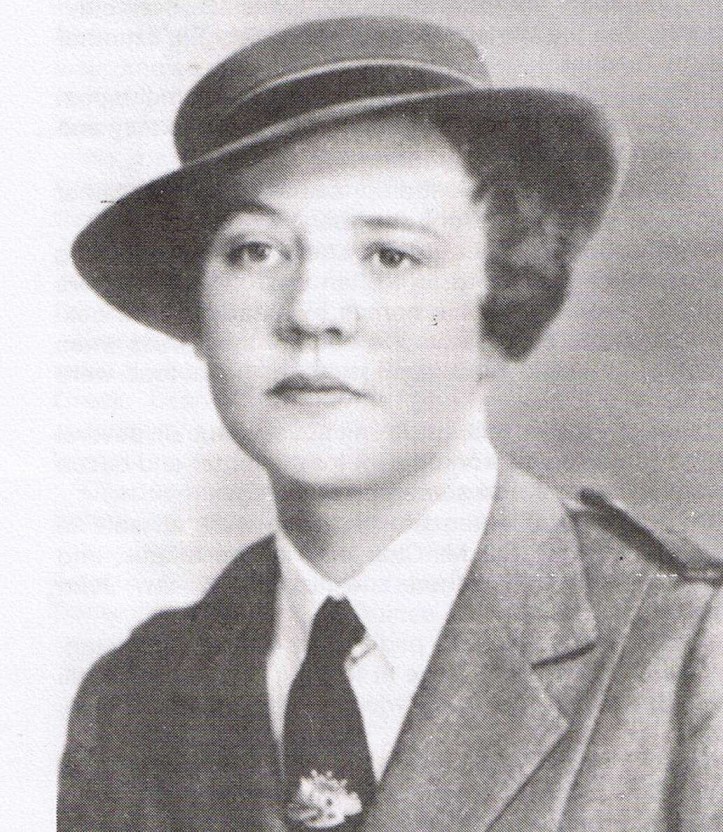
On 31 January Winnie was attached to the 2/10th Australian General Hospital (AGH). On 3 February she proceeded to Darling Harbour and was taken by ferry to the mighty Queen Mary, which was lying at anchor off Bradley’s Point. She boarded the ship in company with fellow New South Wales 2/10th AGH recruits Jess Doyle, Pat Blake, Pat Gunther, Marjorie Schuman, Kath Neuss and others. A contingent of Queensland nurses, including Joyce Tweddell, Florence Trotter, Jessie Blanch, Pearl Mittelheuser, Chris Oxley and Cecilia Delforce, had boarded two days previously.
By 4 February a total of 43 AANS nurses of the 2/10th AGH had embarked, as well as six nurses attached to the 2/4th Casualty Clearing Station (CCS). These two units, together with the 2/9th Field Ambulance, the 2/2nd Mobile Ambulance Company and others, were tasked with looking after the 5,750 troops of the 22nd Brigade of the 8th Division, 2nd AIF – the so-called ‘Elbow Force’ – who were sailing to Malaya following a British request for Australian reinforcements to join British and Indian troops in garrison duties. Although their destination was officially classified, many soldiers had a fair idea of where they would disembark; among other indications, crates marked ‘Singapore’ being loaded onto the Queen Mary helped to give the game away.
The QUEEN MARY
In the early afternoon, with the sky still clear and blue, the mighty ship left Sydney Harbour to the cheers of thousands of troops on board and those of countless well-wishers around the harbour. As the Queen Mary came level with the Heads the ship’s band struck up ‘Haere-ra,’ (‘A Māori Farewell’) and the troops sang ‘Now Is the Hour when We Must Say Goodbye’ again and again.
Outside the Heads the Queen Mary joined the Aquitania and the Dutch liner Nieuw Amsterdam, which were carrying, respectively, Australian and New Zealand troops to Bombay, from where they would transship for the Middle East. The three ships put out to sea escorted by the Australian cruiser Hobart. On 8 February the convoy was joined by the Mauretania, which had embarked from Melbourne and was also bound for Bombay. After a stop in Fremantle, during which two more nurses of the 2/4th CCS boarded the Queen Mary, the convoy set out again, now under the escort of HMAS Canberra.
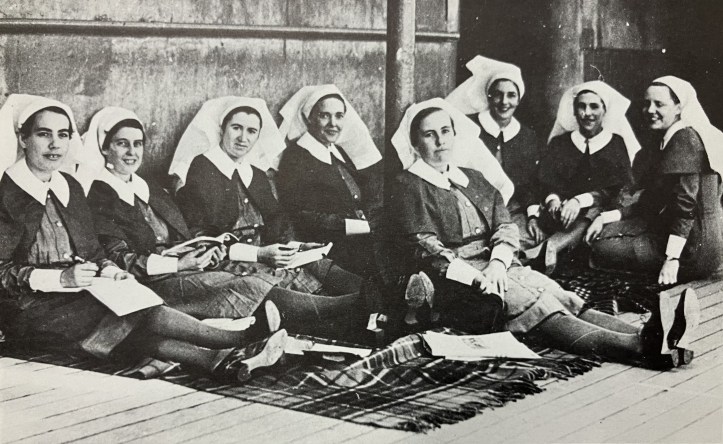
Meanwhile, Winnie and her new 2/10th AGH colleagues had established an emergency hospital to manage sickness and accidents during the voyage. The ship’s smoking room was converted into a ward, and an operating theatre was set up on a lower deck. During their free time, the nurses had access to a range of facilities, including a cinema and a swimming pool. They were invited to concerts and could attend nightly cabarets, but only if accompanied by an officer.
On 16 February, when the convoy was immediately south of Sunda Strait, the Queen Mary broke away from the convoy. Amid much cheering from the troops, it circled the other ships and then steamed off towards Singapore. Two days later the nurses arrived at Sembawang Naval Base on the north coast of Singapore Island, just across Johor Strait from the Malay Peninsula. Opened in 1938, the base was meant to play a significant role in the British Empire’s strategic defences against external threats in East Asia, particularly from Japan.
MALAYA
The nurses disembarked, and Winnie, Pat Gunther, Jess Doyle and the others boarded a train for Malacca, on the west coast of the Peninsula, where their hospital was to be based. They arrived early the next morning, immediately went to bed and awoke to find themselves in the Colonial Service Hospital. The hospital was a modern complex consisting of several blocks, each of five storeys; instead of glass windows, shutters were installed, the better to let in sea breezes.
Initially the heat was enervating, but the nurses soon grew accustomed to it and began to feel at home. They were kept busy looking after the thousands of 8th Division troops but had housemaids (known as amahs) to do their housework and had plenty of time for such off-duty activities as shopping, golf, tennis and swimming, dancing, Sampan picnics, and chicken-suppers on the beach. They were made honorary members of European-only clubs. They were treated by well-to-do residents to curry tiffin, birds’ nest soup, fried rice and mushrooms, and other exotic dishes. They visited tin and gold mines and rubber estates and were taken on long drives through the delightfully verdant countryside. Everywhere they went they were greeted by the local children with cries of “Hullo, Joe!”
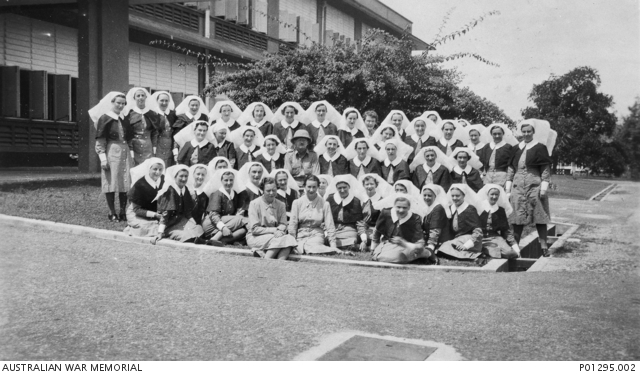
On 7 May Winnie and Pat Gunther were detached to the 2/4th CCS, which was based at a high school in Kajang, south of Kuala Lumpur on the Peninsula. The 2/4th CCS had been raised in Hobart in January under the command of Lt. Col. Tom Hamilton. In the event of war, it would be the closest Australian medical unit with surgical facilities to the front line and would care for casualties until they could be evacuated by ambulance train to the 2/10th AGH – or, from September, the 2/13th AGH.
While still at the 2/4th CCS, Winnie was granted leave from 6 to 9 June and travelled south to Singapore. Singapore was an exciting destination. The nurses could visit Raffles, or even stay there; swim at the European-only Singapore Swimming Club, with all its facilities; or visit the Singapore Botanic Gardens, with their resident monkeys, or the beautiful Chinese Garden. Going out for dinner was de rigueur and might be followed by dancing or a cabaret or perhaps the cinema. And, of course, the shopping was marvellous.
Winnie was granted more leave from 28 June to 2 July. This time she enjoyed the cool climate of Fraser’s Hill, a typical colonial hill station in the highlands north of Kuala Lumpur reached via a narrow, winding road. As in British hill stations elsewhere, the houses of Fraser’s Hill consisted mainly of government bungalows and guests houses in a picturesque ‘Old English’ style of red roofs, grey stone walls and white windows, with gardens of roses, carnations and begonias.
Sometime after Winnie returned to Kajang, she developed appendicitis and on 19 July, accompanied by Pat, returned to the 2/10th AGH to be admitted to hospital. She was discharged on 5 August but then went on sick leave from 11 to 23 August. When she was well enough, she went back on duty, and took more recreation leave in September and November.
At a certain point in the second half of the year, the pleasantness of the nurses’ life in Malaya – the golf, the dancing, the clubs, the relative ease of their work – became monotonous, at least for some of them, as it did for the soldiers. They began to long for action. As December approached, it looked as if they would have their wish.
JAPAN INVADES
All the signs in the international arena pointed to imminent war with Japan. At the end of November, Commonwealth forces in Malaya were advanced to the second degree of readiness, which meant that leave was cancelled, and units had to be ready to move at a few hours’ notice to their areas of deployment. Then, on 4 December, the codeword ‘Raffles’ was given, indicating advancement to the first degree of readiness. War was coming.
Four days later it came. Soon after midnight on 8 December, a force of some 5,000 troops of the Imperial Japanese Army launched an amphibious assault at Kota Bharu on the Malay Peninsula’s northern coast. Four hours later, 17 Japanese bombers attacked Singapore Island.
Not for a minute did the nurses think that the Japanese could possibly reach as far south as Malacca. Many years later, Betty Pyman of the 2/10th AGH recalled that “everyone said, ‘The Japanese haven’t got this, and they haven’t got that, they haven’t got the other thing,’ so we were absolutely staggered when we had to get out.” Jessie Blanch of the 2/10th AGH made the same observation. “We were told by our spies that [the Japanese] all wore glasses and couldn’t see at night,” she wrote. “They weren’t supposed to be able to do anything” (quoted in McCullagh, p. 111).
In fact, over the next nine weeks Japanese infantry, backed by mechanized units and substantial sea and air power, surged down the Malay Peninsula in three lines of attack at a steady pace of 15 kilometres a day, forcing severely outgunned British and Indian troops to retreat southwards. Japanese inadequacy had proved an illusion.
By 29 December it had become clear that the 2/10th AGH would have to evacuate from the Colonial Service Hospital. Kuala Lumpur had been bombed, and Malacca was now in the direct path of the Japanese advance. Col. Alfred Derham, Commanding Officer of the Australian Army Medical Corps in Malaya, decided to move the hospital to Singapore Island but would need time to organise a suitable site. In the interim, on 29 December Winnie, by now promoted to the rank of senior sister, and 19 of her 2/10th AGH colleagues were detached to the 2/13th AGH, which had arrived in Singapore on 15 September and was based in a psychiatric hospital in Tampoi in the southern Malay Peninsula. The hospital had been leased from the Sultan of Johor.
On 5 January 1942, 16 more nurses and around 40 other staff were detached to the 2/13th AGH. Scores of patients had also been moved south from Malacca to Tampoi. The following day, 6 January, 20 more 2/10th AGH nurses, including Matron Dot Paschke, were detached to the 2/4th CCS, which had by now located to the Mengkibol Estate, a rubber plantation five kilometres to the west of Kluang.
On 13 January, Matron Paschke left Mengkibol with the CO of the 2/10th AGH, Col. Edward Rowden White, a Melbourne doctor, to inspect the site chosen on Singapore Island for the unit’s occupation – Oldham Hall, a Methodist boarding school on Barker Road. By 15 January the unit had completed its relocation, and soon the nurses began to return.
In the meantime, on 14 January Australian 8th Division troops entered combat for the first time in northern Johor. They scored a tactical victory against a Japanese force near the town of Gemas, but the following day a much bloodier battle was fought, and the net result of the entire operation was no loss of Japanese momentum and scores of Australian casualties for the 2/4th CCS and for Winnie and the other nurses at Tampoi.
THE FINAL WEEKS
Eight days later the 2/13th AGH followed the 2/10th AGH back to Singapore Island. Over the weekend of 24–25 January, the unit returned to St. Patrick’s School, where it had been based upon its arrival in September, and Winnie returned to the 2/10th AGH.
Since its relocation to Oldham Hall on 15 January, the 2/10th AGH had expanded to occupy Manor House on Chancery Lane, as well as several other buildings in the vicinity. Winnie and the other nurses lived in nearby bungalows that had been abandoned by their British owners.
On 28 January, the 2/4th CCS followed the other two medical units to Singapore Island, relocating to Bukit Panjang English School. Then, on the night of 30 January, the final Commonwealth troops crossed the Causeway from the Malay Peninsula to Singapore Island. The next morning it was blown up. Soon after, the Imperial Japanese Army reached the northern shore of Johor Strait and on 2 February began a ferocious artillery bombardment of the island. The final battle was about to begin.
On 4 February several shells fell a short distance from Oldham Hall. Three days later, three staff members were killed and several injured. To make matters worse, the large British guns to the south of the hospital were returning fire, so artillery was travelling over the hospital in both directions.
On the night of 8 February Japanese troops began to cross Johor Strait. By the morning, they had established a beachhead on the northwestern corner of Singapore island, despite strong opposition from Australian troops. The heavy fighting produced many casualties. At Oldham Hall, the wards became so overcrowded that men were lying on mattresses on the floor while others waited outside. Operating theatre staff worked around the clock, treating severe head, thoracic and abdominal injuries. There was little respite for staff when off duty either, as the constant pounding of bombs and shells meant that sleep was hard to come by.
With Singapore’s fate all but certain, a decision was made to evacuate the nurses. Already in January, following reports of Japanese atrocities in Hong Kong, Col. Derham had asked Maj. Gen. H. Gordon Bennett, CO of the 8th Division in Malaya, to evacuate the AANS nurses. Bennett had refused, citing the damaging effect on morale. Col. Derham then instructed his deputy Lt. Col. Glyn White to send as many nurses as he could with Australian casualties leaving Singapore.
The nurses did not want to leave their patients. It was a betrayal of their nursing ethos and they protested strongly. Ultimately, of course, they had no choice, and on 10 February, six of Winnie’s 2/10th AGH colleagues embarked with 300 wounded on the makeshift hospital ship Wusueh. On 11 February a further 60 AANS nurses, 30 from each AGH as chosen by Matron Paschke, boarded the Empire Star.
EVACUATION
Now only 65 AANS nurses remained in Singapore. On 12 February Matron Paschke drove Winnie and her 2/10th AGH colleagues Jessie Blanch, Dot Freeman, Beth Cuthbertson, Clarice Halligan and Betty Jeffrey from Oldham Hall to Manor House, where, according to Betty Jeffrey, in her book White Coolies, there were wounded men everywhere. They were “in beds, on stretchers on the floor, on verandas, in garages, tents, and dugouts.” Meanwhile, low-flying planes were machine-gunning all around them. At 1.45 pm a car arrived to collect the six to drive them back to Oldham Hall, from where they would be taken by ambulance to Keppel Harbour. They flatly refused to go; there was so much to be done. “Wounded were arriving constantly,” writes Betty Jeffrey, “no hospital ships were in Singapore to relieve the congestion. Our two-hundred-bed Manor House hospital…was rapidly approaching the one-thousand mark.” Nevertheless, Matron Paschke ordered them to leave, and that was that. They felt dreadful leaving the wounded soldiers – those “superb fellows” – behind (Jeffrey, pp. 2–3).
Once back at Oldham Hall, Winnie, Jessie, Dot, Beth, Clarice and Betty were picked up and joined a convoy of all remaining 2/10th AGH nurses, collected from the hospital’s various outbuildings. The ambulances drove along side streets through Singapore city to St. Andrew’s Cathedral, where, during one of the heaviest bombing raids Singapore had yet suffered, the nurses had their names and numbers recorded. In time they were joined by the remaining nurses of the 2/13th AGH and the 2/4th CCS, the third AANS-staffed medical unit in Malaya, whose names were added to the list. There were 65 names on the list.
When the siren sounded all clear, the 65 AANS nurses proceeded to Keppel Harbour until the ambulances could go no further, whereupon the nurses got out and walked. Betty Jeffrey describes an apocalyptic scene. “Singapore seemed to be ablaze,” she writes. “There were fires burning everywhere behind and around us and on the wharf hundreds of people trying to get away, long queues of civilian men and women…Masts of sunken ships were sticking up out of the water [and] and dozens of beautiful cars had been dumped” (Jeffrey, p. 4).
The VYNER BROOKE
Winnie and the other 64 were ferried out to the small coastal steamer Vyner Brooke, lying at anchor in the harbour. On board were as many as 150 people – women, children, old and infirm men. As darkness fell, the ship slipped out of Keppel Harbour and, after straying into a minefield and spending time extricating itself, began its journey south. Behind the Vyner Brooke the night was red with the reflection of flame, and thick black smoke rose into the sky above the devastated city.
That night the Vyner Brooke made little progress and spent much of Friday hiding among the hundreds of small islands that line the passage between Singapore and Batavia. By the morning of Saturday 14 February, Capt. Borton was approaching the entrance to Bangka Strait. To the right lay Sumatra; to the left, Bangka Island.
Suddenly, at around 11.00 am, a Japanese plane swooped over, then flew off again. At around 2.00 pm another plane approached before flying off. The captain, anticipating the imminent arrival of Japanese dive-bombers, sounded the ship’s siren and began a run through open water. When a squadron of dive-bombers appeared on the horizon, Borton commenced evasive manoeuvres.
As the bombers approached, the Vyner Brooke zigzagged wildly at full speed. The first wave of bombs missed the ship. The planes banked, lined up again, and came in for a second run. This time a bomb struck the forward deck, killing a gun crew. Another entered the ship’s funnel and exploded in the engine room; the Vyner Brooke lifted and rocked with a vast roar. A third tore a hole in the side of the ship.
Pat Gunther’s account
Many years later Pat Gunther, by then Pat Darling, was interviewed for the University of NSW Canberra’s ‘Australians at War’ Archive Series and gave an account of what happened next:
[Following the bombing] the ship almost immediately lurched to the starboard, and so the order was given to abandon ship and they launched two life boats and Kath Neuss, Win Davis and I had gone into one of the officer’s cabins and Kath said to me, “Pat, I’m bleeding from my left hip,” and I didn’t have time to look at it, and I said, “No, well let’s get you into a boat.” So we went down the ladder, and I might add that water was pouring down this ladder too and the women and children were coming down so I put Kath into the boat…and I said to Win Davis who had followed, “Look, we can’t stay here, and have to leave it to the women and children,” so I gave my tin hat to Kath in case she needed it to bail water and said, “See you on the beach.”
At this point Winnie and Pat abandoned ship, practically stepping into the water.
Win and I got out of the boat, [and I said] to Win, “See you on the shore,” and we found there were dead bodies floating around already because people had jumped overboard and they, life belt had gone up and would’ve broken their necks as they hit the water and we found a spar and hung on to it for a long time. We were trying to push it to the shore, and then…about four o’clock a raft picked us up and that had Sister [Elizabeth] Simons on board. She was one of the 13th AGH and they picked us up and they had one of the burned gunners on board with them and he was in a great deal of pain, so I had a vial of morphia in my pocket, so I just shook out a handful and gave him [some] because he was in a great deal of pain.
During the night the group saw what they took to be the British navy, but which was in fact a Japanese landing fleet in the act of invading Sumatra and Bangka Island.
[The Japanese] set out from the stern of the big ships fully laden with fully armed soldiers these motorboat things and off they sped to the shore. At about eight o’clock [Sunday] morning we were still struggling, and we were … probably only 200 yards from the shore at this stage and you could see the [Japanese] on the shore, and we didn’t know which way to try and pull the [raft]. Anyway, they came out on a boat, and they were quite kind and gentle, and they pulled us ashore, pulled us on board. I was the first one they grabbed, and I thought, “Well I’m not going to be the only one,” so immediately turned around to grab Win and they pushed me aside quite gently and pulled the others ashore into the boat, and they took us ashore, and they were a medical group and quite kind. They gave us food and they gave us something to drink and about ten o’clock … they took us to a house.
CAPTIVITY
Thus Winnie, Pat and the others arrived at the town of Muntok on the southwest coast of Bangka Island and found themselves in captivity. From the house they were taken to a cinema in the centre of town where they were interned with hundreds of survivors of dozens of ships sunk in Bangka Strait during the past few days by Japanese forces. Here they were reunited with their fellow AANS survivors. There were 31 of them. They did not yet know it, but 12 of their colleagues had been lost at sea when the Vyner Brooke was sunk.
Soon the nurses were taken with the other internees to a site on the edge of town, and here Staff Nurse Vivian Bullwinkel of the 2/13th AGH joined them. She had survived an atrocious massacre of scores of service personnel, merchant sailors, civilians – and 21 of the nurses’ own colleagues – on a beach near Muntok that later became known as Radji Beach. Of the 65 who had set out from Singapore on that fateful day, only 32 were still alive.
So began a long period of captivity for Winnie and the other surviving nurses, as well as the hundreds of interned women, children and men. They were held in six camps on Bangka Island and in southern Sumatra. They were subjected to systematic abuse and random acts of violence. They were slapped, yelled at and made to stand in the sun. They were threatened with starvation and, by the end, nearly did starve. They suffered debilitating diseases, particularly in the final two camps, Muntok on Bangka Island and Belalau on Sumatra, and had life-saving medicines withheld. They were permitted to write home only once, a lettercard on 16 March 1943, and received only two lots of mail from home. They were denied their rights under the Geneva Convention to be treated as prisoners of war.
In the same month that they were permitted to write home, the nurses’ names were broadcast over Tokyo radio. James Davis received a letter from the Army Records Office of New South Wales advising him of such. As printed in the Grafton Daily Examiner on 11 March, it read as follows:
I have to inform you that a broadcast over Tokio [sic] radio intimates that your daughter, sister Winnie May Davis (NX 70,498), 10 Aust. General Hospital, A.I.F., is claimed as being held a prisoner of war by the Japanese. This information is conveyed to you on the understanding that, taking into consideration the circumstances of its receipt and that it originates from enemy sources, it be accepted with reservation that it may not be authentic. Immediately confirmation is obtained through official channels you will be advised of the fact by telegram.
Nine months later, on 18 December 1943, Winnie’s parents received her lettercard of 16 March. It was printed in the Grafton Daily Examiner on 24 December:
It’s marvellous to be able to write again, my first letter for so long, but I hope that you have already had some news of me. I am well and find plenty to occupy my time. I live with the other girls in a bungalow. Pat Gunther is here, also Doyle, Blake. Write to Pat’s father. Casino. We do our own work, the nursing in the camp. Anyone very ill goes to hospital. I do quite a lot of sewing, not for myself unfortunately. Clothes are a bit short, live mostly in shirt and shorts. Try to get news of Bruce. Mother’s address. Mrs. Blakey, Old Victoria street, Bondi; am very anxious. Write to all my friends and the hospital and let them know I am well. Send my love. Would like to hear news of all the family. Don’t worry, I am all right.
The final months
It was in the final two camps, Muntok on Bangka Island and Belalau on Sumatra, that the nurses and other internees fared worst. They suffered debilitating diseases – beriberi, malaria, dysentery and ‘Bangka fever’ – and had life-saving medicines withheld. Along with many other internees, they began to die.
On 8 February 1945, at Muntok camp, Winnie and the others lost their first comrade, when Mina Raymont of the 2/4th CCS died of malaria. Then on 20 February, Rene Singleton of the 2/10th AGH died of beriberi. On 19 March Blanche Hempsted of the 2/13th AGH died too. Shirley Gardam of the 2/4th CCS followed on 4 April.
In April the internees were transported to what would be their final camp, at Belalau rubber plantation, near Lubuklinggau, on Sumatra. It lay deep in the jungle some 250 kilometres west of Palembang.
The three-day journey claimed many lives, and when they finally arrived at Belalau, Winnie’s comrades continued to die. On 31 May Gladys Hughes of the 2/13th AGH died. Nearly two months later, on 19 July, Winnie died. Betty Jeffrey recorded her death in White Coolies:
Win Davis, our ‘Winnie May,’ died today, after being desperately ill for some weeks, poor kid. It was her thirtieth birthday only a week or so ago. Somehow, I can’t imagine not seeing Win again – to die now after all these awfully long years of internment … I shall never forget how wonderful Win was to me during my first weeks of internment when my fingers were burnt and bandaged, and for so long I was so useless. Win always helped me out. Pat Gunther worked wonders getting eggs and English potatoes on the black market, which is very difficult here, to save Win from eating rice. They were great friends. We all did everything we could, but we couldn’t save her (Jeffrey, pp. 175–76).
Two more nurses died before the ordeal ended, Dot Freeman on 8 August and Pearl Mittelheuser on 18 August. They both belonged to the 2/10th AGH. Three days before Pearl’s death, Emperor Hirohito had formally surrendered.
On 16 September the surviving 24 nurses were flown to Singapore and in October returned to Australia. They left behind 41 comrades, including Winnie.
IN MEMORIAM
On 29 October 1945 the following tribute to Winnie appeared in the Grafton Daily Examiner:
Nurse Winnie Davis
An appreciation.
(By E.F.J.)
Syringa time! The snowy petals redolent with their delicate fragrance, wafted on the breeze, and, in memory’s garden, we see again a life as sweet and beautiful as these fragile blossoms, drifting heavenwards.
Winnie Davis, beloved by all, gave of her best and for the sake of suffering humanity paid the supreme sacrifice in a far-off land, the victim of a relentless foe.
In the glory of the sunset we shall picture her again, going down the path of Light and waving her torch, as softly echoes her “good-bye”:—
“So we’ll not fret, nor look back, dear,
But march right on, content and bold,
To where our sun sets—heavenly clear—
Westward! Beyond the hills of gold.”
SOURCES
- Ancestry.
- Anonymous, ‘Malaya,’ in Wellesley-Smith, A. and Shaw, E. L., eds. (1944), ‘Lest We Forget.’ Australian Army Nursing Service. This essay was written anonymously by an AANS nurse following her experiences with the 2/10th AGH in Malaya who returned to Australia on the Empire Star.
- Darling, P. (2001), Portrait of a Nurse, published by Don Wall.
- Goodman, R. (1985), Queensland Nurses: Boer War To Vietnam, Boolarong Press.
- Jeffrey, B. (1954), White Coolies, Angus & Robertson Publishers.
- McCullagh, C. (ed., 2010), Willingly into the Fray: One Hundred Years of Australian Army Nursing, Big Sky Publishing.
- National Archives of Australia.
- Shaw, I. W. (2010), On Radji Beach, Pan Macmillan Australia.
- Simons, J. E. (1954), While History Passed, William Heinemann Ltd.
- University of NSW, Canberra, Australians at War Film Archive, ‘Elizabeth Bradwell (Betty Pyman) – Transcript of interview, 19 January 2004.’
- University of NSW (Canberra), Australians at War Film Archives, ‘Janet Darling.’
SOURCES: NEWSPAPERS
- The Clarence River Advocate (NSW, 5 Apr 1904, p. 2), ‘Orange Blossoms.’
- Daily Examiner (Grafton, 22 Jan 1941, p. 7), ‘A.I.F. Sister.’
- Daily Examiner (Grafton, 23 Jan 1941, p. 6), ‘Red Cross Farewell to Sister Davis.’
- Daily Examiner (Grafton, 11 Mar 1943, p. 2), ‘Ulmarra Nurse Held Prisoner Says Jap Radio.’
- Daily Examiner (Grafton, 24 Dec 1943, p. 2), ‘P.O.W. Sister Writes Home.’
- Daily Examiner (Grafton, NSW, 20 Sept 1945, p. 2), ‘Obituary Lieut. Winnie May Davis.’
- Daily Examiner (Grafton, 29 Oct 1945, p. 2), ‘Nurse Winnie Davis: an appreciation.’
- Daily Examiner (Grafton, NSW, 23 Jun 1948, p. 2), ‘Obituary.’
- Daily Examiner (Grafton, 9 Aug 1948, p. 2), ‘James Davis.’
- The Methodist (Sydney, 26 Nov 1938, p. 1), ‘Armistice Day at the War Memorial Hospital.’
 australianwarnurses.org