QAIMNSR │ Staff Nurse │ First World War │ England
WINIFRED’S PARENTS
Winifred Starling was born at ‘Norwood Hall’ in Marrickville, Sydney, on 16 November 1878. She was the sixth of nine children born to John Penny Starling (1834–1885) and Elizabeth Jane Dudley (1849–1937).
Elizabeth – or Isabella, as she was originally known – was born on 14 June 1849 on the Logan River in what is now southeast Queensland. She was the youngest of three children born to Alfred Ely Dudley, an Irish farmer who migrated to Australia in 1839, and Agnes Louisa Hargraves from Sussex, England, who arrived in Australia in 1835 and married Alfred in Waimate, New Zealand in December 1942. The couple returned to Australia in 1845 with their firstborn son, Arthur, and by July 1846, when their second child, Louisa, was born, they were living on the station of Mr. A. W. Compigne of the Logan River.
Soon after Isabella’s birth, Alfred Dudley was brought before the police magistrate in Ipswich and charged with being a dangerous lunatic. He was taken to Sydney at the end of July, placed in Darlinghurst Gaol, and then committed to Tarban Creek Lunatic Asylum in Hunters Hill, where he died six months later.
Meanwhile, after Alfred’s arrest Agnes took the three children to Gosford in New South Wales, where she registered Isabella’s birth and had her baptised. In time, Isabella would change her name to Elizabeth.
John Penny Starling was born in Warminster in the county of Wiltshire, England. He was the eldest of around 10 children born to John Penny Starling senior and Jane Rebecca Abbey. By October 1857 John junior had migrated to Australia and around 1858 started working as a clerk for W. H. Paling & Co., pianoforte importers, in Sydney.
William Paling had established his famous musical instruments business in 1853. Initially he operated out of premises located at 83 Wynyard Square in Sydney before moving to larger premises on George Street sometime after 1870. John Starling may have begun as William’s clerk but would in time become his business manager and attorney – and also a co-investor in property with William, which would eventually make John a very wealthy man.
THE STARLING CHILDREN
John met Elizabeth, and the two were married on 4 July 1866 at St. Andrew’s Church of England in Sydney. At the time John was living on Bathurst Street in Sydney. Their first child, Arthur, was born on 7 May 1867 – according to the birth notice in the newspapers, at Elizabeth’s residence on Crown Street in Surry Hills. However, the newspapers tell us that their second child, Florence, was born on 11 June 1869 at 95 Bathurst Street, Sydney.
In June 1870 John Starling, as William Paling’s attorney, represented him in an insolvency case against Currawang Copper Mining Co. Ltd., in which Paling was a shareholder. By then John had invested with Paling in 18 acres of the original Balmain Estate in Balmain, Sydney.
On 28 October 1871 Lilian Grace was born, Elizabeth’s and John’s third child. By then the family had moved to 47 Clarence St North in Sydney. Ralph Abbey was born next, on 27 November 1873 at 45 Clarence Street North (presumably John owned adjoining properties).
In mid-1875 John purchased a house known as ‘Norwood Hall’ on Canterbury Road in Marrickville in the parish of Petersham – then still a rural area on the edge of Sydney. Over the next eight years, four more children were born here – Violet in July 1876, Winifred in November 1878, Adelaide Mabel in December 1880 and Edwin Norwood in May 1883.
By the time Ruby Irene was born in June 1885, the family had moved to ‘Warminster’ on New Canterbury Road, next to Audley Street, in Petersham. Ruby was Elizabeth’s and John’s ninth and last child. Just two months after her birth, John Starling died.
John died at Warminster on 12 August aged only 51 and was buried the following day. He left property and money to the value of £46,282 in his will. Clearly a man with a social conscience, among other bequests he left £250 to the Sydney City Mission. Curiously, despite John Starling’s wealth and his position at Paling’s, a well-known business, the newspapers did not carry his obituary.
SCHOOL
Sometime after John’s death, Elizabeth moved the family to ‘Abbeythorpe,’ a two-storey Italianate mansion on Park Road in Burwood, directly opposite Burwood Wesleyan Ladies’ College (soon to become Burwood Ladies’ College and later Methodist Ladies’ College). Despite this, Winifred became a student of Ardnaree Girls’ School, an Anglican grammar school run by the Misses Ashe on Burton Street, a kilometre from Abbeythorpe. After finishing at Ardnaree, Winifred went to Sydney Church of England Girls’ Grammar School in Darlinghurst. Since this school only opened in 1895, she can only have attended for a year or two before completing her schooling.
Meanwhile, in 1892 Winifred’s older sisters Florence and Lilian passed their examinations in home nursing at Sydney Technical College (or a branch thereof), and in 1896 (and presumably in other years) her youngest sister, Ruby, attended Wesleyan Ladies’ College.
Not far from Abbeythorpe was a Sunday school on Queen Street, Burwood run by Miss Sophie Newton, a deaconess of St. Luke’s Anglican Church in Concord. Elizabeth Starling was so impressed by the success of the Sunday school, which was held in a cottage near the Excelsior Brickworks (today Blair Park), that in 1894 she decided to endow St. Luke’s to build a church in the brickfields area. Her endowment of £439 enabled the Queen Street site to be bought and the original section of St. Peter’s Mission Church to be built. The foundation stone was laid in November 1895, and the opening ceremony took place in February 1896. Today it is St. Gabriel Syrian Orthodox Church.
NURSING AND THE OUTBREAK OF WAR
On 1 June 1901 Winifred and her sisters Lilian and Adelaide departed Sydney on the Suevic bound for London. While her sisters returned to Sydney on the India on 6 February 1903, Winifred remained in London. She had begun or was about to begin nurses’ training at the Victoria Hospital for Children in Chelsea. She returned to Sydney in 1904 and completed her training at the Royal Prince Alfred (RPA) Hospital in Camperdown, passing her Australian Trained Nurses’ Association examination in June 1908.
After graduating, Winifred continued to work at the RPA until November 1909 then worked in private nursing in Sydney. From March to December 1910, she was head nurse at a private hospital, possibly in Burwood, and at some stage worked at Wentworth Falls in the Blue Mountains.
In August 1914 Europe was plunged into war. Australia’s prime minister, Joseph Cook, immediately committed Australian troops in support of Britain, and thousands of men volunteered. The Australian Army Nursing Service (AANS) Reserve was mobilised too, and 25 AANS nurses sailed with the 20,000-strong initial contingent of Australian Imperial Force (AIF) troops. Australian nurses also volunteered with other services, such as the Australian Naval and Military Expeditionary Force in the southwest Pacific and the Australian Voluntary Hospital (AVH) in France. Many Australian nurses also served with the Queen Alexandra’s Imperial Military Nursing Reserve (QAIMNSR), the British equivalent of the AANS. Among them was Winifred.
RMS MOREA
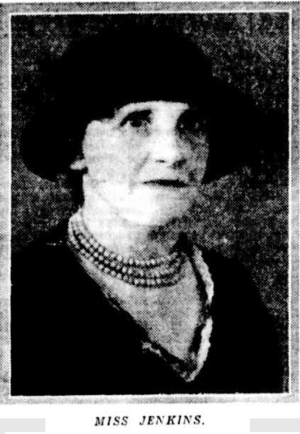
On 21 August 1915 Winifred departed Sydney on the RMS Morea bound for London. Travelling with her was fellow RPA Hospital trainee Mary Louisa Alice Vaughan Jenkins. The two planned to offer their services to the QAIMNSR upon arrival in the English capital.
Mary Vaughan Jenkins was five months older than Winifred. She was born on Callandoon Station in Goondiwindi district, Queensland and trained at the RPA from March 1904 to November 1907. She then obtained her midwifery certificate at the Women’s Hospital in Sydney (either Paddington or Crown Street). From March 1913 to September 1914, Mary studied dietetics in San Francisco, California. Upon the outbreak of war in 1914, she travelled overland to New York, sailed to England and proceeded to France, where she served from 21 December 1914 to 23 March 1915 with the AVH in Wimereux. She returned to Australia and then decided to join the QAIMNSR.
Winifred and Mary were far from the only Australian nurses aboard the Morea. Departing Sydney were 26 AANS nurses of No. 10 Australian General Hospital (AGH), bound for service in England – or so they believed. Eighteen more nurses of the same unit embarked at Port Melbourne on 24 August, and six more boarded in Adelaide, making a total of 50. The ship was also carrying 10 medical officers, eight masseuses (physiotherapists), and 500 AIF reinforcements.
Bypassing Fremantle, the Morea stopped at Colombo, Ceylon before arriving on 21 September at Port Tewfik, the port of Suez, in Egypt. Here the 50 AANS nurses were told that they would not after all be going to England with No. 10 AGH but would instead remain in Egypt as reinforcements for Nos. 1 and 2 AGHs in Cairo, both of which had arrived in Egypt on the Kyarra in January 1915. For reasons unknown No. 10 AGH had been disbanded before it had had the opportunity to serve anywhere.
The Morea then passed through the Suez Canal and entered the Mediterranean. Due to German submarine activity, Winifred and Mary disembarked in Marseilles on 27 September and proceeded overland to London, arriving on 4 October. On 11 October, while staying at 10 Leinster Square in Bayswater, quite possibly a nurses’ home, the two nurses completed their QAIMNSR application forms and signed their declarations. They were interviewed, their applications were accepted, and on 1 November they signed their agreement forms. Finally, on 3 November they were each appointed to the rank of staff nurse and posted to the Cambridge Military Hospital in Aldershot, Hampshire. They arrived the following day.
WINIFRED’S WAR SERVICE
After mobilising on 5 August 1914, the day after Britain declared war on Germany, the Cambridge Military Hospital became the first base hospital in Britain to receive battle casualties from the Western Front. Late at night on 30 August, a hospital train arrived at a government railway siding in Aldershot with around 200 wounded men from the battle of Mons. The casualties were transferred to the Cambridge Military Hospital and to the Connaught Military Hospital, also located in Aldershot. These were the first of many wounded who would arrive in Aldershot throughout the war.
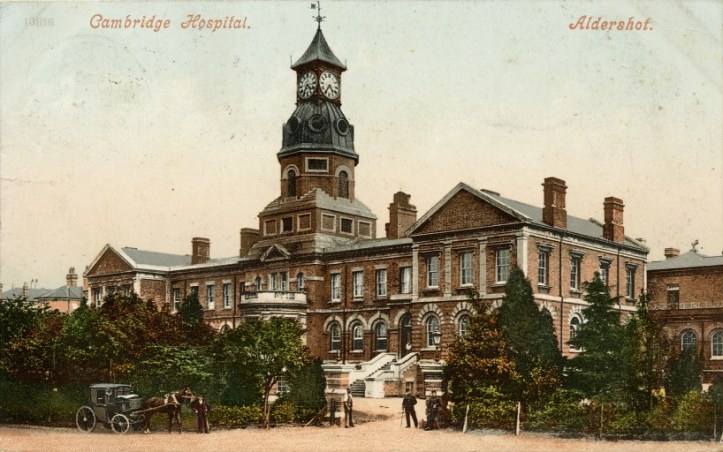
Winifred remained at the Cambridge Military Hospital until 24 July 1916. By then, the Somme Offensive had begun. The opening day of the offensive, 1 July, resulted in some 57,000 British casualties, of whom 20,000 were killed. During the first four days, ambulance trains carried more than 33,000 casualties from clearing stations to base hospitals in France. Many of these casualties were then evacuated to England. The Cambridge Military Hospital had prepared for an influx of patients, with an extra 200 beds opened, for instance, for the pioneering Plastic Surgery Unit – Britain’s first such unit – but even this proved inadequate.
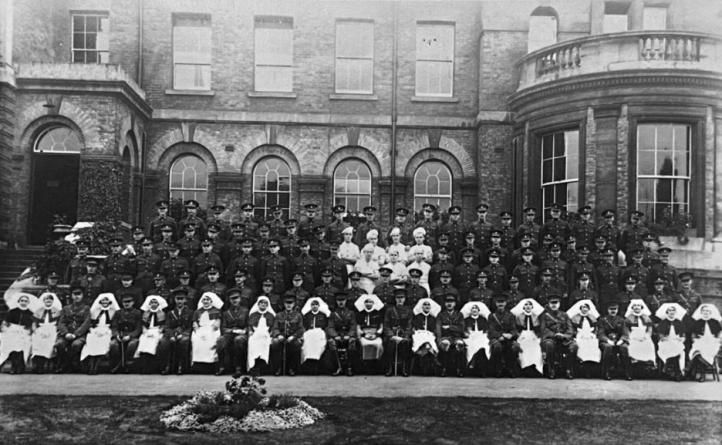
While Mary Vaughan Jenkins remained at Aldershot until 26 August 1917, Winifred was transferred to the Sutton Veny Military Hospital outside Warminster, Wiltshire on 25 July 1916. The hutted hospital, which lay between the town and the village of Bishopstrow, had opened earlier in 1916 with around 1,200 beds.
Winifred spent the next 16 months at Sutton Veny and in November 1917 was transferred No. 2 New Zealand General Hospital (NZGH) in Walton-on-Thames, Surrey.
In June 1915 the War Office had offered the Mount Felix estate, a large Italianate villa in extensive grounds in Walton-on-Thames, to the New Zealand War Contingent Association for use as a military hospital, and in August that year the New Zealand War Contingent Hospital was officially opened.
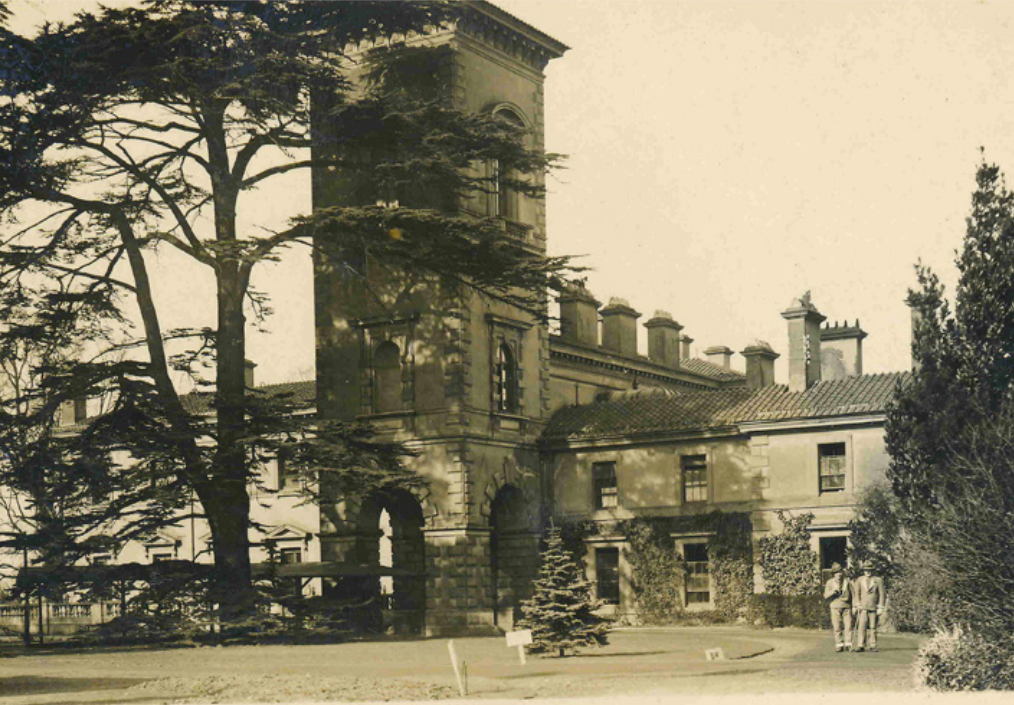
Casualties surged soon after the launch of the Somme Offensive, and the hospital took over the Oatlands Park Hotel in nearby Weybridge to use as an annexe. A month later, after a new hospital for New Zealand troops at Brockenhurst, Hampshire was designated No. 1 New Zealand General Hospital (NZGH), the New Zealand War Contingent Hospital was renamed No. 2 NZGH.
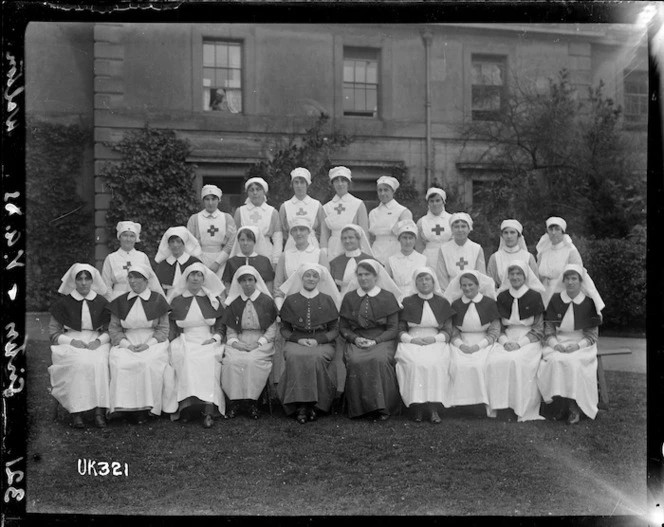
Winifred remained at No. 2 NZGH until September 1918. By then she had been away for more than three years and was ready to return to Australia. After securing working passage on a New Zealand transport ship, she took pre-embarkation leave in Ireland to see her friends – perhaps Mrs. M. A. Asle of Passage West, Cork, whom Winifred had listed on her QAIMNSR application as a referee. Soon it was time to return to England to commence her journey home. She booked a ticket on the RMS Leinster.
RMS LEINSTER
The RMS Leinster was an Irish ship operated by the City of Dublin Steam Packet Company. It carried mail between Kingstown (the port of Dublin, now called Dún Laoghaire) and Holyhead in Wales.
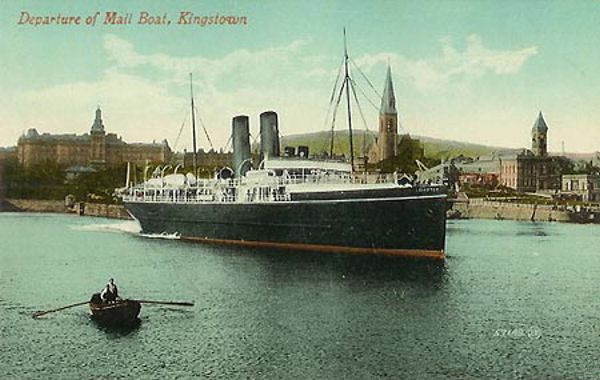
Shortly before 9.00 am on 10 October 1918 the Leinster left Carlisle Pier in Kingstown bound for Holyhead. The morning was dull, and the sea rough. The ship was crowded, with 78 crew and 735 passengers and others aboard, including 201 civilian men, women and children and 22 workers in the ship’s postal sorting room. The majority of the passengers were military personnel, Irish, English, Canadian, American, New Zealander, Australian, many going on or returning from leave. Among them was Winifred. There were lifebelts on board, but it was left to individual discretion whether to wear them, although most passengers did.
At around 9.50 am, when the Leinster had travelled about 30 kilometres, several of those on board saw a torpedo flash through the water in front of the ship. Somebody thought it was a porpoise. Soon afterwards a torpedo struck the port side where the postal sorting room was located, blowing a hole in the hull. The Leinster swung around and began to return to port. It was slowly sinking, but there was no undue panic as the lifeboats were lowered, and few casualties had been sustained.
Ten minutes later a second torpedo smashed into the Leinster amidships on the starboard side, practically severing the ship. The boilers blew up and then it was every man for himself. The Leinster sank soon afterwards, bow first.
Of the 813 people on board, 569 were lost – the greatest ever loss of life in the Irish Sea. Many of the survivors died while awaiting rescue when they were washed off their rafts in the high seas and drowned. Some simply let go of the flotsam they were clinging to, exhausted. Eventually the survivors were picked up and taken to hospitals in Kingstown and Dublin.
No trace of Winifred was ever found, and it was never confirmed that she had been a passenger on the Leinster. However, she was known anecdotally to have been aboard and was counted among the casualties of the sinking.
The torpedoes had been fired by the German submarine UB-123. Just 11 days later, while returning to Germany, UB-123 struck a mine in the North Sea. Everyone on board was lost.
IN MEMORIAM
Winifred’s name is fondly remembered in Australia and in England.
On 6 April 1921, a monument was unveiled at Wentworth Falls in memory of those connected with the area, including Winifred, who lost their lives during the war.
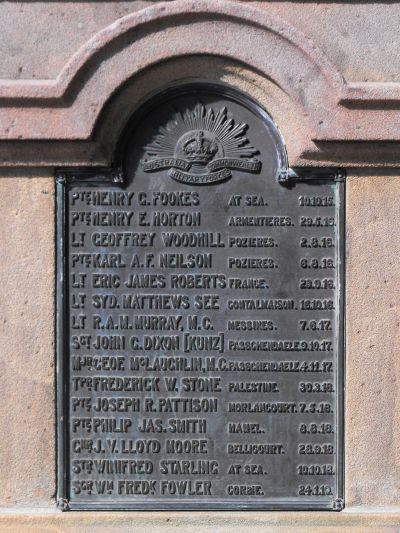
On 24 June 1925, the newly restored Five Sisters Window in York Minster, England was unveiled by the Duchess of York. The beautiful window was now dedicated to the memory of the women of the British Empire who gave their lives in the war of 1914–1918. Honour screens were also unveiled on which were inscribed 1,513 names, among them Winifred’s.
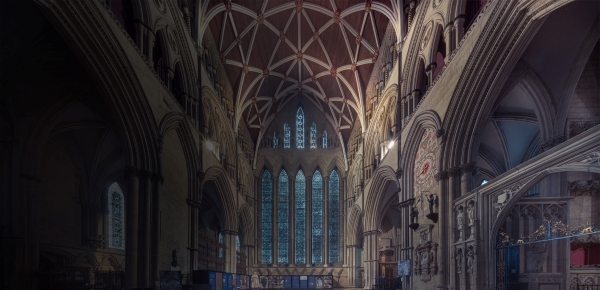
Many commemorative services were held across the British Empire to coincide with the dedication service at York Minster, including one held at the Sydney Town Hall. Winifred’s name was among 36 inscribed on a newly established honour roll.
We will not forget her.
POSTSCRIPT
Mary Vaughan Jenkins finished her war service on 23 April 1919 and remained in England. She trained as a sister tutor at King’s College for Women, University of London; gained membership of the Royal Sanitary Institute; sat for the examination of the Central Midwives’ Board in London (as her Australian midwifery certificate was not recognised); and lectured for three years on maternity, child welfare, and general health subjects for the London County Council. She returned to Australia in February 1924 and became a noted mother and child welfare educator. She died in 1939 in Neutral Bay, Sydney.
SOURCES
- Ancestry.
- Australian Nurses in World War 1 (website), ‘Vaughan-Jenkins, Mary Louise Alice.’
- Australian War Memorial, Australian and Red Cross Society Wounded and Missing Enquiry Bureau Files, 1914-18 War: Nurse Winifred Starling, AWM 1DRL/0428.
- The Australian Women’s Register, ‘Methodist Ladies’ College (MLC), Sydney (From 1914–1977).’
- British Forces Broadcasting Service, Forces News, ‘The proud history of Aldershot’s forgotten military hospital,’ by John-Paul Tooth (31 Oct 2017).
- Butler, J., ‘Very Busy in Bosches Alley’: One Day of the Somme in Sister Kit McNaughton’s Diary,’ Health and History, 2004, Vol. 6, No. 2, Military Medicine (2004), pp. 18–32.
- City of Canada Bay Heritage Society, ‘Lansdown House.’
- Dunlop, E. (1974), Harvest of the Years: The Story of Burwood 1794–1974.
- Elmbridge Museum, ‘The Mount Felix War Hospital.’
- Friends of the Aldershot Military Museum, ‘The Cambridge Military Hospital, Aldershot.’
- Lost Hospitals of London, ‘No. 2 New Zealand General Hospital.’
- Lost Hospitals of London, ‘Victoria Hospital for Children.’
- The National Archives (UK), Mary Vaughan-Jenkins, WO 399/8550
- The National Archives (UK), Winifred Starling, WO 399/7901.
- National Archives of Australia.
- The Sinking of the RMS Leinster (website).
- Wikipedia, ‘Five Sisters window.’
- Wikipedia, ‘MLC School.’
- Wyong Family History Group Inc.
SOURCES: NEWSPAPERS AND GAZETTES
- The Advertiser (Adelaide, 19 Sept 1934, p. 10), ‘The Woman’s World.’
- The Argus (Melbourne, 15 Feb 1924, p. 16), ‘Women’s Views and News.’
- The Daily Telegraph (Sydney, 7 Feb 1903, p. 11), ‘Shipping.’
- The Daily Telegraph (Sydney, 26 Sept 1896, p. 11), ‘Bazaar at Burwood Wesleyan Ladies’ College.’
- The Daily Telegraph (Sydney, 13 Aug 1885, p. 1), ‘Family Notices.’
- The Daily Telegraph (Sydney, Fri 3 Jul 1908, p. 4), ‘Trained Nurses’ Association.’
- Evening News (Sydney, 19 Jan 1870, p. 3), ‘Police Courts, This Day.’
- Evening News (Sydney, 13 Jul 1883, p. 3), ‘Presentation.’
- Lithgow Mercury (NSW, 8 Apr 1921, p. 3), ‘Wentworth Falls.’
- The Moreton Bay Courier (Brisbane, 14 Jul 1849, p. 3), ‘Domestic Intelligence.’
- New South Wales Government Gazette (Sydney, 10 Nov 1857 [Issue No.164], p. 2135), ‘No. 21. List of Unclaimed letters for the Month of October 1857.’
- New South Wales Government Gazette (Sydney, 22 Jan 1869 [Issue No.14], p. 193), ‘Notice Under Real Property Act.’
- New South Wales Government Gazette (Sydney, 10 Jun 1870 [Issue No.141], p. 1261), ‘Pursuant to an order of the Supreme Court of New South Wales…’
- Old Times (Vol. 1, No. 1, Apr 1903), ‘W. H. Paling & Co. Limited.’
- The Sydney Mail and New South Wales Advertiser (26 Sept 1885, p. 679), ‘Supreme Court.’
- The Sydney Morning Herald (11 May 1867, p. 1), ‘Family Notices.’
- The Sydney Morning Herald (15 Jun 1869, p. 1), ‘Family Notices.’
- The Sydney Morning Herald (30 Oct 1871, p. 1), ‘Family Notices.’
- The Sydney Morning Herald (2 Dec 1873, p. 1), ‘Family Notices.’
- The Sydney Morning Herald (3 Jul 1875, p. 7), ‘Mercantile and Money Article.’
- The Sydney Morning Herald (14 Jul 1876, p. 1), ‘Family Notices.’
- The Sydney Morning Herald (23 Nov 1878, p. 1), ‘Family Notices.’
- The Sydney Morning Herald (6 Jan 1881, p. 1), ‘Family Notices.’
- The Sydney Morning Herald (6 Jun 1885, p. 13), ‘Property Sales.’
- The Sydney Morning Herald (3 Aug 1885, p. 8), ‘Overland Passenger Traffic.’
- The Sydney Morning Herald (4 Dec 1885, p. 3), ‘Advertising.’
- The Sydney Morning Herald (8 Dec 1885, p. 2), ‘Advertising.’
- The Sydney Morning Herald (14 Jan 1893, p. 7), ‘Sydney Technical College and Branch Schools.’
- The Sydney Morning Herald (21 Aug 1915, p. 15), ‘R.M.S. Morea’s Passengers.’
- The Sydney Morning Herald (25 Jun 1925, p. 10), ‘Women’s Memorial.’
- The Sydney Morning Herald (29 Sept 1939, p. 8), ‘Family Notices.’
 australianwarnurses.org