AANS │ Lieutenant │ Second World War │ Malaya │ 2/13th Australian General Hospital
Family Background
Wilma Elizabeth Forster Oram was born on 17 August 1916 in Glenorchy, a small town in Victoria’s Wimmera district. She was the middle child of five born to Jane (Janie) Forster (1881–1968) and Alfred John (Alf) Oram (1886–1966).
Janie and Alf both grew up in the locality of Joel Joel, near Stawell in Victoria, and were married on 27 July 1910 at St. John’s Church in Albany, Western Australia. At the time Alf was managing a property at Pingelly, in Western Australia’s Wheatbelt.
When Janie became pregnant, she returned home to her family at Joel Joel while Alf stayed at Pingelly. He was not present when John Alfred Forster (Jack) was born in June 1911. Janie returned to Pingelly with baby Jack and convinced Alf to return to Victoria with them.
By the time Janie’s and Alf’s second child, Phyllis Annie Forster, was born in January 1914, Alf had bought on leasehold a parcel of the Minnieboro Estate near Stawell. Later the family moved to Glenorchy, around 30 kilometres to the west of Joel Joel, where Alf was working another leasehold farm – and where Wilma was born in 1916.
In 1919 the family moved to a 750-acre wheat farm halfway between Rupanyup and Murtoa, a little way north of Glenorchy. Once again Alf held the property on lease but in time bought it outright. Here, in March 1919, Wilma’s younger brother, Lancelot Clive Forster (Lance), was born.
Growing Up
In 1922 Wilma began her schooling at Murtoa State School. With older brother Jack, who attended the Higher Elementary school, and sister Phyllis, she would travel by horse and gig, leaving at 7.00 am in order to arrive by 9.00.
In October 1923 Wilma’s younger sister, Patricia (Pattie or Pat) Kathleen Forster, was born, and the family was now complete. The following year, when Wilma was in her third year of school, Alf sold the farm and moved the family to ‘Troon,’ a large house on Munro Street in Murtoa. He became a garage owner instead.
In 1928 Wilma began attending Murtoa Higher Elementary. Later that year, Alf sold his garage and in September or October bought the 1,800-acre North Minnieboro Estate. This was part of the same estate that had once belonged to pioneering sheep farmer Charles Ayrey, another part of which Alf had previously farmed. The family stayed in Murtoa while Alf commuted between home and the farm in his Singer automobile. Wilma would often go with him, but Janie insisted that Alf bring her home each night.
At the end of 1932 Wilma completed her schooling at Murtoa Higher Elementary School and gained her Intermediate Certificate. She attempted her matriculation through correspondence classes, but the enterprise proved too difficult.
Nursing
In October 1934 Wilma began training as a nurse at Warrnambool Base Hospital, taking an opportunity that was originally offered to her sister Phyllis. On her first day at Warrnambool, she met a nurse by the name of Mona Wilton, who came from a dairy farm nearby at Allansford. Mona was three years older than Wilma and the two became good friends. Wilma became a regular visitor to Mona’s family’s dairy farm.
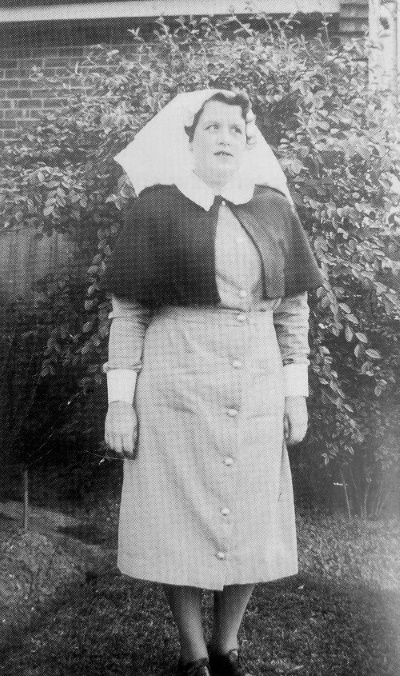
Mona completed her training in April 1937 and moved to Daylesford Hospital. Wilma finished her training nine months later, in January 1938, and immediately moved to Melbourne to take up a position as staff nurse at Jessie McPherson Private Hospital, which functioned as the private section of the Queen Victoria Memorial Hospital. She stayed at Jessie McPherson for two-and-a-half years, working as a theatre nurse for the duration. In 1940 she met a nurse at the hospital who had recently moved to Melbourne, and with whom Wilma would later develop a strong friendship – Vivian Bullwinkel. In mid-1940 Wilma resigned from Jessie McPherson and moved to the Women’s Hospital (which became ‘Royal’ in 1954) to begin training in midwifery.
It was during this time that Wilma met a man by the name of Alan Young, possibly at East Brighton. Alan had purchased some land in the locality of Cardinia, to the east of Melbourne on the western fringes of Gippsland. He was slowly clearing it and was already keeping several dairy cows. However, whatever relationship Wilma and he had struck up by this stage was interrupted by the outbreak of war.
Enlistment
Like so many of her nursing peers, Wilma was motivated to join Australia’s armed forces after hearing the news in May 1940 that Germany had invaded the Low Countries and France and was threatening Britain. Unable to decide whether to join the Australian Army Nursing Service (AANS) or the Royal Australian Air Force Nursing Service, which was only established on 26 July 1940, Wilma took a medical examination and filled out an application form for each. After running into her old friend from Warrnambool, Mona Wilton, who told Wilma that she had joined the AANS, Wilma was no longer unsure and posted her AANS application.
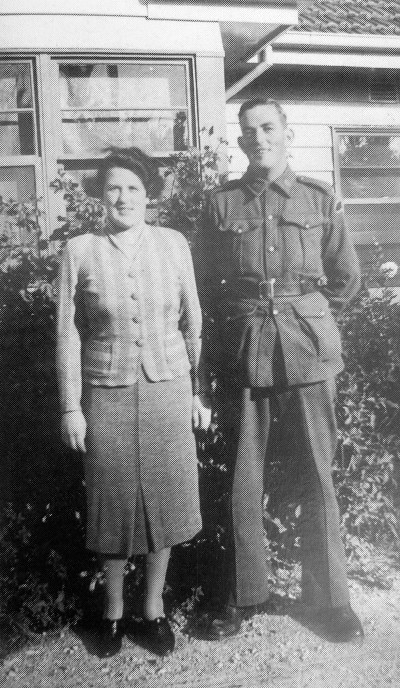
Wilma’s application was successful, and on 12 March 1941 she attended the recruitment centre on William Street in Melbourne and enlisted for home service with the Citizen Military Forces (CMF). On 23 April she was posted to the 115th Australian General Hospital (AGH) in Heidelberg, in Melbourne’s northern suburbs. Two months later Wilma enlisted for service abroad with the 2nd Australian Imperial Force (AIF). On 2 July her appointment to the CMF was terminated upon her secondment to the 2nd AIF. She was posted to the Ambulance Sea Transport unit but detached to the 115th AGH, thus remaining at Heidelberg. She then went on pre-embarkation leave.
On 15 August Wilma was appointed to the 2/13th AGH after being offered the chance to transfer to this unit from the Sea Transport Unit. She was giddy at the prospect of going overseas. The 2/13th AGH had been raised in early August at Caulfield Racecourse in Melbourne following a request for an additional AGH to join the 2/10th AGH in Malaya. The 2/10th AGH, together with the 2/4th Casualty Clearing Station (CCS), the 2/9th Field Ambulance, and several smaller medical units, had sailed in February on the Queen Mary with the nearly 6,000 troops of the 8th Division, who were helping to garrison the British colonial possession.
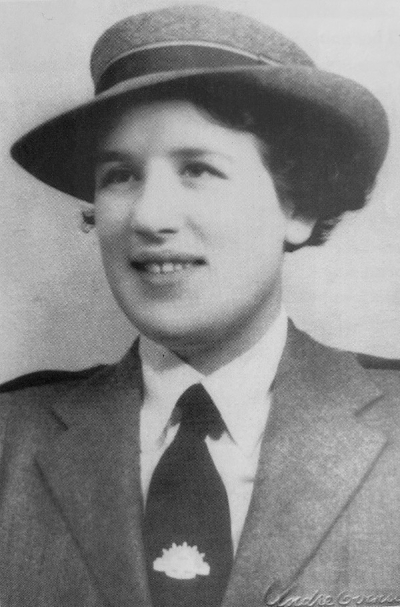
On 1 September Wilma was taken on strength by the 2/13th AGH and transferred from Heidelberg to the Lady Dugan Hostel in South Yarra, where around 24 Victorian, South Australian and Tasmanian nurses attached to the 2/13th AGH had been posted prior to embarkation the following day. Among the Victorian nurses were Wilma’s good friend from Warrnambool, Mona Wilton, and Vivian Bullwinkel from Jessie McPherson. Wilma and Mona were very happy to see each other again. When Mona wrote a letter to their mutual friend Sheilah Jenkin, Wilma slipped in a note. “Mona and I are together, which is absolutely marvellous, and unexpected,” she wrote. “We are thrilled, and at the stage when we can’t think very well” (quoted in Angell, p. 37).
AHS Wanganella
At approximately 9.00 am the next morning the 24 nurses were taken by bus from South Yarra to Port Melbourne, where they boarded the 2/2nd Australian Hospital Ship Wanganella. The newly commissioned hospital ship had left Sydney on 29 August with a contingent of 2/13th AGH personnel from New South Wales and Queensland that included around 19 AANS nurses. Later that day the Wanganella slipped out of Port Phillip Bay and headed out into Bass Strait. Alf Oram was there to see his daughter sail away.
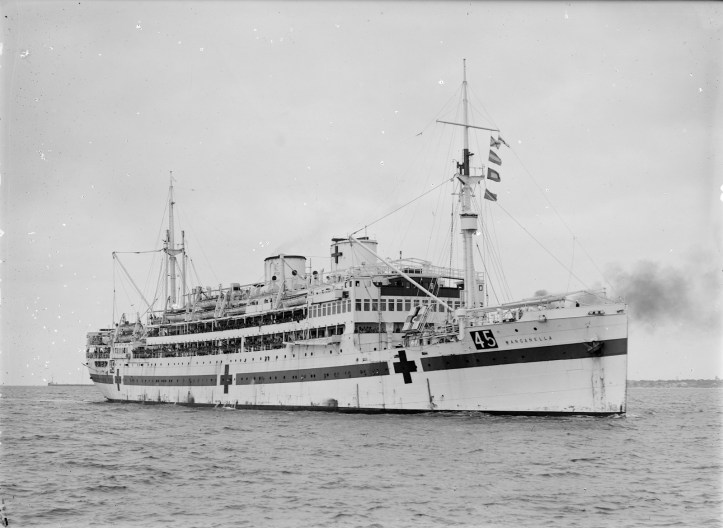
Wilma shared a cabin with Mona during the voyage, and both suffered seasickness during a particularly rough crossing across the Bight. Six days later the Wanganella pulled into Fremantle, and as it did so those on board stared in awe at the enormous passenger liners turned troopships Queen Mary and Queen Elizabeth, both at anchor in Gage Roads, Fremantle’s outer harbour. They were too massive to enter the inner harbour. Wilma and Mona enjoyed a 36-hour layover in Perth, and by the time the Wanganella sailed again late in the day on 9 September, seven more AANS nurses had joined the cohort.
The following day Wilma and her colleagues were officially told that they were going to Malaya. Several of them expressed disappointment at the thought of missing out on the action elsewhere. How wrong they would prove to be.
Malaya
The Wanganella arrived at Keppel Harbour on Singapore Island on 15 September and berthed at Victoria Dock. Wilma and Mona disembarked with most of their colleagues and were taken by bus to St. Patrick’s School, located in Katong on the south coast of the island, where the 2/13th AGH would be based for the time being. Vivian and nine other nurses, however, were detached to the 2/10th AGH and entrained for Malacca on the Malay Peninsula, where the unit was based.
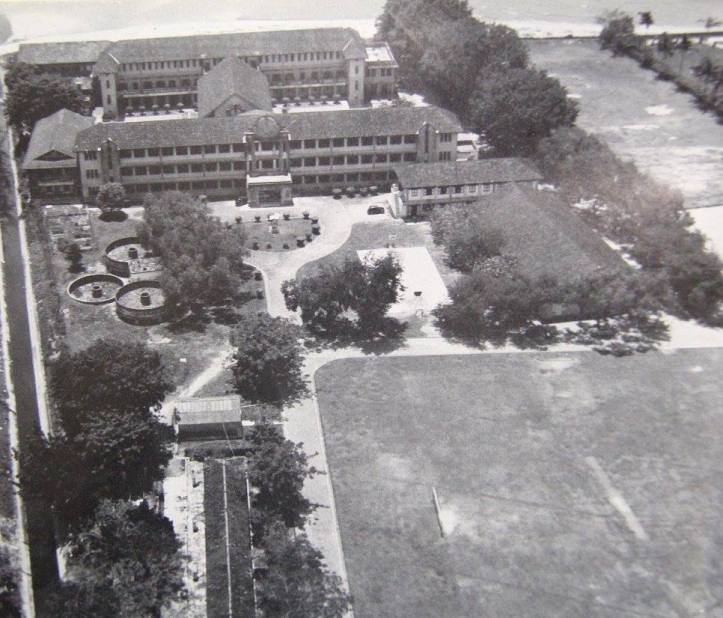
Although the nurses were disappointed at being separated from their colleagues, there was in fact no work for the 2/13th AGH nurses to do at St. Patrick’s School, and detachments to the 2/10th AGH and to the 2/4th CCS gave the newcomers an opportunity to learn tropical nursing from their experienced peers. On 13 October Wilma herself was detached to the 2/4th CCS, which at the time was based in an unfinished psychiatric hospital in Tampoi, in the south of the Malay Peninsula – the same site, as it happened, into which the 2/13th AGH would in due course move.
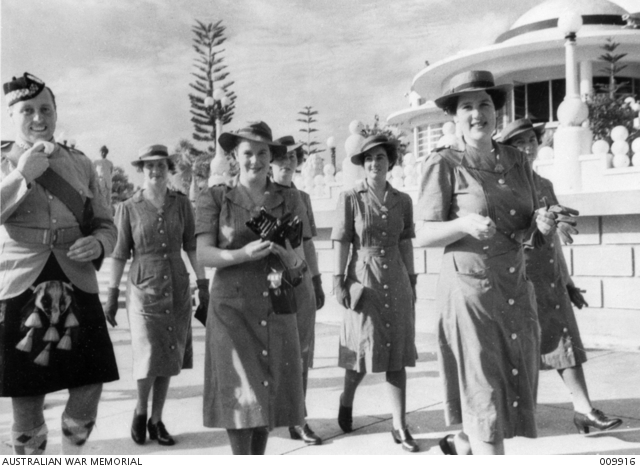
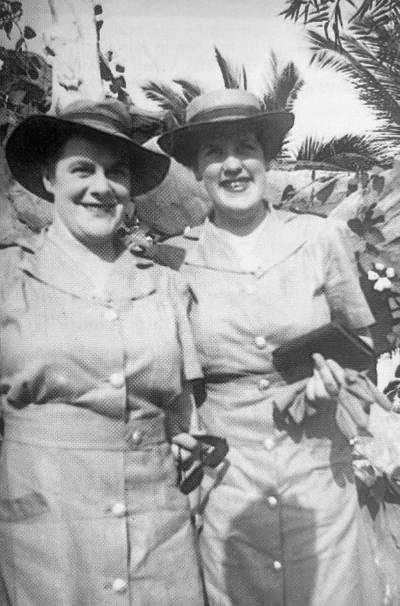
Wilma rejoined her unit on 23 November – or rather they rejoined her, since by then the 2/4th CCS had moved north to Kluang and the 2/13th AGH had begun the process finally of moving into the Tampoi site. It was something of a challenge to bring the hospital up to speed, but between the nurses and the orderlies they soon managed to have a functioning hospital of some 600 beds.
War
On 8 December the pleasant life that the nurses had been enjoying in Malaya came to an abrupt halt when Japan invaded from the north. Many decades later, in an obituary she wrote for Vivian Bullwinkel in 2000, at the very end of her own life, Wilma briefly described the events of the next two months.
In December, the Japanese attacked Malaya and we were at war [she wrote]. Singapore was bombed and the Japanese began fighting their way down the [Malay] Peninsula towards the island of Singapore.
The fighting was fierce and the casualties heavy. The hospital was desperately overcrowded, and the hours of work were long and arduous.
In January 1942, our hospital was evacuated [back] to Singapore Island, and at great speed we had to transform St Patrick’s School into a hospital.
We had to work under constant bombardment, and by 10 February it became obvious that matters were working up to a climax.
On 12 February, with only an hour’s notice, six of our nursing colleagues were ordered to evacuate … aboard a Chinese vessel, the Wah Sui [aka Wusueh]. A further 60 nurses sailed the next morning … aboard the Empire Star.
Imagine the dismay … when the remaining 65 nurses were finally ordered to be evacuated on the Vyner Brooke. Our pleas to stay went unheeded and we boarded the overcrowded ship along with many other civilian evacuees during a heavy bombing raid.
The ship set sail just as darkness set in, and it was a never-to-be-forgotten scene: huge fires were burning along the whole front of Singapore and a heavy pall of black smoke hung over the island.
The next day the ship tried to hide behind islands and avoid detection. Eventually we reached the Bangka Strait.
After dodging bombs from Japanese planes, we received three direct hits at 2pm on 14 February. The ship sank in 15 minutes.
Prisoners of Japan
As the bombs exploded the nurses prepared for evacuation, treating the wounded as best they could, before abandoning ship with the rest. Some were helped into lifeboats, others clung to rafts. Those who could swim made for nearby Bangka Island. Wilma’s legs had been badly gashed by flying glass, but she nevertheless managed to attend to a fatally wounded elderly Englishman. After she and Mona Wilton jumped into the sea, Wilma received a blow to her head from a falling life raft and was knocked unconscious. Tragically Mona was killed in the same incident.
When she regained consciousness, Wilma managed to find a raft and was joined by a certain Mrs. Dorothy Gibson. That night the two of them were sitting quietly on the raft, drifting in the current, when they were almost run down by a Japanese fleet in the act of invading Sumatra and Bangka Island. At daybreak the following morning Wilma and Mrs Gibson came ashore on Bangka Island and were promptly captured by Japanese soldiers and taken to the town of Muntok.
Of the 65 Australian nurses aboard the Vyner Brooke, 12 were lost at sea following its sinking, while 53 made it to Bangka Island. Of these, 21 were murdered by Japanese troops when their lifeboats came ashore on a beach near Muntok. Vivian Bullwinkel survived the massacre and eventually joined the remaining 31 nurses, among them Wilma, who had been captured and interned. They were to remain prisoners of war for the next three and a half years.
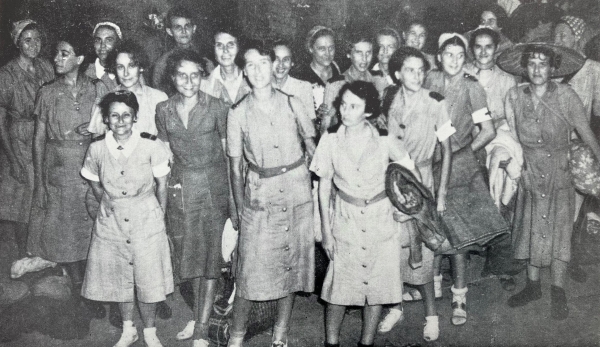
Wilma and her comrades were finally rescued on 16 September 1945, a month after Emperor Hirohito announced Japan’s surrender. During their time in captivity, they had been moved from one hellish camp to another in Sumatra and on Bangka Island. Eight of their colleagues had died. On 5 October, after a period of recuperation in Singapore, Wilma and the other survivors boarded the AHS Manunda bound for Australia. They arrived in Fremantle on 18 October.
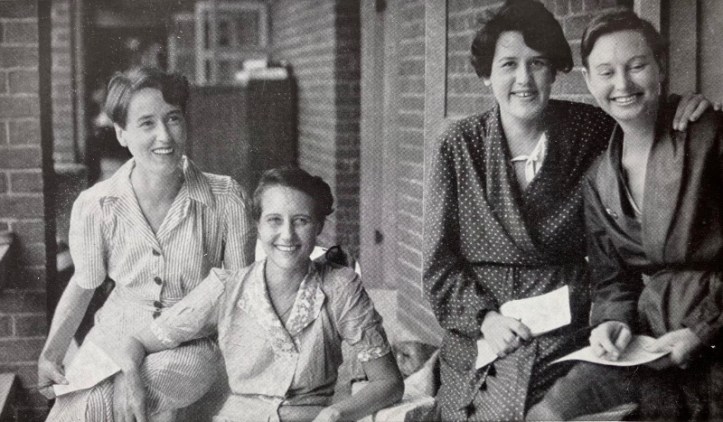
The ship continued to Melbourne. Wilma and the other Melbourne-based nurses were taken to the 115th AGH, by now known as the Heidelberg Military Hospital, where they spent time recovering. When they were deemed strong enough, the POW nurses were granted leave. Wilma and Vivian Bullwinkel embarked on a tour of the country.
Life after war
Wilma was discharged from the army on 5 July 1946 at the rank of captain. She took a position at the Heidelberg Military Hospital, but soon resigned to take up work at a GP clinic in Footscray. Here she stayed until the end of 1947.
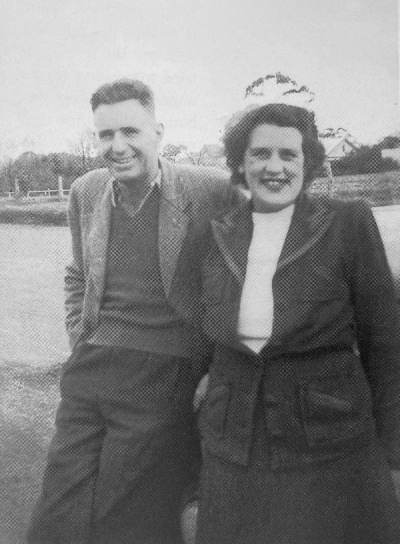
On 5 December 1947 Wilma married Alan Young. Alan, who had himself been a POW during the war, still had his dairy farm in Cardinia, and here Wilma and he went to live after their marriage.
After her marriage, Wilma got on with the rest of her life, but her AANS comrades were never far from her thoughts. She maintained regular contact with Vivian Bullwinkel, Betty Jeffrey and Beryl Woodbridge, and saw various others at reunion events. In what must have been a particularly poignant ceremony, in March 1953 Wilma unveiled a memorial window at Warrnambool Base Hospital dedicated to her fallen friend and colleague Mona Wilton.
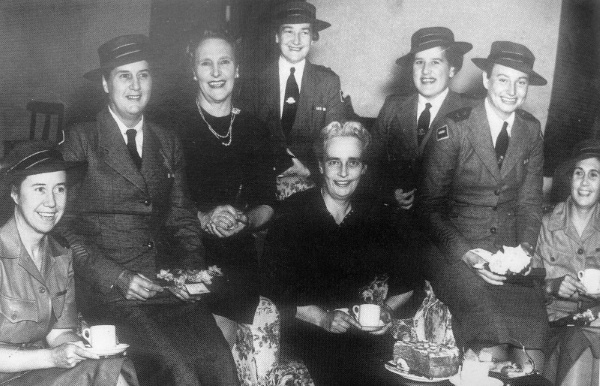
Wilma’s involvement in community activities increased as the years passed. In October 1962 she was appointed superintendent of the Red Cross in Pakenham and in 1963 became president of the Koo Wee Rup High School Ladies’ Auxiliary. In the later 1960s she helped to establish a branch of the Red Cross in Officer. From 1968–1972 she was president of the Pakenham sub-branch of the Returned Services League (now the Returned & Services League), after which she became the sub-branch’s welfare officer – a position she held until her death. In 1986 Wilma was made a life member of the RSL.
On 8 June 1998 Wilma received due recognition for her service to the welfare of ex-service personnel, particularly ex-servicewomen, and to the community, when she was appointed a Member of the Order of Australia. The following year she was a member of the funding committee for the Australian Service Nurses National Memorial, which was unveiled on Canberra’s Anzac Parade in October 1999.
When her friend and colleague Betty Jeffrey died in 2000, Wilma presented a moving eulogy at the memorial service held on 20 September at St. Peter’s Church in Melbourne. “We have lost a gifted and sincere friend,” she said. “My personal loss is very great, and in the words of Margaret Dryburgh, ‘How silent is this place. A hush enfolds me, deep as I have known.’”
Wilma Elizabeth Forster Young AM died on 28 May 2001 at the age of 84. She had lived a rich and varied life and had known great joy and great sorrow.
Sources
- Ancestry.
- Angell, B (2003), A Woman’s War: The Exceptional Life of Wilma Oram Young AM, New Holland Publishers.
- Australian Nursing Journal (Vol. 8. No. 2, Aug 2000, p. 6), ‘Vale Vivian Bullwinkel: A friend remembers.’
- Jeffrey, B. (1954), White Coolies, Angus & Robertson Publishers.
- Manners, N. G. (1999), Bullwinkel, Hesperian Press.
- National Archives of Australia.
- Shaw, I. W. (2010), On Radji Beach, Pan Macmillan Australia.
- Simons, J. E. (1956), While History Passed, William Heinemann Ltd.
- The Sun News-Pictorial (Melbourne, 8 Oct 1928, p. 30), ‘Country News from All Parts.’
 australianwarnurses.org