AANS │ Temporary Head Sister │ First World War │ Egypt, France & England │ No. 1 Australian General Hospital, HMHS Grantully Castle, HMHS Guildford Castle, No. 14 Australian General Hospital, No. 5 General Hospital, No. 42 Casualty Clearing Station, No. 25 General Hospital & No. 3 Australian Casualty Clearing Station
FAMILY BACKGROUND
Valerie Henrietta Zichy-Woinarski was born on 24 June 1886 in Ballarat in central Victoria’s goldfields region. She was the daughter of Flora Dundas Robertson (1860–1942) and Stanislaus Emil Antony Zichy-Woinarski (28 April 1857–5 April 1920).
Both of Valerie’s parents had interesting backgrounds. Flora Robertson was born in 1860 in Fatehgarh, Bengal Presidency, British India to Alexandrina Frances Wallace-Dunlop (1840–1919) and Henry Dundas Robertson (1829–1867), Alexandrina’s first cousin. Following Henry’s death in India, Flora and her brother, Alexander, were brought to Victoria by Alexandrina to live in the Western District with their paternal grandmother, Jemima Vans Wallace-Dunlop (1800–1884). Jemima Vans Wallace-Dunlop was an indomitable woman who owned an 18,000-acre property, ‘Connewarren,’ which stretched between Hexham, Mortlake and Ellerslie. While Alexander was sent off to school in England, Flora remained at Connewarren – where, on 26 July 1883, she married a medical practitioner by the name of Stanislaus Zichy-Woinarski.
Stanislaus Zichy-Woinarski was born in Ballarat in 1857 to Henrietta Zukermann (1836–1906) of Kaminitz Podolska/Kamianets-Podilskyi (today in western Ukraine) and Gyorgy (George) Gustav Zichy-Woinarski (1824–1891) of Teschen/Cieszyn, Silesia (today in southern Poland). Gyorgy’s father, Count Zichy, had married the Countess Wojnarski, and Gyorgy had taken the conjoint name of Zichy-Woinarski. He studied law and in 1848 became an officer in the Polish Legion. In 1848 he joined the rebel army of Hungarian nationalist Lajos Kossuth and at one time was aide-de-camp to a certain Prince Woroniecki. When the Austrians defeated the Hungarian uprising with Russian help, Gyorgy and other members of the Polish Legion fled to England via Ottoman Turkey and in 1851 fetched up in Liverpool. In 1852 Gyorgy migrated to Australia on the Minnesota and joined other veterans of the Polish Legion on the goldfields of central Victoria. In 1856 George, as he was now known, and his business partners acquired the Universal Hotel and the Restaurant Polonais-Français, both in the Ballarat area, from a certain Hyman (or Hyam) Zuckermann. In the same year George married Hyman’s daughter, Henrietta, in Ballarat. Over the coming years they had at least 11 children, of whom Stanislaus was the eldest. George Zichy-Woinarski died on 30 January 1891 at his home at 220 Victoria Street in Melbourne.
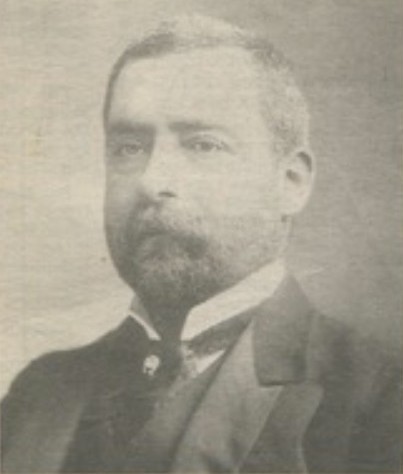
By then Stanislaus had become a successful doctor. After attending school at Melbourne Grammar, he had studied medicine at the University of Melbourne, graduating in 1879 and becoming a resident surgeon at Melbourne Hospital. In 1881 he became public vaccinator for Clunes, near Ballarat, and by May 1881 was acting resident surgeon at Clunes Hospital. In December 1881 Stanislaus departed Clunes for Ballarat, where he commenced general practice. In November 1882 he was appointed health officer for Ballarat.
EARLY LIFE
Following their marriage, Flora and Stanislaus lived at Cardigan Terrace, 204 Sturt Street in central Ballarat, where Stanislaus’s practice was located. On 20 October 1884 Flora gave birth at home to their first child, Alexandrina Vans, known as Nina.
Soon after Nina’s birth, Stanislaus began to organise the construction of the family’s new home (which was also to be his surgery) and in January 1886 the Zichy-Woinarskis moved into ‘Woynarufka,’ their brand-new, two-storey, red-brick residence at 188 Sturt Street. (In 1906 Ballarat’s street numbering changed and the Zichy-Woinarskis’ address became 710 Sturt Street. Today the building is home to the Vera Hotel.)
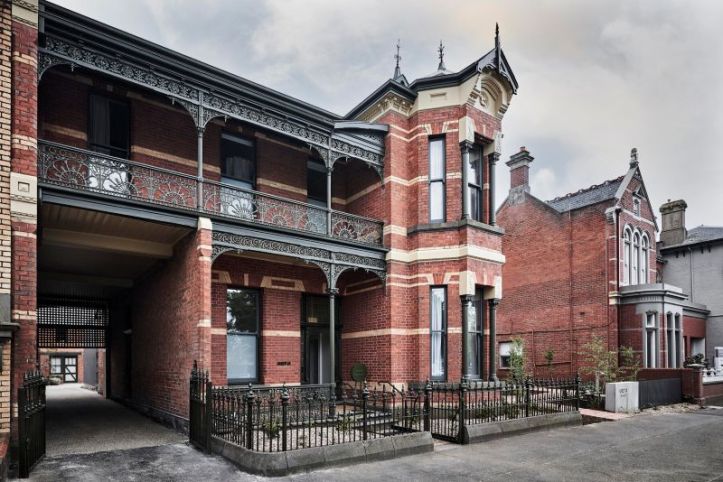
Meanwhile, Stanislaus’s career was progressing nicely. In early 1885 he was elected one of two honorary physicians of Ballarat Hospital and by mid-1886 had asked to be relieved of the duty of shire health officer, as he was now too busy. In 1892 he passed the examination for the Fellowship of the Royal College of Surgeons, Ireland. He then presented himself for examination in London for the Fellowship of the Royal College of Surgeons, England, returning to Australia in early 1893 on the Australasian as ship’s medical officer.
Flora Zichy-Woinarski was busy too, looking after numerous children. Nina’s birth in October 1884 had been followed in June 1886 by that of Valerie. Then came Aniella Flora, known as Nellie, who was born on 12 February 1888, and George Alexander Stanislaus, born on 10 July 1890. Constance Olga was born on 23 March 1894 but died three days later. Ladislas Casimir Henry was born on 10 January 1896 and died on 14 February 1897, aged 13 months. Finally, Bazia Antonia Christabel, known as Nonie, was born on 30 November 1900. Flora and Stanislaus now had five hungry mouths to feed – and five minds to nourish. In this regard, they made sure that their children received a good education.
SCHOOL AND NURSING
The Zichy-Woinarski girls attended Queen’s College, an Anglican girls’ school established in Ballarat in 1876. Valerie and Nina appear to have begun at Queen’s in 1893, Valerie in Form II, Nina in Form III, while Nellie’s first year was 1894.
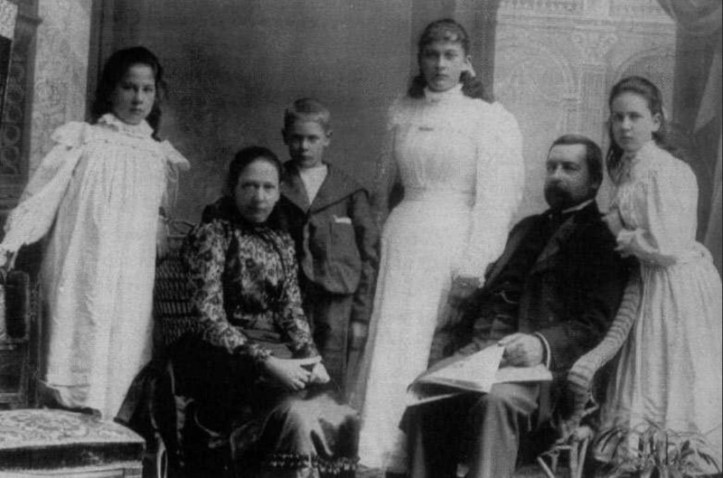
In her earlier years at Queen’s Valerie demonstrated prodigious academic talent, winning practically every honour prize in every subject. She fell away slightly in the higher year levels but still achieved excellent results, with History, Geography and French her best subjects. In her final year, 1902, she was awarded a special prize for French Conversation. Nina and Nellie meanwhile were demonstrating academic brilliance of their own.
One of Valerie’s fellow pupils at Queen’s was a girl by the name of Gertrude Monroe, known as Gertie. Gertie was four years older than Valerie and two forms higher. She was extremely capable academically and conducted herself impeccably.
After leaving school, Valerie decided to become a nurse and was taken on as a probationer at Ballarat Hospital. She trained in infectious diseases nursing, perhaps concurrently with general nursing, and also gained experience in surgical nursing; at one time she was in charge of the operating theatre. On 21 December 1909 she became registered with the Royal Victorian Trained Nurses’ Association. Later she worked in private hospitals and in a private nursing capacity.
Gertrude Munro too had decided to become a nurse and in early 1908 began as a probationer at Ballarat Hospital, likely crossing paths once again with Valerie. Later, when war broke out, Gertrude joined the Australian Army Nursing Service (AANS) – as did Valerie.
On 2 July 1906, while Valerie was likely still training, her paternal grandmother, Henrietta Zichy-Woinarski, sometimes referred to as ‘Countess,’ died at her residence, ‘Wojna,’ on Erskine Street in Toorak. She had outlived her husband, George (Gyorgy), by 15 years.
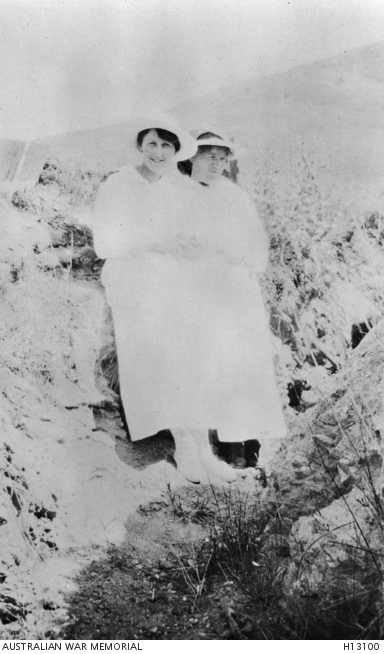
On 3 April 1907 Valerie’s paternal aunt Aniella Victoria Zichy-Woinarski married Thomas Mulhall King, the Auditor-General of Queensland, in a ceremony held at St. Peter’s Church in East Melbourne. Thomas King had previously been married and had 10 children, of whom seven were living. Among those seven were Eileen and Amy King. They too became nurses and served with the AANS during the war. Indeed, Amy and Valerie served together for long periods.
In March 1912 Stanislaus and Flora Zichy-Woinarski left Ballarat after 30 years to move to their seaside property, ‘Wolfdene,’ in Mornington, southeast of Melbourne, which they had owned since 1901. Stanislaus was ailing and unable to attend the farewell tendered to them by their friends and acquaintances in Ballarat. Valerie, Nina and Nonie remained with him while Nellie attended with their mother. In that same month Valerie’s brother, George, was married to Helen Turnbull of Benalla. Another marriage took place on 18 December, when Nina was married to Captain Dundas Keith Macartney of Ilfracombe, Queensland at St. Peter’s Church in Mornington. Valerie and Nonie were their sister’s bridesmaids, and the reception was held at Wolfdene. Only two months later, Valerie was bridesmaid once again when Nellie married Dr Arthur Youl Nankivell on 11 February 1913. Once again, the reception was held at Wolfdene.
THE AUSTRALIAN ARMY NURSING SERVICE
On 5 August 1914 Australia went to war. Prime Minister Joseph Cook was already committed to sending an expeditionary force of 20,000 men to wherever they were needed, and by 8 September the Australian Imperial Expeditionary Force – or simply the Australian Imperial Force (AIF) – had been raised to the last man.
Hundreds of Australian nurses applied to accompany the force overseas; by 13 August, Colonel Charles Ryan, principal medical officer, Victoria, had already received around 500 applications. At this stage army authorities were uncertain whether to take any nurses at all, but eventually applications were sought from among the nurses of the Australian Army Nursing Service (AANS) Reserve.
The AANS had come into being on 1 July 1902, following the change from state to federal organisation of the military forces of Australia. Only a fully trained and certificated nurse could join the service. She remained ‘efficient’ by annually qualifying in first aid and attending three out of four lectures on Organization of Military Hospitals, Hygiene, and Military Surgery.
By late September, 25 AANS nurses had been chosen from the AANS Reserve, five of whom were Second Boer War veterans – including Nellie Gould, who would lead the contingent as principal matron. On 1 November the AIF and the 25 nurses departed from Albany, Western Australia in 28 transport ships. Ten other transports carrying 10,000 New Zealand troops sailed with them. Seven warships protected the 38 ships, and together they became known as the first convoy.
Those on board were expecting to sail to Europe but on 3 December the convoy arrived in Alexandria, Egypt. The AIF men established Mena Camp in the shadow of the Pyramids on the southwestern outskirts of Cairo, while most of the 25 AANS nurses were posted to nearby Mena House, a former hunting lodge turned luxury hotel, where a British military hospital had been established. The other nurses were detailed for duty to the Egyptian Army Hospital at Abbassia in eastern Cairo; No. 19 General Hospital (GH) in Alexandria, which was a (British) Royal Army Medical Corps (RAMC) hospital; and possibly elsewhere.
ENLISTMENT
Meanwhile, by October 1914 the Australian Army Medical Corps (AAMC) had begun to raise an 800-strong medical force to support the AIF. It would sail after the departure of the first convoy but before the departure of the second. The force would comprise five units: No. 1 Australian Clearing Hospital, which was raised in Tasmania and was later known as No. 1 Australian Casualty Clearing Station (ACCS); Nos. 1 and 2 Australian Stationary Hospitals (ASHs), which were raised in South Australia and Western Australia respectively; and Nos. 1 and 2 Australian General Hospitals (AGHs). Each of the AGHs would be staffed by rank-and-file men drawn from Queensland and New South Wales respectively; 20 medical officers recruited from across the Commonwealth; and 93 AANS nurses drawn, like those of the first convoy, from the AANS Reserve.
Valerie had been a member of the AANS Reserve since August 1910 and now she wanted to serve. On 3 November 1914 she completed her Form 107 – her AANS candidates’ questionnaire. She was accepted for service abroad with the AANS and allotted to No. 1 AGH at the rank of sister. Forty-two other Victorian (or Victorian-trained) nurses were accepted for service and allotted to No. 1 AGH. Among them were Staff Nurse Amy King – Valerie’s step-cousin – who had trained at the Homeopathic Hospital on St. Kilda Road in Melbourne and was originally from Brisbane; Staff Nurse Hilda Knox, who had trained with Amy King and was from Benalla in Victoria’s northeast; and Principal Matron Jane Bell, who was born in Scotland, was superintendent of Melbourne Hospital, and had recruited the Victorian nurses.
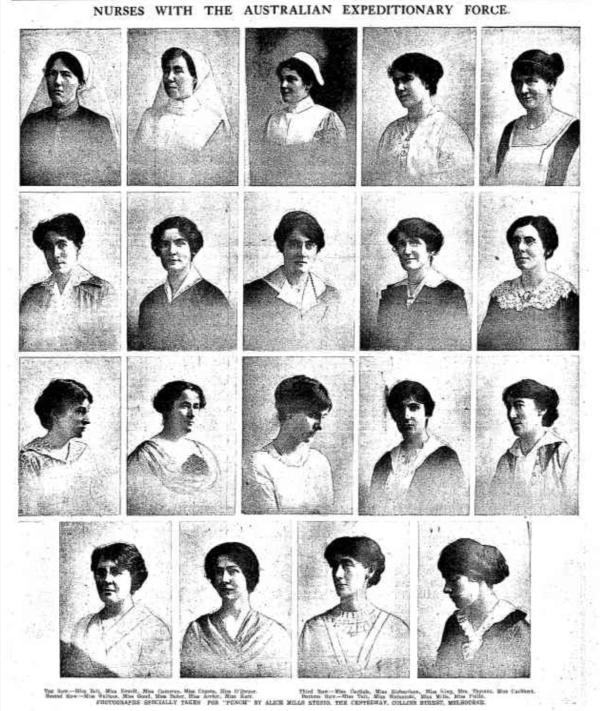
On 20 November the Royal Victorian Trained Nurses’ Association held a farewell party for the 43 nurses at the Grand Hotel in Melbourne. On 28 November the nurses were formally enlisted in the AIF and the following week departed for Egypt.
VOYAGE ON THE KYARRA
On 5 December 1914 Valerie, Amy King, Hilda Knox, Matron Bell and the other 39 nurses, together with officers, NCOs and other ranks of No. 1 AGH, travelled to Port Melbourne and boarded the Australian hospital ship Kyarra. Boarding as well were the Victorian staff of No. 2 AGH, including 40 nurses, and staff of No. 1 ASH and No. 1 Australian Clearing Hospital. Neither of these units had AANS nurses on staff.
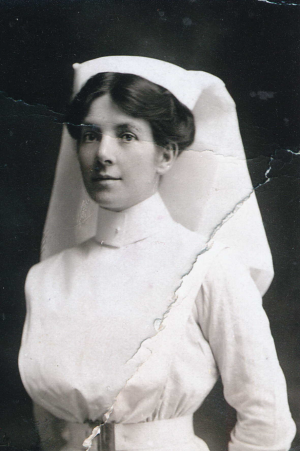
The Kyarra had departed Brisbane on 21 November with around 193 staff of No. 1 AGH – 23 nurses and 170 officers, NCOs and other ranks. Late on 23 November it arrived in Sydney, where staff of No. 2 AGH boarded, including 42 AANS nurses, and departed again on 25 November. Three days later the Kyarra arrived in Melbourne.
As a hospital ship, the Kyarra was carrying only medical units and hospital equipment, including ambulances and x-ray machines. No arms or ammunition, horses, or even petrol for the vehicles were permitted to be carried, as this would contravene the Geneva Convention and render the ship liable to capture or attack by the German navy. Like all hospital ships so designated under the Geneva Convention, the Kyarra was painted white. A wide green band three metres above the water line ran around its hull, and a large red cross was painted on each side, with a third on the funnel.
Later on 5 December 1914 the Kyarra departed Melbourne. It entered Bass Strait, rounded the Bight and on 11 December arrived in Fremantle, where the staff of No. 2 ASH boarded. The ship departed again on 14 December.
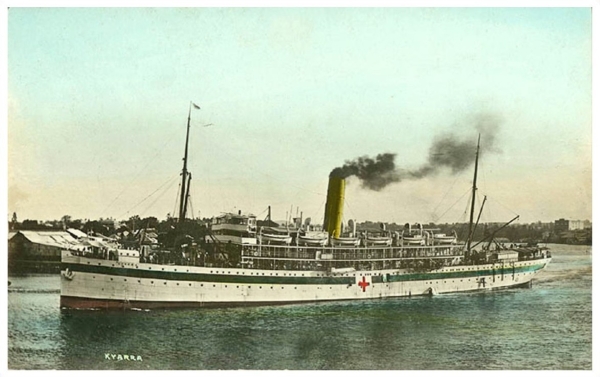
The Kyarra crossed the equator on Christmas Eve to the accompaniment of the usual crossing-the-line rituals. On Christmas Day church services were held, and the nurses of No. 1 AGH enjoyed Christmas dinner. They were shouted champagne by Captain Alcorn and drank the King’s health.
On Boxing Day the Kyarra arrived at Colombo, and the following morning the nurses went ashore. For the next two days they saw many of the sights of the colourful colonial town. They took carriages to Victoria Park, which was located in the area known as Cinnamon Gardens. They visited local neighbourhoods, saw a Buddhist temple, and had lunch at the Grand Oriental Hotel. They visited shops, took rickshaws, and had afternoon tea at the Galle Face Hotel. They witnessed a funeral procession and passed through the Hindu quarter, noting temples with numerous tiny lights. They visited the Gordon Gardens, near the Fort, with its Portuguese-inscribed rock.
On 29 December the Kyarra departed Colombo. On New Year’s Eve the nurses attended a fancy-dress masque ball and at 11.30 pm had supper courtesy of the officers. They welcomed in 1915 with singing and cheering and once again toasted the King’s health.
The Kyarra passed the island of Socotra at the entrance to the Gulf of Aden on 4 January and two days later arrived at Aden. The nurses were not permitted to go ashore, but locals in small boats came out to the ship selling such things as ostrich-feather fans.
On the morning of 7 January the Kyarra passed through the Bab al-Mandab and entered the Red Sea. By 11 January the ship had reached the Gulf of Suez, with Mt. Sinai on the right, and at around 8.00 pm that night arrived at Suez. After an overnight stop, the Kyarra raised anchor in the early afternoon of 12 January and entered the Suez Canal. On 13 January the ship arrived at Port Said and the nurses disembarked. They had morning tea at the Eastern Exchange Hotel and lunch at the Casino Palace Hotel and then went for a gharry ride. The Kyarra departed Port Said at around 6.00 pm and the next day, 14 January, arrived at Alexandria, Egypt’s Mediterranean metropolis.
NO. 1 AUSTRALIAN GENERAL HOSPITAL, HELIOPOLIS
The nurses remained on board the Kyarra while their units awaited disembarkation orders. However, they were given shore leave each day and spent the time pleasantly enough exploring the city. Some even travelled as far afield as Cairo.
Eventually, movement orders came for the staff of No. 2 AGH, and on 20 January 1915 they left the Kyarra and entrained for Cairo, then proceeded to Mena House. Lieutenant Colonel Morgan Martin, the commanding officer, soon had the hospital running like clockwork, and by the end of the month Matron Nellie Gould – who, it will be recalled, arrived with 24 other AANS nurses in the first convoy – had taken over from the British matron.
At around 9.00 am on 24 January Valerie and the other staff of No. 1 AGH disembarked from the Kyarra. They entrained for Cairo and made their way to the Heliopolis Palace Hotel, located in Heliopolis, a newly established garden suburb lying 10 kilometres northeast of central Cairo. When they arrived at around 1.00 pm nothing was ready and there were, of course, no patients. The hospital’s equipment soon turned up, but it was not until the second convoy of AIF men arrived in Egypt on 3 February and established camp at Heliopolis that patients began to arrive in any numbers. Meanwhile, No. 2 AGH at Mena House was treating the men of the first convoy encamped at Mena.
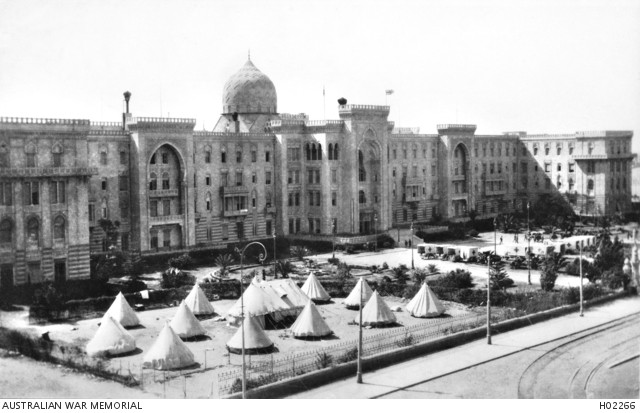
By 15 February there were a good many patients at the Heliopolis Palace Hotel, many with pneumonia and empyema, and No. 1 AGH began to come under bed pressure. In response, the spaces within the hotel were rationalised, and then the hospital began to expand beyond the hotel. Separate tented wards for venereal patients and for infectious patients, mainly measles sufferers, were erected at the Heliopolis Aerodrome, located a kilometre from the hotel. However, it proved difficult to treat the serious measles cases at the Aerodrome, and a tented camp was established in the grounds of the hotel, to which were transferred all serious infectious cases and all cases with complications.
In March, with hot winds beginning to blow, the serious infectious patients were moved from the grounds of the hotel into one of its wings, and the camp abolished. This arrangement proved unsatisfactory, and around 6 April the patients were moved from the hotel to the skating-rink of a nearby pleasure resort known as Luna Park. The remaining infectious patients from the Aerodrome were moved there as well. It became obvious, however, that the skating-rink, which could accommodate up to 750 patients, might better serve as an overflow hospital should the need arise, and on 26 April a nearby building known as the Casino was taken over and the infectious cases transferred there.
Meanwhile, around 19 April a section of the Abbassia Military Barracks, located between Heliopolis and central Cairo, had been obtained and converted into a venereal hospital, to which the venereal cases from the Aerodrome were transferred.
LEMNOS ISLAND
By this time the AIF men of the first and second convoys had struck camp at Mena and Heliopolis respectively and sailed from Alexandria to the Greek island of Lemnos, which lay in the Aegean Sea 100 kilometres west of Ottoman Turkey. Here they joined Allied forces – British, Indian, French and New Zealand – assembling ahead of a campaign against the Turks on the Gallipoli Peninsula. Preparations for the campaign had begun in late February with the arrival on the island of Rear Admiral Rosslyn Erskine Wemyss, the newly appointed governor of Lemnos, who had been tasked with establishing an advanced base around Mudros Harbour in the south of the island. Within two or three weeks, two floating docks, a wireless station, a coaling base and other infrastructure had been constructed.
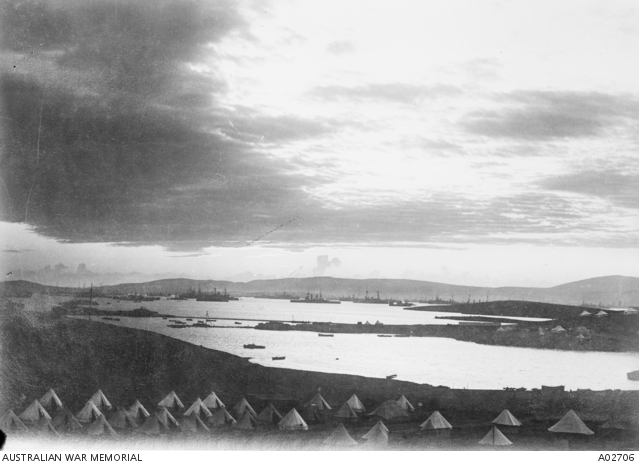
On 1 March Lieutenant-General William Birdwood, the British Indian commanding officer of the Australian and New Zealand forces, arrived on Lemnos from Alexandria. He was followed by the 1st Australian Field Company Engineers, the 11th Australian Infantry Battalion, and other units, who arrived on 4 March aboard the SS Suffolk. Further Australian units arrived over the following days – including staff of No. 1 ACCS. However, they remained aboard HMT Malda in Mudros Harbour and only came ashore every few days for route marches. The first Australian medical unit to establish a hospital on the island was No. 1 ASH, which arrived at Mudros on 12 March.
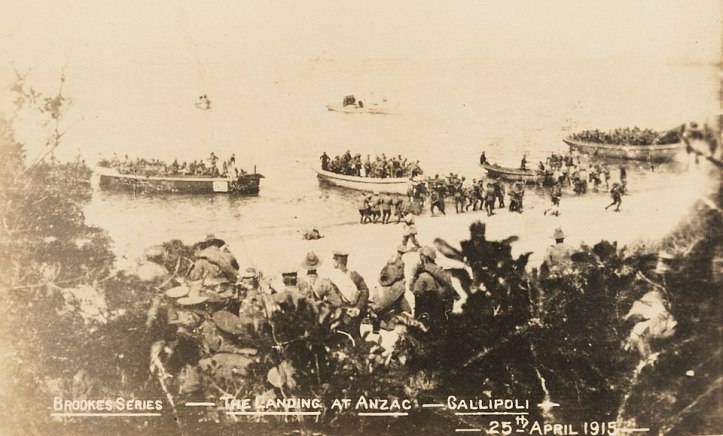
On 24 April the Allied forces, approximately 70,000 strong, boarded transport ships and departed Mudros Harbour for the Gallipoli peninsula. Early in the morning of 25 April Australian, New Zealand and Indian forces landed at Ari Burnu (Anzac Cove), British forces landed at Cape Helles in the south of the peninsula, and French forces mounted a diversionary attack at Kum Kale, just south of Cape Helles on Anatolia. One of the most futile and disastrous campaigns of the Great War had begun.
THE GALLIPOLI CAMPAIGN
On the opening day of the Gallipoli campaign only 495 patients occupied the 893 available beds at the Heliopolis Palace Hotel, the Infectious Diseases Hospital at the skating rink and the Venereal Diseases Hospital at Abbassia. The numbers were similar on 26, 27 and 28 April. On 29 April, without warning, wounded AIF men began to arrive at the Heliopolis Palace Hotel in appalling numbers. They had been carried from the cliffs of Gallipoli down to the beaches, loaded into lighters and carried out to hospital ships, then transported to Mudros. From Mudros they were transported to Alexandria and thence to Cairo. Finally, from Cairo they were brought by train to the newly completed railway siding adjacent to the Heliopolis Palace Hotel.
In a letter home dated 7 May, Valerie’s colleague Sister Constance Keys, one of the 25 AANS nurses who had sailed with the first convoy, described the men’s arrival:
There have been sad happenings since I last wrote. I don’t know if the news is known in Queensland yet but the greater part of the men we came over with are either wounded or killed. The whole Battalion was practically cut to pieces. We did not get any wounded till Thursday April 29th. The hospital train came right behind the Palace – nine long white carriages with the Egyptian star and crescent on the side. Then the unloading commenced. Those who could walk were shown the way in & those on stretchers were carried over in the motor ambulances. I’ll never forget the sight of those hundreds of men walking & being carried in, one after the other in endless procession. There wasn’t a sound except footfalls then the wards commenced to fill up. The work of getting those weary men washed, wounds dressed & fed was a big undertaking, but it was done. Next day we heard we had to make room for more cases so those who were fit were got ready & moved on to another hospital. More trains in that day (Friday) with even more cases, fewer walking & more carried. Saturday the same again & forget about Sunday.
Another colleague, Sister Agnes Isambert, who had travelled on the Kyarra, recorded in her diary that around 500 casualties arrived on that first night, 29 April. The next day was worse:
Tram loads of wounded arrived again today, some very bad indeed & lots transferred to our overflow hospital Luna Park & others to Mena hospital. Infectious diseases measles all moved from Luna Park to Racecourse [Casino] a little further on.
Two train loads of wounded came in on Saturday 1 May. While the first load was not too badly injured,
a tram load arrived at 12 midnight [with] about 140 very badly wounded, a great lot of whom are going to die. Oh the horror of this war, the boys are so proud of themselves. Are so good about their wounds & dressings – so many are going to be cripples & loose [sic] their limbs. Doctors operating all night – not going to bed until 5 am. Theatre nurses also & most of the day staff staying up until midnight.
Sunday was even worse. Four different operating tables were going all day until midnight. The numbers eased off marginally the next day, Monday 3 May. Most of the wounded were transferred to Luna Park, with only the very serious cases staying at the Heliopolis Palace Hotel.
Between 30 April and 2 May more than 1,350 cases were admitted to No. 1 AGH. Faced with such appalling numbers, orders were issued for the hospital to take over the whole of Luna Park. The upper section, known as the Pavilion, was set up within a few hours, and within a few days the skating rink and the Pavilion together were able to accommodate 1,650 patients.
Valerie remained at the Heliopolis Palace Hotel until July 1915. By then the Gallipoli campaign had ground to a stalemate. The Allied forces occupied the lower ground of the peninsula and the Ottoman Turkish forces the heights, with neither side able to dislodge the other. Nevertheless, wounded men and those with diseases and other conditions continued to flow to No. 1 AGH. The unit had acquired more buildings and now consisted of the Heliopolis Palace Hotel and four semi-independent auxiliary hospitals (which by mid-August would be fully independent commands): No. 1 Auxiliary Hospital (Luna Park), No. 2 Auxiliary Hospital (the Atelier), No. 3 Auxiliary Hospital (the Sporting Club), and No. 4 Auxiliary Hospital (an infectious diseases hospital located in the former artillery barracks at Abbassia).
HMHS GRANTULLY CASTLE
On the morning of 7 July 1915, Valerie and Amy King, with Mabel Brown, Zita Lyons, Christense Sorensen and Ernestine Vierk, all of whom had been on the Kyarra with Valerie and Amy, departed the Heliopolis Palace Hotel and set out for Alexandria. All six had been detailed for duty aboard HMHS Grantully Castle, soon to make its maiden voyage as a newly commissioned hospital ship to the Gallipoli Peninsula.
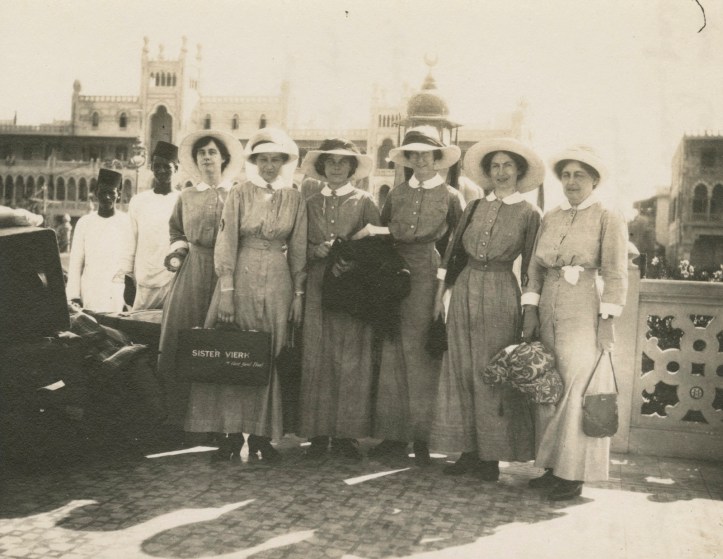
The six nurses were met at Cairo Station by Queen Alexandra’s Imperial Military Nursing Service nurse Ethel Rose Collins – a “tiny edition of a nurse, but very bright and tactful,” noted Mabel Brown in her Nurse’s Narrative (p. 6) – who, although she held the rank of staff nurse, was to be in charge of the six Australians as matron. They entrained for Alexandria and boarded the Grantully Castle. However, it was not yet ready for sailing – beds were still being fitted, among other things, and for the next few days remained at anchor in Alexandria Harbour – as Zita Lyons described in a letter to her brother, Mr A. C. Lyons of Rockhampton, printed in the Rockhampton Daily Record on 18 September 1915:
Well here we are at Alexandria on board the Hospital Ship. I came off night duty at 7 a.m., and from then till 8.30 a.m., well, I remember it not. I know we had to pack, have breakfast, and say good-bye to the dozens that came to our room. However, six of us left in two Ambulance motor cars. The six are, Sister Minoskie [Woinarski], Brown, Veirk [Vierk], Kelly [King], Sorenson [Sorensen], and I. Our men gave us a nice jolly wave off and we left in the best of spirits. We left Cairo at 9.30 a.m., and had a party on the way down. Sister Minoskie and I, who had been on duty all night, had a sleep. When we got to Alexandria, Sister Collins, just the dearest little Imperial Sister, joined us. She is in charge and is just sweet. We are going to be very happy, and are very comfy. We have a cabin each, electric fans, &c. A Hospital ship came in the other day and our Matron knew the Matron of the ship. She went on board, and to my delight brought back a letter from Leon [Lyons, Zita’s brother]. I am posting it by the same mail. She saw one of the boys on board, I think it must have been Byron Ross, who said that he saw Leon after the engagement, and that he was quite alright. I believe we are going right up to Gaba Tepe [a strategically important promontory south of Anzac Cove], that is just near where he is I think, according to the map. The people are just as dirty and lazy as they were when we were here in January. We have to go ashore in little boats from this ship, and we were most amused the other day. We were watching a man fishing. He had three rods in the water and he was laying on the three of them sound asleep. This is the first trip as a Hospital ship this boat has done, so the delay just at present is due to them making wooden beds, wire mattresses, &c. We are to take 500 patients, but I shall be able to tell you all about that when we get back.
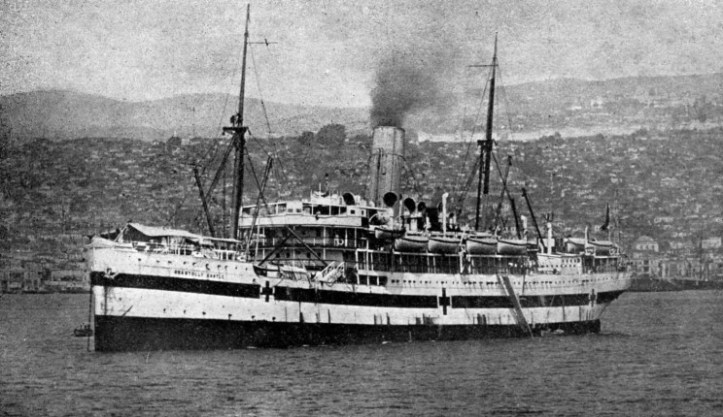
Finally on 11 July 1915 the Grantully Castle, although still not entirely ready, departed Alexandria bound for Mudros, three days’ sailing. Aside from the six AANS nurses and Miss Collins, the ship was staffed by six RAMC medical officers, including the commanding officer, Captain Evans of No. 21 GH, and about 30 Indian and British orderlies. It could accommodate 450 patients in cots.
During the voyage, Zita Lyons wrote to her mother. An excerpt was printed in the Rockhampton Daily Record on 2 October 1915, part of which is reproduced below:
We are nearly up to Lemnos Island. We are to call here and wait for orders. I hope we will hear that we have to go straight on to Gallipoli, 40 miles away from Lemnos, and then I hope to see Leon. We have had a very nice trip. We are a happy family; everyone has a nick name. Mine is ‘Baby.’ We are ready now for the wounded. It has been great getting our wards fixed up. I have two very nice medical officers – a Mr Litt and a Mr Bachanan. They have been great sports, ‘pinching’ things for my ward. It has 73 beds and I have three orderlies, so we shall be kept going as the orderlies are brand-new. But some of them have heaps more. One sister has [?57] beds. There is another hospital ship just ahead of us. The hospital ships look so nice at night. You know they have a green band and a red cross, and then for night time they had a band of green electric lights, with a cross in the centre of red electric lights. It does look so nice. Of course we can’t see ourselves, but the others look great.
Wednesday, July 14. – Well, we got into Lemnos Island. We were very near when we came up from dinner, so we all stayed on deck to watch. It was just the prettiest sunset at 10 to 8.00. It went down fiery red behind the black cheerless hills and the water all looked so black and forbidding with its collection of boats guarding the harbour, where I believe there are hundreds of gunboats. I haven’t been up to see them yet. Funny little black low boats, or ships, I suppose I should say, are at the entrance to Mudros Bay, destroyers, mine sweepers and others. And two other hospital ships that looked fine with their electric band of green lights and red cross. We watched a destroyer hail each other in turn, and then each did a lot of signalling with lights, because it was dark then. Then ours steamed out, and the other remained. We were signalled to by another, and told to remain (for how long we have not heard), and then the ‘boon’ [boom] was put across. The ‘boon’ consists of a long string of buoys attached by a heavy wire chain. There is an outer and an inner ‘boon’ and the inner one is shut. It extends right across the entrance to Lemnos Harbour. Lemnos is one of the places we have taken, and it is a most useful harbour. Only about 40 miles from Gallipoli, so they watch it well. The ‘boon’ is opened again at daybreak, I think. Far in the distance last night we could see other hospital ships. They stand out so at night with all their lights. We did not go far in the harbour, just on the outside. I must tell you my impressions by daylight.
Well everything by daylight is ever so much nicer. There are hundreds of big ships, great big gunboats with four funnels, also great big liners. The destroyers are not very imposing by daylight. They don’t carry very big guns. They say it is their speed that counts. Two hospital ships went out this morning. One was a French boat. She has a green band like we have, but has her red crosses on her funnel. She is bound for Cape Hellas. The Siseleen [HMHS Sicilia] also went out bound for Gaba Tepe. That is where Leon is. There is a Miss Radcliff [Sister Janet Radcliff from Tasmania] on board, who has a brother with Leon, and we have each promised the other to send messages, &c. So I hope she sends Leon word that I am coming, though the skipper thinks that we may be going to Cape Hellas [sic] as she went to Gaba Tepe. They are by land about 12 miles apart.
Later on 15 July the Grantully Castle sailed to Cape Helles at the southern end of the Gallipoli Peninsula, where the British and French had landed on 25 April 1915. For the next 10 days or so the ship remained anchored offshore, though not always out of range of Turkish artillery, and received wounded. During this time the Grantully Castle functioned as a CCS, as Mabel Brown noted in her Nurse’s Narrative (pp. 7–8). The most serious cases remained on board, while those men who were less seriously wounded were fed, had their wounds dressed, and then went “down the side” for transshipment to Lemnos and elsewhere. During the entire time none of the nurses had more than four consecutive hours off duty, so acute were the cases.
Around 26 July 1915 the Grantully Castle left the Gallipoli Peninsula for Port Said, calling in at Lemnos en route, where two English nurses were taken on. When the casualties were finally disembarked in Port Said the nurses “all collapsed for the rest of the day” (Brown, p. 9). On 29 July 1915 Valerie wrote from Port Said to Hilda Knox, who had remained at No. 1 AGH in Heliopolis. Part of her letter was printed in the Benalla Independent on 14 September 1915, as follows:
We had an intensely interesting trip, and, although the work is jolly hard, I wouldn’t have missed it for anything. We only stayed at Lemnos a night, and didn’t go ashore then. When we arrived [at Cape Helles] we commenced at once to take in patients, and filled up slowly, till one day I found I had 100 – three wards altogether. We used to go on at 6.30 [am], and often work till 1.15 a.m. next day. It was hot, but it was worth it, and the men were wonderful. We didn’t go to the Australian side [Anzac Cove], we had Scotch, English and an odd Australian. A German aeroplane flew over us one morning, and that same day the Turks were trying to get a boat near us. Six shells fell very near, and one lot of spent shell came on board forward and caused great excitement. No one was hurt. I was not in the fun, as I was up to my eyes in dressings. The famous Major Robson came on board, and was very nice, but thought we were too short staffed, so gave orders for two sisters out of 48 (English) going to Alexandria to join us at Lemnos. To-day we are to get two more (Canadians), so we will be a mixed lot. We lost 35 coming down, so you can imagine how hopeless some are that we get – awful head injuries. I lost two boys of only 18, which nearly broke my heart – such nice Scotch laddies. Our matron is just charming, and the men and officers of the boat help us all they can. My best orderly for the voyage was a stoker, who used to come up every time he was off duty. We went up to Cape Helles, the English landing, and were only a mile from the shore. One night they got a shell into our ordnance stores, and set thousands of rounds of cartridges on fire. It made an awful blaze.
On the same day, 29 July 1915, Amy King too wrote to Hilda Knox. Part of her letter was printed under Valerie’s in the Benalla Independent on 14 September 1915:
We might be leaving again to-night or early morning for Cape Helles, where we were before. Sister Lyons wants to go to Gaba Tepe, where our boys are, but I think it will be Cape Helles. It’s most exciting there, but we get all the worst cases. Twice we had to move out farther, as the shells were going over us and bursting near us. We all have some fragments that fell on the deck from one bursting quite close. Have three shells, a case, a bomb, and some bullets that the different officers have given me. We got a few Australians on at Lemnos (about 90), and brought them here. I lost 14 men (12 men and two officers). Both officers were shot through the abdomen, and the men were mostly head cases. The work has been heart-breaking at times, still we had to go on. It was nothing to be called at 5.45 a.m. and go on til 1.30 the following morning, with only our meal times to ourselves. Matron insisted that we had our meals properly, which was a blessing. When we arrived at Lemnos Col. –– who left the boat there, sent us on two English sisters. Now we have two more for the return journey (Canadians), so we are quite a mixed crowd. The Australians are managing to keep their end up. The guns make a dreadful noise at times, and fire so close. The earth flies up, and one can see nothing but dust, or, when they hit the water, spray. It’s all very interesting, but deadly. Miss –– and I went along to the hospital yesterday to see some of our boys. They all seemed pleased to see us, and said how happy they were on the Grantully Castle. They all went away in nice clean pyjamas, faces shaved, and most of them freshly dressed. Most of the officers are at the first N.Z. Stationary. The medical cases are under canvas, and the surgical in the house. Very under-staffed, and the nurses, as usual, worked to death. They are getting help to-day, I believe, from the English Sisters.
The following day, 30 July, found the nurses still at Port Said. That day Valerie wrote to Miss Rose Levy of Darlinghurst, Sydney, a blind Red Cross worker, to express thanks for Rose’s face washers, which were greatly appreciated by the wounded soldiers that Valerie was looking after. Her letter was printed in the Sydney Sunday Times on 19 September 1915, as follows:
Port Said, July 30.
Dear Madam, – In helping to unpack Red Cross stores this morning, I came upon your address, and felt you would like to know how your very nice washers were being used. This boat is carrying wounded to base hospital, and every trip we have to get fresh supplies, and I think all your hard work at home would seem even more worth while could you hear the gratitude these poor wounded men express. The Red Cross keeps up our supplies in a wonderful manner, and have done so for months. I worked in base hospital at Heliopolis, then this boat, and in both places your wonderful generosity has added tremendously to the comfort of our patients.
HMHS GUILDFORD CASTLE
After a week in Port Said, the Grantully Castle returned to Alexandria, arriving around 4 August 1915. Many of the ship’s medical staff, including all but two of the nurses and 19 or 20 orderlies, were transferred to HMHS Guildford Castle, with Major Baird officer in charge. Another AANS nurse, Bernice Loughrey, was detailed for duty aboard the ship and appointed sister in charge of the theatre. The two nurses who did not join the ship – neither the Australians nor Miss Collins – were posted to another hospital ship taking patients to England.
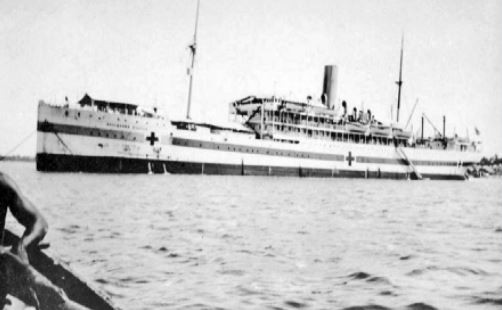
The Guildford Castle was described by Mabel Brown (p. 10) as “most perfectly fitted out, in every respect,” and by Zita Lyons in the Western Champion as “a fine hospital ship … supposed to be one of the best.” There were six doctors on board, several assistant surgeons, and many orderlies.
Around 7 August the Guildford Castle commenced its run from Alexandria to the Gallipoli Peninsula. The August offensive, the Allies’ last-gasp effort to break the stalemate on the peninsula, was underway and had already resulted in thousands of Allied dead and wounded.
By ship 11 August the ship was anchored off Gabe Tepe. That day, Zita Lyons sent a note ashore to her brother, Sergeant Leon Lyons, which read “Sisters Sorensen and Lyons at home, Guildford Castle, Aegean Sea. Sergts. Lyons and [Frederick Mitchell] Waite and friends from August 11th till further notice.” That same night at around 9.00 pm her brother turned up on deck, but not Fred Waite.
Naturally Zita was overjoyed to see her brother. At 8.30 pm on 6 August, the opening day of the offensive, Leon’s and Fred’s unit, the 5th Light Horse Regiment, was meant to have attacked two Ottoman positions on Harris Ridge at the southern end of the Anzac Cove perimeter, Bird Trenches and Balkan Gun Pits, part of a multi-pronged assault on the Sari Bair heights behind Anzac Cove. However, a few minutes before start time, the 5th Light Horse’s attack was cancelled, and the troops withdrew to their lines. Had it gone ahead, Zita might never have seen her brother again.
After a certain time the Guildford Castle left the waters off Gaba Tepe and on 23 August arrived back at Alexandria, presumably having first disembarked hundreds of wounded and sick men at Lemnos. The ship set out again on 29 August. It sailed to Imbros via Lemnos, took on board 670 wounded and sick men, and arrived back at Lemnos on 5 September. The patients were transferred to HMT Scotian, possibly to the SS Somali, and to hospitals on shore. The Guildford Castle then sailed to Suvla Bay, eight kilometres north of Anzac Cove, where thousands of British troops, supported by Australian sappers, had landed during the opening week of the August offensive. The landing, which was intended to support the assault on the Sari Bair heights, began shambolically and in the end failed, with enormous numbers of casualties. The ship arrived on 6 September and began to take in cases.
The Guildford Castle remained anchored off Suvla Cove for two days before leaving on 8 September for Lemnos with 557 cases. After arriving at 6.00 pm the ship set out the following day for Malta with all or some of the 557 cases from Suvla. It arrived on 11 September and the patients were disembarked.
From Malta the ship sailed to Anzac Cove via Lemnos, embarked 600 cases, and returned to Lemnos, arriving on 22 September. On the same day it departed for Alexandria with 520 patients, 120 of whom were accommodated on the decks, and arrived on 25 September. Valerie, Amy, Mabel Brown, Zita Lyons, Christense Sorensen and Ernestine Vierk had now concluded their third roundtrip to Gallipoli.
Valerie and Amy did not return for a fourth trip. Amy left the Guildford Castle on 28 September and Valerie on 29 September, after which they both returned to No. 1 AGH at Heliopolis – where, on 1 December, Amy was promoted to the rank of sister, joining Valerie at that rank. By then, the Gallipoli campaign was effectively over. On 22 November the decision had been taken to evacuate Anzac Cove and Suvla Bay. After being approved by the British War Cabinet, the evacuations began on 15 December and continued until the early hours of 20 December with very few casualties due to enemy fire. British and French forces remained at Helles until 9 January 1916.
On 14 January Valerie was admitted to No. 1 AGH in Heliopolis with influenza. She then developed enteritis and was transferred to the convalescent depot at Helouan, south of Cairo, on 21 January. She returned to Heliopolis on 28 January.
With the end of the Gallipoli campaign, the focus of the AIF shifted to the Western Front, and by April 1916 most infantry units had been sent to France. (The bulk of the Light Horse remained in Egypt to continue the defence of the Suez Canal against the Ottomans.) Many AAMC units followed the infantry to France, including No. 1 AGH, which departed Alexandria for Marseilles at the end of March.
RETURN TO AUSTRALIA
However, Valerie and Amy were no longer with No. 1 AGH. On 3 March 1916 they had embarked aboard the Argyllshire from Port Tewfik, Suez, for Australia, having been detailed to look after invalided AIF personnel on their journey home.
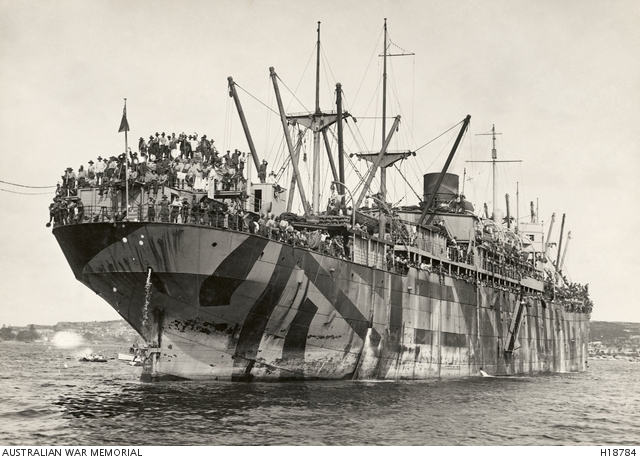
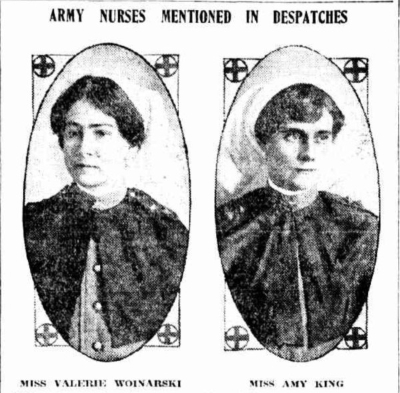
While Valerie and Amy were en route to Australia, they were mentioned alongside 33 other Australian nurses in General Sir John Grenfell Maxwell’s despatch of 16 March 1916 – presumably for their service during the Gallipoli campaign aboard the Grantully Castle and the Guildford Castle. In his introduction to the despatch, Maxwell, who was General Officer Commanding British Troops in Egypt, wrote that “so much of the arduous work done in Egypt by the Force under my Command … was in connection with the operations of the Mediterranean Expeditionary Force in the Dardanelles,” since the Gallipoli campaign had drawn off the bulk of the Turkish forces from the vicinity of the Suez Canal. In other words, even though the Gallipoli Campaign was a catastrophic failure, it did help Britain to maintain control over the Suez Canal. The Mentions in Despatches were promulgated in the Third Supplement of the London Gazette on 21 June 1916.
The Argyllshire arrived in Melbourne on 30 March 1916, and after 16 months away, Valerie and Amy were home.
Valerie’s paternal uncle Dr Victor Zichy-Woinarski had returned from service in Egypt just two months prior, on 21 January 1916. He had joined the AAMC as a medical officer in 1915 and served at the rank of captain. Valerie’s cousin Casimir Henry Woinarski, Victor’s son, joined the AIF in July 1916 and eventually became an artillery officer, returning to Australia in 1919. In August 1916 Valerie’s brother, George, joined the AIF and was attached to the 5th Reinforcements, 23rd Light Horse. Unfortunately, he was discharged as medically unfit in January 1917 due to a suspected gastric ulcer.
Valerie and Amy remained in Australia for nearly five months before returning to Egypt as members of the newly raised No. 14 AGH. On 19 August 1916 they embarked from Melbourne aboard HMAHS Karoola alongside 26 other nurses attached to the unit, including their friend, Sister Hilda Knox; Staff Nurses Edith Moorhouse and her good friend Molly Nielsen; and Matron Rose Creal, who was in charge. Fourteen other nurses had departed earlier aboard the Orsova, the Wiltshire, the Miltiades, the Orontes and the Ballarat and joined the unit in Egypt.
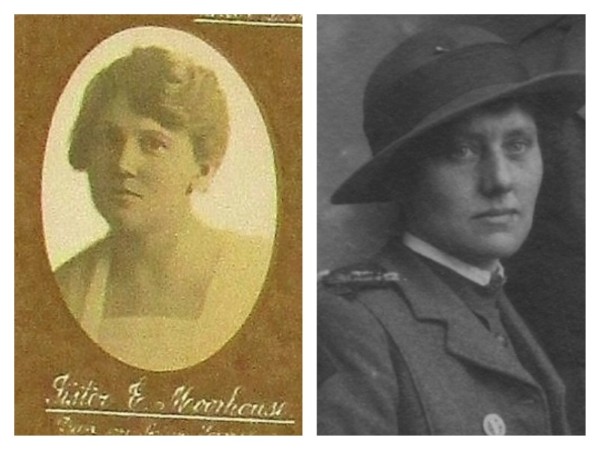
The nurses now wore their updated outdoor uniforms, which consisted of a coat and skirt of grey wincey (instead of a top coat), with a grey felt sailor hat swathed with chocolate-coloured crepe de chine.
Matron Creal and some of the sisters were allocated cabins, and the remainder had a large, airy ward, containing swinging cots, set apart for their use. The food provided was good throughout the voyage
NO. 14 AUSTRALIAN GENERAL HOSPITAL, ABBASSIA
The Karoola arrived at Port Tewfik on the morning of 19 September 1916, having sailed via Fremantle and Colombo, and berthed at Coal Quay. It was only then ascertained that No.14 AGH was to relieve No.3 AGH, and that the latter unit was to proceed to England on the Karoola. No. 3 AGH was based at Abbassia on the eastern outskirts of Cairo and, following the relocation of Nos. 1 and 2 AGHs to France (as referred to earlier), was the single remaining AGH in Egypt.
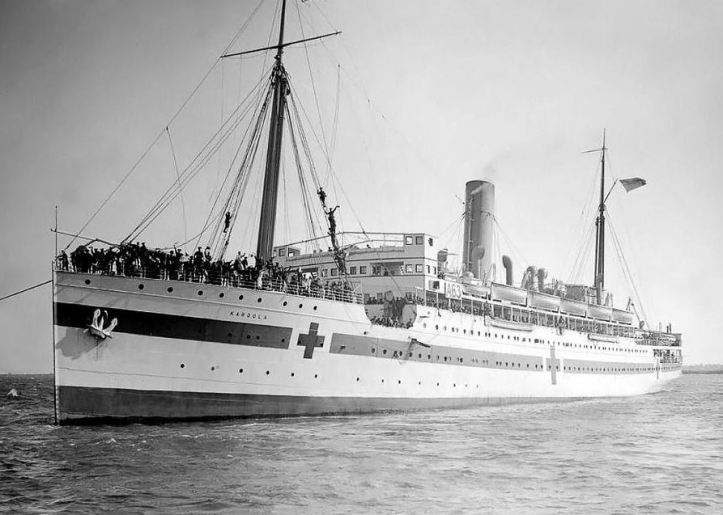
In the early hours of 20 September a special train arrived alongside the Karoola, and all baggage, and a small quantity of equipment, was loaded before daylight. The staff disembarked and boarded the train, which left at 10.00 am and arrived at Abbassia siding, immediately in front of the Main Barracks, where the hospital was situated, at around 6.00 pm that evening.
At the beginning of the war, the barracks had been in a state of disrepair but had been renovated and adapted for use as a hospital before being occupied by No. 3 AGH early in 1916, upon the return of this latter unit from Lemnos.
The commanding officer of No. 3 AGH had made all necessary arrangements for the accommodation of the officers, nurses, and other ranks of No. 14 AGH, who spent the next two days becoming acquainted with their duties before taking over from No. 3 AGH following that unit’s final withdrawal on 23 September.
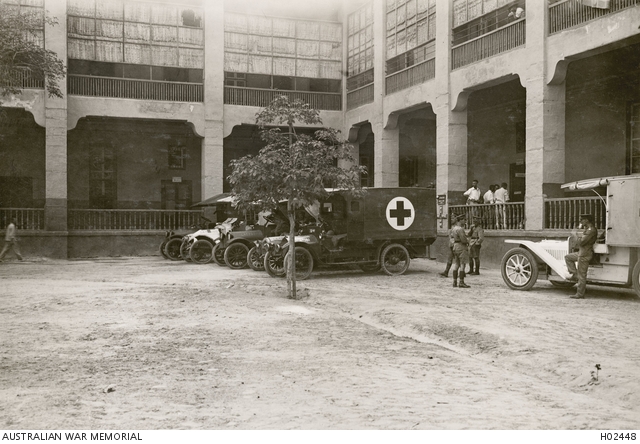
By then, only 366 patients remained in the hospital (which could accommodate up to 1,200 patients without difficulty), a large number having been transferred to the Kanowna on 22 September. Within six weeks the number had increased to 520, and by the end of November there were 600 patients. This number remained stable until Christmas time.
The patients were mainly men of the Australian Light Horse – most of whom, as we have seen, had remained in Egypt following the general transfer of the AIF to the Western Front. Now part of the Egyptian Expeditionary Force (EEF) under General Sir Archibald Murray, they were pushing eastwards across the Sinai Peninsula towards Rafah. They had not been engaged in fighting of any importance since the Battle of Romani in August 1916, during which the EEF had defeated a combined Ottoman and German force 40 kilometres east of Port Said, and the cases coming to No. 14 AGH were mainly medical, not surgical.
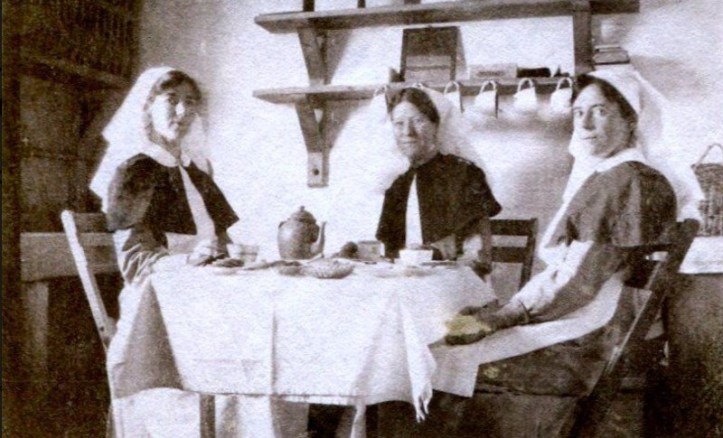
Soon Christmas Day arrived. The patients and staff were provided with extra food, and the patients were given presents by the Australian Red Cross Society. In the afternoon an orchestra played in the gaily decorated wards and in the evening a concert was given by the Kookaburras Concert Party, which was made up of orderlies, with one of the patients, a musician of note, playing a key role.
After Christmas the hospital became much busier. On 23 December 1916 the EEF had engaged an Ottoman force at Magdhaba, 200 kilometres east of Romani and 60 kilometres southwest of Rafah, which resulted in numerous Australian casualties. The successful raid into Mandatory Palestine and the capture of Rafah on 9 January brought a further influx of patients. By 15 January 1917 Valerie, Amy, Hilda, Edith Moorhouse, Molly Nielsen and the others were dealing with 925 patients.
EN ROUTE TO FRANCE
The following day, 16 January 1917, the five nurses departed Abbassia for Alexandria. They were among eight sisters and 27 staff nurses of No. 14 AGH summoned to AIF Headquarters in London prior to deployment to France for service with the RAMC. From Alexandria the 35 nurses embarked for England aboard HMHS Essequibo.They arrived at Southampton on 26 January 1917 and proceeded to London.
Around two weeks later, on 8 February, Valerie, Hilda, Edith and Molly sailed to France. Amy remained in England, having been posted to No. 2 Australian Auxiliary Hospital (AAH) in Southall, Middlesex (but within metropolitan London).
Edith and Molly had been attached to No. 14 Stationary Hospital (SH) in Wimereux, a seaside town five kilometres north of Boulogne, and arrived on 9 February. Wimereux was home to a number of Allied hospitals, including No. 2 AGH, which had relocated to France at the same time as No. 1 AGH. (On 26 September 1917, after seven months at No. 14 SH, Edith and Molly returned to No. 2 AGH. They spent three months there before being separated for the first time on 10 January 1918, when Molly was posted to No. 25 GH at Hardelot, 10 kilometres south of Boulogne.)
Meanwhile, Valerie and Hilda had been posted to hospitals in Rouen, 150 kilometres south of Boulogne. Sited on the Seine with access to the sea, Rouen was a strategically vital city and a hub for Allied medical evacuation. Many base hospitals had been established at the city’s southern racecourse, the Hippodrome des Bruyères – including No. 1 AGH.
En route to Rouen Valerie and Hilda had something of a close shave. Hilda described the events in a letter to her parents on 12 February 1917, after their arrival. It was her last letter home. A section of the letter was printed in The Benalla Standard 20 April 1917, as follows:
We had rather a thrilling experience on our way here. A town where we spent the night was bombed. The noise was terrific, and we were rather frightened. Some anti-aircraft guns were quite close to our hotel, and we could see flashes. The bombing started about 9 p.m., and went on at interval of two hours until 5 a.m. My room was the only one on the ground floor, so all the other girls trooped down, and we shivered together until 6 a.m., when we all left in the dark for our train.
The two friends arrived in Rouen on 11 February 1917 but were then separated. Valerie was sent to No. 5 GH having been appointed temporary head sister – a rank she nevertheless maintained for the remainder of her military career – while Hilda was attached to No. 11 SH. However, both units were based at the Hippodrome des Bruyères, so the nurses were not far apart from one another – and not far from their friends at No. 1 AGH.
On Saturday 17 February Hilda woke with a painful headache and by 4.00 pm she was unconscious. She died two hours later of cerebro-spinal meningitis. It seems that Valerie was able to see her before she died, but whether Hilda was conscious or not is unknown.
Valerie was distraught at the death of her friend. In a letter of condolence to Hilda’s mother, Matron Mary Finlay of No. 1 AGH wrote that “Poor little Sister Woinaski [sic] is just broken-hearted about it all.” In her letter, which was printed in The Benalla Standard on 20 April 1917, Matron Finlay also told Mary Knox that
every one of us who knew Hilda loved her. She was the most popular girl in the unit, and so utterly unspoiled by it – sweet and gentle and unselfish. You have, indeed, great reason to be proud of her life, and now of her going, for that, too, was so fine.
With a tone of bitterness, Matron Finlay questioned why the Australian nurses had been lent to the RAMC in France in the first place: “We were most awfully sorry those girls were lent to the British hospitals, instead of returning to us, and cannot understand at all why.”
Six weeks after Hilda’s death, on 31 March 1917, Valerie returned to No. 1 AGH. Four days earlier Amy had rejoined No. 1 AGH from England. On 24 February 1917 she had been detached to No. 6 AAH at Moreton Gardens, South Kensington from No. 2 AAH before being posted to Rouen on 27 March 1917.
NO. 42 CASUALTY CLEARING STATION, AUBIGNY-EN-ARTOIS
Valerie’s and Amy’s stay at No. 1 AGH was brief, as they had been detailed for duty with another RAMC unit, No. 42 CCS. Preparatory to their posting, on 7 April 1917 they were sent to the Nurses’ Home in Abbeville, 100 kilometres north of Rouen. Three days later they proceeded to Aubigny-en-Artois, 60 kilometres northeast of Abbeville, where No. 42 CCS was based.
Aubigny-en-Artois was only 20 kilometres or so from the fighting at and around the city of Arras. A British offensive known as the Battle of Arras or the Second Battle of Arras had begun on 9 April and would continue until 16 May 1917. In the end, although the offensive was considered a British victory, it came at the cost of 150,000 Allied casualties with no breakthrough.
Many of the patients were badly wounded and half starved, and the work was very heavy. Half frozen men had to be resuscitated – the weather was severe. The gassed cases were the worst of all.
With the offensive over, on 30 May 1917 Valerie and Amy went on leave to England, rejoining No. 42 CCS on 15 June 1917.
After serving at No. 42 CCS for more than three months, on 19 July 1917 Valerie and Amy were detached to No. 25 GH in Hardelot, around 10 kilometres south of Boulogne.
NO. 25 GENERAL HOSPITAL, HARDELOT
In February 1917, 111 AANS nurses had been sent from Australia to France for duty in RAMC hospitals. By May, the number had grown to 155. At the beginning of June it was decided that these AANS nurses should be grouped together in three RAMC units, where they would work under AANS matrons. The units chosen were No.25 GH, to which would be assigned 100 AANS nurses; No.5 SH, Dieppe, 20 AANS nurses; and No.38 SH, Calais, 35 AANS nurses. The matron-in-chief of the AANS, Evelyn Conyers, nominated Matron Maud Kellett to take charge of No. 25 GH; Matron Jean Miles Walker, No.5 SH; and Matron Ethel Davidson, No.38 SH. The medical officers and other ranks would continue to be RAMC personnel.
Valerie and Amy reported for duty at No. 25 GH on 20 July 1917. Matron Kellett, who had arrived at Hardelot on 11 July from No. 2 AAH, had been busy and now had 99 AANS nurses on staff.
The large hospital was picturesquely situated between the beach and a forest profuse in flowers – daffodils, violets, primroses, poppies, bluebells. Sometimes the nurses picked them to decorate the wards.
No. 25 GH principally treated skin cases; of 2,400 beds, only 500 were available for medical and surgical cases. The main theatre, the acute surgical wards, the administrative offices, and the dispensary were housed in the Hôtel d’Hardelot. The acute medical cases were housed in one of the annexes of the hotel, the villa ‘Victoria,’ and the sick officers were housed in two other annexes, the villas ‘Edward’ and ‘Hélène.’ The villas were difficult to nurse in, as they were full of small rooms and narrow staircases and were poorly heated. The remaining patients were under canvas, and it was not until early October 1918 that Nissen huts began to be erected for them.
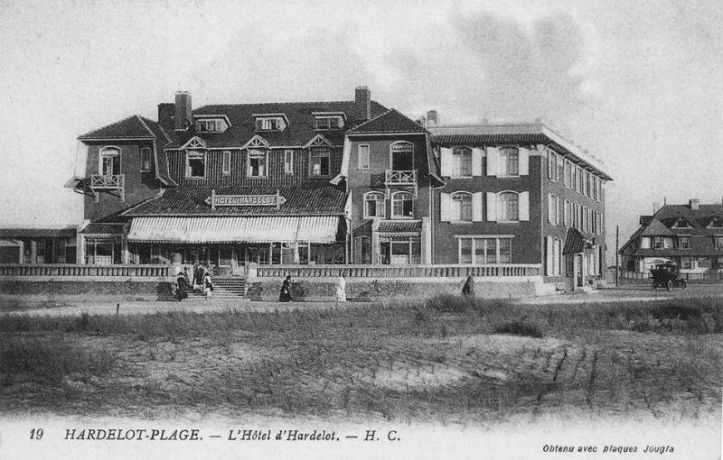
The nurses were billeted in six comfortably furnished villas. However, they were located in different parts of the town, and Valerie, Amy and their colleagues had to brave the elements to converge on the central mess room.
Valerie remained at No. 25 GH for the rest of the year and into 1918, but on 1 December 1917 Amy reported to No. 14 GH in Wimereux, which was based in the Hôtel Splendide and in the nearby Casino (and may also have occupied the Grand Hôtel Mauricien). On 2 January 1918 she was transferred to England on duty and on 8 January was attached to Southwell Gardens Hospital. Otherwise known as the Mrs. T. S. Hall Hospital for Australian Nurses, and located in South Kensington, the hospital operated under the auspices of the Australian Red Cross and provided nursing and medical care for sick Australian nurses. On 1 April Amy was marched out for duty once again with No. 25 GH and the following day rejoined Valerie, who was still at Hardelot.
1918: THE FINAL YEAR OF WAR
On 18 January 1918 Valerie, suffering from influenza, was admitted to No. 14 SH in Wimereux, where Edith Moorhouse had worked. She was discharged and returned to duty on 26 January. By then, Molly Nielsen, Edith’s best friend, had arrived at Hardelot. Valerie was granted leave again from 3 March and travelled to England, returning to Hardelot on 18 March.
The following month Valerie was mentioned in despatches for a second time. For their distinguished and gallant service and devotion to duty under his command during the period 25 September 1917 to 24 February 1918, Sir Douglas Haig mentioned her and 10 other AANS nurses in his despatch of 7 April. The mentions in despatches were promulgated in the Fourth Supplement to The London Gazette of 24 May.
On 14 June Valerie wrote from No. 25 GH in France to her sister Nellie. An excerpt from her letter was printed in the Kerang New Times on 9 August:
I think the folk at home are truly wonderful to work as they do and to give as they do, and I think they would be encouraged if they could see the boys getting the things here. It’s very hard to get things now from the B.R.C. [British Red Cross], and often we can’t even get a pipe for a Tommy. I do hate to refuse them. We get a very decent amount for our own men, and the Canadians look after theirs with bags in the same way. A bag contains writing paper, cigarettes, soap, shaving soap, handkerchief, tooth paste, in fact all they need. They also love the papers, and a ‘Bulletin’ here from the Red Cross goes the rounds and is quite first favorite.
Valerie was granted more leave on 21 October and travelled to England for 14 days. Less than a week after her return to Hardelot, the Armistice that ended the fighting with Germany was signed at Compiègne, and at 11.00 am on 11 November 1918 the guns fell silent on the Western Front. Germany’s allies had already signed armistices: Bulgaria on 29 September, the Ottoman Empire on 30 October, and Austria-Hungary on 3 November.
NO. 3 AUSTRALIAN CASUALTY CLEARING STATION
The fighting may have ended but the work continued for the Allied medical units. On 10 December 1918, after nearly 18 months at No. 25 GH, Valerie was posted temporarily to No. 10 SH at Tourcoing, 120 kilometres east of Hardelot. Three days later she was transferred to No. 3 ACCS at Audenarde in Belgium, 40 kilometres northeast of Tourcoing. Amy King, meanwhile, remained at Hardelot.
No. 3 ACCS had been raised on 17 March 1916 from elements of No. 10 Australian Field Ambulance and had sailed for England on the SS Medic on 20 May 1916. After being based at various locations in France and Belgium for two and a half years, in October 1918 the unit moved to Kezelberg in Belgium, near Ledeghem.
Immediately after the signing of the Armistice, No. 3 ACCS was chosen as one of six CCSs to advance with the British Second Army into Germany as part of the Allied occupation of the Rhineland. The unit would no longer function as a hospital for the treatment of surgical cases, but as a mobile hospital for the clearing of sick. To effect this change, the number of tents was reduced from 154 to 98; the x-ray plant was disposed of; operating theatre capacity was reduced from eight tables to one; the accommodation for patients was reduced from 800 to 300 (of whom 250 would be walking cases); the number of beds was reduced from 200 to 50; the quantity of material was reduced from 450 tons to 75 tons; and the nursing staff was reduced from 18 to seven.
On 13 November No. 3 ACCS was ordered to move forward to Audenarde (Oudenaarde) and on 16 November was established in a field 3 kilometres from the town. Two days later the hospital received its first patients, men of the British Second Army, whose main complaints were sore feet due to heavy marching and influenza – the Spanish flu was sweeping through Western Europe – with the occasional accidental wound from a bomb explosion.
ADVANCE INTO GERMANY
Valerie arrived at Audenarde on 13 December and the following day took over from Eleanor Jeffries as head sister. Sister Jeffries in turn reported to No. 25 GH.
Valerie had charge of three sisters – one of whom was Molly Nielsen, who had joined No. 3 ACCS from No. 25 GH in May that year and had been promoted to the rank of sister in October – and three staff nurses. The day before Valerie’s arrival, No. 3 ACCS had received orders to move forward to Euskirchen, near Cologne in Germany, where the unit would relieve No.1 Canadian CCS. Preceded by an advance party, the main body of No. 3 ACCS, including Valerie and her nurses, arrived at Euskirchen at 7.00 am on 22 December after successfully negotiating various communication, logistical and transport headaches, including a 43-hour train ride.
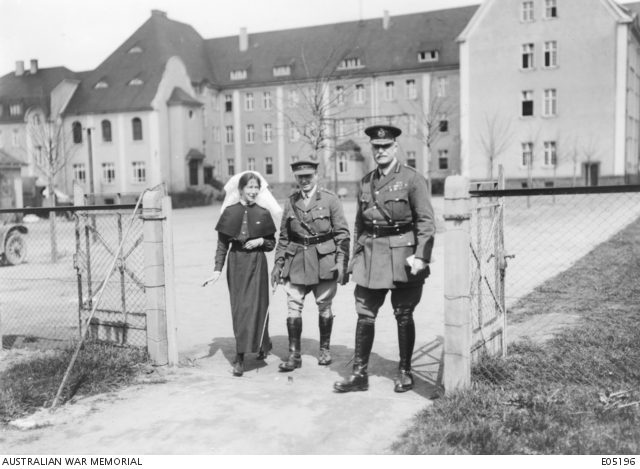
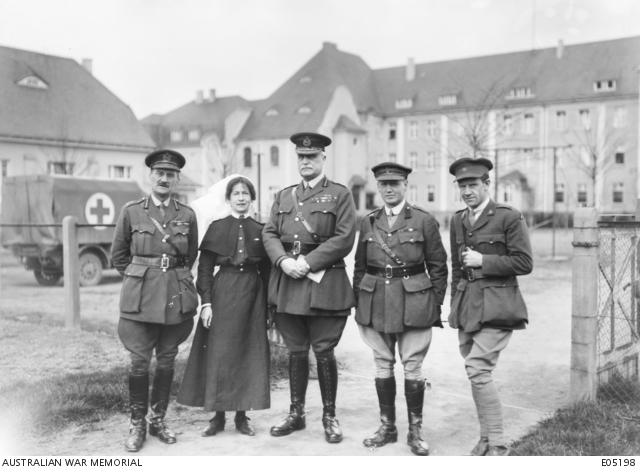
The unit was accommodated in a magnificent building, previously a large institution for deaf people. The officers and men were well accommodated, as were the nurses, who were comfortably billetted in a large house, evidently where the institution’s staff had lived, with central heating and a satisfactory hot water service.
To begin with, the hospital’s patients were received from the British IX Corps, which was billetted in the Euskirchen area. Very few surgical cases arrived, the bulk of the work consisting of medical cases – mainly influenza, but also boils, cellulitis, diarrhoea, and various other conditions. The weather throughout the month was fine, but very cold.
On Christmas Day there was a considerable fall of snow, but owing to insufficient supplies, Christmas celebrations were postponed until 26 December. On that day the staff had a special dinner, followed by a concert in the evening.
During the first half of January 1919 the nurses’ work was fairly heavy, due to the number of influenza cases, but eased off during the second half. In February another wave of influenza kept Valerie and her nurses busy, and by early March No. 3 ACCS was full of men suffering from the virus, many of whom were dying.
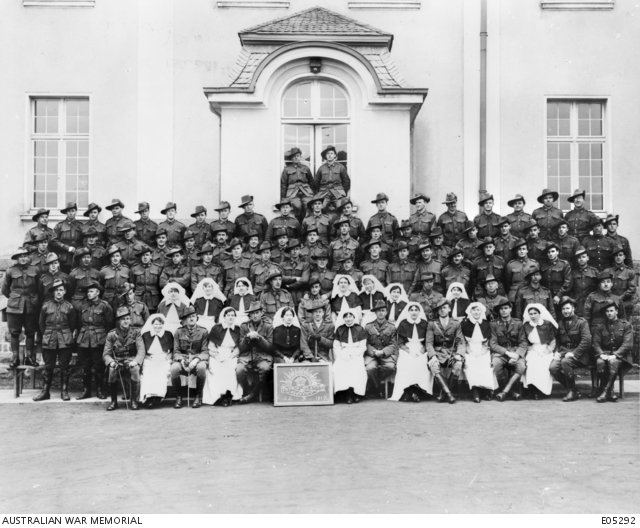
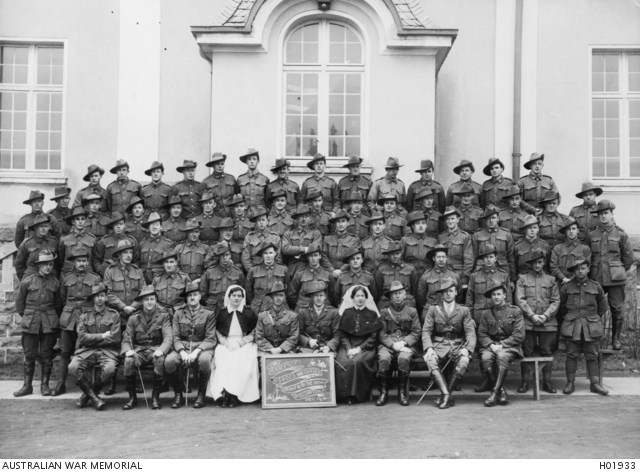
In April orders were received to demobilise No.3 ACCS, and during the first week in May the last of the nursing staff arrived at Le Havre, preparatory to being demobilised. The unit’s last day was 26 April 1919.
VALERIE’S NARRATIVE REPORT
Later in 1919, at the request of the collator of war history, Valerie submitted a report on her service at No. 3 ACCS (which she begins on 11 November 1918, even though she did not arrive at the unit until 13 December). It reads as follows:
On 11.11.18 the news of the Armistice was received, and on the same day orders were received to close the C.C.S. and prepare to move forward, for we had been chosen as one of the C.C.Ss. selected to take part in the advance into Germany. Five other C.C.Ss. were taking part in this advance. The nursing staff was to be reduced to seven; one Head sister, three Staff nurses, and three sisters were selected. The rest of the sisters were returned to the base [Le Havre] on the 15th November, 1918. The nursing staff who were remaining with the unit were as follows: –
Head Sister E. W. Jeffries, A.R.R.C.
Sisters J. B. McDonald. M. M. McNulty, A.R.R.C. F. A. Nicholls.
Staff Nurses A. M. Wilson. D. Robertson. M. M. Neilson.
On 16.11.18, this staff set out in Motor Ambulances for Audenarde, on the Scheldt. We arrived after an interesting trip through country which had been recently fought over, and which had been described to us by the wounded men that we had been nursing at our last site.
On our arrival at Audenarde we found the camp almost completed. It was situated in an open field near the railway station. The camp was very much smaller than our usual camps for in future we would have only the sick to care for. There was accommodation for fifty bed cases and two hundred and fifty stretchers instead of about six hundred, as we had been prepared for in the past. The operating theatre contained only one table, and consisted of two marquees. There were 12 beds in the Officers’ ward and a similar number in the Surgical ward: there were 26 beds in a Medical ward, and tentage for 250 stretchers in four large sets of marquees. The electricity was installed. There were four bell tents as sleeping accommodation for the sisters, with floor boards and a comfortable mess tent, floored and electrically lit and containing a large stove of French pattern.
Soon after our arrival, the weather became very cold, and we had rain and snow. The camp became very muddy, and as it had not been possible to bring duckboards, we realised that this trip was not going to be all pleasure.
Most of the cases that the nursing staff have been called upon to look after, have been influenza and pnuemonia [sic]. There were few accidental wounds, due to explosions of bombs that had been left behind by the troops. Several of these occurred among civilians. There was one old lady who was wounded in the abdomen, who made an excellent recovery.
The opening days of December saw us still at Audenarde. On the 3rd of the month, the C.C.S. closed preparatory to moving forwards. On the 14th, sisters Jeffries and McNulty left for their 1914 leave, and were replaced by Temp. Head sister V. Zichy Woinarski, and Sister Nicholls, also left on the 14th, having been replaced on the previous day by Sister E. L. Slater.
From the 3rd till the 20th, we were waiting for the train which was to take us to Euskirchen in Germany, where our advance party had gone. On the 19th, the train arrived, and began loading. There was accommodation provided for the sisters on the train, and everybody left on the 20th, en route for Germany. After spending the night in the train fairly comfortably, we arrived at Euskirchen on the 20th [No. 3 ACCS’s war diary states 7.00 am on 22 December as the arrival time for the main party], and took over from the first Canadian C.C.S. which was established in the deaf and dumb asylum in that village. On the 21st, the Third Aust. C.C.S. opened.
The sisters quarters we found to be most comfortable, the mess being a large room facing the east and being well furnished, and heated by central steam heating. The mess was about two hundred yards away from the hospital, and there was a fine outlook over the fields to the Rhine Hills in the distance. The sleeping quarters were very comfortable, and quite a contrast to the bell tents, that we had been accustomed to. There was a very fine kitchen, with a good cooking range and all conveniences. The mess and sleeping accommodation were very good.
Permission was given by the Matron in Chief for dancing, from December 20th, to January 3rd, and advantage was taken of this permission to hold a dance on Xmas night. This was very successful, and concluded most happily our Christmas festivities in Germany.
For the first fortnight of the New Year, the work was very heavy in the Medical Wards, owing to the number of cases of acute influenza admitted, and the prevalence of Pnuemonia [sic] as a complication of this disease. During the latter part of January, there was a marked decrease in the number of cases admitted with a consequence [sic] lessening of the amount of work in the Medical Wards.
During January the Surgical Ward was generally full of patients with minor injuries with an occasional acute case. During January there was an opportunity for skating on a neighbouring pond, and this was a very popular form of amusement both for those who were taking part, and for those who were looking on.
February saw a recrudescence of the influenza epidemic, and the work in the Medical wards again became heavy. There were a lot of cases among the Officers, and on 21.2.19, it became necessary to move the Officers into a larger ward. There were several changes in the Staff in February. S. Nurse J. G. Duncan arrived on 3.2.19, to replace Sister A. M. Wilson, who was evacuated the same day to Cologne, sick. On the 15th, our staff was increased by four sisters, E. P. Wright, E. Buchanan, S. Nurses M. C. Giles, and N. J. Wigley. A few days after their arrival, Sister Wright and S. Nurse M. C. Giles left for duty at Rheinbach at the 141st Field Ambulance returning here for duty, 27.2.19.
Skating still remained popular. An old Chateau was discovered at Satevay [Satzvey], which was a few Kilometres away, and there was a moat all round the Chateau, which provided a most beautiful skating place.
During March and April, the weather had considerably improved, and at present the early part of May is glorious. The work during March and April considerably slackened off. There were a few cases of influenza, but the worst of the epidemic is over.
The beginning of May sees us awaiting return to London. The staff at the beginning of May consisted of the following: –
T/Head Sister V. Z. Woinarski
Sister A. Macdonald
Sister M.R. Watt
Sister F. P. Wright
Sister M. M. Nielson
Sister E. Buchanan
Sister A. Dorrington
Sister L. Coomer
Sister A. M. Tait
Sister H. G. Milne
Staff Nurse W. G. Wells
Staff Nurse N. J. Wigley
Staff Nurse M. C. Giles
Staff Nurse J. C. Duncan
On 26.4.19, No. 47 C.C.S. arrived to take over the stores, and equipment of this unit. The nursing sisters however did not come with them, and our staff carried on.
On May 1st, six of the sisters were instructed to report to the Sisters’ Hostel at Cologne. Miss Gibbs arrived the same day accompanied by one sister. The other members of the nursing staff expect orders to depart very shortly, and this will be the end of our stay in Germany. This stay has been most pleasant, as conditions have been almost entirely those of a peace basis, and everybody has been most considerate to us. I should like to record my appreciation, on this, the eve of our departure, my appreciation of the work done by the members of my staff. Their work has always been characterised by conscientiousness and devotion to duty. The high ideals of the A.A.N.S. have indeed not suffered at their hands.
RETURN TO AUSTRALIA
On 21 May 1919 Valerie departed France for London to report for duty to Matron Conyers at AIF Headquarters. She arrived the following day and was placed on leave. On 7 June, her leave complete, she was posted to No. 6 AAH in Holland Park, South Kensington, where Amy King had spent nearly a month from late February to late March 1917. The hospital had relocated from Moreton Gardens to Holland Park in January 1919.
Nearly three years after departing on the Karoola, on 18 July Valerie embarked for Australia aboard the Orsova. The shiparrived in Melbourne on 4 September. Valerie was home.
And what of Amy? She had remained attached to No. 25 GH in Wimereux until 17 February 1919, on which date she proceeded to England. She returned to No. 2 AAH in Southall on 19 February and on 10 May embarked from Tilbury on HMAT Wahehe for Australia. She disembarked in Melbourne on 28 June 1919 (it is not known why the voyage took so long).
On 3 June 1919, Valerie, still in London, and Amy, en route to Australia, were awarded the Associate Royal Red Cross in recognition of their service in France and Flanders. They were among 10 AANS nurses to be thus honoured that day, which marked the occasion of the birthday of George V. The award was instituted by George V in 1915 and was a lesser complement of the Royal Red Cross, which was instituted in 1883 by his grandmother, Queen Victoria. Each was awarded to military and civilian nurses for eminent and valuable treatment of military personnel over a long period of time, or for a notable act of bravery during the execution of service.
The awards were promulgated in the Fifth Supplement of the London Gazette (30 May 1919) on 3 June 1919.
Valerie was discharged from the army on 30 January 1920. Just over two months later, on 5 April, her father died at Wood’s Point, near Mansfield in the Yarra Ranges to the east of Melbourne. He was 62 years old. He had recently returned from a voyage on the SS Ooma to Ocean Island, one of the Gilbert Islands in the Southwest Pacific (today known as Kiribati), and Nauru. Before his death he had been practising in Omeo in eastern Victoria and in December 1918 was appointed Omeo Shire health officer. It is not known whether Flora Zichy-Woinarski had accompanied him to Omeo.
RETURNED ARMY NURSES’ CLUB
On 5 December 1921 Valerie attended a meeting of returned army nurses at Anzac House on Collins Street in Melbourne. Under discussion was the formation of a club for the nurses at Anzac House, an idea that had first been proposed in July 1920. A 12-member executive committee was formed from the nurses present, composed of Valerie, 10 other nurses, and Matron Edith Cornwell as president. The committee’s role was to organise the club and communicate with as many former army nurses in Victoria as possible.
By June 1922 the Returned Army Nurses’ Club (RANC) had been established and clubrooms secured at Anzac House. They were officially opened on 26 June by Helena Rous (Lady Stradbroke), the wife of the governor of Victoria. Valerie and more than 20 other returned nurses attended the opening, among them the celebrated Great War nurses Grace Wilson, who was on the executive committee, and former matron-in-chief Evelyn Conyers.
Aside from providing a venue for social occasions, the RANC carried out important work for the welfare of returned army nurses. It offered an employment service; it lobbied successfully for the provision of an outpatients’ room for returned nurses at the Repatriation Commission branch office on St. Kilda Road; and its work bureau sold handicrafts and needlework made by nurses whose compromised health had prevented their return to nursing.
Valerie remained active on the RANC committee for more than 10 years and in 1932 was elected one of two honorary secretaries. On 5 December that year she attended a reunion dinner of nurses who had sailed to Egypt on the Kyarra 18 years earlier. It is not known whether Amy King was among the many returned nurses in attendance.
Amy did attend a garden party held on 6 November 1937at the Toorak home of Mrs Hume Turnbull (formerly Marjorie Yuille, who, as a staff member of No. 1 AGH, had sailed on the Kyarra with Valerie). Valerie was there too, one of 60 RANC members to be invited.
Each year on the eve of Anzac Day the members of the RANC met at Anzac House. Valerie was consistently in attendance, and on 24 April 1940 she was there as usual. This time was different, however. The world had been plunged into another cataclysmic war. Grace Wilson, who was present, had been matron-in-chief of the AANS since 1925. One can only imagine the gravity of her demeanour that night.
Eventually the RANC transitioned into a sub-branch of the Returned and Services League and continues today.
TOWARDS THE END
On 15 September 1942 Valerie’s mother, Flora Zichy-Woinarski, died at her home at 8 Bradford Avenue in the Melbourne suburb of Kew. She had previously lived at ‘Connewarren’ in East Malvern and in 1925 was living on Kooyong Road in Caulfield. She was 81 years old.
On 4 March 1954 the Queen and the Duke of Edinburgh visited the Repatriation General Hospital in Heidelberg, Melbourne during their first Commonwealth tour. Valerie was a patient at the hospital at the time and was one of many patients seated or standing on the lawn awaiting the arrival of the Queen. When Elizabeth came out, she spotted Valerie’s Associate Royal Red Cross badge and came over to ask Valerie about her war service.
Five and a half years later, on 21 September 1959, Valerie died in Kew at the age of 73 having led a full and interesting life. She was buried the next day at the Springvale Botanical Cemetery in Boronia.
We will not forget her.
SOURCES
- Ancestry.
- Aussie Sappers (website), 1st Field Company Engineers – Australian Imperial Forces, ‘Dramatic Story of the Landing – by 84 William Echlin Turnley.’
- Australian Nurses in World War 1 (website).
- Australian Remembrance Trail: Lemnos 1915–1916 (website), ‘Building a Military Base.’
- Australian Remembrance Trail: Lemnos 1915–1916 (website), ‘First Australian Troops Arrive on Lemnos.’
- Australian Remembrance Trail: Lemnos 1915–1916 (website), ‘No. 1 Australian Stationary Hospital Established.’
- Australian War Memorial, Nurses’ Narratives, H/Sister Mabel Brown, AWM41 947.
- Australian War Memorial, Nurses’ Narratives, Head Sister Jeffries, AWM41 984.
- Australian War Memorial, Nurses’ Narratives, Sister E. H. [sic] Cuthbert, AWM41 958.
- Australian War Memorial, Unit Diaries, 1914–18 War, No. 14 Australian General Hospital (Jul 1916–Sept 1917), AWM4 26/68/1.
- Australian War Memorial, Unit Diaries, 1914–18 War, No. 3 Australian Casualty Clearing Station (Dec 1918), AWM4 26/64/27.
- Australian War Memorial, Unit Diaries, 1914–18 War, No. 3 Australian Casualty Clearing Station (Nov 1918), AWM4 26/64/26.
- Australian War Memorial, Unit Embarkation Nominal Rolls, 1914–18 War, 1 Australian General Hospital (Nov 1914), AWM8 26/65/1.
- Australian War Memorial, Unit Embarkation Nominal Rolls, 1914–18 War, 14 Australian General Hospital and Reinforcements (Jul 1916–Nov 1917), AWM8 26/101/1.
- Australian War Memorial, ‘The Armistice of 11 November 1918’ (Ashley Ekins, Wartime magazine, Issue 84).
- Barrett, J. W. and Deane, P. E. (1918), The Australian Army Medical Corps in Egypt, Project Gutenberg.
- BirtwistleWiki, ‘6th Australian Auxiliary Hospital.’
- BirtwistleWiki, ‘HMHS Grantully Castle.’
- Ford, H. (2015), ‘Gone but Not Forgotten – Sister Hilda Mary Knox,’ Australian Stories: A blog by frev, Great War Forum.
- Gallipoli Association (website), ‘August Offensive.’
- Gardiner, L. (1979, 2006), ‘Jane Bell (1873–1959),’ Australian Dictionary of Biography.
- Grandad’s War (website), ‘War Diary HM HT [sic] Guildford Castle 1915.’
- The London Gazette, 20 Jun 1916 (Third Supplement, 21 Jun 1916, No. 29632, p. 6184).
- The London Gazette, 24 May 1918 (Fourth Supplement, 28 May 1918, No. 30706, p. 6203).
- The London Gazette, 30 May 1919 (Fifth Supplement, 3 Jun 1919, No. 31370, p. 6842).
- The Long, Long Trail (website), Locations of Australian and Canadian Casualty Clearing Stations, 1st Australian Casualty Clearing Station.
- Mortlake & District Historical Society Inc, ‘The amazing story of Jemima Vans Robertson – ‘Mrs Colonel Robertson’ – of ‘Connewarren’, Mortlake, 1800-1884,’ posted 12 July 2014, Facebook.
- National Archives of Australia.
- Public Records Office Victoria, Royal Victorian Trained Nurses’ Association, Register of Nurses No. 2, pp. 713–1465, VPRS 16407.
- Rosenzweig, P. (1997). ‘The service heritage of the Honourable Austin Asche AC, 15th Administrator of the Northern Territory, 1993–1996.’ Sabretache: The Journal and Proceedings of The Military Historical Society of Australia, Vol. 38, No. 2, Apr–Jun 1997.
- Scarlet Finders (website), ‘Report on the Work of the Australian Army Nursing Service in France (The National Archives, WO 222/2134).’
- Scarlet Finders (website), War Diary: Matron-In-Chief, British Expeditionary Force, France and Flanders, Mar 1919 (The National Archives, WO 95/3988/91).
- State Library of Queensland, Agnes Kathrine Isambert papers, ‘Agnes Katharine Isambert Diary (item no. 30894/1).’
- State Library of Queensland, Constance Mabel Keys collection, Series 5: Correspondence (1914–1961), ‘Letterbook (24 September 1914–22 June 1916) (item no. 30674/36).’
- Through These Lines (website), ‘No. 25 General Hospital.’
- Through These Lines (website), ‘No. 3 Australian Casualty Clearing Station.’
- The Western Front Association (website), ‘The Action at Rafa, 9 January 1917’ (David Tattersfield, 10 Jan 2015).
- Wikipedia, ‘Battle of Arras (1917).’
- Wikipedia, ‘Battle of Magdhaba.’
- Wikipedia, ‘Battle of Romani.’
- Wikipedia, ‘Timeline of the Gallipoli Campaign.’
- Wilson, L.C. and Wetherell, H. (1926), History of the Fifth Light Horse Regiment, 1914–1919, Motor Press (via the website Anzacsdotorg).
SOURCES: NEWSPAPERS
- The Advertiser (Adelaide, 3 Sept 1919, p. 9), ‘Shipping News.’
- The Age (Melbourne, 13 Aug 1914, p. 8), ‘Troops for Europe.’
- The Age (Melbourne, 13 Aug 1914, p. 8), ‘Volunteer Nurses.’
- The Age (Melbourne, 8 Sept 1914, p. 6), ‘For Active Service.’
- The Age (Melbourne, 1 Oct 1914, p. 8), ‘The Great Field Hospital.’
- The Age (Melbourne, 7 Dec 1914, p. 10), ‘Nurses for the Front.’
- The Age (Melbourne, 19 Mar 1915, p. 7), ‘Forcing the Dardanelles.’
- The Age (Melbourne, 6 Dec 1921, p. 6), ‘News of the Day.’
- The Age (Melbourne, 23 Feb 1922, p. 6), ‘Military Nurses.’
- The Age (Melbourne, 26 Jul 1932, p. 4), ‘Current Events.’
- The Age (Melbourne, 8 Nov 1937, p. 4), ‘Afternoon Party.’
- The Age (Melbourne, 25 Apr 1940, p. 3), ‘Anzac Eve Reunion.’
- The Age (Melbourne, 5 Mar 1954, p. 5), ‘Colorful Scene at Hospital.’
- The Argus (Melbourne, 8 Dec 1879, p. 5), ‘University of Melbourne.’
- The Argus (Melbourne, 2 Aug 1883, p. 1), ‘Family Notices.’
- The Argus (Melbourne), 24 Nov 1914, p. 8), ‘Military Hospitals.’
- The Argus (Melbourne, 7 Dec 1914, p. 10), ‘Expeditionary Force.’
- The Argus (Melbourne, 7 Apr 1920, p. 1), ‘Family Notices.’
- The Argus (Melbourne, 30 Jul 1920, p. 6), ‘Returned Nursing Sisters.’
- The Argus (Melbourne, 17 Sept 1942, p. 2), ‘Family Notices.’
- The Australasian (Melbourne, 1 Jul 1922, p. 46), ‘Club for Army Nurses.’
- The Australasian (Melbourne, 28 Dec 1940, p. 36), ‘Famous Pastoral Properties: Woolongoon, near Mortlake, Has Celebrated Its Centenary.’
- The Ballarat Courier (Vic., 2 Aug 1883, p. 2), ‘No Title.’
- The Ballarat Star (Vic., 7 May 1881, p. 2), ‘Clunes.’
- The Ballarat Star (Vic., 17 Dec 1881, p. 1), ‘Compliment to Dr Woinarski.’
- The Ballarat Star (Vic., 24 Dec 1881, p. 2), ‘News and Notes.’
- The Ballarat Star (Vic., 30 Jan 1882, p. 2), ‘Government Gazette.’
- The Ballarat Star (Vic., 30 Nov 1882, p. 2), ‘Melbourne.’
- The Ballarat Star (Vic., 10 Jan 1885, p. 2), ‘News and Notes.’
- The Ballarat Star (Vic., 25 Jan 1886, p. 3), ‘Advertising.’
- The Ballarat Star (Vic., 26 May 1886, p. 4), ‘Ballarat Shire Council.’
- The Ballarat Star (Vic., 5 Aug 1890, p. 2), ‘Family Notices.’
- The Ballarat Star (Vic., 20 Dec 1893, p. 3), ‘Advertising.’
- The Ballarat Star (Vic., 20 Dec 1894, p. 3), ‘Advertising.’
- The Ballarat Star (Vic., 19 Dec 1895, p. 3), ‘Advertising.’
- The Ballarat Star (Vic., 19 Dec 1896, p. 3), ‘Advertising.’
- The Ballarat Star (Vic., 18 Dec 1897, p. 4), ‘Advertising.’
- The Ballarat Star (Vic., 21 Dec 1898, p. 3), ‘Advertising.’
- The Ballarat Star (Vic., 16 Dec 1899, p. 8), ‘Advertising.’
- The Ballarat Star (Vic., 19 Dec 1900, p. 6), ‘Advertising.’
- The Ballarat Star (Vic., 19 Dec 1901, p. 6), ‘Queen’s College.’
- The Ballarat Star (Vic., 19 Dec 1902, p. 1), ‘Honor List, 1902.’
- The Ballarat Star (Vic., 24 Dec 1902, p. 2), ‘No title.’
- The Ballarat Star (Vic., 2 Mar 1912, p. 2), ‘Ladies Column.’
- The Ballarat Star (Vic., 11 Mar 1912, p. 4), ‘A Family Farewelled.’
- The Ballarat Star (Vic., 15 Feb 1913, p. 2), ‘Weddings.’
- The Ballarat Star (Vic., 8 Apr 1920, p. 1), ‘Personal.’
- Barrier Miner (Broken Hill, NSW, 28 Nov 1892, p. 3), ‘New Zealand.’
- The Benalla Standard (Vic., 20 Apr 1917, p. 3), ‘The Late Sister Knox.’
- The Brisbane Courier (14 Oct 1914, p. 7), ‘Expeditionary Forces.’
- Camp Chronicle (Midland Junction, WA, 22 Jun 1916, p. 1), ‘Some War Hospitals in Egypt.’
- Daily Record (Rockhampton, Qld., 18 Sept 1915, p. 3), ‘Letters from the Front.’
- Daily Record (Rockhampton, Qld., 2 Oct 1915, p. 2), ‘The War.’
- The Daily Telegraph (Sydney, 9 Feb 1893, p. 7), ‘The S.S. Australasian.’
- Hawthorn, Kew, Camberwell Citizen (Vic., 12 Apr 1918, p. 2), ‘Rambles of a Military Nurse.’
- The Herald (Melbourne, 22 Aug 1916, p. 4), ‘Army Nurses Mentioned in Despatches.’
- The Independent (Benalla, Vic., 14 Sept 1915, p. 3), ‘Sister King.’
- The Independent (Benalla, Vic., 14 Sept 1915, p. 3), ‘Sister Woinarski.’
- Kerang New Times (Vic., 9 Aug 1918, p. 2), ‘Red Cross Work in France.’
- Mornington Standard (Vic., Thu 10 Oct 1901, p. 2), ‘Mornington.’
- Omeo Standard and Mining Gazette (Vic., 13 Dec 1918, p. 2), ‘Omeo Shire Council.’
- Omeo Standard and Mining Gazette (Vic., 1 Jul 1919, p. 2), ‘The Omeo Standard.’
- Punch (Melbourne, 18 Apr 1907, p. 35), ‘Mr. T. M. King to Miss A. V. Zichy-Woinarski.’
- Punch (Melbourne, 26 Dec 1912, p. 29), ‘Weddings.’
- Punch (Melbourne, 26 Nov 1914, p. 25), ‘Farewell to Army Nurses.’
- Richmond Guardian (Vic., 11 Dec 1915), p. 2), ‘Advertising.’
- Sunday Times (Sydney, 19 Sept 1915, p. 5), ‘Wounded Are Grateful: Red Cross Supplies in Egypt.’
- The Sun News-Pictorial (Melbourne, 6 Dec 1932, p. 26), ‘Reunion Dinner.’
- The Sydney Morning Herald (8 Sept 1915, p. 11), ‘The Red Cross. Work in Egypt.’
- Table Talk (Melbourne, 6 Feb 1891, p. 2), ‘Table Talk.’
- Table Talk (Melbourne, 29 Jun 1922, p. 33), ‘Returned Army Nurses’ Club.’
- The Western Champion and General Advertiser for the Central-Western Districts (Barcaldine, Qld., 23 Oct 1915, p. 9), ‘Letters from the Front – Sister Zita Lyons.’
 australianwarnurses.org