Richmond Military Hospital │ Sister │ First World War │ England
FAMILY BACKGROUND
Ursula Mary Roper was born in 1871 in Glebe, an inner suburb of Sydney. She was the second of three children born to Sarah Ann Marshall (1849–1921), and Edmund Alphonsus Roper (1846–1874).
Sarah was born in Hobart and was one of around 11 children. Edmund was born in Nottingham, England and by 1856 had migrated to Hobart with his family. As a young adult he was a pupil teacher and then, like several of his siblings, became a professional musician, playing the piano and organ. He eventually became organist at St. Patrick’s Church in Sydney.
Edmund and Sarah were married on 15 August 1868 at St. Joseph’s Church in Hobart. The following month Sarah resigned her position as teacher at the St. George’s Hill School in Hobart and sailed to Sydney on the City of Hobart to join Edmund, arriving on 2 October 1868. The newly married couple lived on St. John’s Road in Glebe.
In December 1869 Sarah gave birth to the couple’s first child, Edmund Oswald. He was followed by Ursula in 1871 and Violet Elizabeth in 1873.
On 28 March 1874, when little Ursula was just two or three years old, Edmund Roper died after a brief illness at the family home on Derwent Street, Glebe. He was 27 years old. Sometime after her husband’s death Sarah returned to Hobart with the children and in December 1883 married Robert Bothwell Cameron, who was the resident secretary of the Australian Mutual Provident (AMP) Society in Tasmania.
Soon after his marriage, Robert was promoted to the secretaryship of the AMP Society in South Australia, and the family moved to Adelaide. Here Sarah gave birth to three sons, Robert Alan in 1884, Graham in 1888 and John Kenneth in 1890. Later in 1890 Robert was appointed to the national secretaryship at the AMP’s head office in Sydney, and the family moved once again.
NURSING
Ursula’s early life is a mystery. Her new stepfather was a man of means, so presumably she and her siblings attended good schools in Adelaide and Sydney.
When Ursula grew up, she decided to become a nurse. In the 1890s she trained at the Prince Alfred Hospital (PAH) in Camperdown, Sydney (which became ‘Royal’ in October 1903) and had graduated by 1898.
On 28 May of that year Ursula sailed to London on the RMS Oroya with her sister, her mother and her stepfather. En route the ship called into Melbourne, Adelaide, Albany, Colombo and Marseilles. The Camerons and the Misses Roper were away for six months. From England they travelled to Europe, visiting Paris among other cities, and then sailed across the Atlantic to New York. From that eastern metropolis they travelled west to San Francisco, presumably by train, and on 3 November embarked on the RMS Mariposa and sailed via Honolulu, Apia and Auckland to Sydney, arriving on the morning of 28 November.
Ursula became one of the first nurses to join the Australasian Trained Nurses’ Association (ATNA). The ATNA was established in 1899 by a group of nurses and doctors that included Matron Susan McGahey of the PAH and Matron Nellie Gould of the Hospital for the Insane. Matron Gould would soon serve in the Second Boer War and was then instrumental in the formation of the Australian Army Nursing Service (AANS). On 20 July 1900, Ursula was among hundreds of guests at the Sydney Town Hall who had responded to an invitation from the Mayor and Mayoress of Sydney, Sir Matthew and Lady Harris, who wanted to meet the members of the ATNA. She attended with her sister, Violet.
On 21 April 1903 Ursula was one of Violet’s bridesmaids when Violet married George D’Arcy Reddall at St. Jude’s Church in Randwick. After the ceremony a reception was held at Randwick Town Hall.
By 1904 Ursula was working for Susan McGahey at the latter’s private hospital on Darlinghurst Road, Sydney. In July of that year Ursula underwent a traumatic experience when a patient she was specialling cut his throat with a razor while she was in the room. She struggled vainly with him while he was in the act and sustained serious cuts to her hands.
On 17 December 1907 Ursula’s brother, Edmund, died at his home in Brighton, South Australia. He was only 38 years old. Just over two years later her stepfather died. On 7 February 1910 Robert Cameron passed away at the age of 61 at the family home in Randwick, ‘Montpellier.’ In his will, which was sworn at £10,248, he left £500 to Ursula – an amount that granted her a considerable degree of financial freedom.
WAR
When the Great War broke out, Ursula wanted to serve her country. At 44, she was officially too old to enlist in the AANS so instead decided to pay her own way to England, where she intended to work in a military hospital. On 7 September 1915 she departed Sydney on the RMS Majola with sisters Minnie and Nellie Witts, one or both of whom managed Ayshleigh Private Hospital on St. John’s Road in Glebe.
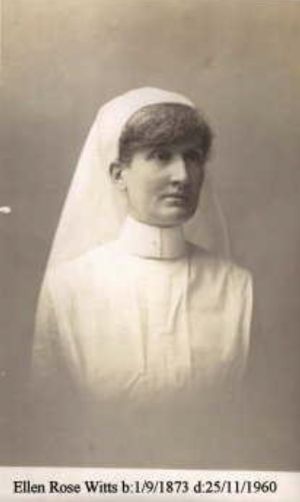
Ursula had known at least one of the Witts sisters for some time. On 1 May 1909, on the occasion of Hospital Saturday, an annual hospitals fundraising appeal, she had collected with one of the sisters at Charing Cross in the eastern Sydney suburb of Waverley, not far from Randwick. It is not unlikely that she was working at Ayshleigh prior to the Witts’ and her embarkation and that they planned the endeavour together.
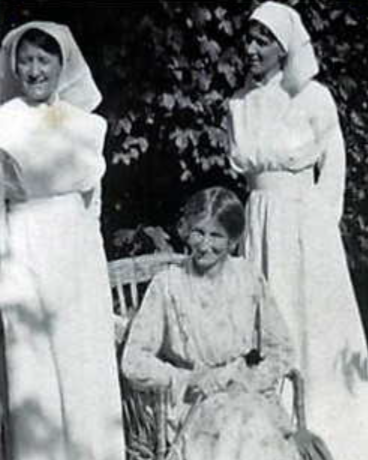
There were other nurses aboard the Majola too. Like Ursula and the Witts sisters, E. H. Garnsey, J. Shiell, M. Fitzsimmons, Nurse Champion and Nurse McPherson all likely paid their own way.
From Sydney, the Majola sailed via Melbourne, Adelaide, Fremantle, Colombo, Bombay, Port Said, Marseilles, Gibraltar and Plymouth before arriving in London on 19 October.
RICHMOND MILITARY HOSPITAL
By February 1916 (and presumably sooner) Ursula, the Witts sisters and Nurse Garnsey were working at the Richmond Military Hospital. The 500-bed hospital occupied the former Richmond Union Workhouse and an adjacent infirmary on Grove Road in Surrey, close to Richmond Park in southwest London. The buildings were taken over by the British War Office in 1915.
The hospital’s matron was Gertrude Fletcher. Born in New Zealand, Matron Fletcher had grown up in Sydney and had trained at the PAH in the 1890s – quite possibly while Ursula was there. In May 1897 she departed for England with another nurse, Susan Black, and trained in London and Edinburgh. Subsequently she joined the Army Nursing Service Reserve and served for 18 months in South Africa. From August to November 1914 Gertrude was matron of the Singer Hospital, also known as the American Women’s War Hospital, in Paignton, south Devon. The hospital had been established in Oldway House, the home of Paris Singer, and was funded by the American Women’s War Relief Committee – a group of wealthy American socialites married to British men. In May 1915 Gertrude joined the Queen Alexandra’s Imperial Military Nursing Service Reserve and one or two months later arrived at Richmond.
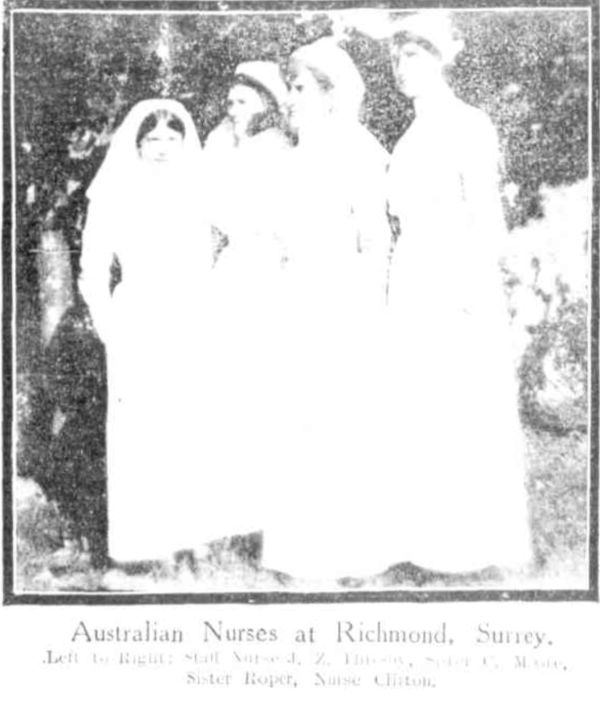
Other Australian nurses at Richmond included Staff Nurse Sprent from Tasmania and Staff Nurse Christiana Throsby from New South Wales, who served there until the Armistice.
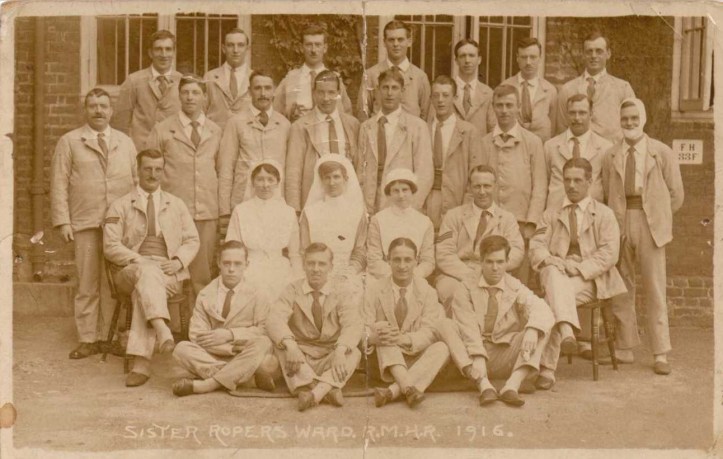
Ursula was placed in charge of a ward, as was one of the Witts sisters, who wrote to a relative in Pambula in southern New South Wales in March or April 1916. A section of her letter was printed in the Bombala Times on 12 May 1916, as follows:
I have been chosen from a hundred others to take charge of the second largest ward in Richmond Hospital, England. Australia is not one whit behind England in nursing, either in methods or training, they all admit that well. We sat back at first and waited to be taught something, or see great things, but they are not a bit ahead of us, in fact I think some of our ‘Ashleigh’ [sic] doctors could teach these a little. We are quite happy and well treated, and will not like leaving England. The winter was cruel, but now it’s quite mild. Richmond is beautiful and London gorgeous.
By January 1917 more Australian nurses had arrived, among them Sister Clara Moore from New South Wales, who had trained at the PAH and may have served with Lady Dudley’s Australian Voluntary Hospital at Wimereux in France prior to working at Richmond, and Staff Nurse Clifton.
THE ANZAC PATIENTS
Among the hospital’s patients were Australian soldiers who had been wounded during the Gallipoli campaign. They included Sgt Cuff of the 5th Battalion and Ptes J. F. Cooper and Sweeney (15th Battalion), Dell (14th), Freeman (13th), Hoolahan (15th) and Smead (5th). Pte Cooper was from Inverell in New South Wales and had received a compound fracture of the right arm at Lone Pine on 6 August 1915 during the failed August Offensive. He was transported to a military hospital in Egypt and was then sent to St. Thomas’s Hospital in Westminster, London, and afterwards to the Richmond Military Hospital.
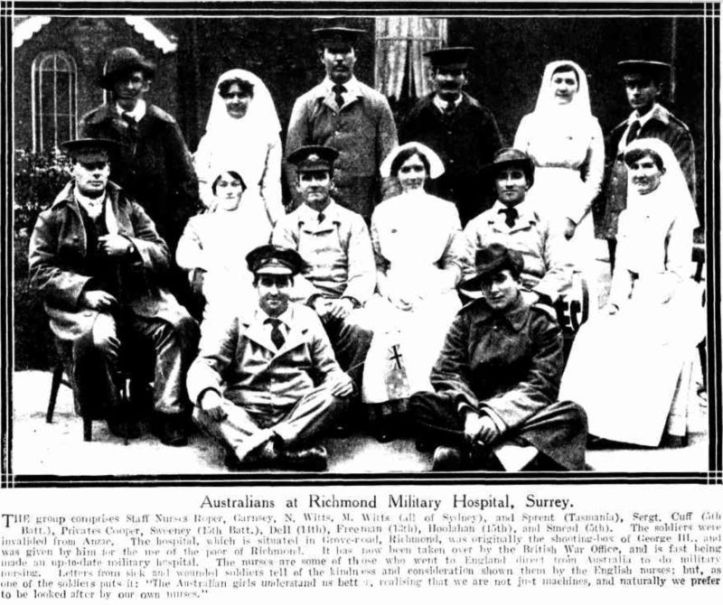
One of the Australian patients was quoted in the Sydney Mail on 24 May 1916 as saying that, while the English nurses had shown the Anzacs kindness and consideration, “the Australian girls understand us better, realising that we are not just machines, and naturally we prefer to be looked after by our own nurses.”
On 26 September 1917 Ursula wrote to the manager of the Australian Red Cross Society in London requesting information concerning the death of Pte Bertram Raymond Jones of the 41st Battalion, who was reported killed in action at Messines, France on 25 June 1917. He was originally from Randwick, and his father, Raymond William Jones, worked at the Australian Bank of Commerce in Randwick, so there may have been a family connection.
In March 1918 Ursula became ill with pneumonia. She was admitted to her own hospital and her condition worsened. She died on 6 April and was buried at Richmond Cemetery.
IN MEMORIAM
On 24 June 1925 a memorial service was held in the Sydney Town Hall for Australian women who had given their lives in the Great War. Among those present were Matron Maud Kellett of the AANS and representatives from the Australian Red Cross, the ATNA, and others.
Thirty-six names were read out, as follows: Charlotte Berrie, Louisa Bicknell, Edith Blake, Emily Clare, Ruby Dickinson, May Dickson, Pearl Goodman, May Hennessy, Narrelle Hobbes, Hilda Knox, Jean Miles Walker, Edith Moorhouse, Gladys Moreton, Norma Mowbray, Gertrude Munro, Lillie Nugent, Amy O’Grady, Rosa O’Kane, Kathleen Porter, Kate Power, Doris Ridgway, Ursula Roper, Elizabeth Rothery, Mary Stafford, Winifred Starling, Ada Thompson, Fanny Tyson, Beatrice Watson, Blodwyn Williams, Myrtle Wilson, Adele Brennan, Lydia Grant, Louie Riggall, Amy Dentan Hirst, Anita Neale and Laura Forster. One was a doctor, some were Voluntary Aid Detachment workers, most were nurses. All gave their lives for Australia.
Many of those at the service wept when ‘The Last Post’ was sounded.
The service at the Town Hall was timed to coincide with a special service held at York Minster in England, during which the newly restored Five Sisters Window was rededicated to those servicewomen of the British Empire who had lost their lives during the war.
In memory of Ursula.
SOURCES
- Ancestry.
- Australian Red Cross Society Wounded and Missing Enquiry Bureau files, 1914-18 War, 2409 Private Bertram Raymond Jones, 41st Battalion, 1DRL/0428.
- Great War Forum, Medical Services (Home and Abroad), post by Anita Isaacs, 9 July 2010.
- Lost Hospitals of London (website), ‘Grove Road Hospital.’
- The National Archives (UK), Gertrude Fletcher, WO 399/2776.
- Wikipedia, ‘Australasian Trained Nurses’ Association.’
SOURCES: NEWSPAPERS AND GAZETTES
- The Australian Star (Sydney, 20 Jul 1904, p. 5), ‘A Squatter’s Suicide.’
- The Bombala Times (NSW, 12 May 1916, p. 3), ‘The Break of ‘Day.’’
- The Daily Telegraph (Sydney, 21 Jul 1900, p. 10), ‘List of Guests.’
- The Daily Telegraph (Sydney, 21 Jul 1900, p. 10), ‘Trained Nurses Association.’
- The Daily Telegraph (Sydney, 15 Feb 1916, p. 9), ‘For Women in the Throng.’
- The Daily Telegraph (Sydney, 27 May 1918, pg. 8), ‘For Women.’
- Evening News (Sydney, 28 May 1898, p. 5), ‘Late Shipping.’
- Evening News (Sydney, 28 Nov 1898, p. 2), ‘Shipping.’
- Evening News (Sydney, 30 Apr 1909, p. 3), ‘In the Suburbs.’
- Evening News (Sydney, 8 Feb 1910, p. 7), ‘Death of Mr. R. B. Cameron.’
- Evening News (Sydney, 15 Apr 1910, p. 5), ‘The Late Mr. R. B. Cameron.’
- The Maitland Daily Mercury (NSW, 12 Aug 1902, p. 2), ‘Local and General Items.’
- The Mercury (Hobart, 11 Oct 1865, p. 2), ‘Board of Education.’
- The Mercury (Hobart, 17 Aug 1868, p. 1), ‘Family Notices.’
- The Mercury (Hobart, 14 Apr 1937, p. 7), ‘Golden Wedding.’
- The Methodist (Sydney, 22 Jan 1916, p. 8), ‘A Fletcher Family Gathering.’
- The Mirror of Australia (9 Dec 1916, p. 2), ‘Write to the Mirror about It.’
- The Muswellbrook Chronicle (NSW, 19 Aug 1916, p. 2), ‘Our Braves.’
- New South Wales Government Gazette (Sydney, 8 Apr 1874 [Issue No.79], p. 1036), ‘Ecclesiastical Jurisdiction.’
- The Scrutineer and Berrima District Press (NSW, 18 Sept 1929, p. 2), ‘Nurse Throsby Killed.’
- The Sydney Mail (10 Oct 1868, p. 2), ‘Shipping Gazette.’
- The Sydney Mail (24 May 1916, p. 19), ‘The Egyptian Campaign – And Other Topics.’
- The Sydney Mail (10 Jan 1917, p. 16), ‘All Working in the Cause of Liberty.’
- The Sydney Mail and New South Wales Advertiser (4 Jun 1898, p. 1204), ‘Shipping.’
- The Sydney Morning Herald (15 Dec 1869, p. 1), ‘Family Notices.’
- The Sydney Morning Herald (30 Mar 1874, p. 1), ‘Family Notices.’
- The Sydney Morning Herald (2 Dec 1898, p. 4), ‘The Australian Mutual Provident Society.’
- The Sydney Morning Herald (25 Apr 1903, p. 7), ‘Social.’
- The Sydney Morning Herald (7 Oct 1903, p. 7), ‘Royal Prince Alfred Hospital.’
- The Sydney Morning Herald (25 Jun 1925, p. 10), ‘Women’s Memorial.’
- The Tasmanian Daily News (Hobart, 14 Jan 1856, p. 4), ‘To the Editor of the Tasmanian Daily News.’
- The Warrnambool Standard (Vic., 20 Jul 1918, p. 2), ‘Family Notices.’
- The Warrnambool Standard (Vic., 20 Jul 1918, p. 5), ‘Heroes at the Front.’
 australianwarnurses.org