Sister │ Second Boer World │ Cape Colony, Natal, Transvaal & Orange Free State
ROSE’S PARENTS
Rose Lena Shappere was born in 1859 in Ballarat East, Victoria. She was the daughter of Catherine Asher (1834–1917) and Solomon Shappere (c. 1824–1907).
Catherine was born in Cheltenham in the English county of Gloucestershire. Solomon was born in Mariampol in Poland (now Marijampolė in Lithuania) around 1824. He found his way to England and on 24 July 1850 married Catherine in Birmingham at a ceremony conducted by the Rev. Lewis D. Chapman, possibly at the Severn Street Synagogue.
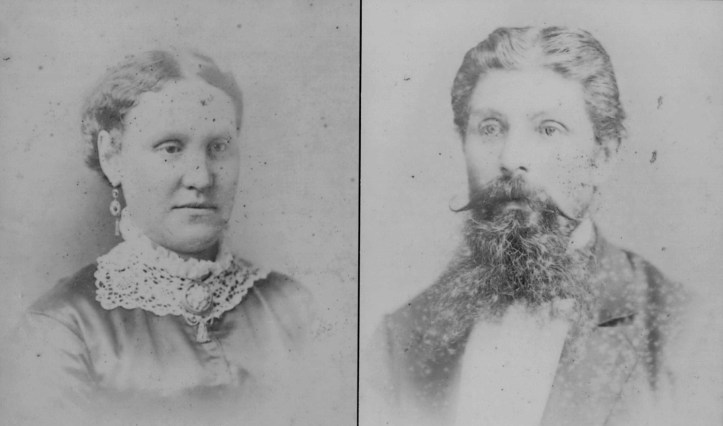
By 1851 Catherine and Solomon were living on Upper Rushall Street in Walsall, a town a short way north of Birmingham, where Solomon was working as a watchmaker. In April 1851 their first child, Catherine Anne Shappere, known as Anne, was born.
VOYAGE TO AUSTRALIA
At a time when the central Victorian goldfields were drawing in adventurous people from around the world, Solomon and Catherine, with baby Anne, decided to migrate to Victoria too. They embarked from Liverpool on 24 June 1852 aboard the Gambia and arrived in Melbourne on 15 October. Sadly, no further record of Anne can be found, and it is surmised that she died as a young child, possibly even during the voyage.
The Shapperes settled in Melbourne, and in 1853 Rebecca Shappere was born. She was followed by Phillip Shappere in 1855. Sometime after Phillip’s birth, the family moved to Ballarat, one of the two main towns of the goldfields (the other being Bendigo), and by July 1856 Solomon had become landlord of the Golden Age Hotel on Main Road.
In 1856 Seraphinah Shappere, usually known as Sarah, was born. On 7 February 1857 Solomon became a naturalised British subject. Two years later Rose was born.
Over the next few years Solomon continued to run the Golden Age Hotel and also appears to have established a wholesale coffee business, which he had sold by February 1861.
DUNEDIN
On 7 September 1861 the enterprising Solomon embarked from Melbourne on the Hydra for Port Chalmers, the main port for Dunedin in the South Island of New Zealand, where he was evidently engaged in business dealings concerning tobacco with an acquaintance from Ballarat, Mr A. C. Rees. It was Solomon’s first foray into New Zealand and came at the time of the Dunedin goldrush. He returned to Melbourne on 28 October on the Ellen Simpson but was intending to go back to Dunedin after obtaining a three-month extension of absence from his licensed premises (the Golden Age Hotel). He sailed again on 18 December on the Themis and while in Dunedin dissolved his business partnership with Mr Rees with effect from 10 March 1862.
It is not certain when Solomon returned to Victoria but one would hope that he was present for the birth in April 1862 of his and Catherine’s sixth child, Asher Joseph Shappere, known as Joseph, at the family home on Melbourne Road in Ballarat.
On 26 November 1862 a calamitous fire tore through 33 shops and business premises on Main Street, Ballarat – including the Golden Age Hotel, occupied at that time by a Mr Bourke, Solomon having established a new coffee business at the North Grant Coffee Works on Melbourne Road. Most of the businesses were uninsured, and the owners and leaseholders alike sustained enormous losses. In December Solomon contracted an architect to manage the rebuilding of the premises in brick and stone, and by April 1863 they were nearly complete.
INVERCARGILL
Solomon, however, did not return to the hotel. Nor, apparently, did he maintain his coffee business. After approximately eight years in Ballarat, he was moving to New Zealand, and on 10 March 1863 sailed on the Aldinga from Melbourne to Port Chalmers. Catherine and the children did not embark with him, and there is no record of their departure on a later (or earlier) ship; they appear to have remained in Ballarat. On 27 May the family’s household goods were auctioned off, and soon after (if they had not already done so), Catherine and the children moved to Melbourne and established their household at 77 Roach Terrace off Smith Street in Fitzroy, near the Grace Darling Hotel.
By then Solomon was living in Invercargill in the far south of the South Island. By January 1864 he had opened a jeweller’s shop in the town and was in receipt of goods coming into the Port of Invercargill from Melbourne.
On 15 October 1864 Solomon arrived in Melbourne on the City of Launceston from Launceston (presumably having sailed to Tasmania from New Zealand) and began working as a watchmaker in Fitzroy, possibly at the family’s Roach Terrace premises. In November he became insolvent due to the depreciation of his assets and a downturn in business. However, on 16 February 1865 he was given his certificate of discharge at the Supreme Court in Melbourne, meaning he was formally released from his debts, and in May that year was granted the licence of the Williamstown Hotel in Melbourne.
HOKITIKA
On 27 February 1866 the Shapperes’ household goods were auctioned off at their Roach Terrace premises, as they were all now migrating to New Zealand. On 3 March Catherine, Rebecca, Sarah, Rose and Joseph, embarked on the Albion in Melbourne and sailed to the town of Hokitika, only recently settled by Europeans, on the west coast of the South Island. Solomon and Phillip presumably travelled separately.
In Hokitika the Shapperes settled into a house on Revell Street, and by June Solomon had opened a watch and jewellery shop. On 29 March 1867 Catherine’s and Solomon’s seventh child, Nathan Victor Shappere, was born.
After two and a half years in Hokitika, on 22 July 1868 Catherine and the children – Rebecca, Phillip, Sarah, Rose, Joseph and Nathan, now a toddler – returned to Melbourne on the Alhambra, arriving on 30 July. At the time Catherine was four months pregnant. Solomon was not on board and appears to have remained in Hokitika. On 5 November that year he appeared in court to defend a charge of having removed a safe from a shop on Revell Street whose owner had recently died. He claimed to have purchased it. Less than a month later, on 3 December, Catherine gave birth to baby Ada Elvina Shappere in Collingwood, Melbourne.
Towards the start of 1869 Solomon sold his stock-in-trade to Mr Joseph Osborn and at the end of February sailed to Melbourne on the Omeo with one of his sons – presumably the eldest, Phillip, who must have returned to Hokitika. They arrived on 4 March.
AUCKLAND
A year after Catherine and the children returned to Melbourne, the whole family set out once again for New Zealand. On 21 August 1869 they sailed on the Hero to Auckland. Either immediately or after a short while they moved into a house on Karangahape Road immediately south of the centre. Solomon then returned to Melbourne.
Solomon sailed back to Auckland on the Hero on 9 January 1870 and in March opened a watchmaking and jewellery business on Queen Street, opposite the Thistle Hotel. Such were the ups and downs of his business life that in May he filed for bankruptcy in the Auckland Supreme Court. This came on top of a much greater tragedy, the death of three-year-old Nathan on 23 April.
Following Nathan’s death, the birth on 21 July that same year of Albert Edward Shappere, known as Edward, must have been bittersweet. He was born at the family home on Karangahape Road. By then Solomon had begun business as a pawnbroker on Wellesley Street in central Auckland.
At a certain point Rose began to attend the Auckland Hebrew School, which had opened in 1865 at the synagogue on Emily Place in central Auckland, near the port. As of December 1870, Joseph Shappere was attending the Preparatory School (“for Young Gentlemen”) run by Mr R. J. Morressy on Hobson Street in the city. And as of June 1871 (at least) one of the Shappere girls was attending Mrs R. J. Morressy’s Ladies’ School at the Morressy residence on Hobson Street, Prospect House.
On 17 January 1872 Rebecca Shappere married Benjamin Henry Solomon at the synagogue. Benjamin was from Dunedin and it appears that sometime after their marriage they returned to the South Island, where Rebecca became a school teacher. In June 1872 Solomon, perhaps already thinking of moving again, disposed of his pawnbroking business to Messrs Neumegen & Moses. Nevertheless, the family remained in Auckland until at least October of that year.
GRAHAMSTOWN
Sometime between October 1872 and December 1873 the Shapperes moved to Grahamstown on the Coromandel Peninsula, 100 kilometres east of Auckland. The town had been established a few years earlier following a modest goldrush in the district and together with the town of Shortland formed the borough of Thames.
On 19 December 1873 Rachel Leah Maud Shappere, known as Maud, was born at the family home on Sandes Street. By this time Solomon was trading as a watchmaker and jeweller in premises on Albert Street.
In Grahamstown it seems likely that Rose attended Kauwaeranga Girls’ School, where her sister Sarah had been helping in some capacity. In October 1874, upon the appointment of Miss Haselden as the school’s new head teacher, Sarah was publicly thanked for having given great assistance in conducting the school. Ada Shappere, meanwhile, was attending St. (Thomas) Aquinas School (run with the help of the Sisters of Mercy from 1874). In March 1875, while in Second Class, she was awarded a prize in General Attention.
By then it was time for the family to move yet again. In March 1875, while Ada was earning her award, Solomon announced in the newspapers that he was holding a clearing-out sale, as he was leaving Thames for Timaru on the east coast of the South Island, where he had purchased E. Jacobs’s business on Great North Road. He was selling his stock, his safe, and the family home.
On 3 April 1875 Catherine and four of the children sailed from Manukau Harbour, Auckland aboard the SS Ladybird for Lyttelton, the port of Christchurch. It would appear that Solomon had left earlier, presumably to conclude the purchase of Mr Jacobs’s business, and seemingly had one of the children with him. Phillip and Sarah must not have gone (at least at this time). Catherine and Solomon met in Lyttelton and on 8 April, with the five children, sailed aboard the SS Bruce to Timaru, where they moved into a house on South Road.
ROSE BECOMES A PUPIL-TEACHER IN TIMARU
Rose was now 15 or 16 years old and newly enrolled at the Timaru Public School, which was composed of Girls’, Boys’ and Infants’ Schools. She decided to become a pupil-teacher and in late July 1875 sat the Canterbury Board of Education pupil-teacher candidates’ examination. Despite a mediocre score, Rose was classified as a first-year pupil-teacher and at the beginning of 1876 was assigned Class 7 in the Girls’ School. In 1877 Rose sat another examination at the start of the year, as required by the Board of Education, and, passing well enough to be classified as a second-year pupil-teacher, taught Class 3 in the Infants’ School. Following her examination in 1878 she was classified as a fourth-year pupil-teacher and remained at the Infants’ School.
At the beginning of 1879 Rose failed her annual pupil-teacher examination. Perhaps she had simply lost interest in teaching. Although she was allowed to continue for that year, on 30 April 1879 Rose resigned her appointment. That day she was presented by her follow teachers with a handsomely bound book, as a token of the esteem in which she was held by them. According to the Timaru Herald of 5 May 1879, the inscription on the book read as follows: “Presented to Miss Rosanna Shappere [as she was known at the school], on the occasion of her resigning her appointment as pupil teacher in the Infant School, by her fellow-sufferers, the teachers of the said school.” The title of the book was said to be ‘Fated to be Free.’ However, as reported in the Timaru Herald on 3 June 1879, when the school’s headmaster inquired into the matter, he found that when the book was presented there was no inscription whatever upon it and that the teachers were not responsible for what may subsequently have been written on the book. The amusing story highlights the very real burden that pupil teachers carried, and one imagines that Rose was relieved not to have to continue in the role.
By then Edward and Maud Shappere were pupils at the school, Edward having been enrolled in 1877 and Maud in 1878. Ada would follow in 1881 and Elijah in 1884.
There had been an addition to the family as well, with the birth of Elijah Henry Shappere on 14 March 1876. He was known as Harry when he was older but often as Elijah and sometimes Henry when younger. Sadly, on 21 January 1878 Catherine had given birth to a stillborn son. He was Catherine’s and Solomon’s twelfth child, of whom nine were living. Later in 1878 Solomon opened a tobacco shop while maintaining his jewellery business. Catherine worked in it on some occasions, if not all the time.
BUSINESS DEALINGS
In mid-1881 Solomon advertised to let a seven-room brick house on Elizabeth Street, one of several properties he had acquired in Timaru, and in September 1881 advertised a clearing sale of his stock of watches, clocks, chains, jewellery etc. as well as tobacco products. He was returning to Victoria after seven years at Timaru and would be leaving at an early date. However, as of December he had still not sold his stock and decided to stay on.
By 1885 the family had moved into a house on Elizabeth Street, presumably the same one that Solomon had advertised in 1881. In May that year Catherine Shappere embarked for Melbourne aboard the SS Manapouri, returning to Timaru in July. In March 1886 Catherine purchased a shop and private residence on Sophia Street and intended opening a business there. In the same month Solomon advertised another clearance sale, stating that he was moving into new premises and starting in a new line of business, and in April he put the entire jewellery business up for sale. In the same month Catherine applied for and was granted a pawnbroker’s licence and in July opened on Sophia Street as the ‘South Canterbury Loan and Discount Office.’ At the same time Solomon advertised that as he had struggled to sell his business, he would continue to sell jewellery and watches at cost price.
In August 1887 Solomon had a 12-room house to let, apparently the house on Sophia Street next to the shop. By October it had been taken by a Mrs Dudley, who opened up a boarding house.
Early in the morning of 11 July 1888 the Shapperes’ house, located on Waimataitai Road about one and a half kilometres from town, was totally destroyed by fire. No one was hurt but nothing was saved. At home were Solomon and Catherine Shappere, two Misses Shappere (presumably the youngest, Ada and Maud) and one of the sons (presumably Harry). The house had only been built nine months earlier and was full of furniture and other possessions. After the fire the family moved back to Sophia Street.
TOWARDS RETIREMENT
In May 1890 Solomon, who had been ill for some time, decided to give up his jewellery business and take a trip to Australia, where Phillip (who had moved to Melbourne by 1885) and Joseph (who had moved to Sydney by 1889) now lived, and where soon Edward would live. He held yet another clearance sale in July, let out his premises on Sophia Street in August and continued to sell off his stock through fellow merchants’ shops into 1891. On 21 May 1891 the Shapperes’ household furniture and other effects were put up for auction, and in the same month Solomon’s final sale of jewellery, watches etc. took place. On 3 June Catherine, Ada, Maud and Harry arrived in Sydney on the Waihora. It is not clear when Solomon arrived – while Rose, as we will see, had sailed to Melbourne in February.
We do not know where the family stayed during their extended holiday – possibly with Rose in Melbourne and with Phillip, Joseph and Edward in Sydney – but after 15 months Solomon, Catherine and one of the girls, presumably Maud, departed Sydney on 13 September 1892 on the Hauroto and arrived at Lyttleton on 22 September. Ada and Harry appear to have remained in Australia.
For the next seven years Solomon, perhaps already thinking about returning to Australia to live, gradually wound down his business interests. In November 1894 he put up for lease once again the 12-room house on Sophia Street in central Timaru. He also advertised the brick house on Elizabeth Street and the house and acre of land in Waimataitai. In February 1895 he put up for lease or sale four acres of land in Salisbury with a two-room cottage. In March that year he successfully tendered to regulate the post office clock in Timaru, but upon discovering that it would be more work than he had been given to understand declined the contract.
By September 1896 the Shapperes had moved to Gleniti, a locality on the western outskirts of Timaru. In May 1897 Solomon put up for lease the house in Gleniti and in October that year put up for sale by auction the property on Sophia Street. By December 1899 Catherine and Solomon, who were both now getting on, had retired to Melbourne. Initially they lived at rented premises at 80 Blessington Street, St. Kilda and by July 1900 had moved to ‘Mizpah,’ 19 Villiers Street, Elsternwick.
NURSING
We know little of what Rose did after leaving her appointment as a pupil teacher at Timaru Public School on 30 April 1879. She continued to live in Timaru until at least 1885 and lived for periods in Dunedin and Wellington.
We do know that Rose enjoyed singing. Between 1881 and 1885 the Timaru and district newspapers carried numerous reports on concerts at which she performed. In June 1881 she sang at Ashburton, 70 kilometres north of Timaru. In June 1882 she sang so well at the Theatre Royal in Timaru in aid of the Relief Fund that an encore was demanded of her. In July 1882 Rose sang at Fairlie Creek, 60 kilometres northwest of Timaru, in aid of the local library. In 1884 and again in 1885 she sang at the annual Waimataitai School Concert in Timaru, and on 16 July 1885 she sang at the Theatre Royal again in aid of the Garrison Band Fund.
Eventually Rose settled on a career in nursing – reportedly against her family’s wishes – and undertook to move to Melbourne. At 6.45 pm on 26 February 1891 she embarked from Port Chalmers on the Rotomahana and arrived in Melbourne on the evening of 5 March. She applied for admission to the school for pupil nurses of the Homeopathic Hospital on St. Kilda Road and on 20 May her application was tabled at a meeting of the hospital’s board of management. The Homeopathic Hospital had been established only six years earlier and was located at 250 St. Kilda Road. It was renamed Prince Henry’s Hospital in 1934.
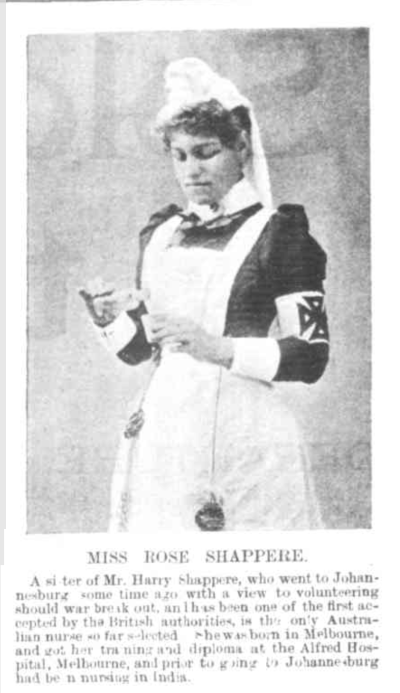
By July 1892 Rose had left the Homeopathic Hospital and was training at the Alfred Hospital in South Yarra, where she had just passed the first examination of the course. According to the Jewish Herald on 15 July 1892, Rose was “the first Jewish lady in the colony who has chosen nursing as a profession, and has already achieved a good position.”
In June 1893 Rose passed her final examination in surgical, medical and general nursing and in July gained her certification. On 11 August 1893 the Jewish Herald reported that “by her cheerfulness, good temper and interest in her work she [had] become a favourite with all.”
By the end of 1893 Rose had begun to work as a private nurse. She was then appointed head nurse of Dr Thomas Fitzgerald’s private hospital on Lonsdale Street in central Melbourne and later ran her own private hospital in Melbourne, a not uncommon practice among more enterprising nurses – and Rose was certainly that.
A number of sources suggest that Rose nursed in India for a time. It was also reported in the Jewish Herald on 22 December 1899 that “not long ago [Rose] undertook a long sea trip in charge of a troublesome patient, whom she, at the end of a few months, restored to her relatives perfectly cured.” On 24 October 1896 a Miss Shappere boarded the RMS Orotava in Melbourne with a Miss Affleck and embarked for Colombo. They returned to Albany aboard the RMS Oruba on 29 January 1897 and continued on to Melbourne. It is not certain that this “Miss Shappere” was Rose, and of course Ceylon is not India, but the timing fits neatly with the report in the Jewish Herald.
In either February or March 1898 Rose sailed to Western Australia. She had been appointed head nurse of the Perth Hospital. By August that year she had moved to the goldfields to work at the Kalgoorlie Hospital. On 29 October she departed Fremantle aboard the Pilbarra bound for South Australia, having been appointed to a position at the Adelaide Hospital, where she became night sister.
Rose did not stay long at the Adelaide Hospital. At the time of her appointment, the hospital was subject to a long-term industrial dispute – the so-called ‘Adelaide Row’ – which no doubt made for a less-than-ideal working environment. At the same time, Rose was aware of the simmering tensions in South Africa between the British of the Cape Colony and Natal and the Boers of the South African Republic (Transvaal) and the Orange Free State. According to a report in the London Jewish Chronicle on 10 January 1902 (cited in Stern), a friend had written to her from Johannesburg suggesting that she come over, as he was sure that war would break out presently. Sensing an opportunity for active nursing work, around April 1899 Rose resigned her appointment at Adelaide.
The hospital authorities were so opposed to her going that Rose had to leave without their permission. She sent her clothes ahead and spirited herself away, leaving a letter of regret. Then on 8 May 1899 she boarded the SS Warrnambool and departed Adelaide for Durban, the main port and largest city of Natal.
ARRIVAL IN SOUTH AFRICA
After landing at Durban in June 1899, Rose travelled to Johannesburg in Transvaal and was appointed to the Johannesburg General Hospital, which was situated on a high point of the Rand, the gold-bearing ridge on which much of the city was built. Here she worked with a number of doctors, including a certain Dr Croghan, who was well-enough acquainted with Rose to feel able to write several letters to her mother, extracts of which were printed in the Jewish Herald on 22 December 1899, keeping her apprised of Rose’s movements.
In early October, on the eve of war, Rose left Johannesburg Hospital to join an ambulance attached to a Boer commando at Standerton, 150 kilometres southeast of Johannesburg on the railway line to Natal. (Boer commandos were volunteer militia units, each with a small medical section, or ambulance, attached to it.) After helping to establish a field hospital at Standerton, Rose learned that it would only take Boer casualties once the fighting began, and she (and possibly other nurses) returned to Johannesburg. Reportedly not even the entreaties of Commandant Sarel Eloff, a grandson of President Paul Kruger of Transvaal, who offered Rose every possible necessity if she would take charge of the ambulance, could persuade her to stay.
Rose made up her mind to join the British in Natal and travel to the front line – for by now war had broken out.
WAR BEGINS
In December 1895 the British colonial administrator Leander Starr Jameson, at the direction of Cecil Rhodes, at the time the prime minister of Cape Colony, led a 500-strong raiding party from Rhodesia into Transvaal. The raid was intended to trigger an uprising by British expatriate workers in Transvaal but failed to do so and brought Anglo-Boer relations to a dangerous low. Transvaal began importing large quantities of arms and in 1897 signed an alliance with Orange Free State. From there it was only a matter of time before war broke out.
On 9 October 1899, Transvaal and Orange Free State jointly issued an ultimatum to the British Government, demanding that all British troops massed on their borders be withdrawn. Britain did not respond, and on 11 October the Boers considered themselves at war with Britain. General Piet Joubert, commanding the Transvaal forces, crossed into Natal on 12 October and began to push south towards Ladysmith.
To reach the front line in northern Natal from Johannesburg, Rose first had to get to Lorenzo Marquez (today Maputo) on Delagoa Bay (Maputo Bay) in Portuguese Mozambique, from where she would take a steamer to Durban. There were two possible train routes from Johannesburg to Lorenzo Marquez: via Elandsfontein and Pretoria, and via Standerton and Belfast. Assuming that she did not wish to go back to Standerton, she likely chose the first route. She entrained for Elandsfontein, changed for Pretoria, and then took the new Eastern Line to Delagoa Bay. It was crowded with British subjects, known to the Boers as uitlanders, who were being expelled from Transvaal. During the journey the train was shelled, some shells reportedly falling near where Rose was sitting.
In due course, Rose arrived at Lorenzo Marquez. The town was full of British refugees, all seeking passage out. To make matters worse, seven days of rain had flooded the town. Great crowds of people slept in puddles in the open squares.
Rose found a place on a steamer and embarked for Durban. She arrived just before the Battle of Dundee (also known as the Battle of Talana Hill), which occurred on 20 October at Dundee Camp, 250 kilometres north of Durban. The battle was the Boers’ first major engagement with British troops in Natal.
LADYSMITH
From Durban Rose entrained for Ladysmith, 230 kilometres to the northwest, and arrived towards the end of October. She began to look for a nursing appointment. “Well, I got into Ladysmith,” she recalled when interviewed in London by a reporter for Jewish World in June 1900 (whose subsequent story was printed on 8 June 1900 and reproduced in the Melbourne Jewish Herald on 20 July 1900), “and got tanned in the broiling sun whilst endeavouring to get appointed on the nursing staff. I went straight to the head people, and by persistence won my point. I saw many other nurses refused.”
By then Joubert’s forces had pushed round from north and west to the south and east of the town, and on 1 November it came under artillery bombardment for the first time, albeit lightly. On 2 November the railway line south to Maritzburg (Pietermaritzburg) and Durban was cut, as was the telegraph. Ladysmith was now isolated. That day bombardment began in earnest. On 3 November the shells flew thick and fast, a large number falling into the town, in particular around the military hospitals, which had been set up in various churches and public buildings near the centre.
One of the hospitals was based at the Ladysmith Town Hall, and it was here that Rose had been taken on. It was known as the Volunteer Military Hospital and was staffed by Army Nursing Service nurses, who had trained at the Royal Victoria Hospital in Netley, near Southampton in England. “At first we had a hospital in the Town Hall,” Rose told the reporter for Jewish World, “and as the Boers fired everywhere, I had to do service under fire. We had a splendid operating theatre there. At the time, of course, we had no idea of a long siege, and there was plenty of everything.”
On the evening of 3 November a deputation of civilian residents of the town asked the commander of the Ladysmith garrison, Lieutenant General Sir George White, to seek permission from General Joubert for them to pass through Boer lines and proceed to the south. At the same time, the garrison’s principal medical officer proposed that permission be sought for the hospitals to be relocated to a camp outside the town. The following day, 4 November, General White sent Major Bateson to the Boer general under a flag of truce with a letter asking that these requests be agreed to on humanitarian grounds. Joubert agreed to the hospitals being moved out of Ladysmith to a site close to Intombi Spruit, six kilometres down the railway, but he refused to allow the residents to go south. He did, however, permit them to accompany the hospitals to Intombi, where they could establish their own camp. One train daily was to be allowed to run between Ladysmith and Intombi with food and all other requisites for the hospital and civilian camps.
The following day, 5 November, was a Sunday, and according to a tacit understanding on both sides, no fighting was undertaken. The British took advantage of the day to send their sick and wounded and any civilian non-combatants – men, women and children – who wanted to go, to Intombi Camp.
By 6.00 pm on 5 November the first marquee tents had been erected at Intombi, and the first wounded admitted. Over the next seven days or so, more marquees were set up and trenches dug around them, purified water from the Klip River was supplied, sanitation organised, and a bakery established. Soon, a neutral, 300-bed hospital had been established, known generically as the Intombi Military Hospital and staffed by elements of No. 1 Natal Volunteer Field Hospital, No. 12 Field Hospital, No. 26 Indian Field Hospital and possibly others. Meanwhile, the civilian camp had been set up nearby.
THE SIEGE BEGINS TO BITE
Even though a hospital continued to operate at the Ladysmith Town Hall until 30 November (when a shell entered the building and killed and wounded 10 people, prompting the hospital’s relocation to a gorge), it appears that Rose and her colleagues had moved to Intombi by around 12 November.
Rose’s arrival at Intombi marked a turning point. “When the siege became more serious we were ordered to encamp at Intombi, and then it was that our troubles began,” she told a reporter in 1902, whose story appeared in the Hebrew Standard of Australasia on 7 March 1902. “The most harrowing experiences I have ever undergone were in connection with this siege. They talk of the siege of Kimberley and Mafeking, but they were nothing at all compared to Ladysmith. We saw our men dying around us, and could do nothing for them [as] the conditions under which we had to work were so terrible. The tents were badly pitched, they were blown away by the wind, and the pelting rain came through, drenching the patients as they lay in their beds. We nurses had to go from tent to tent under the enemy’s fire, because there were so few orderlies to attend to the men.”
Conditions worsened as food supplies began to run low, as Rose explained to the Jewish World reporter in June 1900. “The want of food and comforts was the worst of the siege,” she said. “Even our starving stomachs revolted at the food and the drink, and as for the patients, all that we could give them at night was water; in the day they were allowed half-a-pint of milk. It was terrible in every phase, and in the midst of it shells would come flying into the hospital. It was very hard work, too; going from tent to tent with orderlies who did nothing, and delirious and dying men to attend to.”
Meanwhile, enteric fever (typhoid) and dysentery had become widespread among the British troops. The first two cases of enteric fever were admitted to the Intombi Military Hospital on 11 November, and dysentery appeared early as well. Over the following weeks cases of each grew considerably, until on 31 December there were 452 enteric cases and 376 dysentery cases under treatment at the hospital out of a total of 1,558 sick patients.
By February 1900 Rose’s health, like that of the other nurses, had deteriorated markedly. “[At one point] I got rheumatics from having to sleep in a soaking bed whilst on night duty,” she told Jewish World. “Once I broke down for three days and had to take to my bed, and again for two days, and then I broke down again eight days before the [relief] convoy came. With hard work, anxiety, and no food, I was a skeleton. No one would have known me.”
“WE THOUGHT THAT WE SHOULD NEVER COME OUT ALIVE”
At long last, on 28 February 1900 General Sir Redvers Buller broke the siege on his fourth attempt. That evening some of his men rode into Ladysmith, and on 1 March General Buller entered the town. The siege was over.
By then Rose had reached the end of her tether and become ill – some sources point to enteric fever, others “yellow jaundice.” “We thought that we should never come out alive,” she told the Hebrew Standard of Australasia reporter in 1902, “and in moments of despair some of us almost hoped that the Boers would come and take us prisoners, for then we should have been better cared for. [By the end] the suffering and privations I underwent completely ruined my constitution.”
By 8 March, when Rose wrote a letter to a family member (cited in the Wellington Evening Post on 11 May 1900), she had been laid up for over a fortnight, suffering from “yellow jaundice,” and had been at death’s door. She had given up work just a few days before the relief column reached the town
In mid-March, a little more than two weeks after the end of the siege, Rose, still recovering, wrote to a family member from Intombi. Her letter (or part of it) was printed in the Melbourne Age on 16 May 1900, as follows:
“In Yombi [Intombi] Camp, Military Hospital,
Ladysmith, 16th March.
“It was so delightful to get your warm and nice letter, although in bed. Am up to-day for the first time in three weeks, and such pain as I went through. I am ordered away for a month. I refused to go, but the doctor said I was not fit to go on without a rest, and insisted on it. Wired and sent to Maritzberg [Maritzburg, now Pietermaritzburg, 80 kilometres northwest of Durban] for a room, but there was not such a thing to be got. It would have been nice, as it is the head of the military, and I know so many staying there, and would have had a nice time, a month’s holiday. You know I offered and gave my services gratuitously on behalf of Australia, and came on with that understanding, but found I was put on the pay list, so I will have a nice little cheque. We were to get £2 2/ a week, but after we had been here some time word came that on account of the privations we were undergoing we were to have 3/ a day extra, and the soldiers to have 12 months full pay, and so much for sleeping without beds. I hope you can read this letter. The ink is on active service, and my pen disappeared out of my tent. I am very weak, and this is my first day up and dressed. Dr. Hunter came and asked me this morning if I would like a trip home. Of course I said yes, but did not care to give up nursing until the war was over. He said, ‘You are not fit to nurse for some time, and we insist on you taking a rest.’ The whole camp is scurvy, and we all suffer more or less. It’s just a bed of fever. Any day next week I may leave here for Durban, and catch the mail boat in Capetown for England. We are all, I believe, to be sent home for a trip, and the sick ones are to be first. First class passage, to be presented to the Queen of England, and get our medals and stripes from her hands! I then shall feel proud and have lived for something, and my dear parents will then at least have something to be proud of in me.”
It is not clear what award Rose was referring to here, but possibly the Royal Victorian Medal, which in the end was not bestowed on her until the latter half of 1901.
“Thank God the siege is over, and Ladysmith is relieved,” Rose’s letter continued. “Oh, how we all looked forward to it, praying day and night, for at the last the scenes were heartrending, and I am sure had it not come when it did, a great number of us would have died. I was just on my last legs, so ill I had not taken any food for three days. Our rations the last fortnight or three weeks consisted of 1-6 oz. of tea, 1 oz. of sugar, ½ lb. bread, made of mealies (not eatable), or 1½ hard biscuits, 1 lb. tough meat or ½ lb. bully meat; and sometimes in place of tea we got awful coffee, and at 7.30 a cup of cheveral soup (horse flesh), and it was generally bad. In Ladysmith they had it made into sausages, but by the time we got it it was high. Imagine that food for the day. Breakfast (7.30), black tea and bread; dinner (1 p.m.), meat and a little rice; 4 p.m., black tea, and at 7.30, soup. Imagine that diet after working like a Trojan, and often in our wards till 10 p.m. at night.
“One night I drank a cup of soup, I was just starving, and had a long day (several operations in my marquee). That day the soup was quite bad, but I had to drink it, as there was nothing else till next morning, and then not much, on a weak stomach. I never felt well after that, and gradually had to take to my bed. I was so ill three days before I gave in I could not bear clothes on, and had to go into the ward with just my dress (the bodice is all in one) and my apron on, and at night I just rolled over and over with pain. You know, dear, one does not like to give in. The patients were getting tired, thinking Buller would never come, and if he had not come when he did there would have been none to relieve, for all the patients were simply dying of starvation. We had run short of medicine, stimulants and all medical comforts. I would have given £1 for a little brandy, and could we have got it, many would have been saved an illness. You could get nothing like that unless you went on the sick list. After all Providence was good to us, for not one sister died, though several have been very ill, but we kept up till February. There are two now in bed, but doing well. I have seen my brother Harry, who came here from India, and is in active service, and had a long chat.”
Rose had not seen her brother for many years, and neither had known of the other’s presence in the town. Harry had arrived in India in the latter half of 1898, where he was serving with the A Battery, Royal Horse Artillery at Meerut (where the Indian Rebellion of 1857 began), and as his regiment was not under orders, he had volunteered for service in South Africa. He was attached to A Battery, Royal Field Artillery and departed India with his unit on 5 October 1899. We do not know where the unit was deployed upon arrival in South Africa, but we do know that Harry Shappere took part in the defence of Ladysmith.
Rose continued writing her letter on 17 March 1900:
“17th. – I am so weak from walking about yesterday that I am not able to get up today. I cannot regain my strength; so have made up my mind to leave at once for England – I think by the ‘Germans’ [RMS German, a Union-Castle Line steamer] – so by the time this letter reaches you I will be arriving in London, and will write from there. My letters will all be sent on to me. The troops are just getting the presents sent from different people. Some are so nice and useful, especially the woollen comforters, as the cold weather further up is just coming on. We were supposed to have had tinned vegetables, fruit and butter, and I don’t know what; but we have had nothing as yet. They must have gone to other hospitals, and our poor Tommies had no Christmas dinner or anything else but biscuit and bully meat that day.
“It was an awful Christmas day. One never to be forgotten, blazing hot, and patients dying all round you, and very little comfort could we give them. Oh, one poor Tommy came into my marquee with enteric – very bad – temperature 106, and, poor boy, was so uneasy, and kept watching. I told him not to worry, and he would soon get better if he kept quiet. I could see there was something on his mind (I knew he could never pull through), so I gave him a sleeping draught, and asked him about his friends. He was then quieter, and in a little called ‘Sister.’ I went to him, and, poor chap, he said, ‘Will you take my money from me, and send it to my sister in England’; and he made me write the address – £5 14/9. I sent for the orderly officer, and gave the money into his charge, according to regulations. He said, ‘I am dying, I know,’ and was so brave about it. He thanked me for all I had done; it nearly broke my heart to see him, and made me think of you all. Poor, brave boy, he died the next day. So you see, dear, we are able to do some good, and if I never work again I can say I was able to give some relief to our poor Tommies. They rarely murmured, and their hardships were groat. Sometimes lying for days in the hot sun, and then in the rain, clothes not off their backs for three weeks. Do you wonder that they were covered with vermin? And then when we got them we had no shirts to put on them. The sisters suffered in the same way. I was just alive at one time. I have given all my clothes to the K[–––] that I wore during the siege.”
Although it was hardly a fair exchange, Rose’s dedication throughout the siege had earned her a mention in Lieutenant General Sir George White’s despatch of 23 March 1900, along with 23 other civilian nurses and five army nurses.
When Rose had partially recovered, she was sent not to England to convalesce at No. 4 General Hospital (GH) at Mooi River, a locality in the highlands 100 kilometres south of Ladysmith. (No 4 GH was one of many British military hospitals in Cape Colony and Natal. Others would follow the British advance into Orange Free State and Transvaal.) “I was invalided and went down to Mooi River, being the first nurse to be conveyed by Princess Christian’s Ambulance Train,” Rose told the Jewish World reporter. The Princess Christian Hospital Train had been in operation for only a short while. It was funded by public subscription and named after Princess Christian of Schleswig-Holstein, a daughter of Queen Victoria, who had donated £650 towards its purchase. It could accommodate 100 wounded soldiers, had a surgery, and was able to operate without resupply for weeks at a time.
After spending some time at Mooi River, Rose proceeded to Durban and from there to Cape Town, where she reported for duty. “I wanted to go to the front again,” she told the Jewish World reporter in June, “but as a change I was made nursing superintendent of the S.S. Tagus, which conveyed three hundred and twelve men and fourteen officers to Southampton. That brought me to London.”
LONDON
The Tagus left Cape Town for England on 10 May 1900 and arrived in Southampton on 31 May. During the voyage Rose was knocked about terribly by the winds and gales and soaked to the skin. She was unimpressed by the medical arrangements on board, and her remuneration was much less than it had been for hospital nursing.
From Southampton Rose made her way to London – where, as we have seen, she was interviewed by the periodical Jewish World, whose reporter finished by asking Rose what her next movements might be. Rose replied that she was “going back on Friday to South Africa. I was [there] at the beginning, and mean to be [there] at the finish of the war. I shall come back to England on my way to Australia, where I hope to be the first Australian nurse in Princess Christian’s reserve of nurses.”
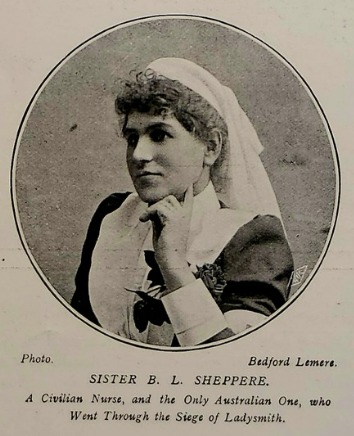
Rose’s statement is somewhat ambiguous, but she evidently did join the Princess Christian’s Army Nursing Service Reserve (PCANSR) while still in London – and quite possibly was the first Australian to do so. The PCANSR had been formed in 1897 and provided a trained civilian nursing reserve to reinforce the Army Nursing Service – with whose nurses Rose had worked at the Volunteer Military Hospital in Ladysmith – in wartime, both at home and abroad. Over the course of the Second Boer War, hundreds of women served in the PCANSR. The PCANSR was eventually subsumed into the Queen Alexandra’s Imperial Military Nursing Service, which was founded in England in March 1902 and replaced the Army Nursing Service.
On Friday 8 June 1900, as a newly minted PCANSR nurse, Rose departed for Cape Town with a certain Colonel Harris and his wife in the Carisbrook Castle. The ship arrived on 26 June and Rose was sent on active service to Johannesburg, which had fallen to the British without serious Boer resistance by 31 May that year, and attached to what she called the “Rand Hospital” (The Argus, 21 January 1901), which was “perfection.” The “Rand Hospital” to which Rose referred was likely either the Johannesburg General Hospital, where she had worked previously, or No. 6 GH, which had moved to Johannesburg from Naauwpoort, Cape Colony in late July 1900 and was located down the hill from the Johannesburg General Hospital on the old Wanderers cricket oval. It is perhaps more likely that she was posted to No. 6 GH, given that she was now a military nurse, but the fact that the hospital did not open in Johannesburg until late July would suggest that Rose had first spent time in Cape Town (or elsewhere).
RETURN TO MELBOURNE
Rose remained in Johannesburg until 17 December 1900 before returning to Australia for a well-earned rest. She left Cape Town on 28 December 1900 aboard the Damascus and arrived in Melbourne on 17 January 1901. Eleven other Victorians had made the journey, including three invalids. For the duration of her time in Melbourne, Rose stayed with her parents in Elsternwick.
Rose had brought back with her a large collection of mementoes of the war. Among these are newspaper cuttings and prints of key events, type-written letters, postcards, British and Boer buttons and badges, pieces of exploded shell, a cup and saucer from President Kruger’s house, wooden weapons and ornaments, a Boer rifle, and a collection of autographed photographs, including those of Field Marshal Lord Frederick Sleigh Roberts and General Buller. However, her most prized possession was doubtless an 18ct gold brooch, decorated with a red enamel Maltese cross and set with a small diamond. The brooch was a gift from the officers of the Imperial Light Horse to the nurses who served through the Siege of Ladysmith and was forwarded to Rose by Lady White (presumably the wife of Lieutenant General Sir George White). Unfortunately, Rose had also lost quite a number of valuable possessions.
ROSE DEPARTS WITH THE 5TH VICTORIAN MOUNTED RIFLES
Rose did not stay long in Australia. Evidently keen to return to South Africa, she sailed with the 5th Victorian Mounted Rifles aboard the Orient, which departed Melbourne on 15 February 1901. The 5th Victorian Mounted Rifles comprised more than 1,000 men under Colonel A. E. Otter and sailed in three ships, the Orient, the Argus and City of Lincoln, although the bulk sailed on the Orient.
On the day of departure, crowds gathered along the Port Melbourne foreshore and around the approaches to the pier, at the far end of which the Orient lay at its berth. The ship was painted black, with red below, and with the number 24 painted in large white figures on its bow. At 2.30 pm the troops were drawn up in lines two deep along the length of the Orient’s hurricane deck, awaiting inspection by Sir John Madden, the lieutenant governor. Just after 3.00 pm Sir John gave a valedictory speech, at the close of which the men saluted and cheered. They were then dismissed and allowed to go onto the pier to bid their last farewells to family and friends.
Once on board again the men ranged themselves along the bulwarks of the main deck and the hurricane deck so thickly that the Orient listed slightly to starboard. Rose, wearing her gold Siege of Ladysmith brooch, was one of the few noncombatants on board.
Punctually at 5.00 pm the lines were cast off, and the Orient moved slowly from the wharf amid a burst of cheers. The ship steamed out into the bay and anchored off Point Gellibrand, Williamstown, to resume its voyage at daybreak.
BACK IN SOUTH AFRICA
The Orient arrived at Cape Town on 8 March 1901. The men of the 5th Victorian Mounted Rifles disembarked and went into camp at Maitland on the outskirts of Cape Town for just over a week before leaving in two contingents for Pretoria in Transvaal. One contingent sailed to Durban on the Orotava and entrained for Pretoria through Natal, while the other sailed to Port Elizabeth on the Orient and entrained for Pretoria via the Orange Free State. The British had by now taken control of the railways and the cities and larger towns of the two Boer republics, but the Boers had refused to surrender their independence for the sake of peace and were employing guerrilla tactics against the British. In turn, the British had launched a scorched-earth campaign. The war had entered a new, even more brutal phase.
Meanwhile, Rose was attached to No. 5 GH in Cape Town. The hospital was based at Woodstock on the waterfront and was formerly known as the Woodstock Base Hospital. It was one of two GHs operating in Cape Town at that time, the other being No. 1 GH at Wynberg, 10 kilometres to the south. After a period of time at No. 5 GH, Rose proceeded to No. 8 GH in Bloemfontein, Orange Free State (or Orange River Colony, as it was officially known following British annexation in May 1900), and on 3 June was posted to No. 16 GH at Elandsfontein in Transvaal, 400 kilometres northeast of Bloemfontein on the main Cape–Transvaal railway line. Towards the end of June, Rose returned to Cape Town.
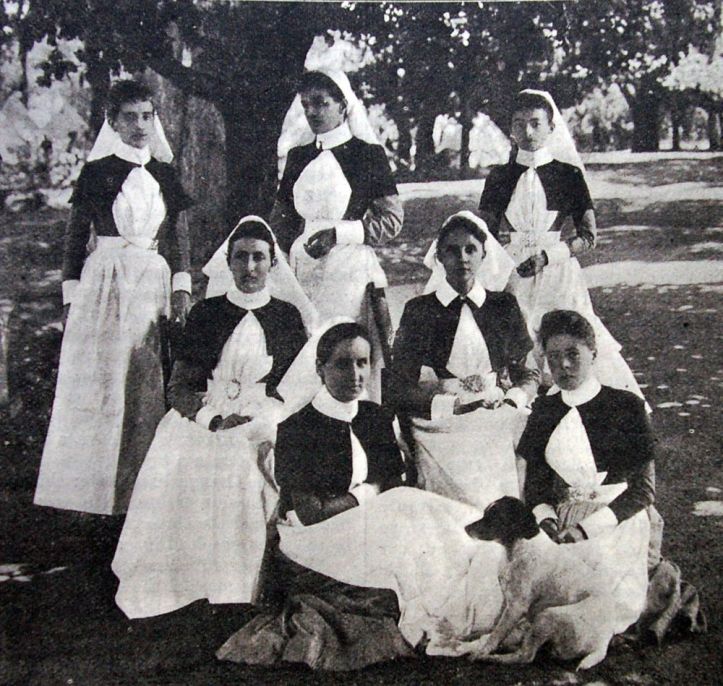
Rose had now served in all four South African states –Cape Colony, Natal, Orange Free State/Orange River Colony, and Transvaal – and was entitled to the Queen’s South Africa Medal. The Queen’s South Africa Medal was authorised in April 1901 and subsequently granted to all officers, warrant officers, non-commissioned officers and men of the British, Indian, and Colonial Forces, and to all nurses and nursing sisters who served in South Africa between 11 October 1899 and 31 May 1902. Unfortunately, as a nurse Rose was classed as a non-combatant and was not entitled to clasps.
ANOTHER VOYAGE TO LONDON
In late July 1901 Rose departed for London, presumably from Cape Town, on His Majesty’s Transport Assaye. On board being invalided home were more than 400 officers, other ranks, and non-combat personnel, including two Army Nursing Service nurses. There were also at least 20 combat and non-combat personnel on passage home, including Rose and five other nursing sisters – O. E. Barrow, H. A. Lawrence, M. B. Pertwee, M. Roche and E. F. Upperby – although it seems that they had been detailed for nursing duty for the duration of the voyage.
The Assaye arrived in Southampton in mid- to late August, and Rose and the other nurses proceeded to London, where Lady Dudley – Georgina Ward, Countess of Dudley, who served with the British Red Cross during the Boer War and helped to run the Mayfair nursing home for disabled officers – engaged rooms for them and showed great interest in their welfare.
In London Rose’s health deteriorated again and she was sent to Scotland to recuperate at Lady Dudley’s castle, placed at the use of convalescent nurses and invalids from the war.
It was while Rose was in England or Scotland that she was awarded the Royal Victorian Medal. The medal was established by Queen Victoria in April 1896 and was associated with the Royal Victorian Order. It was awarded to individuals below the rank of officers for distinguished personal service to the monarch, to a member of the royal family, or to a senior representative of the monarch. It came in three classes, gold, silver and bronze.
TO AUSTRALIA AGAIN
On 3 January 1902 Rose departed London on the RMS Ophir and arrived at Port Melbourne on 12 February. As usual, the newspapers were interested in her story, and on 9 January Melbourne Punch informed its readers that Rose was now the proud possessor of “the badge of the Victorian Order” (that is, the aforementioned Royal Victorian Medal).
On 26 February a large number of people gathered at the Montefiore Hall in St. Kilda to welcome Rose home and present her with a token of their appreciation of her services during the war – a silver brush-and-mirror set in a leather case, on which was engraved ‘Presented by some of the Jewish ladies of St. Kilda to Nurse Shappere.’ Rose acknowledged the gift in a few appropriate words and later addressed the audience for nearly 30 minutes, recounting her experiences in South Africa.
Rose again stayed with her parents in Elsternwick and spent several months in Melbourne. During this time she applied for and gained her Royal Victorian Trained Nurses’ Association (RVTNA) registration, effective 21 May 1902.
Ten days after Rose’s RVTNA registration, the Second Boer War ended. The Boers’ guerrilla war had become unsustainable. Boer numbers had dwindled through attrition, capture, and defections, and morale had been sapped by the British scorched-earth policy. Negotiations began in earnest in early 1902 and on 31 May 1902 the Treaty of Vereeniging was signed, officially ending the war.
On 14 June Rose sailed to Sydney on the Warrigal, arriving two days later, and visited her brother Joseph in Bondi. On 18 June Rose was interviewed by a reporter for the Sydney Morning Herald. According to the article published the next day, Rose had been “gazetted by Sir George Grey to receive the Royal Red Cross honour, and also received a command to attend before his Majesty the King to receive a medal in recognition of the services she had rendered. At the time that the command from his Majesty reached South Africa, Nurse Shappere was at sea, and in consequence could not obey it. [Rose also] said she had been informed that she was to receive four clasps, in recognition of having nursed the sick and wounded in four separate States in South Africa.”
There is no official record of Rose ever having received the Royal Red Cross (which was awarded for exceptional services in military nursing) and it was her Mention in Despatches (by Sir George White, not Sir George Grey, who was governor of Cape Colony from 1854 to 1861 and had died in London in 1898) that was gazetted (on 8 February 1901). The command to attend before the King, presumably to receive her Royal Victorian Medal, must have come while Rose was en route to England aboard the Assaye. Finally, it was the Queen’s South Africa Medal to which one would attach clasps – and unfortunately, as we have seen, Rose, as a nurse, was not entitled to them and had surely been misinformed. As it happened, she was not issued her Queen’s South Africa Medal until 3 January 1903.
More than a year earlier, it was reported in the Hebrew Standard of Australasia (31 May 1901) that Rose had been awarded “the insignia of the Red Cross, which is equal in honor to that of the Victorian Cross. She was especially mentioned in Gen. Buller’s dispatch.” This is more likely a reference to Rose’s gold Siege of Ladysmith brooch, with its red Maltese cross – and again, it was Lieutenant General Sir George White, not General Sir Redvers Buller, who mentioned Rose in despatches.
Rose also told the Sydney Morning Herald reporter – or at least the reporter reported – that she had made three voyages as superintending nurse in charge of invalids from South Africa to England. One, as we have seen, was on the Tagus. The second was (probably) on the Assaye, and the third must have taken place sometime between September and December 1901.
SOUTH AFRICA (BRIEFLY) AND ENGLAND
After a brief sojourn in Sydney, Rose returned to South Africa – Johannesburg according to one newspaper report. The Melbourne Jewish Herald reported on 20 June 1902 that Rose “may probably set up a private hospital in one of the centres of the newly-acquired British colonies in that country.”
In the event, it does not appear as though she did, and in fact on 10 September 1902 Rose departed for England on the Avoca, once again detailed for nursing duty on board, along with Sisters M. S. Farley, M. Fawcett, A. Mackenzie and A. May. The Avoca was due to arrive at Southampton on 1 Oct 1902.
Around April 1903 Rose was appointed matron of the Western General Hospital (possibly the same hospital as the Western Ophthalmic Hospital) on Marylebone Road in London. She had reportedly been chosen from among 120 applicants. She did not remain for very long at the Western General Hospital; around June 1903 she was asked if she would accept the position of matron at the Baroness De Hirsch Convalescent Home in Hampstead, to which she replied in the affirmative. Her new position was a desirable one, as she had a sub-matron under her and a large, competent staff, and she remained in the position for the next three years.
In 1906 Rose left the convalescent home in Hampstead to move to France. She had been appointed inaugural matron of the Queen Victoria Memorial Hospital in Nice. Built between 1903 and 1906 at the initiative of prominent members of the British community, the hospital operated as a charitable institution for the benefit of British and American residents of Nice and surrounding areas. It had 36 beds, 24 of which were completely free and 12 of which charged between 5 and 50 francs per day, the profit going towards the hospital’s upkeep. Charity evenings organised in Nice, Monaco and other localities also helped to raise funds for the hospital. Rose was responsible for organising the general staff and had been chosen from among 100 applicants. The hospital was opened in March 1906 by Princess Christian, who, together with Princess Hohenlohe, was very interested in Rose – not least because Rose had been a member of the PCANSR.
RETURN TO AUSTRALIA
On 28 February 1907 Rose arrived back in Melbourne on the SS Runic on a visit to her parents, who were still at Mizpah on Villiers Street in Elsternwick. Catherine Shappere was now 72 or 73 and Solomon 10 years older.
By September 1907 Rose had been appointed matron of the Queen’s Memorial Infectious Diseases Hospital in Fairfield, which had opened in 1904 after decades of discussion. She was appointed to the position following the resignation of the previous matron, Evelyn Conyers, who became matron-in-chief of the Australian Army Nursing Service during the Great War.
On 25 November, just a short while after Rose’s appointment, Solomon Shappere died at home. On 17 December that year the household furniture was scheduled to be auctioned off, and afterwards Catherine Shappere moved to St. Kilda.
MARRIAGE
In January 1908 Rose resigned from the Infectious Diseases Hospital and in April that year announced her engagement to Edmund Itzig Julius Elkan of Adelaide.
Edmund Elkan, an importer and much in the newspapers, was born c. 1858 in Dessau in the Duchy of Anhalt-Dessau, one of the states comprising the German Confederation. He was the son of Julius Elkan, a knight of the House Order of Albert the Bear (founded in 1836 by three dukes of Anhalt) and a wealthy man. In August 1879 Edmund arrived in Australia via Liverpool and in 1881 married Lena Marian Moate in Melbourne. They had seven or eight children, five of whom survived. Lena died in March 1907.
On 16 May 1908 Rose married Edmund at the office of the Registrar-General in Melbourne. Present were Dr. Inner, the Consul-General for the German Empire (as the German Confederation had by then become), and a number of Rose’s relatives. After the ceremony, the wedding party had lunch at Menzies Hotel, before Rose and Edmund left by the express train for Sydney and the Blue Mountains.
Rose and Edmund returned to Melbourne in time to hold a reception at the Grand Hotel on Spring Street on 29 May 1908. They wanted an opportunity to say goodbye to their Melbourne friends before moving to Adelaide to live at Edmund’s large house, ‘Unsere Heimath’ (‘Our Home’), at 10 Union Street in Semaphore. As reported in the Adelaide Mail on 30 April 1921, Edmund had told Rose prior to their marriage that he was “worth £20,000, and that she could live comfortably, have servants, and all that she desired.”
Rose adjusted to life in Adelaide and, no longer a working nurse, undertook charitable activities. She became involved with the Dorcas Society, established in 1897 to raise funds for the Adelaide Children’s Hospital, and by 1914 had become the society’s president.
Rose still found time to visit her family. In late May or early June 1913 she travelled to Sydney to see her brothers before proceeding to Melbourne to stay with her mother in St. Kilda. She returned to Adelaide in the middle of the month.
THE GREAT WAR
On 5 August 1914 Australia went to war. Rose, still living at Unsere Heimath, immediately saw an opportunity to help. On 14 August she donated £5 to the local Red Cross Society and a few days later wrote to the Adelaide Register. Her letter was published on 20 August, as follows:
“Sir – I quite agree with ‘Humane,’ and I am in a position to form and give an opinion, having been through the Boer war and the siege of Ladysmith, besides having been Superintendent of hospital ships in charge of wounded soldiers on their way to England. There is no doubt that many good, strong and capable nurses will be required at the front; and the more the better. They must be not under 25, and not over 35, years of age, with perfect constitution and strong physique. Weaklings are bound to go under, and will be a burden instead of a help. This will be no child’s play. I remember an instance of a wounded lordling at Ladysmith, young and good-looking, who was fussed over by the lady nurses who had been sent out from England, and who were a great nuisance to the trained staff. They used to come and smooth out the pillows of my lord 50 times a day, till he got so sick of it that he put one day a cardboard notice at the head of his bed – ‘Too ill to be nursed today.’ That kind of nurse is an unmitigated nuisance. Now, as far as medical comforts are concerned, good brandy, of which there is plenty in South Australia, is an absolute necessity; as also are good condensed meat extracts, strong soups, and other nourishing foods. If clothing be sent, it must be washed first, to take out all the dressings and starches. Shirts ought to be opened at the back as well as at the sleeves, and ought to have tapes attached to them. Balaclava caps are not of much use; most soldiers wear their hair close-cropped. Vermin, as a rule, is rampant, and caps would only encourage it. Coloured handkerchiefs, woollen pyjamas, large woollen socks, and cholera belts are an absolute necessity. We were very short of hypodermic syringes, quinine, splints, crutches, and bandages of all descriptions. Hot-water bottles, air cushions, and pillows will be of great use. Too much old linen cannot be sent – first boiled – which can be used for packing wounds, and in many other ways. I would also point out that nurses will require in their kit Wellington boots of indiarubber, and mackintoshes. Winter in Europe is before us, with its rain, snow, and perishing cold. Our troops ought to be well and warmly fitted out for a winter campaign, with heavy clothing, high boots, well shod, with nails, as they have little opportunity to replace them. I will willingly and gladly give any help and advice in my power.
I am, Sir, &c., (Mrs.) E. ELKAN.
Union street, Semaphore.”
Rose did much more than simply offer advice. On 22 August she advised through the Adelaide Register that she was collecting old linen suitable for making ‘charpies’ (wound dressings) for soldiers at the front. On 27 October she joined a Belgian Relief Fund Committee, which aimed to support displaced persons in Belgium through the provision of medical aid, food and clothing. And in June 1915, one imagines at Rose’s instigation, the Elkans’ residence in Semaphore was listed as one of those offered free of charge for use as military hospitals and convalescent homes for returning wounded soldiers.
Meanwhile, Rose was continuing her Children’s Hospital work. On 28 November 1914 she and the other Dorcas Society women had staffed the needlework marquee at the Children’s Hospital’s annual lawn fete. It was one of many stalls set up on the lawns of the hospital grounds. Thanks to the favourable weather, a large crowd had turned out for the occasion. When they were not browsing the stalls, they were kept entertained by the Police Band and a string band, a Punch and Judy show and a variety troupe, The Follies, and a variety of sideshows and other entertainments.
MOVING ON
In early 1916 Rose became separated from Edmund Elkan. He agreed to pay her £2 a week and she spent most of 1916 in Melbourne carrying on her patriotic work in aid of Australia’s war effort.
In February 1916 Rose donated two relics of the Second Boer War to be sold at auction on 25 February in aid of the ‘Our Day’ Button Fund (one of many ‘Button Days’ coordinated through the Commonwealth Button Fund to raise funds for national and international war relief). She was hopeful that a large sum would be offered for the objects, which were among her most treasured possessions. The first memento was a rectangular tin chocolate box presented in 1900 to the troops and nurses in South Africa at the instigation of Queen Victoria and decorated with an image of her head. As many as 120,000 tins were issued and even at the time became highly sought-after items. The second was a wallet containing a nurse’s surgical instruments and bearing the monogram of Queen Alexandra. Such wallets were given to Rose and other British and colonial nurses in South Africa at Christmas 1900. The outcome of the auction is unknown, but one hopes that the bids were high.
Rose returned to Adelaide for three months over the winter of 1916, staying at the Aurora Hotel, before returning to Melbourne to carry on her war work. By November she had returned to Adelaide once again and was living in the inner suburb of Unley. On 4 December she was one of a number of nurses, former nurses and interested parties to attend the formal opening of the Army Nurses’ Club in the Liberal Union Buildings in North Adelaide. Among those present were Lady Galway, who had chaired the Belgian Relief Fund meeting in August 1914; Zelinda Isaacs, wife of the mayor of Adelaide; and Ethelda Uren, principal matron for the 4th Military District (South Australia) and one of three Uren sisters to serve in the Great War.
Just two days later, on 6 December, Rose took Edmund Elkan to court for failing to fulfil their separation agreement. The court ordered him to pay her £12.
On 1 January 1917 Catherine Shappere died in St Kilda at the age of 83. One hopes that Rose had had the opportunity to see her mother during her final days.
In July the Rhodesian Feather and Fur Company gave Rose a number of “handsome and useful articles” to be forwarded to the men in the trenches, as the Adelaide Register put it on 23 July 1917. The donation was associated with Australia Day celebrations, which that year were held on 27 July in many parts of South Australia.
Unfortunately, on 26 September Rose was compelled to take Edmund Elkan to court for a second time, suing him for £7 10/–. Although in December 1916 Edmund had been ordered to pay Rose £12, he had not done so. Instead he had offered her £8, which she had accepted. He had also told her that he could no longer continue to pay £2 a week, arguing that it was beyond his means, and had offered 30/– a week instead – which she had also accepted. He had made his maintenance cheques payable to ‘Maintenance’ or ‘Order,’ not her name, which of course she struggled to cash. Finally, he had sent her abusive letters. Unfortunately, the fact that Rose had accepted the reduced payments from Edmund worked against her claim, as did the fact that she had not kept accurate accounts of payments made by him. In the end her legal counsel intimated that he would be willing to accept just 30/– in settlement of the claim, and judgment was entered accordingly. Rose, however, would have the last laugh.
INFLUENZA PANDEMIC
By May 1919 Rose had returned to Melbourne and was living at 40 Park Street in South Yarra. At that time the city, like much of Australia – and the world – was still in the grip of the pneumonic influenza pandemic (popularly known as the ‘Spanish’ flu). As many as 34 emergency hospitals had been set up across Melbourne since January 1919, the largest being accommodated in Carlton’s Exhibition Building. Thousands upon thousands of patients were successfully treated but many were sent home too early, as there were too few convalescent beds to send them to. On 1 May Rose wrote to the Argus proposing a possible solution. Her letter was published the following day, as follows:
“Sir, – May I suggest tents for convalescents after coming out of hospitals. What better spot than the Grange at the corner of St. Kilda road and Domain road. Double marquees could be erected and fitted up with very little expense, and I feel confident that a large number of V.A.D. and others with whom I have worked during the last four years would only be too willing if this scheme were feasible. Also, the Red Cross Kitchen stall may come to the rescue in the commissariat part and help to save many lives. Patients in hospitals are discharged to make room for bad cases; it is then that they want care and attention from two to four weeks and in most cases cannot get it. Australian women have done so much during the war, let us rally now, and do more to save the situation in this dreadful epidemic. I am a fully trained nurse, and have had varied experiences also in the South African war (siege of Ladysmith), and would willingly give my services if a convalescent hospital could be erected at once. – Yours &c.
ROSE L. ELKAN (MATRON SHAPPERE).
40 Park street, South Yarra, May 1.”
Fortunately, by October 1919 the pandemic had largely run its course in Melbourne.
BACK TO COURT
When Edmund Elkan stopped paying maintenance again at the beginning of April 1921, Rose took him to court for a third time under the Married Women’s Protection Act. However, in a hearing at the Adelaide Police Court on 30 April 1921, the Stipendiary Magistrate, Mr E. M. Sabine, found (inexplicably) that Edmund had not repudiated the separation agreement and dismissed the case. Rose appealed the decision, and on 29 August Mr Justice Angas Parsons of the Adelaide Local Court found that in his opinion Edmund Elkan had unreasonably and obstinately committed a breach of the agreement to maintain his wife, such breach being substantial, serious, and deliberate, and sent the case back to the Police Court to make an appropriate order under section 5 of the Act. On 13 September 1921 the Police Court duly directed that Rose should be relieved of the obligation to cohabit with her husband and allowed her £2 a week maintenance and £5 costs.
Around the beginning of 1926 Rose took an extended holiday to the United Kingdom and elsewhere. After more than a year away, she returned to Australia from London, where her address was 101 St. George’s Square, SW1, embarking on the Moreton Bay on 15 February 1927 and arriving in Melbourne on 27 March. Rose then spent the winter in Sydney visiting her brothers Harry (who had retired from the army as an honorary major) and Joseph (who had been a commercial traveller) before returning to Melbourne in November and settling at Toorak Mansions in South Yarra. As always, she was keen to take up her philanthropic activities again.
In the 1930s Rose, now in her 70s, was actively involved in fundraising activities for the Kiosk Auxiliary of the Queen Victoria Hospital – attending, for instance, a bridge afternoon and the auxiliary’s third anniversary ‘Australian Tea.’
Edmund Elkan died on 16 December 1936.
THE FINAL YEARS
For some time Rose lived at 8 Crimea Street in St Kilda before moving to ‘Delgetti,’ a guesthouse at 53 Park Street in South Yarra.
After a long and fascinating life, on 12 June 1943 Rose died suddenly at Delgetti. She was 84 years old. On 15 June her remains were cremated at the Springvale Botanical Cemetery, where she rests in peace in the Dodonaea Memorial Garden.
We will remember her.
SOURCES
- Anglo Boer War (website), ‘Books: Stott: Chapter III – The Battle of Dundee or Talana Hill.’
- Anglo Boer War (website), ‘Queen’s South Africa Medal.’
- Anglo Boer War (website), ‘Royal Horse Artillery – A Battery.’
- Anglo Boer War (website), ‘Shipping records – May 1900.’
- Anglo Boer War (website), ‘Shipping records – June 1900.’
- Anglo Boer War (website), ‘Shipping records – August 1901.’
- Anglo Boer War (website), ‘Shipping records – September 1902.’
- Australian Jewish Historical Society, ‘Rose Shappere 1859–1943, Fearless Nurse in the Boer War, Jewish Adventuress’ (First published in J-Wire, 19 April 2021).
- Australian War Memorial, ‘Badge: Sister A L Jones, Princess Christian Army Nursing Service Reserve.’
- Deasey, D. (2011), ‘Sister Rose Shappere,’ The Australian Boer War Memorial (website).
- De Villiers, J.C. (1983), ‘The Medical Aspect of the Anglo Boer War, 1899–1902: Part 1,’ Military History Journal (Vol. 6, No. 2, Dec 1983), The South African Military History Society (website).
- De Villiers, J. C. (1999), ‘Hospitals in Cape Town During the Anglo-Boer War,’ South African Medical Journal (Vol. 89, No. 1, Jan 1999).
- France Archives: Portail National des Archives, ‘Queen Victoria Memorial Hospital (Hôpital anglo-américain de Nice).’
- Light, S. (2010), ‘British Military Nurses and the Great War: A Guide to the Services,’ Western Front Association (website).
- The London Gazette (Issue 27282, 8 Feb 1901, pp. 919–33).
- Maurice, F. (1906), History of the War in South Africa 1899–1902 (Vol. 4), via Anglo Boer War (website).
- The National Archives (UK), War Office: Campaign Medal and Award Rolls, Queen’s South Africa Medal, Nurses, WO 100/229.
- National Library of Australia.
- National Library of New Zealand.
- Public Record Office Victoria, Outwards passenger lists (1852–1923) VPRS, 948.
- Public Record Office Victoria, Royal Victorian Trained Nurses’ Association Nurses Register (VPRS 16407/P0001), No. 1, 1–712, 18 Jul 1901–28 Jul 1903.
- Public Record Office Victoria, Unassisted passenger lists (1852–1923), VPRS 947.
- Stern, R. (2004). The Anglo-Boer War 1899–1902: an Australian Jewish Perspective Part II: Rose Lena Shappere, Australian Jewish Historical Society.
- Stirling, J. (1907), The Colonials in South Africa 1899–1902: Their Record, Based on the Despatches,William Blackwood and Sons.
- Van Tonder, E. (2025), ‘Who Really Began the Second Anglo-Boer War?,’ EarthwormExpress (website).
- Watt, S. A. (1982), ‘Intombi Military Hospital and Cemetery,’ Military History Journal (Vol. 5, No. 6, Dec 1982), The South African Military History Society (website).
- Wellcome Collection, ‘Photograph album of the Boer War 1899-1900, including No. 12 Field Hospital and No. 1 Stationary Hospital at Ladysmith,’ RAMC/1011/2.
- Wikipedia, ‘Coromandel Gold Rushes.’
- Wikipedia, ‘Georgina Ward, Countess of Dudley.’
- Wikipedia, ‘Jameson Raid.’
- Wikipedia, ‘Redvers Buller.’
- Wikipedia, ‘Second Boer War.’
- Wikipedia, ‘Royal Victorian Order.’
- Wilson, W. D. (1904), ‘Report on the Medical Arrangements in the South African War,’ His Majesty’s Stationery Office (via The Wellcome Collection).
SOURCES: AUSTRALIAN NEWSPAPERS
- The Advertiser (Adelaide, 30 Jan 1897, p. 5), ‘The Oruba at Albany.’
- The Advertiser (Adelaide, 15 Aug 1914, p. 10), ‘Beleaguered Liege.’
- The Advertiser (Adelaide, 30 Aug 1921, p. 8), ‘An Appeal Upheld.’
- The Age (Melbourne, 19 Dec 1861, p. 4), ‘Shipping.’
- The Age (Melbourne, 17 Oct 1864, p. 4), ‘Shipping.’
- The Age (Melbourne, 11 May 1867, p. 3), ‘Advertising.’
- The Age (Melbourne, 16 May 1900, p. 11), ‘Letters from the Front. A Melbourne Nurse’s Experiences. Hospital Work During Ladysmith Siege.’
- The Age (Melbourne, 27 Jul 1900, p. 1), ‘Family Notices.’
- The Argus (Melbourne, 18 Oct 1852, p. 4), ‘Shipping Intelligence.’
- The Argus (Melbourne, 24 Feb 1866, p. 2), ‘Advertising.’
- The Argus (Melbourne, 31 Jul 1868, p. 4), ‘Shipping Intelligence.’
- The Argus (Melbourne, 5 Mar 1869, p. 4), ‘Shipping Intelligence.’
- The Argus (Melbourne, 6 Mar 1891, p. 4), ‘Shipping Telegrams.’
- The Argus (Melbourne, 23 May 1891, p. 10), ‘Homœopathic Hospital.’
- The Argus (Melbourne, 2 Nov 1899, p. 4), ‘Personal.’
- The Argus (Melbourne, 21 Jan 1901, p. 5), ‘The Army Hospitals.’
- The Argus (Melbourne, 16 Feb 1901, p. 15), ‘Last Scenes on the Pier. Address by the Lieutenant-Governor.’
- The Argus (Melbourne, 13 Jun 1902, p. 4), ‘Personal.’
- The Argus (Melbourne, 11 Dec 1907, p. 2), ‘Advertising.’
- The Argus (Melbourne, 15 Jan 1908, p. 7), ‘Personal.’
- The Argus (Melbourne, 20 May 1908, p. 1), ‘Family Notices.’
- The Argus (Melbourne, 2 May 1919, p. 7), ‘Convalescent Hospital. To the Editor of the Argus.’
- The Argus (Melbourne, 12 Jun 1934, p. 10), ‘Bridge Afternoon.’
- The Argus (Melbourne, 6 Sept 1943, p. 10), ‘Advertising.’
- The Australasian (Melbourne, 31 Oct 1896, p. 37), ‘Shipping.’
- The Australian Israelite (Melbourne, 9 Feb 1872, p. 1), ‘Family Notices.’
- The Bacchus Marsh Express (Vic., 11 May 1901, p. 3), ‘Letter from Trooper J. N. Johnson, No. 765, A. Company, 5th Victorian Mounted Rifles, South Africa.’
- Brighton Southern Cross (Vic., Jun 1907, p. 6), ‘Elsternwick.’
- The Brisbane Courier (28 Jul 1902, p. 8), ‘Social.’
- The Chronicle (Adelaide, 13 May 1899, p. 6), ‘Shipping News.’
- The Chronicle (Adelaide, 16 Dec 1916, p. 69), ‘Opening of the Army Nurses’ Club.’
- Daily Commercial News and Shipping List (Sydney, 27 Apr 1899, p. 5), ‘Clearances.’
- Daily Herald (Adelaide, 28 Oct 1914, p. 5), ‘Belgian Relief Fund.’
- The Daily News (Perth, 31 Oct 1898, p. 2), ‘Shipping.’
- The Daily Telegraph (Sydney, Jun 1891, p. 7), ‘Shipping.’
- The Daily Telegraph (Sydney, 4 Aug 1902, p. 9), ‘Shipping.’
- Express and Telegraph (Adelaide, 10 Jul 1900, p. 2), ‘An Adelaide Nurse’s Experience.’
- Geelong Advertiser (Vic., 29 Nov 1862, p. 3), ‘The Late Fire at Ballarat.’
- The Hebrew Standard of Australasia (Sydney, 15 Jun 1900, p. 9), ‘Victorian News.’
- The Hebrew Standard of Australasia (Sydney, 31 May 1901, p. 10). (No title).
- The Hebrew Standard of Australasia (Sydney, 7 Mar 1902, p. 7), ‘Interview with a Jewish Nursing Sister.’
- The Hebrew Standard of Australasia (Sydney, 20 Jun 1902, p. 8), ‘Nursing Sister Rose Shappere.’
- The Herald (Melbourne, 23 Nov 1864, p. 3), ‘New Insolvents.’
- The Herald (Melbourne, 10 May 1865, p. 4), ‘Police Courts.’
- The Herald (Melbourne, 3 Jan 1902, p. 5), ‘Sister Shappere.’
- The Herald (Melbourne, 22 Feb 1916, p. 7), ‘Women’s World.’
- The Herald (Melbourne, 19 Sept 1933, p. 14), ‘Third Birthday.’
- Jewish Herald (Vic., 15 Jul 1892, p. 6), ‘Notes and News.’
- Jewish Herald (Vic., 11 Aug 1893, p. 7), ‘Notes and News.’
- Jewish Herald (Vic., 29 Dec 1893, p. 5), ‘Sara Rintel.’
- Jewish Herald (Vic., 22 Dec 1899, p. 10), ‘An Australian Jewish Nurse.’
- Jewish Herald (Vic., 27 Apr 1900, p. 8), ‘Notes and News.’
- Jewish Herald (Vic., 20 Jul 1900, p. 11), ‘Miss Rose Shappere.’
- Jewish Herald (Vic., 1 Feb 1901, p. 10), ‘Return of Sister Rose Shappere.’
- Jewish Herald (Vic., 20 Jun 1902, p. 8), ‘Notes and News.’
- Jewish Herald (Vic., 17 Jul 1903, p. 9), ‘Notes and News.’
- The Journal (Adelaide, 4 Jun 1915, p. 2), ‘Military Hospitals.’
- The Journal (Adelaide, 19 Aug 1916, p. 11), ‘Social Notes.’
- The Kalgoorlie Miner (WA, 4 Aug 1898, p. 4), ‘Grand All Nations Fair.’
- Leader (Melbourne, 16 Feb 1901, p. 33), ‘Social Circle.’
- The Mail (Adelaide, 28 Nov 1914, p. 5), ‘Adelaide Children’s Hospital.’
- The Mail (Adelaide, 30 Nov 1914, p. 2), ‘Adelaide Children’s Hospital.’
- The Mail (Adelaide, 30 Apr 1921, p. 2), ‘A German Estate.’
- Melbourne Punch (25 May 1899, p. 18), ‘Alsop–Loughnan Wedding.’
- Mount Alexander Mail (Vic., 4 Jan 1901, p. 3), ‘Leaving South Africa.’
- Punch (Melbourne, 9 Jan 1902, p. 20), ‘Fact and Rumour.’
- Punch (Melbourne, 23 Apr 1903, p. 24), ‘“Mistakes Will Happen” at the Bijou Theatre, Melbourne.’
- Punch (Melbourne, 10 May 1906, p. 17), ‘Literary Jabez.’
- Punch (Melbourne, 7 Mar 1907, p. 24), ‘Fact and Rumour.’
- Punch (Melbourne, 27 Jun 1907, p. 28), ‘Deaf Mutes’ Bazaar.’
- Punch (Melbourne, 21 May 1908, p. 28), ‘Mr. T. Sugden to Miss A. Anwin.’
- Punch (Melbourne, 28 May 1908, p. 24), ‘Fact and Rumour.’
- The Register (Adelaide, 1 Oct 1908, p. 6), ‘Concerning People.’
- The Register (Adelaide, 20 Aug 1914, p. 9), ‘Correspondence.’
- The Register (Adelaide, 22 Aug 1914, p. 10), ‘Red Cross Society.’
- The Register (Adelaide, 3 Nov 1916, p. 6), ‘Personal Notes.’
- The Register (Adelaide, 5 Dec 1916, p. 8), ‘Local.’
- The Register (Adelaide, 23 Jul 1917, p. 4), ‘For the Men in the Trenches.’
- The Register (Adelaide, 27 Sept 1917, p. 7), ‘Local Adelaide.’
- The Register (Adelaide, 16 Jul 1921, p. 13), ‘Appeal from Police Court.’
- The South Eastern Times (Millicent, SA, 3 May 1921, p. 3), ‘General News.’
- Standard (Port Melbourne, Vic., 11 May 1901, p. 3), ‘South African War.’
- The Star (Ballarat, Vic., 29 Jul 1856, p. 3), ‘Police Court.’
- The Star (Ballarat, Vic., 2 Aug 1856, p. 2), ‘Police Court.’
- The Star (Ballarat, Vic., 4 Feb 1861, p. 3), ‘Advertising.’
- The Star (Ballarat, Vic., 29 Oct 1861, p. 2), ‘Shipping Intelligence.’
- The Star (Ballarat, Vic., 5 Dec 1861, p. 2), ‘News and Notes.’
- The Star (Ballarat, Vic., 12 Dec 1862, p. 3), ‘Advertising.’
- The Star (Ballarat, Vic., 23 Dec 1862, p. 3), ‘Advertising.’
- The Star (Ballarat, Vic., 24 Apr 1863, p. 2), ‘Building Operations.’
- The Star (Ballarat, Vic., 26 May 1863, p. 3), ‘Advertising.’
- The Sydney Morning Herald (23 Aug 1869, p. 4), ‘Shipping.’
- The Sydney Morning Herald (16 Jan 1892, p. 7), ‘Advertising.’
- The Sydney Morning Herald (19 Jun 1902, p. 5), ‘Return of Sister Roselind Shappere.’
- Table Talk (Melbourne, 21 Dec 1899, p. 5), ‘Miss Rose Shappere.’
- Table Talk (Melbourne, 17 May 1900, p. 4), ‘Personal.’
- The Tarrangower Times and Maldon Advertiser (Vic., 1 May 1901, p. 4), ‘South African War.’
- Weekly Times (Melbourne, 7 Sept 1907, p. 26), ‘News in Brief.’
- Williamstown Advertiser (Vic., 11 May 1901, p. 2), ‘Captain John Kelly.’
SOURCES: NEW ZEALAND NEWSPAPERS
- Ashburton Guardian (Volume III, Issue 665, 17 Jun 1882, p. 2), ‘Masonic Concert.’
- Ashburton Guardian (Volume VII, Issue 1890, 11 Jul 1888, p. 2), ‘Local and General.’
- Auckland Star (Volume I, Issue 66, 25 Mar 1870, p. 1), ‘Advertisements.’
- Auckland Star (Volume I, Issue 167, 22 Jul 1870, p. 2), ‘Birth.’
- Auckland Star (Volume III, Issue 748, 7 Jun 1872, p. 3), ‘Advertisements.’
- The Daily Southern Cross (Volume XXVI, Issue 3961, 3 May 1870, p. 1), ‘Advertisements.’
- The Daily Southern Cross (Volume XXVI, Issue 4165, 19 Dec 1870, p. 20).
- The Daily Southern Cross (Volume XXVII, Issue 4179, 5 Jan 1871, p. 3), ‘Police Court.’
- The Daily Southern Cross (Volume XXVII, Issue 4329, 30 Jun 1871, p. 2), ‘Amateur Vocal and Instrumental Concert.’
- Evening Post (Volume LIX, Issue 111, 11 May 1900, p. 2), ‘Siege-Time in Ladysmith.’
- Evening Star (Issue 6780, 9 Dec 1885, p. 3), ‘Shipping.’
- Evening Star (Issue 11124, 27 Dec 1899, p. 2), ‘The Western Frontier.’
- Globe (Volume III, Issue 257, 8 Apr 1875, p. 2), ‘Shipping.’
- Lyttelton Times (Volume LI, Issue 5649, 3 Apr 1879, p. 6), ‘Board of Education.’
- Lyttelton Times (Volume LXXV, Issue 9337, 13 Feb 1891, p. 4), ‘Shipping.’
- Manawatu Standard (Volume XL, Issue 7039, 26 Jun 1901, p. 2), ‘Pressing For Peace.’
- New Zealand Herald (Volume VII, Issue 1867, 10 Jan 1870, p. 4), ‘Shipping.’
- New Zealand Herald (Volume X, Issue 3779, 22 Dec 1873, p. 2), ‘Birth.’
- New Zealand Mail (Issue 983, 2 Jan 1891, p. 32), ‘Shipping.’
- New Zealand Mail (Issue 984, 9 Jan 1891, p. 33) ‘Shipping.’
- Otago Daily Times (Issue 98, 10 Mar 1862, p. 5), ‘Advertisements.’
- Press (Volume XXVII, Issue 3615, 8 Feb 1877, p. 3), ‘End of First Year.’
- South Canterbury Times (Issue 2731, 21 Dec 1881, p. 3), ‘Advertisements.’
- South Canterbury Times (Issue 3480, 31 May 1884, p. 3), ‘Advertisements.’
- South Canterbury Times (Issue 4043, 26 Mar 1886, p. 3).
- South Canterbury Times (Issue 4047, 31 Mar 1886, p. 3), ‘Advertisements.’
- South Canterbury Times (Issue 4063, 19 Apr 1886, p. 3), ‘Magisterial.’
- South Canterbury Times (Issue 4145, 27 Jul 1886, p. 3), ‘Advertisements.’
- South Canterbury Times (Issue 6214, 13 May 1890, p. 3), ‘Advertisements.’
- South Canterbury Times (Issue 7270, 25 Jul 1893, p. 2), ‘News of the Day.’
- South Canterbury Times (Issue 2399, 4 Feb 1899, p. 3).
- Southland Times (Volume 2, Issue 58, 29 May 1863, p. 5), ‘Fire Brigade.’
- Southland Times (Volume III, Issue 26, 6 Jan 1864, p. 3) ‘Resident Magistrate’s Court.’
- Thames Advertiser (Volume VII, Issue 1870, 6 Oct 1874, p. 2).
- Thames Advertiser (Volume VIII, Issue 1993, 15 Mar 1875, p. 3), ‘Advertisements.’
- Thames Advertiser (Volume VIII, Issue 2012, 6 Apr 1875, p. 2).
- Thames Star (Volume III, Issue 1662, 16 Apr 1874, p. 1), ‘Advertisements.’
- Thames Star (Volume VII, Issue 1924, 4 Mar 1875, p. 2), ‘Thames Convent Schools Examination.’
- Timaru Herald (Volume XXV, Issue 1569, 7 Nov 1876, p. 3), ‘Timaru Public School.’
- Timaru Herald (Volume XXVIII, Issue 1984, 11 Mar 1878, p. 4), ‘School Examinations.’
- Timaru Herald (Volume XXIX, Issue 1289, 6 Nov 1878, p. 3), ‘Resident Magistrates’ Court.’
- Timaru Herald (Volume XXX, Issue 1419, 8 Apr 1879, p. 3), ‘Timaru District School Committee.’
- Timaru Herald (Volume XXX, Issue 1441, 5 May 1879, p. 2), ‘Untitled.’
- Timaru Herald (Volume XXX, Issue 1466, 3 June 1879, p. 3), ‘Timaru School Committee.’
- Timaru Herald (Volume XXXV, Issue 2180, 17 Sept 1881, p. 4), ‘Advertisements.’
- Timaru Herald (Volume XXXVI, Issue 2406, 8 Jun 1882, p. 3), ‘Popular Entertainment in Aid of Relief Fund.’
- Timaru Herald (Volume XXXVII, Issue 2451, 31 Jul 1882, p. 3), ‘Fairlie Creek.’
- Timaru Herald (Volume LII, Issue 5135, 7 May 1891, p. 3) ‘Advertisements.’
- Timaru Herald (Volume LVII, Issue 1609, 17 Nov 1894, p. 1), ‘Advertisements.’
- Timaru Herald (Volume LVII, Issue 1612, 21 Nov 1894, p. 1) ‘Advertisements.’
- Timaru Herald (Volume LVIII, Issue 1708, 12 Mar 1895, p. 3), ‘Timaru Borough Council.’
- West Coast Times (Issue 883, 22 Jul 1868, p. 4), ‘Resident Magistrate’s Court.’
- West Coast Times (Issue 884, 23 Jul 1868, p. 2), ‘Port of Hokitika.’
- West Coast Times (Issue 975, 6 Nov 1868, p. 2), ‘Resident Magistrates Court.’
- West Coast Times (Issue 1063, 17 Feb 1869, p. 3), ‘Advertisements.’
 australianwarnurses.org