AANS │ Captain │ Second World War │ Malaya │ 2/10th Australian General Hospital
FAMILY BACKGROUND
Pearl Beatrice Mittelheuser was born on 28 April 1904 on a sugarcane farm in Wallaville, 50 kilometres west of Bundaberg and 10 kilometres south of Gin Gin in southern Queensland. She was the daughter of Margaret Eliza Kelly (1879–1958) and Johannes Heinrich (John) Mittelheuser (1875–1964).
Margaret was born in Maryborough, 100 kilometres south of Bundaberg. She was one of around 15 children. Her parents, Sarah and William, had arrived in Maryborough from England in June 1866. After trying their luck on the Victorian goldfields, they returned to Queensland and in 1877 settled in the Isis district, between Maryborough and Gin Gin, where William became a sugarcane farmer.
John was born in Mount Perry, 100 kilometres west of Bundaberg. His parents, Paul and Anna, had migrated with their respective families from Schleswig-Holstein in Germany, arriving in Moreton Bay, Brisbane in August 1872. They were married in Maryborough and in 1873 began their large family. By 1898 the family had acquired a sugarcane property in Wallaville named ‘Aurora Farm.’
In time John met Margaret and the two were married on 19 November 1903. They settled on John’s sugarcane property, ‘Greenfield,’ close to Aurora Farm, and over the next 11 years four children were born – Pearl in 1904, Irene in 1905, Laura in 1911 and John (sometimes known as Jack) in 1914.
CHILDHOOD
Pearl and her sister Irene went to Walla Lagoon State School, which was located two or so kilometres to the east of Greenfield and close to Aurora Farm. After the school’s breakup function of 7 December 1912, during which every pupil was given a prize, all the children walked to Aurora Farm, where they feasted on watermelons and had a wonderful afternoon.
Pearl had a horse called Pedro. In 1914 the Wallaville and Currajong Farmers and Breeders Race Club held a race meeting at Greenfield, and Pedro came second in the Ladies’ Bracelet Handicap, for a prize of 10/–.
When the Great War broke out in Europe, children across Australia demonstrated tremendous patriotic spirit. In August 1915, when Pearl was 11 years old, she and Irene and the other pupils of Walla Lagoon State School collected money for the Belgian Relief Fund. In December 1916 the sisters helped to organise a fete at the school in aid of the Gin Gin Red Cross Society. The Bundaberg Mail and Burnett Advertiser praised the pupils’ efforts and singled out Pearl and Irene for special mention. “The enthusiastic spirit,” the newspaper stated, “in which the children of this school entered into the work of their little bazaar … evoked a very deep spirit of patriotism in all who visited the little fete … The artistic arrangement of the charming and useful articles of fancy-work, which were entirely the work of three little girls, Pearl and Irene Mittelheuser, and Arminell Wadsworth … reflects very great credit on all concerned. It was the generous thought of the two little girls, Misses Pearl and Irene Mittelheuser, to undertake some little patriotic fete in their school, and … all pupils willingly agreed to sacrifice any personal pleasure, in the way of prizes, to help the wounded soldiers.”
After finishing primary school, Pearl and Irene each sat the state school scholarship examination and subsequently attended Bundaberg State High School.
NURSING
Around 1925 Pearl began nurses’ training at Brisbane General Hospital, perhaps influenced in her decision to do so by the work of her uncle Heinrich George Mittelheuser on the board of the Gin Gin District Hospital. After gaining her certificate in general nursing from Brisbane General, Pearl trained in midwifery at Lady Bowen Hospital, a maternity hospital on Wickham Terrace in Brisbane. At some point she gained a third certificate, most likely in mothercraft, making her a highly sought-after triple-certificated nurse.
By 1936 Pearl was on staff at Brisbane General Hospital and in 1939 began working at the new Brisbane Women’s Hospital, which was built adjacent to the Brisbane General Hospital and opened in 1938. In October 1939 she gave evidence at an inquest held at the Coroner’s Court into the death of a patient. Pearl had been on duty on the night of 16 September when 22-year-old Florence Irene Stone, who had just given birth to a stillborn baby, disappeared from her room. She was found outside on a concrete pavement five metres below the room’s window. It was alleged by the late woman’s husband that his wife’s death had been the result of negligence on the part of hospital staff. The Deputy Coroner, however, did not find this to be the case.
THE OUTBREAK OF WAR
By then war had broken out in Europe for a second calamitous time in 25 years. Pearl wanted to play her part and in late 1939 applied to join the Australian Army Nursing Service (AANS). Many of Pearl’s relatives would end up volunteering too, including her sister Laura and her cousin Lorna May Mittelheuser, each of whom joined the Women’s Auxiliary Australian Air Force in 1942, and her cousin Dell Mittelheuser, who joined the Australian Women’s Army Service in 1943.
Pearl was accepted into the AANS reserve on 2 January 1940 and assigned the rank of staff nurse. Then she awaited her call up. After having a medical examination on 5 July, she was mobilised for home service with the AANS on 16 October. On that day Pearl presented herself at the recruitment centre in Brisbane, signed her attestation form and was attached to the camp dressing station at Southport army camp, on the south coast of Queensland. On 18 December Pearl was transferred to the camp dressing station at Enoggera army camp, 10 kilometres northwest of central Brisbane.
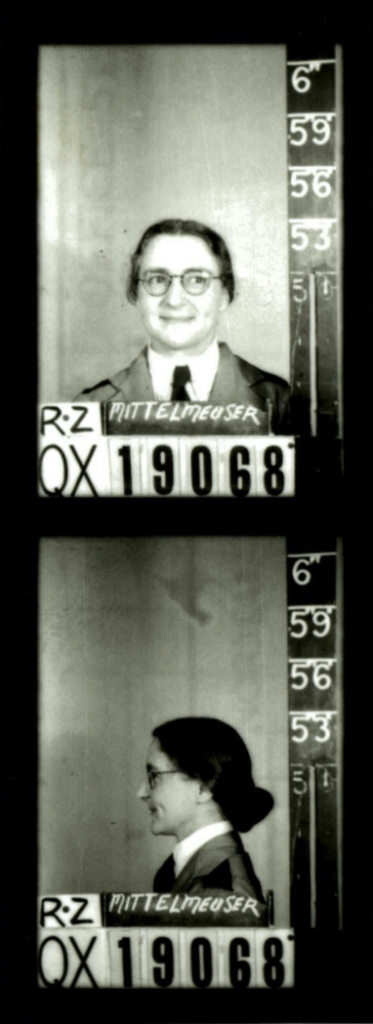
On 16 January 1941, having been promoted to the rank of sister eight days earlier, Pearl ceased full-time duty at Enoggera. The following day she was appointed to the Second Australian Imperial Force (2nd AIF) for service abroad with the AANS and allotted to the 2/10th Australian General Hospital (AGH).
The 2/10th AGH was being raised at that time at the Royal Agricultural Society Showground in Sydney under the command of Col. Edward Rowden White. The unit had been established for service in Malaya, where it would support the 22nd Brigade of the 8th Division, 2nd AIF. Numbering nearly 6,000 troops, the 22nd Brigade was being deployed to Malaya at Britain’s request to join British and Indian troops in garrison duty amid rising tensions with Imperial Japan. On 22 September 1940 Japan had begun to move into French Indochina after signing an agreement with Vichy France. Five days later it had signed the Tripartite Pact with Germany and Italy. The 22nd Brigade, the 2/10th AGH, the 2/4th Casualty Clearing Station (CCS), the 2/9th Field Ambulance, and sundry smaller medical units were scheduled to sail to Malaya on 4 February aboard the Queen Mary.
Pearl was advised to prepare for imminent embarkation. She was granted leave from 24 to 28 January and took the train to Bundaberg to visit her parents at ‘Fremont,’ the house on Targo Street where they had lived since around 1930. On the evening of 27 January, she caught the overnight mail-train back to Brisbane, arriving at barracks on 28 January.
THE QUEEN MARY
On the morning of 31 January, Pearl made her way to Brisbane railway station and joined a contingent of Queensland AANS nurses waiting to board the 10.00 am train to Sydney. Staff Nurses Jessie Blanch, Iva Grigg, Florence Trotter and Joyce Tweddell, fellow graduates of Brisbane General Hospital, and Staff Nurses Monica Adams, Cecilia Delforce and Chris Oxley and Sister Irene Ralston had been attached to the 2/10th AGH and would sail with to Malaya with Pearl on the Queen Mary. Staff Nurses Ivy Machon, Jessie Newman, Eileen O’Keefe, Winifred Short, Thora Skyring and Daphne Tomlins had been attached to the 2/5th AGH and would embark for the Middle East on the Aquitania.
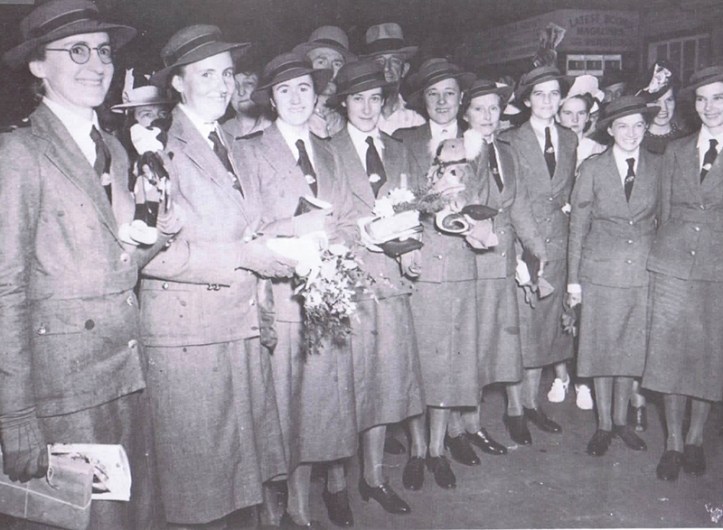
At the appointed time, the 15 nurses, laden with gifts of flowers, fruit and sweets, departed amid cheers and fluttering streamers from family, friends and official representatives. Another 2/10th AGH nurse, Staff Nurse Nell Calnan, boarded the train en route.
The Queenslanders arrived in Sydney at around 8.00 am the next morning. Pearl and the other 2/10th AGH nurses travelled to Darling Harbour and caught a ferry to Bradley’s Point, where the mighty Queen Mary lay at anchor, opposite Taronga Zoo and within sight of the Heads. They embarked at 1.00 pm, joining a scrum of 22nd Brigade troops marching up the gangway. Meanwhile, the 2/5th AGH nurses were taken to Woolloomooloo to board the Aquitania, which was in the process of embarking around 3,300 troops for the Middle East.
Pearl and her fellow Queenslanders were allocated their cabins and over the next two days met their counterparts from New South Wales and Victoria. Of the unit’s 43 nurses, Pearl was the third-most senior, behind Matron Dot Paschke, who was from Victoria and a year younger than Pearl, and Sister Nesta James, also from Victoria and six months older. There were also three masseuses (physiotherapists) attached to the unit – Thelma Gibson from Queensland, Bonnie Howgate from Victoria, and Winsome Zouch from New South Wales. The 2/10th AGH nurses also met six nurses attached to the 2/4th CCS, five South Australians and one Tasmanian, among whom Sister Irene Drummond was the most senior. Each of the two units established a medical facility – the 2/10th AGH a hospital and the 2/4th CCS a dressing station. With nearly 6,000 troops on board, there were patients requiring care even before the Queen Mary sailed.
In the early afternoon of 4 February, the Queen Mary pulled away from Bradley’s Head to the cheers of countless well-wishers around the harbour foreshore and bobbing about on the water in boats. As the Queen Mary came level with the Heads the ship’s band struck up ‘Haere-ra’, (‘A Māori Farewell’), and the troops sang ‘Now is the hour when we must say goodbye’ again and again.
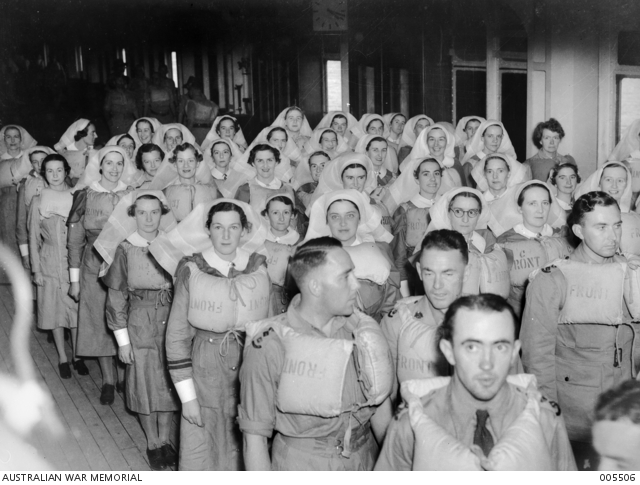
Outside the Heads the Queen Mary joined the Aquitania and the Dutch liner Nieuw Amsterdam, which had arrived the previous day from Wellington with around 3,800 New Zealand troops for the Middle East. The ships put out to sea escorted by HMAS Hobart. On 8 February the convoy was joined by the Mauretania, which had embarked from Melbourne with some 3,900 troops for the Middle East. After a stop in Fremantle, during which two Western Australian nurses of the 2/4th CCS boarded the Queen Mary, the convoy set out again, now under the escort of HMAS Canberra. A day later, those on board the Queen Mary were officially told that their destination was Malaya; they had believed that they were sailing to the Middle East.
On 16 February, as the convoy was nearing Sunda Strait, HMS Durban came into sight and swung into line abreast of the Canberra. At this point the Queen Mary swung to port and circled behind the other ships, then charged past them at a rate of knots and peeled off to the right for Malaya. The Aquitania, Niew Amsterdam and Mauretania carried on to Bombay, where the troops would transship for the Middle East.
On 18 February, the Queen Mary arrived at Sembawang Naval Base, on the north coast of Singapore Island, just across Johor Strait from the Malay Peninsula. The nurses disembarked and were taken to adjacent railway sidings. They gave their names and addresses, were issued with rations, and then entrained for the peninsula. In the early hours of the following morning, the 2/10th AGH nurses alighted at Tampin and were driven to the Colonial Service Hospital in Malacca, while the 2/4th CCS nurses, who had been detached to the 2/9th Field Ambulance, continued to Seremban. From there they were transported to Port Dickson, where the 2/9th Field Ambulance was based.
MALACCA
Malacca was an old colonial town on the west coast of the Malay Peninsula with an interesting mixture of Portuguese, Dutch and British architecture. The Colonial Service Hospital was located on a slight rise just out of town. The modern, five-storey building was set in verdant grounds studded with bougainvillea, frangipani and hibiscus. The 2/10th AGH had been allocated several wings of the hospital, while the other wings continued to operate as a civilian hospital. The nurses were quartered on the fourth floor of one of the wings and enjoyed spectacular views across the lush countryside.
Despite the heat and humidity of Malacca, the nurses lived very comfortably. They enjoyed the services of amahs (house maids), who washed and ironed their clothes, made their beds and generally cleaned up after them. Other local staff cooked for them. They enjoyed amenities provided by the Red Cross, including a sewing machine, a gramophone and records, and books.
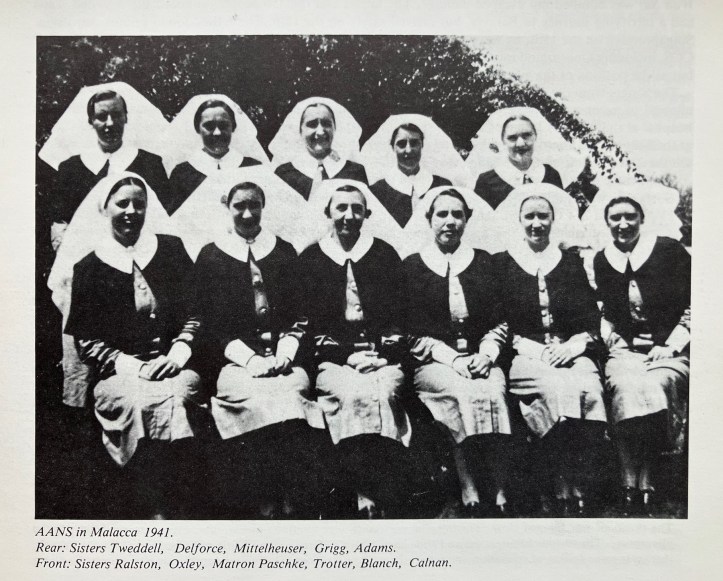
With 6,000 soldiers to look after, Pearl and her colleagues were certainly kept busy. Between April and December, they treated an average of 400 patients a month. The main complaints were tropical skin and ear infections, but they also treated plenty of injuries caused by training accidents, including gunshot wounds, and motor accidents, as well as the occasional case of malaria or typhus.
Nevertheless, the nurses had plenty of time for leisure activities, particularly given that they were spared the time-consuming drudgery of domestic chores. They explored the historic centre of Malacca, visiting for instance the ruins of St. Paul’s Church, where the Spanish Catholic missionary St. Francis Xavier was temporarily buried in 1553. They went shopping, went to the pictures, or just stayed in and wrote letters. They were permitted to use the tennis courts at the hospital. They played golf. They were made honorary members of the Malacca Swimming Club, where they would go in groups whenever they could organise transport. The nurses received numerous society invitations to afternoon teas and bridge nights, and socialised with male officers, who took them out to dinner followed perhaps by a visit to the Capitol Cabaret, a popular picture theatre and dance hall.
The nurses were granted generous periods of leave and travelled in groups of four or five to Singapore, where they could visit Raffles, the famed Singapore Swimming Club, and Haw Par Villa; Kuala Lumpur, with its interesting architecture and relatively comfortable climate; and Fraser’s Hill, a typical British hill station lying in the cool highlands north of Kuala Lumpur. Pearl was granted her first period of leave from 7 to 9 June.
COMINGS AND GOINGS
On 10 June, the day after Pearl’s return to Malacca, eight reinforcement nurses arrived at the hospital. Sister Jean Stewart and Staff Nurses Mary Clarke, Jenny Greer, Mary Holden, Betty Jeffrey, Nell Keats, Betty Pyman and Beryl Woodbridge had arrived in Singapore the previous day aboard the Zealandia. The ship had departed Sydney on 19 May with around 22nd Brigade 1,200 reinforcements.
Pearl was granted more leave from 10 to 14 July and likely travelled to Fraser’s Hill in a group that included Staff Nurse Gwenda ‘Buddy’ Elmes. The nurses left Malacca at 7.00 am on 10 July and after travelling via Kuala Lumpur arrived at Fraser’s Hill at around 3.00 pm. They spent the afternoon relaxing in the beautiful town, admiring its bungalows with red roofs, grey stone walls and white windows, and gardens of roses, carnations and begonias. The following morning, they went walking over the hills, played tennis in the afternoon, and in the evening went out to a club. They spent the next two days in a similar manner, with the addition of golf, and on 14 July returned to Malacca.
On 19 July, five days after her return, Pearl and several other 2/10th AGH nurses, including Staff Nurses Caroline Ennis and Rene Singleton, were detached to the 2/9th Field Ambulance at Port Dickson. They worked at the 50-bed dressing station established by the nurses and some of the medical officers of the 2/4th CCS during their detachment in February. Two of the nurses, Staff Nurses Peggy Farmaner and Bessie Wilmott, were still attached to the 2/9th Field Ambulance, but the others had returned to the 2/4th CCS at Kajang, just south of Kuala Lumpur.
From February to August the 2/9th Field Ambulance had engaged in training exercises with the 22nd Brigade, whose three battalions were deployed in a wide area around Port Dickson. The training exercises concluded at the end of August, and Pearl and the other 2/10th AGH nurses returned to Malacca on 1 September.
THE WAR CLOUDS GATHER
Meanwhile, following intelligence reports pointing to the vulnerability of Singapore to Japanese attack from the north – the island had hitherto been regarded as an impregnable fortress – a second 8th Division brigade, the 27th, around 2,000 strong, had arrived in Malaya on 15 August on the troopships Johan Van Oldenbarnevelt and Marnix Van St. Aldegonde. Accompanying the brigade were five further reinforcement staff nurses for the 2/10th AGH – Beth Cuthbertson, Clarice Halligan, Jean Russell, Florence Salmon and Ada ‘Mickey’ Syer.
A month later, on 15 September, a second AGH, the 2/13th, arrived aboard the Australian hospital ship Wanganella. The unit had been raised in Melbourne in August at the request of Col. Alfred P. Derham, Assistant Director of Medical Services (ADMS), 8th Division, and had a staff of around 250, including 49 AANS nurses. It was based at a Catholic boys’ school, St. Patrick’s, situated in Katong on the south coast of Singapore Island, pending the readiness of its permanent site, a psychiatric hospital in Tampoi, in the far south of the peninsula. On the day of the 2/13th AGH’s arrival in Singapore, 10 of the unit’s nurses were detached to the 2/10th AGH to learn tropical nursing from their more experienced peers. They arrived in Malacca the following day.
Pearl was granted more leave from 27 to 30 October and again from 12 to 19 November. Less than three weeks after her return, Japan invaded Malaya.
JAPANESE INVASION
All the while Japanese troops had been massing in French Indochina, and all the signs pointed to war. On 1 December the codeword ‘Seaview’ was issued, advancing all Commonwealth forces in Malaya to the second degree of readiness. All leave was cancelled, and units had to be ready to move at a few hours’ notice to their war stations. This was followed on the evening of Saturday 6 December by the codeword ‘Raffles.’ War with Japan was imminent.
In the very early hours of Monday 8 December, an assault force of some 5,000 troops of the Imperial Japanese Army landed at Kota Bharu on the Malay Peninsula’s northern coast. At around the same time, Japanese troops landed at Pattani and Singora (Songkhla) in Thailand. At 4.00 am Japanese bombers attacked Singapore Island, killing many people. Elsewhere, Pearl Harbour, Guam, Midway, Wake Island and American installations in the Philippines were attacked, and Hong Kong invaded. Japan declared war on the United States, Great Britain, Australia, Canada, New Zealand and South Africa.
Over the coming days, the Japanese troops broke out of their beachhead at Kota Bharu and began to advance southwards on the eastern side of the peninsula. Meanwhile, two other Japanese columns crossed from Thailand into Malaya and moved south along the peninsula’s western side. Further south, HMS Prince of Wales and HMS Repulse were sunk off the east coast of the peninsula, with tremendous loss of life.
Although outnumbered by the British and Indian troops stationed in northern Malaya, the Japanese soldiers were combat-ready and moved rapidly, often by bicycle. They were backed by mechanized units and substantial sea and air power and forced the severely outgunned British and Indians to retreat before them.
EVACUATION TO SINGAPORE
By the end of December, it had become clear that the 2/10th AGH would have to be evacuated from the Colonial Service Hospital. Kuala Lumpur had been bombed, and Malacca was now in the direct path of the Japanese advance. Col. Derham decided to move the hospital to Singapore Island but would need time to organise a suitable site. In the meantime, the unit’s nurses, staff and patients were progressively evacuated south. By the evening of 5 January 1942, 36 nurses, around 40 other staff and scores of patients had been relocated to the 2/13th AGH, which had by now moved into the psychiatric hospital in Tampoi. The following day, 6 January, Pearl and 19 other 2/10th AGH nurses, including Matron Paschke, were detached to the 2/4th CCS, now based at Mengkibol Estate, a rubber plantation five kilometres to the west of Kluang.
On 13 January Pearl and Matron Paschke travelled to Singapore Island with Col. White to inspect the site chosen by Col. Derham for the unit’s occupation – Oldham Hall, a Methodist boarding school on Bukit Timah Road. The two nurses remained at Oldham Hall to assist with the setting up of the wards, and soon the dusty old school was converted into a clean and functional 200-bed hospital. By 15 January the unit had completed its relocation, having set up its surgical wing in Manor House on nearby Chancery Lane, and soon the nursing staff began to return from the other units.
Meanwhile, Australian soldiers had engaged Japanese forces for the first time. Shortly after 4.00 pm on 14 January, B Company of the 2/30th Battalion ambushed bicycle-mounted Japanese troops at Gemencheh Bridge, 40 kilometres north of Malacca. The following day the main force of the 2/30th Battalion, together with elements of the 2/4th Anti-Tank Regiment, made further contact with Japanese forces outside Gemas, 20 kilometres east of Gemencheh Bridge, in a battle that lasted two days. Although the Australians scored a tactical victory, they did little to slow the Japanese advance and sustained many casualties. At around 6.00 pm on 15 January the casualties began to arrive at the 2/4th CCS at Mengkibol, and by the following morning 73 of the lighter cases had been evacuated to the 2/13th AGH at Tampoi.
Soon the 2/13th AGH itself was forced to evacuate to Singapore Island, and by the evening of 25 January had recrossed Johor Strait and moved back to St. Patrick’s School. On 28 January, with a general evacuation of all Commonwealth forces under way, the 2/4th CCS followed the two AGHs across the strait to the island, moving into the Bukit Panjang English School.
On the morning of 31 January, after the last Commonwealth troops had crossed Johor Strait onto Singapore Island, the Causeway was blown in two places. Soon after, Japanese forces reached the northern shore of the strait and on 2 February began a sustained artillery bombardment of the island. On 4 February several shells fell a short distance from Oldham Hall. Three days later, three staff members were killed and several injured by stray ordnance. To make matters worse, the large British guns to the south of the hospital were returning fire, so artillery was travelling over the hospital in both directions.
THE FINAL DAYS
In the daylight hours of 8 February, Japanese forces began an intensive artillery and aerial bombardment of the western defence sector of Singapore Island, destroying military headquarters and communications infrastructure. At around 8.30 pm that night, the first wave of Japanese soldiers in amphibious craft began to cross Johor Strait to the west of the causeway. They came under withering fire from Australian 2/20th Battalion and 2/4th Machine Gun Battalion defenders, but the Australians were hopelessly outnumbered and could not communicate effectively with base. The Japanese continued to cross all night and by the morning of 9 February had established a beachhead on the northwestern corner of Singapore Island.
Tuesday 9 February was a black day. Some 700 casualties poured into the 2/10th AGH, and Oldham Hall and Manor House became so overcrowded that men were lying on mattresses on the floor while others waited outside. Even though the unit had requisitioned further bungalows, it was impossible to cope with the numbers, and many were sent on to the 2/13th AGH at St. Patrick’s School, to the British Military Hospital, and to the Indian General Hospital (situated in Tyersall Park, now part of the Singapore Botanic Gardens). The theatre staff now worked around the clock, treating severe head, thoracic and abdominal injuries. There was little respite for staff when off duty, as the constant pounding of bombs and shells meant that sleep was hard to come by.
With Singapore’s fate all but certain, a decision was made to evacuate all the AANS nurses. Already in January, following reports of Japanese atrocities in Hong Kong, Col. Derham had put the question to Maj. Gen. H. Gordon Bennett, commander of the 8th Division. He had refused, citing the damaging effect on morale. Col. Derham then instructed his deputy, Lt. Col. Glyn White, to send as many nurses as he could with Australian casualties leaving Singapore. The evacuation of the nurses began on 10 February.
That morning, Pearl and her 2/10th AGH colleague Thelma May Bell were working on the same ward, when they were told by Dot Paschke that one of them was to go with five other 2/10th AGH nurses to accompany wounded Commonwealth soldiers on a ship to Batavia. Thelma did not want to be separated from her good friend Molly Campbell, who was one of the five, so Thelma and Pearl tossed a coin. Thelma won, and later that day departed that on the Wusueh, a Yangtze River steamer fitted out as a hospital ship, with Molly, Aileen Irving, Veronica Sawyer, Vi Haig and Iva Craig. On board were around 350 wounded soldiers, including about 150 2nd AIF men and a few RAAF men and British and Indian troops, many of whom were severely wounded. The nurses made it safely to Batavia and eventually reached Australia.
The next day a further 60 AANS nurses, 30 from each of the AGHs, boarded the Empire Star with more than 2,000 evacuees, mainly British army and naval personnel, and set out for Batavia. The ship was bombed and strafed by Japanese aircraft for the loss of 12 lives but limped into Priok Tanjung, the port of Batavia, on the morning of 14 February.
THE VYNER BROOKE
Now 65 AANS nurses remained in Singapore. On Thursday 12 February they too had to go. Late in the afternoon, Pearl and the remaining 2/10th AGH nurses and four of their peers from the 2/4th CCS were driven in ambulances through the side streets of Singapore city to St. Andrew’s Cathedral. Here they were joined by the 27 remaining 2/13th AGH nurses and the other four 2/4th CCS nurses. After a roll call, they all continued by ambulance to Keppel Harbour.
The ambulances drove through the ruined city towards the wharves. When rubble blocked the vehicles’ further progress, the nurses got out and walked. Fires burned along the waterfront, and the offshore oil installations were ablaze. At the wharves there was chaos, as hundreds of people attempted to board any vessel that would take them.
Eventually a tug took Pearl and her 64 comrades out to a small coastal steamer, the Vyner Brooke, a one-time pleasure craft of the Sir Charles Vyner Brooke, a colonial administrator. As darkness fell, the ship slid out of Keppel Harbour and after some delay began its journey to Batavia. There were as many as 200 people on board, mainly women and children. Behind them, thick black smoke billowed high into the night sky.
During the night, Captain Borton guided the Vyner Brooke slowly and carefully through the many islands that lay between Singapore and Batavia, and at first light on Friday 13 February he sought to hide the vessel among them – the better to evade Japanese planes. That morning the nurses were addressed by Matron Paschke, who set out a plan of action in the event of an attack. The nurses were to attend to the passengers, help them into the lifeboats, search for stragglers, and only then save themselves. Since there were not enough places in the Vyner Brooke’s six lifeboats for everybody, those nurses who could swim were to take their chances in the water. They did at least have their lifebelts, and rafts would be deployed too.
Saturday 14 February dawned bright and clear. After another night of slow progress through the islands, the Vyner Brooke lay hidden at anchor once again. The ship was now nearing the entrance to Bangka Strait, with Sumatra to the right and Bangka Island to the left. Suddenly, at around 2.00 pm, the Vyner Brooke’s spotter picked out a plane. It circled the ship and flew off again. Captain Borton, guessing that Japanese dive-bombers would soon arrive, sounded the ship’s siren. The nurses, wearing their lifebelts, put on their tin helmets and lay on the lower deck. The ship began to zig-zag through open water towards a large landmass on the horizon – Bangka Island. Soon, bombers appeared, flying in formation and closing fast.
The planes, grouped in two formations of three, flew towards the Vyner Brooke, and as they approached, they released their bombs and strafed the ship. The Vyner Brooke weaved, and the bombs missed their target, but the three portside and one of the starboard lifeboats were holed. The planes regrouped, flew in again, and this time the pilots scored three direct hits. When the first bomb exploded amidships, the ship lifted and rocked with a vast roar. The next went down the funnel and exploded in the engine room. As passengers swarmed up to the open air, a third bomb dealt the ship a final blow. With a dreadful noise of smashing glass and timber, it shuddered and came to a standstill, around 15 kilometres from Bangka Island.
The nurses carried out their action plan. They helped the women and children, the oldest people, the wounded, and their own injured colleagues into the three starboard lifeboats. The first two got away safely. However, as the Vyner Brooke listed ever more alarmingly, the third lifeboat, the one that had been strafed, juddered and swayed and crashed awkwardly into the water as it was being lowered. Several of its passengers jumped out and swam, for fear that the ship might fall onto them.
After a final search, the nurses abandoned the doomed ship. They removed their shoes and their tin helmets and entered the water any way they could. Some jumped from the portside railing, now high up in the air, while others practically stepped into the water on the starboard side. Some slid down ropes or climbed down ladders.
Once in the water, some of the nurses clambered into the lifeboats where there was room or caught hold of the ropes that trailed behind them. Other nurses climbed onto rafts or grabbed hold of passing wreckage. Still others simply floated in their lifebelts among dead bodies and oil and wreckage. Meanwhile, the Vyner Brooke settled lower and lower in the water and then slipped out of sight. It had taken less than half an hour to sink. Twelve of Pearl’s colleagues had died in the attack or were subsequently lost at sea. Matron Dot Paschke was among them.
AT SEA
Pearl found herself clinging to the third lifeboat, which was now partially submerged but still floating. Alongside her were Sister Jean Ashton and Staff Nurses Veronica Clancy and Gladys Hughes of the 2/13th AGH and Staff Nurses Shirley Gardam and Mina Raymont of the 2/4th CCS. Sometime later, Pearl helped to pull Staff Nurse Sylvia Muir of the 2/13th AGH aboard the lifeboat. Sylvia had got into difficulties in the water. Alongside the nurses on the lifeboat were a number of civilians, including an American woman named Helene Anna-Ben Jean Bull and her four-year-old daughter, Hazel. Mrs. Bull had lost her two older children in the sinking of the Vyner Brooke but in an extraordinary turn of events was reunited with them at the end of the war.
As night came on, Pearl and the others struggled with their slowly sinking lifeboat. They tried to plug the machinegun holes with clothing, but it was a futile exercise, and in the end they abandoned the boat and joined a group of survivors around two lashed-together rafts. By now Sister Blanche Hempsted of the 2/13th AGH, another Brisbane General Hospital trainee, had joined them.
At one point during the night, when the rafts had been pulled by the current quite close to Bangka Island, the party saw a fire burning on a beach. They tried to reach shore, but the current pulled them away again. Pearl and her colleagues would later learn that what they had seen was a bonfire lit by the passengers of the first lifeboat to leave the Vyner Brooke.
BANGKA ISLAND
Towards morning, while Pearl and the others remained on the rafts, Veronica Clancy, Blanche Hempsted and Gladys Hughes decided to swim for shore, which was once again quite close. They were picked up in the water by two British airmen in a launch, who proceeded to collect the others and deposit them at the end of a long jetty before hightailing it at the approach of Japanese soldiers. During the night, Japanese forces had launched an invasion of Sumatra and had already captured Bangka Island.
Pearl and the others had been brought to shore in the vicinity of Muntok, the largest town in this northwestern part of Bangka Island, and now they were taken by the soldiers to a cinema in town. Here they found hundreds of interned survivors of scores of ships sunk in Bangka Strait by Japanese forces over the past few days, including nearly two dozen of their surviving colleagues.
After a day or two at the cinema, the internees were marched from the cinema to workers’ quarters on the edge of town. They had been here for some 10 days when Staff Nurse Vivian Bullwinkel of the 2/13th AGH was brought in. She had miraculously survived a massacre on a beach that killed 21 of the nurses’ colleagues and dozens of civilians, merchant seamen and soldiers. For Vivian’s and the other nurses’ safety, they all vowed never to talk about it while they remained in captivity. The infamous beach later beknown known as Radji Beach.
Of the 65 Australian nurses who had set out from Singapore on that fateful day, 33 had died. Under these tragic circumstances, the surviving 32 nurses, along with hundreds of civilian men, women and children, began a period of captivity that would last for more than three years.
BUKIT BESAR CAMP (‘LAVENDER STREET’), PALEMBANG
On 2 March 1942 the internees – nurses, civilians and service personnel – were marched from the barracks down to the jetty at which Pearl had arrived just over two weeks earlier. They waited there overnight and in the morning were taken by barge across Bangka Strait to Sumatra then up the Musi River to Palembang, the women and children in one boat, the men in a larger one that followed. Upon disembarking, the women and children were driven to a MULO (School for More Advanced Primary Education) school on the outskirts of town and found that the men had already arrived.
The next day, some of the interned military men argued with Japanese officials that the AANS nurses should be treated as military prisoners of war, not as civilian internees, but to no avail. That afternoon, the nurses and civilian internees were marched away to the Bukit Besar (‘Big Hill’) district of Palembang, where a number of houses had been sequestered as a makeshift internment camp.
At Bukit Besar, Pearl and the other nurses were accommodated in two houses abandoned by their Dutch owners. Soon these houses were wanted by the camp’s six Japanese officers for use as a ‘club,’ and the nurses were forced to move to adjacent houses. However, it was soon made clear to the nurses that their presence was required at the ‘opening night’ of the club, the evening of Wednesday 18 March. Wednesday arrived, and some of the nurses were ordered to clean out three houses in a nearby street. Once the purpose of these houses became known, they took to calling them ‘Lavender Street’ after a red-light district in Singapore. Later in the day, five of the nurses were ordered to go into the club in turn, where their willingness to oblige the officers later that evening in ‘Lavender Street’ was gauged. All responded with an unequivocal ‘no.’
At 8.00 pm Wednesday night, 27 of the nurses piled into the club en masse, greatly surprising the Japanese officers. The women had attempted to make themselves appear as ugly as possible – like “gaunt harpies,” according to Sister Elizabeth Simons of the 2/13th AGH in her book While History Passed (Simons, p. 37) – in order to discourage the officers from pursuing their objective, and through determination and resourcefulness they thwarted the officers’ designs. In the days that followed, the officers continued to apply pressure, even threatening to withhold the internees’ food rations, but the nurses were steadfast. Eventually the matter was reported to a local Red Cross official, the club was closed, and the officers from then on ignored the nurses. Nevertheless, the enormous anxiety caused by these events stayed with Pearl and the others for a long time.
WOMEN’S CAMP (‘IRENELAAN’), PALEMBANG
On 1 April 1942 the women were separated from the men and marched off to a new camp two kilometres away from Bukit Besar. The men were taken to their own camp. The women’s camp became known among the nurses as ‘Irenelaan’ (Irene Avenue, after the daughter of Princess Juliana of the Netherlands), the name of one of two streets on which the houses of the camp were located, the other being ‘Bernhardlaan.’
There were some 400 women and children at Irenelaan, crammed into houses formerly occupied by Dutch residents. The 2/10th AGH nurses and several civilian women and children were at No. 9 Irenelaan, while the 2/13th AGH and 2/4th CCS nurses shared No. 7 with civilians. Despite this, Irenelaan was probably the least awful camp of the nurses’ and civilians’ long imprisonment.
As time passed, the nurses settled down to a daily routine, dividing the cooking and housekeeping, and taking turns to “district nurse” (Jeffrey, p. 38). Their nurses’ training and army discipline served them well, enabling them to work together to take care of problems. Each house appointed a captain, who spoke on behalf of the others to guards or officials and represented the house at community meetings. Pearl was appointed captain of the 2/10th AGH nurses and Sister Jean Ashton captain of 2/13th AGH and 2/4th CCS nurses.
As one of the senior nurses, Pearl was obliged to lead the bowing during ‘tenko’ – roll call – as Betty Jeffrey described in White Coolies:
One infuriating habit our ‘masters’ have is counting what is called ‘tenko.’ We suddenly have to dump everything on the spot and stand outside on the roadway in the midday sun or rain and wait to be counted. Mitz, Sister Mittelheuser, a senior sister in our group, takes the bow. She has to stand at the top of the line and bow to the waist and say, ‘Dua puloh umpat,’ which means ‘twenty-four’ in Malay. We all mutter it individually just to help, and the guard, after counting half a dozen times, is usually surprised to find all correct (Jeffrey, pp. 50–51).
In February 1943, following a series of altercations – fights, really – with one of their civilian housemates, the 2/13th AGH and 2/14th CCS nurses moved into No. 9 with their 2/10th comrades.
COMMUNICATION AT LAST
It was around this time that Irenelaan was visited by a Japanese official who had flown in from Singapore especially to see the Australian nurses. He passed on a message from the Australian government – “Keep Smiling” – and, more importantly, recorded their full personal details and a personal message to be broadcast home. He also told them that they would be allowed to write a letter home.
In late February 1943 the nurses’ names and messages were broadcast over Radio Tokyo. The transmissions were picked in Australia by official listening posts – and also potentially by individuals with shortwave radios – and conveyed officially and unofficially to the nurses’ families. The family of Pearl’s 2/10th AGH colleague Sister Winnie May Davis, for instance, received a letter from the Army Records Office of New South Wales advising them of Winnie’s message.
On the other hand, on 3 March Margaret Mittelheuser was informed of Pearl’s message by the matron of an Australian barracks. As printed in the Bundaberg News-Mail on 12 March, it read as follows:
Calling 141 Targo Street, Bundaberg, Queensland, Australia, to my father and mother and sisters. Keeping fit and cheerful; conditions and treatment good; hope you are well; fondest love.
In mid-March, for the first and only time, the nurses were permitted to write home, as promised by the official. They were given lettercards and a limit of 25 or 30 words. The cards were collected and sent to Australia through the Prisoner of War Service. Margaret and John Mittelheuser received Pearl’s card, dated 16 March, in early December. As reported in the Bundaberg News-Mail on 9 December, Pearl told her parents that she and the other nurses were reasonably comfortable and that their time was fully occupied with their own work. They lived together, and the days passed fairly quickly. They played a lot of bridge and mahjong, having made the cards and sets by themselves. In one week, they celebrated two birthday parties in the house in which they were living and attended two very good concerts in the place next door. They did all the necessary nursing in the camp, but the patients had to go to hospital once a week. The Dutch people had been marvellous in their attention, and their kindness would never be forgotten. Finally, Pearl asked to be remembered to all friends and sent love to all.
‘MEN’S CAMP,’ PALEMBANG
In September 1943, three months before Pearl’s card reached her parents, the nurses and civilian women and children were moved to a new camp at Puncak Sekuning, around two kilometres away from Irenelaan. It became known among the nurses simply as the ‘Men’s Camp’ (as it had most recently been occupied by the male internees who were formerly held with the women and children).
In April 1944 the camp came under military administration, where previously it had been under civilian administration. Conditions worsened considerably. Bowing was mandated, and face-slapping and punching occurred regularly. Sadistic punishments, such as being made to stand in the sun for hours, were meted out. The internees were threatened with starvation unless they dug and tended their own gardens, and even so rations were dangerously inadequate.
By August that year the nurses were earning money in various ways to pay for food. They mended shoes, washed clothes and looked after children for the Dutch internees. Mina Raymont made little handkerchiefs out of bits and pieces. Cecilia Delforce became a champion woodcutter. Florence Trotter made money by cutting and setting hair for the interned Dutch women. Sylvia Muir made toys out of odd bits of timber. Vi McElnea, a Queenslander who had come over with the 2/13th AGH, sold fried rice. Her customers, who were mostly Dutch, would supply their own oil and for 10 cents she would fry a small portion of rice for them. Winnie May Davis and Pat Gunther of the 2/10th AGH made hats from bits and pieces of material, and Winnie also made shorts from worn-out clothes with Mavis Hannah of the 2/4th CCS.
MUNTOK CAMP, BANGKA ISLAND
In mid-October 1944 the internees were moved in stages back up the Musi River and across Bangka Strait to a camp established at Muntok on Bangka Island. Although Muntok camp was brand new and spotless, with big airy buildings that caught the sea breeze, it did not take the nurses long to discover that it was in fact “as near hell as we were likely to get” (Simons, p. 84). Diseases like malaria and beri beri became so widespread that little notice was taken of them.
In mid-November, Pearl, Shirley Gardham, Mickey Syer and Jenny Greer joined Betty Jeffrey in the camp hospital with symptoms that Betty described in White Coolies as “awful fever, raging temperatures, and unconsciousness, followed by skin actions” (Jeffrey, p. 140). For want of a better name the condition was dubbed ‘Bangka Fever.’
Already weakened by chronic undernourishment, and without the medicines that might have saved their lives, the internees, particularly the eldest and youngest, began to die. “When people die,” wrote Betty Jeffrey in White Coolies,
the women have to carry them out of the camp to a small … cemetery in the jungle not far from here. We have a special corner for the people from this camp. Our working squads have to dig the graves with chungkals … The missionaries or the nuns always take the service at the graveside. The cemetery is in a very pretty spot on the hillside, with a profusion of wild jungle flowers everywhere. … Two wooden crosses … mark the graves and the inscriptions are burnt on them (Jeffrey, p. 144).
Christmas 1944 was barely celebrated. The nurses made a tired effort to arrange a Christmas concert as in previous years but simply did not have the energy. There were no presents exchanged among them. They had not got a thing.
By late January 1945 all of the nurses except one had contracted malaria. Six were in the camp hospital, and four – Shirley Gardam, Mina Raymont, Blanche Hempstead and Rene Singleton – were gravely ill. The others, despite having malaria themselves, did everything they could for their colleagues. Mina was eventually discharged but on 7 February collapsed and was carried back to hospital. She died the following day, most likely of cerebral malaria.
Mina was given a military funeral. The nurses wore their tattered and stained uniforms, and as they carried Mina’s coffin past the guardhouse at the entrance to the camp, the guards stood to attention and removed their caps – something they had never done before. Once outside the camp, the nurses marched down the path to the small cemetery in the jungle and lowered Mina’s coffin into a freshly dug grave.
Mina’s death was followed on 20 February by that of Rene Singleton, who died of beri beri. On 19 March, Blanche Hempsted died. Shirley Gardam followed on 4 April.
BELALAU CAMP, LUBUKLINGGAU, SUMATRA
Following Shirley’s death, the internees were moved for a final time, to a camp in southern Sumatra. After enduring a 26-hour journey in a boat across Bangka Strait and then up the Musi River to Palembang, they spent 36 hours on a train to Lubuklinggau, with hours of waiting in between. Finally, they were driven in trucks to a rubber plantation known as Belalau. Around a dozen internees died during the hellish journey.
At their new camp Pearl’s comrades continued to succumb to disease and malnutrition. Gladys Hughes died on 31 May, Winnie May Davis on 19 July and Dot Freeman of the 2/10th AGH on 8 August. Two days before Dot’s death, the United States had dropped an atomic bomb on the Japanese city of Hiroshima. One day after Dot’s death, the United States dropped another atomic bomb, this time on Nagasaki. On 15 August Emperor Hirohito formally announced Japan’s surrender.
“OUR DEAR MITZ DIED THIS AFTERNOON”
At the time of Dot’s death, Pearl herself was gravely ill with beri beri. She died on 18 August. Betty Jeffrey recorded the terrible event in White Coolies:
18th August 1945. Our dear Mitz died this afternoon, having been through a most uncomfortable few days,” Betty wrote. “If only we could do something to help these sick girls! We never leave their sides and do all we can to make them comfortable. It is terrible to keep a sick girl warm by covering her with an old rice sack. These damned Japs won’t give us a thing in the way of medical supplies; we all feel sure they have the stuff, but are just being thoroughly nasty about it, and won’t give it to us … Mitz, Sister Mittelheuser, was third senior sister in our hospital unit, 2/10th AGH, and had worked terribly hard in Malaya and Singapore. Then later in camp she worked like the Trojan she was as our house captain and housekeeper. Of the sixty-five sisters who left Singapore we are now only twenty-four (Jeffrey, p. 180).
According to Elizabeth Simons, the only thing Pearl wanted when she was lying perilously ill was “to hear her people call her by her Christian name” (Simons, p. 91).
Sylvia Muir was with Pearl during her final hours. Sylvia had sat there in despair, trying to soothe her. All she could do was to wipe the sweat from Pearl’s face and limbs with a damp cloth and give her sips of water from an old milk tin. When Pearl died, Sylvia was too weak even to cry.
Six days after Pearl’s death, the internees were told that the war was over. Thereafter, their situation changed dramatically, but it would still be three weeks before the remaining 24 nurses were found at Belalau camp and flown to Singapore. After a period of recuperation, the nurses boarded the Australian hospital ship Manunda and sailed for Australia. They arrived in Fremantle on 18 October. They were home.
IN MEMORIAM
On 19 November 1948 two landscape paintings presented by the nursing and medical staff were unveiled at Brisbane General Hospital as a memorial to Pearl. They were hung in the nurses’ dining room and were to be moved to the new nurses’ quarters upon their completion. Present at the unveiling were Pearl’s mother and her sister Laura.
Pearl’s name is recorded on the Bundaberg War Nurses Memorial, which was officially opened by Bundaberg’s mayor on 15 October 1949.
Pearl is also remembered with honour at the Jakarta War Cemetery in Indonesia and at the Australian War Memorial in Canberra.
In memory of Pearl.
SOURCES
- Ancestry.
- Arthurson, L., ‘The Story of the 13th Australian General Hospital, 8th Division AIF, Malaya,’ as reproduced by Peter Winstanley on the website Prisoners of War of the Japanese 1942–1945.
- Australian War Memorial, ‘Wallet 1 of 1 – Letters from Sister Dorothy Gwendoline Howard Elmes, 1941–1942,’ Accession Number AWM2020.22.162.
- Barrett, D. and Robertson, B. (2012), Digger’s Story: Surviving the Japanese POW camps was just the beginning, The Five Mile Press.
- De Vries, S. (2004), Heroic Australian Women in War, HarperCollins Publishers.
- Goodman, R. (1985), Queensland Nurses Boer War to Afghanistan, Boolarong Publications.
- Hamilton, T. (1957), Soldier Surgeon in Malaya, Angus & Robertson Publishers.
- Jeffrey, B. (1954), White Coolies, Angus & Robertson Publishers.
- Kirkland, I. (2012), Blanchie: Alstonville’s Inspirational World War II Nurse, Alstonville Plateau Historical Society Inc.
- National Archives of Australia.
- National Library of Australia, Oral History Program, ‘Mavis Hannah interviewed by Amy McGrath,’ interview conducted at Grove Hill House, Dedham, Colchester, 13 July 1981.
- Nine Field Ambulance Association Rockhampton (website), ‘A History of 9 Field Ambulances.’
- Queensland State Archives, Register of passengers on immigrant ships arriving in Queensland – No. 1, DR39241 Register of Immigrants: Reichstag, 1871–1873.
- RAEME.info (website), ‘Thelma May Bell McEachern.’
- Shaw, I. W. (2010), On Radji Beach, Pan Macmillan Australia.
- Simons, J. E. (1954), While History Passed, Heinemann.
- Syer (née Trotter), F. (1995), ‘More Than Conquerors,’ from Fisher, F. G. (ed.), We Too Were There: Stories Recalled by the Nursing Sisters of World War II 1939–45, Returned Sisters sub-branch, R&SLA (Queensland).
SOURCES: NEWSPAPERS
- The Brisbane Courier (18 Jun 1915, p. 4), ‘Gin Gin Show.’
- The Brisbane Courier (31 Jan 1922, p. 9), ‘Gin Gin.’
- The Brisbane Courier (15 Jun 1929, p. 19), ‘District Shows: Bundaberg.’
- The Brisbane Courier (8 Mar 1930, p. 24), ‘Bride-Elect Honoured.’
- The Bundaberg Daily News-Mail (Qld., 23 Oct 1930, p. 2), ‘Social and Personal.’
- The Bundaberg Daily News-Mail (Qld., 27 Jan 1941, p. 2), ‘Social and Personal.’
- The Bundaberg Mail (Qld., 18 Jul 1919, p. 4), ‘Personal.’
- The Bundaberg Mail (Qld., 19 May 1924, p. 4), ‘A Trip to Wallaville.’
- The Bundaberg Mail and Burnett Advertiser (Qld., 31 Oct 1894, p. 3), ‘The Sugar Industry.’
- The Bundaberg Mail and Burnett Advertiser (Qld., 4 Mar 1895, p. 3), ‘Gin Gin Central Mill Company Limited.’
- The Bundaberg Mail and Burnett Advertiser (Qld., 19 Mar 1908, p. 2), ‘Gin Gin.’
- The Bundaberg Mail and Burnett Advertiser (Qld., 11 Dec 1912, p. 6), ‘Wallaville.’
- The Bundaberg Mail and Burnett Advertiser (Qld., 28 Jan 1914, p. 4), ‘Wallaville Race Club.’
- The Bundaberg Mail and Burnett Advertiser (Qld., 18 Dec 1915, p. 4), ‘Gin Gin.’
- The Bundaberg Mail and Burnett Advertiser (Qld., 13 Dec 1916, p. 4), ‘Walla Lagoon State School.’
- The Bundaberg News-Mail (Qld., 12 Mar 1943, p. 2), ‘Silence Broken.’
- The Bundaberg News-Mail (Qld., 9 Dec 1943, p. 2), ‘Kind Dutch: Woman Prisoner of War.’
- The Bundaberg News-Mail (Qld., 18 Sept 1945, p. 2), ‘Roll of Honour.’
- The Bundaberg News-Mail (Qld., 18 Dec 1948, p. 2), ‘Round the Town.’
- The Courier-Mail (Brisbane, 27 Sep 1945, p. 3), ‘Nurses’ Fund Over £1000.’
- The Courier-Mail (Brisbane, 20 Nov 1948, p. 3), ‘She gave her life as nurse.’
- Maryborough Chronicle, Wide Bay and Burnett Advertiser (Qld., 17 Sep 1885, p. 3), ‘Bundaberg Land Court.’
- Maryborough Chronicle, Wide Bay and Burnett Advertiser (Qld., 20 Aug 1926, p. 2), ‘Childers.’
- The Queenslander (Brisbane, 11 Jan 1879, p. 57), ‘Bundaberg.’
- Truth (Brisbane, 15 Oct 1939, p. 26), ‘Expectant Young Mother’s Death.’
- The Week (Brisbane, 30 Dec 1921, p. 25), ‘Queensland University. Junior Public Examination.’
 australianwarnurses.org