Captain │ Second World War │ Malaya │ 2/10th Australian General Hospital
Family Background
Janet Patteson Gunther, known as Pat in later life, was born on 31 August 1913 on a farm in Mongogarie in northeastern New South Wales. She was the daughter of Jane Eileen Thomson (1881–1933) and Arthur Patteson Theo Gunther (1872–1953).
Jane was born in Burrier, near Nowra, on the south coast of New South Wales. She was the daughter of James Thomson, a grazier and the first Parliamentary representative of the St. Vincent electorate. Jane was a great-granddaughter of the famous Mary Reiby, who, in 1824, received Burrier as a grant from the Crown; gave it to James Thomson and another grandson in 1847, and died in 1858 at Newtown.
Arthur was born in Parramatta, now a western suburb of Sydney. He was the son of the Venerable Archdeacon William James Willis Gunther, who served as rector of St. John’s Church of England, Parramatta, for 43 years, and whose father had moved to Australia from Germany via Oxford and had settled in Mudgee, New South Wales, where he was archdeacon of the district.
On 30 January 1907 Jane and Arthur were married at Jane’s family home in Burrier in a service officiated by Arthur’s father. They continued to live in the area, and in October of that year their first child, William James (Bill), was born.
Soon after the new family moved north to Mongogarie, between Hogarth Range and Leeville, near the large town of Casino. Although not of farming stock, Arthur had acquired some land and began to farm. In June 1909 his and Jane’s second child, Mary Eileen (Meg), was born, followed by Thomas Richmond in 1911 and then Janet in 1913.
Over the next 10 years the family continued to grow. Kenneth Speir was born in 1915, Arthur Philip (Phil) in 1918, Winifred Pamela (Pam) in 1920 and finally Sybil in 1923.
Growing Up
Janet enjoyed a simple life on the farm. She played tennis and rode horses. Like so many other children, she wrote to the children’s pages of the newspapers, in her case the Sydney Mail. In September 1927, for example, she wrote to ‘Cinderella’ to propose a puzzle in which ship’s names were hidden in a story. It was published in November.
Janet and her siblings attended local schools, mostly likely those at Mongogarie and Leeville (Deep Creek). In the mid-1930s Sybil attended the Hogarth Range Public School.
At the beginning of 1928 Janet successfully sat the High School Entrance Examination and qualified for admission to Lismore High School. However, we do not know whether she ended up attending. Some sources suggest she left school to help on the farm.
Nursing
When Janet was around 17 years old, she decided to follow her sister Mary into nursing. One of their aunts had studied medicine and had worked at the Royal Prince Alfred Hospital in Camperdown, Sydney, and suggested that Janet apply there. Janet did, and at the age of 19 was accepted as a trainee. She found her training interesting and made friendships that lasted forever.
On 17 September 1933 Jane Gunther passed away in Casino. She had not yet turned 52. We do not know whether Janet was able to see her mother before she died.
In May 1936 Janet returned home to act as bridesmaid at Mary’s wedding to Mr. H. Strain of Hogarth Range.
Later in 1936 Janet completed her training. She passed her Nurses’ Registration Board examination in November and gained her Australasian Trained Nurses’ Association certificate. She was officially registered in general nursing on 9 September 1937. By then Janet had joined the Nurses’ Club at 5 Rockwall Crescent, Potts Point, and was engaged in private nursing.
Enlistment
When Australia entered the Second World War in September 1939, Janet volunteered for service, as did many of her colleagues. On 27 June 1940 she had her army medical but missed her first call-up, as she was in the country at the time. In time Janet received a second call-up and on 27 November enlisted in the Second Australian Imperial Force (2nd AIF) at Victoria Barracks. She was attached to the Australian Army Nursing Service (AANS) Emergency Unit and the following day posted to the camp dressing station at Tamworth army camp.
After three weeks or so at Tamworth, Janet – or Pat, as she was always known by her wartime colleagues – went on leave. After her return, she was advised that she would soon be joining a medical unit for overseas service and was sent on several days’ pre-embarkation leave. Then on 31 January Pat was attached to the 2/10th Australian General Hospital (AGH) at the rank of staff nurse.
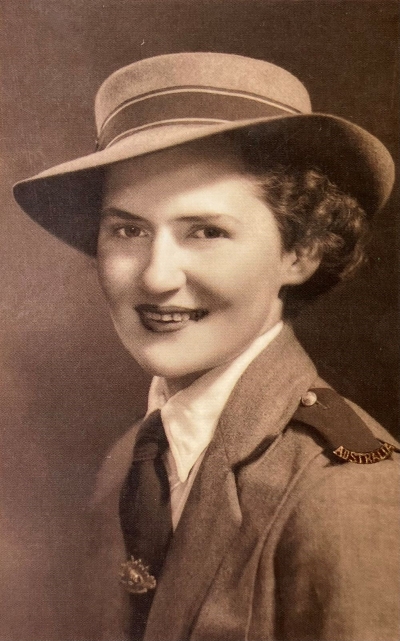
The 2/10th AGH had been raised in Sydney at the Royal Agricultural Society Showground under the command of Colonel Edward Rowden White. Along with the 2/4th Casualty Clearing Station (CCS), the 2/9th Field Ambulance and other, smaller medical units, the unit was set to accompany the 22nd Brigade, 8th Division, known as ‘Elbow Force’, to Malaya. The 22nd Brigade would join British and Indian formations in garrisoning the British colonial possession against possible Japanese aggression.
Among the other New South Wales AANS nurses attached to the 2/10th AGH on 31 January were Winnie May Davis from Ulmarra, Jess Doyle from Potts Point, Pat Blake from Chatswood, Marjorie Schuman from Tingha, Kath Neuss from Mollongghip in Victoria, and ‘Buddy’ Elmes from Cheshunt in Victoria. They were due to sail within days for Malaya, although they would not know their destination until well into the voyage.
The Queen Mary
On 3 February Pat and her new colleagues were taken to Darling Harbour, where they caught a ferry to Bradley’s Point and boarded the famous passenger liner turned troopship Queen Mary. Once on the ship they met their Queensland counterparts, who had boarded the previous day, and later those from Victoria, among whom was Dot Paschke, the unit’s matron, and Nesta James, the second in charge. They also met six nurses attached to the 2/4th CCS. Before long, the nurses of each unit had been assigned duties in makeshift wards. All the while the approximately 5,700 troops of ‘Elbow Force’ continued to stream on board.
The Queen Mary was due to sail the following day in convoy with the Aquitania and the Nieuw Amsterdam, all three under the escort of HMAS Hobart. The Aquitania was currently embarking around 3,300 troops bound for the Middle East, while the Nieuw Amsterdam had arrived that day from Wellington with around 3,800 New Zealand troops for the same destination. The ships would sail to Bombay, where the troops would transfer to other ships to complete their journey. The convoy would be joined some days later by the Mauretania, due to depart Melbourne with some 3,900 troops.
On 4 February, the convoy sailed out of Sydney Harbour – the Aquitania leading, followed by the Queen Mary and the Nieuw Amsterdam. HMAS Hobart escorted them. It was a beautiful day and thousands of people had gathered around Sydney Harbour to watch the spectacle and farewell their loved ones. The Mauretania joined the other ships in the Bight, and the convoy steamed on for Fremantle. Here more 8th Division personnel boarded, including two more nurses of the 2/4th CCS, Bessie Wilmott and Peggy Farmaner. Several days out of Fremantle, when the convoy was approaching Sunda Strait, the other ships lined up while the Queen Mary steamed slowly past them. Each ship’s band was playing ‘Haere-ra’, (‘A Māori Farewell’). When the Queen Mary got to the end of the line, it turned to the right with a tremendous burst of speed, and the nurse knew then that their destination was Singapore.
Malaya
The Queen Mary arrived at Sembawang Naval Base on the north coast of Singapore Island on 18 February. The nurses disembarked and walked to adjacent railway sidings. They gave their names and addresses, were issued with rations, and then entrained for the Malay Peninsula. Early in the morning Pat and her 2/10th AGH colleagues alighted at Tampin, while the 2/4th CCS nurses continued to Seremban, further north.
From Tampin the 2/10th AGH nurses were driven to Malacca, situated on the west coast of the peninsula. The unit had been allocated several wings of the Colonial Service Hospital, a modern, five-storey building set in spacious grounds on a slight rise and some way out of town. The grounds were replete with bougainvillea, frangipani, hibiscus, and other tropical plants, creating a pleasant haven. The patients would be accommodated on four floors of one of the wings in spacious and airy wards, while the nurses were quartered on the fourth floor of one of the wings, from where they enjoyed expansive views of the countryside.
Pat enjoyed her time in Malaya, despite the heat and humidity. Malacca was an interesting town that still showed signs of its Portuguese and Dutch colonial heritage, and she met many interesting British residents, including rubber planters and their wives, and staff of the Colonial Service Hospital. There were opportunities for shopping, dining and dancing, and swimming and tennis. Pat and her colleagues were also entertained by wealthy Chinese residents. On one occasion she was invited to a dinner party at a beautiful home owned by a millionaire tin-mine owner.
At first the nurses’ work was easy. The number of cases grew, however, as 8th Division soldiers began to injure themselves during training exercises and contract various tropical infections and diseases, including the particularly troublesome ‘Dhobie’s Itch.’ Between April and December the 2/10th AGH treated an average of 400 patients each month.
On 7 May Pat and her New South Wales colleague Winnie May Davis were detached to the 2/4th CCS, which was based at a high school in Kajang, a short distance south of Kuala Lumpur. The 2/4th CCS had been raised in Hobart in January under the command of Col. Tom Hamilton, a surgeon from Newcastle. In the event of war, the CCS would be the closest Australian medical unit with surgical facilities to the front line and would care for casualties until they could be evacuated by ambulance train to an AGH.
From 16 to 20 June Pat was granted leave and travelled to Fraser’s Hill with her New South Wales colleague Kath Neuss, who had been detached to the 2/4th CCS four days earlier. Fraser’s Hill was a delightfully cool hill station in the highlands north of Kuala Lumpur, reached via a tortuous road. The nurses played tennis and golf, walked, and relaxed, while around them mountains disappeared into the distance and mists rose in the gullies. Pat and Kath also visited Singapore between 23 and 26 June. They found it fascinating. The harbour was packed with sampans, and the botanical gardens were a joy. They visited Raffles, the swimming club, the Tanglin Club, and other popular tourist spots.
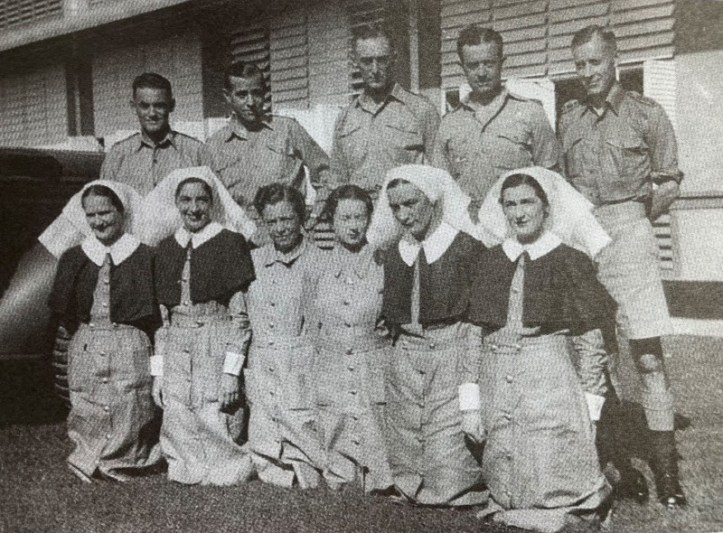
On another occasion Pat visited Kuala Lumpur. She was impressed by the delightful small city, with its air of quiet affluence and varied and interesting architecture. The swimming club and golf course were first class, and the Majestic Hotel and Selangor Club were favourite spots for dining and dancing.
Pat, Winnie and Kath returned to the 2/10th AGH at Malacca on 19 July, and life carried on. Reinforcement nurses had arrived at the unit in June, and more would arrive on 15 August with the 27th Brigade, 8th Division, sent to reinforce the 22nd Brigade. Then in September a second AGH, the 2/13th, arrived in Malaya following a request from Colonel Alfred P. Derham, Assistant Director of Medical Services (ADMS) 8th Division. In view of intelligence reports suggesting the possibility of a Japanese invasion, Col. Derham had felt that a second military hospital was urgently needed to supplement the 2/10th AGH. The unit had a staff of 49 AANS nurses and around 175 officers and men and was billeted in St. Patrick’s School on the island before moving to Tampin on the peninsula.
Japan Invades
The intelligence reports proved correct. On 8 December, Pat’s pleasant life was turned upside down when the Imperial Japanese Army invaded Malaya from the north and bombed Singapore. The Pacific War had begun. The well-trained, combat-ready Japanese forces, backed by mechanized units and substantial sea and air power, began to press southwards, forcing severely outgunned British and Indian troops to retreat before them.
By 29 December it had become clear that the 2/10th AGH would have to evacuate from the Colonial Service Hospital. Col. Derham decided to move the hospital to Singapore Island but would need time to organise a suitable site. In the meantime, the unit’s personnel and patients moved south in stages. Between 29 December and 5 January 1942, 36 nurses, including Pat, Winnie Davis and Kath Neuss, were detached to the 2/13th AGH at Tampoi, while others went to the 2/4th CCS, now at Mengkibol rubber plantation near Kluang.
The 2/10th AGH had relocated to Singapore Island by 15 January. Col. Derham, in consultation with Col. E. R. White and Matron Paschke, had settled on Oldham Hall, a Methodist boarding school at Bukit Timah, and the unit’s staff were returning. At Tampoi, meanwhile, Pat, Winnie and Kath were busy treating the dozens of casualties on stretchers that had begun to flow to the 2/13th AGH following the first Australian engagements with Japan. The unit had worked hard to prepare operating theatres to receive them and by now had close to 1,200 beds available on the wards.
Pat, Winnie and Kath returned to the 2/10th AGH at Oldham Hall on 25 January, after the 2/13th AGH itself had been evacuated back to St. Patrick’s School on Singapore Island. On 28 January it was turn of the 2/4th CCS to evacuate to Singapore Island, relocating to Bukit Panjang English School. Then, on the night of 30 January, the final Commonwealth troops crossed the Causeway from the peninsula to the island. The next morning it was blown up. Soon after, Japanese forces reached the northern shore of Johor Strait and on 2 February began a ferocious artillery bombardment of the island.
When Japanese soldiers began to cross Johor Strait on the night of 8 February, the end was nigh. By the morning, they had established a beachhead on the northwestern corner of Singapore island, despite strong opposition from Australian troops. The heavy fighting produced many casualties, and at Oldham Hall the wards became so overcrowded that men were lying on mattresses on the floor while others waited outside. Pat marvelled at their calmness and patience. Operating theatre staff worked around the clock, treating severe head, thoracic and abdominal injuries. There was little respite for Pat when she was off duty, as the constant pounding of bombs and shells meant that sleep was hard to come by.
Evacuation
With Singapore’s fate all but certain, a decision was made to evacuate the nurses. Already in January, following reports of Japanese atrocities in Hong Kong, Col. Derham had asked General H. Gordon Bennett, commanding officer of the 8th Division in Malaya, to evacuate the AANS nurses. Bennett had refused, citing the damaging effect on morale. Col. Derham then instructed his deputy Lieut. Col. Glyn White to send as many nurses as he could with Australian casualties leaving Singapore.
The nurses’ pleas to be allowed to stay with their patients were ignored, and on 10 February, six of Pat’s 2/10th AGH colleagues embarked with 300 wounded Australian soldiers on the makeshift hospital ship Wah Sui. The following day a further 59 AANS nurses, drawn from both AGHs, left on the Empire Star.
On Thursday 12 February the last 65 AANS nurses in Singapore were ordered to leave. Leaving the hospital was one of the worst moments of Pat’s life. She and her colleagues were taken in ambulances through the ruins of Singapore city to St Andrew’s Cathedral, where they met their comrades from the 2/13th AGH and the 2/4th CCS. They continued as a body to the wharves, where they boarded the coastal steamer Vyner Brooke. The small ship was originally a cargo vessel and at one time the Rajah of Sarawak’s private yacht. It had accommodation for 44 first class passengers and now as many as 250 women, children, and old and injured men were crammed aboard.
At around 4.00 pm, the Vyner Brooke started to move away from the pier, and Pat’s 2/10th colleague Jenny Greer broke into ‘Wish Me Luck as You Wave Me Goodbye’, a song popularised during the Second World War by Gracie Fields. Almost immediately, however, the ship was ordered to wait in the harbour. As they waited, Pat watched sporadic bombing attacks on the city, which was covered by a pall of black smoke. More people were boarded at around 11.00 pm, and sometime after midnight the Vyner Brooke left Singapore harbour and steamed south.
To avoid detection by Japanese aircraft, the Vyner Brooke spent Friday 13 February creeping through the many small islands that line the passage between Singapore and Batavia, the ship’s destination. During the morning, Matron Paschke summoned the 65 nurses to a meeting in the ship’s saloon to formulate a plan of action in the event of an attack. The nurses were assigned duty areas and were expected to take care of passengers before themselves. Pat, Kath and Winnie were to be responsible for the forward part of the ship.
As night approached, the Vyner Brooke’s captain, Richard Borton, endeavoured to steer the ship towards open water but was forced back among the islands by searchlights and made little progress. At around 11.00 am on Saturday 14 February, while the ship was at anchor, Japanese aircraft flew over and strafed the starboard side, holing the lifeboats, before flying off again. Captain Borton feared the aircraft would signal their position to Japanese dive-bombers, and proposed making a run for Bangka Strait, which runs between the Sumatran mainland and Bangka Island. For 90 minutes the ship raced through the open sea, then weighed anchor in the lee of another island.
In the early afternoon another aircraft approached, prompting Captain Borton to sound the ship’s siren and begin another dash through the open. Soon after, at around 1.50 pm, bombers were spotted in the distance. They approached rapidly, and as the first bombs began to fall, Captain Borton began evasive manoeuvres. The ship raced at full speed and zigzagged wildly.
The Sinking of the Vyner Brooke
Initially the bombs missed the weaving ship, but inevitably, when the Vyner Brooke was positioned just to the northwest of Bangka Island, one struck home, and the ship lifted and rocked with the vast roar of a bomb exploding amidships. The bomb had entered through the ship’s funnel and exploded in the engine room, killing or wounding many passengers. Then another struck the ship, and another, and the Vyner Brooke was doomed. It began to list to starboard almost immediately.
People jumped overboard or slid down ropes into the water, burning their hands. Two starboard lifeboats were launched; the portside lifeboats had been cut loose in the bombing and had slid into the water and sunk or drifted off. Pat helped Kath, who was injured, down a ladder and into one of the lifeboats. She then turned to Winnie, who had followed, and proposed that they swim together. “See you on the beach,” Pat called to Kath, then she and Winnie entered the water, lifebelts on, and began to swim away from the sinking ship. They never saw Kath again.
Pat and Winnie found a spar and, holding on to it, tried to manoeuvre towards the shore of Bangka Island, which was not far away. They swam through leaking oil, while dead bodies floated around them. At around 4.00 pm, just as Pat was becoming exhausted, a life raft occupied by Elizabeth Simons of the 2/13th AGH, two British sailors – one critically injured – an English mother and daughter, and a Malay radio operator came alongside them. Jessie left the raft and helped Pat aboard, then alternated with Winnie and one of the British sailors between the raft and the water. When Pat had recovered sufficiently, she administered morphia tablets to one of the British sailors. It was all she could do. Later Pat entered the water and swam alongside Winnie, holding on to the rope around the raft.
During the night, the party drifted southwards towards the entrance to Bangka Strait. They saw a bonfire on a beach and concluded that some of the survivors of the Vyner Brooke had succeeded in reaching the shore. Pat, Winnie and Jessie would later learn that this was the group that included the AANS nurses, servicemen and civilians massacred by Japanese on Radji Beach on 16 February. Later they saw Japanese transport ships disgorging landing craft full of soldiers.
Dawn on Sunday confirmed the invasion of Sumatra. A Japanese fleet was anchored off the coast of Bangka Island, and troops were being ferried ashore in launches. Pat and the others signalled to one of the launches, which changed course and came over to them. The launch’s crew, who happened to be medics, helped Pat and Winnie aboard and towed the others on raft.
Prisoners of Japan
Once ashore, Pat and her party slept in huts near the beach and were later taken by Japanese soldiers to a large cinema in the nearby town of Muntok. They were placed with hundreds of other prisoners, the survivors of dozens of ships sunk by the Japanese invasion force, and to their great joy were reunited with a group of their own AANS nurses. Some days later, two more nurses, Iole Harper and Betty Jeffrey (2/10th AGH), came in. They had become lost in a mangrove swamp after reaching the shore.
Some days later the hundreds of internees, among whom were now 31 AANS nurses, were taken from the cinema to workers’ barracks on the edge of town. Then, after 10 or so days, Vivian Bullwinkel of the 2/13th AGH was brought in. She had survived the horrific massacre on the beach.
Of the 65 Australian nurses who had set out from Singapore on the ill-fated Vyner Brooke, 12 were lost at sea and 21 killed in the massacre. Now the surviving 32 began a period of three-and-a-half years as prisoners of war. During this time, Pat and her comrades, together with many hundreds of interned women, children and men, were moved between half-a-dozen camps in Muntok and southern Sumatra, each more hellish than the previous. They were subjected to systematic abuse and random acts of violence. They were slapped, yelled at and made to stand in the sun. They were threatened with starvation and, by the end, nearly did starve. They were denied their rights under the Geneva Convention to be treated as prisoners of war.
During all this time there was little news of the outside world, and what did arrive was out of date. In March or April 1943, they received a Christmas message from Prime Minister Curtain, in which he told them to “keep smiling.” Sometimes, a Malayan newspaper was smuggled in. There were only three deliveries of mail, and some of the nurses received not a single letter. They were permitted to write home only once, in March 1943.
Discipline and routine kept the nurses going. They formed committees and allocated duties, such as preparing meals, cleaning latrines, carrying water, chopping wood etc. Nevertheless, by the end of 1943 sickness had become so prevalent due to chronic malnourishment that only the very worst cases could be admitted to the camp hospital. Bronchitis, dysentery and dengue fever were common complaints, and tinea was widespread.
In November 1944, nearly three years into their ordeal, Pat and the others were moved back to Muntok on Bangka Island. After some initial optimism, it proved to be the worst camp yet. Lice, scabies and bedbugs spread throughout the huts, and disease became rife. Around Christmastime Pat contracted severe malaria, and on New Year’s Day 1945 she suffered the worst headache she had ever experienced. One of the British camp doctors gave her two quinine tablets from a limited supply, asking her not to tell anyone. Following the attack Pat had great difficulty walking; even six metres to the cookhouse was an ordeal.
Now at the end of their tether, the internees began to die – including the first four AANS nurses. On 8 February Mina Raymont of the 2/4th CCS died of malaria. On 20 February Rene Singleton of the 2/10th AGH died of beriberi. Blanche Hempsted of the 2/13th AGH died on 19 March and Shirley Gardam of the 2/4th CCS on 4 April.
The same month that Shirley died, the internees were transported to what would be their final camp, at Belalau rubber plantation, near Lubuklinggau, on Sumatra. It lay deep in the jungle some 250 kilometres west of Palembang. The three-day journey claimed many lives, and when they finally arrived at Belalau, Pat’s comrades continued to die. On 31 May Gladys Hughes of the 2/13th AGH died. Then, nearly two months later, on 19 July, Pat’s great friend Winnie died, after being desperately ill for some weeks. Pat had obtained eggs and potatoes on the black market to save Winnie from eating rice, but to no avail.
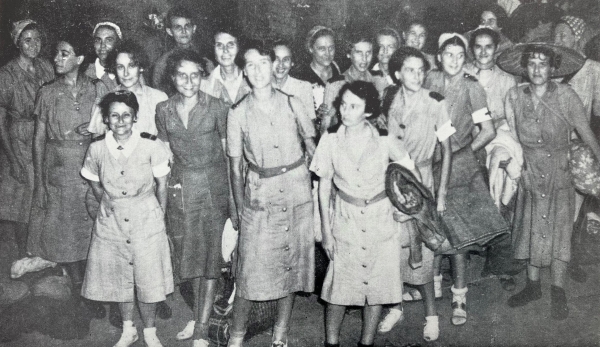
Two more nurses died before the ordeal ended, Dot Freeman on 8 August and Pearl Mittelheuser on 18 August. Both belonged to the 2/10th AGH. Three days before Pearl’s death, Emperor Hirohito had formally surrendered. On 16 September the 24 surviving nurses were flown to Singapore to recuperate and on 5 October embarked for Australia aboard the AHS Manunda. They arrived in Fremantle on 18 October. They were home but had left behind 41 comrades.
Return to Australia
Now began the next chapter in Pat’s life. In late November she returned to Casino while on leave and was feted by the towns’ nurses at the Country Women’s Association Rooms. The only thing she could tell those present was that for the first year of her captivity she worked hard, and for the remainder of the time she was busily engaged striving to maintain life on the meagre food provided.
Early in 1946 Pat took up a 12-month posting to the 113th AGH, based at Concord in Sydney. She received her army discharge on 4 February 1947 and was mentioned in despatches the same year.
In 1948 Pat trained in midwifery at Crown Street Women’s Hospital in Sydney and gained her registration on 15 December. The following year she moved to England to work. She departed Sydney aboard the Moreton Bay on 1 June and arrived at Southampton on 16 July. Three years later she returned to Australia, departing London aboard the Mooltan on 8 October 1952. On 18 July 1953, Pat’s father, Arthur, died in Casino and was buried at Casino General Cemetery.
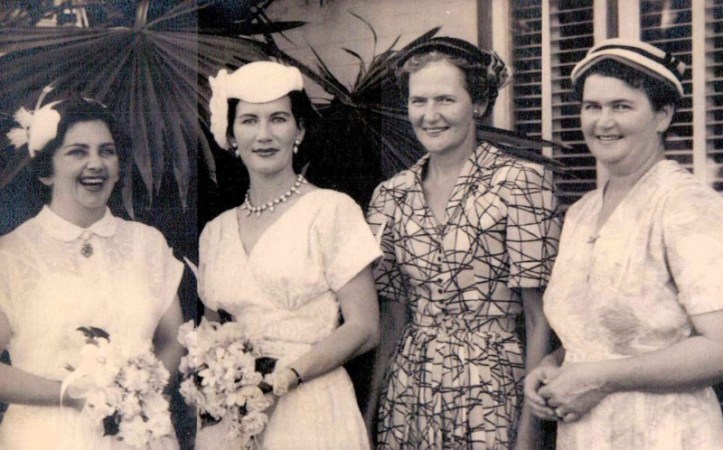
Pat married Major George Colin Darling on 11 May 1957 in Burwood, Sydney. George was born in Brighton, a bayside suburb of Melbourne, and had been married previously. They lived at Port Kembla and later moved to Mt. Keira in Wollongong, where they developed a display garden at their home for the annual Illawarra Garden Festival. George passed away on 29 August 1983.
In February 2001 Pat released her memoirs, Portrait of a Nurse: Prisoner of War of the Japanese 1942–1945. It was published by Don Wall, who had been member of the 2/20th Battalion of the 22nd Brigade, which had sailed to Malaya on the Queen Mary with Pat.
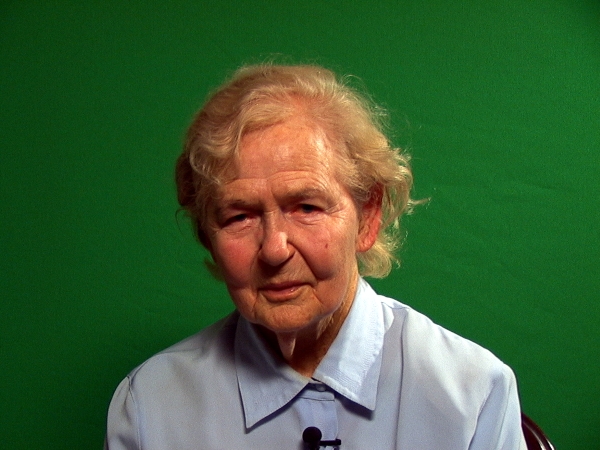
After a long, eventful life, Pat Darling passed away at Manor House, Mosman, on 2 December 2007. She was 94 years old. She is buried at the Rookwood Garden of Remembrance in Sydney.
We will remember her.
Sources
- Ancestry.
- Arnold Hague Convoy Database (website).
- Arthurson, L., ‘The Story of the 13th Australian General Hospital, 8th Division AIF, Malaya,’ edited by Winstanley, P. (2009).
- Australian War Memorial (1998), ‘Janet Patteson (Pat) Darling (nee Gunther) interviewed by Barbara Orchard about her experiences as a nurse and prisoner of war (POW) of the Japanese 1942–1945.’
- BirtwistleWiki, ‘2/4th Australian Casualty Clearing Station.’
- BirtwistleWiki, ‘2/10th Australian General Hospital.’
- BirtwistleWiki, ‘2/13th Australian General Hospital.’
- Darling, P. (2001), Portrait of a Nurse, published by Don Wall.
- Department of Veterans’ Affairs, Australian Government, ANZAC Portal, ‘Escape on MV Empire Star.’
- Design and Art Australia Online, ‘Pat Gunther.’
- Gill, G. H. (1957), Australia in the War of 1939–1945, Series 2 – Navy, Vol. I – Royal Australian Navy 1939–1942, Chap. 12 – Australia Station 1941 (410–63), Australian War Memorial.
- Jeffrey, B. (1954), White Coolies, Angus & Robertson Publishers.
- Malayan Volunteers Group (website), ‘SS Vyner Brooke Passenger List (version 3.2.0, June 2017).’
- National Archives of Australia.
- Shaw, I. W. (2010), On Radji Beach, Pan Macmillan Australia.
- Simons, J. E. (1954), While History Passed, William Heinemann Ltd, Melbourne.
- University of NSW (Canberra), Australians at War Film Archives, ‘Janet Darling.’
- WikiTree, Janet Patteson (Gunther) Darling (1913–2007).
- Winstanley, P. (2007), Prisoners of War of the Japanese 1942–1945, ‘Darling (nee Gunther) Janet Patteson (Pat) NFX70493.’
Sources: Newspapers and Gazettes
- Casino and Kyogle Courier and North Coast Advertiser (4 Feb 1928, p. 2), ‘For the High School.’
- Northern Star (Lismore, 11 May 1937, p. 4), ‘In and out of Town.’
- Northern Star (Lismore, 6 Oct 1939, p. 4), ‘Through Women’s Eyes.’
- Northern Star (Lismore, 28 Nov 1945, p. 4), ‘Released P.O.W. Sister.’
- Sarawak Gazette, November 1, 1927 (pp. 278–279), ‘S.S. ‘Vyner Brooke.’’
- Sydney Mail (28 Sept 1927, p. 55), ‘Cinderella’s Answers.’
- Sydney Mail (2 Nov 1927, p. 55), ‘Hidden Ships.’
- Sydney Morning Herald (28 Sept 1933, p. 17), ‘Mrs. A. P. T. Gunther.’
 australianwarnurses.org