AANS │ Sister Group 1 │ Second World War │ Malaya │ 2/10th Australian General Hospital
Ellenor (also spelled Ellinor) Calnan, known as Nell, was born on 4 March 1912 at Mundawaddera Station, near Henty in southern New South Wales. Nell’s parents were Mary Ellen O’Brien (1884–1953) and William Norman Calnan (1885–1940). Each was marked by tragedy at a young age.
NELL’S MOTHER’S STORY
Mary Ellen O’Brien, whose name was originally registered as Eleanor Mary O’Brien and who was known as Nellie, was born somewhere between Blackall and Muttaburra in central Queensland. At the beginning of 1892, heavy rains in the district flooded roads and isolated the family in their rough dwelling. Finally on 24 January, Nellie’s father, William, who worked as a groom at a Cobb & Co staging post, set out for the Kensington Hotel, some 12 kilometres distant on the road between Muttaburra and Winton. He told Nellie’s mother, Rebecca, that he was going for provisions and would be back by 8.00 pm. He did not return, and after three days Rebecca determined to set out for the hotel with her four young children – Nellie, who was seven, Eliza Jane (known as Jane), five, William (known as Willie), three, and Annie, 10 months.
Rebecca O’Brien started out in the rain, but the children could not walk through the mud. She then carried two of the children a few hundred metres, returning again for the other two. This slow progress was maintained nearly all day, and at nightfall they were within four or five kilometres of the hotel. But Rebecca could go no further and sank down utterly exhausted. At that moment two horsemen passed by and took Rebecca and the children to the hotel, where Mr. Jordan, the landlord, gave them every attention. William O’Brien was subsequently found drowned in the swollen Western Creek, having evidently lost his depth while crossing.
Such was Rebecca’s plight that she had to relinquish custody of Nellie and Jane, and by late February a lady in the district had secured good homes for them. Nellie and Jane never saw their mother again until years later, when Rebecca O’Brien was an old woman, and they were married adults, though they did correspond with her through their sister Annie, who stayed in the district.
Meanwhile, a certain Henry Sirdefield Eldershaw was overseer at Bowen Downs Station, near Muttaburra. Henry Eldershaw had gone to Queensland in 1885 and after a short while had been appointed overseer at Bowen Downs by Scottish Australian Investment Company Ltd. Scottish Australian owned several pastoral and agricultural properties, including a large sheep and wheat station in southern New South Wales known as Mundawaddera. Sometime between December 1892 and September 1894 Henry returned to New South Wales with his new wife, Margaret, and their first daughter, Mary Windeyer Eldershaw, known as Molly, and was soon appointed overseer of Mundawaddera Station. Travelling with them, or following soon after, was Nellie O’Brien. She became a station girl at Mundawaddera.
NELL’S FATHER’S STORY
William Calnan was born in or near the town of Cashel, now known as Dookie, in Victoria’s Goulburn Valley. Following the birth of his brother, the family moved south to Violet Town and lived in part of the Williamses’ property on Sydney Road. Here another brother was born. On 18 February 1891 the boys’ mother, Gertrude, was in the act of drawing a bucket of water from the large underground water tank, which was five metres deep and contained three metres of water, when the plank upon which she was standing up-ended and precipitated her into the water. Mrs. Williams saw the accident and raised an alarm, and for some time Mr. Williams, who had only one leg, did his best to rescue Gertrude, but she remained under the water for about fifteen minutes before he was able to get hold of her clothes with a grappling iron. By then it was too late. The three boys – William, aged six, James, about four, and John, only 15 months – were left without a mother, and James Calnan was left without a wife.
Perhaps James took his boys north to the Henty district of New South Wales, or perhaps they were split up and cared for by other relatives – but in any case at a young age William Calnan became a station boy at Mundawaddera, and here he met Nellie O’Brien. Their paths had crossed due to the most tragic of circumstances.
William and Nellie were married on 17 February 1909 at the nearby Yerong Creek Catholic Church. Noel William (Bill) Calnan (1909–1973) was born in December that year, and Nell followed just over two years later.
By now William had established himself as a wheat farmer on a share basis at Mundawaddera Station. This meant that he did not own the land on which he grew wheat, but instead shared the returns with the Scottish Australian Investment Co. Those returns were at times very good. In 1916 he harvested what was considered to be one of the greatest wheat crops in the state, and in December 1923 came equal fourth in a competition held under the auspices of the Henty Pastoral and Agricultural Society to determine the best grower of crops in the district.
MUNDAWADDERA AND ‘MOONDARA’
“Nell was born to the farm and she was happy.” So wrote Peter Snodgrass (the pen name of Hugh S. Robertson, wheat grower, politician and writer from the wider district) in a moving tribute to Nell printed in July 1944, after Army Headquarters had announced that she had likely been lost at sea while escaping Singapore. “There is not much joy in our wheat farms – and the share farmer has not even a farm! … But Nell found joy in the farm and she was happy.”
When Nell was old enough, she attended local schools – Munyabla Public School, south of Mundawaddera, and Grubben State School, east of Munyabla and north of Henty. “She went to school from the farm,” writes Mr. Snodgrass, “and no one but a country child will know what that means. There was the dusty road, the little bare school house, the teacher, and the children; but Nell took her place timidly among them. She had the kind of intelligence that is undistinguished – and frequently undiscovered – at school.”
Nell helped her mother, who was always working, and she helped her father. With only the four of them to work the farm, they depended on her. She was quick and deft and on a horse she was fearless. She rode around herding her father’s sheep, or going after cattle, or visiting her new friends.
Sometimes Nell went into town. “In those days,” Peter Snodgrass writes, “Henty was a stirring town, a place of urban elegance, of banks and shops and churches, of prosperous people going in and coming out, and sleek horses standing quietly in the shade of pepper trees.”
The years and the harvests slipped by, and eventually Nell stopped going to school. There was too much to do at home. “I don’t know what the school taught Nell,” writes Peter, “but I know that she learned to think, and to reach her own decisions, and express herself in a great scrawly hand – like her mother’s.” Her life was full, and she was happy.
In 1927, when Nell was 15, the Calnans left the Henty district. William Calnan had bought his own land 80 kilometres north of Henty in the Marrar district, between Winchendon Vale and Old Junee. He named the 623-acre property ‘Moondarra,’ and over the next two years improved it considerably, building a six-room weatherboard and iron dwelling and erecting fencing and various sheds.
In June 1928 Nell’s mother was matron of honour at the wedding of her sister Jane to George Henty Carter of Albury. What had become of Jane after Nellie travelled from Queensland to Mundawaddera in the 1890s, we do not know. Perhaps Jane came to Mundawaddera too. Regardless, by the 1910s she was living in Victoria and training as a nurse in Port Fairy. When the Great War broke out she joined the Australian Army Nursing Service, having enlisted in Melbourne, and served in hospitals in Alexandria and Salonika. By 1920 she was nursing in Albury.
Nellie’s brother, Willie, who had remained with Annie in Muttaburra, also enlisted for service in the Great War. Tragically, in 1916, while waiting in Brisbane to be called up, he contracted influenza and died.
NURSING
In time Nell wanted to become a nurse like her aunt – in particular, according to Peter Snodgrass, a children’s nurse. “She wanted to go among sick children and heal them and bring them comfort and health and happiness,” he wrote. She went to Sydney first of all, and then to Brisbane, where she began her training at St. Helen’s Hospital. She was so highly regarded that upon the completion of her training she was offered and accepted the position of Theatre Sister at St. Helen’s.
Nell was still working at St. Helen’s in Brisbane when the Second World War broke out. Towards the end of 1940, following in the footsteps of her aunt and uncle, she volunteered for service. Before then, however, another terrible blow had befallen the Calnan family. William Calnan had died.
William had been ill for two weeks when he was admitted to Wagga Base Hospital around 7 July 1940. On 21 July he passed peacefully away in the presence of his wife and children, who had been in constant attendance ever since the seriousness of his condition had become known to them. Following his death, Nellie Calnan went to stay at ‘Glen Isla’ in The Rock, a small town located 30 kilometres north of Henty, with her lifelong friend, Molly Eldershaw – the daughter of Henry Eldershaw.
At the time of William’s death, there was little equity in ‘Moondarra,’ as the property had been mortgaged. It was now taken over by the bank, since Nellie was unable to continue farming and could not therefore make repayments. With the £300 paid out by William’s life insurance providers she planned to buy herself a little house one day, and in the meantime was dependent on Nell’s income and the kindness of family and friends.
ENLISTMENT
Having determined to play her part in Australia’s war effort, Nell joined the Australian Army Nursing Service. Despite having lived most of her life in New South Wales, as she was working in Brisbane at the time of her joining, Nell fell under the authority of the 1st Military District (Queensland) and was therefore counted as a Queensland military nurse. Nevertheless, while awaiting her call-up, she joined the nursing staff of the Randwick Military Hospital in Sydney.
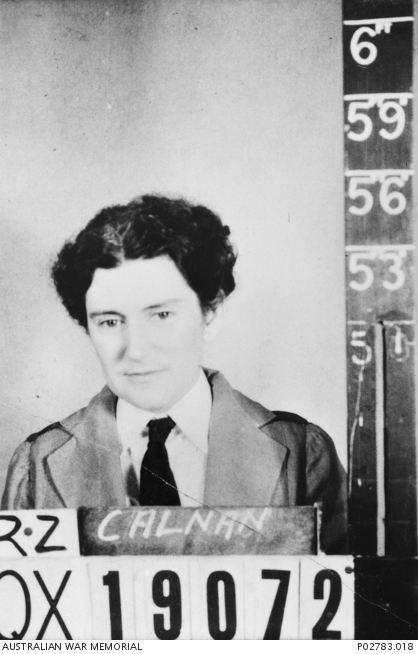
On 9 January 1941 Nell and nine other Queensland nurses were appointed to the 2nd Australian Imperial Force (AIF) and allotted to the 2/10th Australian General Hospital (AGH). Appointed at the rank of sister were Pearl Mittelheuser and Dorothy Ralston, while Nell, Monica Adams, Jessie Blanch, Cecilia Delforce, Iva Grigg, Chris Oxley, Florence Trotter, Joyce Tweddell were appointed at the rank of staff nurse. The 10 nurses were soon told of their appointments and advised to be ready for embarkation – destination unknown.
Nell and the others were marched in to the 2/10th AGH on 17 January and officially enlisted on the same day. Ten days later Nell was sent on pre-embarkation leave. She visited her mother and her brother, Bill, at his property at Kywong, 80 kilometres southwest of Winchendon Vale.
The QUEEN MARY
On 31 January Nell joined her new Queensland 2/10th AGH colleagues on a train bound for Sydney. They arrived in the Harbour City at around 8.00 am the following day. Making their way to Darling Harbour, they caught a ferry to Bradley’s Point and boarded the Queen Mary. The mighty vessel was due to depart in three days’ time with some 5,800 troops of the 22nd Brigade, 8th Division on board. Their destination remained classified, though rumours swirled that the men were bound for Malaya.
Once on board the ship, the Queensland contingent met their New South Wales and Victorian counterparts, as well as six South Australian and Tasmanian nurses attached to another medical unit, the 2/4th Casualty Clearing Station (CCS).
On 4 February the Queen Mary departed Sydney Harbour to the cheers of thousands of well-wishers on land and in boats. It sailed in convoy with three other converted troopships, the Aquitania, the Niew Amsterdam and the Mauretania, all of which were carrying troops to Bombay for transshipment to the Middle East.
On 16 February, as the convoy was nearing Sunda Strait, the Queen Mary swung to port, circled behind the other ships, then charged past them and peeled off to the right for Singapore. Two days later Nell and the other nurses arrived at Sembawang Naval Base on the north coast of Singapore Island.
MALAYA
Nell and her 2/10th AGH colleagues disembarked and entrained for Malacca, where the unit had been allocated several wings of the Colonial Service Hospital. The unit’s patients were the men of the 22nd Brigade, whose three battalions, the 2/18th, 2/19th and 2/20th, were encamped at various sites within a day’s drive of Malacca. The 2/4th CCS, meanwhile, set up its hospital in Kajang, just south of Kuala Lumpur.
For the next 10 months Nell and her colleagues enjoyed a relatively easy life in Malaya. Their nursing work was more or less routine. They treated tropical conditions such as tinea, prickly heat and infected ear (also known as ‘Singapore ear’) and sometimes diseases such as malaria. They treated injuries from training and other accidents and assisted at routine operations, such as tonsillectomies. Beyond this they had plenty of time for sporting and social activities. They played golf and tennis and had access to a fine swimming pool. They were invited to parties and dances. When on leave, they visited Singapore, Kuala Lumpur, and Fraser’s Hill in the cool highlands north of Kuala Lumpur.
INVASION
Those carefree days disappeared forever on 8 December, when the Imperial Japanese Army invaded Malaya. Soon after midnight approximately 5,200 troops launched an amphibious assault at Kota Bharu on Malaya’s northern coast. A few hours later, Japanese bombers attacked Singapore Island. Several days after that, Japanese troops crossed into northern Malaya from occupied Thailand. The lines of Japanese soldiers rapidly proceeded southwards, brushing aside the British and Indian troops ranged against them.
By the end of December, it had become obvious that the 2/10th AGH would have to be evacuated. Colonel Alfred Derham, the commanding officer of the Australian medical units in Malaya, decided to move the hospital to Singapore Island but would need time to organise a suitable site. In the meanwhile, the unit’s personnel and patients were moved to other units. Between 29 December and 5 January 1942 Nell and many of her colleagues were detached to the 2/13th AGH, which had arrived in Malaya in September and was based at Tampoi, in the very south of the Malay Peninsula. Others were sent to the 2/4th CCS, then based at Mengkibol rubber plantation near Kluang, halfway between Malacca and Tampoi. While she was at Tampoi with the 2/13th AGH, Nell was promoted to the rank of sister.
Nell returned to the 2/10th AGH on 24 January. The unit had completed its move to Singapore Island and was now based at Oldham Hall and Manor House in Bukit Timah. On 25 January the 2/13th AGH relocated to the island, followed a few days later by the 2/4th CCS. The entry of Australian forces into active combat on 14 January had done nothing to slow down the Japanese.
In the early hours of 31 January, the last British, Indian and Australian troops crossed the Causeway that linked the Malay Peninsula and Singapore Island, and it was then blown up. When Japanese forces reached the northern shore of the strait soon after, they began a ferocious artillery bombardment of the island.
On 7 February Nell sent her last letter home from Singapore, a section of which was printed in the Coolamon-Ganmain Review on 30 June 1944. “Things are very black,” Nell wrote, “but we only pray we can stay here with our wounded men. We came to nurse them and not one of us will leave them if we can help it.”
When Japanese soldiers crossed Johor Strait on the night of 8 February the end was nigh. By the morning, they had established a beachhead on the northwestern corner of Singapore Island, despite strong opposition from Australian troops. The heavy fighting produced many casualties, and at Oldham Hall the wards became so overcrowded that men were lying on mattresses on the floor while others waited outside. The nurses marvelled at their calmness and patience. Operating theatre staff worked around the clock, treating severe head, thoracic and abdominal injuries. There was little respite for Nell when she was off duty, as the constant pounding of bombs and shells meant that sleep was hard to come by.
“NOT ONE OF US WILL LEAVE THEM IF WE CAN HELP IT”
With Singapore’s fate all but certain, a decision was made to evacuate the Australian nurses. Already in January, following reports of Japanese atrocities in Hong Kong, Colonel Derham had asked Major General H. Gordon Bennett, commanding officer of the 8th Division in Malaya, to evacuate the AANS nurses. Bennett had refused, citing the damaging effect on morale. Colonel Derham then instructed his deputy Lt. Colonel Glyn White to send as many nurses as he could with Australian casualties leaving Singapore.
The nurses pleaded to be allowed to stay with their patients but they were ignored, and on 10 February, six of Nell’s 2/10th AGH colleagues embarked on the makeshift hospital ship Wusueh with some 350 wounded men, including 150 8th Division troops, a few RAAF men, and scores of British and Indian troops. The following day a further 60 AANS nurses, drawn from both AGHs, embarked on the Empire Star with as many as 2,400 passengers – mainly British RAF personnel, but also 139 8th Division troops and many civilian refugees, including more than 160 women and 35 children.
Sixty-five AANS nurses remained in Singapore, among them Nell. On Thursday 12 February they too were ordered to leave. Late in the afternoon they were driven by ambulance to St. Andrew’s Cathedral, where they were joined by the remaining nurses of the 2/13th AGH and the 2/4th CCS. From the cathedral the ambulances proceeded towards Keppel Harbour until they could go no further, at which point the nurses got out and walked the remaining few hundred metres to the devastated waterfront.
The VYNER BROOKE
At the wharves Nell and her 64 comrades were ferried through a congested mass of shipping of all types to the Vyner Brooke, a small coastal steamer that was formerly the private yacht of Charles Vyner Brooke, the ‘White Rajah of Sarawak.’ As darkness fell, the ship slipped out of Keppel Harbour with as many as 250 women, children and men on board. Behind it, the Singapore waterfront burned, and thick black smoke rose into the sky.
That night the Vyner Brooke made little progress and spent much of Friday hiding among the hundreds of small islands that line the passage between Singapore and Batavia. By the morning of Saturday 14 February, Captain Borton was approaching the entrance to Bangka Strait. To the right lay Sumatra; to the left, Bangka Island.
In the early afternoon the Vyner Brooke was located by a Japanese spotter plane, and soon dive-bombers appeared on the horizon. Captain Borton engaged evasive manoeuvres, but to no avail, and the ship received three direct hits. One struck the forward deck, killing a gun crew. Another entered the ship’s funnel and exploded in the engine room. A third tore a hole in the side of the ship. With a dreadful noise of smashing glass and timber, the Vyner Brooke shuddered and came to a standstill. It was lying 15 kilometres from Bangka Island.
Nell and the other nurses hurried about the deck, helping women and children, the elderly, the wounded, and their own injured colleagues into the three viable lifeboats, which were then lowered into the sea. After a final search of the ship, it was the nurses’ turn to evacuate. They removed their shoes and their tin helmets and entered the water any way they could. Some jumped from the railing on the portside, others practically stepped into the water on the listing starboard side, while others slid down ropes or climbed down ladders.
Once in the water, some of the nurses managed to clamber onto rafts and some grabbed hold of passing flotsam. Others caught hold of the ropes trailing behind the lifeboats or simply floated in their lifebelts. Meanwhile, the Vyner Brooke settled lower and lower in the water and then slipped out of sight. It had taken less than half an hour to sink.
LOST AT SEA
Twelve nurses lost their lives during or immediately after the attack or later at sea. Nell was among them.
Mary Clarke, Caroline Ennis and Matron Dot Paschke of the 2/10th AGH, Iole Harper, Myrtle McDonald and Merle Trenerry of the 2/13th AGH, and Millie Dorsch of the 2/4th CCS were carried away on a current and never seen again. Mona Wilton of the 2/13th AGH was struck on the head by a falling raft and floated away. Vima Bates of the 2/13th AGH and Kath Kinsella of the 2/4th CCS were seen fleetingly in the water before vanishing. Nell disappeared without a trace, as did her 2/10th AGH colleagues Jean Russell and Marjorie Schuman.
AFTERMATH
Over the next 18 hours, the other 53 nurses washed up on Bangka Island in a wide arc around the northwestern town of Muntok. Twenty-one were shot on Bangka Island by Japanese soldiers, who had just invaded Bangka Island and Sumatra. The surviving 32 were imprisoned by the Japanese for three and a half years, and only 24 came home.
The survivors returned to Australia in October 1945. Over the next few years, initiatives to build memorials to their fallen colleagues – and to all military nurses who had given their lives for Australia during the Second World War – took root around the country. From Melbourne, Betty Jeffrey of the 2/10th AGH and Vivian Bullwinkel of the 2/13th, who had survived the massacre on Bangka Island, set off at the end of 1947 on a fundraising drive around Victoria in aid of that state’s initiative. They visited hospitals and spoke at town halls in dozens of Victorian towns, helping to raise a record amount of money. They also visited the mothers of some of the nurses who were lost – including Nellie Calnan in Albury. It may have brought some small measure of comfort to a woman who had endured so much tragedy in her life.
In memory of Nell.
SOURCES
- National Archives of Australia.
- Ancestry.
- Muttaburra (website), ‘Rebecca O’Brien.’ (Written by William and Rebecca’s grandson John William McNeil. Supplied to the website by great granddaughter Robyn Robertson.)
- Muttaburra (website), ‘William O’Brien.’
SOURCES: Newspapers
- The Albury Banner and Wodonga Express (NSW, 29 Sept 1922, p. 2), ‘Henty Show.’
- The Albury Banner and Wodonga Express (NSW, 28 Sept 1923, p. 2) ‘Henty Show.’
- The Albury Banner and Wodonga Express (NSW, 14 Dec 1923, p. 43), ‘Henty Crops.’
- The Albury Banner Wodonga Express and Riverina Stock Journal (NSW, Fri 7 Feb 1941, p. 30), ‘Country News.’
- The Catholic Press (Sydney, 28 Jun 1928, p. 37), ‘Diocese of Wagga.’
- Coolamon-Ganmain Farmers’ Review (NSW, 7 Jun 1929, p. 4), ‘Coolamon Shire Valuation Court.’
- Coolamon-Ganmain Farmers’ Review (NSW, 9 Aug 1929, p. 2), ‘Obituary.’
- Coolamon-Ganmain Farmers’ Review (NSW, 12 Jan 1940, p. 2), ‘Marrar News.’
- Coolamon-Ganmain Farmers’ Review (NSW, 26 Jul 1940, p. 2), ‘Mr. W. N. Calnan.’
- Coolamon-Ganmain Review (NSW, 30 Jun 1944, p. 2), ‘The Late Lieut. Ellinor Calnan.’
- Daily Advertiser (Wagga Wagga, NSW, 30 Mar 1953, p. 2), ‘Mrs. M. E. Calnan.’
- Euroa Advertiser (Vic., 20 Feb 1891, p. 2) ‘“Drown’d! Drown’d!”‘
- Freeman’s Journal (Sydney, Sat 24 Aug 1895, p. 17), ‘The Traveller.’
- The Henty Observer and Culcairn Shire Register (23 Jun 1944, p. 5), ‘Personal and Social’.
- The Land (Sydney, 28 Jul 1944, p. 4), ‘This Farm Girl’s Patriotism Was Finely Drawn And She Knew The Price Of Peace.’ (By ‘Peter Snodgrass.’)
- Morning Bulletin (Rockhampton, 16 Feb 1892, p. 6), ‘Barcaldine.’
- The Sydney Morning Herald (NSW, 20 Jan 1916, p. 7), ‘Harvesting In Riverina.’
- The Telegraph (Brisbane, 19 Feb 1941, p. 10), ‘Departure of Nurses’.
- The Western Champion and General Advertiser for the Central-Western Districts (Barcaldine, 1 Mar 1892, p. 5), ‘Muttaburra.’
 australianwarnurses.org