AANS │ Sister Group 2 │ Second World War │ Malaya │ 2/13th Australian general Hospital
EARLY LIFE
Gladys Myrtle McDonald, known as Myrtle, was born in Brisbane on 17 July 1909. She was the daughter of Charlotte Mabel (Annie) Smith (1883–1928), born in Rockhampton, Queensland, and John McDonald (1876–1939), born in Gympie, Queensland.
Charlotte and John were married on 13 January 1904 in Rockhampton. Five years later Myrtle was born. She was to be an only child.
In 1919 the McDonalds moved back to Wowan, in the Dawson Valley, around 70 kilometres southwest of Rockhampton, where they had lived when Myrtle was younger. Initially John farmed and kept an orchard but later opened a shop. Myrtle was registered at Wowan State School on 8 April at the age of nine years and nine months.
A KEEN LETTER WRITER
Over the next few years, Myrtle became a regular letter writer to the children’s pages of the Rockhampton newspapers. Her first letter appeared on 19 March 1921 in the ‘Uncle Sam’s Letter Bag’ column of the Morning Bulletin, as follows:
Will you please enrol me as one of your many nieces? I am eleven years of age. I am in the fifth class at school. We have had a nice drop of rain in the last few days. It was badly needed. I have a nice little poddy foal. I call it Ruby. I have another pony called Jean. Dad is just breaking it into harness. I also have two dear little foxies. One I call Trixie, the other Tango. Dad has a cattle dog called Bluey, but he has not had much work for it since we came to the shop. Wowan is rather a nice little township for a country place. There are a butter factory, a bank, an ambulance centre, a smithy, a bakery, a butcher’s shop, a two-storied hotel, a police station, and several stores. In fact, it is quite a busy little place, especially on the day that cream is brought to the factory. I quite forgot to tell you that we have a nice school here. Wishing you and the Corner every success.
More letters followed in March and May 1922, in which we learn that the Dawson Valley grew a lot of cotton, and other interesting things.
At the end of March 1924, Myrtle helped to organise a meeting of parents, children and friends at the school to bid farewell to Mr John Handcock, who had been headmaster for the previous three years. She presented him with a writing case and made an admirable speech. At the end of the meeting Myrtle and her co-organisers were thanked by all those present.
In August 1925 the Rockhampton Evening News published another of Myrtle’s letters, which this time was addressed to Kay, the children’s editor.
Dear Kay [wrote Myrtle], — You don’t know how pleased I am that you have started this dear old letter bag. I did not notice it till to-day. You see we are pretty busy here. I am an only child, so, as we have a shop, I have to help a good deal. I am taking a postal course of shorthand and typewriting, of which I intend to make great use in the future (if I can).
Do you know I am beginning to feel old. I had my 16th birthday on the 17th of July. I’ve actually got one grey hair and a wisdom tooth. I don’t suppose you’ll discharge me for being over age though, will you? Hope not. Even if I do not often write, I really think of the page, and I’ve started about half a dozen storied for it. I have pets, as well as some of the other page writers. I have two canaries, a parrot, four dogs, and two cats. Another cat came here, but Mum gave it away.
I play the piano a bit. I like it very much, but I don’t practice enough. I did not go to the Rockhampton Carnival, although Dad did.
Last night I developed some photos. I think photography is an excellent hobby, don’t you?
I was supposed to go to tennis today, but I had a cold and did not feel up to much, so I stayed home. I reckon tennis is the best game of all, both for men and women (boys and girls, too).
We have pictures here every Saturday night. I wouldn’t miss them for worlds. Of course, I don’t like dancing, so I go to pictures instead.
I had three little boys out walking this afternoon. I love kiddies (really little ones I mean), don’t you, Babies especially.
We have an orchard at the back of our place. There are 130 trees altogether, these include mandarins, oranges, mulberries, peaches, apricots, plum, lemons, persimmons, and apples. Dad sunk a well right in the middle of them, and then when the dry weather comes, he waters them. Another man sunk a well about 200 yards away. He went down 58ft. (ours is only 38) and then drove 28ft., but they can’t get water. It beats me how they can’t get it with such a little distance between.
I think it is much nicer to have a letter bag, because some of the little tots can’t write stories, whereas they can write little letters.
Well, Kay, dear, I think I will close now as I am taking up too much room.
—I am yours as B4.
MYRTLE McDONALD
Wowan.
Another letter appeared in the newspaper on 29 August:
Dear Kay, — Again I avail myself of the opportunity of writing to your dear old self. I am going to tell as many of the kiddies as I can about the letter bag. Some of the people about here do not get any paper, so naturally some of the children never any of these things. However, I’ll soon let them know about it. I’m going to play in a tennis match tomorrow afternoon. I do hope it doesn’t rain. We are ungrateful I suppose, because the rain is really needed. I don’t think that there were ever truer words written than those to be found in that little song called ‘Grumbling.’ Do you know it?
I think that that idea of ‘Laughing Aussie’s’ about writing to one another is an excellent one. I for one would like writing to my fellow—. What shall I call them?
I reckon that you must enjoy reading all the letters. I can as a rule tell what sort of disposition anyone has by the way they express themselves in their letters.
We have been living in Wowan for six years this time. Strange, you know, we lived here years ago, in the days, when I was young. Seems as if we can’t tear ourselves away. We went away and then came back again. It gets your ‘dig’ at times—, but then you know it’s home. Mother and all our friends that heard of it wanted we to go down for the Exhibition, but I somehow didn’t want to go. However, Mum got sick, and I turned chief cook and bottle washer, and of course did not go. I was glad in a way. I no sooner get away than I want to come back again. Mum says I’m a real ‘Ninny.’
I hope I can get someone from the Page to write to me. I hate not getting any letters, and I haven’t had a single one for ever so long. Renie Pearson promised to write when she went away, but the little tinker didn’t. Thanks ever so much for not discharging me. After I get twenty grey hairs, and three more wisdom teeth, I think I’ll feel awful. I suppose it does seem funny me not liking dancing, but nevertheless, it’s a fact. I have a few goosie ways, though. Well, dear Kay, I think you will expel me altogether if I keep writing trailers of letters like this one, so I think I will close now, with best wishes for the Page and yourself.
Yours ‘till the sands of the desert grow cold.’
MYRTLE McDONALD
Wowan, Dawson Valley.
In further letters we discover that Myrtle played tennis often and belonged to a private club called the ‘Wattle Club.’ Sometimes she went out for drives into the bush in a sulky with her little fox-terrier. She also told an amusing story of how, after Sunday school, she and six little friends were walking through a paddock, when her friends convinced her to let them eat some prickly pears. She agreed to this and proceeded to open the prickly pears for them by biting into them. Myrtle ended up with a mouth full of spines! On another occasion the family drove by car to Mount Morgan, crossing a river to get there. On the return journey they were stranded on the other side of the river, which had risen dramatically in the meantime due to the rain.
Myrtle’s letters were very popular among the page’s other correspondents. She also wrote stories for the Evening News, at least one of which was printed – ‘Heather’s Special Xmas, or Xmas at the Petersens,’ which appeared on 2 January 1926.
In April 1926 Myrtle told Kay about the dry weather. “We’ll have orange jam in our yard if the heat continues,” she wrote. “Some of the fruit are absolutely cooked on one side.”
In her letter of 6 November, she tells us that she had been to Biloela a couple of times to visit her mother, who had gone to stay there in some official capacity for the Biloela cricket club. Myrtle had also been working hard in the garden and had been to two dances in the past fortnight.
By February 1927 Myrtle herself had gone to live in Biloela with her mother and had just spent a week in Wowan with her father. The rain had started again, and the orchard was overgrown with weeds.
NURSING
By this time Myrtle was going on 18 and thinking about her future. She decided to become a nurse, and on 29 June 1927 began training at Rockhampton General Hospital.
On 1 September 1930, now in her third year of training, Myrtle was called upon to give evidence at a special commission into complaints of the nursing staff of Rockhampton General against the General Medical Superintendent, Dr. J. B. Gordon, and Matron E. M. Smith. Dr. Gordon was accused of a pattern of arbitrary and demeaning behaviour towards the nursing staff. Among numerous instances cited was an incident in April 1930. She stated that following her inability to answer a question in one of Dr. Gordon’s lectures, she and two other third-year trainees, who had also been unable to answer the question, were told to report to his office the next morning. When they did so, Dr. Gordon told them that he would not allow them to sit for their final examinations because “he did not want any failures.”
In the end, Myrtle sat for her final examination later in September and passed. The commission of inquiry concluded in November and recommended, among other things, the dismissal of Dr. Gordon and Matron Smith. In early December both were relieved of their appointments on generous terms by the Rockhampton Hospitals’ Board.
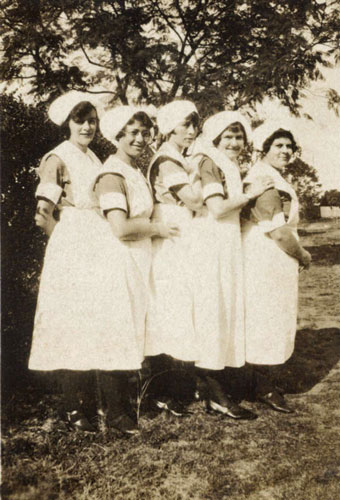
Myrtle completed her training on 20 June 1931 and in August or September accepted an offer of a position as staff nurse at Tambo Hospital, west of Wowan. She had been chosen from among 13 applicants. A year later she resigned to return to Rockhampton to undertake midwifery training at the Lady Goodwin Hospital, and in October 1933 qualified for her certificate of registration as a midwifery nurse.
In December 1937 Myrtle was appointed matron of Adavale Hospital, 200 kilometres southwest of Tambo. In October 1938 she fell while playing tennis and broke one wrist and sprained the other. She was taken to Charleville Hospital by ambulance. On at least one occasion during her tenure at Adavale she assisted at Quilpie Hospital, 100 kilometres away by road, when the latter hospital was full.
Myrtle’s father, John McDonald, died on 20 October 1939 in Brisbane. Myrtle travelled to Brisbane following his death and stayed for a week. She returned to Adavale on 29 October. Myrtle’s mother had died 11 years previously, on 8 October 1928, at the age of only 45. She was buried in Rockhampton.
ENLISTMENT
In March 1940 Myrtle travelled to Brisbane to take a month-long holiday. By then, Australia had become involved in the war in Europe, and the Australian Army Nursing Service (AANS) was recruiting eligible nurses. Myrtle decided to volunteer. In September that year she received word that her application for army service had been accepted and requested to be released from her position at Adavale Hospital effective 28 September. The Quilpie Hospitals Board accepted her resignation with regret.
On 3 October, prior to her departure from the district, Myrtle was farewelled in the Shire Hall by members of the Adavale branch of the Country Women’s Association. Competitions and community singing were enjoyed, and afternoon tea was served in the supper room.
However, Myrtle still had a while to wait until the commencement of her service with the AANS, and in the meantime accepted a position as matron of the Texas District Hospital, in southeast Queensland. She stayed until January 1941 and then resigned. She had her army medical on 27 February and finally enlisted in the Australian Military Forces on 11 July. She was assigned the rank of staff nurse and posted to the 112th Australian General Hospital (AGH), then based at ‘Yungaba,’ Kangaroo Point, Brisbane. At the 112th AGH Myrtle likely met Sister Blanche Hempsted of Brisbane and Staff Nurse Valrie Smith of Wondecla in Far North Queensland, both of whom would soon serve with her overseas.
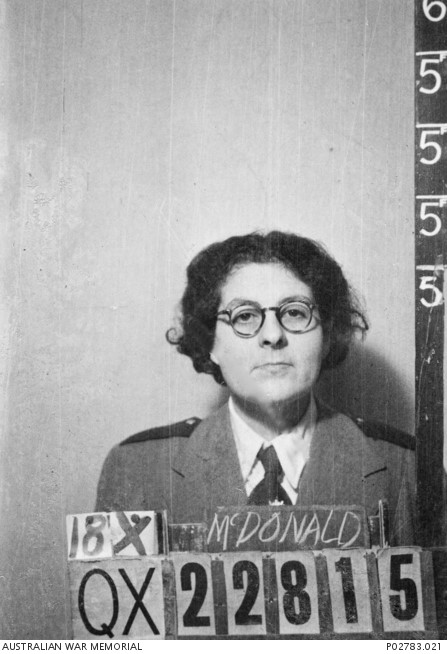
On 15 August Myrtle transferred to the Second Australian Imperial Force (2nd AIF). She was granted six days’ pre-embarkation leave and then on 27 August attached to the 2/13th AGH, still at the rank of staff nurse. Also attached to the unit that day were Blanche, Val and several other Queensland nurses.
The 2/13th AGH had been raised in Melbourne in early August following a request from Col. Alfred P. Derham, the commanding officer of 8th Division medical services in Malaya, who felt that a second military hospital was urgently needed in view of intelligence reports suggesting the possibility of a Japanese invasion. The 2/13th AGH would join the 2/10th AGH and the 2/4th Casualty Clearing Station (CCS), which had sailed to Malaya on the Queen Mary in February 1941 with nearly 6,000 troops of the 22nd Infantry Brigade, 8th Division.
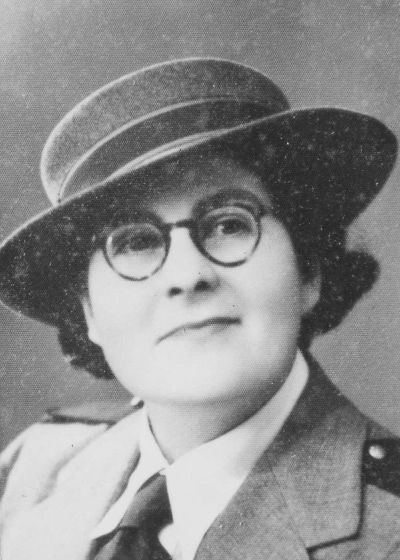
On 28 August Myrtle, Blanche and Valrie met their new 2/13th AGH nursing colleagues at South Brisbane Station. Sister Julia Powell from Blackall oversaw the Queensland contingent. She was formerly matron of Blackall Hospital. Staff Nurse Eileen Short was from Maryborough and was formerly matron of Isisford Hospital. Staff Nurse Sylvia Muir was from Longreach, Staff Nurse Violet McElnea from Ingham, and Staff Nurses Margaret Selwood and Phyllis Pugh from Brisbane. They were led by Maj. Bernard (Bernie) Clarke, a consultant radiologist from Brisbane, described by Phyllis Pugh as “a Clive Brook lookalike for sure – unflappable – a twinkle in his brown eyes” (quoted in Arthurson, p. 116).
HMAHS WANGANELLA
The group entrained for Sydney and arrived the next day, 29 August. They proceeded to the harbour and boarded the converted hospital ship Wanganella. Here the Queensland nurses were joined by a New South Wales 2/13th AGH contingent of nurses led by Sister Marie Hurley. Among the NSW nurses were Sister Ellie McGlade and Staff Nurse Veronica Clancy. Marie Hurley became second-in-charge to Matron Irene Drummond upon the unit’s arrival in Singapore.
On 30 August the Wanganella departed for Melbourne. The ship arrived at Port Melbourne on 1 September, where a further 24 Victorian, South Australian and Tasmanian AANS nurses and around 180 other 2/13th AGH personnel embarked. After setting out again, the ship ran into a severe storm in the Great Australian Bight, and many of the nurses became seasick. A final stop in Fremantle saw seven more AANS nurses come aboard. One nurse, very weak and dehydrated, disembarked and was transshipped back to the Eastern States. The 2/13th AGH now had a strength of 49 AANS nurses.
Shortly after leaving Fremantle the nurses and other personnel were officially told that they were going to Malaya. Many expressed disappointment: they had thought they were going to the Middle East and feared that they would not see action in Malaya. They could not have been more mistaken.
ARRIVAL IN SINGAPORE
On 15 September the Wanganella arrived at Victoria Dock on Singapore Island. Ten nurses were detached immediately to the 2/10th AGH at Malacca – which, along with the 2/4th CCS at Kajang, would be a training centre for the newly arrived nurses. The 10 entrained for Malacca somewhat dismayed at being so suddenly separated from their 2/13th AGH colleagues.
Meanwhile, Myrtle and the other 38 nurses were transported in sweltering heat to St. Patrick’s School, located in Katong on the south coast of Singapore Island between Singapore city and Changi. Here the 2/13th AGH would be based while it awaited relocation to a psychiatric hospital in Tampoi, near Johore Bahru in the south of the Malay Peninsula.
St. Patrick’s School was a Roman Catholic boys’ school comprising several large, brick buildings and set in large, lush grounds. The nurses’ quarters were comfortable, but the heat and humidity were oppressive. There was no work for Myrtle and her colleagues to do at this stage, so mornings were spent lecturing the unit’s orderlies in general nursing and then attending lectures themselves on tropical diseases, tropical nursing and other relevant topics. In the afternoon the nurses could play tennis or squash or arrange to travel in groups to the exclusive Singapore Swimming Club. Sometimes at sunset they would walk down the road a little way to watch the 2/26th Battalion’s ‘changing of the guard’ ceremony.
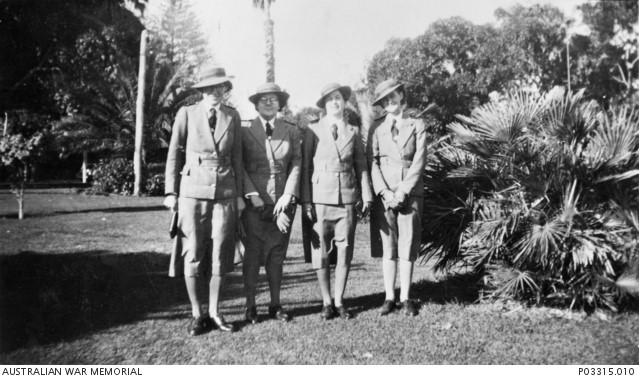
The nurses were allowed out three nights a week and had to be in by 11.59 pm. The commanding officer, Col. D. C. Pigdon, punished breaches of this rule by confining the whole nursing staff to barracks for a fortnight. According to Phyllis Pugh, this was most effective, and the nurses did not break the rules (Arthurson, p. 117). The nurses took advantage of the many invitations to dinners, dances and parties they received from well-connected Singapore residents. Phyllis Pugh and Margaret Selwood, for instance, found themselves invited to government dinners at Raffles Hotel – very formal affairs, with glamourous people, magnificent décor, an abundance of tropical flowers, and music courtesy of the 2nd Argyll and Sutherland Highlander Regiment band (Arthurson, p. 117).
DETACHED TO THE 2/10TH AGH AND THE 2/4TH CCS
On 6 October it was the turn of Myrtle, Sylvia Muir and others to be detached to the 2/10th AGH. They arrived in Malacca the next day. Malacca was an old colonial town on the west coast of the Malay Peninsula, by all accounts very pleasant. The 2/10th AGH had been allocated several wings of the Colonial Service Hospital some little way out of town. The modern, five-storey building was set on a slight rise in spacious grounds bright with bougainvillea, frangipani and hibiscus. The nurses were quartered on the fourth floor of one of the wings.
The nurses’ life in Malacca was similar to that of their peers in Singapore. During time off, they played tennis and went swimming; played bridge; attended dances and concerts; and went to sampan parties. Like their associates on the island, they were entertained by local socialites.
On 29 October Myrtle and Sylvia returned to Katong. On 11 November they were detached to the 2/4th CCS, which by now was based at the same psychiatric facility in Tampoi into which the 2/13th AGH was shortly due to move. The 2/4th CCS had established a small hospital of 150–200 beds in the sprawling facility, which had been leased from the Sultan of Johore.
Less than two weeks later, the 2/4th CCS moved north to Kluang, and the 2/13th AGH was ordered to proceed to Tampoi. In an extraordinary feat of logistics, 100 tons of equipment was moved in just three days, 21–23 November. On 23 November Matron Drummond and the remaining nurses and other staff of the 2/13th AGH arrived from Katong, and Myrtle, Sylvia and the other nurses already at Tampoi rejoined their unit. The hospital was rapidly brought up to speed and its bed capacity expanded to more than 1,000.
The psychiatric hospital was not a particularly pleasant place to work. Instead of windows there were iron bars, which had to be removed. Wards were separated by long, covered concrete paths, and so bicycles were needed to get from one area to another. The nurses’ quarters, surrounded by a high brick wall, were far enough from the hospital to necessitate the use of a bus for transport.
All the while the nurses were treating routine cases of fever and the odd surgical complaint, and at a certain point the pleasant rhythm of their life in Malaya became monotonous, at least for some. They began to long for action. It was, after all, why they were there.
THE GATHERING STORM
As December approached, it looked as if they would have their wish. All the signs in the international arena pointed to imminent war with Japan. At the end of November, Commonwealth forces in Malaya were advanced to the second degree of readiness, which meant that leave was cancelled, and units had to be ready to move at a few hours’ notice to their areas of deployment. Then, on 4 December, the codeword ‘Raffles’ was given, indicating advancement to the first degree of readiness. War was coming.
Despite the official line and widespread belief that Commonwealth forces were sufficiently strong enough to stop any Japanese invasion, some of the 2/13th AGH officers thought otherwise. Phyllis Pugh recalls that one night at tea, soon after the unit had relocated to Tampoi, Maj. Bruce A. Hunt shook the nurses out of their complacency by saying, and here she is no doubt paraphrasing Maj. Hunt, that: “There will be war with the Japanese. The Japanese will come in through the back door and advance down the Peninsula. Our troops most likely would retreat to Singapore Island, trapped like rats. The Japanese, then, could control our Singapore reservoirs and we then would be under extreme stress. At the worst, none would go home to Australia” (quoted in Arthurson, pp. 117–8).
Maj. Hunt was proved correct. The night of 7 December was calm and peaceful. There was a lovely moon, and all the patients were sleeping. Just after midnight a force of some 5,000 troops of the Imperial Japanese Army launched an amphibious assault at Kota Bharu on the Malay Peninsula’s northern coast. Four hours later, 17 Japanese bombers attacked Singapore Island. Having heard the bombs in the distance, some of the nurses at Tampoi decided that it must be a practice raid. Then they saw tracer bullets followed by ack-ack guns firing skyward at Japanese planes overhead. The realisation struck that they were at war with Japan.
On 12 December the 2/13th AGH received a memo from Lt. Col. J. G. (Glyn) White, Deputy Assistant Director of Medical Services (ADMS), 8th Division, ordering the hospital to expand from 600 to 1,200 beds. The memo also ordered that Red Cross brassards from then on be worn by all ranks on the left arm. By 15 December two new wards had been set up and the number of available beds had grown to 643.
At a certain point, Col. Pigdon summoned the nurses to their mess and stressed the dangers ahead. He asked them not to underestimate the strength of the Japanese. He was concerned that paratroops might be employed to isolate the hospital. Should the nurses be at risk they must head into the jungle and make their way to the coast. They had to familiarise themselves with the area by studying maps. Col. Pigdon also placed the nurses under curfew. They were not allowed outside the hospital compound after dark, nor were they allowed visitors.
All the while, well-trained Japanese forces, backed by mechanized units and substantial sea and air power, were pressing southwards and forcing severely outgunned British and Indian troops to retreat before them. The illusion that had held for so long – that Malaya was well defended – was shattered.
WAR APPROACHES
The war was getting hotter and closer, and Myrtle and her colleagues quickly became used to interrupted sleep, blackouts and air-raid warnings. Some of the nurses were formed into a signals squad, whose job it was to ring a large brass bell upon receiving the message ‘Air Raid Red’ from the Army Signals Corps, whereupon the nurses and their amahs (housemaids) would head for the cover of the jungle.
Christmas came. The wards were decorated, and the Red Cross and Salvation Army were prevailed upon to boost the patients’ rations for the festive event. The officers helped to carve up the poultry and ham and helped the nurses to serve the bed patients. They also made the nurses sit down with the up patients and waited on them. In return the nurses arranged a party in their mess for the officers and on Boxing Day a larger party for the troops. Finally, the Sultan of Johore invited Matron Drummond, Col. Pigdon and the officers and nurses who could be spared to a festive dinner at his palace.
Events sped up after Christmas. With Japanese progress southwards continuing unabated, it became clear that the 2/10th AGH at Malacca would have to evacuate to Singapore Island. On 29 December, 20 nurses were detached from Malacca to the 2/13th AGH and arrived the next day. On 5 January 1942, 16 more nurses and around 40 other staff were detached to the 2/13th AGH. Scores of patients had also been moved south from Malacca to Tampoi.
On 14 January Australian 8th Division troops entered combat for the first time. They scored a tactical victory against a Japanese force near the town of Gemas, in northern Johore state, but the following day a much bloodier battle was fought. Soon, convoys of Australian casualties were being sent via the 2/4 CCS at Mengkibol to the 2/13th AGH, which by now had 1,165 beds ready and had worked hard to prepare operating theatres to receive the anticipated casualties. On the evening of 16 January, the war hit the unit “right between the eyes. Men, on stretchers with tickets pinned to them showing the most urgent injuries, were delivered in rapid succession from transports of all types…The admission room quickly established identity, rank, injury of the admitted. Stretcher bearers ran the battle casualty to either ward or theatre. Matron Drummond had her staff fine-tuned and expert attention was provided at all times” (Arthurson, p. 19).
THE HOSPITALS EVACUATE SOUTHWARDS
By now the 2/10th AGH had relocated to Oldham Hall and Manor House on Singapore Island, and before long the 2/13th AGH itself was compelled to follow its sister unit to the island. On 21 January a decision was made to return to St. Patrick’s School, and a handful of nurses and orderlies were sent there to clean and prepare it for the unit’s arrival. Abandoned bungalows adjoining the school were cleaned in preparation for their use as staff quarters.
The relocation took place over the weekend of 24–25 January. The final convoy, carrying medical patients, arrived late on Sunday night. Beds had been made, pyjamas placed at the ready with towels, cold drinks and sandwiches prepared, and teapots got ready. The convoy became lost in a blackout, and it was not until nearly midnight that all patients were safely bedded down. The move had been a startling success; despite constant air raids, not even an ambulance had been lost.
On 28 January, the 2/4th CCS followed the other two medical units to Singapore Island, relocating to Bukit Panjang English School. Then, on the night of 30 January, the final Commonwealth troops crossed the Causeway from the Malay Peninsula to Singapore Island. The next morning it was blown in two places. Soon after, the Imperial Japanese Army reached the northern shore of Johor Strait and on 2 February began a ferocious artillery bombardment of the island. The final battle was about to begin.
Myrtle and her colleagues were now working under extreme pressure. Their shifts were 12 hours long, and the theatre, blood bank and x-ray staff worked even longer. Daytime air-raids, bombings and regular artillery barrages made sleep difficult. One night the top floor of the hospital was bombed, and a direct hit caused much damage; many patients had lucky escapes.
On the night of 8 February Japanese troops began to cross Johor Strait. By the morning, they had established a beachhead on the northwestern corner of Singapore island, despite strong opposition from Australian troops. The heavy fighting produced many casualties, and convoys of ambulances arrived at St. Patrick’s carrying hundreds of wounded soldiers, mainly with gunshot and shrapnel wounds. The hospital was by now so overcrowded with wounded combatants that outbuildings and even tents were used as wards. Casualties lay closely packed on mattresses on floors or even outside on the lawns.
EVACUATION OF THE NURSES
With Singapore’s fate all but certain, a decision was made to evacuate the nurses. Already in January, following reports of Japanese atrocities in Hong Kong, Col. Derham had asked Maj. Gen. H. Gordon Bennett, CO of the 8th Division in Malaya, to evacuate the AANS nurses. Bennett had refused, citing the damaging effect on morale. Col. Derham then instructed his deputy Col. Glyn White to send as many nurses as he could with Australian casualties leaving Singapore.
On 10 February, six 2/10th AGH nurses embarked with 300 wounded on the makeshift hospital ship Wusueh. The converted riverboat, painted white with large red crosses on both sides, had already been used to evacuate wounded from Singapore to Java. Although buzzed by enemy aircraft, the boat was not attacked and safely reached Tanjung Priok, the port of Batavia (today’s Jakarta).
At St. Patrick’s, meanwhile, Col. Pigdon summoned the nurses into their mess and told them they were to be evacuated when more ships were available. Two lists of names were drawn up, and when the time came, they were requested to go quietly with no good-byes. They were to pack just one small suitcase and take respirators and iron rations with them. Naturally, the nurses did not want to leave their patients. It was a betrayal of their nursing ethos, and they protested strongly, but they had to go. On 11 February the nurses on the first list boarded the Empire Star with counterparts from the 2/10th AGH.
Now 65 AANS nurses remained in Singapore, of whom 26 belonged to the 2/13th AGH. Among them was Myrtle. On 12 February they too had to go. They were driven by ambulance to St. Andrew’s Cathedral in Singapore city where, during one of the heaviest bombing raids Singapore had yet suffered, they joined the remaining nurses of the 2/10th AGH and the 2/4th CCS.
When the siren sounded all clear, the 65 nurses proceeded to Keppel Harbour until the ambulances could go no further. The nurses got out and walked the remaining few hundred metres. There were fires burning everywhere and on the wharf women and children were running everywhere trying to get on boats. Dozens of cars had been dumped in the harbour, and from the water protruded the masts of sunken ships. While the nurses were waiting, two bombs fell not far away.
The VYNER BROOKE
Eventually Myrtle and her 64 comrades were ferried out to the Vyner Brooke, a small coastal steamer and one-time pleasure craft of Sir Charles Vyner Brooke, lying at anchor in the harbour. On board there were as many as 150 people – women, children, old and infirm men. In the gathering darkness the ship slipped out of Keppel Harbour and, after straying into a minefield and spending time extricating itself, began its journey south. Behind the Vyner Brooke the city was burning, and a pall of thick, black smoke hung in the sky.
That night the Vyner Brooke made little progress and spent much of Friday hiding among the hundreds of small islands that line the passage between Singapore and Batavia. By the morning of Saturday 14 February, Captain Borton was approaching the entrance to Bangka Strait. To the right lay Sumatra; to the left, Bangka Island.
Suddenly, at around 11.00 am, a Japanese plane swooped over, then flew off again. At around 2.00 pm another plane approached before flying off. The captain, anticipating the imminent arrival of Japanese dive-bombers, sounded the ship’s siren and began a run through open water. When a squadron of dive-bombers appeared on the horizon, Borton commenced evasive manoeuvres.
As the bombers approached, the Vyner Brooke zigzagged wildly at full speed. The first wave of bombs missed the ship. The planes banked, lined up again, and came in for a second run. This time there was no escape. A bomb struck the forward deck, killing a gun crew. Another entered the ship’s funnel and exploded in the engine room. The Vyner Brooke lifted and rocked with a vast roar. A third bomb tore a hole in the side of the ship. The Vyner Brooke listed to starboard and began to sink. It was 15 kilometres from Bangka Island.
After the first explosion, the AANS nurses put into action a plan they had worked out the previous day. They dispersed to their assigned posts and directed passengers to the Vyner Brooke’s three remaining lifeboats. They attended to the wounded, including their own, and helped them to reach the boats. They searched the lower decks for stragglers and then abandoned the doomed ship.
LOST AT SEA
Myrtle found herself in the water and managed to reach a raft with seven other nurses: Staff Nurses Iole Harper and Merle Trenerry of the 2/13th AGH, Staff Nurses Mary Clarke and Betty Jeffrey, Sister Caroline Ennis and Matron Dot Paschke of the 2/10th AGH, and Staff Nurse Millie Dorsch of the 2/4th CCS. Two crew members and four or five civilian women were also on the raft, as well as two small children, a Malay boy and an English girl. Caroline Ennis was holding them. Those on board were using pieces of wood as oars, but this was having little effect. It was decided therefore that whoever was able to swim beside the raft should do so in order to lighten the load.
After many hours the current carried the raft close to shore. The evacuees saw a lighthouse and a long pier before being carried out to sea again. Later, the current carried them in again, and they saw a fire on the beach. They knew then that at least one of the lifeboats had made it to shore. During the night a storm blew up, and the raft rocked and tossed until everybody was sick. It woke the little girl, who had slept most of the time in Caroline Ennis’s arms with the little boy, and she said to Caroline, “Auntie, I want to go upstairs.”
When daylight came the raft was as far out to sea as it had been to begin with. At this point, Betty Jeffrey, Iole Harper and the two crew members took their turn to swim alongside. After making progress towards the shore, the raft was suddenly caught in a current that somehow missed the swimmers and pulled swiftly out to sea. Myrtle and the other nurses called out to Betty and Iole, but it was hopeless. They were now too far away and were being carried further all the time. Betty and Iole never saw their six comrades again.
Six other nurses were lost at sea when the Vyner Brooke sank. Staff Nurse Mona Wilton of the 2/13th AGH, after just entered the water with her friend and colleague Staff Nurse Wilma Oram, was struck on the head by a falling raft and floated away. Sister Vima Bates of the 2/13th AGH and Sister Kath Kinsella of the 2/4th CCS were seen fleetingly in the water before vanishing, and Staff Nurse Nell Calnan, Sister Jean Russell and Staff Nurse Marjorie Schuman, all of the 2/10th AGH, disappeared without a trace.
The 53 nurses who survived the sinking of the Vyner Brooke were washed up on the shores of Bangka Island. Twenty-one of them were shot and killed by Japanese soldiers. Staff Nurse Vivian Bullwinkel of the 2/13th AGH survived the massacre and managed to find the remaining 31, who had been interned by the Japanese. For three and a half years they were imprisoned on Bangka Island and Sumatra. Eight died during their captivity. In October 1945 the surviving 24 came home. It was only then that the grim fate of their colleagues became publicly known.
In memory of Myrtle.
SOURCES
- Ancestry Library Edition.
- Arthurson, L., ‘The Story of the 13th Australian General Hospital, 8th Division AIF, Malaya,’ as reproduced by Peter Winstanley on the website Prisoners of War of the Japanese 1942–1945.
- Jeffrey, B. (1954), White Coolies, Angus & Robertson Publishers.
- National Archives of Australia.
- Shaw, I. W. (2010), On Radji Beach, Pan Macmillan Australia.
SOURCES: NEWSPAPERS
- The Central Queensland Herald (Rockhampton, 16 Oct 1930, p. 55), ‘Nurses’ Examinations.’
- The Charleville Times (Brisbane, 11 Sep 1931, p. 2), ‘Tambo.’
- The Charleville Times (Brisbane, 16 Sep 1932, p. 3), ‘Tambo Hospitals Board.’
- The Charleville Times (Brisbane, 3 Nov 1939, p. 5), ‘Adavale.’
- The Charleville Times (Brisbane, 20 Sep 1940, p. 6), ‘Alarming Increase.’
- The Charleville Times (Brisbane, 4 Oct 1940, p. 5), ‘Adavale.’
- The Evening News (Rockhampton, 15 Aug 1925, p. 11), ‘Column for Young Folk.’
- The Evening News (Rockhampton, 29 Aug 1925, p. 11), ‘Column for Young Folk.’
- The Evening News (Rockhampton, 3 Oct 1925, p. 11), ‘Kay’s Letter Bag.’
- The Evening News (Rockhampton, 13 Oct 1925, p. 4), ‘Wowan Masonic Ball.’
- The Evening News (Rockhampton, 10 Apr 1926, p. 11), ‘Kay’s Letter Bag.’
- The Evening News (Rockhampton, 19 Feb 1927, p. 9), ‘Mira’s Letter Bag.’
- The Evening News (Rockhampton, 2 Sep 1930, p. 7), ‘“Gallery” at Hospital Inquiry Amused by Nurses’ Accounts of Lectures.’
- The Evening News (Rockhampton, 27 Dec 1932, p. 1), ‘General Hospital a Blaze of Colour.’
- The Evening News (Rockhampton, 21 Oct 1933, p. 10), ‘Nurses’ Examinations.’
- The Inverell Times (3 Feb 1941, p. 5), ‘Texas Hospital.’
- The Longreach Leader (29 Oct 1938, p. 24), ‘Quilpie.’
- Morning Bulletin (Rockhampton, 19 March 1921, p. 13), ‘Uncle Sam’s Letter Bag.’
- Morning Bulletin (Rockhampton, 3 Apr 1924, p. 6), ‘Dawson Valley News: Wowan.’
- The Telegraph (Brisbane, 2 Sep 1930, p. 15), ‘Hospital Inquiry.’
 australianwarnurses.org