AANS │ Lieutenant │ Second World War │ 2/3 Australian Hospital Ship Centaur
FAMILY BACKGROUND AND EARLY LIFE
Myrle Mary Eileen Moston was born on 22 September 1907 in Trangie, near Dubbo in central New South Wales. She was the daughter of Elizabeth Margaret Pearce (1879–1955), from Carcoar, 240 kilometres southeast of Trangie, and Alfred Thomas Moston (1868–1940), from Dubbo.
Elizabeth and Alfred were married in Dubbo in 1899 and moved to Trangie. In November 1900 Elizabeth gave birth to a son, Hylton. A few months later, the family moved to Wellington, 50 kilometres southeast of Dubbo, after Alfred bought the freehold to the Great Central Hotel. On 5 August 1901 Alfred took over the hotel’s licence and he and Elizabeth ran it. Alfred’s father, Thomas Moston, was a well-known local hotelier, and Alfred was following in his footsteps.
Hylton died in April 1903 at the age of two-and-a-half. He was buried in the Presbyterian portion of the Dubbo Cemetery. Later that year, Thomas Moston died too and was buried alongside his grandson.
In June 1904 Alfred sold the Great Central Hotel, and he and Elizabeth returned to Trangie – where, in 1907, Myrle was born. Sometime later Alfred bought the Commercial Hotel in the nearby town of Warren and sold it again in July 1911. He continued to buy and sell hotels throughout his life.
By August 1915 the family was living in or near Lavington, on the northern outskirts of the town of Albury in southern New South Wales. It appears that Myrle finished her primary schooling here in 1919, gaining her Qualifying Certificate.
In the 1920s the family moved to Macpherson Street in Bronte, a beachside suburb of Sydney. Time passed, and in September 1928 Myrle celebrated her 21st birthday at a party organised by her mother at the ritzy Ambassadors Café.
NURSING AND ENLISTMENT
Myrle was working as a stenographer but decided to go into nursing. In 1931 she began her training at Sydney Hospital on Macquarie Street in central Sydney before moving to Lister Private Hospital on Rosebank Street in Darlinghurst, where she completed her training. In May 1936 she successfully sat her Nurses’ Registration Board examination and on 1 October that year became registered in general nursing. At the time Myrle was living on Beach Road in Bronte.
In 1941, with war raging in Europe and beyond, Myrle applied to join the Australian Army Nursing Service (AANS). She was accepted on 25 June, while still on staff at Lister Private Hospital.
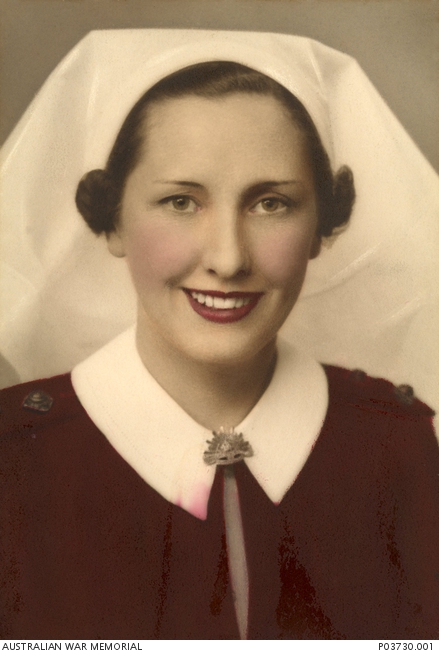
Having joined the AANS, on 12 July Myrle enlisted in the Australian Military Forces (AMF) for home service and was appointed to the rank of staff nurse. On her attestation form she nominated her mother, then living in Newcastle, as her next of kin, her father having died on 25 September 1940.
HOME SERVICE
On the day of her enlistment Myrle was attached to the 113th Australian General Hospital (AGH), located in Concord, Sydney. There she met Staff Nurses Eva King and Nell Savage, with whom she would later serve on an Australian hospital ship, the Centaur.
On 18 November Eva King and Nell Savage were seconded from the AMF to the Second Imperial Australian Force (2nd AIF). Both subsequently joined the nursing staff of the 1st Netherlands Military Hospital Ship Oranje (loaned by the Netherlands East Indies government to the Australian and New Zealand governments) – Eva on 27 January 1942 and Nell on 24 March 1942.
On 23 February 1942 Myrle was transferred from the 113th AGH to the 5th Field Ambulance, which had established a camp dressing station at Bathurst, New South Wales. On 8 March, following the relocation of the 5th Field Ambulance to Narellan, on the southwestern outskirts of Sydney, Myrle joined the 104th AGH, which was also based in Bathurst. In July she was promoted to the rank of sister.
The CENTAUR
On 1 October 1942 Myrle enlisted in the 2nd AIF. She remained at the 104th AGH in Bathurst for the next five months but in March 1943 was attached to the nursing staff of the 2/3 Australian Hospital Ship Centaur.
The Centaur was built in Scotland in 1924 and arrived in Australia that same year to ply a route between Fremantle and Singapore. In 1940 the ship was placed under the control of the British Admiralty but continued its normal operations. At the start of 1943, following a request for a ship capable of serving in shallow Southeast Asian waters as a hospital ship, the Centaur was loaned to the Australian government. It was converted in Melbourne and designated 2/3 Australian Hospital Ship Centaur.
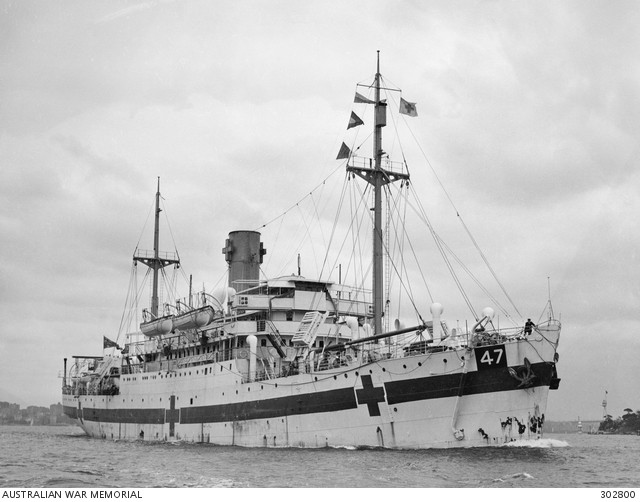
Although the Centaur was considerably smaller than the other Australian hospital ships – 2/1 AHS Manunda, 2/2 AHS Wanganella, and the Oranje – careful attention had been paid to ventilation and refrigeration, and its 250 patients would be comfortably accommodated in tropical conditions.
On 9 March 1943 Lt. Col. Clement Manson was appointed officer in charge of the Centaur. Subsequently other staff were recruited, including at least three medical specialists, more than 40 nursing and ward orderlies, and 12 AANS nurses. Joining Myrle were Matron Anne Jewell (Western Australia) and Sisters Mary McFarlane (South Australia), Margaret Adams, Alice O’Donnell, Eileen Rutherford and Jenny Walker (Victoria), Cynthia Haultain, Eva King, Nell Savage and Edna Shaw (New South Wales), and Joyce Wyllie (Queensland). As we have seen, Eva King and Nell Savage had been on the nursing staff of the Oranje, and so had Margaret Adams, Cynthia Haultain, Mary McFarlane, Eileen Rutherford, Jenny Walker and Matron Anne Jewell. Joyce Wyllie had worked with Myrle at the 113th AGH.
On 17 March the 12 nurses boarded the Centaur in Sydney after the ship had arrived from Melbourne on the first leg of a trial voyage. On 21 March, after a number of problems had been rectified, the Centaur set out for Brisbane, arriving two days later. Further alterations were made, and the ship sailed on to Townsville. Here Australian casualties repatriated from New Guinea were embarked and taken back to Brisbane.
On 8 April the Centaur set out for Port Moresby on the final leg of its trial run. It returned with Australian and American wounded, along with several wounded Japanese prisoners of war. The ship’s arrival back in Brisbane on 18 April marked the end of its shakedown voyage. The Centaur‘s effectiveness as a hospital ship had been demonstrated.
THE FINAL VOYAGE OF THE CENTAUR
On the morning of 12 May 1943 the Centaur set sail from Sydney for New Guinea. Myrle and her 11 AANS colleagues were on board, along with the ship’s other medical staff. The captain had been tasked with delivering 193 members of the 2/12th Field Ambulance to Port Moresby and then returning with Australian casualties.
Myrle shared a cabin with Nell Savage. In the cabin next door was their colleague from the 113th AGH, and Nell’s good friend, Eva King.
At dinnertime on 13 May, when the Centaur was off the northern New South Wales coast, Matron Anne Jewell celebrated her birthday with a party. The nurses had decorated the dining table with flowers, and everything looked lovely. During the special dinner a birthday cake was brought out for Matron Jewell, which the nurses had bought in Sydney. The ship’s cook had iced it in white icing with ‘Happy Birthday from the Centaur’ written in pink across it. The nurses did not finish the cake at dinner, so took it to the main saloon to finish off during the evening. At around 10.00 pm Myrle and Nell retired to their cabins.
That night the weather was clear and visibility excellent. The Centaur was travelling unescorted and was fully illuminated and marked with the Red Cross. With dawn not more than two hours away, it had reached the islands off the southern Queensland coast.
Suddenly, at 4.10 am, while most of the 332 people on board were asleep, a Japanese torpedo slammed into the ship’s portside, igniting a fuel tank and causing a massive explosion. A large hole was also torn in the hull. In their cabin, Myrle and Nell were awakened by the explosion and practically thrown out of bed. They rushed to a porthole to see the ship ablaze. They were so shocked that they did not speak to each other, but both registered what had happened. From her cabin next door, Eva ran to their door and shouted “Savage, out on deck.” The three nurses hurried to the deck, tying their lifejackets in place as they ran. After Eva became separated from them in the confusion, Myrle and Nell jumped into the water together, but Myrle was struck on the head by falling debris and disappeared. She was not seen again.
Meanwhile, fire was spreading throughout the ship, and water rushing in through the hole in the hull. There was no time to launch the lifeboats. The Centaur capsized and sank within three minutes.
Myrle and 10 of her AANS colleagues died that day. Nell Savage was the only nurse to survive. Altogether 268 people lost their lives, including 178 members of the 2/12th Field Ambulance. The survivors clambered onto rafts and bits of wreckage and floated on the sea for 34 hours.
IN MEMORIAM
On the anniversary of Myrle’s death, her mother placed a notice in the Sydney Morning Herald. It read as follows:
MOSTON – Beautiful memories of my loving daughter Sister Myrle (Moss), missing hospital ship Centaur May 14, 1943. Sadly missed by her lonely mother.
In memory of Myrle.
SOURCES
- Ancestry Library Edition.
- Australian War Memorial, ‘The Last Post Ceremony commemorating the service of (NFX125936) Sister Myrle Mary Eileen Moston, Ships Staff Centaur AANS, Second World War’ (6 June 2013).
- Department of Veterans’ Affairs, Anzac Portal, ‘The Sinking of the Centaur.’
- Goodman, R. (1992), Hospitals Ships, Boolarong Publications.
- Howlett, L. (1991), The Oranje Story, Oranje Hospital Ship Association.
- Milligan, C. and Foley, J. (1993), Australian Hospital Ship Centaur: The Myth of Immunity, Nairana Publications.
- Museums of History NSW, Nurses Index 1926–1954.
- National Archives of Australia.
- Walker, A. B. (1961), Second World War Official Histories, Australia in the War of 1939–1945, Series 5 – Medical, Vol. IV – Medical Services of the Royal Australian Navy and Royal Australian Air Force with a section on women in the Army Medical Services (1st edition, 1961), Part III – Women in the Army Medical Services, Chap. 36 – The Australian Army Nursing Service (pp. 428–476), Australian War Memorial.
SOURCES: NEWSPAPERS
- The Australian Women’s Weekly (29 May 1943, p. 9), ‘Men of Centaur Mourn Loss of Gallant Nurses.’
- The Border Morning Mail and Riverina Times (Albury, 28 Aug 1915, p. 6), ‘Lavington’.
- The Daily Advertiser (Wagga Wagga, 19 Jan 1920, p. 3), ‘Qualifying Certificates’.
- The Daily Telegraph (Sydney, 24 Sep 1928, p. 18), ‘21st Birthday Parties’.
- The Dubbo Dispatch and Wellington Independent (5 Sep 1903, p. 4), ‘Death of Mr. T. Moston’.
- The Dubbo Liberal and Macquarie Advocate (5 Sep 1903, p. 3), ‘Obituary’.
- The Dubbo Liberal and Macquarie Advocate (29 May 1943, p. 3), ‘Personal’.
- Government Gazette of the State of New South Wales (Sydney, 22 Sep 1909 [Issue No.124], p. 5161), ‘Publicans’ Licenses’.
- National Advocate (Bathurst, 5 Sep 1903, p. 2), ‘Mr. Thomas Moston’.
- The Sun (Sydney, 11 Mar 1943, p. 3), ‘New Hospital Ship Ready.’
- The Sydney Morning Herald (13 May 1944, p. 18), ‘Family Notices’.
- The Wellington Times (5 Aug 1901, p. 2), ‘Licensing Court’.
 australianwarnurses.org