AANS │ Staff Nurse │ First World War │ Salonika
FAMILY BACKGROUND
May Hennessy was born in 1893 in Castlemaine, Victoria. She was the first of six children born to Helen Mary Craike (1862–1953), of Strathfieldsaye, Victoria, and James Joseph Hennessy (1860–1936), of Castlemaine, Victoria, who worked at least for some period of time as a publican.
Helen and James were married in March 1893 in Bendigo, Victoria. May was born in the same year, followed by Mary Hilda in 1895, Annie Jean in 1897, Jack in 1899, Helen Margaret in 1902 (who sadly died the same year), and Thomas Anthony in 1904.
SCHOOL, NURSING AND ENLISTMENT
May attended Longlea State School, in Longlea, near Strathfieldsaye (and Bendigo). Later she was active in the Holy Trinity Anglican Church on Hallam Street in Bendigo and for many years was secretary of the Sunday School.
In time May decided to become a nurse, and in December 1913 was appointed as a probationer to the Gippsland Hospital in Sale, eastern Victoria. In November 1916 she sat her final Royal Victorian Trained Nurses’ Association (RVTNA) examinations. She not only passed but was one of three nurses to receive an honourable mention in competition for the Sister Madge Kelly Memorial Prize, awarded to the trainee showing the highest standard of general proficiency as determined by aggregate marks in the RVTNA examinations.
After completing her training in January 1917, May spent a month at St. Helen’s Private Hospital in Sale. She then joined the staff of the Caulfield Military Hospital (also known as No. 11 Australian General Hospital) in Melbourne.
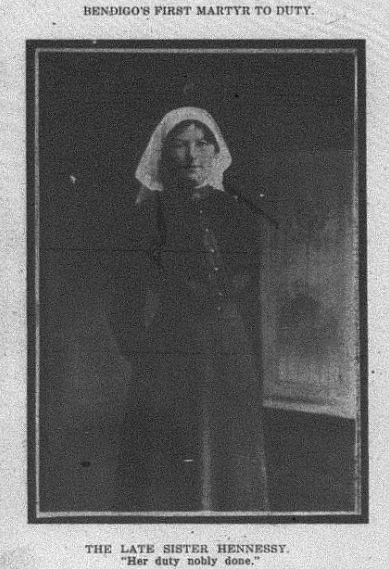
By then, war had been raging in Europe and the Middle East for two and a half years, and May, having now graduated, wanted to do her bit. She joined the Australian Army Nursing Service (AANS), presumably while still at Caulfield, or even prior to that appointment, and enlisted in the Australian Imperial Force (AIF). She signed her attestation paper on 29 May (and again on 4 June) and was attached as a staff nurse to a reinforcements unit.
RMS MOOLTAN
May and two other trainees of Gippsland Hospital, Harriett Selina Mogg (also known as D. Mogg) and Elsie Muriel King, were among several hundred AANS nurses selected for service in British military hospitals in Salonika, Greece.
Salonika had become a key Allied base in the fight against German-aligned Bulgaria. In mid-1916 more than 110,000 Serbian troops, forced out of Serbia by Bulgarian, Austro-Hungarian and German forces, joined French, British, Russian and Italian troops in the Greek city and established the Allied Army of the Orient. A score of Allied military hospitals, mainly British, had been set up, and in April 1917 British authorities asked their Australian counterparts to deploy Australian nurses to Salonika to relieve the British, French and Canadian nurses.
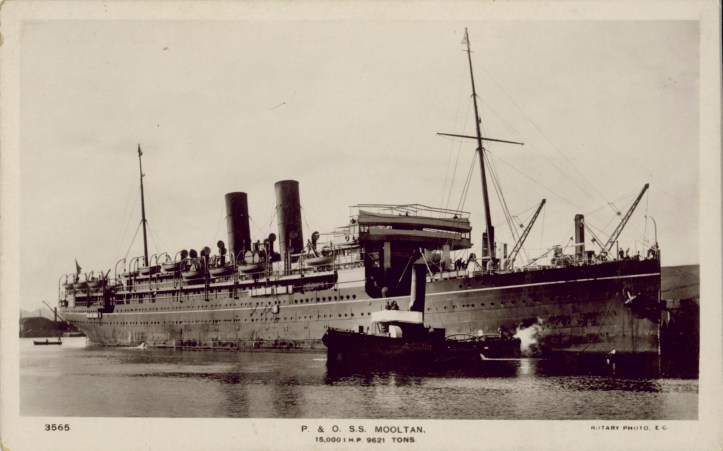
On 12 June 1917, May, Harriett and Elsie departed Melbourne aboard the RMS Mooltan. Around 90 other nurses had embarked with them under the charge of Matron Jessie McHardie White. Three days earlier the Mooltan had left Sydney carrying some 140 nurses. A score more joined the ship in Adelaide on 14 June, and a further five or so came aboard in Fremantle. When the Mooltan departed Fremantle on 18 June, something like 270 nurses were aboard. They were bound for Egypt, from where they would transship to Salonika in contingents.
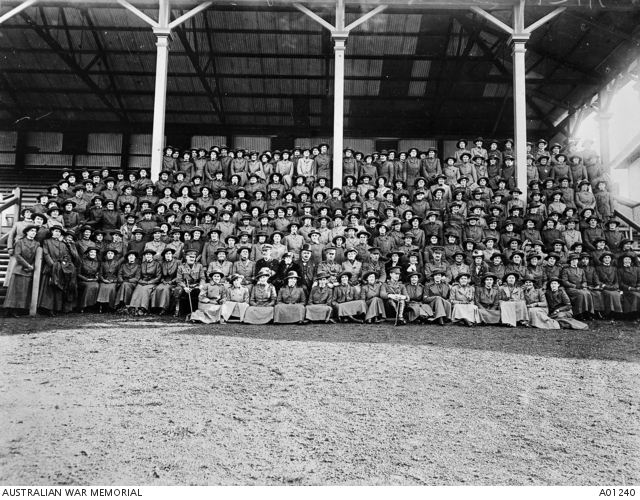
The Mooltan arrived at Port Tewfik, the port of Suez, Egypt, on 19 July, and the nurses disembarked. They entrained for Cairo and were billetted at the Continental Hotel. They then departed Egypt for Greece by contingent; May left Cairo with the other nurses of her contingent on 25 July, entrained for Port Said, and departed for Salonika aboard the Chagres.
SALONIKA
After a hazardous voyage through the islands of the eastern Mediterranean, thick with German submarines, May and her colleagues arrived in Salonika 30 July. They took over No. 66 General Hospital (GH) at Hortiach (Chortiatis), a tent hospital of 800–900 beds.
Conditions in Salonika were challenging. The summers were long and hot, and mosquitoes were legion. Many of the patients contracted malaria, and dysentery was common too.
The winters, on the other hand, were bitter. The cold caused medicines, ink, hot water bottles and even eggs to freeze overnight. Carbon monoxide poisoning became a problem. Fuel was scarce, and often the only means of heating came from charcoal burnt in braziers.
In November 1917 May and the other nurses of No. 66 GH transferred to No. 52 GH at Kalamaria, a southern suburb of Salonika. Here May became ill with dysentery and on 17 November was admitted to No. 43 GH, where she was accommodated on the ‘Sisters’ ward.’ In time she recovered, and soon it was 1918.
MALARIA
The year passed by. As it was drawing to a close, May contracted malaria, as so many of her colleagues had. She became seriously ill and on 27 November returned to the Sisters’ ward at No. 43 GH. She began to improve and on 23 December was removed from the seriously ill list.
On 18 January 1919 May was discharged from No. 43 GH and returned to No. 52 GH to await embarkation for Australia. She was being invalided home.
May departed Salonika on 3 February on RMS Gorgon bound for Alexandria, Egypt. She arrived in the coastal metropolis on 8 February and was given leave. Some days later she made her way to Suez and on 22 February embarked on the Novgorod bound for Australia.
The NOVGOROD
The Novgorod was a cargo steamer operated by the Royal Mail Steam Packet Co. that had previously been trading in the Mediterranean. Although the vessel was capable of carrying some 1,300 troops, the ship was carrying only 18 passengers. Aside from May, there were seven other nurses – Sisters Scott, Sampson, Reed, Egan, Ritchie, Shidel and Matron Finley – as well as eight officers and an English woman, Mrs. Pascoe, and her child.
The Novgorod made only one stop en route to Australia, calling in at Colombo, before leaving again on 6 March for Fremantle.
Throughout the voyage May’s condition had been a cause of concern, but after the Novgorod left Fremantle, she suffered a relapse of malaria and became seriously ill once again. Her condition was complicated by dysentery and jaundice. Though as yet undiagnosed, May was suffering from acute nephritis – inflammation of the kidneys.
Early on the morning of 1 April the Novgorod berthed at Railway Pier (today known as Cunningham Pier) in Geelong. It was the first vessel to bring returning troops and nurses directly to Victoria’s second city.
THE SUPREME SACRIFICE
May was carried off the ship and into a waiting motor ambulance. Her condition was so serious that it was impossible for her to entrain for her home city of Bendigo, as had been anticipated, and instead she was admitted to ‘Riviera,’ Nurse McKenzie’s private hospital on Myers Street in Geelong. Matron Hayes of Osborne House, a nearby military hospital, accompanied May to Riviera.
May did not recover. She died late on Wednesday night 9 April 1919.
Early in the morning of Friday 11 April, a service was conducted for May at Christ Church in Geelong. Matron Hayes and the nurses of Osborne House were in attendance, along with several personal friends. After the service, May’s coffin, covered in the Union Jack and her AANS uniform, was carried by hearse to the train station, preceded by the Osborne House nurses in motor cars. At the station the nurses formed a guard of honour, and several acted as pallbearers. May’s coffin was conveyed to Bendigo by the 8.05 am train, accompanied by numerous wreaths.
MILITARY FUNERAL
The following day, Saturday 12 April, May was buried with military honours at Bendigo Cemetery. Her funeral was one of the largest ever seen in the city. Many people were present when the funeral cortege moved away Helen and James Hennessy’s house on McIvor Street, and thousands more lined the route to the cemetery. May’s coffin, still wrapped in the Union Jack, was carried on the salvage waggon of the Bendigo Fire Brigade. Two wreaths had been placed on it, one from the Osborne House nurses, and the other from the Bendigo branch of the Returned Soldiers’ Association. More than 100 wreaths had been sent by organisations and friends, and these were placed in a cab, which followed the mourning coaches. A firing party, consisting of returned soldiers with their rifles, took up a position at the head of the funeral procession. Then followed the band, which played Chopin’s ‘Funeral March.’ Marching behind the band were ranks of some 200 returned soldiers. At the conclusion of the service the firing party ranged up alongside the grave and fired a volley.
IN MEMORIAM
On 2 November 1919 a memorial tablet to May was unveiled at St. Paul’s Church of England in Bendigo. Its inscription read as follows:
To The
Honoured Memory
Of
Nurse May Hennessy
Who Served In The A. A. M. C.
For 2 Years
And Died On 9th April 1919
“Faithful Unto Death”
On 9 April 1920, to mark the anniversary of May’s death, her friend Elsie Muriel King, who shared May’s adventure in Salonika, placed a notice in the Melbourne Argus in memory of May. It read as follows:
HENNESSY – A tribute to the memory of my dear pal, Sister May Hennessy, who made the supreme sacrifice on April 9, 1919. Dear pal o’ mine.
– (E. M. K.)
In memory of May.
PHOTOS
Staff Nurse May Hennessy. Courtesy Bendigo Roll of Honour.
Nurses from the Mooltan en route to service in Salonika, Adelaide, 14 Jun 1917. Courtesy Australian War Memorial A01240.
SOURCES
- Australian War Memorial, ‘Mettle and Steel: the AANS in Salonika,’ Ashleigh Wadman, 13 January 2015.
- Australian War Memorial, Records of A.G. Butler, Historian of Australian Army Medical Services, Nurses Narratives, Mrs McHardie White, AWM41 1056.
- National Archives of Australia.
- Prides of Place, ‘Staff Nurse May Hennessy,’ posted by the Western Front Association Central Victoria Branch, 13 August 2021.
SOURCES: NEWSPAPERS
- The Age (Melbourne, 26 Feb 1919, p. 7), ‘Australian Transports.’
- The Age (Melbourne, 3 Nov 1919, p. 11), ‘Bendigo.’
- The Argus (Melbourne, 15 Apr 1919, p. eight), ‘Bendigo And District.’
- The Argus (Melbourne, 9 Apr 1920, p. 1), ‘Family Notices.’
- The Bendigo Independent (Vic., 14 Mar 1893, p. 2), ‘Family Notices.’
- Geelong Advertiser (Vic., 2 Apr 1919, p. 3), ‘Geelong’s First Transport Lands Officers & Nurses.’
- Geelong Advertiser (Vic., 3 Apr 1919, p. 2), ‘The Novgorod Reception.’
- Geelong Advertiser (Vic., 12 Apr 1919, p. 6), ‘Obituary.’
- Gippsland Mercury (Sale, 9 Jan 1914, p. 3), ‘Gippsland Hospital.’
- Gippsland Times (Vic., 11 Jun 1917, p. 3), ‘Personal.’
- Gippsland Times (Vic., 14 Apr 1919, p. 3), ‘Personal.’
- Gippsland Times (Vic., 1 May 1919, p. 3), ‘Personal.’
- The Herald (Melbourne, 12 Apr 1919, p. 1), ‘Personal.’
- The Herald (Melbourne, 15 Apr 1919, p. 5), ‘Events of the Day.’
- The Mercury (Hobart, 1 Aug 1917, p. 4), ‘R.M.S. Mooltan Sunk.’
- Mount Alexander Mail (Vic., 14 Dec 1895, p. 3), ‘Castlemaine Licensing Court.’
- Mount Alexander Mail (Vic., 27 May 1896, p. 3), ‘Advertising.’
- Warracknabeal Herald (Vic., 2 Jan 1917, p. 4), ‘Personal.’
 australianwarnurses.org