QAIMNSR │ Staff Nurse │ First World War │ England
MAY’S PARENTS
May Dickson was born on 29 June 1880 in the town of Warwick in southeastern Queensland. She was the daughter of Stuart Beck (1850–1917) and Robert Peter Dickson (1850–1913).
Stuart Beck was born at Canal Creek, Leyburn, in southeastern Queensland. She had at least two sisters, one of whom was named Janet, and a brother, John. Her father, John Beck, migrated from Scotland and in 1847 married Marian Brown in New South Wales. Around 1850 John and Marian moved to southeastern Queensland, and soon John and his brother-in-law, Samuel Brown, founded the firm of Beck and Brown. In 1852 they took up 1,500 kilometres of country in the Moonie district, stocked it with sheep, and established Coomrith, Canmaroo, Cooroora, Tartha and Inglestone stations. The partnership dissolved in March 1862 with John taking Canmaroo. John and Marian died within days of each other in April 1866.
Robert Dickson was one of many children born to grazier David Dickson and Jane Strachan at Bolwarra, near West Maitland in the Hunter region of New South Wales. Robert attended Sauchie House School in West Maitland.
After his father died in 1867, Robert was thrust into independence and by 1873 was working on a property called Barney Downs at Tenterfield in New South Wales, possibly belonging to his brother James. Evidently, Robert was coming and going between Barney Downs and Bolwarra, for in 1874 he advertised farms to let in the Maitland district and listed his address as Bolwarra.
In time Robert met Stuart, and the two were married on 8 May 1878 by the Rev. James Bennie at Bolwarra House, Robert’s late father’s residence. By then Robert had moved to Severnfield, a property on the Severn River near the town of Texas on the Queensland–New South Wales border, where he appears to have been dealing in horses among other pursuits.
In February 1879 Stuart’s and Robert’s first child, Valentine (Val), was born, followed by May in 1880. Their births were registered in Warwick, a large town 100 kilometres northeast of Texas. At the time of May’s birth, Robert was member of the Divisional Board of Inglewood, a town 50 kilometres north of Texas and around 100 kilometres west of Warwick.
BOLWARRA STATION
The family did not remain in the Texas district for very long. Robert became interested in North Queensland, perhaps drawn by the tin rush at Herberton, and in 1882, together with his cousin David Peter Dickson, took up the Crown lease of a run that became known as Bolwarra Station, located on the Lynd River around 50 kilometres southwest of Chillagoe, inland from Port Douglas. The Dickson cousins also invested around £3,000 of stock and plant in nearby Dagworth Station, owned by their business partner, Mr. Bernard Brodie.
While Robert was in North Queensland, Stuart and the children had moved to West Maitland and were living at Bolwarra House with Robert’s mother, who was now quite elderly. In 1883 Stuart took charge of 13-year-old Martha Caroline Surridge, whose mother had died that year, leaving Martha an orphan. Martha became nurse to Val and May and was also at times Stuart’s lady’s maid.
Meanwhile, Robert was shuttling between Port Douglas, Brisbane, Sydney and West Maitland, and in 1884 his and Stuart’s third child, Roy Stuart, was born. In that year also Jane Dickson, Robert’s mother, died.
In 1886, following the birth of his fourth child, Edith Beck, Robert was ready to move his family to North Queensland. In July, Robert, Stuart, their four children and Martha Surridge boarded the SS Warrego and sailed to Port Douglas. However, instead of moving to Bolwarra Station, Stuart, her children and Martha remained in Port Douglas for three years.
In 1889 Stuart and the children finally left for Bolwarra Station. Martha accompanied them, as did the children’s Irish governess. They travelled on horseback and on a buckboard (a wagon tray) with a long string of pack horses and after a few days arrived at Bolwarra.
INSOLVENCY
In 1890 David Dickson mortgaged his share in Bolwarra Station to the bank and the following year he and Robert agreed to buy Dagworth Station from Bernard Brodie, paying £2,500 in cash and bills. Unfortunately, in common with other stations in the district, both Bolwarra and Dagworth were declining in value, and Robert was unable to meet the bills as they matured. In October 1894, Bernard Brodie filed a petition for the liquidation of Robert’s assets and in that same month Robert was declared insolvent. By then, his and Stuart’s fifth child, Chris Benvie, was 18 months old.
In 1896 Robert was granted a certificate of discharge by the Supreme Court in Brisbane. Throughout his period of insolvency Robert had continued to graze cattle at Bolwarra Station, and life for the family had carried on as before.
Martha Surridge remained with the Dickson family until her marriage in 1902 to James Pillar of Port Douglas. Even then, she remained on Bolwarra Station with James, who carried out various jobs on the station. Martha had watched the Dickson children grow up and was especially proud of her connection with May. Many years later, as Mrs. James Pillar, she was interviewed by The Townsville Daily Bulletin. “I had the honor,” she recalled, “of being nurse to the first lady to be given a military funeral in Australia, Sister May Dickson.”
In 1903 Bolwarra Station was sold to Mr. William Cope, but Robert continued to manage the property, and the family continued to live there. The station was sold again in April 1904 to Mr. Freeman Lawrence, and after that the Dicksons moved away.
NURSING AND WAR
By then May had become a nurse. In April 1903 she had moved to Sydney and had begun training at the Coast Hospital in Little Bay. There she met a fellow trainee by the name of Mary Charlotte Timms, and the two became friends. Mary was five years older than May and had been born in the Robertson district of southern New South Wales before moving to the Richmond River district in the north of the state later in her life.
May graduated in April 1906, three months after Mary, and remained at the hospital as a staff nurse until October 1906. She then worked in private nursing, including a stint with Mary at The Pines Private Hospital in Randwick, Sydney, and from June to December 1909 trained in midwifery.
At some point, presumably after her midwifery training, May travelled to New Zealand to nurse and then to South Africa. Mary Timms also nursed in New Zealand and around February 1913 departed on what was described in a newspaper report as “a tour to the old world.” By June 1913 she had accepted a nursing position en route at King William’s Town (today Qonce) in South Africa. Given their common history to that point, and in view of later events, it seems reasonable to guess that May and Mary travelled and worked together.
In the early 1910s May’s sister Edith also decided to become a nurse. She (apparently) trained in Sydney and passed her Australian Trained Nurses’ Association entrance examination in December 1913, just a month after the death of Robert Dickson in Chillagoe Hospital at the age of 63.
In June 1914 Archduke Franz Ferdinand, the heir to the Austrian throne, was assassinated in Sarajevo. By August the Great War had broken out, and Australia had agreed to support Britain and the Allies against the Central Powers. Thousands of men volunteered to fight, and hundreds of women volunteered to nurse. May, Mary and Edith were among them.
QUEEN ALEXANDRA’S IMPERIAL MILITARY NURSING SERVICE RESERVE
May and Mary were working in South Africa when they decided to join the Queen Alexandra’s Imperial Military Nursing Service Reserve (QAIMNSR), the British equivalent of the Australian Army Nursing Service (AANS). They sailed from South Africa to England on the Benalla, arriving on 22 May 1915. The Benalla was originally built for P&O to ply the England–Australia immigration route via the Cape of Good Hope and in November 1914 had been part of the convoy that carried the first contingent of Australian Imperial Force (AIF) troops to Egypt.
May and Mary secured lodgings at the Nurses’ Hostel on Francis Street in London and on 27 May completed and signed their QAIMNSR application forms. On 10 June they signed their acceptance forms. May’s nominated next-of-kin was her mother, who by then was living with May’s brother Val and his family at Harvey’s Creek, near Cairns. Both May and Mary nominated a Mrs. Rose of St. Mary’s, Liphook, Hampshire as someone who could provide a reference. On 11 June the two friends were posted to Grantham Military Hospital (possibly also known as Belton Park Military Hospital), in Grantham, Lincolnshire.
While May was working at Grantham, back in Australia Edith had become one of around 20 nurses to serve on a civilian basis with the Australian Naval and Military Expeditionary Force (otherwise known as ‘Tropical Force’) at the Namanula Hospital in Rabaul on the island of New Britain in the Territory of New Guinea (formerly German New Guinea). After joining Tropical Force on 19 August 1915, Edith sailed to Rabaul and began her service on 16 September 1915.
ILLNESS
At Grantham, May had become ill with bronchitis, and on 30 December 1915 a medical board met to discuss her case. The board found that she was suffering from valvular disease of the heart (VDH) and found further that the action of her heart was feeble and irregular. She was considered to be permanently unfit for military service and was invalided out of the QAIMNRS on 4 January 1916.
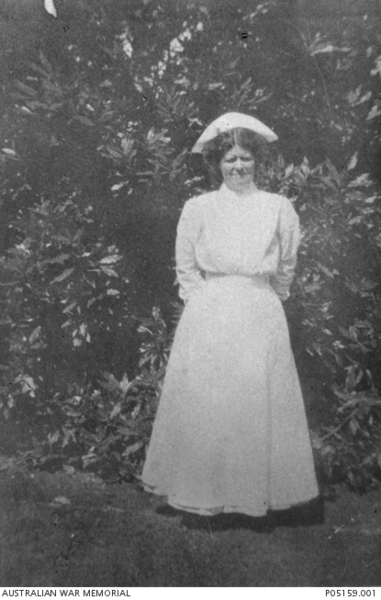
May remained in England for the next 19 months – in what capacity, we do not know. Initially at least she was staying at St. George’s Court on Gloucester Road in Kensington.
Meanwhile, on 30 September 1916 May’s brother Val had joined the AIF as a private. On 22 December 1916 he sailed to England on the Demosthenes and later served in France. Edith had remained in Rabaul until 8 October 1916, and after returning to Australia worked at the Randwick Military Hospital in Sydney before joining the AANS and enlisting in the AIF. She departed Australia in February 1917 and sailed via South Africa to England, arriving in April. After three weeks’ leave, she reported for duty at No. 3 Australian Auxiliary Hospital in Dartmouth. One hopes that she had an opportunity to meet May.
RETURN TO AUSTRALIA
In April 1917 May applied to AIF Headquarters in London for passage to Australia on a hospital ship. She was clearly still unwell. Finding a place on a hospital ship to Australia was a more difficult proposition than might be expected, and it was not until mid-July that she departed. Less than a month earlier, on 26 June, her mother had died at Harvey’s Creek and was buried at Gordonvale Cemetery.
It is possible that May had been given a berth aboard No. 2 Australian Hospital Ship Kanowna, which departed England on 16 July and arrived in Melbourne on 11 September. By then May was too ill to continue to Sydney and was disembarked and taken to No. 5 Australian General Hospital (AGH) on St Kilda Road, otherwise known as the Base Hospital. She died at around 2.00 am on the morning of 4 October 1917.
FUNERAL
On 5 October May was buried with full military honours at Coburg Cemetery, becoming the first Australian woman accorded this honour.
In the presence of large crowds, the funeral procession left the Base Hospital shortly after 11.30 am. It was led by the Domain Band, with muffled drums and instruments. The big drum and the side drums were draped in black crepe; and the drum major, whose staff was also draped in black crepe, walked behind instead of leading the band.
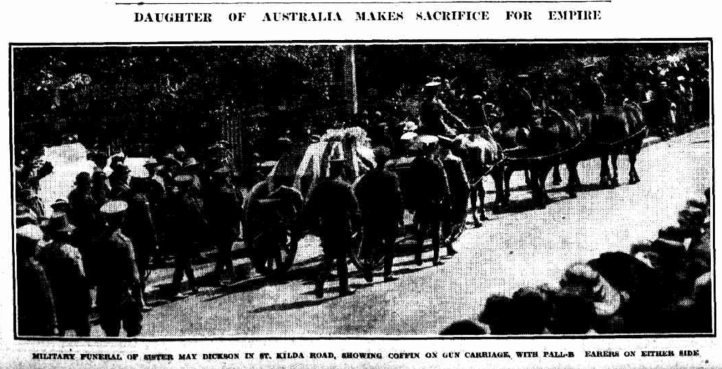
May’s coffin was placed on the carriage of an 18-pounder field gun and was covered with the Union Jack. Resting on the coffin lid were her cape and cap as well as a beautiful wreath, and the gun carriage was drawn by six black horses, controlled by soldiers who rode as postillions. About a score of non-commissioned officers and privates representing the male orderlies of the Base Hospital followed. The non-commissioned officers, who took their places on each side of the coffin, were the pallbearers. They were all returned soldiers, and some had been nursed by May in England.
Following the gun carriage was a car laden with wreaths and carrying representatives of the QAIMNSR. Then came cars carrying staff nurses, sisters and matrons of the Base Hospital; Lieutenant Colonel J. Steele, Acting Principal Medical Officer of the Base Hospital; Captain G. Sykes, representing the Director-General of Medical Services; and the chief mourner, one of May’s aunts, who was accompanied by Chaplain-Captain Thomson of the Presbyterian Church.
As the cortege passed slowly along St. Kilda Road and then Elizabeth Street and Sydney Road to the Coburg Cemetery, the strains of Handel’s ‘Dead March’ brought tears to the people lining the route.
Chaplain-Captain Thomson conducted the service at the graveside, and a firing party fired the customary volleys over the grave. Then a bugler sounded ‘The Last Post,’ and May was laid to rest.
We will not forget her.
POSTSCRIPT
After serving with No. 3 Australian Auxiliary Hospital in Dartmouth until January 1918, Edith Dickson was transferred to No. 3 AGH in Abbeville, France. Things were quiet until towards the end of March, after the German Spring Offensive was launched, when the hospital in effect became a casualty clearing station, with very few cases staying any length of time. At the end of March Edith was transferred to No. 25 British General Hospital in Hardelot and in May she reported to No. 5 Stationary Hospital in Dieppe. In October she was attached to No. 1 Group Clearing Hospital in Sutton Veny, England, where staff had their hands full treating influenza cases. Finally, in April 1919 Edith was transferred to No. 1 AGH in Sutton Veny before returning to Australia.
Edith went on to have a long career with the New South Wales Department of Public Health and in July 1950 retired from her position as Matron of State Hospitals and Homes.
Mary Timms returned home to Australia in August 1919 after four years’ service with the QAIMNSR. After staying at Grantham for some time with May, she had been posted to No. 7 General Hospital (GH) in St. Omer, France before being transferred to No. 3 GH in Le Tréport in September 1916.
In March 1917 Mary was posted to No. 61 Casualty Clearing Station (CCS), originally known as the 2/1st South Midland CCS. At the time of her posting the unit was based in Puchevillers, France, and in May moved to Dernancourt on the Somme. In early June No. 61 CCS moved to Belgium and established its hospital in the Trappist abbey of Sint-Sixtus, near the village of Proven, 15 kilometres east of Ypres. It was ironically dubbed ‘Dosinghem’ by the British.
On the evening of 17 August, during the Third Battle of Ypres, No. 61 CCS was bombed. One bomb fell on the nurses’ mess, destroying it totally and killing the nurses’ cook. Cups, crockery etc. were strewn all over the nurses’ compound. Had the attack happened later that night, during supper time for instance, many nurses would have been killed. As it was, three were injured, one losing an eye, and at least one medical officer was badly wounded. Five bell tents had to be replaced the following day. The German bombers returned each of the next three nights, the night of 20 August being particularly bad, with more deaths resulting.
In September Mary was transferred back to France, to No. 11 Stationary Hospital (SH) in Rouen. She was safe once again but missed serving close to the front. In a letter to her brother, part of which was printed in the Goulburn Evening Penny Post on 26 March 1918, she wrote “I wish I were back [at No. 61 CCS] again. One feels she really is doing something there; it is fine.”
In March 1918 Mary was appointed to the rank of acting sister and for the rest of the year passed through numerous hospitals: No. 41 SH in Amiens, No. 56 CCS in Gézaincourt, No. 12 SH in Saint-Pol-sur-Ternoise, No. 56 CCS again, and No. 4 GH in Camiers. In May 1919 she returned to England and was posted to the Kitchener Hospital in Brighton while awaiting passage home. Finally, on 9 July she departed for Australia aboard the SS Friedrichsruh and arrived in Fremantle at the end of August.
SOURCES
- Ancestry.
- Australian War Memorial, Official History, 1914–18 War: Records of A. G. Butler, Historian of Australian Army Medical Services, AWM41 963 – [Nurses Narratives] E. B. Dickson.
- Ford, H. (2025, 4 Oct), “May was working in Sth Africa at the outbreak of war…” (Facebook comment, Australian War Nurses, 4 Oct 2025).
- The National Archives (UK), Mary Charlotte Timms, WO 399/8349.
- The National Archives (UK), May Dickson, WO 399/2228.
- Sea Witch Images, ‘SS Benalla.’
- Wellcome Collection, Album of photographs of the 2/1st South Midland Casualty Clearing Station, later called No. 61 Casualty Clearing Station, in training, March 1915-March 1916, and on the Western Front, July 1916–Nov 1918, RAMC/1341.
SOURCES: NEWSPAPERS AND GAZETTES
- The Argus (Melbourne, 5 Oct 1917, p. 6), ‘Death of Army Nurse.’
- The Brisbane Courier (1 Jun 1896, p. 6), ‘Recent Certificate Application.’
- The Cairns Post (Qld., 4 Dec 1913, p. 3), ‘Chillagoe Notes.’
- The Cairns Post (27 Jun 1917, p. 4), ‘Family Notices.’
- The Capricornian (Rockhampton, Qld., 23 Apr 1904, p. 30), ‘Late Commercial.’
- The Courier (Brisbane, 12 Apr 1862, p. 6), ‘Classified Advertising.’
- The Darling Downs Gazette and General Advertiser (Toowoomba, Qld., 28 Apr 1866, p. 2), ‘Family Notices.’
- Goulburn Evening Penny Post (NSW, 26 Mar 1918, p. 2), ‘Casualty Clearing Station Bombed.’
- Government Gazette of the State of New South Wales (Sydney, 30 Sept 1927 [Issue No.140 (SUPPLEMENT)], p. 4779), ‘Appointments.’
- Government Gazette of the State of New South Wales (Sydney, 31 Mar 1950 [Issue No.58 (SUPPLEMENT)], p. 961), ‘Retirements.’
- The Herald (Melbourne, 5 Oct 1917, p. 1), ‘With Flag as Shroud, Nurse Goes to Rest.’
- The Maitland Mercury and Hunter River General Advertiser (NSW, 25 Apr 1874, p. 4), ‘Advertising.’
- The Maitland Mercury and Hunter River General Advertiser (NSW, 18 May 1878, p. 4), ‘Family Notices.’
- The Maitland Mercury and Hunter River General Advertiser (NSW, 18 Dec 1879, p. 8), ‘Sauchie House School, West Maitland.’
- New South Wales Government Gazette (Sydney, 13 Sept 1873 [Issue No.214 (Supplement)], p. 2517), ‘Registration of Brands Act of 1866.’
- Northern Star (Lismore, NSW, 24 Jun 1913, p. 4), ‘Personal.’
- The Sydney Morning Herald (8 Jul 1886, p. 6), ‘Clearances. – July 7.’
- The Sydney Morning Herald (31 Dec 1913, p. 17), ‘Trained Nurses.’
- The Telegraph (Brisbane, 16 Mar 1880, p. 2), ‘Divisional Boards.’
- The Telegraph (Brisbane, 17 Oct 1894, p. 4), ‘Insolvency Items.’
- The Telegraph (Brisbane, 28 May 1896, p. 2), ‘Supreme Court.’
- The Townsville Daily Bulletin (Qld., 11 Feb 1931, p. 5), ‘Mr. and Mrs. James Pillar, Tate Tin Mines.’
- Truth (Brisbane, 13 Oct 1907, p. 4), ‘Purely Personal.’
 australianwarnurses.org