Princess Mary’s Royal Air Force Nursing Service │ Sister │ Second World War │ England & the Middle East
CO. DONEGAL, IRELAND
Margery Reid Campbell, known as Maud, was born on 5 November 1906 in Milford, County Donegal – then part of the United Kingdom, now part of the Republic of Ireland.
Maud was the daughter of Margery Stevenson (c. 1879–1953) and William John Campbell (1874–1960).
Margery Stevenson appears to have been born in the United States. Her parents, Margery Reid and Alexander Stevenson, were both from Co. Donegal and migrated to New York soon after their marriage in Letterkenny on 19 July 1866. Following the deaths of his elder son, Thomas, and of Margery, Alexander returned to Ireland with little Margery and his younger son, Scott, and by 20 June 1885 – the day his father died – had taken up farming at Ballygay, just east of Milford.
William Campbell was born at Cratlagh, a locality just west of Milford, to Thomas Campbell, a farmer, and Rebecca Hunter.
William and Margery were married in the Milford Presbyterian Church on 14 May 1903. At the time of their marriage, Margery was living at Ballygay with her father, while William was evidently farming at Malin More, 100 kilometres southwest of Milford.
The newlyweds settled in Milford and on 27 March 1904 their first child, Thomas Alexander, was born. By then, William had opened a grocer’s shop in Milford.
Margery’s and William’s second child, James, was born on 23 March 1905. Sadly he died of acute laryngitis just a year later, on 9 March 1906. Margery was born later that year, on 5 November. Then came Scott Stevenson, on 2 December 1907; Wilhemina, known as Mina, on 30 October 1909; Alec Stevenson, on 5 March 1912; William John, on 14 January 1914; and Hugh, on 18 January 1916.
All the while, William had been a grocer in Milford. However, when the family’s last child, Robert Stanley, known as Stanley, was born on 19 June 1919, William was listed on his birth registration as a farmer in Cratlagh.
MIGRATION TO AUSTRALIA
In 1928 William and Margery were living at Elagh on the northwestern outskirts of Derry/Londonderry, 25 kilometres east of Milford. They had decided to migrate to Australia and on 28 February, having booked their passage to Sydney, departed from London on the RMS Oronsay with Maud, Wilhelmina, Alec, William, Hugh and Stanley. Thomas and Scott would come out later. The ship arrived at Fremantle on 5 March and at Sydney on 11 March.
Initially, the Campbells lived in North Sydney, and between April and July 1928, 12-year-old Hugh attended the Miller Street Public School. By August 1928, however, the family had moved to Western Australia and had settled at Yandanooka, 300 kilometres north of Perth, where Hugh attended the Overland State School. In September 1928 William and Margery took over the property owned by Mr J. S. Watson and previously farmed by Mr Jolly. William began to buy wethers, hoggets and ‘suckers’ (younger lambs). Sometime after 1936 the Campbells moved to Enanty Station, near Mingenew, around 30 kilometres northwest of Yandanooka.
NURSING
By the early 1930s Maud had decided to become a nurse. She was taken on as a trainee at the Perth Hospital and in the mid-1930s gained her certificate, serving thereafter as a staff nurse at the hospital. On 28 November 1935 she became registered in general nursing.
After resigning from the Perth Hospital, Maud was appointed to a position at a private hospital. She left this to undertake midwifery training at the King Edward Maternity Hospital and gained her registration on 29 December 1938. She then began, or had already begun, to train in infant welfare at the King Edward. Upon the completion of her training, Maud would be triple certificated – a prize recruit.
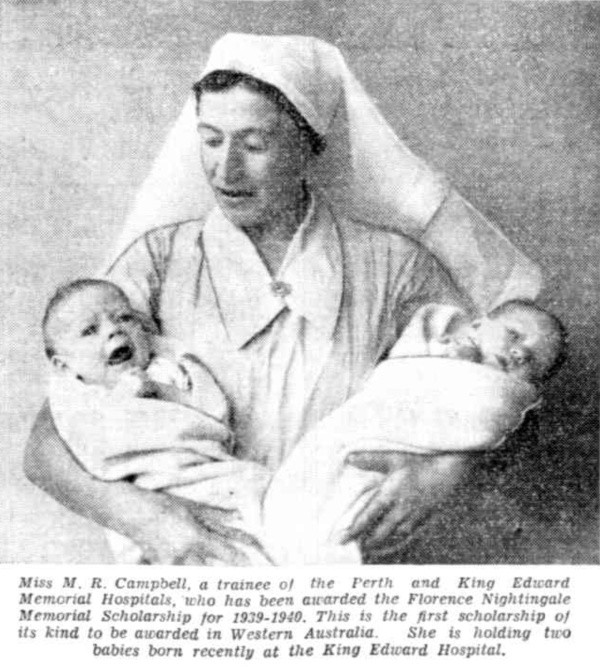
On 13 February 1939, the Western Australian branch of the Florence Nightingale Memorial Committee of Australia (FNMCA), under the auspices of the Florence Nightingale International Foundation in London, decided that the Florence Nightingale Memorial Scholarship for the year 1939–1940 should be awarded to Maud, who was still training in infant welfare. It was the first Florence Nightingale Memorial Scholarship to be awarded in Western Australia.
FLORENCE NIGHTINGALE MEMORIAL SCHOLARSHIP
Under the terms of the scholarship, Maud would travel to London and from 15 August 1939 reside for one year at Florence Nightingale House, 151 Manchester Square – where, since 1934, facilities for postgraduate education for selected nurses from around the world had been maintained and developed. During this time she would attend a course of lectures at the Bedford College for Women, University of London and visit the many hospitals and nursing institutions connected with the course.
The course was designed for prospective sister tutors and hospital administrators and encompassed nursing education, a combined course of the principles of hospital and training-school administration, and the principles of education and methods of teaching.
On the completion of the course, Maud would return to Perth and be appointed a sister tutor at the King Edward Maternity Hospital.
ENGLAND
On Monday 3 July 1939 Maud departed for England on the RMS Maloja to take up her scholarship. Three days earlier the FNMCA (WA branch) along with members of the Florence Nightingale Club and the Australasian Trained Nurses’ Association had held a farewell tea for her at the Florence Nightingale Club clubrooms. Among those present were Lady Mitchell, wife of the lieutenant governor of Western Australia; Mrs A. M. Walsh, president of the Florence Nightingale Club; and Mr. John Nicholson of the Australian Red Cross Society.
After sailing via Colombo, Bombay, Aden, Suez, Port Said, Malta, Marseilles, Gibraltar, Tangier and Plymouth, the RMS Maloja arrived in London on 4 August – and Maud, with a month to fill before her course commenced, took a position in the midwifery block at the Redcliffe Infirmary in Oxford.
The Radcliffe Infirmary was founded in 1770. On 27 January 1941 it became the first hospital in Britain to administer therapeutic penicillin, and in July 1941 the first accident service in Britain began.
Maud was meant to have begun her residence at Florence Nightingale House in London on 3 September 1939. History intervened, and her life took a different path, for that was the day that Britain declared war on Germany. The Florence Nightingale International Foundation was temporarily discontinued, and Maud’s course was cancelled.
Maud stayed on at the Radcliffe Infirmary instead. From the midwifery block she moved to the neurosurgical block and by March 1940 had been appointed assistant sister tutor.
PRINCESS MARY’S ROYAL AIR FORCE NURSING SERVICE
While Maud was working at the Redcliffe Infirmary, she applied to join the Princess Mary’s Royal Air Force Nursing Service (PMRAFNS) as a Reserve.
The PMRAFNS was established as the Royal Air Force Temporary Nursing Service in 1918 and became the Royal Air Force Nursing Service on 27 January 1921. Princess Mary gave her name to the service after she agreed to become its patron in June 1923. Prior to 3 September 1939, the PMRAFNS had 184 Regular nursing sisters and 69 Reserves, plus a pool of 200 Voluntary Aid Detachment workers. Following the declaration of war, no new members were appointed as Regulars; each new recruit entered as a Reserve and remained in her civilian post until called up to serve, in Britain or overseas. By the end of September 1939, 6,000 volunteers had applied for 460 Reserve vacancies.
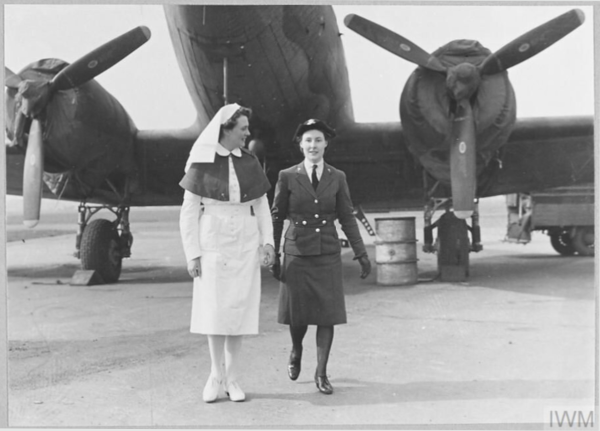
Unfortunately, PMRAFNS service records are held by the UK Ministry of Defence and are unavailable to the public, so we know next to nothing of Maud’s service. She remained at the Redcliffe Infirmary until around August 1940, at which time she was called up for service. She took a holiday in Ireland – no doubt visiting Donegal – before taking up her new duties. She was issued with an indoor uniform of white with a blue-grey cape and white head-dress, and an outdoor (or ‘walking-out’) uniform of tunic and skirt in Air Force blue and was the only Western Australian nurse in the service.
In Wards in the Sky, Mary Mackie, who served as a PMRAFNS nurse (or colloquially, a PM), writes that on call-up, PMs “began a six-month probationary term, at one of the three main RAF hospitals, where [they] learned about service routine and practice, ward administration, and what one new recruit called ‘those wretched forms’. This initiatory period could include specialist training in areas such as infectious diseases, burns treatment, rehabilitation, electrotherapy and thoracic surgery” (Mackie, p. 102).
One of the biggest RAF hospitals was located at Halton, near Aylesbury, where many PMs got their start. It was perhaps here that Maud was sent. At the start of the war, Halton had been used as an initial assessment point for aeromedical evacuations from Europe, and later it became the first hospital in the world to use penicillin on a large scale.
“From her training hospital,” Mary Mackie continues, “the new PM moved on to wherever need arose. It might be a station hospital or a sick quarters, in rural Wales or on the south coast, or up in the windy wilds of north Scotland; it might even be, and increasingly was, some overseas spot that she had never heard of and possibly couldn’t spell, let alone pronounce” (Mackie, p. 102).
The PMs worked long hours tending the sick and wounded. In Britain, the nurses based in station sick quarters looked after the everyday health of serving men and women – treating eyes, ears, nose and throat infections, stomach upsets, hernias, cuts and grazes, varicose veins, blisters and even colds – while those at the large hospitals treated the terrible burns and other injuries of casualties brought from the front by RAF Medical Services units.
For part of her service Maud was posted to the Middle East. Before the war RAF hospitals had been established at Habbaniyah in Iraq and in the British colony of Aden. In 1942 No. 5 RAF General Hospital (GH) opened in Cairo, and in February 1944 No. 3 RAFGH opened in Jaffa, Mandatory Palestine. Based on a cable that William Campbell received in mid-1944 (see later), it was possibly to Cairo that Maud was posted.
MAUD’S BROTHERS JOIN THE SERVICES
In November 1940 Maud’s brother Hugh joined the RAAF Reserve and in July 1941 enlisted in the RAAF. At the time of his enlistment he was working as a farmhand at Enanty Station, William’s and Margery’s farm at Yandanooka.
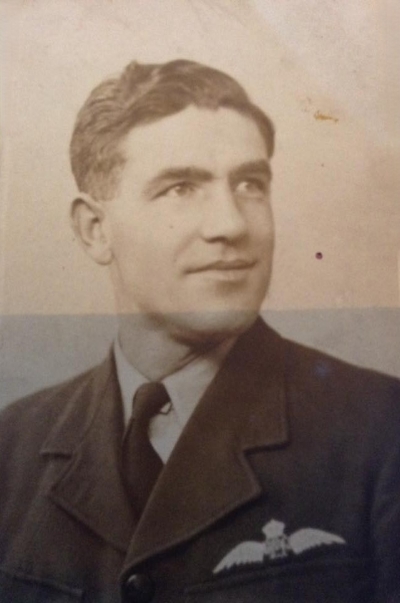
Thomas Campbell enlisted in the army in April 1942 but was found temporarily unfit. He tried again in July but was found unfit due to his history of nervous dyspepsia.
Scott Campbell also enlisted in the army in April 1942 and was found temporarily unfit due to albuminuria. However, he was taken on strength in May and served two years in the Citizen Military Forces in Western Australia.
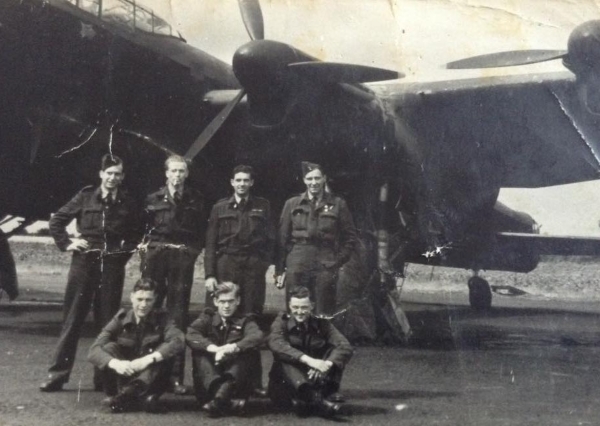
In August 1942 Hugh sailed to England with the RAAF and on 20 July 1943 was posted at the rank of flight sergeant to 103 Squadron RAF, based at Elsham Wolds in north Lincolnshire. From 29 July to 26 November 1943 he and his crew flew 19 successful bombing missions, always in a Lancaster and mostly over German cities, but on one occasion over Milan and on another over Modane in France. Two other missions they could not join, as their Lancaster would not take off, and during another they had to return early due to engine trouble. Their 23rd mission was scheduled for 16 December 1943.
At around 4.30 pm that day, Hugh – now a warrant officer, the highest non-commissioned rank in the RAF – and his crew took off from Elsham Wolds in Lancaster JB658. Their objective was Berlin, as it had been on their previous four missions: in November, RAF Bomber Command had commenced a campaign against Berlin known as the Battle of Berlin. Theirs was one of 483 Lancasters taking part in the raid that night.
The raid destroyed the National Theatre and a building housing military and political archives and inflicted further damage on the Berlin railway system but came at a very heavy cost. Two of the Lancasters had collided soon after take-off, 25 were destroyed over Berlin, and 29 were downed on the return journey. Almost 300 aircrew were killed. Hugh and his crew were among them.
It would appear that Hugh’s aircraft was shot down in the vicinity of Teufelssee in the Grunewald, close to the centre of Berlin, or in the vicinity of Döberitz, a little further west, possibly by night fighter pilot Oberfeldwebel Herbert Altner, possibly by flak.
In late December 1943 Australian military authorities reported that Hugh was “Missing air ops from UK. Missing believed killed target Berlin.” In late February 1944 he was reported “Missing believed killed 16/17.12.43.” By mid-July 1944 his status had changed to “Presumed dead by Air Min w. e. f. 16/12/43.”
This sad news was reported on 29 July in Mingenew’s local newspaper, the Irwin Index, likely the first time that most of Hugh’s acquaintances from Mingenew and Yandanooka had heard of his death.
Hugh is memorialised at the Berlin 1939–1945 War Cemetery.
ASSOCIATE ROYAL RED CROSS
In tragic juxtaposition to the report of Hugh’s death, the 29 July edition of the Irwin Index also reported that William Campbell had received a cable from the Australian Red Cross Society in Cairo advising that Maud had been awarded the Associate Royal Red Cross, also known as the Royal Red Cross, Second Class. At the time she was Acting Senior Sister.
The Associate Royal Red Cross was instituted by George V in 1915 and was a lesser complement of the Royal Red Cross, which was instituted in 1883 by his grandmother, Queen Victoria. Each was awarded to military and civilian nurses for eminent and valuable treatment of military personnel over a long period of time, or for a notable act of bravery during the execution of service.
We know nothing of the circumstances of Maud’s award but can assume that it was well deserved. It was gazetted in London on 8 June 1944.
BACK IN AUSTRALIA
In August 1945 Maud returned to Australia and on 24 August attended a welcome home event held at the Yandanooka Hall for returned service personnel from the district. However, according to the London Gazette of 14 September 1945, “M. R. Campbell (5404)” did not resign her commission from the Princess Mary’s Royal Air Force Nursing Service Reserve until 26 August 1945. It seems improbable that there could be another M. R. Campbell in the PMs, and there may be a perfectly good reason why the dates overlap.
After Maud’s return from England she attended a refresher course in mothercraft and infant health work, which dealt with the latest methods and ideas.
On 15 February 1946 a new departure in infant health work in Western Australia was announced by Dr Eleanor Margrethe (Rita) Stang, supervisor of infant health within the Department of Public Health, who stated that Maud had been appointed to give mothercraft lectures in senior schools and colleges in the Perth metropolitan area, and would also promote mothercraft by writing a series of newspaper articles and appearing in radio broadcasts. Maud was one of only two nurses employed by the department to assist Dr Stang in her infant health work.
The first of Maud’s newspaper articles, titled ‘Guarding Our Children’s Health’ – which then became the name of the series – appeared in the Western Mail on 4 April 1946. Further articles appeared in the same newspaper on 18 April, 2 May, 16 May, 31 May, 13 June, 27 June, 11 July and 25 July, which appears to have been her final article.
We do not know how long Maud remained with the Department of Public Health, but by September 1950 she was working at the Repatriation General Hospital in Hollywood, Perth.
RETURN TO YANDANOOKA
By 31 March 1951 Maud appears to have returned to Yandanooka to live. On that date, her letter calling for the widening of Stephen’s Crossing was published in the Irwin Index. It would seem that she had taken over Enanty Station, her parents’ farm, for on 12 January 1952 the Irwin Index reported that “firefighters proceeded to an outbreak on Enanty Station, the property of Miss M. R. Campbell.” Luckily, the fire was brought under control in an hour, and damage was confined to about 60 acres of stubble.
Possibly retired from nursing, Maud threw herself into community activities. In April 1952 she was voted club adviser of the Mingenew branch of the Junior Farmers’ Federation, and by May 1952 she had become the president of the associates of the Mingenew Golf Club. In that capacity she was invited to drive the first ball of the 1952 season. By March 1953 she had become a committee member of the Mingenew branch of the Silver Chain and Bush Nursing Association. The Mingenew Bush Nursing Centre was scheduled to open in May 1953.
On 8 February 1953 Maud’s mother, Margery Campbell, died at Rosella Hospital in Geraldton. Although her health had not been good for some time, her death occurred somewhat suddenly. She was interred at the Presbyterian Cemetery in Mingenew the following day. William Campbell died on 19 Feb 1960. He was 86 years old.
Maud died on 19 April 1998 at the ripe old age of 91. She was buried at Mingenew Cemetery.
We will remember her.
SOURCES
- Ancestry.
- Australian Broadcasting Corporation, ‘A very special place: Perth’s 99-year-old King Edward Memorial Hospital for Women’ (Emma Wynne, 102.5 ABC Perth, 3 Feb 2015)
- Carnamah Historical Society & Museum (website), ‘Western Australian Nurses 1919–1949.’
- Fell, D., ‘Summary of the History of 103 Squadron, Royal Air Force,’ 103 Squadron – RAF (website).
- Fell, D., ‘W/O Hugh Campbell RAAF and crew – 103 Squadron – RAF Elsham Wolds – 1943,’ 103 Squadron – RAF (website).
- Mackie, M. (2014), Wards in the Sky: The RAF’s Remarkable Nursing Service, The History Press, Kindle Edition. (Originally published in 2001 as Sky Wards.)
- National Archives of Australia, ‘Campbell, Hugh, 415115.’
- Tamblyn, M. (1990), ‘Eleanor Margrethe Stang (1894–1978),’ Australian Dictionary of Biography (originally published in the Australian Dictionary of Biography, Vol. 12, 1990).
- Turner, Shaun, Facebook post to RAF Bomber Command Crews and Aircraft Pictures (Facebook group), 17 Dec 2015.
- Wikipedia, ‘Battle of Berlin (RAF campaign).’
- Wikipedia, ‘Princess Mary’s Royal Air Force Nursing Service.’
SOURCES: NEWSPAPERS AND GAZETTES
- Commonwealth of Australia Gazette (14 Sept 1950 [Issue No.55], p. 2366), ‘Appointments and Retirements.’
- Daily News (Perth, 22 Jan 1941, p. 13), ‘WA Girl in RAF Nursing Service.’
- The Farmers’ Weekly (Perth, 10 Apr 1952, p. 18), ‘Club Activities.’
- The Farmers’ Weekly (Perth, 24 Dec 1952, p. 14), ‘Junior Farmers’ Federation.’
- The Irwin Index (Mingenew, WA, 22 Sept 1928, p. 7), ‘Social and Personal.’
- The Irwin Index (Mingenew, WA, 16 Mar 1935, p. 1), ‘Rural Topics.
- The Irwin Index (Mingenew, WA, 12 Nov 1938, p. 3), ‘Damage in Mingenew District.’
- The Irwin Index (Mingenew, WA, 29 Jul 1944, p. 3), ‘Personal.’
- The Irwin Index (Mingenew, WA, 1 Sept 1945, p. 2), ‘Local and General.’
- The Irwin Index (Mingenew, WA, 7 Aug 1948, p. 2), ‘C. W. A. Activities.’
- The Irwin Index (Mingenew, WA, 31 Mar 1951, p. 5), ‘Mingenew Road District.’
- The Irwin Index (Mingenew, WA, 12 Jan 1952, p. 2), ‘News and Notes.’
- The Irwin Index (Mingenew, WA, 3 May 1952, p. 3), ‘New Season at Mingenew.’
- The Irwin Index (Mingenew, WA, 14 Feb 1953, p. 2), ‘News and Notes.’
- The Irwin Index (Mingenew, WA, 28 Mar 1953, p. 1), ‘Bush Nursing Centre.’
- The Irwin Index (Mingenew, WA, 18 Apr 1953, p. 2), ‘News and Notes.’
- The Irwin Index (Mingenew, WA, 27 Jun 1953, p. 3), ‘Golf.’
- The Irwin Index (Mingenew, WA, 27 Mar 1954, p. 2), ‘News and Notes.’
- The London Gazette (2 Jun 1944, Supplement 36544 [8 Jun 1944], p. 2647).
- The London Gazette (14 Sept 1945, Supplement 37269 [18 Sept 1945], p. 4630).
- The West Australian (Perth, 14 Feb 1939, p. 6), ‘Nursing Scholarship.’
- The West Australian (Perth, 1 Jul 1939, p. 8), ‘Going to London.’
- The West Australian (Perth, 21 Mar 1940, p. 6), ‘A Nurse Abroad.’
- The West Australian (Perth, 21 Mar 1940, p. 6), ‘Roundabout.’
- The West Australian (Perth, 18 Nov 1940, p. 6), ‘Woman’s Realm.’
- The West Australian (Perth, 16 Feb 1946, p. 13), ‘Mothercraft. Lectures to Girls.’
- The West Australian (Perth, 7 Feb 1947, p. 7), ‘Hospital Patient.’
- The West Australian (Perth, 9 Feb 1953, p. 29), ‘Family Notices.’
- Western Mail (Perth, 4 Apr 1946, p. 10), ‘Guarding Our Children’s Health.’
 australianwarnurses.org