QAIMNSR │ Sister │ Second World War │ England, France, Belgium, Scotland, India, Malaya & Netherlands East Indies
FAMILY BACKGROUND
Alice Mary Matilda Ward, known as Mattie, was born in 1899 in the district of Candelo in the Bega Valley, southern New South Wales. She was the daughter of Elizabeth Louisa Spears (1866–1934) and Ernest George Ward (1864–1928).
Elizabeth Spears was born in the district of Eden, 50 kilometres south of Bega. She was the eldest of some nine children and grew up on a farm. Her mother, Mary Bartley (1845–1883), was born in Cooma, 100 kilometres west of Bega in the Monaro. Elizabeth’s father, James Spears (1841–1905), was born in Sydney and by 1864 had moved to Eden.
Ernest Ward was the eldest of 12 children and grew up on the Kameruka Estate in the district of Candelo. His mother, Mary Anne Butler, was born in Ireland around 1842 and in 1845 was transported to Van Dieman’s Land (Tasmania) with her mother and brother, William, on a convict ship. By around 1860 Mary Anne had moved to the district of Tantawanglo, near Candelo, possibly having followed her brother, who had moved to the Monaro a few years earlier.
Ernest’s father, George Ward, was born in Kidderminster, England in 1840 and arrived in Australia as a 12-year-old in 1852. On 6 August 1859, as a 19-year-old cabin boy, he survived the wreck of the SS Admella on Carpenter Rocks off the southern Australian coast near Mount Gambier. Later that year (or in 1862; sources differ) he moved to the Kameruka Estate in the Bega Valley, where he worked as a stockman and overseer for the Tooth family of brewing fame. On 24 December 1863 he married Mary Anne Butler and for many years they lived on the estate in ‘Bembooka House.’ George later purchased ‘Garraween’ in Bemboka township, known as Colombo until 1894. By then he had become a successful dairy farmer and chairman of the Bemboka Co-operative Butter Company.
Elizabeth Spears and Ernest Ward were married on 27 June 1894 in Kiama, 300 kilometres north of Bega. After their marriage they returned to the Bega Valley and (may have) lived at ‘Rosedale,’ a dairy property outside the locality of Mogilla that may have been owned (or leased) by George Ward. In 1897 their first child, Norman Maximillian Ward, was born. He was followed by Mattie in 1899.
Sometime after Mattie’s birth the Wards moved to a property in the locality of Clarkson’s Crossing, halfway between Mogilla and Candelo, and in 1901 or thereabouts Ernest was appointed manager of the Candelo Cooperative Butter Company, which was formed in 1895 and had its separating station on his property.
In 1902 George Ernest Ward was born but tragically died the following year. In 1906 the Wards’ fourth and final child, Kenneth Austin Ward, known as Austin, was born.
In mid-1910 Ernest Ward became seriously ill with measles and pneumonia and at one point nearly died. It took him several months but eventually he recovered. At the time of his illness he was still managing the Candelo Cooperative Butter Company, but in July 1911, after 10 years as manager, he resigned his position. In 1913 the family relocated to the town of Armidale, 800 kilometres to the north, where Ernest had been appointed to a position with the Australian Mutual Provident Society (AMP).
On 20 December 1917 Mattie’s brother Norman enlisted in the Australian Imperial Force (AIF). He sailed from Sydney in June 1918, served in England and France, and returned to Australia safely in February 1920 aboard the Port Napier.
Meanwhile, in mid-1919 the Wards had moved again, this time to the town of Singleton, 300 kilometres south of Armidale, where Ernest had been appointed district inspector for Mutual Life & Citizens Assurance Company Limited (MLC). On 22 December 1919 Ernest’s father, George Ward, died after a long illness. Less than a year later, on 2 August 1920, Ernest’s mother, Mary Anne Ward, died of heart failure while visiting Ernest and Elizabeth at Singleton.
By August 1925 the Wards had moved to Sydney and were living on Cary Street in the suburb of Drummoyne. Ernest Ward died on 12 July 1928, and afterwards Elizabeth moved nearby to 24 Marlborough Street.
NURSING
Mattie was 28 or 29 years old at the time of her father’s death and for five years or so had been working as a nurse.
Sometime after completing her schooling at Armidale State School, where she gained her Qualifying Certificate at the end of 1915, Mattie had decided to become a nurse. She began training at the Maitland Hospital, located 40 kilometres east of Singleton in West Maitland, and on 4 November 1926 became registered in general nursing.
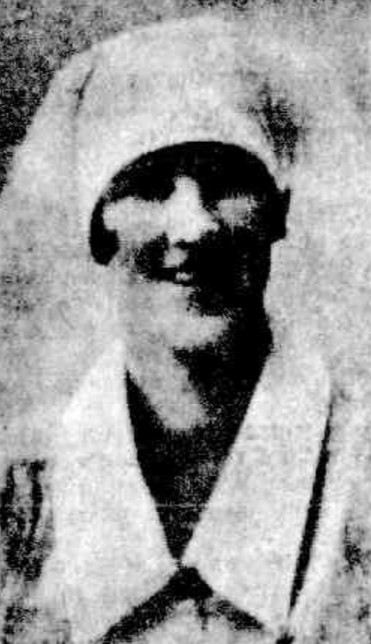
Around May 1927 Mattie was granted leave of absence from Maitland to train in midwifery at the Royal Hospital for Women in Sydney. At a farewell organised for her, she was given a leather travelling case and a bedroom clock by the nurses, a crystal powder bowl by the domestic staff, and a fountain pen by the secretary’s department. After gaining her midwifery certificate Mattie returned to Maitland and became a highly regarded theatre nurse. Perhaps deciding that theatre nursing was her preferred area, she did not become registered in midwifery until 3 April 1930. In that same month she acted as matron, possibly not for the last time.
In May 1931 Mattie was appointed head sister of the new Masonic Hospital under Adeline Victoria Stacey, her former matron at Maitland Hospital. The hospital, on Victoria Street in Ashfield, a western suburb of Sydney, was officially opened on 13 June 1931 with 48 beds.
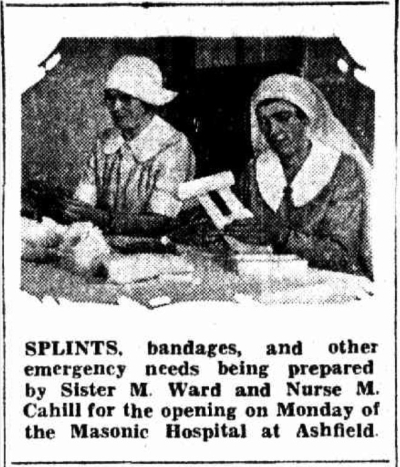
To say goodbye to Mattie, the nursing and medical staff of the Maitland Hospital tendered her a farewell social on Friday 19 June 1931 at the nurses’ quarters, at which many of her friends were also present. On behalf of the staff, Dr Douglas Stewart presented her with a solitaire diamond ring, while a certain Mr J. M. Proctor presented Mattie with a crystal electric reading lamp and a crystal bedroom clock on behalf of her friends. Mr Proctor spoke of the esteem in which she was held and stated that she would be missed by many in Maitland. Mattie was deeply appreciative.
Prior to her farewell party, Mattie had been in hospital in Sydney with a serious throat condition. After being discharged, she had returned to Maitland for a few days in preparation for her move to Sydney.
On 12 April 1934 Elizabeth Ward died at her home in Drummoyne. She was 67. Just over a year later Mattie embarked upon an adventure that led to her service as a military nurse in the Second World War and kept her away for seven years. It is tempting to speculate that her mother’s death, as sad as that must have been for Mattie, also freed her of her daughterly obligation to remain in Sydney.
INDIA
At around 6.00 pm on 20 April 1935, Mattie embarked for Bombay from No. 4 Wharf, West Circular Quay, Sydney aboard the RMS Strathnaver. She was sailing to India to join the Lady Minto’s Indian Nursing Association. Headquartered in Simla, the summer capital of British India in the beautiful foothills of the Himalayas, the association was established in 1906 by Mary Caroline Elliot-Murray-Kynynmound (née Grey), Countess of Minto, a British aristocrat and Vicereine of India, and supplied qualified nurses to British homes in remoter parts of India and Burma, such as those on the tea plantations of Assam, where transfer to hospital was not feasible.
To see Mattie off, a large party of Sydney and Maitland friends and family had gathered in her cabin aboard the Strathnaver, filling it with flowers and presents. In the days prior she had been given a farewell party by Dr Greaves and his family (seemingly in Maitland), at which the doctor presented her with a beautiful necklet.
The Strathnaver sailed via Melbourne, Adelaide, Fremantle – from where Mattie wrote to a Maitland friend saying how much she was enjoying the voyage – and Colombo before arriving at Bombay on 11 May.
Mattie remained in India for the next three years – the standard length of contracted service with Lady Minto’s. Initially she was posted to somewhere “seven thousand feet above sea level, and fourteen hundred miles from Bombay,” as she told a Maitland friend in a letter that was cited in the Maitland Daily Mercury on 27 June 1935 – which would place her in Kashmir, possibly Srinagar. Indeed, two years later, on 26 August 1937, it was reported in the same newspaper that she had fallen ill in Kashmir, which she described as “a wonderspot of the world.”
During periods of leave Mattie travelled widely, visiting many parts of India and gaining valuable experience. At one point she was offered a senior position on the staff of the new Delhi Hospital but declined.
After three years it was time to leave. In a letter to a Maitland friend mentioned in the Maitland Daily Mercury 7 January 1938, Mattie stated that she had had a wonderful time in India but had booked her passage to England and was to leave Bombay on 21 April that year.
ENGLAND
Mattie arrived at Plymouth, England on 15 May 1938 aboard the City of Hong Kong. She travelled to London and met up with Adeline Stacey, her matron at the Masonic Hospital, who arrived in the city on 19 May 1938 on the Orama. They kept company with another nurse from Sydney, Sister McCauley.
The three friends borrowed a Morris 12 car and set off on a touring holiday, travelling 6,000 kilometres through England, Scotland and Wales in six weeks. They found the country very beautiful, particularly Loch Lomond in Scotland and the Lake District in Cumbria. In a letter to a Maitland friend, quoted in the Maitland Daily Mercury on 13 October 1938, Mattie wrote that
the Devon and Cornwall coasts I cannot describe. I really could never have believed you could see such marvellous colouring. The blue of the sea and the pink of the cliffs just left one spellbound.
The nurses visited little fishing villages along the Cornish coast – where driving was difficult, the streets being only wide enough to allow one car – and the old cities of York, Lincoln, Edinburgh, Oxford, Stratford-on-Avon, Bath and Chester, which were most interesting. Mattie then went to Kent and stayed for a few weeks with Dr. and Mrs. Hinksman, whom she had met in India. It was not difficult to get work in England, but she stated that she would probably return to the East. She had promised to stay for a few weeks in Hampshire, Lincolnshire and Surrey.
Having joined the Queen Alexandra’s Imperial Military Nursing Service Reserve (QAIMNSR), in October 1938 Mattie began to work at the Royal Herbert Military Hospital in Woolwich, London. Built for the nearby Woolwich garrison in 1865, the Royal Herbert was the first specially designed military hospital in England and the first to utilise Florence Nightingale’s revolutionary ‘pavilion’ design, whereby light, airy and well-ventilated wards ran off a long central corridor in pairs, one on either side, each pair constituting a pavilion.
After working for nine or ten months, Mattie was granted leave and spent a number of weeks over the summer of 1939 travelling. She went to Ireland, and she travelled to Italy, visiting Genoa, Rome, Capri, Florence and Venice. She then returned to England via Switzerland and France. Before going back to the Royal Herbert, she spent a few days in London, a city of which she never tired. From London she wrote to a friend in Maitland. As reported in the Maitland Daily Mercury on 24 August 1939, she said that she expected to be “transferred to an eastern station shortly” – India perhaps, or even Malaya.
FRANCE
Mattie was not sent to an eastern station after all – at least not yet. Soon after Britain declared war on Germany on 3 September 1939, she was mobilised and sent with the British Expeditionary Force (BEF) to France. She was attached as a theatre nurse to No. 3 General Hospital (GH), which arrived in the village of Offranville, 10 kilometres southeast of Dieppe, on 17 September. Dieppe was a medical hub, from where cross-channel ships would carry sick and wounded to Newhaven for onward transport to base hospitals; two steamers were always kept in the harbour. By the time No. 3 GH opened on 25 November, it consisted of 1,200 beds in marquee tents.
There were many admissions during the months that Mattie spent with the unit. Most were for mild medical conditions, others for accidental injuries. However, for the surgical members of staff, such as Mattie, there was little of interest. Staff knew very little about the general military situation; no doubt the war seemed very far away.
GERMAN INVASION
The calm was shattered at around 3.30 am on 10 May 1940, when Germany launched Fall Gelb (‘Case Yellow’), its invasion of Belgium and the Netherlands. The invasion of the Low Countries was expected by the Allies, and ‘D’ Plan – the forward movement of BEF troops and medical units into Belgium to block the German advance – was put into operation.
Mattie was allotted to a surgical team and sent to Bois-Bernard on the outskirts of Rouvroy, near Arras, where she joined No. 1 Casualty Clearing Station (CCS). Early on Sunday 12 May, No. 1 CCS moved forward to Belgium and at 10.30 am, arrived in Ninove, a small town about 20 kilometres southwest of Brussels. Mattie’s new colleague Sister M. J. Diss described the nurses’ arrival and their new hospital (quoted in WW2Talk):
We arrived at our destination at 10.30 a.m. on Sunday May 12th. This was Ninove, a small town about 20 kilometres S.W. of Brussels, and we eventually managed to find billets, and established a mess. First thing Monday morning, we went to the Hospital. The main building was an evacuated school, which we found would take 100 stretcher cases. The reception station was about 100 yards away behind the school, off a narrow winding cobbled street. This was a [textile] factory, consisting of 2 large buildings (full of machinery), and various offices and outhouses. Here were established the reception rooms, resuscitation ward, operation, dispensary, stores, offices, kitchens etc, X-ray dept, post and pre-operative ‘wards.’ We knew our duties and set about getting the place ready as quickly as possible – everywhere was very dirty, and the school was packed with things left by the children. The theatre was set up, X-ray apparatus established, stretchers made up, instruments sterilised, and water boiled. For the last two items we had to rely on primus and oil stoves, and in the whole school, there seemed to be only one very small tap.
The hospital opened on Tuesday 14 May. Two days later, with German forces bearing down, the BEF made the decision to withdraw to the line of the Escaut (Scheldt) River, and that night No. 1 CCS closed and withdrew from Ninove. With just 20 minutes’ notice, Mattie and the other nurses, some of the medical officers, and the patients were evacuated on No. 4 Ambulance Train, which had arrived unexpectedly on 15 May from Bourg le Herbert, a village near Lille. The other members of staff boarded No. 7 Ambulance Train with as much equipment as possible, leaving a light section behind.
The nurses endured a difficult journey aboard No. 4 Ambulance Train. The Belgian drivers refused to move, the signals and points were destroyed or deserted, and the train was subjected to aerial bombardment for most of the way. It was particularly fortunate to get through Tournai, which was on fire. Finally, on the night of 20–21 May, the train arrived at Dieppe Harbour. “From there it was one continuous retreat until we reached Dunkirk,” Mattie recalled when interviewed in 1942 by the Maitland Mercury (her story appearing in the 18 April 1942 edition). “I left there on a hospital ship laden with wounded, and we were lucky enough to get away without being hit.”
SCOTLAND AND BACK TO INDIA
Upon her arrival back in England, Mattie was given a few days’ rest, then posted for a month to a military hospital in Edinburgh, Scotland.
From Scotland Mattie wrote to friends in Maitland expressing her confidence in an Allied victory. “I had a rotten time,” she wrote in her letter, sections of which were printed in the Mackay Daily Mercury on 17 August 1940,
but count my blessings, as I was right up near Brussels. You have heard all the rest of my story. The news has been rather grim, but we will win; of that I am sure. We have just been unlucky, but it can’t go on.
Mattie had returned from Dunkirk with only the clothes she was wearing, having lost all her kit in the evacuation from Ninove.
In June or July 1940 Mattie returned to London and remained there until being detailed for duty in India around November. She sailed with a large convoy (the largest ever to leave England, according to a newspaper report) and spent around eight months in a military hospital in Madras (today Chennai). On Christmas Day 1940 she wrote to a friend in West Maitland saying that she was thinking of her friends at home and wondering what their Christmas was like.
MALAYA
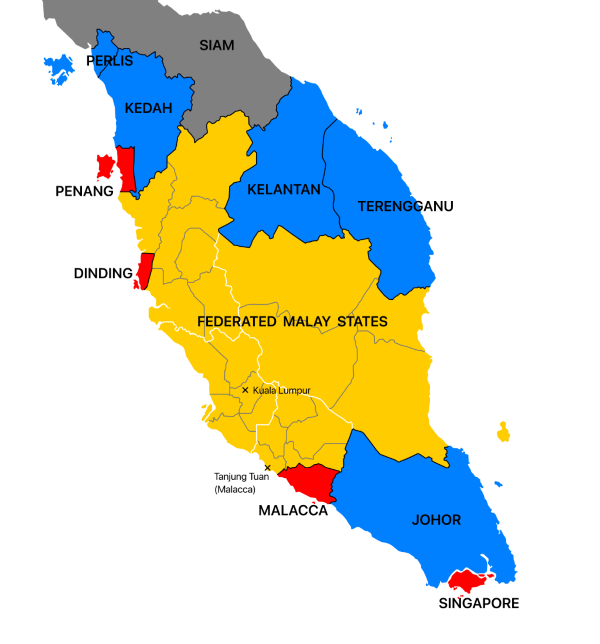
In July 1941 Mattie was posted to Penang, Malaya, possibly with 27 Indian General Hospital, which arrived in Penang in August.
Penang lay off the western coast of the Malay Peninsula and was one of three British territories comprising the Straits Settlements, the other two being the former Portuguese and Dutch colony of Malacca, on the southwest coast of the peninsula, and Singapore Island, off the southern end of the peninsula. The Straits Settlements, the Federated Malay States (Negeri Sembilan, Selangor, Pahang and Perak) and the Unfederated Malay States (Johor, Kedah, Kelantan, Perlis and Terengganu) in turn formed Malaya.
Around October 1941 Mattie wrote to the secretary of the West Maitland branch of the Red Cross Society to express her thanks for the work of the branch towards the war effort. Part of her letter was reproduced in the Maitland Mercury on 1 December 1941:
We are reaping the benefit of what the Red Cross Society is doing. I don’t know what we would have done without it. I used to think it was overrated, but I have completely changed my mind after seeing what it has done, and is still doing, both here and in France.
JAPANESE INVASION
Just seven days after Mattie’s letter was printed, Japan invaded Malaya. At around 12.30 am on 8 December troops from General Yamashita’s 25th Army made coordinated amphibious landings at Kota Bharu in Kelantan State in northeastern Malaya and at Pattani and Singora (Songkhla) in Thailand. At Kota Bharu the 8th Indian Infantry Brigade offered stiff ground resistance, while No. 1 Squadron RAAF bombed and strafed the landing force, but ultimately to no avail, and before long Japanese forces had established a beachhead. Meanwhile, the landings in Thailand were unopposed, and Japanese forces immediately proceeded inland. Then at around 4.30 am 17 Japanese bombers, flying from southern Indochina, attacked targets on Singapore Island, including air bases at Tengah and Seletar in the north of the island. Raffles Place in Singapore city was also hit, killing 61 people and injuring hundreds, mainly soldiers. Elsewhere, Pearl Harbour, Guam, Midway, Wake Island and American installations in the Philippines were attacked and Hong Kong was invaded. Japan declared war on the United States, Great Britain, Australia, Canada, New Zealand and South Africa. The Pacific War had begun.
By then Mattie had been posted to the 20th Combined General Hospital (CGH), also known as the Indian 20th Combined General Hospital, at Taiping in Kedah State in northwestern Malaya. Before the invasion the hospital had 600 beds, 500 for Indian troops and 100 for British.
Although significantly outnumbered, the Japanese 25th Army was superior in all other aspects of warfare: air cover, armour, coordination, tactics and experience. Through the innovative use of bicycles and light tanks, Japanese infantrymen were able to move rapidly through jungle terrain and soon forced British and Indian troops to retreat.
Taiping was on the line of retreat down the west coast, and it was soon decided to relocate the 20th CGH southwards. On 15 December the hospital’s patients, some 600, were evacuated by ambulance train to Tanjong Malim, 200 kilometres south of Taiping, and to Singapore. Meanwhile, the hospital’s surgical team and four nurses proceeded to the civil hospital in Seremban, around 140 kilometres south of Tanjong Malim. On 17 December the 20th CGH moved to Kajang, 40 kilometres north of Kajang, and by 26 December was effectively functioning as a CCS.
“We were the first hospital which had to evacuate,” Mattie told the Maitland Mercury during her interview (published on 18 April 1942).
We were right on the Thai border. During the evacuation another sister and myself were chosen to go on an ambulance train, and we remained on the train, transporting wounded from the front line to the base hospital, until the short-lived siege of Singapore began. During that time the railway lines and railway stations were bombed, and a number of trains hit, but, in my opinion they were not hit intentionally.
With the Japanese thrust down the peninsula proving unstoppable, around 5 January 1942 the Deputy Director of Medical Services, Indian III Corps decided to send the 20th CGH back to Singapore. The hospital relocated to Gilman Barracks, not far from the Alexandra Military Hospital to the west of Keppel Harbour in the south of the island.
By mid-January Japanese forces had reached Johor State, where Australian 8th Division troops were stationed. The gallant Australians took the fight up to Japan but ultimately achieved little, and in the end joined the general retreat to Singapore. By the end of the month Commonwealth personnel had crossed Johor Strait to Singapore, and the causeway spanning it was blown in two places.
Mattie continued (Maitland Mercury, 18 April 1942):
When the causeway separating Singapore from Malaya was blown up and trains were no longer necessary, I rejoined my unit, which had set up a new hospital at the Gillman barracks at Singapore, and remained there as ward sister and theatre sister until orders suddenly came that we were to leave.
EVACUATION OF THE NURSES
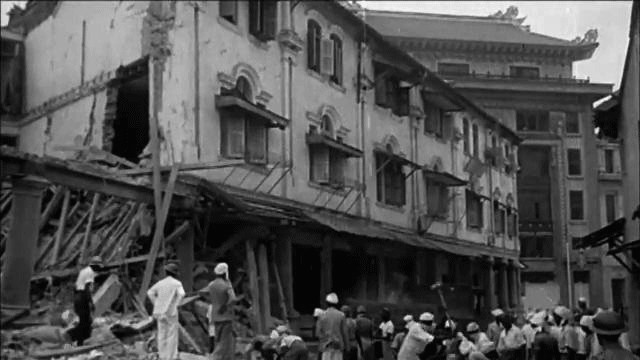
Like their Australian peers in the Australian Army Nursing Service (AANS), the nurses of the QAIMNS, the Territorial Force Nursing Service and the Emergency Military Nursing Service began to be evacuated. On Tuesday 10 February Mattie was among the first to leave. She and other nurses from the 20th CGH were given 15 minutes to get to Keppel Harbour and join a hospital ship. On the way to the docks they were under constant machine-gun fire, while bombs rained all around them, tearing up huge craters wherever they struck, and adding to the inferno of noise, dust and smoke.
Mattie again (Maitland Mercury, 18 April 1942):
The Japanese were only a mile behind the hospital when we got out, and the whole place was in flames. It was like some fantastic nightmare, or a scene from Wells’ ‘Shape of Things to Come.’ The docks were ablaze from end to end, and the roar of the flames merged eerily with the crackle of machine-gun bullets, the whine of bomb and the crazy clatter of ships anchors and the wail of sirens.
At Keppel Harbour the 20th CGH nurses met up with peers from other units and boarded the Wusueh. Built in 1930 for the China Navigation Company to ply the Yangtze River between Shanghai and Yichang, the flat-bottomed, twin-screw cargo vessel with room for 220 passengers was requisitioned by British authorities in April 1941 to carry troops between Singapore and Penang. Later in the year the Wusueh was refitted as a hospital ship, complete with an operating room, wards, dispensary, and even a padded cell. However, although it was painted white with red crosses, the Wusueh had not been internationally registered as a hospital ship and as such was not protected under the Hague Convention on Hospital Ships.
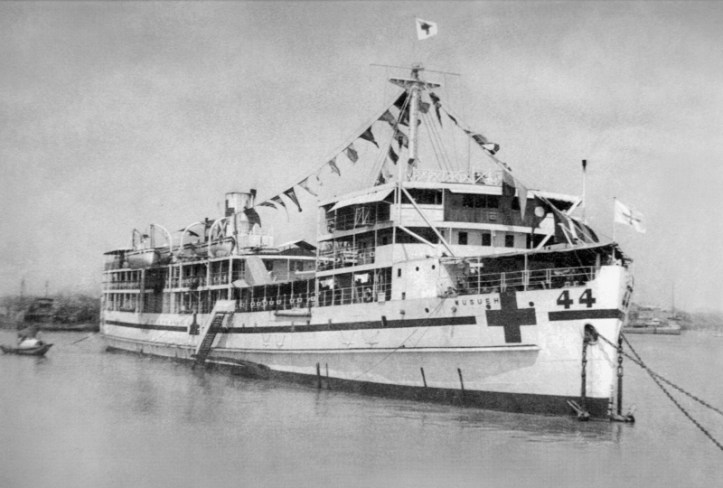
The Wusueh “was loaded to the gunwale almost with wounded, and a puff of wind would have blown it over,” Mattie recalled during her Maitland Mercury interview (printed on 18 April 1942). On board there were perhaps 350 wounded men, including around 150 Australian 8th Division troops, a few RAAF men, and scores of British and Indian troops. They were lying densely packed in the hold and all over the deck. There were also a number of women and children, and six AANS nurses attached to the 2/10th Australian General Hospital (AGH) – Thelma Bell, Molly Campbell, Veronica Dwyer, Iva Grigg, Violet Haig and Aileen Irving. They were the first of 131 AANS nurses to be evacuated from Singapore. Sixty departed on the Empire Star on Wednesday 11 February, while the final 65 left on the ill-fated Vyner Brooke on Thursday 12 February.
The Wusueh remained tied up at the wharf for many hours. Finally, after the captain received a warning from Japanese authorities to move away or face being attacked, the ship steamed out into the roadstead beyond Keppel Harbour, where it stopped again. Japanese aircraft then bombed the harbour, shattering the wharf from which the Wusueh had recently embarked. That night the ship was lit up by the burning waterfront.
Eventually, either on Wednesday night 11 February or Thursday morning 12 February, the Wusueh set off in loose convoy for Batavia, the capital of the Netherlands East Indies on the island of Java. “[Japanese] planes flew overhead, but instead of bombing, the pilots waved us on,” Mattie recalled (Maitland Mercury, 18 April 1942). At one point the Wusueh came across two burning ships. The captain steamed over to see if he could assist, but as no one could be seen it was assumed that the passengers and crew had got away. At this juncture, a passing Japanese cruiser turned its searchlights on the Wusueh. “[It] could have sunk us without trouble had it desired. However, it, too, allowed us to pass unmolested.”
BATAVIA AND BANDUNG
On Sunday 15 February – the day that Singapore fell to the Japanese – the Wusueh arrived at Tanjung Priok, the port of Batavia. The harbour was crowded with all manner of vessels, some of which had departed Singapore in the city’s final days and had managed to evade Japanese attacks.
The casualties were disembarked and taken to military hospitals. For the time being they were stuck in Batavia, but many would end up being transported to Colombo in Ceylon – some once again on the Wusueh, and some on other ships, including HMT Orcades and HMHS Karapara.
Meanwhile, Mattie and her fellow QAs had also disembarked. According to Mattie’s recollections as presented in the Maitland Mercury on 18 April 1942, the nurses helped to set up and staff a hospital in conjunction with the six AANS nurses. However, no sooner had the hospital been established and about 200 patients taken in than orders came to pack up again. After spending the night on board an unnamed ship, the QAs departed inland for Bandung. They had only been there for two hours when they received instructions to return to Batavia. From there they were brought to Australia aboard HMT Orcades.
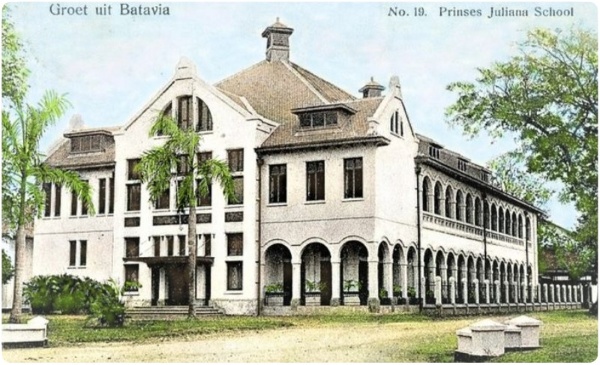
The six 2/10th AGH nurses later recounted events a little differently. After disembarking from the Wusueh, they were taken to the Princess Juliana School, a Catholic girls’ school located at Weltevreden in central Batavia, around 10 kilometres south of Tanjung Priok. There they assisted the Ursuline nuns, who had established a hospital.
On Monday 16 February HMT Orcades arrived at Tanjung Priok from the Middle East via Ceylon and Sumatra. Among the units on board the ship was the 2/2nd CCS (whose chief surgeon, Lt. Col. Edward ‘Weary’ Dunlop, would later become known throughout Australia). There were eight AANS nurses with the unit – Mary Finlay, Vera Hamilton, Margaret Marshall, Vida Paterson, Phyllis Pym, Marcia Thorpe, Mary Wallace and Heather Wilson. After waiting in the roadstead overnight, the Orcades moved inside Tanjung Priok harbour on 17 February and pulled up to a wharf. Disembarkation of the military personnel on board commenced that afternoon and continued throughout the following day. Finally, on 19 February, with Batavia now under Japanese air attack, the staff of the 2/2nd CCS disembarked. They were tasked with setting up the 1st Allied General Hospital at Bandung, an elevated town located 150 kilometres southeast of Batavia, and entrained the same day accompanied by Mattie, the other QAs, and the six 2/10th AGH nurses.
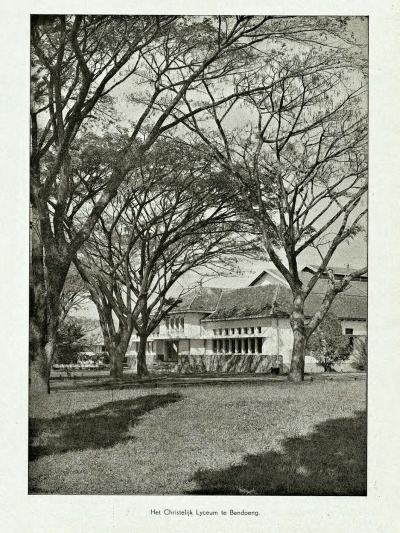
After arriving in Bandung, the staff of the 2/2nd CCS converted an RAF hospital that was already operating in the Christelijk Lyceum (‘Christian Lyceum’), a high school on Dagoweg, into a well-equipped and well-supplied 1,200-bed general hospital.
ANOTHER EVACUATION
By now Bandung was under air attack too, and it was decided that the nurses should be evacuated. A Japanese invasion was feared, and Dutch women and children were beginning to leave. On 21 February Mattie, the other QAs, and the 14 AANS nurses entrained for Batavia, travelling in cattle trucks due to the demand for places on board. In Batavia they were told that the Orcades was about to leave for Colombo, from where it would sail to Australia. The ship’s captain agreed to take them on board and gave them two hours’ notice to get ready. In the end, the ship sailed in such a hurry that their hastily packed luggage was left behind on the wharf.
The nurses arrived in Colombo on 27 February in their working uniforms – Mattie in her distinctive grey and red QAIMNS uniform, with its flowing cape and close-fitting cap – plus a tin hat and gas mask, and not much else. The wounded and sick on board the Orcades were disembarked and taken to the 2/12th Australian General Hospital (AGH) at Welisara, just outside the Ceylonese capital. After that, the Orcades remained at port until 2 March.
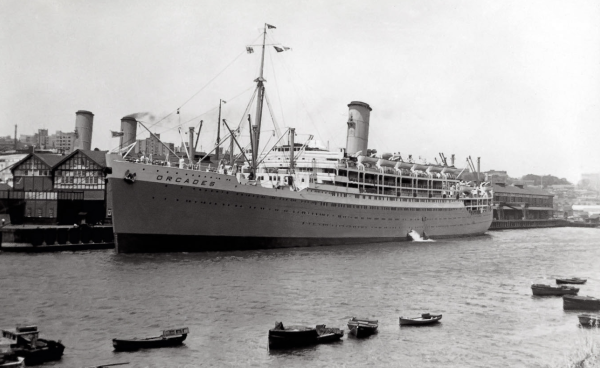
On 2 March the Orcades departed Colombo for Australia. On board were Mattie and the 14 AANS nurses but it is not known what became of Mattie’s fellow QAs. They may have been posted to a British hospital in Ceylon or transshipped to India or even England.
HOME AT LAST
On Saturday 14 March 1942 the Orcades arrived at Port Adelaide. After seven years Mattie was back in Australia. The 2/2nd CCS nurses disembarked the same day (and arrived in Melbourne on 18 March) but the 2/10th AGH nurses and possibly Mattie did not disembark until 15 March. The following day they entrained for Melbourne and arrived at Spencer Street Station on Tuesday 17 March.
It was cold and bleak in Melbourne, and nobody from Army Headquarters on St. Kilda Road was at the station to greet them. They were, however, met by Red Cross volunteers, who gave them warm clothing and toiletries. The six AANS nurses then reported to Victoria Barracks on St. Kilda Road, where Principal Matron Gwladys Parker Field gave them a dressing down for being out of uniform! it is not known whether Mattie went along as well.
On Tuesday evening Mattie, Thelma Bell and Vi Haig entrained for New South Wales and Iva Grigg for Queensland. After the train arrived in Sydney the following day, Iva continued to Brisbane and on 19 March presented herself at the Principal Matron’s office. Mattie, meanwhile, was back in her home state.
BACK IN MAITLAND
Upon her return to Sydney Mattie spent a fortnight recovering at the 113th AGH at Concord and was then given three weeks’ leave, which she spent on the Manning River visiting a certain Lilian Malcolm (née Horn), and in West Maitland. It was during this time that she was interviewed by the Maitland Mercury, her story appearing on 18 April 1942. Various passages have been quoted already, but this is how the report began:
Probably no nurse in the British Empire, and certainly none in Australia, has had a more varied experience of active service conditions and front line fighting than Sister M. Ward, trainee at the Maitland Hospital, who is at present holidaying here as the guest of Mrs. Howland, of Rutherford. Sister Ward has visited many countries of the world, and has helped care for the dying and wounded on battlefronts stretching from France to Malaya. She has witnessed scores of deeds of heroism and self-sacrifice, and tells stirring tales of the immortal courage and endurance of those who fought their way but of the hells of Dunkirk and Singapore.
She has seen the Nazis and the Japanese in action, and regards neither as a race of supermen. When tales of the barbarous treatment meted out to Allied prisoners were referred to her she refused either to confirm or deny them, but one extremely interesting disclosure she did make was that the Japanese made no attempt to bomb Red Cross ships leaving Singapore, whereas the Nazis bombed indiscriminately all ships attempting to depart from Dunkirk.
The report then quoted Mattie:
From the experience I have had, and it has been considerable in this direction, I can say definitely that the Japanese do not wantonly bomb hospital ships or trains, unless they are in the vicinity of ammunition trains or ships carrying munitions. We could never have got out of Singapore Harbour alive had they bombed us.… With the Germans at Dunkirk it was a different story. They bombed all ships alike and showed the wounded no mercy. They seemed to delight in mowing down refugees with machine guns and in racing their heavy tanks over the bodies of the wounded.
I don’t think the Japanese are unusually brave or that they welcome death, and I know that the British Tommies and our own boys certainly don’t fear them. They won the battle in Malaya because of sheer weight of numbers, and because it is useless to deny that they are expert at the jungle type of fighting. They were lightly clad and were able to get through the jungle quickly and without noise. Their bombing was very accurate and their pilots are daring, but they encountered no real opposition, and I think it will be a very different story if they ever attack Australia … It is not for me to say why or how Singapore was lost, but I can say that it was due in no small measure to the work of fifth columnists. Frequently it was very difficult for our troops to distinguish between the Japanese, the Malayans and the Indian Gurkhas. The last mentioned, by the way, are marvellous and courageous fighters, who will fight on to the death even after their English officers have been killed.
On 20 April, two days after her story appeared in the Maitland Mercury, Mattie was formally welcomed home at a ceremony held in the mayor’s room at the West Maitland Town Hall. The mayor had some very kind words to say about Mattie and gave her some letters from friends who could not attend, while the president of the West Maitland Red Cross Society gave her a beautiful bunch of red flowers.
Mattie returned to Sydney on 22 April and the following day reported for duty at the Masonic Hospital.
MARRIAGE AND LIFE AFTER NURSING
In May 1942 Mattie married John Malcolm Proctor (1885–1968) – undoubtedly the same “Mr J. M. Proctor” who had presented her with a crystal electric reading lamp and crystal bedroom clock in June 1931. John was from West Maitland in the Hunter region and had previously been married to Myra Caroline Crane, who died in 1940. John and Myra had had (at least) four children.
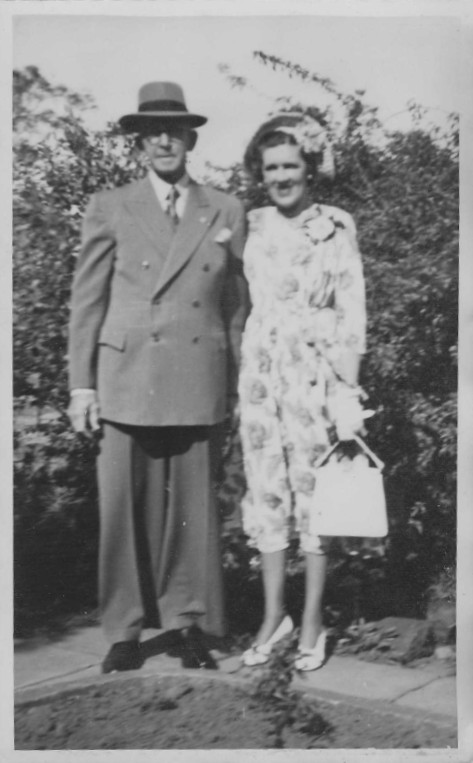
Following her marriage, Mattie appears to have given up nursing and by 1943 was living with John at 62 Queen Street in Rutherford, a town adjacent to West Maitland and now a suburb of Maitland. At the time John was working as a traffic inspector.
Mattie and John remained at the Queen Street address for at least the next 15 years. By 1949 John was working as a railway superintendent and by 1958 had retired.
By 1963 Mattie and John had moved to ‘Kanangra’ on Thurlow Avenue in Nelson Bay, 50 kilometres east of Maitland. In 1968 John died at the age of 82 or 83 in Newcastle.
By 1977 Mattie was living at 58 Thurlow Avenue, presumably the same house as ‘Kanangra.’ By 1980 Mattie had moved to Waratah, a suburb of Newcastle. She died that year.
In memory of Mattie.
SOURCES
- Ancestry.
- Australian War Nurses (website), ‘Escape on the Wusueh.’
- Crew, F. A. E. (1956), The Army Medical Services, Campaigns Vol. I: France and Belgium 1939–1940, Norway, Battle of Britain, Libya 1940–1942, East Africa, Greece 1941, Crete, Iraq, Syria, Persia, Madagascar, Malta. Her Majesty’s Stationery Office.
- Crew, F. A. E. (1957), The Army Medical Services, Campaigns Vol. II: Hong Kong, Malaya, Iceland and the Faroes, Libya 1942–1943, North-West Africa. Her Majesty’s Stationery Office.
- Harrison, A. (ed., 1944), Grey and Scarlet: Letters from the War Areas by Army Sisters on Active Service, Hodder & Stoughton Ltd.
- Lost Hospitals of London (website), ‘Royal Herbert Hospital.’
- Malta RAMC (website), ‘RAMC Officers of the Malta Garrison: George Andrew Douglas Gordon (1909–1997).’
- Museums of History NSW, State Archives Collection, Nurses Index 1926–1954, ‘Alice Mary Matilda Ward.’
- National Archives of Australia.
- Ogier Ward, R. (1958), Thirteen Days on Service in France after Dunkirk, Williams, Lea and Co. Ltd.
- Royal Herbert Pavilions, ‘History of the Building.’
- Wellcome Collection, ‘Brief history of No. 8. Casualty Clearing Station, RAMC, 1939–1940, concentrating on the retreat from Rouvroy to Dunkirk in May 1940, by Lieutenant-Colonel J.R. McDonald, the officer commanding (1941),’ RAMC/1617.
- Wikipedia, ‘Mary Elliot-Murray-Kynynmound, Countess of Minto.’
- Wikipedia, ‘Straits Settlements.’
- Wikipedia, ‘Taiping War Cemetery.’
- Wikipedia, ‘Twenty-Fifth Army (Japan).’
- WikiTree, ‘George Ernest Ward.’
- WW2Talk (forum), ‘No. 1 Casualty Clearing Station, Ninove, Belgium’ (discussion in ‘1940’ started by ‘Dirk’ on 22 Sept 2012).
SOURCES: NEWSPAPERS
- The Age (Melbourne, 18 Mar 1942, p. 3), ‘Women’s Section. Nurses from Singapore: Six More Return.’
- The Armidale Chronicle (NSW, 26 Jan 1916, p. 8), ‘District School Exams.’
- The Armidale Express and New England General Advertiser (NSW, Tue 6 May 1919, p. 4), ‘Local and General News.’
- The Bega Budget (NSW, 30 Aug 1911, p. 2), ‘Local and General.’
- Bega District News (NSW, 16 Apr 1942, p. 2), ‘About People.’
- The Bega Standard and Candelo, Merimbula, Pambula, Eden, Wolumla, and General Advertiser (NSW, 2 Nov 1906, p. 3), ‘Imlay.’
- The Bega Standard and Candelo, Merimbula, Pambula, Eden, Wolumla, and General Advertiser (NSW, 30 Dec 1919, p. 2), ‘Death of Mr. G. E. Ward.’
- The Bega Standard and Candelo, Merimbula, Pambula, Eden, Wolumla, and General Advertiser (NSW, 6 Aug 1920, p. 2), ‘No Title.’
- The Cairns Post (Qld., 30 Mar 1942, p. 3), ‘Queensland Nurses.’
- Daily Commercial News and Shipping List (Sydney, 8 May 1935, p. 6), ‘Shipping Review.’
- The Daily Mercury (Mackay, Qld., 17 Aug 1940, p. 3, ‘“We Will Win”: Australian Nurse Confident of Result.’
- The Daily Telegraph (Sydney, 15 Jun 1931, p. 7), ‘Big Masonic Hospital Opened at Ashfield.’
- The Daily Telegraph (Sydney, 17 Jul 1931, p. 8), ‘No title.’
- The Maitland Daily Mercury (NSW, 2 May 1930, p. 2), ‘Maitland Hospital.’
- The Maitland Daily Mercury (NSW, 3 Jun 1931, p. 4), ‘Personal.’
- The Maitland Daily Mercury (NSW, 20 Jun 1931, p. 4), ‘Popular Nurse.’
- The Maitland Daily Mercury (NSW, 21 Jul 1931, p. 4), ‘Personal.’
- The Maitland Daily Mercury (NSW, 13 Apr 1934, p. 10), ‘Obituary.’
- The Maitland Daily Mercury (NSW, 25 Feb 1935, p. 5), ‘Going to India.’
- The Maitland Daily Mercury (NSW, 25 Apr 1935, p. 3), ‘The Woman’s Corner.’
- The Maitland Daily Mercury (NSW, 9 May 1935, p. 3), ‘The Woman’s Corner.’
- The Maitland Daily Mercury (NSW, 26 Aug 1937, p. 3), ‘Social Doings.’
- The Maitland Daily Mercury (NSW, 7 Jan 1938, p. 6), ‘Sister M. Ward Going to England.’
- The Maitland Daily Mercury (NSW, 13 Oct 1938, p. 4), ‘In England.’
- The Maitland Daily Mercury (NSW, 20 Jul 1939, p. 3), ‘Social Doings.’
- The Maitland Daily Mercury (NSW, 24 Aug 1939, p. 5), ‘Social News.’
- The Maitland Mercury (NSW, 16 Jan 1941, p. 4), ‘In India.’
- The Maitland Mercury (NSW, 1 Dec 1941, p. 3), ‘Nurse’s Tribute.’
- The Maitland Mercury (NSW, 25 Mar 1942, p. 2), ‘At Dunkirk and Singapore.’
- The Maitland Mercury (NSW, 15 Apr 1942, p. 2), ‘Great War Experience of Former Maitland Nurse.’
- The Maitland Mercury (NSW, 18 Apr 1942, p. 2), ‘From Dunkirk to Singapore.’
- The Maitland Mercury (NSW, 20 Apr 1942, p. 3), ‘War Nurse on Leave.’
- The Maitland Mercury (NSW, 23 Apr 1942, p. 4), ‘No Title.’
- Newcastle Morning Herald and Miners’ Advocate (NSW, 6 Jun 1927, p. 6) ‘Maitland District.’
- Singleton Argus (NSW, 26 Aug 1919, p. 3), ‘Advertising.’
- The Southern Record and Advertiser (Candelo, NSW, 27 Jul 1928, p. 1, ‘Local and General.’
- The Southern Record and Advertiser (Candelo, NSW, 3 Jul 1931, p. 1), ‘The Romance of District Dairying.’
- The Sydney Morning Herald (13 Apr 1934, p. 10), ‘Family Notices.’
- The Sydney Morning Herald (16 Apr 1935, p. 1), ‘Advertising.’
- The Twofold Bay Magnet and South Coast and Southern Monaro Advertiser (NSW, 24 Jul 1911, p. 10), ‘Candelo.’
- The Wingham Chronicle and Manning River Observer (NSW, 21 Apr 1942, p. 2), ‘Personal.’
 australianwarnurses.org