RAAFNS │ Sister │ Second World War │ Morotai
FAMILY BACKGROUND
Marie Eileen Craig was born on 6 August 1914 in Balmain, Sydney. She was the fourth of five children born to Jessica (Jessie) Maud Anning (1886–1970), from Hobart, Tasmania, and Alexander Joseph Craig (1884–1934), from Liverpool, England.
Jessie and Alexander, who worked as a labourer, were married in Sydney on 7 December 1907. Their first child, Leslie, was born in 1908 and their second, Alex, in 1910. By early 1911 the family was living at 263 Bridge Road in Forest Lodge, an inner western suburb. John was born in 1912 and Marie in 1914.
In March 1916, with the Great War raging in Europe, Alexander, still working as a labourer, volunteered for service with the Australian Imperial Force. At the time the family was living at 36 Hampton Street in Balmain. It is not known whether he was accepted or not, and a military record cannot be found for him. However, his and Jessie’s fifth child, Harold, was not born until 1920, suggesting that he may have been away.
In 1933 Alexander Craig lost his job of 25 years (broken by the war if he did in fact serve). He became unwell and towards the end of the year was admitted to a psychiatric hospital, where he spent the next few months. On 13 March 1934 he was discharged from the hospital and went to stay at the house of his father-in-law, Alfred Anning, on Talbot Street in Peakhurst, to act as caretaker. A week later Alexander was found in the shed of the house with a bullet wound in his head. He had been mowing the lawn and had gone to the shed ostensibly to put away the lawnmower. A family member found him, presumably Alfred Anning, and called a doctor. Alexander was taken to St. George District Hospital but died soon after.
Marie was 19 years old when her father died so tragically. This traumatic experience must have affected her, her siblings and their mother profoundly.
ROYAL AUSTRALIAN AIR FORCE NURSING SERVICE
In the course of time, Marie decided to become a nurse and in 1938 began training at Royal North Shore Hospital in St. Leonards, Sydney. She graduated on 4 April 1942, gained her certificate, and became registered in general nursing on 7 May. She then undertook private nursing.
Australia was now at war, and on 1 September 1942 Marie applied to join the Royal Australian Air Force Nursing Service (RAAFNS). At the time her address was 140 Victoria Road in Drummoyne, Sydney, where her mother was living with her new husband, Aubrey McCarty, having married him earlier that year.
As Marie’s application was being processed, she undertook obstetrics training at Crown Street Women’s Hospital in Sydney, which she completed on 20 February 1943.
Seven weeks later, on 8 April, Marie had her RAAFNS interview. Her manner of approach was described as “definite, striding, confident,” her deportment “good,” and her appearance “pleasant … businesslike.” She was recommended for a commission at the rank of sister group II.
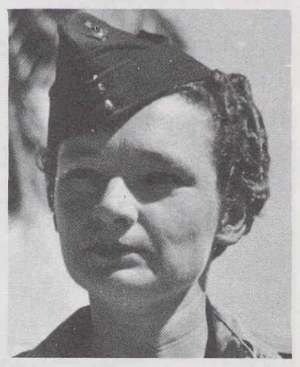
On 6 May Marie had her medical examination and x-ray. She also completed her Application for a Commission form, in which she stated that she was now engaged in private nursing on Talbot Street, Peakhurst – presumably the home of her maternal grandfather, Alfred Anning, who had turned 80 years old.
Marie’s commission was confirmed and approved on 21 May, and the following day she was appointed to the rank of sister group II and posted to 3 RAAF Hospital, which was based at the 113th Australian General Hospital in Concord, Sydney.
On 16 February 1944 Marie was transferred to 1 RAAF Hospital in Wagga Wagga, New South Wales. From 14 to 23 September, she attended No. 2 School of Technical Training in Kingston, Canberra, and on 6 December was transferred to the medical facility at RAAF Station Richmond, in northwestern Sydney.
MAETU
In late 1943 the RAAF proposed establishing an air evacuation unit, known as the Medical Air Evacuation Transport Unit, or MAETU, based on an American model. A MAETU nurse assisted by an orderly would fly to a combat area in a transport aircraft, usually a Douglas C-47 Dakota; select cases suitable for air evacuation, many of whom would be on “litters” (stretchers); supervise their loading; provide in-flight medical care back to base; and supervise their unloading. The patient would then be treated at a field hospital or flown via the clearing hospital at Townsville to an Australian base hospital.
In April 1944 the first training course was held, known as No. 1 MAETU Course for Sisters and Orderlies. Of 100 RAAFNS applicants, 15 were chosen, and upon completion they formed the nursing core of No. 1 MAETU, supplemented by orderlies and other staff. By late August all 15 nurses had been posted to Nadzab, 20 kilometres north of Lae in the Territory of New Guinea. From here they undertook evacuation flights to destinations such as Finschhafen and Tadji in the Territory of New Guinea; Dobodura and Milne Bay in the Territory of Papua; Biak and Wakde off the north coast of Netherlands New Guinea; and Momote on Manus Island, the largest of the Admiralty Islands.
As the war against Japan intensified in New Guinea and the Southwest Pacific, the work of No. 1 MAETU increased to the extent that another unit was needed. In early 1945, No. 2 MAETU Course was advertised, and Marie was among scores of RAAFNS applicants. As with the earlier intake, applicants were required to be between the ages of 21 and 30, weigh no more than 130 pounds (59 kilograms), be at least 5 feet 4 inches (163 centimetres) in height, be medically fit, and be recommended by a commanding officer of a hospital or senior medical officer of the unit to which the nurse was attached at the time of her application.
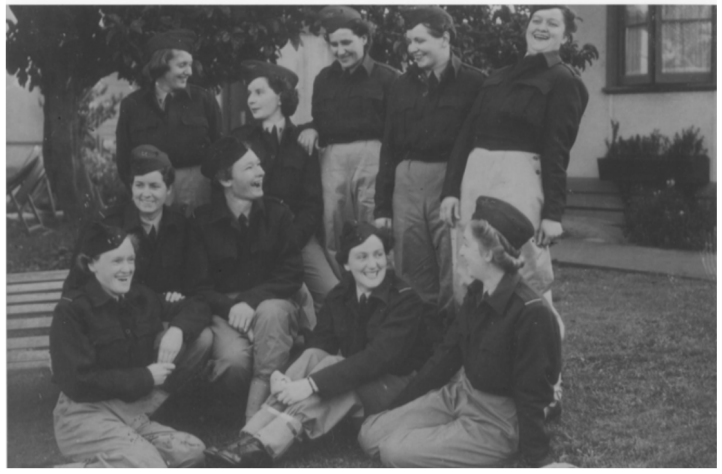
Marie was one of 10 successful RAAFNS applicants. The others were Blanche Due, Joan Rodwell and Gwen Schache from Victoria, Patricia Howard, Jean Menzies and Betty Stafford from New South Wales, Helen Cleary from South Australia, Hilda Davis from Western Australia and Tess du Moulin from Queensland. On 6 April they and 19 male orderlies began training at ‘Janefield’ Hygiene Camp in Preston (now part of Bundoora) in the northern suburbs of Melbourne.
During the two-week course the trainees were given lectures on anoxia, physiology of changes in flight, aircraft recognition, tropical medicine, tropical hygiene, security, altitude medicine, aircraft recognition and loading, and jungle survival, including the preparation and cooking of dehydrated foods. They undertook water survival training, life raft training, swimming testing and even compression chamber testing to ensure their ability to sustain high-altitude flying.
On 19 April the training concluded, and the following day the 10 nurses were attached to No. 2 MAETU, issued with their flying kits – drab slacks, shirt, gaiters, boots, navy wool-lined flying jacket and blue forage cap – and posted for the time being to 2 RAAF Hospital at the Showgrounds in Ascot Vale, Melbourne.
The 10 graduates had anticipated staying together, but on 14 May, Marie, Helen Cleary, Hilda Davis, Joan Rodwell, Gwen Schache and Betty Stafford proceeded to Brisbane by air and four days later flew to the island of Morotai, one of the Halmahera Islands of the Netherlands East Indies. There they joined six nurses of No. 1 MAETU – Senior Sister Margaret Braid and Sisters Alice Budd, Beryl Chandler, Veronica Harbourd, Margo Scott and Margaret Wroe – who had been attached to No. 2 MAETU to provide an experienced base for the six newcomers. Meanwhile, Blanche Due, Patricia Howard, Jean Menzies and Tess du Moulin were attached to No. 1 MAETU, now based in Lae, and departed for New Guinea.
MOROTAI
To begin with, RAAF authorities were poorly prepared for the nurses’ arrival. According to the first Unit History Report, No. 2 MAETU “was operating in a state of flux … The Sisters and orderlies were sent to the unit when no administrative or mechanical needs were provided” (quoted in Dahl, pp. 156–57).
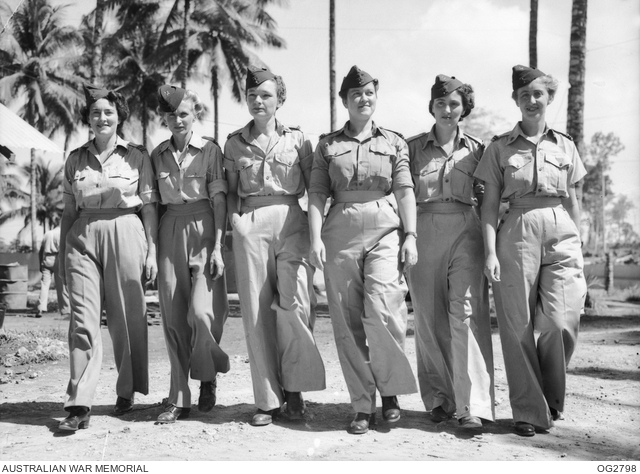
Despite this, within a matter of weeks Marie and her colleagues had flown many hours in forward areas of combat, through difficult flying conditions, and had adapted to their role in the air.
By the start of August 1945, the focus of No. 2 MAETU had fallen on Borneo. In May, Allied forces led by Australia had begun to land on the vast island and soon dislodged Japanese forces from great swathes of it. In late June the first No. 2 MAETU nurses flew to Labuan in the northwest of the island, in July to Tarakan in the northeast, and in early August to Balikpapan in the southeast.
When not flying, the nurses spent their time preparing for their next flight, carrying out rostered duties, attending to domestic chores such as washing and ironing, playing sport, going swimming, or going to the club or the officers’ mess.
A PREMONITION
For a fortnight in August the artist Nora Heysen, one of around 40 official war artists, stayed with the nurses of No. 2 MAETU in Morotai. One day, when she was in the officer’s mess with Marie and Beryl Chandler, she asked Beryl if she could paint her portrait. Beryl was reluctant, so Marie offered to sit instead. Beryl recalled the episode in her memoir:
Miss Nora Heysen … was to spend a fortnight with us at Morotai painting us at work. Writing of these days brings to mind Nora’s painting of Marie and how it came about. Nora had approached me many times to sit for her and for one reason or another I did not want to. One day there was only Marie, Nora and myself in the Officer’s Mess when once again Nora asked me to allow her to paint me. Again I wasn’t keen and dithered whereupon Marie said to Nora, ‘Look Nora, you might as well paint me, I’ll pose for you. This job is going to kill me anyway and at least people will know what Marie Craig looked like.’ I was aghast at this statement, because she seemed to mean it. I remember saying to her, ‘Marie, it is a volunteer job and no one would mind if you transferred to ground duties’ … but she was adamant, she was going to fly on and she was just as sure she was not going to make it home to Australia. ‘No Chan, the writing is on the wall. I am just not going to come through’ (quoted in Willoughby, p. 222).
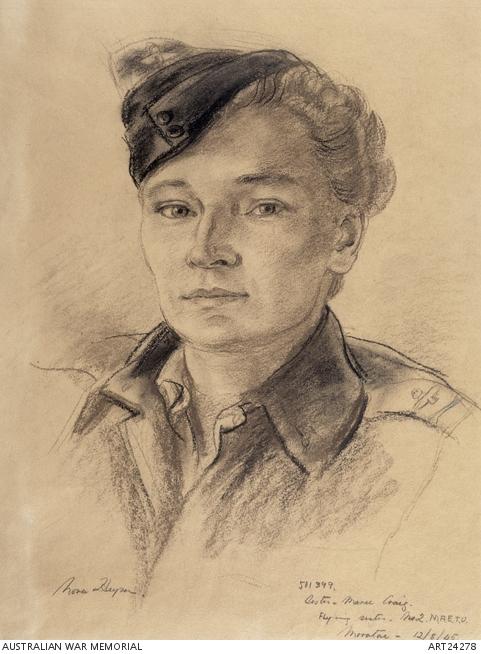
Marie sat for Nora Heysen on 12 August. Nora later sent the portrait to Marie’s mother, and today it is part of the National Collection at the Australian War Memorial.
REPATRIATING PRISONERS OF WAR
On 15 August Emperor Hirohito announced Japan’s surrender, which was formally signed on 2 September. Thousands of Australian prisoners-of-war were now free, and many needed urgent medical care. They began to be concentrated in three locations across Southeast Asia, Singapore, Manila and Morotai, from where they would be repatriated to Australia.
By mid-September No. 2 MAETU, bolstered by extra nursing staff, was operating not only out of Morotai but also out of Singapore, where a detachment had been sent to collect POWs from Malaya and Thailand. Helen Cleary was one of the nurses posted to Singapore. After visiting Changi, she wrote: “I had thought when evacuating battle casualties from the front lines that we were doing an important job, but here was something much bigger, and it was our aim to get the boys back to civilization and decent conditions, where they could be nursed to health as quickly as possible” (quoted in Dahl, p. 175).
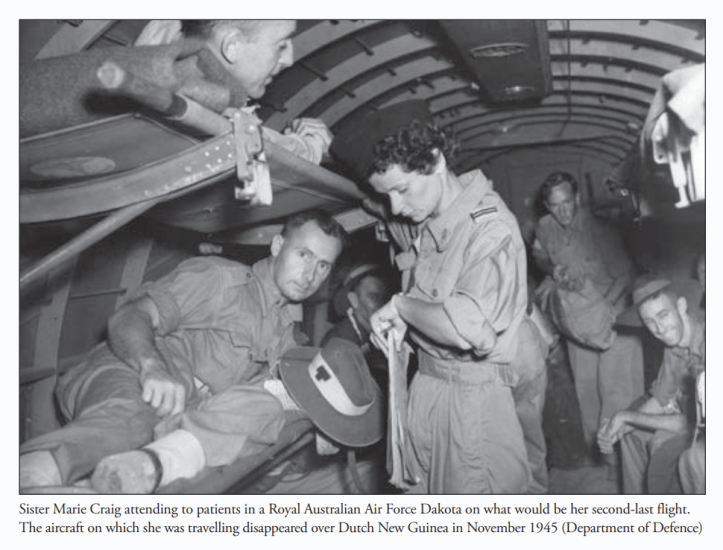
Dakotas would usually carry no more than 27 patients, but with POWs weighing so little, as many as 46 patients could be carried. Although carrying so many made nursing very difficult, the nurses felt that this was better than leaving anyone behind.
On 15 September Beryl Chandler flew to Sumatra with a team that included Major Harry Windsor of the 2/14th Australian General Hospital in Singapore and ABC Singapore correspondent Haydon Lennard. They were hoping to recover 32 Australian Army Nursing Service nurses whose whereabouts in a remote south Sumatran internment camp had been kept secret by Japanese authorities. The nurses were found, and after being extracted on 16 September were flown to Singapore. Only 24 had survived their three-and-a-half-year ordeal.
THE FINAL FLIGHT
At 6.45 am on 18 September aircraft VH-CUT of the 38th Squadron, a Dakota, took off from Wama Airstrip on Morotai with the intention of flying to Merauke on the south coast of Netherlands New Guinea. On board were 18 ex-POW stretcher patients arranged by No. 2 MAETU for medical evacuation to Townsville, with Marie and Sgt. Blackmore detailed for duty as medical escort. Also on board were eight other RAAF personnel – and, as it was subsequently discovered, a young soldier hitching a ride to Townsville.
From Morotai the Dakota would fly to Biak, an island off the north coast of Netherlands New Guinea, and from there to Merauke. Next would be Higgins Field, in the far north of Cape York Peninsula, Queensland, and finally Townsville.
The Dakota never arrived at Merauke. All trace of it vanished between Biak and Merauke. Twenty-eight people – or so it was thought at the time – were lost.
On 24 May 1947, the Governor-General of Australia recommended that Marie be posthumously awarded a Mention in Despatches for services rendered in the Northern Command Area. The citation read as follows: “Sister Craig rendered outstanding service as a flight nurse with No. 2 Medical Air Evacuation Transport Unit before being posted as missing on 18th September, 1945, following the loss of air evacuation aircraft VH-CUT of No. 45 [sic] Squadron, flying from Biak and Higgins Field on the trip from Morotai to Townsville. At all times, she displayed outstanding skill and keenness, and carried out her duties without regard for personal health or safety.”
The award was promulgated in the London Gazette on 15 July 1947 and in the Commonwealth of Australia Gazette on 24 July.
DISCOVERY
In 1968 aircraft wreckage was found at a height of about 4,100 metres on Mt. Carstensz in the Nassau Range of Irian Jaya, Indonesia (today known as Puncak Jaya in the Sudirman Range of Central Papua). It was the Dakota that Marie was on.
It was not until December 1970, however, that a combined RAAF–Army team was able to reach the crash site, so remote and inaccessible was it. Most of the remains of those on board were recovered, and on 26 January 1971 Marie was buried in the Bomana War Cemetery in Port Moresby.
Following an attempt in 1999, the final remains and personal effects, including identification tags, watches and glasses, were recovered in June 2005 by a team from the RAAF and Indonesian Air Force.
On 10 August that year more than 50 of the crash victims’ relatives were flown to Papua New Guinea to attend a funeral service at Bomana War Cemetery. Among the relatives was Dorothy Wall from Melbourne – Marie’s niece. “Marie was revered by my father because she was his special little sister,” Dorothy told Air Force News. “When I became a nurse I wanted to join the Air Force like Marie, but because of what happened to her, my father wouldn’t allow it. To see her personal effects, like her lipstick, still intact after all this time, is absolutely amazing and very emotional for me.” During the service, eight of the POW stretcher patients and three of the RAAF men who had now been positively identified were buried, along with a communal coffin containing remains of other victims. Australian and Indonesian defence force members provided guards of honour, and members of Australia’s Federation Guard fired volleys over the graves. There was a fly-past by a C-130, and a lone bugler played ‘The Last Post.’
SOURCES
- Australian War Memorial, Memorial Articles, ‘A woman interrupted,’ Claire Hunter, 5 July 2019.
- Australian War Memorial, Memorial Articles, ‘Portraits of Angels,’ Alex Torrens, 8 April 2020 (first published in Wartime, Issue 58, Autumn 2012).
- Battle for Australia Association, ‘Marie Craig, RAAF Nurse in the Battle for Australia,’ by Major Eileen Henderson OAM RFD (Retd).
- Dahl, M. (2009), ‘Air Evacuation in War: The Role of RAAF Nurses Undertaking Air Evacuation of Casualties between 1943-1953.’ PhD research thesis, Institute of Health and Biomedical Innovation, Queensland University of Technology.
- RAAF Historical Section (1995), ‘Units of the Royal Australian Air Force: A Concise History, Vol. 8, Training Units,’ AGPS Press.
- Willoughby, A.-L. (2019), Nora Heysen: A Portrait, Fremantle Press.
SOURCES: NEWSPAPERS
- The Age (Melbourne, 8 Sept 1949, p. 2), ‘Mr. McKell to Unveil Plaque.’
- Air Force News (25 Aug 2005, p. 2) ‘Dakota Ghosts Now at Peace.’
- The Argus (Melbourne, 28 Apr 1945, p. 12), ‘More Flying Sisters in Training.’
- Border Morning Mail (Albury, NSW, 26 Sept 1945, p. 2), ‘About People.’
- The Canberra Times (12 Dec 1970, p. 3), ‘Victims named.’
- The Daily Telegraph (Sydney, 29 Apr 1945, p. 29), ‘Flying sisters handpicked.’
- The Maitland Daily Mercury (NSW, 21 Mar 1934, p. 8), ‘Fatal Wound.’
- The Propeller (Hurstville, NSW, 23 Mar 1934, p. 8), ‘Man Shot at Peakhurst.’
 australianwarnurses.org