AANS │ Staff Nurse │ First World War │ Egypt & India
FAMILY BACKGROUND
Kathleen Power, known as Kate and sometimes Kitty, was born c. 1887 in the village of Garrygaug, County Kilkenny, Ireland. She was the daughter Johanna Walsh (c. 1858–1936) and Michael Power (c. 1857–1935), a farmer.
Johanna and Michael were married c. 1885 and over the next 17 years had eight children – Thomas, Kate, Ellen, Walter, Patrick, Johanna (Hannie), Mary and James.
According to one source, Kate attended the Holy Faith Convent School in Mullinavat, a few kilometres to the east of Garrygaug, but nothing more is known of her early life.
NURSING
In time Kate decided to become a nurse. She moved to Dublin and around 1908 was taken on as a trainee at the venerable Dr. Steevens’ Hospital, the second-oldest charitable hospital in the city. After training for four and a half years, she gained her certificate in 1912.
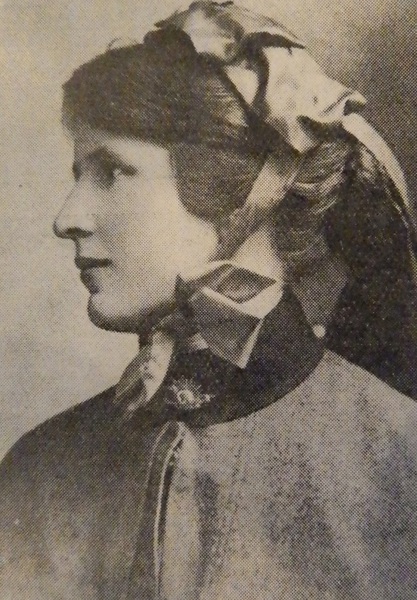
Sometime between 1912 and 1914 Kate moved to Melbourne. She found work at St. Vincent’s Hospital in Fitzroy – or at least resided at the nurses’ home – and may have engaged in private nursing. On 5 February 1914 she became registered with the Royal Victorian Trained Nurses’ Association.
AUSTRALIAN ARMY NURSING SERVICE
On 11 August 1915 Kate filled out her candidates’ application form for enrolment as a nurse in the Australian Army Nursing Service (AANS). By then, the Great War had been raging for a year, and, like many of her peers, Kate wanted to serve.
With her six-and-a-half-years’ experience in the execution of medical orders, Kate was a suitable candidate. She was duly accepted and allotted to No. 10 Australian General Hospital (AGH) as a staff nurse.
On 24 August she and 17 other AANS nurses attached to No. 10 AGH embarked on the RMS Morea at Port Melbourne for what they believed was service in England. The ship had departed Sydney three days earlier with 26 nurses attached to the unit, and six more boarded at Port Adelaide a few days later, making a total of 50.
Among Kate’s new colleagues was Staff Nurse Amy O’Grady, an experienced older nurse from Chewton, near Castlemaine in the central Victorian goldfields. Amy’s parents had both migrated from Ireland, and by dint of this, and the fact that they were two of only six Roman Catholics in the contingent, they may have developed a rapport.
EGYPT
After leaving Port Adelaide, the Morea steamed on for Colombo, having bypassed Fremantle, and on 21 September arrived at Port Tewfik, the port of Suez, in Egypt. No doubt to their consternation, the 50 nurses were now told that they would not after all be going to England but would instead remain in Egypt as reinforcements for Nos. 1 and 2 AGHs in Cairo. For reasons unknown No. 10 AGH had been disbanded before it had had the opportunity to serve anywhere.
Nos. 1 and 2 AGHs had arrived in Egypt in January 1915 on HMAT Kyarra to provide medical services for the 20,000-strong first Australian expeditionary force, which had arrived the previous month. No. 1 AGH, the larger of the two units, established its hospital in the Heliopolis Palace Hotel, in the new garden suburb of Heliopolis, 12 kilometres northeastern of central Cairo. No. 2 AGH took over Mena House, a luxurious hotel situated close to the Pyramids of Giza, southwest of central Cairo.
As patient numbers increased, No. 1 AGH expanded beyond the Heliopolis Palace Hotel into nearby buildings. At first these functioned as overflow wards of the hotel and were administered from there. However, once it became clear that the Gallipoli campaign would result in huge numbers of casualties, the overflow wards were transformed into well-equipped auxiliary hospitals administered from the Heliopolis Palace Hotel. In mid-August, however, they became independent commands but were still staffed through No. 1 AGH. Meanwhile, No. 2 AGH had moved into the Ghezireh Palace Hotel in central Cairo, retaining Mena House as an overflow hospital. Mena House was later mothballed, but in early August it reopened as a convalescent depot.
The 50 AANS nurses disembarked from the Morea and entrained for Cairo, a journey that took between six and 10 hours. Upon arrival they were distributed between the two units, and Kate and Amy both ended up attached to No. 1 AGH. On 23 September Kate was posted to No. 4 Auxiliary Hospital (AH), a specialist infectious diseases hospital established by No. 1 AGH in the Egyptian Military Barracks in Abbassia, on the northwestern edge of central Cairo. We do not know to which of the auxiliary hospitals Amy was posted.
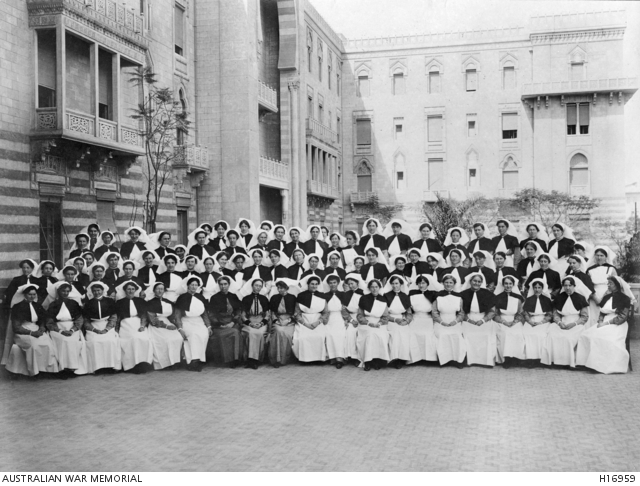
NO. 4 AUXILIARY HOSPITAL, ABBASSIA
No. 4 AH had opened on 7 August, five weeks before Kate’s arrival, and the day before the final attack on Hill 971, the highest point of the Sari Bair Ridge on the Gallipoli Peninsula. The capture of the hill was one of the main objectives of the August Offensive, which was undertaken by the Allies in a final effort to take the high ground on the peninsula and break the stalemate between their forces and those of the Ottomans. The attack on Hill 971 was repulsed with tremendous loss of life, and No. 4 AH received many badly wounded soldiers. Other battles ended in defeat too, and by the end of the month, the August Offensive had proved a costly failure.
Kate arrived at the military barracks in Abbassia to find a hospital of five blocks, each composed of separate buildings, with a total of 450 beds. Separated within the blocks were patients suffering from diphtheria, scabies, meningitis, scarlet fever, measles, chicken pox and mumps, while isolated within the hospital grounds were smallpox patients.
Disease had now become the biggest killer of men on the Gallipoli peninsula, and in October, the number of patients at No. 4 AH increased so rapidly that eight new huts were erected, each hut carrying 54 patients, bringing the total number of beds to 900. Large tents were also erected, and the convalescent patients drafted into these, so that in December the hospital was accommodating 1,200 patients.
The patients wore coloured patches on their khaki coats that indicated their infection. Those with diphtheria wore yellow patches, scarlet fever – red, measles – blue, and so on. The system was established to prevent the excessive mixing of the patients, but the more enterprising among them simply turned their coats inside out.
CHRISTMAS 1915
Christmas was a time for celebration at No. 4 AH. The Gallipoli Campaign was nearly over; the Australian and New Zealand troops had been evacuated from the peninsula, and everyone could now take a brief pause from thinking about the horror and misery of the trenches. In the lead up to Christmas, some of the artistically inclined among the patients bought paints and painted neatly in black and blue the names of the eight huts – Adelaide, Anzac, Brisbane, Canberra, Hobart, Melbourne, Perth and Sydney. And in front of their huts, they sculpted shapes in the sand and decorated them with painted stones.
A Christmas tree fitted with electric lights was erected inside the hospital, and each ward was decorated. Christmas Day dinner was roast turkey and plenty of plum pudding, and each patient received a present from the Christmas tree – a tin containing tobacco, cigarettes, chocolates and several other things, courtesy of the Australian Red Cross Society. At night a concert was held.
Kate remained at No. 4 AH until the beginning of March 1916, by which time the Australian and New Zealand troops had been reorganised as I Anzac Corps and II Anzac Corps. I Anzac Corps was about to transfer to France, and Nos. 1 and 2 AGHs were set to go with it.
NO. 3 AUSTRALIAN GENERAL HOSPITAL, ABBASSIA
Nevertheless, many Australian nurses remained in Egypt, including Kate and Amy, who were both taken off strength of No. 1 AGH. On 1 March Amy was attached to the Military Infectious Diseases Hospital in Choubra, nine kilometres north of central Cairo, while on 12 March Kate was attached to No. 3 AGH, based, like No. 4 AH, at the military barracks in Abbassia.
No. 3 AGH had served on the island of Lemnos from July 1915 until mid-January 1916 – at which point, following the end of the Gallipoli campaign, it had transferred to Egypt aboard the hospital ship Oxfordshire. The unit was then billetted at Mena House for a week before establishing itself in an old Ottoman harem at the Abbassia barracks. In a letter home dated 26 March 1916, Kate’s new colleague Staff Nurse Anne Donnell described the hospital as a “queer funny old home … with barred windows & inside a huge stone wall 20 ft high … The rooms are large & lofty & the old garden at the back when it has had some attention will be a haven of rest when we come off duty in the summer months.”
According to Kate’s military record, on 10 April she was struck off strength of No. 3 AGH, but there is no record of where she was subsequently posted until 11 July, when she was temporarily attached to No. 15 General Hospital, a British military hospital in Alexandria. She did not remain there long. On 22 July Kate was detailed for duty aboard HMHS Devanha, and the following day left Alexandria for Bombay.
INDIA
That same day, 23 July, Amy O’Grady arrived in Bombay with 49 other nurses. They had departed Egypt on 14 July after Australian authorities had offered their services to the Indian government. The nurses were given to understand that they would be treating sick and wounded British and Indian troops invalided to Bombay from Mesopotamia (Iraq) and would serve as a unit. In fact, they ended up being posted to small ‘station’ or garrison hospitals across north India, where they treated local garrison troops. In the meantime, they were staying at the Taj Mahal Hotel, which had been converted into a military hospital.
Kate arrived in Bombay around 1 August and, together with other nurses from the Devanha, was billetted at the Taj Mahal Hotel. The 50 nurses were now beginning to set off for their station hospitals. On 2 August a group of 11 departed Bombay on the 5.00 pm train, and the following day several more departed.
Amy, however, remained behind. She had contracted cholera and was admitted to the isolation unit of the Colaba Military Hospital in southern Bombay. Five medical officers working at the hospital at the Taj Mahal Hotel also contracted the disease.
Before long Kate contracted it too. She was admitted to Colaba Hospital with Amy and died on 13 August. Amy had died the previous day.
Kate and Amy were buried at Sewri Cemetery in the north of the city. Between 1955 and 1960 most of the war graves were moved from Sewri to Kirkee War Cemetery in Pune, today known as Khadki War Cemetery.
Kate is also memorialised on the Kilkenny World War I Memorial, located at MacDonagh Station in Kilkenny, Co. Kilkenny, Ireland.
We will not forget her.
SOURCES
- Ancestry.
- Australian War Memorial, Official History, 1914–18 War, Records of A. G. Butler, AANS nurses interviewed by Matron Kellett (AWM41 1072) – Miss J. V. M. Kennedy.
- Australian War Memorial, Official History, 1914–18 War, Records of A. G. Butler, Nurses’ Narratives (AWM41 988) – Matron A. Kellett.
- Burke, E. K. (ed., 1927), With Horse and Morse in Mesopotamia, Arthur McQuitty & Co.
- Butler, A. G. (1938), Official History of the Australian Army Medical Services, 1914–1918, Vol. I – Gallipoli, Palestine and New Guinea , Part I – The Gallipoli Campaign, Chap. XVI – The Disease Debacle at Gallipoli (pp. 341–73), Australian War Memorial.
- Butler, A. G. (1938), Official History of the Australian Army Medical Services, 1914–1918, Vol. I – Gallipoli, Palestine and New Guinea , Part I – The Gallipoli Campaign, Chap. XVIII Egypt: August to December (pp. 399–427), Australian War Memorial.
- Butler, A. G. (1943), Official History of the Australian Army Medical Services, 1914–1918, Vol. III – Special Problems and Services, Section III – The Technical Specialties, Chap. XI – The Australian Army Nursing Service (pp. 527–89), Australian War Memorial.
- Dr Steevens’ Hospital: A History (website).
- Mitchell Library, State Library of New South Wales, Sister Anne Donnell circular letters, with diary, 25 May 1915–31 Jan 1919, ML MSS 1022.
- National Archives (Ireland), Census records.
- National Archives of Australia.
- Public Record Office Victoria, Royal Victorian Trained Nurses’ Association Nurses Register (VPRS 16407/P0001), No. 3, pp. 1466–2428, 22 Oct 1910–4 Mar 1915.
- Virtual War Memorial Australia, ‘Kathleen Power.’
SOURCES: NEWSPAPERS
- Geelong Advertiser (Vic., 19 Feb 1916, p. eight), ‘Letters from the Front. Pte. L. J. Graves.’
- Sun (Sydney, 5 Apr 1916, p. 5), ‘Australia’s Sick Soldiers: Cricket and Football: No. 4 Auxiliary Hospital.’
 australianwarnurses.org