AANS │ Lieutenant │ Second World War │ 2/3rd Australian Hospital Ship Centaur
FAMILY BACKGROUND
Doris Joyce Wyllie, known as Joyce, was born on 6 September 1916 in St Kilda, Melbourne. She was the daughter of Doris Marion Fischer (b. 1891) and Ernest Percival Wyllie (1890–1982).
Doris Fischer was from Sydney, the daughter of Charles Fischer and Emily Usher. Ernest Wyllie was from Sydney too, but by 1912 had moved to Melbourne and was studying to be an accountant at Stott’s Business College. In October 1914 he passed his final accountancy examination.
Doris and Ernest were married on 17 April 1915 at St. Peter’s Anglican Church in Woolloomooloo, where Doris’s parents had been married 42 years earlier. By then Ernest had gained his credentials and was working as an accountant at the Melbourne branch of the Millaquin Sugar Co. Ltd.
After their wedding, Ernest returned to Melbourne with Doris, and they resided on Austin Avenue in South St. Kilda (today known as Elwood). In November of that year Ernest was given a promotion at Millaquin and was now the manager of the Melbourne branch.
In 1916 Doris and Ernest began their family with the birth of Joyce, and in 1919 her little brother, Alan John, was born. In January 1921 the family moved to Queensland after Ernest was appointed secretary of the Millaquin Sugar Co. and had relocated to Bundaberg, the centre of Australia’s sugar industry.
SCHOOL AND NURSING
In Bundaberg Joyce went to Beresford House Preparatory School and by 1928 was attending Bundaberg High School. In November 1932 she successfully sat the Junior Public Examination and gained an endorsed certificate, having taken English, English History, Geography, Arithmetic, Algebra and Geometry.
After finishing school, Joyce decided to become a nurse. She was taken on as a trainee at Sydney Hospital and departed Bundaberg for Brisbane in January 1935. She then sailed to Sydney. She passed her final examination in November 1938 and by March 1939 had completed her training. She was subsequently appointed to a position at the Royal Prince Alfred Hospital in Sydney.
In May 1940 Joyce became engaged to Lt. Kenneth Reginald Jacob of Adelaide. Germany had just launched its invasion of France and the Low Countries, and thousands of Australian men and women were joining the services. Kenneth Jacob volunteered for service with the Second Australian Imperial Force (2nd AIF) and was posted to the Middle East. Later, following the Japanese invasion of Southeast Asia and the southwest Pacific, he was transferred to New Guinea. On 30 August 1942 Kenneth was killed in action. He was buried on the Kokoda Track between Eola Creek and Alola.
ENLISTMENT
In 1941, a year prior to the tragic event that claimed the life of her fiancé, Joyce joined the Australian Army Nursing Service (AANS) as a staff nurse. After receiving her call up, she enlisted in the Australian Military Forces on 21 November and was posted to the 113th Australian General Hospital (AGH) in Concord, Sydney.
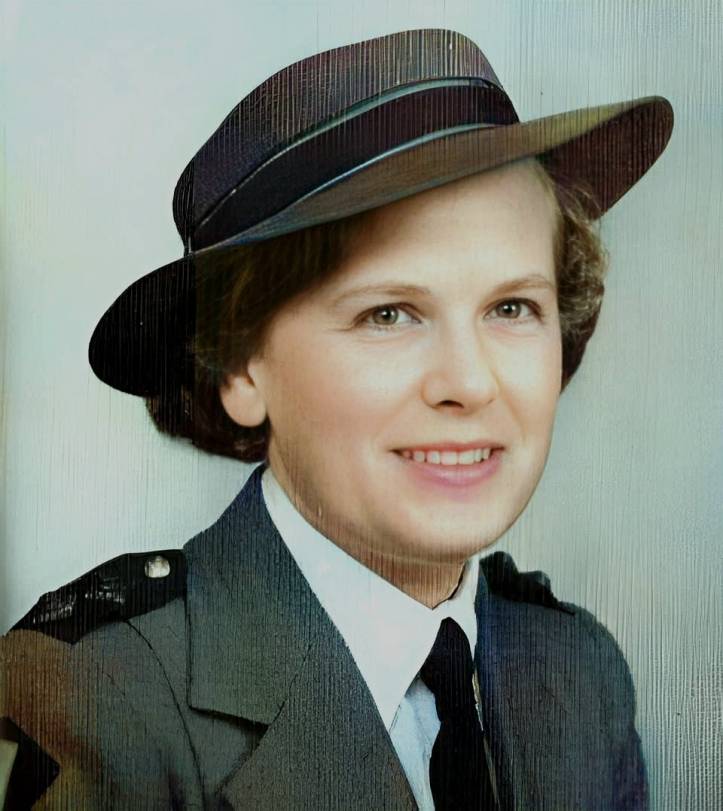
On 22 October 1942 Joyce volunteered for service abroad with the 2nd AIF and in the meantime remained at the 113th AGH. A month later she was promoted to the rank of sister.
2/3 Australian Hospital Ship CENTAUR
In March 1943, after 18 months’ service at Concord, Joyce was detailed for duty aboard a hospital ship, the Scottish-built Centaur. In January that year, had been loaned to the Australian government. After being refitted in Melbourne, the vessel was recommissioned on 1 March as 2/3 AHS Centaur and joined 2/1 AHS Manunda and 2/2 AHS Wanganella in the service of 2nd AIF troops.
On 12 March the Centaur commenced a trial voyage, sailing from Melbourne to Sydney. Five days later Joyce and 11 other AANS nurses – Sisters Margaret Adams, Cynthia Haultain, Eva King, Mary McFarlane, Myrle Moston, Alice O’Donnell, Eileen Rutherford, Nell Savage, Edna Shaw and Jenny Walker, and Matron Annie Jewell – boarded the ship in Sydney along with other members of staff. Eva King, Myrle Moston and Nell Savage had worked with Joyce at the 113th AGH in Concord. On 21 March the Centaur set out for Brisbane on the next leg of its trial.
The trial continued over a number of short voyages until 18 April, when the Centaur returned to Brisbane following a trip to Port Moresby to collect Australian casualties. It had demonstrated its capability and was now ready to go into service proper.
THE FINAL VOYAGE
At 10.45 am on 12 May the Centaur departed Sydney on its first post-trial voyage. The ship’s crew had been tasked with transporting 193 members of the 2/12th Field Ambulance to Port Moresby and then returning with Australian casualties. Once again Joyce and her colleagues were on board.
On the evening of 13 May the nurses celebrated Matron Annie Jewell’s birthday. They had bought a cake in Sydney, which the ship’s cook iced and served as part of a special birthday dinner. The evening concluded at around 10.00 pm and the nurses retired to their cabins.
That night the weather was clear and visibility excellent. The Centaur was travelling unescorted and was fully illuminated and marked with the Red Cross. At 4.10 am, while most of those on board were asleep, a Japanese torpedo slammed into the ship’s hull. The Centaur exploded in a huge ball of fire and sank within three minutes.
Joyce and 10 of her AANS colleagues died that day. Only Nell Savage survived. In total, 268 of the 332 people on board lost their lives, including 178 members of the 2/12th Field Ambulance.
IN MEMORIAM
Joyce’s name is recorded on the Bundaberg War Nurses’ Memorial, which was officially opened by the city’s mayor on 15 October 1949. Also memorialised are Lieutenant Katie Christina Hector, who served in Australia; Lieutenant Dorothy May Christie, who served in Australia and New Guinea; and Captain Pearl Mittelheuser, who served in Malaya and died in a Japanese internment camp in Sumatra three days after Japan’s surrender.
In memory of Joyce.
SOURCES
- Ancestry.
- Milligan, C. and Foley, J. (1993), Australian hospital ship Centaur : the myth of immunity, Nairana Publications.
- National Archives of Australia.
- Walker, A. B. (1961), Second World War Official Histories, Australia in the War of 1939–1945: Series 5 – Medical, Vol. IV – Medical Services of the Royal Australian Navy and Royal Australian Air Force with a section on women in the Army Medical Services (1st edition, 1961), Part III – Women in the Army Medical Services, Chap. 36 – The Australian Army Nursing Service (pp. 428–476), Australian War Memorial.
Sources: newspapers
- The Brisbane Courier (Qld., 15 Mar 1929, p. 10), ‘Bundaberg.’
- Bundaberg Daily News and Mail (Qld., 25 Jan 1935, p. 4), ‘Social and Personal.’
- Bundaberg Daily News and Mail (Qld., 30 Mar 1939, p. 2), ‘Social and Personal.’
- The Bundaberg Mail (Qld., 29 Jan 1921, p. 3), ‘Personal.’
- Empire (Sydney, 2 Dec 1873, p. 1), ‘Family Notices.’
- The Herald (Melbourne, 18 Dec 1914, p. eight), ‘School Speech Days.’
- Punch (Melbourne, 18 Feb 1915, p. 24), ‘Successful Candidates at Accountancy Examination.’
- The Sydney Morning Herald (NSW, 4 May 1940, p. eight), ‘Social and Personal.’
- The Telegraph (Brisbane, 18 Jan 1933, p. 7), ‘Details of Students’ Successes in Junior Public Examination.’
- The Telegraph (Brisbane, 4 Apr 1939, p. 26), ‘Bundaberg Social.’
 australianwarnurses.org