AANS │ Lieutenant │ Second World War │ 1st Netherlands Military Hospital Ship Oranje & 2/3rd Australian Hospital Ship Centaur
FAMILY BACKGROUND
Wendy Walker, known as Jenny, was born on 7 March 1919 in Macedon, Victoria. She was the second of three daughters born to Aileen Whiting (1886–1958) and Major Geoffrey Beresford Casson Walker (1887–1969).
Aileen was from Prahran in Melbourne. Her father, Robert Salmon Whiting, was a wealthy William Street lawyer.
Geoffrey was born in Cork, Ireland. He was the son of Sir George Casson Walker, a Knight Commander of the Order of the Star of India, and had himself been an army officer in India, attached to the 31st Punjabis. Later he became a member of the Indian Police Service.
In early 1916 Aileen and Geoffrey were married in Steyning, a town in Sussex, England. Later that year they travelled to Melbourne, where on 16 December Aileen gave birth to their first child, Elizabeth Sheila, known as Betty.
The family remained in Melbourne, residing in the inner suburb of South Yarra, and in 1919 Jenny was born. Her birth is registered in Macedon, so it is possible that the Walkers were staying on Mount Macedon that summer. They were certainly well off – and socially active too: Aileen and Geoffrey were often mentioned in the society columns of Melbourne’s newspapers.
Sometime after October 1922 the Walker family sailed to England, where they lived in Hove, Sussex. However, after a year or so they returned to Melbourne, embarking from Liverpool on 13 October 1923 on the steamship Ascanius. They returned to South Yarra and this time they stayed.
On 14 October 1925, the Walkers’ third daughter, Robin, was born. Her birth was registered in Sorrento on the Mornington Peninsula, where the family kept a beach house, ‘The Haven,’ where they sometimes stayed for the whole of summer.
EARLY LIFE AND NURSING
Jenny and Betty attended St. Catherine’s School in Toorak. Jenny was evidently a competent swimmer, for in 1934 she came first in the 50-yard breaststroke in the Open division at the school’s annual swimming sports day, held at Malvern baths. She had some writing talent too, and in that same year contributed an article to St. Catherine’s Magazine titled ‘A Pioneer Heroine.’ Jenny’s final year at St. Catherine’s was 1935. The following year she joined the school’s Old Girls’ Association.
After completing her schooling, Jenny decided to become a nurse, and in November 1936 began training at the Royal Melbourne Hospital. At the time Jenny was living at home on Walsh Street in South Yarra.
In March 1940 Jenny sat her final nurses’ examination and by the end of the year had become a registered nurse. By now her parents had moved to 3 Shipley Street in South Yarra. They also maintained a flat in Cliveden Mansions in East Melbourne.
ENLISTMENT
Meanwhile, Europe was at war. In 1941, like so many of her peers, Jenny applied to join the Australian Army Nursing Service (AANS). Her application was accepted on 15 April, and she was appointed to the rank of staff nurse. She was then called up for service and on 30 July enlisted in the Australian Military Forces (AMF). Finally, on 19 August Jenny was attached to the 115th Heidelberg Military Hospital in Melbourne’s northern suburbs.
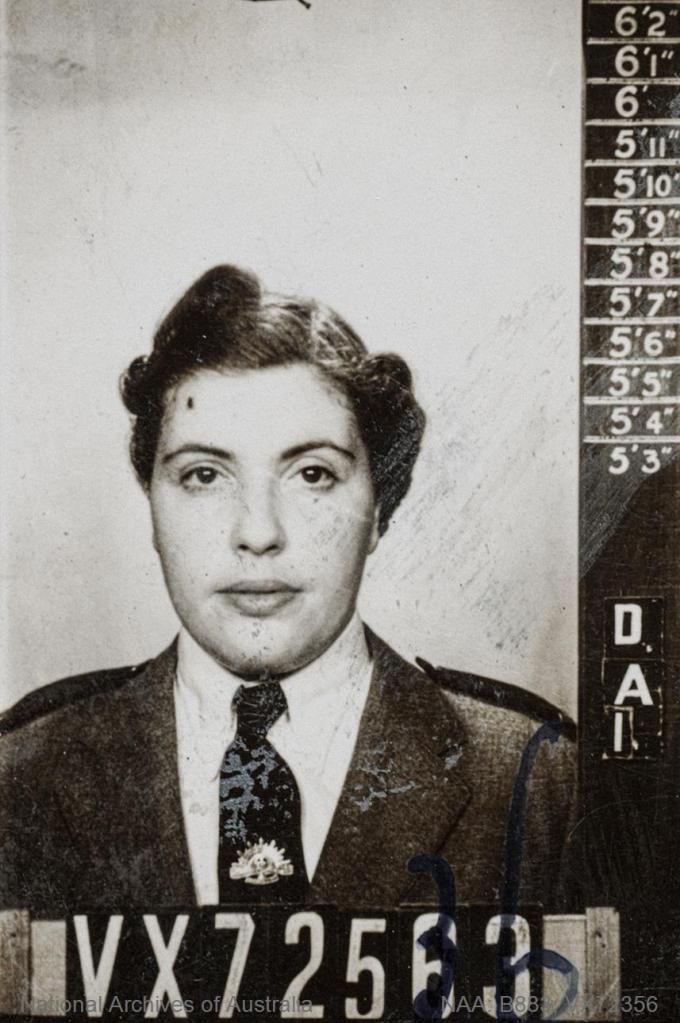
At Heidelberg Jenny met a nurse by the name of Eileen Rutherford, who was known during her time at Windermere Private Hospital in Armadale as ‘Nan.’
On 17 January 1942 Jenny’s service with the AMF was terminated upon her secondment to the Second Australian Imperial Force (2nd AIF) as a staff nurse. She had been chosen for service on a hospital ship, the Oranje. Eileen Rutherford had also been seconded to the 2nd AIF at the rank of staff nurse and would join Jenny on the Oranje.
On 22 January Jenny was granted pre-embarkation leave. After returning to duty on 25 January, she reported to the Lady Dugan Nurses’ Hostel on Domain Road in South Yarra. Here she met Eileen and Staff Nurse Margaret Adams, who had also been attached to the Oranje.
1st Netherlands Military Hospital Ship Oranje
Originally a luxurious Dutch passenger liner, the Oranje had been offered to the Australian and New Zealand governments in February 1941 for use as a hospital ship to repatriate Australian and New Zealand casualties from Egypt. It was refitted in Sydney and recommissioned as the 1st Netherlands Military Hospital Ship Oranje.
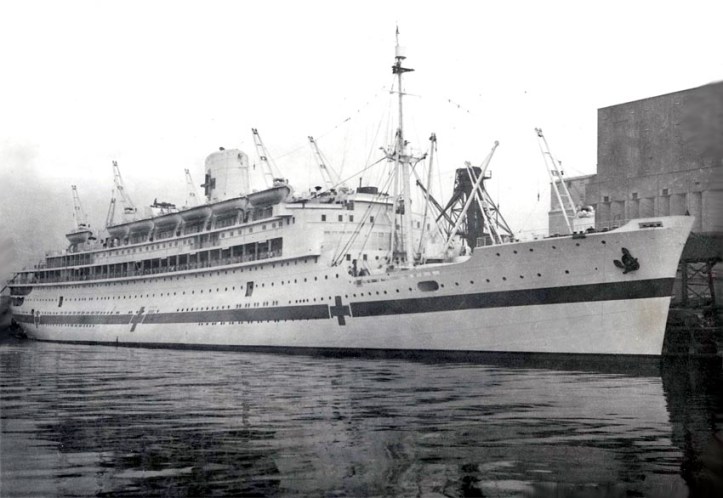
The Oranje had already completed two voyages to Port Tewfik, the port of Suez in Egypt, with a mainly Dutch medical staff. However, following the Japanese invasion of Southeast Asia in December 1941, many of the Dutch staff had been redeployed to the Netherlands East Indies. For the ship’s third voyage, they would be replaced by Australian and New Zealand medical staff – among them Jenny, Eileen and Margaret Adams.
On 28 January 1942 the three nurses travelled to Port Melbourne and boarded the Oranje, which had departed Sydney the previous day. On board they met their new colleagues. Staff Nurses Betty Glasson, Cynthia Haultain, Eva King, Ruth Lindsay and Matron Annie Jewell were joining the ship for the first time, while Sister Mary McFarlane had been a liaison officer on the Oranje’s first two voyages.
That afternoon the Oranje departed Melbourne, sailing to Egypt via Fremantle and Aden. In Port Tewfik, 603 Australian and New Zealand patients were embarked, and on 9 March the ship arrived back in Sydney.
Jenny, Eileen and Margaret completed four more voyages with the Oranje over the next 12 months. During this time, more New Zealand and Australian personnel joined the staff, including Sisters Estelle Davis, Nell Savage and Phyllis Vickers and Staff Nurse Elizabeth Smith.
2/3rd Australian Hospital Ship CENTAUR
The Oranje’s return to Sydney on 1 March 1943 marked the end of its seventh voyage and the end of Australian involvement with the ship. Due to the growing Japanese threat to the immediate north, the Australian staff were being withdrawn for service at home and in the southwest Pacific, and the Oranje was being relocated to the Mediterranean.
However, Jenny, Eileen, Margaret, Cynthia Haultain, Eva King, Mary McFarlane, Nell Savage, all now at the rank of sister, Matron Annie Jewell, and many of their male colleagues were attached to another hospital ship, the Centaur.
The Centaur had been loaned to the Australian government at the beginning of 1943 for use as a hospital ship. It was refitted in Melbourne and officially designated 2/3rd AHS Centaur, joining 2/1st AHS Manunda and 2/2nd AHS Wanganella.
On 12 March the Centaur sailed from Melbourne to Sydney on the first leg of a trial voyage. On 17 March Jenny and her seven Oranje colleagues boarded the ship and were joined by four more AANS nurses, Sisters Myrle Moston, Alice O’Donnell, Edna Shaw and Joyce Wyllie. Jenny had trained with Alice O’Donnell at the Royal Melbourne Hospital.
Four days later the Centaur set out on the second leg of its trial run, this time bound for Brisbane. After arriving in Brisbane, the ship completed several more short voyages. By the time it arrived back in Brisbane on 18 April with wounded Australian soldiers repatriated from Port Moresby, it had demonstrated its capability.
THE FINAL VOYAGE
On the morning of 12 May the Centaur departed Sydney on its next voyage. The ship’s crew had been tasked with transporting 193 members of the 2/12th Field Ambulance to Port Moresby and would then return with Australian casualties. Once again the 12 nurses and the other medical staff were on board.
On the evening of 13 May the nurses celebrated Matron Annie Jewell’s birthday with a cake that they had bought in Sydney. They finished at around 10.00 pm and retired to their cabins. That night the weather was clear and visibility excellent. The Centaur was travelling unescorted and was fully illuminated and marked with the Red Cross. At 4.10 am, while most of those on board were asleep, a Japanese torpedo slammed into the ship’s hull. The Centaur exploded in a huge ball of fire and sank within three minutes.
Jenny and 10 of her AANS colleagues died that day. Only Nell Savage survived. In total, 268 of the 332 people on board lost their lives, including 178 members of the 2/12th Field Ambulance.
IN MEMORIAM
On 2 June 1943 a minute’s silence was observed at a meeting of the Royal Melbourne Hospital Trained Nurses’ Association as a tribute to Jenny Walker and Alice O’Donnell. Among those in attendance were Matron in Chief Annie Sage, Principal Matron (Victoria) Lydia Shaw, and Matron Ethel Bowe. Annie Sage spoke of the work of the AANS and paid tribute to the courage and endurance of its nurses.
On 26 November 1949 the headmistress of St. Catherine’s School, Sophie Borland, unveiled a memorial plaque in honour of Jenny that was placed on the school’s clock tower. It is still there today.
In memory of Jenny.
SOURCES
- Ancestry.
- Goodman, R. (1992), Hospitals Ships, Boolarong Publications.
- Goossens, R. SS Maritime (website), ‘MS Oranje’.
- Howlett, L. (1991), The Oranje Story, Oranje Hospital Ship Association.
- Milligan, C. and Foley, J. (1993), Australian Hospital Ship Centaur: The Myth of Immunity, Nairana Publications.
- National Archives of Australia.
SOURCES: NEWSPAPERS
- The Age (Melbourne, 3 Jun 1943, p. 3), ‘Tribute to Nurses.’
- The Age (Melbourne, 19 Nov 1949, p. 6), ‘School Honors Old Girl.’
- The Argus (Melbourne, 17 Oct 1929, p. eight) ‘Will of Mr. R. S. Whiting.’
- The Argus (Melbourne, 10 Mar 1934, p. 25), ‘St. Catherine’s School Swimming.’
- The Argus (Melbourne, 14 Sep 1937, p. eight), ‘The World of Women.’
- The Argus (Melbourne, 6 Apr 1940, p. 12), ‘Nurses’ Exam.’
- The Australasian (Melbourne, 29 May 1943, p. 18), ‘Spotlight on Society: Nurse’s Bravery in Hospital Ship.’
- The Australian Women’s Weekly (29 May 1943, p. 9), ‘Men of Centaur Mourn Loss of Gallant Nurses.’
- The Herald (Melbourne, 3 Mar 1937, p. 16), ‘In the Social News.’
- The Sun News-Pictorial (Melbourne, 29 Dec 1933, p. 26), ‘Visitor in Three Generations Group.’
- Table Talk (Melbourne, 17 Mar 1938, p. 34), ‘Birthday Celebrated at Sherry Party.’
 australianwarnurses.org