AANS │ Lieutenant │ Second World War │ Malaya
EARLY LIFE
Gladys Laura Hughes was born on 19 September 1907 in Waikino, New Zealand. She was the daughter of Elizabeth Shore Montgomery (1880–1962), born in Huntly, New Zealand, and James Hughes (1875–1956), born in Napier, New Zealand.
Elizabeth and James were married on 4 March 1903 at Ōtāhuhu, a town just south of Auckland (and now a suburb). They moved to Whangārei in Northland and began their family with the birth of their first child, William (1903–1951), followed by Vera (1904–1978). In 1905 the family moved to Wairiki, on the Bay of Islands, where James worked as a millhand. Here James jnr. (1906–1986) was born. By the time Gladys was born in 1907 the family had moved to Waikino, south of Auckland.
Four more children were born in Waikino, namely Gordon (1909–1994), Emily (1910–1991), Charles (1911–1992) and Kenneth (1913–1977). Elizabeth and James then moved a short distance to Waihi, and a further five children were born, Margaret (1915–1966), James (1917–1987), Jean (1918–2000), Keith (1920–1980) and last of all Winifred, who died an infant in 1922.
Gladys attended Waihi District High School, and in October 1922, while a pupil at the school, passed her Technical School First Aid examination – possibly Gladys’s first foray into nursing.
NURSING AND ENLISTMENT
After Gladys finished school, she decided to become a nurse. Around 1929 she began training at Thames Hospital, 40 kilometres northwest of Waihi. She graduated in 1932, gained her registration and then embarked on midwifery training at St. Helens maternity hospital in Auckland. She later served as a sister at the Waikato and Rotorua Hospitals and became well known in nursing circles in the Wairarapa region of southern North Island. In 1935 she was living in Featherston. In 1938 Gladys moved to Australia, living in West Brunswick in Melbourne, where she worked in private nursing, at one point at St. George’s Hospital in Kew.
While Gladys was living in Australia war broke out in Europe, and she decided to volunteer for service with the Australian Army Nursing Service (AANS). She filled out her application form and on 17 June 1940 was appointed to the AANS, 3rd Military District (Victoria). After a long wait she received her call-up. On 19 February 1941 Gladys enlisted in the Australian Military Forces for domestic service with the AANS and on 5 April was posted to the 107th Australian General Hospital (AGH) at Puckapunyal, Victoria.
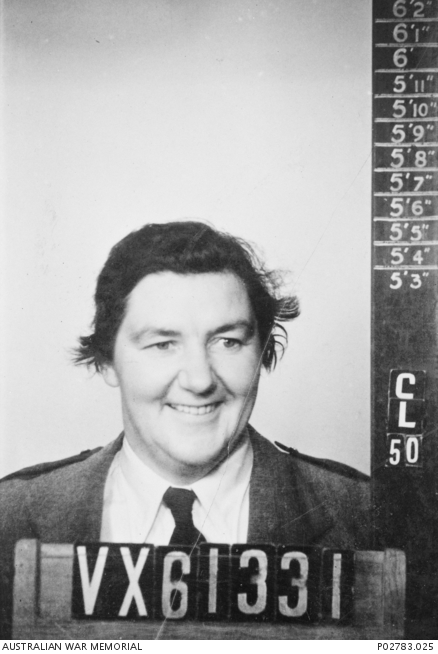
In early August, following intelligence reports suggesting the possibility of a Japanese invasion of Malaya, Australian military authorities approved a request for the deployment of a second military hospital to the British colony. The 2/13th AGH would support the 2/10th AGH, which had sailed to Malaya with the 8th Division, 2nd Australian Imperial Force (AIF) in February and was based in Malacca. Accordingly, on 11 August it was directed that the 2/13th AGH be formed in haste and ready to embark by early September. Although the unit was raised in Melbourne, personnel were chosen from all over the country. Fifty AANS nurses were selected to join, Gladys among them. She was seconded to the 2nd AIF and on 1 September attached to the 2/13th AGH. That same day she reported to the Lady Dugan Nurses’ Hostel in South Yarra, Melbourne, prior to embarking for Malaya the following day.
At approximately 9.00 am on the morning of 2 September 1941, Gladys and 23 other Victorian, South Australian and Tasmanian nurses were taken by bus from the Lady Dugan Nurses’ Hostel to Port Melbourne, where they boarded Australian Hospital Ship (AHS) Wanganella. The newly commissioned hospital ship had departed Sydney on 30 August with a contingent of 2/13th AGH personnel from New South Wales and Queensland that included 19 AANS nurses. Later that day AHS Wanganella slipped out of Port Phillip Bay and headed out into Bass Strait. Six days later the ship pulled into Fremantle, where seven more AANS nurses joined the cohort.
SINGAPORE
The Wanganella arrived at Keppel Harbour on Singapore Island on 15 September and berthed at Victoria Dock. Ten of the unit’s nurses were immediately detached to the 2/10th AGH, where they would train in tropical nursing with their more experienced peers before returning to their unit. They remained on board and later entrained for Malacca, while the remaining nurses, among them Gladys, disembarked into open trucks and in sweltering heat drove to St. Patrick’s School in Katong on the south coast of the island.
St. Patrick’s School consisted of three large buildings with many outhouses. It was set in large, lush grounds with views of the sea. Here the 2/13th AGH would be based while it awaited the upgrading of its permanent site, a psychiatric hospital located in Tampoi, in the south of the Malay Peninsula. Gladys and her colleagues did not have any nursing work to begin with, so they attended lectures, went on field trips to hospitals on the island, and gave instruction in general nursing techniques to the unit’s orderlies.
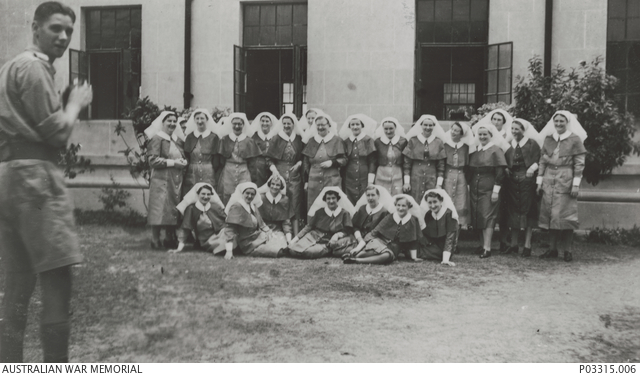
On 1 October Gladys herself was attached to the 2/10th AGH. She returned to St. Patrick’s on 22 October before being detached on 11 November to the 2/4th Casualty Clearing Station (CCS), a smaller medical unit that had travelled to Malaya with the 2/10th AGH in February. The 2/4th CCS was based at that time at the same psychiatric hospital in Tampoi that was earmarked for the 2/13th AGH. When the 2/13th AGH finally moved into the Tampoi site on 23 November, Gladys returned to her unit. The 2/4th CCS meanwhile moved 100 kilometres north to Kluang.
Meanwhile, all the signs in the international arena were pointing towards war with Japan. By the end of November, the British, Indian and Australian garrison troops had been advanced to the second degree of readiness, which meant that leave was cancelled, and units had to be ready to move at a few hours’ notice to their areas of deployment. Then, on 6 December, the codeword ‘Raffles’ was given, indicating advancement to the first degree of readiness. War was imminent.
JAPANESE INVASION
On 8 December it came. Soon after midnight, a force of some 5,000 troops of the Imperial Japanese Army launched an amphibious assault at Kota Bharu on the Malay Peninsula’s northern coast. Four hours later, 17 Japanese bombers attacked Singapore Island. At Tampoi, Gladys and her 2/13th AGH colleagues were awakened by the sound of anti-aircraft guns. As searchlights crossed the sky, explosions were heard, most likely coming from Singapore’s airfields and oil installations.
From their beachhead at Kota Bharu the well-trained, combat-ready Japanese forces, backed by mechanized units and substantial sea and air power, began to press southwards, forcing severely outgunned British and Indian troops to retreat before them. Within six days, two more Japanese forces had crossed into northern Malaya from Thailand.
The 2/13th AGH was ordered to expand its hospital from 600 to 1,200 beds, and by 15 December two new wards had been set up. Staff were required to wear Red Cross armbands and to carry steel helmets and gas masks about with them. They were no longer allowed outside the hospital compound after dark and were not allowed visitors.
As the war became hotter and closer, Gladys and her colleagues quickly became used to interrupted sleep, blackouts and air-raid warnings. At least Christmas was a welcome distraction. The wards were decorated, and the Red Cross and Salvation Army were prevailed upon to boost the patients’ rations for the festive event. The officers helped to carve up the poultry and ham and helped the nurses to serve the bed patients. They also made the nurses sit down with the ‘up’ patients and waited on them. In return, the nurses arranged a party in their mess for the officers and on Boxing Day a larger party for the troops.
On New Year’s Day 1942, 20 nurses from the 2/10th AGH were detached to the 2/13th AGH. The 2/10th AGH had begun to relocate to Singapore Island.
By now, mail had become less reliable and more sporadic, as the Japanese air force controlled the sky south of Singapore and had begun to bomb ships. The RAAF squadron’s remnants were now based in Sumatra, leaving Singapore unprotected from aerial attack. At the 2/13th AGH lights were shaded, and tents camouflaged. Meanwhile, colonial Britons, believing the island impregnable and, like the authorities, never for a moment thinking of an invasion from the north, continued wining and dining in blacked-out restaurants and clubs.
On 13 January the first Australian troops went into combat. In readiness, the 2/13th AGH had 1,165 beds ready for occupancy by 15 January. Of the unit’s 880 patients, very few were battle casualties, but the operating theatres were working day and night to be in readiness, for there would soon be many hundreds. And indeed, by the evening of 16 January, war struck home. Wounded soldiers on stretchers were delivered in rapid succession from transports of all types. The admission room quickly established the identity, rank and injury of those admitted. Stretcher bearers ran the casualty to either ward or theatre. Matron Irene Drummond had her nurses finely tuned.
As more and more battle casualties arrived, between 16 and 21 January 200 medical and minor surgical cases were transferred to the 2/10th AGH, which by then had relocated to Oldham Hall and Manor House on Singapore Island. Japanese radio transmissions began to be received warning the unit to evacuate the Tampoi site, as it was required by Japanese forces, which by this time were at Muar, only 170 kilometres or so north of Tampoi. The situation was looking grim.
RETURN TO ST. PATRICK’S SCHOOL
On 21 January a decision was made to evacuate the unit back to St. Patrick’s School on the island. The relocation of patients began on 24 January and was completed by 11.00 pm the next day. The transfer went so smoothly that not one patient missed a dose of medicine. Meanwhile, the detached 2/10th nurses returned to Oldham Hall.
The movement of the hospital equipment was an enormous exercise. It was undertaken in transports between Tampoi and Katong in convoys of 20–30 trucks. Singapore was being bombed continually, and trucks had to be rerouted as roads disappeared in front of them. As the wards at Tampoi were being dismantled, the sound of guns and bombs could be plainly heard. When the 2/13th AGH finally settled back in St Patrick’s School, everyone involved was exhausted, but the work of caring for patients had to be carried on.
It was decided that all available rooms in the school building were to be used as wards, with the staff sleeping in evacuated houses in Katong, but even so, by 28 January, the number of patients, mainly battle casualties, had risen to nearly 700, and more wards still were needed. The chapel was turned into a resuscitation ward, to which all surgical cases were initially sent, then transferred to appropriate surgical wards.
‘FORTRESS’ SINGAPORE
On Saturday 31 January the causeway between the Malay Peninsula and Singapore Island was blown in two places, with the last of the hospital equipment from Tampoi crossing only the day before. Japanese troops had advanced 1,500 kilometres in only six weeks and were now on the threshold of Singapore itself. Allied casualties mounted, and patient numbers rose steadily. A nearby convent was taken over.
Night and day, Japanese planes roared overhead to attack the harbour, ack-ack guns stuttered half the time, sirens wailed, and the traditional peace and quietness of a hospital was completely broken. The hospital shook with every blast of the British 15-inch guns at Changi, no more than 10 kilometres away. During air-raids the nurses went about their tasks with a total disregard of self. From the hospital could be seen Keppel Harbour and the docks ablaze, and the oil installations of nearby islands blown up. At night the red glow extended over the whole island.
By February, it had become obvious that the end was near. The defence perimeter was shrinking, and casualty numbers increasing unceasingly. Air raids were as regular as clockwork. Only now realising the danger, many Singaporeans were crowding every available ship in the harbour or putting to sea in yachts and launches. On 6 February it became known that the AANS nurses were to be evacuated from the island as soon as possible.
During the night of 8 February, Japanese troops crossed the Johore Strait and rapidly established themselves in the north of the island, despite being strongly opposed by the Australian troops of the 2/20th Battalion and 2/4th Machine Gun Battalion. Casualties were heavy, mainly with gunshot and shrapnel wounds, and poured into St. Patrick’s. The unit’s surgeons operated nonstop, and all were surprised at how calmly the nurses and other hospital staff were performing under such extreme pressure.
On 10 February the evacuation of the nurses began, with six nurses departing aboard the improvised hospital ship Wusueh with wounded soldiers of the 8th Division. The following day, approximately 60 more nurses left on the Empire Star. Then, on 12 February, an order came for the remaining 65 AANS nurses to evacuate Singapore.
The VYNER BROOKE
At 5.00 pm that day Gladys and the other nurses of the 2/13th AGH reluctantly bid farewell to their patients and were transported to the Singapore docks. En route they joined the nurses of the 2/10th AGH and the 2/4th CCS at St. Andrew’s Cathedral in the city centre. They drove through indescribable ruin to the wharves, where they were ferried through a congested mass of shipping of all types to the SS Vyner Brooke. The small ship, which in former times had been a luxurious pleasure craft with accommodation for a few dozen first-class passengers, steamed south that night with more than 200 people aboard.
After 36 hours spent moving stealthily through the numerous small islands that line the passage from Singapore to Batavia, in the early afternoon of Saturday 14 February, the Vyner Brooke was bombed and machine-gunned by Japanese aircraft. It listed alarmingly and sank within half an hour near the northwestern coast of Bangka Island, which lies across the Bangka Strait from the Sumatra.
Gladys managed to join a lifeboat with fellow nurses Jean Ashton, Veronica Clancy, Shirley Gardam, Blanche Hempsted, Pearl Mittelheuser, Sylvia Muir and Mina Raymont, together with numerous civilians and crew. The lifeboat was half filled with water, and while some passengers bailed, others plugged machine-gun holes with clothing. Veronica Clancy and Sylvia Muir donated their uniforms to use as sails, but to no avail. The occupants eventually gave up the struggle and transferred to a pair of passing life rafts that had been lashed together.
There were 23 people on the life rafts, and most occupants took turns swimming beside them, trying to manoeuvre them in some direction or other, but the currents were too strong. During the night those in the water saw a fire on a beach in the distance.
PRISONERS OF WAR
Towards morning, Gladys, Veronica Clancy and Blanche Hempsted began to swim for shore, which was now quite close. They were picked up by two RAAF airmen in a launch, who then collected the remaining passengers and ferried them to what turned out to be the town of Muntok. They were taken by Japanese soldiers to a cinema building where many hundreds of survivors of more than 40 ships sunk by Japanese aircraft in Bangka Strait had been put. Here, Gladys and the others encountered other AANS colleagues, and within two weeks they were 32.
The period of captivity that followed tested the mental and physical resolve of the nurses and civilians as few experiences ever will. Nevertheless, Gladys and the others survived for three years in five main internment camps in Sumatra and Bangka Island before the dreadful conditions finally began to take their toll. By 1944 the nurses had begun to suffer the effects of long-term hunger, and by 1945 malnutrition and disease had reduced the health of the nurses to such an extent that they began to die.
When Gladys passed away on 31 May of that year, she had already buried four of her colleagues. Now she was carried by her friends to a shallow grave in a nearby glade and buried with a rough cross above her. Three more nurses would succumb by the time the internees were freed in September.
In memory of Gladys.
SOURCES
- Ancestry.
- Arthurson, L., ‘The Story of the 13th Australian General Hospital, 8th Division AIF, Malaya,’ edited by Peter Winstanley (2009).
- Jeffrey, B. (1954), White Coolies, Angus & Robertson Publishers.
- National Archives of Australia.
- New Zealand War Graves Project, ‘Sister Gladys Laura Hughes’.
- Shaw, I. W. (2010), On Radji Beach, Pan Macmillan Australia.
- Simons, J. E. (1954), While History Passed, William Heinemann Ltd.
SOURCES: NEWSPAPERS
- Auckland Star (Vol. LXXVI, Issue 237, 6 Oct 1945, p. 9), ‘Sister Gladys L. Hughes’.
- Kai Tiaki – The New Zealand Nursing Journal (15 Nov 1945, vol. 38, no. 1, p. 271).
- Waihi Daily Telegraph (Vol. XX, Issue 6756, 3 Nov 1922, p. 2) ‘First Aid Examinations’.
- Waihi Daily Telegraph (Vol. XXXXI, Issue 9763, 27 Apr 1942, p. 2) ‘Local and General’.
- Wairarapa Times-Age (15 Dec 1943, p. 5), ‘Greytown’.
 australianwarnurses.org