AANS │ Captain │ Second World War │ Australia
Family Background
Florence Adelaide Cox was born on 4 December 1913 in Mount Lawley, Western Australia. She was the daughter of Harriet Eliza Siviour (1873–1957) and Alfred Edward Cox (1869–1942).
Harriet Siviour was from Manoora, South Australia. Her father, Richard Siviour, migrated to Australia with his family in 1840 and became a well-known landowner in the Manoora district, 100 kilometres north of Adelaide. Sometime after Richard’s death in 1879, Harriet’s mother, Ann Pamplin Siviour née Trimming, moved to Western Australia with the children, and in the mid-1890s Harriett was living in Cue, a boom town in the Murchison goldfields.
Alfred Cox was born in Walkerville, Adelaide. He became an architect of note and in 1893 sailed to Geraldton in Western Australia, from where he walked to the Murchison goldfields. He spent time prospecting and mine surveying and in 1895 was appointed resident architect of the Murchison District Public Works Department, based in Cue. He went on to design many public and private buildings in Cue and elsewhere in the region.
Alfred met Harriet (who was known as Hal) at around the time that she was secretary of the Miners’ Institute and they were married in Cue on 15 September 1897 at the Anglican Church of St. John the Evangelist. The following day the happy couple left on their honeymoon. They were away for two weeks, and upon their return to Cue moved into a pretty villa on Dowley Street.
Harriet’s and Alfred’s first child, Alfred Richard Baxter, was born in 1898, followed in 1900 by Linwood Gillard. In 1905 Alfred left his position in Cue and the family moved to Perth, where a third child, Richard, was born that same year. Tragically, Richard died after just one day.
By 1906 the family had settled in the inner northern suburb of Mount Lawley. Here, on 8 September, Doreen Pamplin and Jeffrey Pamplin were born. The birth of twins may have helped to lessen the grief associated with the death of Richard the previous year. Three years later Marian (or Marion) Beatrice was born, followed by Florence four years after that.
Meanwhile Alfred had formed an architectural practice with Charles Lancelot Oldham, and over the following years the pair designed some of Perth’s finest public buildings, including the AMP Chambers in 1912–1913.
School, Nursing and Enlistment
Like her sisters, Florence attended the Church of England Girls’ High School in Claremont (known today as St. Hilda’s Anglican School for Girls). She must have been academically inclined, for in December 1927, at the completion of Form IV, she came 4th in her class.
Sometime after finishing school, Florence decided to go into nursing. She began training at the Children’s Hospital in Subiaco and became a registered nurse on 28 November 1935. She then undertook midwifery training at the King Edward Memorial Hospital, also in Subiaco. After gaining her midwifery certificate Florence was appointed to the staff of the Mount Hospital, a private hospital on St. Georges Terrace in central Perth.
War broke out in Europe while Florence was working at Mount Hospital, and in the first half of 1940 she applied to join the Australian Army Nursing Service (AANS). By 5 June her application had been approved and she had had a medical. She then awaited her call up.
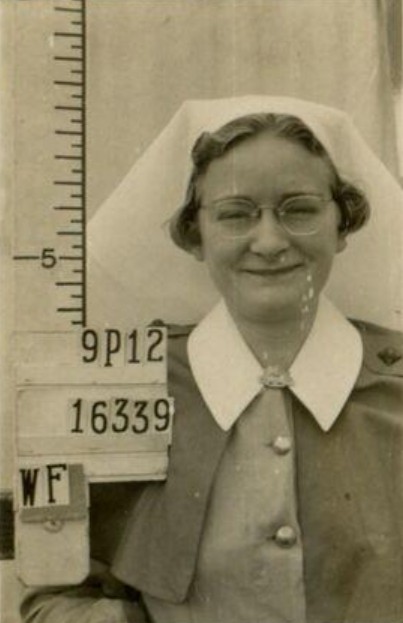
Finally, after a year, Florence was called up and on 10 June 1941 enlisted in the Australian Military Forces (AMF) at Swan Barracks. She was attached to the 110th Australian General Hospital (AGH) in Claremont at the rank of Temporary Sister.
110th (Perth) Military Hospital
The 110th AGH had been raised at Claremont in January 1940. In late 1941 the unit moved to a specially built hospital in Hollywood, a precinct of the suburb of Nedlands, and became Western Australia’s main military hospital. In November 1943 it was renamed 110th (Perth) Military Hospital but was often referred to as Hollywood Military Hospital.
Florence spent the next four years and three months at the 110th AGH. During her second year with the unit, on 28 July 1942, her father died at the age of 73. After dissolving his partnership with Charles Oldham and working for a few years with his eldest son, Alfred had practised on his own since 1928 and had only recently retired.
At the end of 1942 Florence was promoted to the rank of Senior Sister, and became Captain Florence Cox on 23 March 1943, the date on which all AANS nurses were commissioned as officers. Hitherto, they had been granted the status of officers but not the rank. Nonetheless, they continued to be addressed as ‘sister’ as a rule and did not observe such formalities as saluting.
On the same day that she and her fellow AANS nurses were commissioned, Florence returned to duty at the 110th AGH having been in hospital for the previous two months. We do not know what her illness was but it may have been related to the condition that would so tragically take her life at the end of 1945.
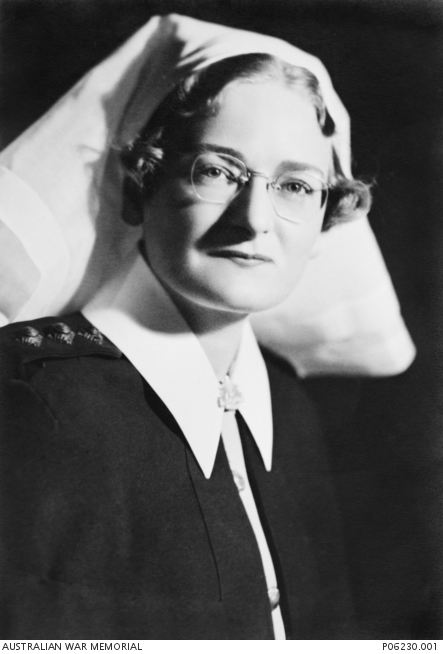
On 13 October 1943 Florence was detached to the 1st Australian Women’s Hospital (AWH) for temporary duty. The 1st AWH had begun in September 1942 as a women’s wing of the 110th AGH. In February 1943 the wing had become a standalone hospital but was reincorporated into the 110th in October. On 11 December Florence returned to her unit, which by then had been renamed the 110th (Perth) Military Hospital.
The final months
Two years went by. On 29 September 1945 Florence was detached to the 75th Australian Camp Hospital (ACH) in Fremantle. The Pacific war had ended with Japan’s surrender on 15 August, and now thousands of Australian prisoners of war were returning home. There was as great a need of the skills of Florence and her colleagues as ever.
On 10 October Florence was allotted regimental duties at the 75th ACH – likely indicating that all was not right with her – and on 19 October was admitted to the 110th (Perth) Military Hospital. A metastatic melanoma had poisoned her blood. On 2 December Florence was placed on the seriously ill list and by 21 December she was considered dangerously ill.
Following an appeal by one of Florence’s sisters, a new serum for the treatment of malignant blood disorders known as ‘H-11’ was flown in from England and administered to Florence. The serum was largely unknown in Australia but her doctors were hopeful it might make some difference. A second batch, also from England, was lost but eventually turned up, and a third batch arrived from Queensland on 24 December following a nationwide appeal on ABC radio.
The serum did nothing.
Florence died at 9.50 pm on Sunday 30 December 1945. Her funeral was held at the Perth War Cemetery on 1 January 1946 and was attended by the acting commanding officer of the 110th, Col. Philip H. G. Cardale, and the Deputy-Director of Medical Services, Col. H. M. Trethowan. More importantly, around 30 of Florence’s fellow nurses from the 110th were there to say their final goodbyes to a dear friend and colleague.
In memory of Florence.
SOURCES
- Ancestry.
- Carnamah Historical Society and Museum, ‘Western Australian Nurses 1919–1949.’
- Museum of Perth, ‘Alfred Edward Cox,’ by Shannon Lovelady, from the exhibition ‘Demolished Icons of Perth.’
- National Archives of Australia.
- Shire of Cue, ‘Cue Community Profile 2010.’
SOURCES: NEWSPAPERS
- The Daily News (Perth, 20 Dec 1945, p. 1), ‘Sick Nurse Gets Serum.’
- The Daily News (Perth, 1 Jan 1946, p. 3), ‘Army Nurse Buried in War Cemetery.’
- The Herald (Melbourne, 20 Dec 1945, p. 3), ‘H 11, Mystery Drug, Sent by Air to Save Nurse.’
- The Murchison Times and Day Dawn Gazette (Cue, 31 Aug 1897, p. 3), ‘Advertising.’
- The Murchison Times and Day Dawn Gazette (Cue, 16 Sept 1897, p. 3), ‘Socialites.’
- South Australian Register (Adelaide, 26 Oct 1897, p. 4), ‘Family Notices.’
- The West Australian (Perth, 15 Dec 1927, p. 24), ‘Girls’ High School.’
- Western Mail (Perth, 24 Sept 1897, p. 38), ‘Social Items.’
 australianwarnurses.org