Sister │ Second Boer World │ Rhodesia
FAMILY BACKGROUND
Frances Emma Hines, known as Fanny, was born on 26 August 1864 in Apsley, a small town in far western Victoria. She was the daughter of Eleanor Mary Caroline Brewer (1833–1873) and Francis Patrick Hines (1826–1891).
Eleanor Brewer was born in Ireland of Scottish and English parents and migrated to South Australia with her family in 1839. Francis Hines was born in Hobart of English and Irish parents and moved to Victoria with his mother and sister after his father died in 1838. Evidently possessing some means, in the late 1940s he purchased the Neuarpurr run, a large sheep property near Apsley, for £300. It had no water, but he made the run a paying concern by scooping out waterholes.
In time Francis met Eleanor and the two were married on 30 March 1854 at Benyeo, the property of Francis’s near-neighbour Mr. Hugh MacLeod, located just south of Neuarpurr. The newlyweds settled at Neuarpurr and over the coming decades Francis became wealthy raising sheep and breeding greyhounds and racehorses. He also became a director of the Australasian Agency and Banking Corporation.
In the meantime, there was a family to raise. In a 16-year period Eleanor gave birth to eight children. Elizabeth Anne Harriet was the eldest, born in 1855. She was followed by Eleanor Mary Stockley (1857–1929) and Charles Hugh (1859–1864), who died just a young lad of four or five, then Emily Sarah (1862–1921), Francis Edward Victor, known as Victor (1867–1879), Fanny, Annie Philippa, who died a newborn in 1870, and finally Agnes Ida Margarita, known as Ida (1871–1946).
MELBOURNE
On 28 March 1873 Eleanor died in Melbourne under unknown circumstances. She was only 39 years old. Sometime the following year, Francis sold Neuarpurr and with a certain John Brewer, very likely Eleanor’s brother, bought the 220,000-acre Merri Merrigal sheep station, situated near the town of Hillston in south-central New South Wales. John lived there with his family and managed it while Francis and the children apparently moved to a house on Dalgety Street in St. Kilda, Melbourne, the suburb where his mother lived. On 27 May 1875 he married Sarah Tweedie at All Saints’ Church in St. Kilda.
In Melbourne Fanny attended Faireleight, a private girls’ school on Alma Road in East St. Kilda that was established in 1875 by the Misses Chambers. We do not know whether she was academically inclined.
In April 1878 Fanny’s stepmother gave birth to Elizabeth Josephine Winifred Hines. She was known as Winnie and in the course of time would also attend Faireleight. She later gained her bachelor’s degree at the University of Melbourne and became a teacher. In June 1878 Fannie, Eleanor, Emily, Ida and Victor sailed to London with their father, stepmother and baby Winnie on the Northumberland. They returned to Melbourne aboard the same ship in April 1880.
In 1881 Fanny’s stepmother gave birth to her second child, Francis Patrick Hines. Sadly, he died in 1898, aged only 16 or 17 years.
Ten years later, on 6 November 1891, Fanny lost her father. Francis Hines died of a nasal haemorrhage while on his property at Merri Merrigal. He had been unwell for some time after falling from his buggy. Following his death, his remains were conveyed to Melbourne, and he was buried at Melbourne General Cemetery in Carlton.
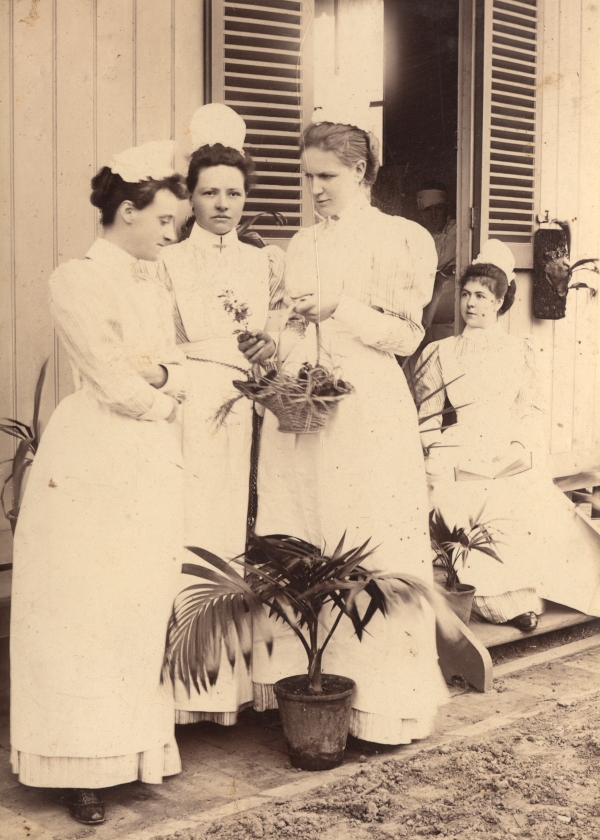
It was perhaps around that time that Fanny decided to become a nurse. She was taken on as a trainee at the Children’s Hospital in Carlton, and may have stayed on as a staff nurse after the completion of her training. She later nursed at what was described in a newspaper report as “Sir T. N. Fitzgerald’s hospital,” possibly meaning Melbourne Hospital, where Sir Thomas Naghten Fitzgerald was consulting surgeon for many years.
THE SECOND BOER WAR
In 1899 the Second Boer War broke out between Britain and the Boers of Orange Free State and the Transvaal (South African Republic) in southern Africa. Troops were sent from the Australian colonies to fight alongside the British forces. Accompanying the troops were more than 60 Australian nurses.
The first to leave were 14 nurses of the New South Wales Army Nursing Service Reserve. On 17 January 1900, they departed Sydney aboard the SS Moravian bound for Cape Town. They were accompanying the 2nd New South Wales Contingent.
The departure of the New South Wales nurses catalysed efforts in the other colonies to organise their own nursing contingents. In Victoria, the socialite and philanthropist Janet Lady Clarke supported the local effort with fundraising drives that raised enough money to send 10 nurses. On 10 March, the 10 travelled to Port Melbourne and embarked on the Euryalus for Cape Town. In charge was Sister Marianne Rawson as lady superintendent. The others were Sisters Julia B. Anderson, Isobel Ivey (originally from Tasmania), Eleanor Augusta Victoria Langlands, Dorothy F. Smith, Ethel Mary Bernhard Smith, Annie Eliza Helen Thomson (also Tasmanian originally), Diana Tiddy, Ellen Walter – and Fanny.
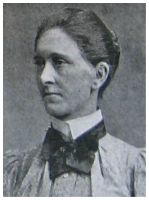
The Victorian nurses were accompanying the 3rd Victorian Bushmen’s Contingent, which comprised 15 officers and 261 other ranks, with 357 horses and four wagons. The Bushmen, as they were known, were under the command of Captain (later Major) William Wood Dobbin and were going to join General Frederick Carrington’s Rhodesian Field Force. There were also a number of medical staff attached to the contingent, among them Sir Thomas Naghten Fitzgerald himself.
BEIRA
The Euryalus arrived at Cape Town on 3 April 1900. In an article published three years later in the journal of the Victorian Trained Nurses’ Association, Julia Anderson described what awaited the nurses when they disembarked. “On arriving at Cape Town our lady superintendent found orders awaiting us to proceed to Bloemfontein that night,” she wrote.
However, as our Bushmen’s contingent was going round to Beira without any nurses, we had the option of going with them, and decided that we would not desert our own men, although we were warned that Rhodesia was not a fit place to send women to, and that there were no arrangements made for nurses to accompany the troops.
Beira was a coastal town in Portuguese East Africa (today Mozambique) and the terminus of a partially narrow-gauge railway that ran to Salisbury (Harare), the capital of Rhodesia (Zimbabwe). Stopping at Durban en route, the nurses and the Bushmen arrived at Beira on 12 April.
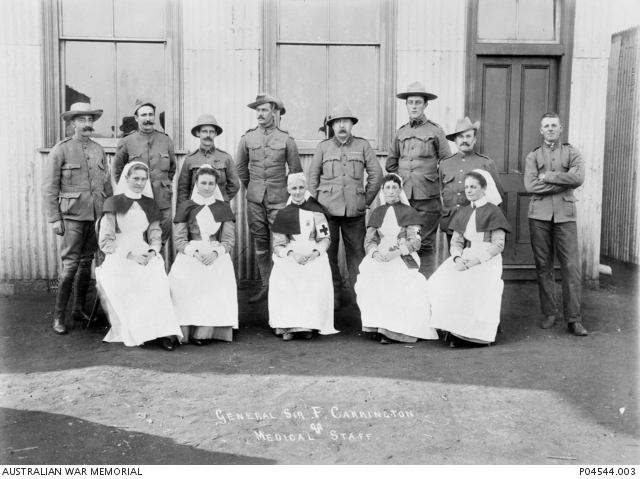
In a letter subsequently written from the Queen’s Hotel in Salisbury, Isobel Ivey described the nurses’ experience in Beira and beyond. A section of her letter was printed in the North Western Advocate and Emu Bay Times on 14 June, as follows:
Beira is quite tropical, black boys galore, swarms of them; just a very few white men; no white women to be seen out of doors. The English, on getting up in the morning have a cup of coffee, go to work, home at 11 for breakfast, sleep till near 4; afternoon tea, start business again at 4 p.m., and dine in the evening. We went to Government House to tennis and afternoon tea, and a ball. The latter I enjoyed very much; tea and tennis, slow, very. An ‘At Home,’ followed by a dance, was also attended by the Bush women (I am sure that is what they call us). The Governor asked for a waltz. We were photographed (and promised a copy each) with the Government House party. A Mrs Dalrymple invited us to breakfast and a bath. Several other functions we attended, and all the people have done their utmost to give us a good time.
BY TRAIN TO SALISBURY
On 21 April, after nine days in Beira, the nurses set out for Salisbury. With them travelled 200 of the Bushmen, while the horses were left behind for now with the Cameron Scouts, a special unit of the contingent .
The train had no railway carriages, so the troops travelled in horse boxes, while the nurses travelled in the luxurious personal carriage of Mr. Lawley, described by Isobel Ivey as “the railway king of Beira,” who appears to have accompanied them for part of the journey. After 12 hours the Victorians reached Bamboo Creek (Nhamatanda), an unsavoury staging post where the broad-gauge line commenced. Isobel Ivey continues the story:
We left Beira, with all its dirt, heat, and beauty, on Saturday, the 21st, for Bamboo Creek, 60 miles distant. Taking train 7.15 a.m., reached Bamboo Creek 7 p.m.; had dinner at the creek, and left the same night, or next morning rather, at 2 a m.; went nine miles, when the engine broke down. Started again Sunday 12, but every mile or so stopped for wood or water, or to get up enough steam to descend a small rise. It was too funny. Just imagine an express stopping half-way up a rise to get up a enough steam, then to run back half a mile, to finish the hill. This happened quite six times. Once we stopped three hours to allow two other trains to pass us (single line). After the three hours wait we started, went about two miles, when one of the men discovering he had left his watch behind, the engine was reversed, and went back for it.
At around 7.00 pm on 24 April the nurses arrived at Umtali (Mutare), on the Rhodesian side of the Portuguese East Africa–Rhodesia border. It had taken 84 hours to cover the 300 kilometres from Beira. Capt. Dobbin and his men had remained at Bamboo Creek, where they would await the arrival of other colonial troops before proceeding along the line to Marandellas (Marondera), 70 kilometres before Salisbury. There they would be sorted into regiments of the Rhodesian Field Force and march to Bulawayo, and from there to Mafeking, where they would be mobilized and equipped and cross into Transvaal.
The residents of Umtali would not allow the nurses to sleep on the train, so five stayed at a beautiful house provided by Cecil Rhodes for passing visitors, while the other five were given tea and beds for the night by one of the townswomen, Mrs. Goode.
Julia Anderson was delighted with Umtali. “We … had a delightful hot bath, the first fresh bath since leaving Melbourne,” she wrote in her article. “Umtali is a very pretty place, surrounded by lovely green hills, covered with vegetation, in fact the scenery the whole way from Beira was beautiful.”
From Umtali the nurses continued to Marandellas, and from there to Salisbury. They were billetted for between a week and a fortnight at the Queen‘s Hotel, one of the best hotels in town, paid for by the Imperial Government at 15s. a day for each nurse.
DISPERSED FOR WORK
In mid-May, Fanny and her colleagues were at last dispersed for work. Ethel Bernhard Smith, Isobel Ivey, Eleanor Langlands and Dorothy Smith were posted to Umali, with Dorothy Smith in charge. Here they were based in an unfinished hotel, which had been taken over for use as a temporary hospital, the Umtali Hospital being full. The main building of the hotel contained three large rooms used as wards, as well as the doctors’ and nurses’ quarters. There was also an annex, with eight separate rooms and no interleading doors, each of which had to be visited every hour throughout the night. The four nurses were kept busy, particularly in the first two weeks of June, when between 50 and 60 Yeomanry were occupying beds. During this time, seven deaths occurred – two from malaria and five from dysentery. One night, five lions came as close to the hospital as 90 metres – as Ethel Bernhard Smith, who had been on night duty, discovered the next morning. Decades later she related the story to the Australian Women’s Weekly.
Julia Anderson was sent on her own to Charter (sometimes referred to as Fort Charter), an outpost around 80 kilometres south of Salisbury. She had only one patient to begin with, a certain Lt. Fraser from New South Wales, who was lying ill with pneumonia, but over the next eight weeks she nursed around 30 more. They were suffering variously from pneumonia, double pneumonia, broncho-pneumonia after measles, concussion, malaria and dysentery.
Marianne Rawson, Diana Tiddy and Annie Thomson went to the Civil Hospital in Bulawayo, four days’ journey by coach from Salisbury, leaving Fanny and Ellen Walter to follow when instructed. However, instead of going to Bulawayo, Fanny ended up being posted on her own to Enkeldoorn (Chivhu), 60 kilometres south of Charter. As for Ellen, in due course she did travel south to Bulawayo and, perhaps after spending time at the Civil Hospital, helped to set up the Rhodesian Field Force base hospital a few kilometres away. She was joined there by Marianne Rawson and, from early July, by Julia Anderson, who had left Charter and travelled by coach to Bulawayo.
On 15 July Ellen Walter wrote a letter home from Bulawayo, a section of which was printed in the Ballarat Star on 25 August, as follows:
We started this hospital here for the troops, and it has been a great business getting things fixed. It is just a large room in the athletic sports ground, formerly used for a gymnasium, which we use as a ward. The grandstand is boarded up for the doctors’ and our rooms – all wood and iron – hot in the day and cold at night. Sister Anderson and I are doing all the nursing work at present, as it takes Sister Rawson all her time looking after the housekeeping. Sisters Tiddy and Thompson are still at the Civil Hospital here, as there are a few of our men there still. Each lot of men that arrived in camp had such a lot of men ill with fever, dysentery and pneumonia; so far no typhoid among our men. We have now 30 in the ward, and 10 in tents with measles; such a lot of New Zealanders arrive with it. Four nurses are still at Umtali, and will come on here later, as the base hospital is to be here. Sister Hines is at Enkeldoorn, but we expect her here soon. She has been a long time all alone there.
Fanny had not been faring well at Enkeldoorn. At one point she had 26 patients to look after, with no possibility of assistance or relief and without sufficient nourishment. She became worn down and contracted pneumonia. Finally, Fanny was admitted to the Civil Hospital in Bulawayo, apparently having developed enteritis too. She died on 7 August.
Fanny was buried with full military honours at Bulawayo Cemetery. Sometime after her funeral, a large marble cross was erected over her grave by her fellow nurses and the Victorian Bushmen.
Fanny was the first Australian nurse to die on operational service overseas and the only Australian nurse to die during service in the Second Boer War.
IN MEMORIAM
On 27 September 1901, a brass tablet in an oak setting was unveiled at Faireleight in memory of Fanny by Maj. Gen. Downes. It had been paid for by her former classmates. Speakers at the unveiling included Mr. S. Winter-Cooke, Maj. Gen. Downes and Dr. J. Wood. These were followed by a speech from Lt. F. Cochrane, who spoke feelingly from personal experience, of the nature of the work done in South Africa by Fanny. A medal that would have gone to Fanny had she survived was handed to Miss Chambers, the school’s principal, for presentation to Fanny’s sister (either Ida or Winnie), who was a teacher at the school.
The tablet bore the following inscription:
In affectionate remembrance of Frances Hines, who died at Bulawayo aged 36 years, a pupil at Faireleight; a nurse at the Children’s Hospital, who gave her life nursing the soldiers in South Africa. ‘What is success? It is to live for others, simple, earnest, and intense; to lay down the life as a sacrifice for Christ.’ Faithful unto death.
In memory of Fanny.
SOURCES
- Anderson, J.B., ‘Some Experiences of a Victorian Nurse in South Africa,’ UNA: The Journal of the Victorian Trained Nurses’ Association (Vol. I, No. 2, July 1903, pp. 31–33), Melbourne.
- Anglo Boer War (website), ‘3rd Victorian Bushmen’s Contingent.’
- Australian Boer War Memorial (website), ‘Nurses in the Boer War’ (Max Chamberlain, Margaret Klaassen, Robin Droogleever and David Deasey).
- Australian Boer War Memorial (website), ‘Sister Frances Hines’ (David Deasey).
- Australian War Memorial, ‘The grave of Sister Frances Emma (Fanny) Hines.’
- Australian War Memorial, ‘Nursing Sister Frances Emma Hines.’
- Australian War Memorial, ‘Official records of the Australian military contingents to the war in South Africa, 1899–1902. The Third (Bushmen’s) Contingent (pp. 240–51),’ RCDIG1069341.
- Cannon, A. O. (1992), ‘Pastoralism and the Landscape: A Lower Lachlan Survey, Vol. III’ thesis submitted in fulfilment of the requirements for the degree of Master of Philosophy, Department of Prehistory and Historical Archaeology, University of Sydney.
- Public Records Office Victoria, Unassisted passenger lists (1852–1923), VPRS 947.
- Wikipedia, ‘Fanny Hines.’
- Zim Field Guide (website), ‘Fort Charter.’
- Zim Field Guide (website), ‘The story of a Trooper’s experiences in the Imperial Yeomanry and Rhodesia Field Force during the second Boer War 1899–1902.’
SOURCES: NEWSPAPERS
- The Age (Melbourne, 28 Sept 1901, p. eight), ‘About People.’
- The Argus (Melbourne, 2 Apr 1873, p. 4), ‘Family Notices.’
- The Argus (Melbourne, 12 Mar 1900, p. 5), ‘Departure of Sir Thomas Fitzgerald.’
- The Argus (Melbourne, 25 Jun 1900, p. 5), ‘The Invasion of the Transvaal.’
- The Argus (Melbourne, 2 Aug 1900, p. 6), ‘The Boer Surrender.’
- The Argus (Melbourne, 19 Mar 1901, p. 5), ‘Victorian Nurses at the Front: Letter from Major Dobbin.’
- The Australasian (Melbourne, 3 Jan 1914, p. 6), ‘Pioneering Days in Western Victoria.’
- Australian Town and Country Journal (Sydney, 10 Mar 1915, p. 38), ‘Questions Answered.’
- The Australian Women’s Weekly (20 Apr 1940, p. 47), ‘Real Life Stories.’
- The Ballarat Star (Vic., 25 Aug 1900, p. eight), ‘The Victorian Nurses.’
- The Ballarat Star (Vic., 30 Sept 1901, p. 1), ‘News of the Day.’
- The Church of England Messenger (Melbourne, 9 Dec 1875, p. 13), ‘Advertising.’
- The Kerang Times (Vic., 29 May 1900, p. 2), ‘Letters from Camp.’
- The North Western Advocate and the Emu Bay Times (Tas., 14 Jun 1900, p. 4), ‘With the Bushmen.’
- Portland Guardian and Normanby General Advertiser (Vic., Mar 1859, p. 1), ‘Advertising.’
- The Riverine Grazier (Hay, NSW, 14 Aug 1878, p. 4), ‘Reserves.’
- The Riverine Grazier (Hay, NSW, 17 Nov 1891, p. 2), ‘The Country.’
- South Australian Register (Adelaide, 27 Apr 1854, p. 2), ‘Family Notices.’
- The Sydney Morning Herald (20 Dec 1890, p. 4), ‘In Rabbit Land.’
- Weekly Times (Melbourne, 22 Jun 1878, p. 17), ‘Shipping.’
 australianwarnurses.org