AANS │ Staff Nurse │ First World War │ India
FAMILY BACKGROUND
Emily Carol Clare, sometimes known as Emmie, was born on 11 September 1890 in Footscray in Melbourne’s inner west. She was the daughter of Mary Anne Edhouse (1852–1919) and Peter Clare (1850–1912).
Mary Edhouse was born in Peel, New South Wales, one of 10 children born to Mary O’Shannassy (1820–1854), from Gort in Co. Galway, Ireland, and Benjamin Edhouse (1816–1887), from Bury St. Edmunds in Suffolk, England.
Benjamin Edhouse arrived in New South Wales as a convict aboard the Aurora on 3 November 1833. He gained his ticket of leave in January 1840 and on 3 December 1840 married Mary O’Shannassy in Parramatta, east of Sydney. Mary had arrived in Botany Bay, Sydney as a free settler aboard the Clyde on 21 April 1840. After Benjamin gained his certificate of freedom in 1847, he and Mary moved north with their children to Moreton Bay, before returning south to the Peel goldfield near Tamworth in New South Wales, and finally to Bald Hill, near Fryer’s Creek in the Mount Alexander goldfields of central Victoria, where he opened a shop and inn and where Mary died in 1854. With five living children to take care of, in 1855 Benjamin married Harriet Rigby. In the same year he established the Loddon Brewery. Benjamin and Harriet went on to have six children.
Peter Clare was born in the town of Albury, on the Murray River in southern New South Wales. His mother was Sarah Ann Crawford (1830–1904) from England and his father was Arnold Clare (1812–1886), from Culcheth, Lancashire, England. Arnold arrived in Sydney as a convict in 1826 on the Speke. He gained his certificate of freedom in 1833 and married Sarah in March 1846. In November 1850 Arnold bought a Crown land allotment of two roods (around half an acre) in Albury and was granted the title deed a year later.
In his early 20s, Peter met Mary, and they were married in 1874. Later that same year Mary gave birth to their first child, William. His birth was registered in Craigieburn, now a northern suburb of Melbourne, but then a rural locality in the Shire of Broadmeadows. Tragically, baby William died in 1875, either before or after the birth of the Clares’ second child, Harry. By then the family had moved to Flemington, an industrial suburb lying between the Saltwater River (renamed the Maribyrnong River in the 1910s) and the Moonee Ponds Creek, four kilometres northwest of central Melbourne. Flemington was notable not only for its racecourse but for the Newmarket livestock saleyards and the City abattoirs. Given his later work, it is likely that Peter worked in the abattoirs as a slaughterman.
Two more children were born while the Clares were living in Flemington, Edward William in 1877 and Eva in 1880. Their fifth child, Alice Mary, was born in 1882, but her birth was registered in Eddington, 50 kilometres northwest of Fryer’s Creek, where Mary’s people were. In 1885 Olivia Grace (known as Olive) was born in Flemington, followed by Violet May in 1888. By 1889 the family had moved to Chambers Street in Footscray and Peter was working as a butcher (probably not a retail butcher but more akin to a slaughterman).
FOOTSCRAY
Footscray was an industrial suburb located on the opposite side of the Saltwater River from Flemington. As a consequence of its proximity to the saleyards and abattoirs over the river, Footscray developed countless animal by-product factories – boiling-down works, bone mills, tanneries, wool scourers, soap and candle makers, glue works, tallow works, manure works, fellmongers. In many or most cases, these factories were built on the Saltwater and pumped effluent into it, turning the river into a toxic drain. Footscray also had its own abattoirs.
On 25 May 1889 Harry Clare was run over by a carriage on Hopkins Street in Footscray while attempting to stop its horse from bolting. He was severely bruised and was attended to by a doctor.
In 1890 Emily was born. She was followed in 1893 by the Clares’ ninth and final child, Ernest Peter.
Nothing of Emily’s childhood in Footscray is known, other than the fact that until partway through 1899 she attended Footscray State School on Geelong Road. After that, she no longer lived with her family.
Emily had gone to live with her maternal uncle Henry Edhouse in Stawell, a town in the Wimmera region of western Victoria. We do not know why but can speculate that the financial pressure of raising eight children on an abattoir worker’s wage may have been too much for the family to bear.
Despite the fact that by July 1897 Peter Clare had become an abattoir foreman, in which position he presumably earned more than he had previously, he could not always meet his debts and on at least two occasions ended up before the local court. In March 1901 he appeared over an amount of 15/3 he owed to a certain A. G. Green and was ordered to pay the amount plus 7/6 in costs; and in September 1902 he appeared over an amount of 17/– owing to one Catherine Drysdale. This time he had to pay the amount and 10/6 in costs.
All the same, it is difficult to understand how Emily’s absence could have made much difference to the family’s finances, with five children still at home (Harry and Edward likely having moved out).
Whatever the reason, in July 1899 Emily was enrolled at Stawell State School and was living with Uncle Henry and his wife, Elizabeth.
HENRY EDHOUSE
Henry Edhouse was a wealthy man and had no children of his own. Elizabeth had two surviving adult sons from her previous marriage.
Henry was born in 1843 and was Mary Clare’s eldest living sibling. He had led an adventurous life since his childhood – when he had travelled thousands of kilometres up and down eastern Australia on a bullock cart with Mary and their other siblings and their parents. In the 1850s he trained in brewing and management at his father’s brewery in Fryer’s Creek and carted goods to there from Melbourne. In the 1860s he served in the New Zealand Wars (formerly known as the Māori Wars), joined the goldrush at Gympie Creek in Queensland, and started a (short-lived) brewery at Godfrey’s Creek (Gobur), near Alexandra in Victoria, with a Mr Whittingham.
In the late 1870s Henry came to Stawell and became a managing partner in the Stawell Brewery with Charles Bryant, the former husband of his late sister Emily. Charles’s brewing company, Bryant & Co., had recently acquired the Stawell Brewery, and under Henry’s management it grew considerably. In 1899 Henry acquired the Jamieson Brewery and over the coming years acquired the freeholds of hotels in the Wimmera and built new ones.
Henry was a civic-minded man. In February 1887 he was elected to the Stawell Borough Council and served for many years, including as major from 1891–1892 and from 1911–1912. In 1893 he served as a justice of the peace. With his considerable wealth he supported many public institutions. He was on the hospital committee and was president in 1898. He was a member of the Stawell Athletic Club and president for a term. He was also president of the bowling club and was an early member of the Stawell branch of the Australian Natives’ Association (ANA).
STAWELL
In Stawell Emily was as engaged in social activities as any other child. For instance, she joined the Bate sisters’ dancing school and one night in November 1900 took part in a concert with the other pupils. As reported in the Stawell News, 10-year-old Emily “danced an Irish jig which brought down the house” and later performed a “graceful skirt dance” (cited in Rae, p. 236).
Emily also tried her hand at recitation. In April 1903 she participated in Stawell ANA’s second annual eisteddfod and came second in the Recitation (under 16) competition with her reading of ‘Somebody’s Mother.’
In November the following year Emily took part in the fifth annual ANA eisteddfod held in the neighbouring town of Ararat, 30 kilometres southeast of Stawell. She came second in the Recitation (boys or girls from 12 to 16) competition with ‘The Song of the Market Place.’ Sadly, the judge found her reading somewhat monotonous and at times inaudible. Emily also competed against adults in the open Humorous Recitation competition with ‘Bachelor Bill’s Thanksgiving.’
In 1902 Emily completed her schooling at Stawell State School and later attended the secondary school at the Brigidine Convent in Ararat. Perhaps this was why she was baptised in 1904 at St. Patrick’s Catholic Church in Stawell. Ararat was connected to Stawell by rail, so while Emily may have boarded at the convent, she was easily able to return home to Stawell each weekend. In September or October 1906, while a pupil at the convent, Emily passed her music examination held in connection with the University of Melbourne.
NURSING AND ENLISTMENT
In her early 20s Emily decided to become a nurse and towards the end of 1912 began as a probationer at Stawell Hospital. On 4 May that year her father had died in Footscray aged 62 after a tough life. Whether or not Emily had ever returned home to live, we do not know.
Emily completed her training in December 1915 and passed her Royal Victorian Trained Nurses’ Association (RVTNA) final examination in November 1916, remaining at Stawell Hospital in the meantime. When she became registered with the RVTNA on 1 March 1917, her stated address was 46 Collett Street in Kensington, her mother’s new house. She had apparently moved back to Melbourne.
By then the Great War had been raging in Europe and the Middle East for two and a half years. Tens of thousands of Australian men had joined the Australian Imperial Force (AIF); as many as 70,000 had already been killed or wounded. Many hundreds of Australian women had volunteered as nurses with the Australian Army Nursing Service (AANS) or with other nursing services and organisations.
Later in 1917 Emily decided to join the AANS too. On 27 July she had a medical examination and on 29 August was attached as a staff nurse to the 11th Australian General Hospital (AGH) in Caulfield, better known as the Caulfield Military Hospital, which had been established in April 1916 at the property known as ‘Glen Eira.’
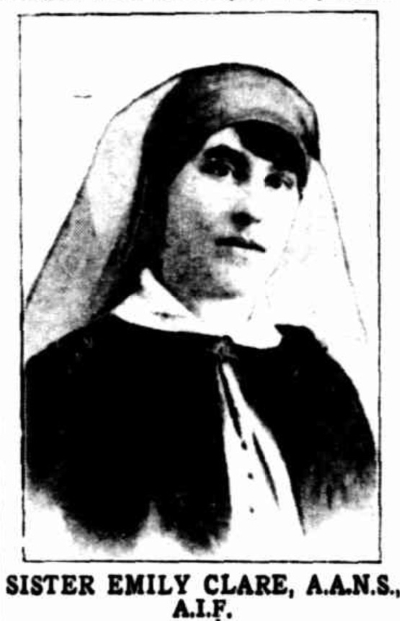
After two months at Caulfield, the opportunity arose for Emily to work in India looking after sick and wounded British and Indian troops of the Mesopotamian Expeditionary Force (MEF) invalided from Mesopotamia (modern Iraq), where the MEF was fighting Ottoman (mainly Turkish) troops. After being treated in Mesopotamia, the men were transported thousands of kilometres down the Persian Gulf and across the Arabian Sea to Bombay. Following the capture of Baghdad in March 1917, large numbers of sick and wounded Turkish prisoners of war were transported to Bombay too, and later German prisoners of war from East Africa.
INDIA
On 7 November 1917 Emily signed her attestation paper for service abroad with the AIF and was attached to the British India Service as a reinforcement staff nurse. On 16 November she and 55 other staff nurses, including Irene McPhail, under the charge of Sister Ethel Brice Butler (whose brother Col. Arthur Graham Butler would write the official history of the Australian Army Medical Services in the Great War), departed Sydney aboard the newly commissioned troopship Canberra.
The Canberra was carrying hundreds of AIF troops and 20 AANS nurses to Egypt. After stopping in Fremantle, the Canberra continued to Colombo, the capital of Ceylon, and here the 56 nurses disembarked. When Emily later wrote to her sister Alice from Bombay, she described her journey there from Colombo and her subsequent experiences at the Victoria War Hospital. A section of her letter was printed in the Footscray Independent on 27 April 1918, as follows:
“After arriving here [Bombay] on the 13th December,” Emily wrote, “we were quarantined owing to the development of cholera among one of our company. We enjoyed our five days’ stay at Colombo, which is a very beautiful place, and came overland from there after a short trip by steamer. It took us 5 days by rail to get here, in a very comfortable train, with magnificent scenic wonders stretching as far as the eye could see, all the way. Bombay is rather an extraordinary place. They call it the ‘city that never sleeps,’ and perhaps it is aptly described. At the time of writing I sit doing night duty, and no matter what time one looks out – be it 3 or 4 a.m., or any time – people are always moving about the streets.
“Up to a few nights ago I had been nursing in the prisoners’ ward (Turks and Germans). An incident occurred where one of the Germans sent the orderly I had when I was in that ward up to me with two lions’ claws, as a souvenir, with his grateful thanks for what I did for them when I was there … The Turks and Germans have quite a cordial form of hate towards each other. We had three Turkish lieutenants, and really they were very handsome and most gentlemanly fellows. The natives here are interesting, and the Parsee ladies exquisitely dainty. They wear gorgeously tinted garments of richest design and quality. The Indian sari consists of yards of silk, in which they gracefully encircle their bodies, and drapes over their heads in fantastic form that quite becomes their peculiar beauty. It might be said that the wealth among the Parsees wings high beyond even the dreams of insatiable desire. Their residences are so enormously spacious as to beggar description and stagger belief. In fact, one is vividly reminded of Solomon’s glory. There is magnificence in the buildings and beautiful statuary that abler pens than mine might find it difficult to describe.”
Emily went on to say that cholera was still raging in Bombay, with over 600 deaths in a week, and so the nurses were not allowed outside the city. She also noted that as the Mesopotamian conflict was practically at an end (dating her letter to perhaps March 1918), she expected to be transferred to another centre, and hoped that it might be Italy.
No. 34 WELSH GENERAL HOSPITAL, DEOLALI
Eventually Emily was indeed transferred, but not to Italy – to No. 34 Welsh General Hospital (WGH) in the town of Deolali, 160 kilometres northeast of Bombay and 10 kilometres from the ancient city of Nasik (today Nashik). Deolali had grown up around a British army camp established in the 1860s and, as it lay at around 500 metres above sea level, had a more comfortable climate than that of Bombay.
No. 34 WGH had its origins in the Welsh Hospital, a 100-bed military hospital built in October 1914 in Netley, near Southampton in England, as a gift of the Principality of Wales to the War Office. In 1916 the hospital’s commanding officer, Lt. Col. A. W. Sheen, was ordered to relocate to India with his staff and equipment and by June had established No. 34 Welsh General Hospital in Deolali. The hospital occupied a sprawling complex of military barracks, bungalows and huts, part of the original army camp.
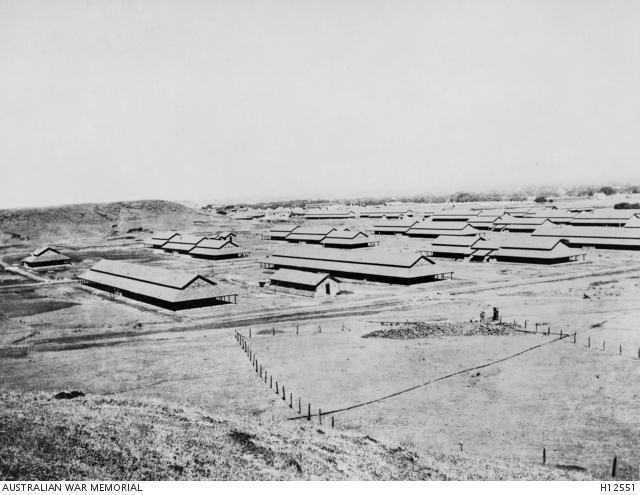
In late June 1917 the hospital’s British nurses, who were being transferred to Mesopotamia, were replaced by a contingent of 45 AANS nurses from the Victoria War Hospital. Matron Gertrude Davis, the principal matron of the AANS in India, accompanied the nurses to Deolali, and they were met there by the hospital’s newly appointed matron, Alma Bennett from Victoria. Matron Bennett had just returned from duty aboard the hospital ship Herefordshire and prior to that had been on the staff of the Victoria War Hospital.
When Alma Bennett arrived at No. 34 WGH, the hospital’s cases were all from Mesopotamia. Some arrived directly while others came via the various Bombay hospitals. There were also around 200 Turkish prisoners of war, almost all surgical cases – some with awful, septic wounds. By September 1917 Matron Bennett had 2,188 patients to look after with a staff of 59 AANS nurses and 15 local nurses, who worked alongside British medical officers and orderlies. As the months passed, the best of the British orderlies were transferred to Mesopotamia, and the nurses’ work became that much heavier.
Perhaps around August, during the monsoon, Emily again wrote to Alice. According to the report in the Footscray Independent on 21 September 1918, she was disappointed with her transfer to No. 34 WGH. “The heat is intense,” Emily told her sister, “and I am in a busy ward, where there are lots of operations. The captain in charge of the ward is a clever surgeon. The other sister and I take turn about removing the cases to the operating theatre, and in doing so have always to protect the patients with a sunshade covering owing to the heat. The sweeper (native woman who sweeps the rooms) has got a tiny coal black baby three months old. She merely lays it down in the dirt outside in the shade. It never cries, and, needless to say, it is filthy dirty; in fact, all the natives are; even their clothes emit a vile odour – such loathsome creatures. The monsoon weather is here – quite fine, then suddenly teeming, a few minutes of which finds oneself drenched.
“My ‘boy’ (servant) bought me an umbrella at a native bazaar – an immense thing – for three rupees (4/-), remindful, perhaps, of Annie Wynne’s ‘expensive umbrella for the country.’ We have a dear little chapel, and, with some of the sisters and a few soldiers, sing in the choir. It is quite a ‘top hole’ choir, too; you ought to hear us!” Before finishing her letter, Emily mentioned the enormous cobras that lived not far from the hospital.
‘SPANISH’ INFLUENZA
In June 1918 cases began to appear in Bombay of what was diagnosed as ‘Bombay influenza’ or ‘Bombay fever’ but was in fact the influenza virus that came to be known, incorrectly, as the Spanish flu. In August it reached Deolali.
In her 1919 report to the Assistant Collator of Medical War History, Alma Bennett wrote that “Everything [had gone] on quietly [at No. 34 WGH] until August when the Spanish Influenza made its appearance in the Station. We were getting in all the local [cases] as the [nearby] 44th B.G.H [British General Hospital] had been converted into an Isolation Hospital the previous month [so] we began to be busy again. In September it was at its worst. Continuing into Oct & Nov. Until that time the health of my Staff had been excellent, but early in Oct. they were attacked with influenza having been then nursing the cases some weeks. They were tired and soon fell victims. 18 being off duty at one time.”
One of those nurses who had fallen ill with influenza was Emily. The virus weakened her immune system and by 15 October she had become dangerously ill with pneumonia. She died on 17 October in the Family Hospital, a section of No. 34 WGH.
“To my intense regret one of my [nurses] died Oct 17th from Pneumonia following Influenza. [Only] five days ill,” wrote Alma Bennett in her report. Another nurse meanwhile remained on the dangerously ill list for five weeks. After a tremendous fight for life, she ultimately recovered.
Such was the lag in the transmission of news at this time, that the day after Emily’s death, Henry Edhouse was informed that she had become dangerously ill. He and Emily’s friends in Stawell harboured hopes that she might recover. It was not until 22 October that the news of her death was circulated in the town. On that day, the Town Hall flag was flown at half-mast as a mark of respect. Henry must have been devastated. Emily was like a daughter to him.
FUNERAL
Emily was buried on 18 October in the Roman Catholic section of the camp cemetery at Deolali, later to become the Deolali Government Cemetery. Staff Nurse Hilda Lapidge of Adelaide, who was on the Canberra with Emily and who worked at No. 44 BGH before being transferred to No. 34 WGH, witnessed the funeral and on 19 October wrote a letter to her sister Freda describing it. Her description, possibly the most beautiful of any military funeral one is likely to read, was printed in the Adelaide Register on 9 December 1918.
“By the time you get this,” wrote Hilda, “you will know that we have lost one of our girls. She took ‘flu, and pneumonia supervened. The pneumonia they are getting is not ordinary, but is sort of plague-infected, and it does not matter how hard we fight, it generally beats us. This girl came out on our boat, and has only recently come up to No. 34 General Hospital; and less than a week ago she was doing nights in the busiest ward here. I will tell you all about the funeral, because, although so heartbreaking, it was grand and impressive.
“At 5.30 [pm] her body was taken into the Roman Catholic Church, where a short service was held, and was then carried by three R.A.M.C. and three garrison officers and placed on a guncarriage. The carriage was covered with the Union Jack, and her hat and cape placed on the top. The Convalescent Band went ahead and played ‘Go bury thy sorrow.’ Then came we girls, in mess dress with black arm bands, then the officers (even the Hindu officers were there), then the R.A.M.C., the Depot, the Convalescent, No. 6 Camp, No. 4 Camp, the 44th Orderlies, and so on. Truly, I never thought there were so many troops in Deolali.
“The road was lined most of the way with troops and hundreds of patients. An ‘Aussie’ boy, who is a patient here, went with we girls, and also the padre, the only two ‘Aussie’ men here. Just as the sun was setting, they lowered her into her flower-lined grave. One girl placed a crown of tuber roses on her coffin, and surely it was a fitting symbol of the crown of life which is hers, and as the rifles fired and the bugle sounded ‘The Last Post’ the rays of the setting sun caught on the Crucifix, and seemed to cast a radiance around, and the sky reflected the glory also, for it had the most beautiful pink and golden shades. And as it went, so the moon rose, and gave just that touch of peace over everything, that made it all seem just the time and place where we should leave her to rest.
“And I am convinced of this, that no statesman has ever had a more fitting farewell than that accorded to our ‘Aussie’ sister by these Englishmen and native officers. I believe that this is the second Australian sister to die in India.”
(In fact, Emily was the fourth and the last. In August 1916 Staff Nurses Amy O’Grady and Kate Power died of cholera at Colaba Hospital in Bombay, and in November 1916 Staff Nurse Gladys Moreton died of enteric in Quetta. Amy O’Grady and Gladys Moreton were members of the first contingent of 50 AANS nurses to arrive in India, having transferred from Egypt on the Neuralia in July 1916. Kate Power had arrived shortly afterwards aboard the hospital ship Devanha.)
In memory of Emily.
SOURCES
- Aberystwyth at War 1914–1919 (website), ‘Aberystwyth Connections with The Welsh Hospital, Netley, Southampton’ (25 July 2019).
- Ancestry.
- Australian War Memorial, Butler Collection, Nurses’ Narratives, Sister Alma L. Bennett, AWM41 942.
- Australian War Memorial, Butler Collection, Nurses’ Narratives, Sister G. E. Davis, AWM41 960.
- Burke, E. K. (ed., 1927), With Horse and Morse in Mesopotamia, Arthur McQuitty & Co.
- Butler, A. G. (1943), Official History of the Australian Army Medical Services, 1914–1918, Vol. III – Special Problems and Services, Section III – The Technical Specialties, Chap. XI – The Australian Army Nursing Service (pp. 527–89), Australian War Memorial.
- Convict Records (website), ‘Benjamin Edhouse.’
- Haskins, V. K., ‘Australian Nurses and the 1918 Deolali Inquiry: Transcolonial Racial and Gendered Anxieties in a British Indian War Hospital,’ Ebrary.
- Heritage Victoria, Victorian Heritage Database Report, ‘Former Newmarket Saleyards and Abattoirs.’
- Museums of History New South Wales, Convicts Index 1791–1873.
- National Archives of Australia.
- Netley Military Cemetery (website), ‘The Welsh Hospital.’
- Perrin, P., ‘Henry Edhouse 1834–1922 C. Bryant & Co. Brewery, Stawell,’ via Ancestry.
- Public Record Office Victoria, Royal Victorian Trained Nurses’ Association Nurses Register (VPRS 16407/P0001), No. 4, 2,429–3,470, 4 Mar 1915–1 May 1919.
- Rae, R. (2009), Veiled Lives: Threading Australian nursing history into the fabric of the First World War, College of Nursing Australia (Kindle Edition.)
- Wikipedia, ‘1918 Flu Pandemic in India.’
SOURCES: NEWSPAPERS
- The Age (Melbourne, 31 Mar 1874, p. 3), ‘Selling Unwholesome Meat.’
- The Ararat Advertiser and Chronicle for the Stawell and Wimmera Districts (Vic., 11 Feb 1887, p. 2), ‘Stawell.’
- The Ararat Advertiser and Chronicle for the Stawell and Wimmera Districts (Vic., 17 Apr 1903, p. 3), ‘Stawell A.N.A. Competitions.’
- The Ararat Advertiser and Chronicle for the Stawell and Wimmera Districts (Vic., 18 Nov 1904, p. 3), ‘Thursday Afternoon.’
- The Ararat Advertiser and Chronicle for the Stawell and Wimmera Districts (Vic., 18 Nov 1904, p. 3), ‘Wednesday Evening.’
- The Ararat Advertiser and Chronicle for the Stawell and Wimmera Districts (Vic., 26 Oct 1906, p. 2), ‘No Title.’
- The Argus (Melbourne, 5 Jul 1897, p. 6), ‘Alleged Pollution of the Saltwater River.’
- The Ballarat Star (Vic., 21 Feb 1922, p. 6), ‘Stawell.’
- The Horsham Times (Vic., 19 Dec 1916, p. 3), ‘Nurses Pass Tests.’
- Independent (Footscray, Vic., 1 Jun 1889, p. 2), ‘News in Brief.’
- Independent (Footscray, Vic., 23 Mar 1901, p. 2), ‘Brevities.’
- Independent (Footscray, Vic., 12 Jul 1902, p. 2), ‘Brevities.’
- Independent (Footscray, Vic., 13 Sept 1902, p. 2), ‘Brevities.’
- Independent (Footscray, Vic., 24 Dec 1904, p. 3), ‘Footscray Court.’
- Independent (Footscray, Vic, 27 Apr 1918, p. 1), ‘Sister Clare in India.’
- Independent (Footscray, Vic., 21 Sept 1918, p. 2), ‘Social and Personal.’
- Independent (Footscray, Vic., 2 Nov 1918, p. 2), ‘Social and Personal.’
- Mount Alexander Mail (Vic., 24 Dec 1858, p. 8), ‘Advertising.’
- New South Wales Government Gazette (Sydney, 28 Feb 1851 [Issue No.23], p. 367), ‘Government Gazette Notices.’
- New South Wales Government Gazette (Sydney, 9 Mar 1852 [Issue No.26], p. 418), ‘Title Deeds.’
- The Register (Adelaide, 9 Dec 1918, p. 8), ‘How an Australian Nurse Was Buried in India.’
- Stawell News and Pleasant Creek Chronicle (Vic., 2 Jun 1914, p. 2), ‘Obituary.’
- Stawell News and Pleasant Creek Chronicle (Vic., 23 Oct 1918, p. 3), ‘Died on service Nurse E. Clare.’
- Stawell News and Pleasant Creek Chronicle (Vic., 26 Oct 1918, p. 4), ‘Ladies’ Column.’
- Weekly Times (Melbourne, 30 Jun 1928, p. 5), ‘Victoria’s Country Towns.’
 australianwarnurses.org