AANS │ Lieutenant │ Second World War │ 1st Netherlands Military Hospital Ship Oranje & 2/3rd Australian Hospital Ship Centaur
FAMILY BACKGROUND
Eileen Mary Rutherford was born on 2 June 1909 in the town of Hamilton in Victoria’s Western District. She was the daughter of Mary Ann Hale (1876–1913) and William Rutherford (1860–1919).
Mary Ann was born in Hamilton and lived there her entire life. She was the daughter of Jane and William Hale of Clarendon Street in Hamilton. William Rutherford was born in Flemington, an inner suburb of Melbourne. He was the son of John Rutherford, who was a gardener. Around 1872 the family moved to Hamilton after John Rutherford took a gardening job there. They then moved to Hexham, near Warrnambool, before returning to Strathkellar, outside Hamilton, and finally moving into Hamilton township. William eventually became a gardener like his father.
Mary Ann and William were married in Hamilton in March 1901 and resided in Mary Ann’s late parents’ house on Clarendon Street. They had passed away in the 1890s. Mary Ann and William had six children – three boys followed by three girls. Walter Moore (Wally) was born in 1902, followed by William John (Jack) in 1903 and Leslie Hamilton (Toby) in 1906. Eileen came next, then Ivy Jean (Jean) in 1911 and finally Lorna May in 1913.
GROWING UP
On 19 October 1913, eight months after Lorna May’s birth, Mary Ann Rutherford died in Hamilton Hospital of acute peritonitis. She was only 37. She was buried the following day at the Hamilton Cemetery. Mary Ann’s death followed that of William Rutherford’s father only three months earlier.
It is assumed that Eileen and her siblings went to local schools in Hamilton; we know at least that her brothers Jack and Wally went to Hamilton High School when they were old enough. Eileen did attend St. Andrew’s Sunday School, and on 2 December 1914 received a prize at the school’s annual celebrations.
In December 1919 William Rutherford died and was buried beside Mary Ann. At the age of just 10, Eileen had lost both her parents.
NURSING
As an adult, Eileen decided to go into nursing. She moved to Melbourne and began her training at the Alfred Hospital in South Yarra, passing her final examination in November 1935 and becoming registered in general nursing on 5 February 1937. After finishing at the Alfred, Eileen moved to the Women’s Hospital in Carlton and then to Windermere Private Hospital on High Street, Armadale, where she was sub-matron. At Windermere, Eileen became known as ‘Nan’ Rutherford, a nickname that stuck.
ENLISTMENT
Like so many of her peers, when war broke out in Europe, Eileen wanted to help. In mid-1941 she applied to join the Australian Army Nursing Service (AANS). Once she was accepted she enlisted in the Australian Military Forces and was posted to 115th Heidelberg Military Hospital in Melbourne.
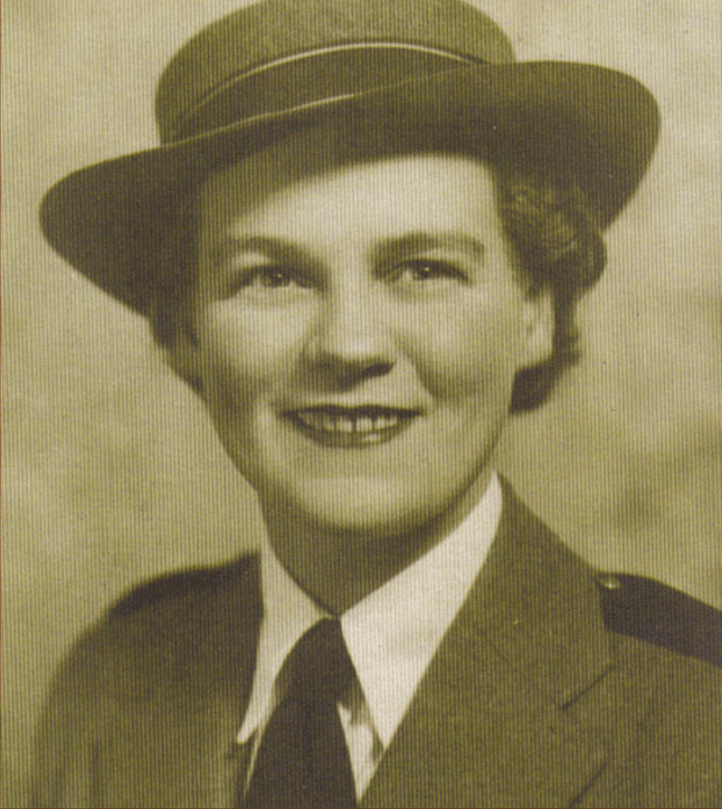
Eileen’s sister Jean, who had trained as a surgery attendant, enlisted in November that year and was posted to the 115th Heidelberg Military Hospital as a Volunteer Aid Detachment, whose role was that of a nursing orderly in hospitals.
1st Netherlands Military Hospital Ship Oranje
In January 1942, while still at Heidelberg, Eileen learned that she had been selected to serve on the hospital ship Oranje. Originally a Dutch passenger liner, the Oranje had been offered to the Australian and New Zealand governments in February 1941 for use as a hospital ship to repatriate Australian and New Zealand casualties from Egypt. It was refitted in Sydney and recommissioned as the 1st Netherlands Military Hospital Ship Oranje.
The Oranje had already completed two voyages to Port Tewfik with a mainly Dutch medical staff. However, following the Japanese invasion of Southeast Asia in December 1941, many of the Dutch staff had been redeployed to the Netherlands East Indies. For the ship’s third voyage, they would be replaced by Australian and New Zealand medical staff – among them Eileen.
As the time for embarkation drew near, Eileen farewelled her friends and colleagues at Heidelberg and transferred to the Lady Dugan Nurses’ Hostel in South Yarra. Joining her at the hostel were Victorian AANS nurses Margaret Adams and Jenny Walker, who had also been attached to the Oranje. On 28 January Eileen, Margaret and Jenny travelled to Port Melbourne and boarded the magnificent vessel, which had departed Sydney the previous day. They met their new colleagues Betty Glasson, Cynthia Haultain, Eva King, Ruth Lindsay and Matron Annie Jewell, who, like the three Victorians, were joining the ship for the first time, and they met Mary McFarlane, who had been a liaison officer on the Oranje’s first two voyages.
That afternoon the Oranje set off once again, sailing to Egypt via Fremantle and Aden. In Port Tewfik 603 Australian and New Zealand patients were embarked, and on 9 March the Oranje arrived back in Sydney.
Eileen completed four more voyages with the Oranje over the next 12 months. During this time, more New Zealand and Australian personnel joined the staff, including AANS nurses Estelle Davis, Nell Savage, Elizabeth Smith and Phyllis Vickers.
2/3rd Australian Hospital Ship CENTAUR
The Oranje’s return to Sydney on 1 March 1943 marked the end of its seventh voyage and the end of Australian involvement with the ship. Due to the growing Japanese threat to the immediate north, the Australian staff were being withdrawn for service at home and in the southwest Pacific, and the Oranje was being relocated to the Mediterranean.
However, Eileen, Margaret Adams, Cynthia Haultain, Eva King, Mary McFarlane, Nell Savage, Jenny Walker and Matron Annie Jewell, together with many of their male colleagues, were almost immediately attached to another hospital ship, the Centaur.
The Centaur had been built in Scotland in 1924 and arrived in Australia later that year to ply a route between Fremantle and Singapore. In 1940 the ship was placed under the control of the British Admiralty and at the beginning of 1943 loaned to the Australian government for use as a hospital ship. It was refitted in Melbourne and on 1 March recommissioned as 2/3rd Australian Hospital Ship Centaur.
On 12 March the Centaur sailed from Melbourne to Sydney on the first leg of a trial voyage. During the voyage, faults and inadequacies became apparent and were resolved upon the ship’s arrival in Sydney. By 17 March the Centaur was ready for the nurses’ embarkation, and Eileen and her seven Oranje colleagues boarded the ship. They were joined by four more AANS nurses, Myrle Moston, Alice O’Donnell, Edna Shaw and Joyce Wyllie.
By 21 March all was ready for the next leg of the Centaur’s trial voyage. On that day the ship set out for Townsville. Upon arrival it embarked Australian casualties repatriated from New Guinea and transported them to Brisbane. The Centaur then sailed north to Port Moresby, picked up more wounded Australians, and returned to Brisbane. The trial was now complete, and the Centaur had proved its capability.
THE FINAL VOYAGE
On the morning of 12 May the Centaur set out from Sydney tasked with delivering 193 members of the 2/12th Field Ambulance to Port Moresby and then returning with Australian casualties.
On the evening of 13 May, the Centaur was off the northern New South Wales coast and the nurses were celebrating Matron Annie Jewell’s birthday. A special dinner menu had been prepared, which included a cake that the nurses had bought in Sydney. They finished the evening at around 10.00 pm and retired to their cabins.
That night the weather was clear and visibility excellent. The Centaur was travelling unescorted and was fully illuminated and marked with the Red Cross. Suddenly, at 4.10 am, while most of the 332 people on board were asleep, a Japanese torpedo slammed into the Centaur, causing a massive explosion. Fire rapidly spread throughout the ship and water rushed in through a gaping hole in the hull. There was no time to launch the lifeboats. The Centaur capsized and sank within three minutes.
Eleven of the nurses died that day, including Eileen. Nell Savage survived. Altogether 268 people lost their lives, including 178 members of the 2/12th Field Ambulance. The survivors clambered onto rafts and bits of wreckage and floated on the sea for 34 hours.
REMEMBRANCE
The tragedy of the Centaur was felt deeply by the whole country. Thousands of ‘in memoriam’ notices inserted by friends and family who had lost loved ones appeared in the newspapers in the immediate aftermath and in the coming years. Dozens were inserted in memory of Eileen, by her siblings and other family members, by friends, and by colleagues from Windermere Hospital.
On 14 February 1953, the 11th anniversary of another tragic event, the sinking of the Vyner Brooke, a sundial donated by Eileen’s friends and relatives was unveiled in her honour outside the Alfred Hospital Nurses’ Home on Punt Road in South Yarra. On the same occasion, a short dedication service was held to mark the opening of memorial gates at the entrance to the nurses’ home. The gates were erected by the Alfred Hospital Nurses’ League and memorialised Eileen and three other Alfred trainees who had lost their lives during the war – Sister Dot Freeman (who died a prisoner of war in Sumatra), Sister Frances Stevenson (who died of illness in Australia) and Matron Gwladys Thomas (who was killed in a car crash in Egypt). Former matron-in-chief of the AANS Grace Wilson ceremonially unlocked the gates with the following words: “The nurses to whom these gates are dedicated gave their all. They should be a constant reminder to all of us to give nothing but the best that is in us.”
In memory of Eileen, who gave nothing but the best.
SOURCES
- Ancestry.
- Goodman, R. (1992), Hospitals Ships, Boolarong Publications.
- Milligan, C. and Foley, J. (1993), Australian Hospital Ship Centaur: The Myth of Immunity, Nairana Publications.
- National Archives of Australia.
SOURCES: NEWSPAPERS
- The Age (Melbourne, 16 Feb 1953, p. 4), ‘No title.’
- The Argus (Melbourne, 31 May 1943, p. 2), ‘Family Notices.’
- The Argus (Melbourne, 13 May 1944, p. 2), ‘Family Notices.’
- The Argus (Melbourne, 15 May 1944, p. 10), ‘Family Notices.’
- The Argus (Melbourne, 14 May 1947, p. 15), ‘Family Notices.’
- Hamilton Spectator (Vic., 21 Apr 1904, p. 2), ‘Items of News.’
- Hamilton Spectator (Vic., 17 Jul 1913, p. 3), ‘Obituary.’
- Hamilton Spectator (Vic., 31 Jul 1913, p. 5), ‘Advertising.’
- Hamilton Spectator (Vic., 20 Oct 1913, p. 4), ‘Death of Mrs W. Rutherford.’
- Hamilton Spectator (Vic., 12 Nov 1913, p. 6), ‘Hamilton Hospital and Benevolent Asylum.’
- Hamilton Spectator (Vic., 21 Dec 1914, p. 5), ‘Advertising.’
- The Herald (Melbourne, 6 Dec 1935, p. 12), ‘Successful at Nurses’ Exams.’
 australianwarnurses.org