AANS │ Sister │ First World War │ Egypt & France │ No. 2 Australian General Hospital, Ras-el-Tin Convalescent Depot, Choubra Infectious Diseases Hospital, HMAT Nestor, No. 14 Australian General Hospital, No. 14 Stationary Hospital & No. 1 Australian Casualty Clearing Station
FAMILY BACKGROUND
Edith Ann Moorhouse was born in 1886 in Lancaster, a small town between Kyabram and Mooroopna North in northern Victoria’s Goulburn Valley. Edith was the daughter of Deborah McCleary (1853–1891), who was born in McCallum’s Creek in Victoria’s Goldfields region, and Frederick Moorhouse (1844–1892), who was born in Upperthong, a small village near Holmfirth in Yorkshire, England. Frederick migrated with his family to Victoria in 1852 and as a young adult became one of the early selectors in the Lancaster area.
Deborah and Frederick were married in 1879 and had five children. Matthew Henry was born in 1880, followed by Jane Elizabeth (Janie) in 1882, Mary Helen in 1884, Edith in 1886, and Sarah Louisa (Sadie) in 1889.
EARLY LIFE
Edith and her siblings spent the early part of their childhood on the family property in Lancaster, ‘Holmfirth Farm,’ named after the town closest to Frederick’s birthplace in England.
On 26 April 1891, when Edith was only four or five, Deborah Moorhouse died at home aged only 47 or 48. The tragedy was compounded when, on 26 May 1892 – just a year later – Frederick Moorhouse died of heart disease at the age of 49. He was buried at Mooroopna Cemetery.
Edith and her four siblings were now orphans.
The children’s paternal uncle, Henry Moorhouse of Echuca, a successful land surveyor with 10 children, was the executor of his brother’s will. Holmfirth Farm – land, livestock, crops, equipment, implements, household furniture, etc – was put up for sale in October 1892. When debts were cleared, £795 remained in the estate for the maintenance, education and benefit of the five children, of which £179 was immediately available, with the balance to be held in trust and released over time.
The five children now lived in Echuca. Edith and Mary (and presumably the others) attended the Echuca State School, where in August 1899 Edith gained her Standard of Education certificate.
NURSING
In time, Edith decided to become a nurse. She trained for three years at Mooroopna General Hospital and passed her Royal Victorian Trained Nurses’ Association (RVTNA) final examination in June 1910.
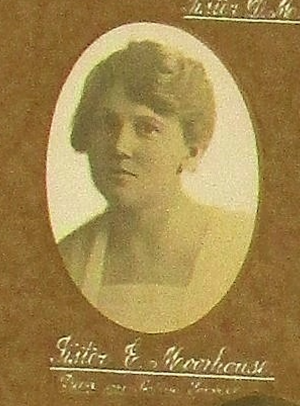
One of Edith’s fellow trainees at Mooroopna was a nurse by the name of Mary Margaretta Nielsen, who was known as Molly. They became best friends. Molly was from Rushworth, 40 kilometres southwest of Mooroopna, and was a year older than Edith. She passed her final examination in 1909. Besides general nursing, each had also gained a certificate in infectious nursing.
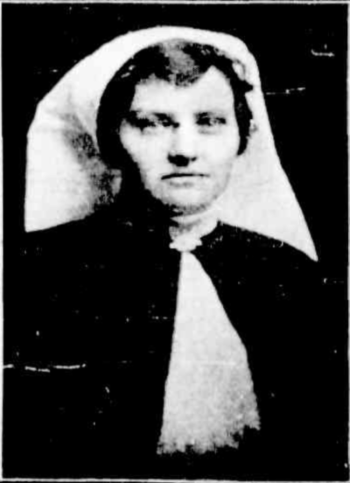
After completing her training Edith was offered a 12-month position as staff nurse at Mooroopna General and later spent another 12 months as sister in charge. Molly, meanwhile, also spent time on staff at Mooroopna. She also worked as a charge nurse at St. Andrew’s Private Hospital in Brighton, Melbourne, and was for a time matron of Kurri Kurri Hospital in New South Wales. Then, for 12 months or so, until July 1915, Edith and Molly worked together at The Elms Private Hospital on Archer Street in Mooroopna.
ENLISTMENT
By now the Great War had broken out. More than 20,000 troops of the Australian Imperial Force (AIF) had sailed to Egypt and from there to the beaches of the Gallipoli Peninsula. Thousands of casualties had flooded into Australian and British military hospitals established in Egypt, and many hundreds of nurses of the Australian Army Nursing Service (AANS) were looking after them. Edith and Molly wanted to join them. They filled out their application forms on 14 July 1915 and on 20 August were attached to No. 2 Australian General Hospital (AGH), each at the rank of staff nurse. The following day they departed Melbourne aboard HMAT Kyarra with 13 other nurses of the unit.
EGYPT
No. 2 AGH had arrived in Egypt in January 1915 and had taken over Mena House, a luxury hotel situated close to the Pyramids. Faced with a rush of casualties following the opening of the Gallipoli campaign, the unit had moved into the Ghezireh Palace Hotel in central Cairo, which had a 1,000-bed capacity, and maintained the 500-bed Mena House as an overflow hospital. By mid-1915 the fighting in Gallipoli had ground to a stalemate and Mena House was mothballed. It reopened as a convalescent depot at the beginning of August in anticipation of a series of operations, collectively known as the August Offensive, which were aimed at breaking the Gallipoli deadlock.
By the end of August the number of battle casualties was tailing off. The August Offensive had failed, and before long the Allies would decide to evacuate the Gallipoli Peninsula altogether. As summer gave way to autumn, however, infectious diseases and illnesses proliferated, and September saw the highest rate of non-combat admissions in the entire war. No. 2 AGH and its sister hospital, No. 1 AGH, based at the Heliopolis Palace Hotel on the eastern outskirts of Cairo, were packed with cases of typhoid, dysentery and influenza.
In mid-September 1915 Edith and Molly arrived in Egypt and were taken to the Ghezireh Palace Hotel, where their training in infectious nursing must have proved immediately useful.
After just over a month at Ghezireh, on 21 October Edith was detached to the Ras-el-Tin Convalescent Depot in Alexandria, the ancient Egyptian city on the Mediterranean coast. She returned to her unit on 18 November.
Edith then spent time detached to the Military Infectious Diseases Hospital in Choubra, east Cairo. She reported back to No. 2 AGH on 8 February 1916.
RETURN TO AUSTRALIA AND BACK TO EGYPT
Meanwhile, Edith and Molly had been detailed for hospital duty aboard HMAT Nestor. Bound for Melbourne, the ship sailed from Port Tewfik, Suez on 9 February 1916, the day after Edith’s return from Choubra, and arrived on 13 March.
After five months back home Edith and Molly returned to Egypt. They had been attached to No. 14 AGH, which had been tasked with relieving No. 3 AGH at Abbassia, around 5 kilometres to the east of Ghezireh. They sailed from Melbourne on 19 August 1916 on HMAT Karoola as part of a contingent of 28 AANS nurses under Matron Rose Creal, as well as other staff. Edith and Molly officially reenlisted in the AIF en route, signing their attestation forms on 9 September.
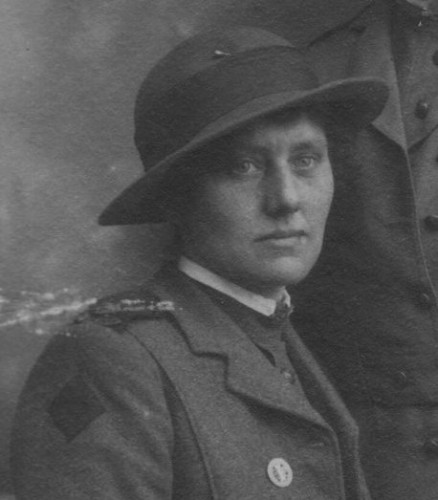
The Karoola arrived at Port Tewfik on the morning of 19 September, having sailed via Fremantle and Colombo. In the early hours of 20 September a special train arrived alongside the ship and all baggage and a small quantity of equipment was loaded before daylight. The staff of No. 14 AGH disembarked and boarded the train, which left at 10.00 am and arrived at Abbassia siding, immediately in front of the main barracks, where the hospital was situated, at around 6.00 pm.
The commanding officer of No. 3 AGH had made all necessary arrangements for the accommodation of the officers, nurses, and other ranks of No. 14 AGH, who spent the next two days becoming acquainted with their duties. These began at 9.00 am on 23 September after the final departure of No. 3 AGH.
Only 366 patients remained in the hospital on the morning of 23 September, a large number having been transferred to the AHS Kanowna on 22 September, and the number rose only gradually over the next three months.
Soon Christmas Day arrived. The patients and staff were provided with extra food, and the patients were given presents by the Australian Red Cross Society. In the afternoon an orchestra played in the gaily decorated wards and in the evening a concert was given by the Kookaburras Concert Party, which was made up of orderlies, with one of the patients, a musician of note, playing a key role.
After Christmas the hospital saw a dramatic rise in the number of admissions. The heavy fighting on 23 December at Magdhaba, a village located in the northern Sinai desert, had resulted in many casualties, and the raid into Mandatory Palestine on 7 January resulting in the capture of Rafa brought a further influx of patients. By 15 January 1917 the nurses and other staff were dealing with 925 patients. However, the repatriation of 267 patients towards the end of the month, and the arrival of a contingent of 60 nurses, helped to ease the situation.
On 16 January Edith and Molly embarked for England from Alexandria aboard HMHS Essequibo, part of a contingent of 35 nurses of No. 14 AGH to leave Egypt. They arrived in Southampton on 26 January.
FRANCE
From England Edith and Molly sailed for France, departing on 8 February 1917. The following day they were attached to a British Royal Medical Corps (RMC) hospital, No. 14 Stationary Hospital in Wimereux, a small seaside town to the north of Boulogne in northern France.
After seven months at No. 14 Stationary Hospital, on 26 September Edith and Molly returned to their old unit, No. 2 AGH, now based at Wimereux. After spending another three months together they were separated for the first time on 10 January 1918, albeit by only 12 kilometres, when Molly was posted to No. 25 General Hospital, an RMC hospital at Hardelot-Plage.
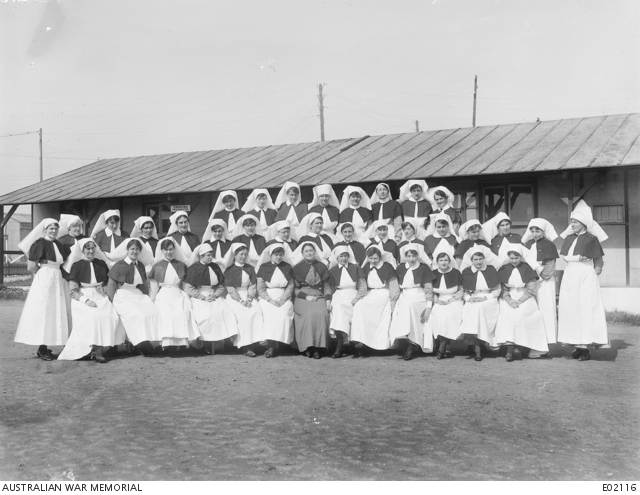
Edith stayed with No. 2 AGH. She was granted leave on 21 January and crossed the Channel to England, returning to her unit on 4 February. By May she was working as a theatre nurse or in the x-ray department. She was granted more leave from 31 August to 14 September and again crossed to England.
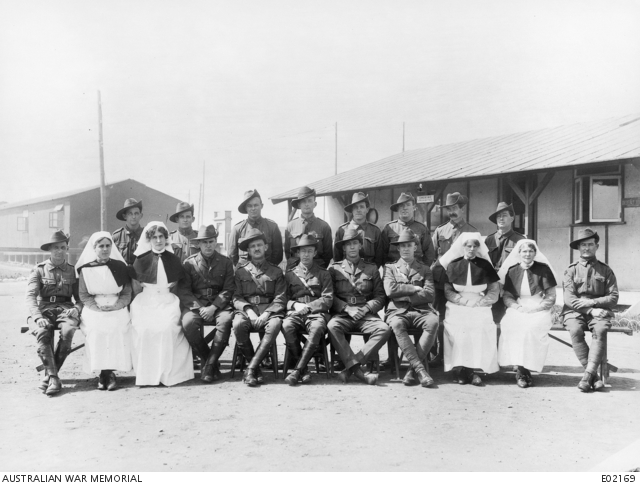
On 1 October 1918 Edith was promoted to the rank of sister and attached to No. 1 Australian Casualty Clearing Station (ACCS), based at that time at an old asylum on the outskirts of Saint-Venant, a small town 90 kilometres east of Wimereux. (Molly Nielsen, now at No. 3 ACCS, near Roesbrugge in Belgium, was promoted to sister on the same day.)
After the Allied recapture of Lille in late October, No. 1 ACCS moved to Fretin, 50 kilometres east of Saint-Venant – “a dreary bleak spot” according to Edith’s colleague Sister Leila Brown in her brief account of her service composed in 1919 at the request of the official war archivist. Here the nurses were billeted in an old chateau, 20 minutes by foot from their hospital. The weather had turned filthy, with cold winds and rain, and the team of night-duty nurses, which included Edith and Leila Brown, had no alternative but to walk through it. Leila later wrote that they were cold and miserable long before they reached their ward for the night’s work. It was at this time, walking back and forth through the dismal late-autumn weather while on night duty, that Edith became sick. She “took ill,” wrote Leila Brown, “but would not give in until she could not move, and it was too late to save her precious life.”
On 13 November Edith was admitted to No. 1 ACCS and was transferred the same day to No. 39 Stationary Hospital in Lille with influenza and pneumonia. She died on 24 November and was buried two days later at Lille Southern Cemetery.
IN MEMORIAM
A year later, on 18 November 1919, a notice appeared (a few days prematurely and with an incorrect middle initial) in the Melbourne Argus marking the first anniversary of Edith’s death. It had been placed by Molly Nielsen’s sister Kate. It read as follows:
MOORHOUSE. — In loving memory of our dear friend, Sister E. M. Moorhouse (Moorie), and beloved pal of Sister M. M. Nielsen (on active service), died of illness, November 18, 1918.
Ever remembered.
Duty nobly done. — (K. Nielsen, Berrimal.)
EPILOGUE
Molly returned to Melbourne on 26 December 1919 on the Ormonde. The following year she married Cecil Percy Thompson. On Anzac Day in 1935, 20 years after she and Edith had first signed up, Mrs. C. P. Thompson marched with nearly 300 other Great War nurses along St. Kilda Road to the Shrine of Remembrance – where, we can be sure, her thoughts will have turned to her fallen friend.
In memory of Edith.
SOURCES
- Ancestry Library Edition.
- Australian War Memorial, Nurses’ Narratives, AWM41 946 – Staff Nurse Leila Brown, AWM2021.219.9.
- Australian War Memorial, Unit Diaries, AWM4 Subclass 26/68 – No. 14 Australian General Hospital, AWM4 26/68/1 – July 1916 – September 1917.
- Australian War Memorial, Unit Embarkation Nominal Rolls, 1914–18 War, No. 2 Australian General Hospital (1 to 16 and Special Reinforcements, Dec 1914–Mar 1916), AWM8 26/66/3.
- Australian War Memorial, Unit Embarkation Nominal Rolls, 1914–18 War, No. 14 Australian General Hospital and Reinforcements (Jul 1916–Nov 1917), AWM8 26/101.
- Brighton Cemetorians, ‘Mary Margaretta Nielson [sic].’
- MacDonnell, F., ‘Creal, Rose Ann (1865–1921),’ Australian Dictionary of Biography, National Centre of Biography, Australian National University (published first in hardcopy 1981).
- National Archives of Australia.
- Through These Lines (website), ‘No. 1 Australian Casualty Clearing Station.’
- Victorian Public Records Office, ‘49/544 Frederick Moorhouse: Grant of Probate.’
SOURCES: NEWSPAPERS
- The Age (Melbourne, 7 Jun 1892, p. 1), ‘Family Notices.’
- The Argus (Melbourne, 30 Jun 1910, p. 5), ‘Trained Nurses.’
- The Argus (Melbourne, 7 Dec 1918, p. 13), ‘Family Notices.’
- The Argus (Melbourne, 18 Nov 1919, p. 1) ‘Family Notices.’
- Kyabram Free Press (Vic., 27 May 1892, p. 2), ‘Removing Headquarters.’
- Kyabram Free Press (Vic., 30 Sep 1892, p. 2), ‘Advertising.’
- Kyabram Free Press (Vic., 21 Oct 1892, p. 2), ‘Vox Populi Vox Det.’
- Kyabram Union (Vic., 3 Jun 1892, p. 2), ‘Local and Other Items.’
- The Riverine Herald (Echuca, Vic., 2 Jun 1892, p. 2), ‘Family Notices.’
- The Riverine Herald (Echuca, Vic., 22 Oct 1892, p. 3), ‘Advertising.’
- The Riverine Herald (Echuca, Vic., 5 Sep 1899, p. 3), ‘Annual State School Examination.’
- The Riverine Herald (Echuca, Vic., 24 Nov 1939, p. 1), ‘Early Chronicles: 1900.’
- Shepparton Advertiser (Vic., 24 Dec 1909, p. 2), ‘The Advertiser.’
- Shepparton Advertiser (Vic., 8 Jul 1910, p. 3), ‘Personal.’
- Shepparton Advertiser (Vic., 12 Jul 1915, p. 2), ‘Under the Clock.’
- Sun News-Pictorial (Melbourne, 26 Apr 1935, p. 46), ‘Nearly 300 Nurses Take Their Quiet Part in Anzac Day March.’
 australianwarnurses.org