AANS │ Staff Nurse │ First World War │ Australia │ No. 7 Australian General Hospital & Woodman’s Point Quarantine Station
EARLY LIFE
Doris Alice Ridgway was born on 13 November 1891 in Salter’s Springs, around 80 kilometres north of Adelaide in the district of Gilbert, South Australia. She was the daughter of Ada Mitton (1864–1941) and Arthur John Samuel Ridgway (1862–1935).
Arthur Ridgway was born and raised in the town of Salter’s Springs, one of 13 children from a farming family. He attended primary school in the district and was later a pupil of Prince Alfred College in Kent Town, Adelaide. In time he met Ada Mitton, daughter of Ellen Mitton (née Shearing) and John Edward Mitton of Hindmarsh, then a town on the northwestern fringe of Adelaide (and now a suburb). Ada and Arthur were married on 10 March 1887 at the Hindmarsh Congregational Church.
After their marriage the Ridgways may have lived for a short while in Hindmarsh, where their first child, Irene Ada, was born in 1888, before moving to Salter’s Springs, where Irene’s birth was registered. In Salter’s Springs Arthur carried on the family farming tradition.
Over the next eight years, seven more children were born to the Ridgways. John Edward Keith was born in 1889, followed by Merle Mitton in 1890, Doris in 1891, Hugh Kelly in 1893, Clive Wakefield in 1894, Eric Bertram in 1896 and Victor Mitton in 1897.
Arthur Ridgway was very active in public life. He was a member of the Methodist Church and in the early 1890s became a member of the Alma Plains District Council. He was chairman of the council when the family left Salter’s Springs in February 1899, apparently to return to Adelaide.
When the Ridgways left Salter’s Springs, Ada was pregnant again. The new baby, named Arthur after his father, was born on 23 March, presumably in Adelaide, but tragically died on the same day and was buried at Hindmarsh Cemetery.
Later that year, and on a happier note, it would appear that Arthur Ridgway and his brother-in-law John Edward Mitton together undertook a course in dairying at the School of Mines, on North Terrace, Adelaide, a course that encompassed chemistry, bacteriology, veterinary science, butter and cheese making, and general dairy farming. They sat the final examination on 23 December and each achieved a pass, John with 88% topping the class, and gained their government dairying certificate.
In March 1900, a short while after Arthur gained his dairying certificate and a year after the death of baby Arthur, Ada gave birth to Wilfred Roberts. By then it would appear that the family was resident on Kirkaldy Road, Henley Beach, located on the coast seven kilometres to the west of Hindmarsh. In those days, some farming was still carried on near central Adelaide, and given that Arthur had studied dairying, this may have been his pursuit at this time.
By 1904 the family had moved to Woodville, a suburb of Adelaide northeast of Henley Beach. Doris attended Woodville Public School until March 1906, at which time she transferred to Sturt Street Public School in central Adelaide as a Lower VI Class pupil. At the end of the year she gained her Junior Certificate. In November Doris also sat and passed the Pupil Teacher Candidates’ Examination, the first step towards her qualification as a pupil teacher.
In February 1907, after sitting a competitive examination, Doris was one of 25 pupils of Adelaide schools to be awarded a scholarship to the Adelaide School of Design, commencing the following year. In the meantime she continued at Sturt Street Public School in Upper VI Class. In December Doris successfully sat the Pupil Teachers’ Entrance Examination, the next step on the path to teaching, and in November 1908 was appointed a monitor on a stipend of £8 per annum, a level of remuneration much lower than that of a pupil teacher.
By now Doris had begun her course at the School of Design and in December 1908 achieved an ‘excellent’ pass in First-grade Model Drawing. In the first half of 1909 she studied Intermediate Perspective and in May was awarded a standard pass. It is not clear whether she was acting at this point in her capacity as monitor – or indeed whether she ever did.
Meanwhile, around 1906 Arthur Ridgway had taken up land at Cooke’s Plains, 100 kilometres southeast of Adelaide. By October 1908 he and Ada – together with their new baby, Gertrude Ellen Jean, who was born in May that year, and whichever of their other children who were not otherwise engaged in Adelaide – had moved into their new homestead, ‘Tooriarra.’ Arthur was just as engaged in public life in Cooke’s Plains as he had been elsewhere. He continued his work with the Methodist Church, at one point teaching Sunday School, and in 1910 was appointed a justice of the peace. He and Ada remained in the district until around 1920, when they moved to the property known as ‘Dunalbyn’ in Wolseley, close to the Victorian border.
THE GREAT WAR
Just a few months after Australia went to war in August 1914, Doris – or Dorrie as she was sometimes known – began to train as a nurse at Adelaide Hospital, where she joined her sister Irene. She could not have imagined that the war would still be going when she graduated three years later – or that she herself would have the opportunity to serve her country.
By the time Doris finished her training on 17 December 1917, two of her brothers had already served. Hugh and Eric Ridgway enlisted together in the Australian Imperial Force (AIF) on 25 June 1915 and were attached to the 9th Light Horse via the 11th Reinforcements for service in Egypt. Tragically, Eric was accidently shot by a comrade on 21 June 1917 and died on 1 July. Hugh returned home in mid-1919.
With Eric’s death still fresh in her mind, and Hugh still away, Doris applied to join the Australian Army Nursing Service (AANS) one day after completing her training. She had gained first-class passes in her final examinations and been awarded a gold medal, one of five recipients in her cohort of trainees. She had also spent three months as acting charge nurse and possessed a recommendation from her matron, so in the end had little difficulty being accepted into the AANS.
While awaiting her call up, for some months Doris worked as a staff night nurse at the Ru Rua Hospital, a private hospital located in North Adelaide that was part founded in 1909 by a champion of women’s healthcare, obstetrician and gynaecologist Thomas George Wilson. On 29 June 1918 another of Doris’s brothers joined the AIF. Victor Ridgway was attached to the 9th Light Horse via the 7th Reinforcements and on 16 October embarked for Egypt on HMAT Malta. Like Hugh, he survived the war.
In August 1918 Doris finally received notification from the Army that she was to present at Keswick Barracks, immediately southwest of the city centre, and on 24 August she enlisted in the Australian Military Forces (AMF).
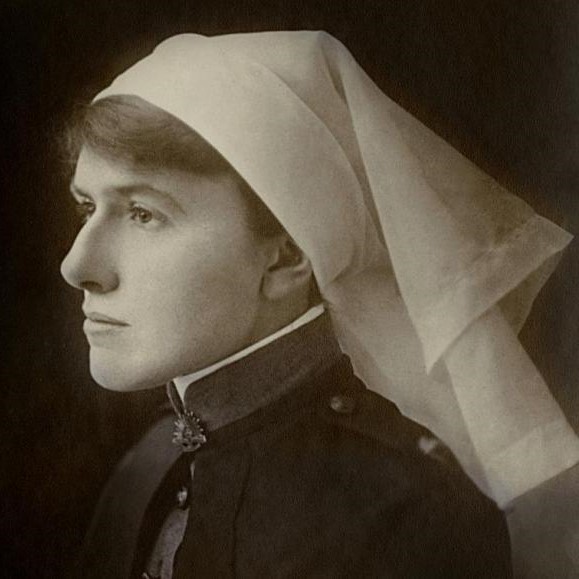
Two days later Doris was posted to No. 7 Australian General Hospital (AGH) at Keswick Barracks. The hospital’s matron later described Doris as the possessor of a loveable, amiable and bright disposition who was very popular among the other members of the hospital staff, and loved by the patients.
While she was at Keswick, Doris nominated and was accepted for service in England with 24 other nurses. However, the signing of the Armistice on 11 November meant that they were no longer required, and they remained at Keswick.
WOODMAN’S POINT QUARANTINE STATION
Early on the morning of 11 December, HMAT Boonah dropped anchor in Gage Roads, the outer harbour of Fremantle. The ship had been on its way to England with around 1,000 AIF troops aboard when it was recalled to Australia following the signing of the Armistice. It returned with several hundred cases of pneumonic influenza on board. Waiting for the infected men at Woodman’s Point Quarantine Station hospital were 20 AANS nurses from HMAT Wyreema, which had itself been recalled to Australia and was running one day ahead of the Boonah. The nurses were requested by quarantine authorities when the extent of the outbreak on board the Boonah became known, and had been dropped off by the Wyreema at Fremantle. Despite the best efforts of the AANS nurses and their civil counterparts at the quarantine station hospital, the number of patients was too great, and a call was made to 4th Military District (South Australia) Headquarters, Keswick, for nurses to go into quarantine with the patients at Woodman’s Point.
The nurses of No. 7 AGH answered the call. On 21 December Doris enlisted in the AIF and together with 11 colleagues – Helena Barry, Sister Collins, Ella Charity Dart, Mary Compson Daw, Laura Hancock, Mary May Hogan, Sister Howe, Sister Muirson, Bessie Paltridge, Stella Victoria Richards and Mary May Rodgers – departed Adelaide on the East-West Express for Perth via Port Augusta and Kalgoorlie. They arrived at the quarantine station on Christmas Eve.
By then one of the AANS nurses from the Wyreema had already died. Rosa O’Kane, from Charters Towers in Queensland, was hospitalised on 14 December and died at 1.45 am on 21 December. She was given a military funeral later that day at the cemetery attached to the quarantine station.
A second nurse from the Wyreema, Ada Thompson from New South Wales, passed away at 5.00 pm on 1 January 1919. The following day she too was buried at the quarantine station cemetery, but inexplicably her colleagues were not permitted to attend. A third nurse, Hilda Williams, a civilian nurse from Perth, died on 4 January.
Together the three nurses had spared no exertion and risked every danger to save their patients – and had paid the ultimate price.
FUNERAL
One more nurse would pay the ultimate price – Doris. After become infecting with the dread virus she died at 9.00 pm on Monday 6 January. She was buried with full military honours at 4.00 pm the following afternoon.
Afterwards, one of the nurses present at Doris’s funeral, ‘R.E.L.,’ wrote a poignant narrative, which appeared in the West Australian newspaper on 18 January.
They lifted the little pitch-pine coffin covered with the Union Jack out of the waggon reverently and carried it through the white sand to its last resting place. The sun shone very sweetly on the blossoming bush, and a bird pausing on its way to the sea beyond, stayed and mourned softly. Somehow, though the nursing sister friends were weeping, that was the only hopeless note that sounded at the burial of the little sister who had died while doing her simple duty. She who had passed to the Great Beyond must have had a gentle, joyous, lovely soul, happy in her work whilst faithfully carrying it on; patient, nay smiling, they said, when sick, and contented now to rest in peace for ever, for in all that still air round her grave there was no discordant vibration, no wandering, restless looks, no sighing with remorseful memory.
The firing party who had led the way with reversed bayonets from the old quarantine hospital along the winding stone-flagged way to the little God’s acre of happy souls, looked down, and, as at a queen’s requiem, turned down also, their guns, and, resting their hands quietly on them, stood so while the exquisite words of the service rang out: ‘Oh death, where is thy sting; oh grave, where is thy victory?’ The nursing sisters in gray dresses, white capped and red caped, wept, but there was no hopeless sadness at the funeral of the little sister who had died doing her duty; rather would one wish that might be one’s own fate – to die nobly, peacefully, gloriously, and be buried in the sunshine by the sea, with these who had worked and suffered with one – standing so quietly near – for ‘Blessed are the dead which die in the Lord … for they rest from their labours … For as much as it has pleased Almighty God to take unto Himself the soul of our dear sister in sure and certain hope of the resurrection to eternal life.’
The four stalwart lads who had lifted and lowered the beloved sister’s body in its shell, on which the white cap and scarlet cape now rested, to its last home, stood humbly by, their hands folded, their young faces stern with regret, and the sister-friends bowed their heads sorrowfully weeping. There were others there also, others who had fought the world-wide dread disease through its virulence in this little corner of Australia to which it had crept, with less tragic result to themselves, and though they sighed the stillness was intense.
Then one by one the three volleys rent the air, the three volleys which tell a soldier that one of his comrades has been laid to rest, and then like a sharp shower of rain on an arid electric day the rifles clattered to the salute, and the men in khaki presented arms to the still body, which lay unheeding with feet set towards the dawn, while the bugle rang out with its triumphant note, slowly sounding the Last Post.
So do the bodies of some thirty valiant men and maids lie there at peace. Men and maids who have done what they could, whose souls soar and whose lives live on in the memory of those who love them. And the example of work cheerfully done, of suffering nobly borne, of life freely given, will add laurels to Australia’s flag for ever. Wasted life! Is it waste if the dread disease is kept out of one country in the world? Those who have wrestled with it hand in hand, those who have gone down to the depths with it, those who have battled against fearful odds – they know; and the little white sand mounds surrounded by blossoming shrubs, canopied by the blue sky of heaven, in the tiny square along the coast where the birds pause on their way to the sea beyond, give testimony that our land is ready to do or die, ready to fight and lose if necessary, for the good of the common cause, ready – as other facts have shown – to give its bravest and best for the glory of the nation. Advance Australia, your children are with you for ever!
And all this – because one little nurse was buried today beside the still forms of three other sisters who died while nursing Spanish influenza in Western Australia. ‘Blessed are they who die in the name or the Lord.’
Doris was the last nurse to die at Woodman’s Point. She lay in her grave until such time as she was reinterred at the Perth War Cemetery, in Karrakatta.
We will not forget her.
SOURCES
- Ancestry.
- Adelaide AZ (website), ‘Ru Rua Hospital, North Adelaide, founder an obstetrics/gynaecology champion of women’s health: Thomas Wilson.’
- FamilySearch, Sturt Street Public School Admission Register, South Australia.
- McGuire, A. (2013), ‘Pupil Teachers to Junior Teachers South Australia, 1873–1913,’ Dictionary of Educational History in Australia and New Zealand.
- National Archives of Australia.
- Public Record Office Victoria, ‘Diary of Nurse Susie Cone’ (VPRS19295).
- South Australian Red Cross Information Bureau 1916–1919, ‘Doris Alice Ridgway.’
- State Library of South Australia, Post Office Directories.
SOURCES: NEWSPAPERS
- The Advertiser (Adelaide, 9 Oct 1907, p. 10), ‘University of Adelaide.’
- The Advertiser (Adelaide, 14 Nov 1908, p. 13), ‘Education Notes.’
- The Advertiser (Adelaide, 15 Dec 1908, p. 9), ‘Art Examinations.’
- The Advertiser (Adelaide, 9 Jun 1909, p. 5), ‘Art Examinations.’
- The Advertiser (Adelaide, 18 Dec 1917, p. 6), ‘Personal.’
- The Advertiser (Adelaide, 9 Jan 1919, p. 4), ‘Personal.’
- Chronicle (Adelaide, 20 Jan 1900, p. 43), ‘The Dairy Examinations.’
- Chronicle (Adelaide, 11 Apr 1935, p. 60), ‘Mr. A. J. S. Ridgway.’
- Evening Journal (Adelaide, 13 Feb 1907, p. 1), ‘School Of Design.’
- The Express and Telegraph (Adelaide, 15 Nov 1906, p. 2), ‘Advertising.’
- The Express and Telegraph (Adelaide, 20 Oct 1920, p. 2), ‘Family Notices.’
- The Mount Barker Courier and Onkaparinga and Gumeracha Advertiser (10 Jan 1919, p. 2), ‘Personal.’
- The Register (Adelaide, 8 Jan 1907, p. 9), ‘Pupil Teacher Candidates’ Examination.’
- The Register (Adelaide, 9 Jan 1919, p. 6), ‘Concerning People.’
- The Register (Adelaide, 15 Apr 1919, p. 5), ‘Hindmarsh Congregational Honour Roll.’
- South Australian Register (Adelaide, 22 Mar 1887, p. 4), ‘Family Notices.’
- Sunday Times (Perth, 22 Dec 1918, p. 1), ‘Nurses from Adelaide.’
- Sunday Times (Perth, 29 Dec 1918, p. 10), ‘The Boonah Crime.’
- Sunday Times (Perth, 12 Jan 1919, p. 14), ‘Perth Prattle.’
- The West Australian (Perth, 23 Dec 1918, p. 6), ‘Personal.’
- The West Australian (Perth, 31 Dec 1918, p. 4), ‘Goldfields Inoculation.’
- West Australian (Perth, 8 Jan 1919, p. 6), ‘Pneumonic Influenza. Third Nurse Succumbs. More Convalescents Released.’
- The West Australian (Perth, 18 Jan 1919, p. 6), ‘A Nurse’s Burial at Wood-Man’s Point (by R.E.L.)’
 australianwarnurses.org