AANS │ Sister Group 1 │ Second World War │ Ceylon │ 2/12th Australian General Hospital
Early Life
Cynthia Mabel Thiedeke was born on 30 August 1915 at Maroochy River, in the hinterland of Queensland’s Sunshine Coast. She was the second youngest of seven children born to Margaret Johanna Maria (Anna) Dreier (1881–1958) and Carl Friedrich Wilhelm (Frederick) Thiedeke (1874–1947).
Anna was from the Eagleby district of southeastern Queensland and was one of 16 children born to German migrants. Her mother was from Prussia and her father was from Schleswig-Holstein. Frederick was from the Beenleigh district, next to Eagleby. His mother had migrated with her family from Brandenburg in northern Germany in the 1860s and had settled in Beenleigh. Frederick’s father had also migrated with his family from Brandenburg, in 1865. They too had settled in Beenleigh. The two families were part of a wave of Lutheran German migration to the area that began in 1864.
Anna and Frederick met, presumably somewhere near Beenleigh, and were married on 8 June 1904. They moved to the vicinity of Beaudesert, 40 kilometres southwest of Beenleigh, and here their first three children were born, Gladys Muriel (1904–1948), Clive William (1905–1986) and Myrtle Zoeller (Zollie) (1907–2001).
After the birth of Myrtle, the family moved 200 kilometres north to Maroochy River where, in 1907, Frederick began to grow sugar cane, one of the first farmers in the region to do so. He continued to grow cane in the area for the next 15 years. Meanwhile, Anna gave birth to four more children, Thelma May (1909–2003), John Leslie (Jack) (1912–1994), Cynthia in 1915 and Anne Daphne (Peggy) (1918–1992).
In 1922 the family returned to the Beaudesert district, where they lived in a homestead named ‘Killara.’ Frederick had purchased part of the Kargorum Estate and now took up dairy farming. He was actively involved in district farmers’ organisations, was on the committee of the local show, and was for a time a member of the Beaudesert municipality.
On 31 January 1923 Cynthia began attending Beaudesert State School and continued until the end of 1929. She later went to Stott’s Business College in Brisbane.
Nursing
After finishing at Stott’s, Cynthia decided to become a nurse, and in 1935 began training at Brisbane General Hospital. On 19 June of that year, Cynthia, now 19, made her society debut at the eighth birthday ball of the Beaudesert branch of the Queensland Country Women’s Association. Making her debut alongside her was Miss Daphne Tulloch.
When Frederick Thiedeke retired from the land in 1937, he and Anna moved to Wellington Point, a coastal town 20 kilometres to the east of central Brisbane. He had always liked fishing, swimming and sailing. He took up boat building as a hobby and later became Commodore of the Wellington Sailing Club.
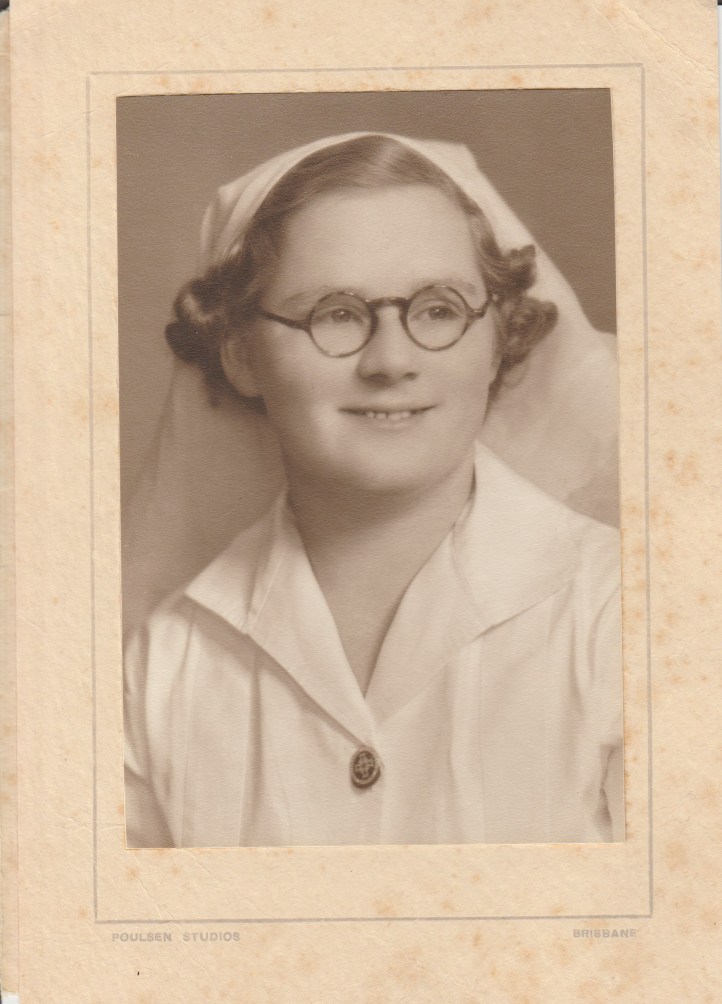
Meanwhile, in 1939 Cynthia completed her training and gained her certificate in general nursing. She subsequently joined the staff of the hospital. In that same year, war broke out in Europe, and Cynthia decided to volunteer for service. Many of the nurses with whom she had trained volunteered too. Among them were Blanche Hempsted, Sylvia Muir and Phyllis Pugh, who joined the 2/13th Australian General Hospital (AGH), and Jessie Blanch, Pearl Mittelheuser, Flo Trotter and Joyce Tweddell, who joined the 2/10th AGH. Both units served in Malaya; Blanche and Pearl did not come home.
Enlistment
Early in 1940 Cynthia applied to join the Australian Army Nursing Service (AANS). Her application was accepted and on 9 March she was appointed to the AANS, Northern Command (Queensland). In August, still waiting to be called up, Cynthia announced her engagement to Ernest John Dean, second son of the late Mr. and Mrs. Dean of Cairns. Ernest had enlisted in the Second Australian Imperial Force (2nd AIF) at the start of June and had been posted to the 2/1st Motor Ambulance Convoy (MAC). He was then admitted to Brisbane General Hospital with measles, and it was perhaps here that he met Cynthia. In December Ernest sailed to the Middle East.
After more than a year Cynthia was called up for service. On 27 April 1941 she was appointed to the AANS, Australian Military Forces (AMF) at the rank of Staff Nurse and posted to the 112th AGH at the Exhibition Grounds at Bowen Hills, just north of central Brisbane. The unit had been raised two days earlier, and among those attached was Blanche Hempsted, Cynthia’s Brisbane General colleague.
Cynthia’s full-time duty with the AMF was terminated on 22 July upon her appointment, effective the following day, to the AANS, 2nd AIF. She was soon to go overseas. She remained attached to the 112th AGH, which by now had relocated to a small and cramped site at the Kangaroo Point Immigration Depot (after the war known as ‘Yungaba’) in central Brisbane. The hospital mainly treated patients from those AMF units training or based in Brisbane.
On 17 August Cynthia was sent on pre-embarkation leave. Three days later she was given a farewell party at the home of her parents at Wellington Point. Among the 40 guests were many from Beaudesert, indicative of the high esteem in which the Thiedeke family was held in that town. After being presented with a writing case and gold pencil, Cynthia thanked the attendees for their good wishes and promised that should any “Beaudesert boys” come under her care, she would do her very best for them. After leaving Wellington Point she visited Beaudesert and on 22 August was farewelled at the Beaudesert School of Arts, during a social evening held as a welcome home to Frederick Taffs of the Royal Australian Navy.
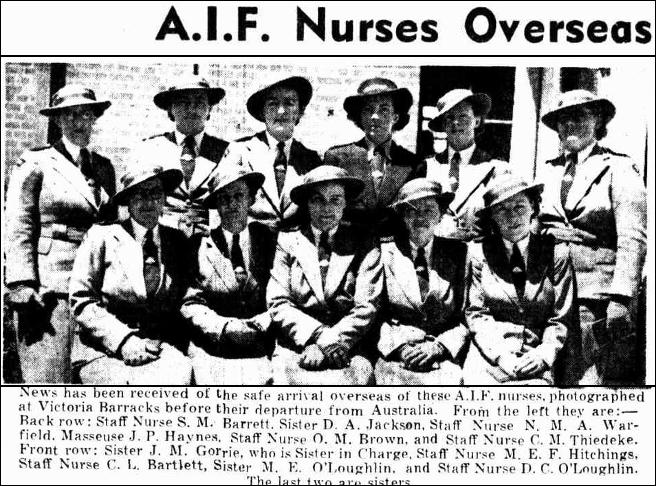
After finishing her leave, Cynthia returned to the 112th AGH at Kangaroo Point. On 17 September she was transferred to the 4th Australian Camp Hospital at the Exhibition Grounds at Bowen Hills. Finally, on 2 October she travelled from Bowen Hills to Victoria Barracks in the heart of Brisbane, where she found herself among a sizable Queensland contingent of nurses. Cynthia, Staff Nurses Stella Barrett, Norma Warfield, Olive Brown, Matilda Hitchings, Doreen O’Loughlin and C. L. Bartlett, Sisters Dorothy Jackson, Molly O’Loughlin and Jessie Gorrie (Sister in Charge), and masseuse J. P. Haynes, were all attached that day to the 2/12th AGH.
2/12th Australian General Hospital
The 2/12th AGH had been raised at the Sydney Royal Agricultural Society Showground in July under the command of Colonel George W. Macartney, who had served with distinction in Gallipoli, and Matron Anna Ruth Baker. Its staff complement would include 44 AANS nurses, three masseuses and 20 Voluntary Aid Detachments (VADs), who would be the first to serve overseas in the Second World War.
The unit would be tasked with setting up a staging hospital in Ceylon. By June of that year, Australian military authorities had begun to explore the possibility of establishing such a hospital to take some of the pressure off the six AGHs in the Middle East, which were becoming increasingly crowded. Ceylon, halfway between the Middle East and Australia, seemed an ideal location to place a ‘halfway house’, where patients evacuated from Middle East campaigns could rest and recuperate and return to their units rather than be evacuated to Australia. Soon, the King George V Hospital, a partially completed tuberculosis hospital in Welisara, around 18 kilometres north of Colombo, was identified, and by 9 September it had been acquired for the use of the 2/12th AGH.
After being photographed and completing other formalities, Cynthia and her new colleagues were driven from Victoria Barracks to the interstate train station in south Brisbane, where they entrained for Sydney. Five days later, on 7 October, they were taken to Sydney Harbour and boarded the Australian hospital ship Wanganella. “We sailed away in a cloud of mystery for the usual unknown destination,” wrote one of the 2/12th AGH nurses two years later, anonymously, in a small publication called ‘Lest We Forget.’ “[We] were not unduly surprised when, after 15 days at sea, we saw the palm-fringed shores of Ceylon. For most of us it was our first glimpse of the East.”
Welisara, Ceylon
The Wanganella arrived at Colombo Harbour on 24 October. The 2/12th AGH nurse continues the story:
We landed on one of those sweltering hot tropical days, which we were soon to learn occur exactly 365 times a year, and were met by our commanding officer, Col. G. W. Macartney, D.S.O., who had preceded us. A convoy of native buses, packed with Unit personnel then threaded its way from the harbour, through the streets of the native quarters, thronged with hooting taxis, clanking yak-carts and chattering Ceylonese in their colourful garb, and on through small, picturesque villages and cocoanut [sic] groves to the site of the hospital. This was to be the home of the 2/12th for some 15 months.
Cynthia and her colleagues had arrived at the hospital in Welisara. Surrounded by lush greenery, principally coconut plantations, “the hospital buildings left nothing to be desired,” writes our anonymous nurse. “They consisted of 10 wards, Administration and Specialists’ Blocks, plus various messes and living quarters. These were constructed of brick with cement facing and red tiled roofs.” Six of the 10 wards were complete, and it was these that the 2/12th AGH utilised. Furthermore, the sleeping quarters “were made of cadjan (palm leaf) and very ideally suited to the prevailing tropical climate.” Each bed was provided with a mosquito net, and mosquito drill was compulsory; everyone had to wear long sleeves after sunset.
Once extra tented wards were set up, the hospital had a 600-bed capacity. However, for the first 10 weeks or so relatively few patients came through, and not more than 40 at a time. They were mainly Australian troops en route to Australia or British naval personnel, including some from the British base at Trincomalee, on the northeastern coast of Ceylon.
At Welisara, Cynthia and her colleagues gained their first experience of tropical disease. Over the course of their posting, they would treat cases of scrub typhus, malaria, blackwater fever, dengue and sandfly fevers, sprue, dysentery, ankylostomiasis (hookworm infection) and various skin diseases and ulcers. One of the unit’s nurses had studied occupational therapy in Australia, and this service was subsequently established at the hospital with considerable success.
With their none-too-heavy workload, the nurses had plenty of time for leisure. Our nurse correspondent enthuses that “sporting facilities were many both inside and outside the hospital area – tennis, cricket, swimming and surfing. A rest room and bathroom, provided by the Australian Red Cross, in Colombo was a welcome haven during shopping expeditions.” Some of the male staff, on the other hand, found reason to complain. When interviewed decades later, Major John H. Colebatch, one of the unit’s doctors, suggested that a lack of recreation room in the grounds of the hospital, combined with the paucity of work and the absence of safe, reliable transport into Colombo, led to boredom and frustration among some of the staff. Soccer balls and badminton sets were eventually procured, and some of the men bought bicycles and went cycling through the surrounding countryside.
When granted leave, the nurses had access to a bungalow at Nuwara Eliya, a hill station 2,000 metres above sea level in Ceylon’s central highlands, around 130 kilometres east of Colombo – “a popular retreat for Europeans from the humidity of the coast. There, members of the Unit spent short leave among the tea and rubber plantations and enjoyed the warm friendliness and hospitality of the planters,” our nurse informs us.
From 6 to 18 November Cynthia was admitted to hospital for appendiceal colic and on 20 November was admitted again with appendicitis. After having an appendectomy, she wrote to her brother Clive and told him that she had been taken ill and had been operated on. She told him she was doing well and expected to be about again by the time he received the letter. Since 2nd AIF personnel could never disclose where they had been posted, Cynthia told Clive that she had been en route to the Middle East when taken ill and was recovering in hospital in an “Empire city.” She was discharged on 15 December, having been promoted to the rank of Sister Group II.
Japan Attacks
During Cynthia’s admission, a seismic shift occurred in the direction of Australia’s war effort – and in the role of the hospital. On 8 December 1941 Imperial Japan invaded Malaya, the Philippines, Guam and Hong Kong, and bombed Singapore Island and Pearl Harbour, and soon the 2/12th AGH received its first casualties from Malaya and Singapore. Among them were British sailors rescued after Japanese forces sank HMS Prince of Wales and HMS Repulse off the coast of Malaya on 10 December.
The hospital’s workload continued to increase as the new year began. On 1 January 1942, the British hospital ship Vita arrived with 240 British marines picked up from the Mobile Naval Base Defence Organisation at Addu Atoll in the Maldives. They were variously suffering from malaria, scrub typhus, and septic abrasion caused by coral or insect bites. Then on 24 January the first Australians were admitted to the 2/12th AGH from Malaya, while in February over 250 evacuees from Singapore arrived, mainly women and children, who were accommodated in empty wards. They were later embarked on a ship for England.
Operation ‘Stepsister’
With Japan now in a position to threaten Australia, Britain and Australia agreed that Australian forces should be diverted from the Middle East to the Dutch East Indies, and the 6th and 7th Divisions along with I Corps Headquarters were embarked from several ports in the Middle East in the movement known as ‘Stepsister’. Some 60,000 troops were involved, and an imposing number of ships was assembled to carry them. In early February the ships began to pass through Colombo en route to Sumatra and Java, in some cases offloading further casualties for Cynthia and the other staff of the 2/12th AGH to look after.
However, the fall of Singapore on 15 February 1942 and the rapid movement of Japanese forces through the Dutch East Indies scrambled the Allies’ plans for the redeployment of Australian troops to the Dutch colony. Some of the ships that had reached Sumatra and Java sailed on to Australia or returned to Colombo, in some cases carrying 2nd AIF wounded collected from Tanjong Priok, Batavia’s port, who were then admitted to the 2/12th AGH.
Other ships that had left the Middle East but had not yet reached Colombo were held in Colombo Harbour upon arrival, pending a decision about their onward movement. Among these was the Strathallan, which arrived in Colombo on 26 February carrying elements of the 2/1st MAC. Among them was Cynthia’s fiancé, Ernest Dean. Even though the ship spent five days at anchor, the men were not allowed shore leave. One truly hopes that Cynthia managed to come aboard to see him – assuming she knew he was there. For after the Strathallan departed for Australia on 2 March, they would never see each other again.
Meanwhile, the casualties kept arriving. Around 4 March the 2/12th AGH admitted wounded soldiers from the hospital ship Wusueh, which had departed Tanjong Priok on 25 February. The ship had arrived in Tanjong Priok after leaving Singapore on 10 February crammed with 8th Division casualties and six AANS nurses of the 2/10th AGH. On 18 March a handful of survivors from HMAS Yarra, attacked and sunk by the Japanese navy on 4 March, were admitted in bad condition, suffering from exposure and exhaustion.
Eventually, following the intervention of Prime Minister Curtain, it was decided that the ‘Stepsister’ troops should sail to Australia, and by the end of March, I Corps Headquarters and the 6th and 7th Divisions had arrived in Fremantle. However, two brigades of the 6th Division, the 16th and 17th, accompanied by the 2/4th AGH and other, smaller medical units, were kept in Ceylon in anticipation of a Japanese invasion, and a defensive formation known as ‘AIF Ceylon’ was established. The 2/4th AGH set up a hospital at St. Peter’s College, south of Colombo. Patients from the 16th Brigade’s area of responsibility were taken here by road, while patients from the 17th Brigade’s area were taken to the 2/12th AGH by rail.
In the event, the only hostile action occurred on Easter Sunday morning, 5 April, when Colombo came under attack. Cynthia and her colleagues were sitting quietly at breakfast when the noise of aircraft was heard overhead. Suddenly the air-raid siren sounded – a bell attached to a tree branch, but nonetheless effective – and explosions were heard. Squadrons of Japanese fighter and bomber aircraft had been launched from a Japanese carrier off the Andaman islands with the aim of attacking the mass of shipping in the harbour. Quietly and efficiently the nurses led their patients to shelter in the nearby coconut groves, something they had practised many times. Fortunately, warning of the attack had been received a short while beforehand, and most of the ships had relocated during the night. No serious damage was suffered, and heavy losses were inflicted on the Japanese aircraft by British Hurricanes.
Following the attack, Cynthia and the others had to carry their tin hats around with them. However, the threat of Japanese invasion abated, and by June it was felt that ‘AIF Ceylon’ was no longer needed. In July the brigades left for Australia, along with the 2/4th AGH, whose approximately 300 patients were transferred from St. Peter’s College to Welisara.
As the year progressed, Cynthia, now promoted to the rank of senior sister, and the other staff of the 2/12th AGH were once again able to relax a little after the intense months that followed the opening of the Japanese offensive. There was more time for social interaction with well-to-do local residents, some of whom took the nurses for sightseeing tours.
Illness
Tragically, Cynthia’s health deteriorated once again. She was admitted to hospital with intestinal obstruction on 18 September, and despite the best efforts of the unit’s doctors, her condition steadily worsened. She died at 2.00 am on 27 September 1942 and was buried in the military section of the Colombo General Cemetery (today the Borella Kanatte General Cemetery). The 2/12th AGH was just over two months away from being relieved by the 50th Indian General Hospital and returning to Australia.
After Cynthia’s death her parents received several letters from soldiers who had been nursed by her. They all spoke in the highest terms of the kindness she had shown them. Numbered among her patients was a 2nd AIF soldier from Beaudesert – one of those “Beaudesert boys” for whom she had promised to do her very best. It was a promise she kept.
The Beaudesert Volunteer Defence Corps held a ceremony in honour of Cynthia on 18 October. A short citation was given by the commanding officer and then the whole company presented arms – the highest form of respect paid by an armed force.
Those who knew Cynthia recognised her as someone with a most happy and kind disposition. As a nurse she was truly excellent, as attested by the number of patients who spoke so highly of her.
In memory of Cynthia.
Sources
- 2/30th Battalion AIF Association, Makan (no. 179, June/July 1968).
- 2/4th Machine Gun Battalion (website), ‘Soldiers of 2/4th who were ill and returned to Australia and those who were not taken POW.’
- 2/4th Machine Gun Battalion (website), ‘Wu Suii/Wah Sui/ Wusei/Wusueh Hospital Ship evacuation of sick, injured to Ceylon February 1942’.
- Ancestry Library Edition.
- Australian Army Nursing Service (1944), Lest We Forget (fundraising booklet in support of the Centaur Memorial Scholarship).
- Australian War Memorial, 2/1 Motor Ambulance Convoy War Diary, January–March 1942 and May–June 1942, accession number AWM2022.5.740.
- Australian War Memorial, 2nd AIF (Australian Imperial Force) and CMF (Citizen Military Forces) Unit War Diaries, 1939–45, Australian Military Liaison Officer Bombay, August 1940–May 1943, AWM52 1/12/21.
- Australian War Memorial, Sound Archive of Australia in the War of 1939–1945, ‘Transcript of interview with (Major) Dr John Houghton,’ recorded on 14 October 1990, AWMS00984.
- Bassett, J. (1992), Guns and Brooches: Australian Army Nursing from the Boer War to the Gulf War, Oxford University Press.
- BirtwhistleWiki (website), ‘2/12th Australian General Hospital.’
- The British Pacific and East Indies Fleets: The forgotten fleets that fought the Japanese in the Pacific and Indian Oceans (website), ‘H.M.H.S. Vita.’
- Goodman, R. (1985), Queensland Nurses: Boer War to Vietnam, Boolarong Publications.
- Goodman, R. (1991), Voluntary Aid Detachments in Peace and War, Boolarong Publications.
- Henning, P. (2013), Veils and Tin Hats: Tasmanian Nurses in the Second World War.
- National Archives of Australia.
- Queensland Government Archives, ‘Beaudesert State School Register 1920–1929.’
- Royal Marines in the Indian Ocean (website), ‘Royal Marine Group, Mobile Naval Base Defence Organisation (M.N.B.D.O.).’
- Walker, A. S. (1962), Second World War Official Histories, Australia in the War of 1939–1945, Series 5 – Medical, Vol. II – Middle East and Far East, Part II, Chap. 21 – I Australian Corps Returns (pp. 459–67), Australian War Memorial.
- Walker, A. S. (1961), Second World War Official Histories, Australia in the War of 1939–1945, Series 5 – Medical, Vol. IV – Medical Services of the Royal Australian Navy and Royal Australian Air Force with a section on women in the Army Medical Services, Part III – Women in the Army Medical Services, Chap. 36 – The Australian Army Nursing Service (pp. 428–76), Australian War Memorial.
Sources: Newspapers
- The Beaudesert Times (2 Oct 1942, p. 5), ‘Death of Sister Cynthia Thiedeke with the A.I.F. Abroad.’
- The Beaudesert Times (19 Sept 1947, p. 1), ‘Pioneer’s Passing.’
- The Beaudesert Times (21 Jun 1935, p. 5), ‘Eighth Birthday Ball.’
- The Beaudesert Times (29 Aug 1941, p. 1), ‘Farewell to Sister Thiedeke at Wellington Point.’
- The Beaudesert Times (24 Sept 1943, p. 2), ‘Family Notices.’
- The Beaudesert Times (29 Aug 1941, p. 1), ‘The Navy Had Mumps.’
- The Beaudesert Times (17 Jun 1938, p. 8), ‘Weddings.’
- The Beaudesert Times (23 Oct 1942, p. 2), ‘Local & General.’
- The Beaudesert Times (24 Dec 1941, p. 4), ‘Local & General.’
- The Courier-Mail (Brisbane, 17 Aug 1940, p. 18), ‘Family Notices.’
- Telegraph (Brisbane), 29 Oct 1941, p. 9), ‘AIF Nurses Overseas.’
 australianwarnurses.org