AANS │ Captain │ Second World War │ Malaya │ 2/10th AGH
Family Background
Cecilia May Delforce was born on 7 September 1912 in Augathella, in Queensland’s southern outback. She was the youngest of six children born to (Lydia) Elizabeth Ogden (1878–1973) and Samuel Delforce (1867–1955).
Elizabeth was born in Augathella to parents who had migrated from England. Samuel was born in Cassilis, in the Hunter region of New South Wales, also to parents who had migrated from England. By May 1896 Samuel was working as a shearer on Oakwood Station, an enormous sheep station near Augathella. Also working at Oakwood Station at the time was a certain James Ogden snr. Samuel met his daughter Elizabeth, and the two were married in Augathella on 18 February 1897 by the Reverend James Gillespie.
Elizabeth and Samuel stayed in Augathella, where Samuel continued to work as a shearer, and over the next 14 years Elizabeth gave birth to six children. Samuel junior was born in 1898, followed by Andrew (b. 1899), Hewson Austin (b. 1901), Emma Lydia (b. 1903) and John William (b. 1909). Finally, in 1912, Cecilia was born.
Growing Up
Cecilia, who was sometimes known as Cis, and her siblings grew up in the family home, which was situated in Augathella township on the right-hand side of the Warrego River. At the back of the property there was a garden with fruit trees in it. Young Samuel had a pet pony, which he planned to call Black Bess, and a cow.
The Delforce children went to the local school, Augathella State School. Cecilia was registered on 9 October 1917 at the age of five and attended until the end of 1926. Earlier in 1926 she had entered the IXL Competition, promoted nationally by Tasmanian jam manufacturers Henry Jones and Co. She ended up coming second in the Darling Downs section of the Queensland division and won £2.
Nursing
In time, Cecilia decided to become a nurse. In January 1931, having turned 18, she took up a position at Stanthorpe Hospital, 700 kilometres away in southeastern Queensland. In January 1932 she returned to Augathella to visit family and friends, the first time in a year she had been back. She presumably returned to Stanthorpe after her holiday but by July was back in Augathella and may have continued her training at Augathella Hospital.
Meanwhile Cecilia was demonstrating an aptitude for music. On many occasions in the latter half of 1932 and into the following year, she played as part of an ensemble at dances, which were usually held at Claren Hall in town. In August 1932, for example, she and the other amateur musicians performed at a children’s fancy dress dance and in December at a dance held in aid of (her future sister-in-law) Miss Florence Hansen’s candidature in the Augathella Hospital Queen competition. In March 1933 the musicians played at a dance hosted by the members of the Church of England Sewing Guild and in May at a fundraiser for the state school.
Cecilia also played tennis. Throughout the 1930s she played in many tournaments in Augathella and beyond, including a mixed-doubles fundraiser in December 1932 once again in support of Florence Hansen’s candidature in the Queen competition.
In due course Cecilia finished her training, and sometime later took a position as staff nurse at Aramac Hospital, 350 kilometres north of Augathella. She stayed there until August 1937, then resigned to take up a similar position at Longreach Hospital. In September 1938 Cecilia resigned from Longreach Hospital.
Perhaps after a break in Augathella, Cecilia next travelled to Brisbane and worked at Dalkeith Private Hospital, on Rose Street in Wooloowin. During this time, she lived with her aunt Mrs. A. Maguire of Dorchester Street, South Brisbane.
Enlistment
By now the war in Europe was underway, and like many of her peers, Cecilia decided to volunteer for service. Early in 1940 she applied to join the Australian Army Nursing Service (AANS). Her application was accepted and on 22 February she was appointed to the AANS, Northern Command (Queensland). She had her medical on 20 May and after several months received her call up. On 9 October Cecilia enlisted in the Australian Military Forces (AMF) for domestic service with the AANS. She was posted to the camp dressing station at Redbank army camp, located near Ipswich, west of Brisbane.
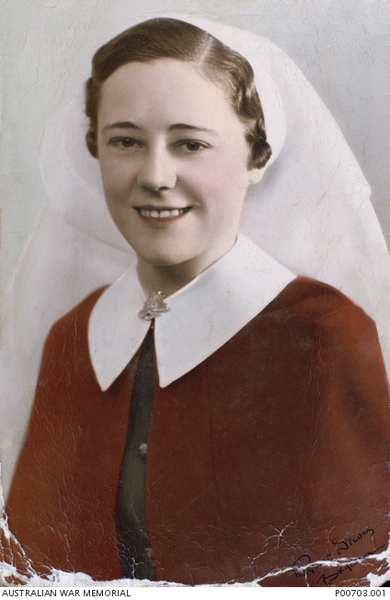
Cecilia’s full-time duty with the AMF terminated on 16 January 1941 and the following day she was appointed to the all-volunteer Second Australian Imperial Force (2nd AIF) for overseas service with the AANS. She was assigned the rank of staff nurse, told to prepare herself for an imminent overseas posting, and sent on pre-embarkation leave from 24 to 28 January.
On the morning of 31 January, having returned from leave, Cecilia made her way to Brisbane central station and joined a group of eight Queensland nurses – Monica Adams, Jessie Blanch, Iva Grigg, Pearl Mittelheuser, Chris Oxley, Irene Ralston, Florence Trotter and Joyce Tweddell – waiting to board the 10.00 am train to Sydney. That very day they had all been attached to the 2/10th Australian General Hospital (AGH).
The 2/10th AGH had been raised in Sydney under the command of Colonel Edward Rowden White and, along with the 2/4th Casualty Clearing Station (CCS), the 2/9th Field Ambulance, and other, smaller medical units, was tasked with looking after the approximately 5,800 personnel of the 22nd Brigade, 8th Division – known as ‘Elbow Force – in Malaya. The British government had requested the Australian troops to supplement its own formations against possible Japanese aggression. The 22nd Brigade was set to sail on the passenger liner turned troopship Queen Mary in four days’ time.
There were six other nurses waiting for the train to Sydney that morning. Ivy Machon, Jessie Newman, Eileen O’Keefe, Winifred Short, Thora Skyring and Daphne Tomlins would not, however, be joining Cecilia and the others on the Queen Mary. Instead, they would board the Aquitania and sail to the Middle East for service with the 2/5th AGH.
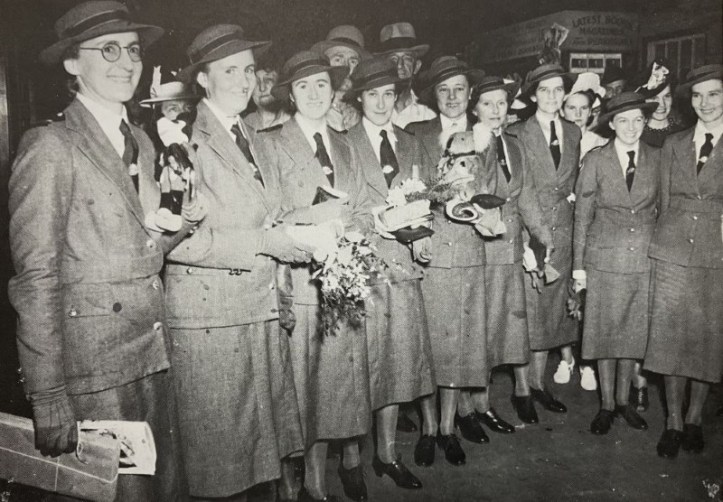
At the appointed time, Cecilia and her companions, laden with gifts of flowers, fruit and sweets, departed amid cheers and fluttering streamers from family, friends and official representatives. En route, another 2/10th AGH nurse, Nell Calnan, boarded.
The Queen Mary
When the Queenslanders arrived in Sydney early the next morning, the 2/10th AGH nurses were taken to Darling Harbour. They caught a ferry to Bradley’s Point, where the Queen Mary lay at anchor, and boarded the mighty vessel cheek by jowl with hundreds of embarking 8th Division troops. Meanwhile, the other nurses were taken to Woolloomooloo and boarded the Aquitania. That venerable ship was embarking around 3,300 troops bound for the Middle East and would sail in convoy with the Queen Mary and with a third troopship, the Nieuw Amsterdam, due to arrive on 3 February from Wellington with around 3,800 New Zealand troops. The convoy would be escorted by HMAS Hobart.
On 4 February the Queen Mary was ready to sail. The troops had embarked, and Cecilia and the Queensland 2/10th AGH nurses had been joined by 34 peers from New South Wales and Victoria. Six South Australian and Tasmanian nurses attached to the 2/4th CCS had also boarded. In the early afternoon, the mighty ship pulled away from Bradley’s Point to the cheers of thousands of well-wishers arrayed around the harbour and on the water in hundreds of bobbing boats. The Aquitania had left its wharf a little time before and lead the way through the Heads, followed by the Queen Mary and the Nieuw Amsterdam. When the Queen Mary passed through, the ship’s band struck up ‘Haere-ra,’ (‘A Māori Farewell’), while the troops sang “Now is the hour when we must say goodbye” again and again.
When the convoy reached the Great Australian Bight four days later, a fourth troopship, the Mauretania, with some 3,900 personnel, joined it. After a stop in Fremantle, during which two more nurses of the 2/4th CCS boarded the Queen Mary, the ships set out again, now under the escort of HMAS Canberra. On 16 February, with the convoy approaching Sunda Strait, the other ships lined up while the Queen Mary steamed slowly past them. It reached the end of the line, turned to the right with a tremendous burst of speed, and steamed off towards Singapore. Only now were the nurses certain of their destination. The other ships carried on to Bombay, from where the troops would transship for the Middle East.
Malacca
On 18 February the Queen Mary arrived at Sembawang Naval Base on the north coast of Singapore Island. The nurses disembarked and walked to adjacent railway sidings. They gave their names and addresses, were issued with rations, and then entrained for the Malay Peninsula. Early in the morning Cecilia and her 2/10th AGH colleagues alighted at Tampin, while the 2/4th CCS nurses continued to Seremban, further north.
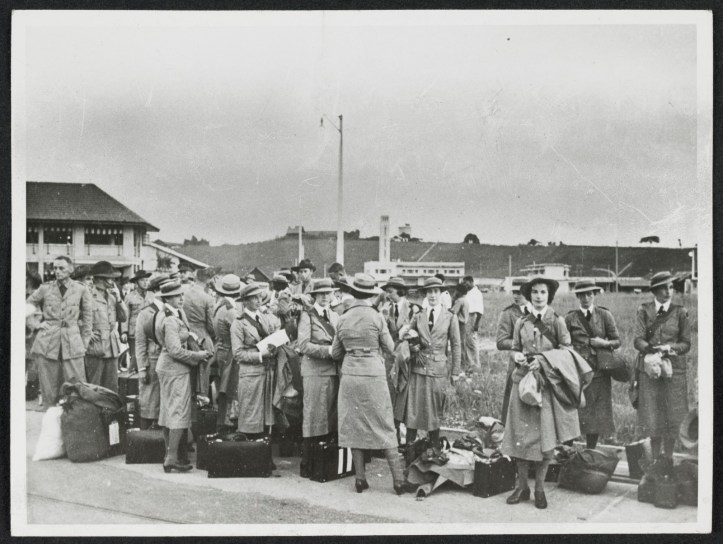
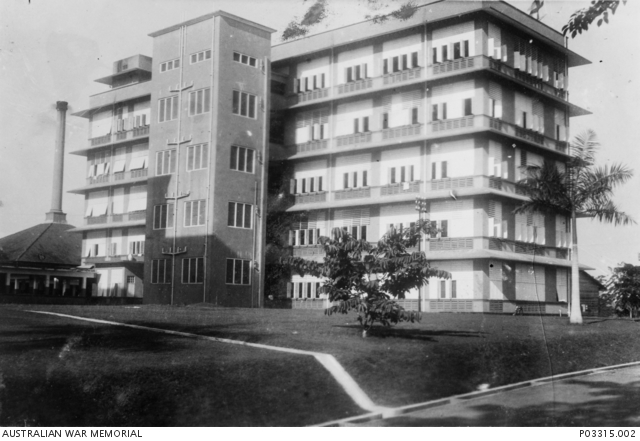
From Tampin the 2/10th AGH nurses were driven to Malacca, situated on the west coast of the peninsula. The unit had been allocated several wings of the Malacca General Hospital, a modern, five-storey building set in spacious grounds on a slight rise and some way out of town. The grounds were replete with bougainvillea, frangipani, hibiscus, and other tropical plants, creating a pleasant haven. The patients would be accommodated on four floors of one of the wings in spacious and airy wards, while the nurses were quartered on the fourth floor of one of the wings, from where they enjoyed expansive views of the countryside. The building was fitted with louvred shutters instead of glass windows, which served to let in breezes and moderate the heat and humidity.
At first the nurses’ work was easy. The number of cases grew, however, as the Australian soldiers began to injure themselves during training exercises or contract tropical infections and diseases. Between April and December, the 2/10th AGH treated an average of 400 patients each month. Nonetheless, Cecilia and her colleagues had plenty of time for sporting and social activities and were granted generous periods of leave. They travelled to Singapore, Kuala Lumpur and Fraser’s Hill, a cool retreat in the highlands north of Kuala Lumpur.
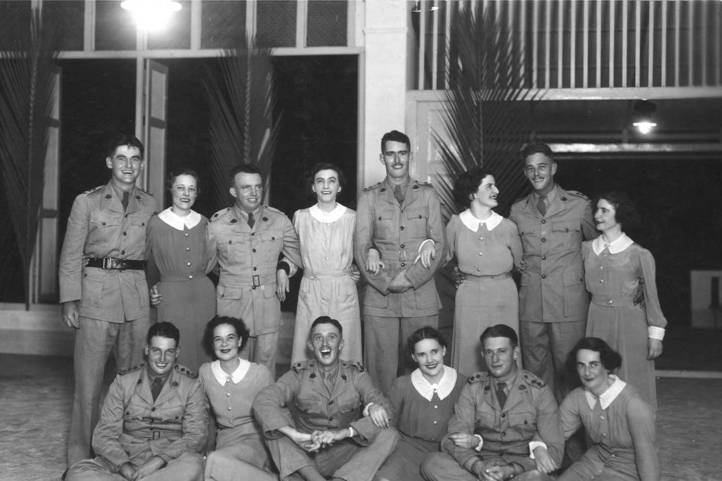
The months passed by, and life was pleasant for Cecilia. Towards the end of the year, however, she became unwell. In October and again in November she suffered from tonsillitis and was hospitalised for several days each time. Then from 26 November to 10 December she was granted sick leave – possibly related to the tonsillitis, possibly something else. When she returned to active duty, Japan had invaded, the Pacific War had begun, and Cecilia’s life would never be the same again.
War
For some time prior, intelligence reports had been warning of the concentration of Japanese forces in the north. However, a complacent belief in the strength of ‘Fortress Singapore’ meant that Malaya’s defences were woefully lacking. When General Yamashita launched an invasion of Malaya in the early morning of 8 December, there was nothing to stop him. Just after midnight, an amphibious force landed at Kota Bharu in the north of the peninsula and established a beachhead. A few hours later Singapore Island was bombed. The Japanese troops soon broke out of their beachhead and began to surge southwards. They were battle-hardened, well organised and supported by air and armour; the inexperienced British and Indian garrison troops could offer little resistance.
By the end of December, it had become clear that the 2/10th AGH was vulnerable in Malacca and would have to evacuate south. Colonel Alfred Derham, the commanding officer of the Australian medical units in Malaya, decided to move the hospital to Singapore Island but would need time to organise a suitable site. In the meanwhile, the unit’s personnel and patients were moved to other units. Between 29 December and 5 January 1942 Cecilia and many of her colleagues were detached to the 2/13th AGH, which had arrived in Malaya in September and was currently based at Tampoi, in the southern Malay Peninsula. Others went to the 2/4th CCS, based at Mengkibol, near Kluang.
The 2/10th AGH had relocated to Singapore Island by 15 January. Col. Derham had settled on Oldham Hall, a Methodist boarding school at Bukit Timah. At Tampoi, meanwhile, as waves of Japanese bombers flew overhead on their way to bomb Singapore Island, Cecilia and her colleagues were busy treating the dozens of casualties on stretchers that had begun to arrive following the first Australian engagements with Japan. The unit had worked hard to prepare operating theatres to receive them and by now had close to 1,200 beds available on the wards.
Cecilia returned to the 2/10th AGH at Oldham Hall on 25 January, after the 2/13th AGH itself had been evacuated to St. Patrick’s School on Singapore Island, where it had originally been based. On 28 January it was turn of the 2/4th CCS to evacuate to Singapore Island, relocating to Bukit Panjang English School. Then, on the night of 30 January, the last British, Indian and Australian troops crossed the Causeway that spanned Johor Strait between the peninsula and the island. The next morning it was blown in two places. Soon after, Japanese forces reached the northern shore of Johor Strait and on 2 February began a ferocious artillery bombardment of the island.
When Japanese soldiers began to cross Johor Strait on the night of 8 February, the end was nigh. By the morning, they had established a beachhead on the northwestern corner of Singapore island, despite strong opposition from Australian troops. The heavy fighting produced many casualties, and at Oldham Hall the wards became so overcrowded that men were lying on mattresses on the floor while others waited outside. The nurses marvelled at their calmness and patience. Operating theatre staff worked around the clock, treating severe head, thoracic and abdominal injuries. There was little respite for Cecilia when she was off duty, as the constant pounding of bombs and shells meant that sleep was hard to come by.
Evacuation
With Singapore’s fate all but certain, a decision was made to evacuate the nurses. Already in January, following reports of Japanese atrocities in Hong Kong, Col. Derham had asked General H. Gordon Bennett, commanding officer of the 8th Division in Malaya, to evacuate the AANS nurses. Bennett had refused, citing the damaging effect on morale. Col. Derham then instructed his deputy Lieut. Col. Glyn White to send as many nurses as he could with Australian casualties leaving Singapore.
The nurses’ pleas to be allowed to stay with their patients were ignored, and on 10 February, six of Cecilia’s 2/10th AGH colleagues embarked with 300 wounded Australian soldiers on the makeshift hospital ship Wusueh. The following day a further 60 AANS nurses, 30 from each of the AGHs, left on the Empire Star.
Sixty-five AANS nurses remained in Singapore, among them Cecilia. On Thursday 12 February they too were ordered to leave. Late in the afternoon they were driven by ambulance to St. Andrew’s Cathedral, where they were joined by the remaining nurses of the 2/13th AGH and the 2/4th CCS. From the cathedral the ambulances proceeded towards Keppel Harbour until they could go no further, at which point the nurses got out and walked the remaining few hundred metres to the devastated waterfront.
The Vyner Brooke
At the wharves Cecilia and her 64 comrades were ferried through a congested mass of shipping of all types to the Vyner Brooke, a small coastal steamer that was formerly the private yacht of Charles Vyner Brooke, the ‘White Rajah of Sarawak.’ As darkness fell, the ship, which had once accommodated 44 first-class passengers, slipped out of Keppel Harbour with as many as 250 women, children and men on board. Behind it, the Singapore waterfront burned, and thick black smoke rose into the sky.
That night the Vyner Brooke made little progress and spent much of Friday hiding among the hundreds of small islands that line the passage between Singapore and Batavia. By the morning of Saturday 14 February, Captain Borton was approaching the entrance to Bangka Strait. To the right lay Sumatra; to the left, Bangka Island.
Suddenly, at around 11.00 am, a Japanese plane swooped over, then flew off again. At around 2.00 pm another plane approached before flying off. The captain, anticipating the imminent arrival of Japanese dive-bombers, sounded the ship’s siren and began a run through open water. When a squadron of dive-bombers appeared on the horizon, Borton commenced evasive manoeuvres. As the bombers approached, the Vyner Brooke zigzagged wildly at full speed. After many near misses, a bomb inevitably struck the forward deck, killing a gun crew. Another entered the funnel and exploded in the engine room, causing the ship to lift and rock with a vast roar. A third tore a hole in the side. The Vyner Brooke listed to starboard and began to sink. It was 15 kilometres from Bangka Island.
Bangka Island
After helping to evacuate the passengers, Cecilia found herself floating in the water and covered in oil from the Vyner Brooke’s engines. She drifted past bodies and debris towards Bangka Island, but couldn’t reach it, as the current was too strong and kept pulling her back out. After more than 18 hours in the water, she finally washed ashore. Thirty years later, her 2/10th AGH colleague Betty Jeffrey described what happened next to Cecilia in her book Matron A. M. Sage ‘Sammie’ (pp. 21–22), which Betty wrote as a tribute to Matron Annie Sage, matron-in-chief of the AANS from 1943–1947.
“Del was one of our nurses and came from New South Wales,” Betty wrote.
She was a slim girl, in her twenties, dark hair and complexion and lively brown eyes. She had a superb sense of humour, including one of those complainy ones, the more she complained, the funnier she was, and we all enjoyed her company.
This is the amazing story of her capture as far as I can remember it.
She must have come ashore away from the other nurses she had been with in the water, because she waded ashore and walked up the beach looking for the rest of us. We had all been told before we left Singapore that the Japanese were not taking prisoners, so we all knew after our ship was bombed and sunk that, for us, the games were over, but not one of us would accept this.
Del could not find a soul on the beach so she walked along a road hoping to reach the town of Muntok. On the way she heard light gunfire and so walked towards it to see what it was all about. She thought it might have been us and in trouble.
Behind a building she saw a terrifying sight. British and Dutch men were lined up facing the wall of the building and one lone Japanese soldier was loading his rifle and shooting the men down, reloading, shooting again and so on down the line. She thought, ‘Well, it must be true,’ so she walked up to the line of men and stood there waiting beside the last man in the row. The Japanese soldier saw her – was completely nonplussed at the sight of a young woman, stopped firing and waddled over to her, said something to her in Japanese, then took her by the arm and marched her off to the cinema in the town and pushed her in the door. Here all the other British and Australian women were temporarily housed as they came out of the sea and were taken prisoner. Del had found her nursing friends again. The Japanese soldier did not return to his work. He went off duty and back to his camp!
And so the lives were saved of the remainder of those British and Dutch men in that firing line. They lived to be prisoners of war.
When Betty Jeffrey herself and Iole Harper of the 2/13th AGH were brought to the cinema one or two days later, the AANS survivors numbered 31. They did not yet know it, but 12 of their colleagues had been lost at sea when the Vyner Brooke was sunk. And when Vivian Bullwinkel of the 2/13th AGH joined them 10 days later, they learned that 21 nurses had been murdered on a beach near Muntok. Of the 65 who had set out from Singapore, only 32 remained alive.
Prisoners of Japan
Under these tragic circumstances Cecilia and her comrades, together with hundreds of captured women, children and men – survivors of the dozens of ships sunk by the Japanese navy and air force in Bangka Strait – began a long period of captivity. They were held in six camps on Bangka Island and in southern Sumatra. They were subjected to systematic abuse and random acts of violence. They were slapped, yelled at and made to stand in the sun. They were threatened with starvation and, by the end, nearly did starve. They suffered debilitating diseases, particularly in the final two camps, Muntok on Bangka Island and Belalau on Sumatra, and had life-saving medicines withheld. They were permitted to write home only once, a lettercard on 16 March 1943, and received only two lots of mail from home. They were denied their rights under the Geneva Convention to be treated as prisoners of war.
During her first two years of internment, Cecilia spent many hours playing patience, bridge and mahjong – helping, as she told the Australian War Memorial many decades later, “to eliminate from our minds the sordidness, depression, and all-consuming hunger which all who lived those years will remember always.” The nurses made packs of cards and mahjong sets themselves: the lack of material goods in the camps inspired creativity and ingenuity. A mahjong set that Cecilia and Jessie Blanch made is on display at the Australian War Memorial. The set began life as the slat of a cot, which was cut to size with a borrowed hand saw. Each smaller piece was then split into four chips using an old knife and a heavy stone as a hammer. Cecilia used the leaves of a sandpaper tree (possibly Streblus asper) to smooth each chip, and Betty Jeffrey and a young Chinese woman named Kong helped to decorate them. The packs of cards were made from photos found in a discarded album.
Later in their internment, many of the nurses started businesses to earn money to buy food from the camp store. Cecilia became a champion woodcutter. She charged according to the thickness of the wood and the distance she had to cart it to her customers. She became so successful at it that she wore out a pair of shorts every few weeks chopping wood for dozens of people. “Nobody knows how that girl does it,” wrote Betty Jeffrey in her book White Coolies (p. 118). “She certainly has it down to a fine art. A grand lass, Del.”
Florence Trotter made money by cutting and setting hair for the interned Dutch women. At first, she charged 10 cents, but as food became scarcer, she raised her price to 25 cents. Vi McElnea, a Queenslander who had come over with the 2/13th AGH, was reputed to be the best rice frier in the camp. Her customers, who were mostly Dutch, would supply their own oil and for 10 cents she would fry a small portion of rice for them.
By scrounging odd bits of timber, Sylvia Muir, another 2/13th AGH nurses from Queensland, manufactured toys for which she received one guilder 50 cents, and for her dolls she was paid as much as three guilders 50 cents. In the early days of her internment, she made a kangaroo, which is on display at the Australian War Memorial. Winnie Davis and Pat Gunther from New South Wales made hats from bits and pieces of material, and Winnie and Mavis Hannah, who would end up being the sole-surviving 2/4th CCS nurse, made shorts from worn-out clothes – even from a nun’s gown.
In November 1944, nearly three years into their ordeal, Cecilia and the others were moved from Sumatra back to Muntok on Bangka Island. After some initial optimism, it proved to be the worst camp yet. Lice, scabies and bedbugs spread throughout the huts, and disease became rife. The internees began to die – including the first four AANS nurses. On 8 February Mina Raymont of the 2/4th CCS died of malaria. On 20 February Rene Singleton of the 2/10th AGH died of beriberi. Blanche Hempsted of the 2/13th AGH died on 19 March and Shirley Gardam of the 2/4th CCS on 4 April.
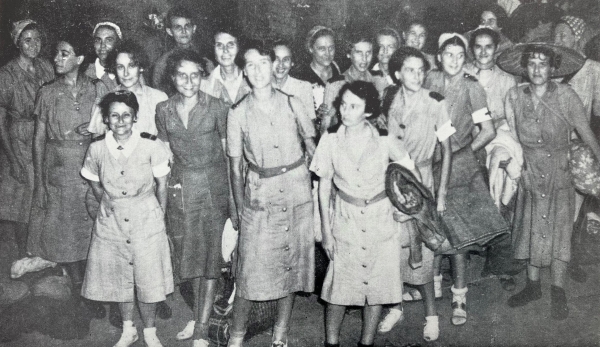
The same month that Shirley died, the internees were transported to what would be their final camp, Belalau rubber plantation, near Lubuklinggau, on Sumatra. It lay deep in the jungle some 250 kilometres west of Palembang. The three-day journey claimed many lives, and when they finally arrived at Belalau, Cecilia’s comrades continued to die. On 31 May Gladys Hughes of the 2/13th AGH died and on 19 July Winnie Davis died, after being desperately ill for some weeks. Two more nurses died before the ordeal ended, Dot Freeman on 8 August and Pearl Mittelheuser on 18 August – only three days after Emperor Hirohito had formally surrendered. On 16 September the 24 surviving nurses were plucked from the Sumatran jungle and flown to Singapore. Just six days earlier, Cecilia’s brother Sam had died in Brisbane. He was buried at Augathella Cemetery.
The Journey Home
After a period of recuperation in Singapore, on 5 October Cecilia and her fellow ex-POWs boarded the AHS Manunda in Keppel Harbour and sailed home. The ship reached Fremantle on 18 October, and when it moved into its berth, the cheering crowds on the wharf were suddenly hushed. They stared, quiet with emotion, at the 24 women in grey army tunics and slacks standing on the boat-deck. As they put their feet on Australian soil for the first time in more than four years, the nurses turned and waved to the crowd, on the verge of tears but with huge smiles of thankfulness and joy. They were taken to the 110th Perth Military Hospital and given a gala reception. Following an appeal broadcast on the radio, the reception rooms of the hospital were banked with flowers. For each nurse was a special gift of a posy from the garden of Peggy Farmaner of the 2/4th CCS, one of the nurses shot on the beach. Her mother had brought the flowers to her daughter’s comrades.
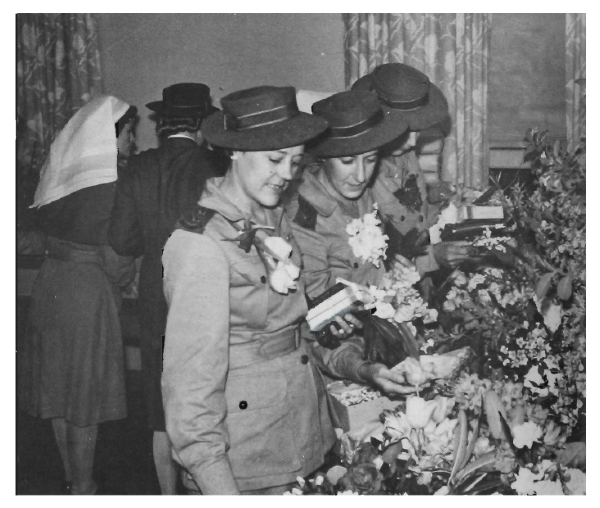
The next day, having said goodbye to Iole Harper and Ada ‘Mickey’ Syer in Fremantle, the nurses continued their journey, and late in the afternoon of 24 October, the Manunda arrived in Melbourne. When it pulled into Port Melbourne, 188 ex-POWs disembarked, including all 22 remaining nurses. They were all to attend a welcome-home party at the 115th Heidelberg Military Hospital arranged by Matron J. Oddie and the nurses of the hospital.
Cecilia and the others walked down the gangplank and through a guard of honour formed by between 40 and 50 members of the AANS. They were then greeted by the matron-in-chief of the AANS, Colonel Annie M. Sage, who had been on the plane that carried them to freedom from Sumatra. They boarded the first bus in a convoy of buses and set out. The buses travelled from Melbourne’s port through the city centre and onto Heidelberg in the northeastern suburbs. At the hospital the Victorian nurses were greeted by family and friends, and all the nurses were presented with a box of flowers and welcome-home message from Victorian members of the AANS. Cecilia and the other Queensland and New South Wales nurses spent the night at the hospital and the next day returned to Port Melbourne and embarked once again.
From Melbourne the Manunda sailed on to Sydney, its final stop. When the ship arrived at Woolloomooloo on 27 October, Cecilia and all the others were taken to the 3rd Australian Women’s Hospital (AWH) at Concord for observation and tests. The Queensland nurses were considered fit to continue their journey home – all except Eileen Short, who stayed at Concord until 6 November – and late on Sunday 28 October, they boarded a hospital train bound for Brisbane. On the morning of Tuesday 30 October, after a journey of some 30 hours, Cecilia, Jessie Blanch, Vi McElnea, Sylvia Muir, Chris Oxley, Valrie Smith, Flo Trotter and Joyce Tweddell, along with five civilian nurses freed from internment in Totsuka, Japan, and around 80 other Queensland POWs, arrived at Clapham Junction (the nickname given to Moorooka Railway Station, one of the busiest transport hubs in Brisbane), where they were met by family and friends.
From the station they were driven in cars through streets lined with cheering and clapping crowds to the 2nd AWH at Yeronga. On arrival they were welcomed by the 4th Australian Armoured Brigade Band playing ‘We’re Much Better off in a Home’ and almost before the cars had stopped were in the arms of more family and friends. The nurses exchanged enthusiastic hugs with Sister Beryl Chandler of the No. 1 Medical Air Evacuation Transport Unit, who, like Colonel Sage, had been a member of the party that had flown into Sumatra to rescue them. They were each greeted in turn by the principal matron of Queensland, Joan Abbott, who introduced them to the chairman of the Queensland division of the Red Cross Society. Mrs. A. E. Moore, president of the 2nd AIF Nurses’ Fund, presented each nurse with a cheque for £100.
After spending time recuperating in Brisbane, on 7 November Cecilia reached Charleville on the mail train and received a hearty welcome at the railway station. Although not quite yet in Augathella, she was as good as home.
Life After War
The task ahead of Cecilia now was to get on with life, and the following year she did her best to fulfil it. On 9 January she was the first of the 24 surviving Vyner Brooke nurses to be discharged from the army, at the rank of captain. Then on 2 February she married Lieutenant Allen Bean McPhee (more commonly spelled ‘Alan’) at the Methodist Church in Wollongong. Alan, like Cecilia, was an ex-POW, and prior to enlisting in the 2nd AIF was on the staff of the Wollongong City Council and was also an active member of the Wollongong Surf Life Saving Club. Florence Trotter was Cecilia’s bridesmaid, and at the reception were 10 more of Cecilia’s ex-POW comrades.
Cecilia and Alan made their home in Wollongong, where Alan worked as a clerk and later as a shopkeeper. They had two sons. They continued to live in Wollongong into the 1970s and then moved to the Gold Coast in Queensland.
Cecilia was the last of the Vyner Brooke nurses. She died at Broadbeach Waters on 5 March 2011 at the extraordinary age of 98. She had requested that there should be no flowers at her funeral, as she had not been able to bury her friends in Sumatra with flowers – and that would be good enough for her.
In memory of Cecilia.
Sources
- Ancestry.
- Arthurson, L., The Story of the 13th Australian General Hospital, 8th Division AIF, Malaya. AS presented by Winstanley, P. (ed.) (2009).
- Australian War Memorial, ‘Mahjong set: Sister C M Delforce, 2/10 Australian General Hospital.’
- Australian War Memorial, ‘Nurse survivors of the Vyner Brooke.’
- Jeffrey, B. (1954), White Coolies, Angus & Robertson Publishers.
- Jeffrey, B. (c. 1973), Matron A. M. Sage ‘Sammie,’ Herald Gravure Printers.
- Kenny, K (1986), Captives: Australian Army Nurses in Japanese Prison Camps, University of Queensland Press.
- Malayan Volunteers Group, ‘Singapore Evacuation Ships.’
- National Archives of Australia.
- National Museum of Australia, ‘Fall of Singapore.’
- Naval Historical Society of Australia, ‘The Naval Evacuation of Singapore – February 1942.’
- Queensland Government, Archives Search, ‘Admission Register – Augathella State School.’
- Shaw, I. W. (2010), On Radji Beach, Pan Macmillan Australia, Sydney.
- Simons, J. E. (1954), While History Passed, William Heinemann Ltd, Melbourne.
- Stillman, H. (2010), ‘Cecilia May Delforce,’ Find My Past.
- Walker, A. S. (1961), Second World War Official Histories, Australia in the War of 1939–1945, Series 5 – Medical, Vol. IV – Medical Services of the Royal Australian Navy and Royal Australian Air Force with a Section on Women in the Army Medical Services, Part III – Women in the Army Medical Services, Ch. 36 – The Australian Army Nursing Service (pp. 428–76), Australian War Memorial.
- WikiTree, ‘Cecilia May (Delforce) McPhee (1912–2011).’
Sources: Newspapers
- The Australasian (Melbourne, 29 Oct 1910, p. 60), ‘The Young Folk.’
- The Australian Women’s Weekly (3 Nov 1945, p. 19), ‘Emotional welcome as gallant women return.’
- The Brisbane Courier (24 Dec 1932, p. 14), ‘Augathella.’
- The Charleville Times (16 May 1896, p. 3), ‘Advertising.’
- The Charleville Times (23 Jan 1931, p. 5), ‘Augathella.’
- The Charleville Times (15 Jan 1932, p. 5), ‘District News.’
- The Charleville Times (9 Nov 1945, p. 2), ‘Personal.’
- The Charleville Times (6 Sept 1946, p. 2), ‘Family Notices.’
- The Charleville Times (28 Feb 1947, p. 17), ‘50 Years Ago.’
- The Courier-Mail (Brisbane 3 Nov 1945, p. 4), ‘Club Welcomes P.O.W. Nurses.’
- The Courier-Mail (Brisbane, 5 Dec 1945, p. 3), ‘Cheques to Aid Nurses.’
- The Daily Telegraph (Sydney, 26 Apr 1946, p. 16), ‘Long Journeys for P.O.W. Reunion with Lady Louis.’
- Illawarra Mercury (Wollongong, 22 Feb 1946, p. eight), ‘Ex-Prisoners of War Marry.’
- The Longreach Leader (24 Sep 1938, p. eight), ‘Three Probationers.’
- The Maitland Mercury and Hunter River General Advertiser (29 Jan 1887, p. 4), ‘Cassilis.’
- The Mercury (Hobart, 1 Apr 1947, p. 7), ‘Former POW Nurses Honoured.’
- Morning Bulletin (Rockhampton, 11 Sept 1937, p. 5), ‘Aramac.’
- Sarawak Gazette (1 Nov 1927, pp. 278–279), ‘S.S. “Vyner Brooke.”’
- The Sydney Morning Herald (25 Apr 2012), ‘Stoic nurses stared down an atrocious death.’
- The Telegraph (Brisbane, 19 Feb 1941, p. 10), ‘Departure of Nurses.’
- The Telegraph (Brisbane, 26 Sept 1945, p. 5), ‘Prisoners Freed From Japs.’
- The Telegraph (Brisbane, 30 Oct 1945, p. 4), ‘AIF Sisters Showed Keen Initiative While POWs.’
- Townsville Daily Bulletin (1 May 1926, p. 5), ‘Advertising.’
 australianwarnurses.org