AANS │ Sister │ First World War │ Egypt, England & France
FAMILY BACKGROUND
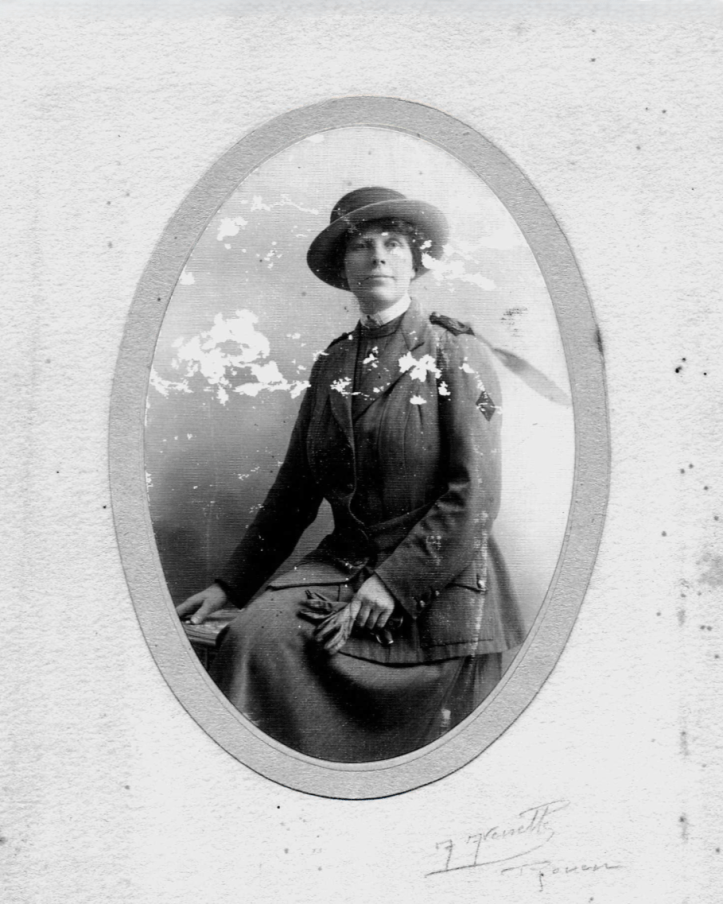
Blodwyn Williams, known as Billie within her family, was born in Ballarat in 1880. She was the second youngest of 10 children born to Elizabeth Jones and Theophilus Williams.
Theophilus Williams was born on 7 August 1824 in Bristol, England and while still an infant moved with his parents to Loughor in Glamorganshire, Wales. Upon leaving school he became an apprentice at Sir John Guest’s ironworks in Dowlais, near the town of Merthyr Tydfil. In 1840 he was placed under the care of Sir Charles Barry, one of the architects of the new Palace of Westminster (Houses of Parliament), and spent three years working as a mason on the massive project. In September 1853 Theophilus arrived in Ballarat after hearing of the Victorian goldrush. He became engaged in mining pursuits and in 1854 witnessed the battle of the Eureka Stockade.
Elizabeth Jones was born in 1841 in the village of Hope in Flintshire, Wales. Her family migrated to Australia and settled in Box Forest (now Fawkner and surrounding suburbs) in Melbourne.
Elizabeth and Theophilus were married on 14 February 1862 at Trinity Church in Pentridge (now Coburg) in Melbourne. They lived in Ballarat and in 1863 Elizabeth gave birth to their first child, Taliesin. Soon after this, the family moved to Wales, where, in September 1864, Elizabeth gave birth to their second child, Tudor, in Llanelly, near Abergavenny.
The family returned to Australia after Tudor’s birth and by February 1865 was living once again in Ballarat. In 1866 a third son, Ivor, was born, followed by a fourth, Theophilus, in 1868.
In 1870 Elizabeth gave birth to her first daughter, Rachel Maud (known as Maud). She then had five more: Beatrice in 1873, Lavinia (known as Vina or Vin) in 1875, Gwladys (sometimes spelt Gladys) in 1877, Blodwyn in 1880, and finally Gwendoline in 1882.
By this time the family had moved into a newly built house at 308 Barkly Street in Ballarat, and Theophilus Williams had become a successful businessman and public figure. In 1872 he had taken over the management of the Llanberris Mining Co. and sometime later its tributary, Llanberris No. 1. In 1876 he was voted onto the Ballarat Town Council and in 1881 was elected mayor. He served three terms in this capacity, 1881–82, 1887–88, and 1894–95.
CHILDHOOD
Theophilus Williams was deeply engaged with the Welsh community in Ballarat and as early as 1858 had been chairman of the first Ballarat Eisteddfod. He was for a time moderator of the Welsh Calvanistic Methodist Association of Victoria and was also involved with the Welsh Sunday School on Armstrong Street in Ballarat, which Blodwyn, Lavinia, Gwladys and Gwendoline attended as children. The Williams girls also attended meetings of the Sunday School’s Band of Hope.
The Band of Hope was an English temperance movement that was often associated with Methodist and Presbyterian churches and run in conjunction with Sunday Schools. Meetings opened with singing and prayer, followed by the chairman’s address, then recitations, songs and readings. Finally, meetings closed with some words from the chairman and the signing of pledges by new members.
In 1899 Blodwyn was a pupil at the Ballarat East School of Art. In July that year two of her oil painting were on display at the annual exhibition of pupils’ work. One was a study of Carnarvon Castle, the other of poppies and roses.
The first decade of the 1900s was a sad one for Blodwyn and her siblings. On 17 February 1901 their eldest brother, Taliesin, died at Llanberris House, the family’s new residence on Dowling Street in Ballarat (sometimes referred to as Wendouree). He was only 37. Three years later, on 26 June 1904, their father died after a series of strokes that had left him bedridden at home. Four years after that, on 22 June 1908, their mother died. All three were interred in the family grave at Ballarat New Cemetery.
NURSING AND ENLISTMENT
Following the death of her mother, Blodwyn decided to become a nurse, and around July 1909 was taken on as a probationer at Ballarat District Hospital. She thus followed her sister Lavinia, who had trained at Ballarat Hospital from 1895 to 1898 before moving to Maryborough Hospital. The sisters’ late mother had had a role at the hospital too. In 1887 Elizabeth Williams was elected president of the Queen Victoria Women’s Ward Fund Committee, whose aim was to raise funds for the construction of a women’s ward. She remained in that position until the ward was opened in 1901.
Blodwyn graduated in July 1912 and for the time being remained on staff at Ballarat Hospital. Later she moved to Brunswick, an inner-northern suburb of Melbourne, where her sister Gwendoline lived. In Melbourne Blodwyn may have worked in private nursing, but there is no record of this. On 8 April 1915 she became a registered member of the Royal Victorian Trained Nurses’ Association.
By then the Great War had started. Blodwyn wanted to do her bit, and like many of her peers joined the Australian Army Nursing Service (AANS). She completed her AANS Candidates’ Enrolment Form on 24 June 1915 and was attached as a reinforcement staff nurse to No. 2 Australian General Hospital (AGH), a medical unit of the Australian Imperial Force (AIF). She was set to go to Egypt.
HMAT ORSOVA
On 17 July 1915 Blodwyn, 20 other staff nurses, and six medical officers, all newly appointed as 2nd AGH reinforcements, embarked from Port Melbourne on His Majesty’s Australian Troopship (HMAT) Orsova, bound for Egypt.
HMAT Orsova had departed Sydney on 14 July with around 700 personnel on board – mainly soldiers, but also staff of various medical units, including the Convalescent Depot (Harefield Park) and No. 1 Australian Hospital Ship (AHS) Karoola. There was also a contingent of 23 staff nurses and six medical officers of No. 2 AGH. When the ship reached Melbourne on 16 July, hundreds more soldiers boarded, together with further elements of the Convalescent Depot (Harefield Park) and No. 1 AHS Karoola, plus staff of the Hospital Transport Corps, No. 1 Australian Clearing Hospital, No. 1 Australian Casualty Clearing Station, and No. 1 AGH.
On 22 July the Orsova reached Fremantle. More personnel boarded, including five more No. 2 AGH staff nurses. When the ship departed later that day it was carrying a total of around 1,500 combat, medical and ancillary staff, including 138 AANS nurses. Some of the nurses, like those of No. 2 AGH, were bound for Egypt, while the others would remain with the ship and travel on to England.
GHEZIREH, CAIRO
After stopping in Aden, the Orsova arrived at Port Tewfik, Suez on 11 August 1915. Blodwyn and her No. 2 AGH colleagues – 48 staff nurses and 12 medical officers – disembarked and caught the 5.20 pm train to Cairo. At around 1.00 am the next morning they were met at Cairo station by Lieutenant Colonel Thomas Morgan Martin, the commanding officer of No. 2 AGH, and taken to the Ghezireh Palace Hotel, where the unit was based.
No. 2 AGH had arrived in Cairo in January 1915 on HMAT Kyarra and had taken over Mena House, a luxury hotel situated close to the Pyramids. Following the opening of the Gallipoli campaign, the hospital moved into the Ghezireh Palace Hotel in central Cairo while maintaining Mena House as an overflow hospital. When the fighting in Gallipoli ground to a stalemate, Mena House was mothballed, but was reopened as a convalescent depot at the beginning of August in anticipation of a new offensive aimed at capturing the heights above Anzac Cove and thus breaking the Gallipoli deadlock. The offensive had begun on 6 August, just six days before Blodwyn’s arrival, and already thousands of Allied soldiers had been killed and wounded. Casualties poured into No. 2 AGH, as well as into the unit’s sister hospital, No. 1 AGH, which had also arrived in January and was based in Heliopolis on the northeastern outskirts of Cairo.
In the very early hours of 12 August Blodwyn and the other nurses were shown to their quarters at the Ghezireh Palace and placed four to a room with mattresses on the floor for beds. After a few hours’ rest, they reported to their wards. Blodwyn was detailed for duty in a medical ward with 100 beds, and that night had her first experience of convoys of sick and wounded from the Gallipoli offensive. “I shall never forget [them],” she stated in an interview with Matron Maud Kellett conducted in 1919. “It was simply dreadful to see the poor boys, absolute wrecks, nothing but skin and bone, and the heat and flies were a great trial at times, still the boys were always bright and cheerful in the midst of it all.” She noted how relatively little she and the other nurses had to grumble about.
Blodwyn found Egypt a wonderful and fascinating place and enjoyed being there immensely. However, after little more than five weeks she was transferred to England, and on 21 September embarked from Port Said on the Royal Mail Ship (RMS) Morea. The Morea had departed Sydney on 15 August with reinforcement troops, who had disembarked at Suez.
3RD LONDON GENERAL HOSPITAL, WANDSWORTH
On 3 October 1915 Blodwyn reported to AIF Headquarters in London and was posted to No. 3 London General Hospital (LGH) in Wandsworth, southwest London. No. 3 LGH had been established in August 1914 as a 520-bed Territorial General Hospital. It was housed in a building that was previously occupied by the Royal Victoria Patriotic School, an orphanage for daughters of British military veterans. The hospital had grown considerably since then, to the point where, just before Blodwyn’s arrival, the commanding officer was able to enter into an arrangement whereby 500 beds would be permanently at the disposal of Australian patients and a contingent of Australian medical officers would be brought in to assist.
Blodwyn was disappointed with her experience at No. 3 LGH. In her interview with Matron Kellett she stated that she “did not care for it very much as we did not receive a very good reception.” The majority of the staff and patients at No. 3 LGH were British, and Australian nurses generally preferred to be posted to Australian hospitals or at least to look after Australian patients. Perhaps this is why Blodwyn was less than pleased. However, once the beds set aside for AIF patients began to fill up, she may have begun to feel more at home.
ZEPPELIN ATTACK
At 6.30 pm on 13 October 1915, just 10 days after Blodwyn’s arrival at No. 3 LGH, five German navy Zeppelins crossed the Norfolk coast and flew towards London. Four went astray and ended up bombing Norfolk and the metropolitan fringes, but one made it through to central London. It bombed the theatre district around Charing Cross, damaging the Lyceum Theatre and a building at the corner of Exeter and Wellington Streets. It then attacked Holborn, damaging Lincoln’s Inn Chapel among other buildings. That night in central London, 17 people lost their lives and 20 were injured.
Zeppelin attacks were not infrequent, and the staff of No. 3 LGH were used to “Lights out!” warnings. In a letter to her sister Gwladys, as reported in the Shepparton Advertiser on 23 March 1916, Blodwyn referred to the strange sensation of going round the wards at night with only the tiniest glimmer of light, lest a target should be offered to Zeppelins overhead. She also recounted her own experience of a Zeppelin raid. She was in a theatre when an air-raid siren was sounded. The audience was given the choice of leaving on the instant or staying to watch the show. Everyone chose to stay.
CHRISTMAS 1915
Soon Christmas approached, and Blodwyn and the other nurses busied themselves with decorating the hospital wards. One was decorated as ‘Winter,’ with snow falling from the ceiling fastened by invisible threads. Another was decorated in shades of pink and mauve. A third was decorated with flower-filled bonnets suspended from the ceiling, and a fourth with wisteria. While this was going on, the hospital’s Ladies’ Committee was preparing Christmas stockings for the patients, each filled with apples, oranges, sweets, toys and crackers. The ladies also prepared a handkerchief for each patient in which was tied up a book, tobacco, cigarettes, chocolate and a pair of socks.
On Christmas Eve the nursing staff gathered in the main hall at 8.30 pm with Chinese lanterns lighted, and divided off into three sections, going through every ward in the hospital to sing carols. The patients joined in with the nurses. Later, the night nurses had the enviable task of placing the presents prepared by the committee on the patients’ beds, and watching them wake up in the morning to find them there.
On Christmas morning every man was given a buttonhole, with the Australians getting wattle. Later, Christmas dinner was served – the principal event of the day. The sisters, staff nurses, probationers, and ‘orderlettes’ (women orderlies) dined in the wards with their patients at decorated tables. There was the usual Christmas fare: turkey, plum pudding, fruit, crackers etc.
Meanwhile, the Receiving Room, where new patients were admitted, was being turned into a tearoom, with long tables up the centre and a platform at the end. By 3.30 pm the tables were all loaded with cakes, fruit, and crackers, and beautifully decorated, and at 4.00 pm the men who could walk were seated, between 400 and 500 of them, and tea was in full swing. There was a continual noise of laughter, crackers, singing and merrymaking. At the right moment the commanding officer of the hospital lifted his hand for silence, and Princess Louise, Duchess of Argyll, read a special message for the men from the King, and everybody cheered. Then the hospital orchestra played ‘God Save the King,’ and the whole hall stood to attention and sang along.
Men on stretchers and in wheelchairs, who could not attend tea in the Receiving Room, were brought theirs in the Recreation Room. When Princess Louise had finished in the Receiving Room, she came into the Recreation Room and spoke to many of them.
Curiously, although Blodwyn, in her report to Matron Kellett, recalled having “spent a few months at the 3rd London General Hospital,” her military record states that she was posted there until November 1916.
No. 1 AUSTRALIAN AUXILIARY HOSPITAL, HAREFIELD
After more than a year at No. 3 LGH, on 18 November 1916 Blodwyn was transferred to No. 1 Australian Auxiliary Hospital (AAH), located in the village of Harefield on the northwestern edge of Greater London.
In November 1914, expatriate Australians Letitia and Charles Billyard-Leake had offered ‘Harefield Park,’ their estate in Harefield, to the Australian Government for use as a convalescent hospital for AIF soldiers. The offer was accepted and at the end of March 1915, Matron Ethel Gray and five sisters arrived for duty after sailing to England on the RMS Osterley. More staff arrived in early May, including the hospital’s initial medical superintendent, Captain Marcus Southey.
The newly arrived staff erected five huts on the elegant green lawns of the estate and unpacked and distributed cases and crates full of blankets, pillows and linen. Soon 80 beds were ready to receive patients, and the first eight arrived on 2 June. The hospital officially opened on 4 June and was known as Convalescent Depot (Harefield Park). Within weeks, however, the number of patients had ballooned to nearly 400, and in August reinforcement staff arrived – the same staff with whom Blodwyn had shared passage on the Orsova.
By the time Blodwyn arrived at the end of 1916, Harefield was known as No. 1 AAH and could accommodate 1,000 patients. It had an eye ward, a radiography unit, and physiotherapy services, with considerable emphasis on physical rehabilitation.
After her dissatisfaction at No. 3 LGH, Blodwyn was “very pleased when we were recalled to one of our own hospitals” and was “very happy amongst our own boys again.” She was somewhat surprised at how busy on occasion she and the other nurses were. As she told Matron Kellett, “We had some very busy times there although it was supposed to be a Convalescent Hospital, we had some very heavy work when the cars came in from the English Hospitals prior to embarking on the hospital ships for Australia. We were only staffed for convalescents.”
Many of the Australians convalescing at Harefield had lost arms or legs in the Gallipoli campaign and many were blind. Their courage was extraordinary. One who was both blind and had lost a leg was offered a chair but replied “No thank you, Sister, I have one good leg and am quite alright” (quoted in Blair).
On 22 September 1917 a staff nurse arrived at Harefield by the name of Florence Hudson. Florence was from Ballarat, and no doubt they had much to talk about.
NO. 5 STATIONARY HOSPITAL, DIEPPE
Four months later, Blodwyn and Florence were both transferred to No. 5 Stationary Hospital (SH), a British hospital in Dieppe, a handsome seaside town in northern France. On 14 January 1918 they crossed the English Channel with another Victorian, Staff Nurse Mary Donaldson, who had been with No. 2 AAH in Southall and was now joining Blodwyn and Florence at No. 5 SH. All three were briefly attached to Blodwyn’s old unit, No. 2 AGH (which had relocated to France at the end of March 1916 and was now based at Wimereux, near Boulogne), before proceeding the following day to Dieppe. They arrived at the hospital on 18 January.
No. 5 SH was comprised of four long huts each divided into two wards. The first hut housed acute surgical and medical patients; the second and third huts, medical patients. The fourth had originally accommodated some of the nurses, but they had since moved into Villa Marguerite, a beautiful old house with a fine garden located nearby. In addition, there was an officers’ ward, divided into four; a skin ward; and various huts for convalescents. The hospital was beautifully kept, with spotless huts, polished floors and white covers for the beds and lockers. Although the nursing staff was Australian, the medical officers and orderlies were English.
Blodwyn, Florence and Mary were billeted with the other nurses at Villa Marguerite. Unfortunately, they had arrived in winter, and the old house, though comfortable in other respects, was damp and cold – so cold, in fact, that Staff Nurse Elsie Tranter, a fellow Victorian who had left No. 5 SH five days before the three nurses arrived, wrote in her diary that she had icicles hanging on the wall by her bed.
Nevertheless, Blodwyn enjoyed her time at Dieppe. Since the hospital received mainly local sick and injured soldiers, not those from the front, the nurses’ workload was comparatively light and they worked hours akin to those at home, with one day per week off duty and alternate long and short days. Consequently, there was plenty of time for recreation. The nurses spent time walking around town and in the surrounding countryside and had access to a golf course and a tennis court.
No. 1 AUSTRALIAN GENERAL HOSPITAL, ROUEN
On 3 April 1918 Blodwyn and Mary Donaldson were posted to No. 1 AGH at Rouen and reported to the unit the same day. Florence Hudson, meanwhile, had earlier been posted to No. 42 SH in Amiens.
Like No. 2 AGH, No. 1 AGH had departed Egypt for France at the end of March 1916 and was based in the city of Rouen. Sited on the Seine with access to the sea, Rouen lay 50 kilometres south of Dieppe and was an important centre of British and Allied medical evacuation and home to numerous hospitals. Many of these were located at the city’s southern racecourse, the Hippodrome des Bruyères (today the Parc du Champ des Bruyères), and it was here that No. 1 AGH had established its hospital in April 1916.
For the next seven months Blodwyn enjoyed her time at No. 1 AGH, even though – or perhaps because – the work was at times very heavy. She was granted leave from 19 September to 6 October and crossed the Channel to England. When she returned to Rouen, she had been promoted to the rank of sister.
THE END OF HOSTILITIES
Early on the morning of 11 November, in a clearing in the Forest of Compiègne in northern France, the Armistice that ended the fighting on the Western Front was signed in Marshall Foch’s railway carriage. At 11.00 am that day the guns fell silent. The fighting was over.
The cessation of hostilities was celebrated throughout the hospital with great joy, but not frivolously – rather with seriousness, if not solemnity. No special festivities took place, as there was too much work to do; the wards were still full of wounded men as well as those who had contracted pneumonic influenza – the so-called Spanish Flu – which by then was raging everywhere.
On 28 November the commanding officer of No. 1 AGH, Col. James A. Dick, was notified that the hospital was to be transferred to Sutton Veny, a village in Wiltshire, England. The last patients arrived at Rouen on 30 November.
No. 1 AUSTRALIAN GENERAL HOSPITAL, SUTTON VENY
Blodwyn and her colleagues remained in France for just over two more weeks. Finally, at 8.00 pm on 16 December 1918, orders were received for an advance party to go to Sutton Veny.
On 17 December 1918 an advance party of 21 nurses and 20 other ranks departed Rouen. Twenty more nurses left Rouen on 19 December, among them Blodwyn. They disembarked at Southampton on 21 December, arrived at Sutton Veny on the same day, and the following day went on duty.
A further 20 nurses arrived at Sutton Veny on 23 December, including Mary Donaldson – now, like Blodwyn, promoted to the rank of sister. The final contingent of 15 nurses arrived on Christmas Day.
No. 1 AGH officially reopened on 15 January 1919. The unit had taken over the site of a British military hospital and had inherited that hospital’s patients, among them Australians, British, other Allied nationals, and German prisoners of war.
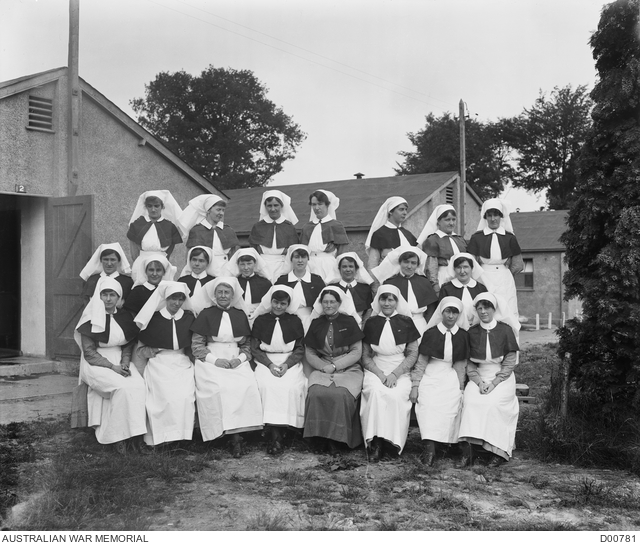
The work of the hospital during the first months of 1919 was chiefly concerned with the treatment of patients with pneumonic influenza. Hundreds of men, not to mention staff, had contracted the virus, and dozens had died. The epidemic began to subside in March, and by June the workload for Blodwyn and her colleagues had lessened significantly.
Staff were now being sent back to Australia, and Blodwyn was slated to be among them, but a serious illness intervened. On 19 August she was admitted to No. 1 AGH and on the same day underwent an emergency operation to remove an abdominal growth.
RETURN TO AUSTRALIA
By 9 September 1919 Blodwyn’s condition had improved to the point where she could safely be invalided home. On 28 September she embarked on the RMS Osterley with Sister Melania Ambler, Sister Alice Douglas ARRC, Staff Nurse Enid Wells, and Staff Nurse Dorothy White. All five nurses disembarked in Melbourne on 6 November.
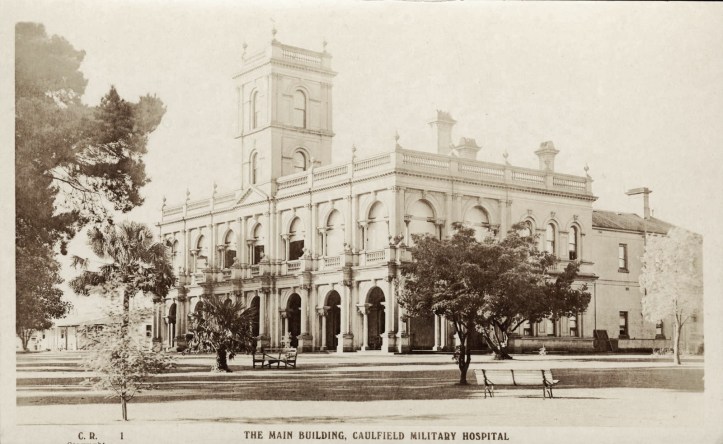
(Rose Stereograph Co., SLV H42809/13)
However, Blodwyn was not well. She had contracted cancer. At a certain point she was admitted to the Caulfield Military Hospital, where she died on 24 May 1920. The cause of death was carcinoma of the right lung, with secondary causes of debility and heart failure.
Blodwyn’s funeral took place on 26 May after her remains were conveyed home to Ballarat. Her coffin, draped in the Union Jack, was carried from Llanberris House, where some of her siblings still lived, to Ballarat New Cemetery, and she was interred in the family grave. After the Benediction was pronounced, the ‘Last Post’ was sounded by Pte. Thomas.
IN MEMORIAM
Among many other places, Blodwyn’s name is inscribed on the Brunswick Honour Roll, which was unveiled in August 1928 in the Brunswick Town Hall. It remains there to this very day.
We will not forget her.
SOURCES
- ABC, ‘Letitia Leake used $40m inheritance to help 50,000 wounded Anzacs during WWI,’ story by Bec Whetham, 23 Apr 2021.
- Ancestry Library Edition, State Library of Victoria.
- Australian War Memorial, ‘The arrival of the first Australian wounded from Gallipoli at the Third London General Hospital, Wandsworth.’
- Australian War Memorial, Australian Imperial Force Unit War Diaries, 1914–18 War, No. 1 Australian General Hospital, Dec 1918, AWM4 26/65/33.
- Australian War Memorial, Australian Imperial Force Unit War Diaries, 1914–18 War, No. 1 Australian General Hospital, Jan 1919, AWM4 26/65/34.
- Australian War Memorial, ‘History of Harefield Park Harefield (No 1 Australian Auxiliary Hospital) 1914-1919,’ 11 June 1974, AWM 449/9/302.
- Australian War Memorial, Nurses’ Narratives, Sister B. E. Williams, AWM41 1057.
- Australian War Memorial, Nurses’ Narratives, Staff Nurse Leila Brown, AWM41 946.
- Australian War Memorial, Records of Arthur G. Butler, AANS nurses interviewed by Matron Kellett, Miss R. O’Reilly, AWM41 1072.
- BirtwistleWiki (website), ‘1st Australian Auxiliary Hospital.’
- Blair, L., ‘The Gift of Harefield,’ posted 19 Dec 2024, Royal Brompton and Harefield Hospitals (website).
- Lost Hospitals of London (website), ‘Third London General Hospital.’
- Lost Hospitals of London (website), ‘No. 1 Australian Auxiliary Hospital.’
- The National Archives (UK), Lines of Communication Troops, 5 Stationary Hospital (Jan 1918–Nov 1919), WO 95/4100/4.
- National Archives of Australia, various records.
- Public Record Office Victoria, Royal Victorian Trained Nurses’ Association Nurses Register (VPRS 16407/P0001), No. 1, 1–712, 18 Jul 1901–28 Jul 1903.
- Public Record Office Victoria, Royal Victorian Trained Nurses’ Association Nurses Register (VPRS 16407/P0001), No. 4, 2,429–3,470, 4 Mar 1915–1 May 1919.
- Through These Lines (website), ‘Dieppe,’ ‘No. 5 Stationary Hospital,’ ‘Dieppe in Sister Elsie Tranter’s diary’ and ‘Villa Marguerite.’
- Tregarthen, N., Sea Transport of the A.I.F., Naval Transport Board.
- Wellcome Collection, The Gazette of the 3rd London General Hospital (Territorial Force), Wandsworth: monthly, Oct 1915–Jul 1919, RAMC/866. ‘Christmas at the 3rd,’ (Feb 1916, pp. 111–13).
- Wikipedia, ‘German bombing of Britain, 1914–1918.’
SOURCES: NEWSPAPERS
- The Age (Melbourne, 21 Oct 1919, p. 8), ‘Victorians on Osterley.’
- The Ballan Times (Vic., 30 Jun 1904, p. 3), ‘Death of Mr Theo Williams.’
- The Ballarat Star (Vic., 30 Dec 1858, p. 2), ‘The Eisteddfod.’
- The Ballarat Star (Vic., 18 Nov 1864, p. 2), ‘News and Notes.’
- The Ballarat Star (Vic., 4 Feb 1865, p. 4), ‘Police.’
- The Ballarat Star (Vic., 1 Jun 1889, p. 4), ‘Society Meetings.’
- The Ballarat Star (Vic., 3 Dec 1889, p. 4), ‘Welsh Sunday School, Armstrong Street.’
- The Ballarat Star (Vic., 4 Jul 1899, p. 4), ‘Ballarat East School of Art.’
- The Ballarat Star (Vic., 27 Oct 1900, p. 1), ‘Address By Mrs T. Williams.’
- The Ballarat Star (Vic., 25 Jul 1901, p. 3), ‘Ballarat District Hospital.’
- The Ballarat Star (Vic., 27 Jun 1904, p. 1), ‘Death of Mr Theophilus Williams.’
- The Ballarat Star (Vic., 28 Jun 1904, p. 5), ‘Family Notices.’
- The Ballarat Star (Vic., 23 Jan 1909, p. 4), ‘Family Notices.’
- The Ballarat Star (Vic., 28 May 1920 p. 1), ‘Obituary.’
- The Ballarat Star (Vic., 23 Jul 1921, p. 1), ‘Personal.’
- The Evening Echo (Ballarat, Vic. 2 Nov 1914, p. 4), ‘General News.’
- The Herald (Melbourne, 23 Apr 1923, p. 8), ‘Says and Hearsays.’
- Shepparton Advertiser (Vic., 23 Mar 1916, p. 3) ‘Sister B. Williams.’
- The Sydney Morning Herald (21 Aug 1915, p. 15), ‘R.M.S. Morea’s Passengers.’
 australianwarnurses.org