QAIMNSR │ Staff Nurse │ First World War │ England
Family Background
Alice Atkinson, known as Blanche, was born on 5 July 1879 at Crafers, South Australia. She was the eldest daughter of Mary Ann Martha Church (1852–1919) and Frederick John Atkinson (1847–1913).
Mary Ann Church was born in the district of Poplar in London, England and was the eldest child of Ann and Thomas Church. In May 1855 she migrated with her parents and her younger sister, Elizabeth, to South Australia, settling near Angaston on the Murray Flats at a locality then known as Duck Ponds and today as Moculta. Thomas worked as a shepherd and later a labourer, and was also an experienced butcher. He and Ann had five more children.
Frederick Atkinson was born in Cowandilla in Adelaide. His father, John Jagger Atkinson, had migrated to South Australia from England in 1840 and settled in the area around Mount Barker, east of the Adelaide Hills. He became a farmer and married his second wife, Susan Hillam, the daughter of a neighbouring farmer, in 1843. They had seven children, of whom Frederick was the third. After Susan died in 1857, John married Mary Jane Haining, and they lived in Walkerville in Adelaide.
Mary Ann and Frederick were married on 29 November 1868 at St. John’s Church in Kapunda, South Australia, and only two days later Mary Ann gave birth to their first child, a boy, who died unnamed on the same day.
Sometime after this tragic event Mary Ann and Frederick moved to Glen Osmond at the base of the Adelaide Hills, and in 1871 William Henry was born, followed by Frederick in 1873.
In 1874 the family went to live at Crafers, a small town in the Adelaide Hills, where Frederick started a butcher’s business on Main Street. Here more children were born – Arthur in 1875, Alfred in 1877, Blanche in 1879 and Clement in 1881.
When John Jagger Atkinson died in February 1882 he bequeathed money to Frederick. In August that year Frederick put his Crafers butcher’s shop and attached premises on the market, but it is not known whether it sold, and in any case he continued to work as a butcher for the rest of his life. He also acquired several parcels of land and began to keep racehorses.
CHILDHOOD
In the meantime, the Atkinson family was continuing to grow. Leonard was born in 1884, followed by Jessie in 1886, Victoria May (known as May) in 1887, Bruce in 1889, Gilbert in 1891, Ida Grace (known as Grace) in 1893, and finally Linda Dorothy in 1897. At least some of the children, including Blanche, attended Stirling East School.
In April 1895 Blanche, now nearly 16, enrolled in the Sunbeam Society, a children’s club founded in September 1894 by David Bottrill as ‘Uncle Harry’ in the children’s pages of the Adelaide Observer and the Evening Journal. The society rapidly attracted a great number of younger children as members and older children like Blanche as ‘associates.’ The members and associates were encouraged by Uncle Harry to form ‘Sunbeam circles’ in their local area, each comprising around six children. Each circle would organise events at which to raise money to send to Uncle Harry for disbursal to various charities. The honorary secretary of each circle would send a letter with each cheque telling Uncle Harry what their circle had done.
Blanche, as the honorary secretary of the ‘Alexandra’ circle – named, like the other circles, after a well-known public or historical figure – sent numerous letters to Uncle Harry over the next few years and had a number of them printed – for example this one, printed on 26 June 1897:
Crafers, June 10.
Dear Uncle Harry – We held our Concert and Bazaar in the Crafers Institute on May 20. We did better than we expected considering what an unpleasant day we had for it. We realized £10. Our expenses were heavy, being £2 8s. 9d; 7s. 9d we kept for our banner. I am sending a cheque for £7; I am sorry we are not able to send you more. We were pleased to see you at the Concert. We wish to thank Mrs. Wise, who kindly opened our Bazaar for us, and the Rev. P. W. Wise, who presided in the evening; also the ladies who so kindly helped us both with the Concert and Bazaar. I am sure we could not have done so well had it not been for their help. I am sending a parcel of things which were left from our Bazaar for the Fair.
With love to all, I am, your loving Niece, BLANCH ATKINSON, Hon. Secretary ‘Alexandra’ S.C.
In June 1898 Blanche wrote to Uncle Harry regarding Ella Bills of Bridgewater, a member of the ‘Alexandra’ circle:
Poor little Ella, as you know, was a cripple, and a great sufferer. Her heart was quite wrapped up in our Sunbeam Society, and it grieved her very much when she was unable to write to you. She had made sixteen woollen dolls for bazaars, &c., and she had wool ready to make another.
NURSING TRAINING
As a young adult Blanche, clearly community minded and caring, decided to take up nursing. Around 1901 she found work as an untrained nurse at the Kalyra Sanatorium in Belair, around 8 kilometres from Crafers on a spur of the Mt. Lofty Range. At that time the sanatorium was based in an old house and it was not until 1910 that work began on a much grander home for the tuberculosis sufferers.
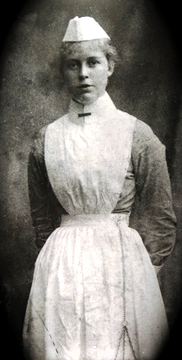
Before then, however, on 13 November 1907, Blanche had been appointed as a probationer nurse at the Adelaide Hospital. She completed her training in September 1910 and then worked for six months as a charge nurse at Alberton Private Hospital in Adelaide, before moving to Western Australia to work in private nursing.
On early Friday morning 18 April 1913, while Blanche was in Western Australia, her father died of heart failure at the age of 65. His death followed those of two of Blanche’s brothers only months earlier. It is not known whether Blanche was able to attend any of the funerals.
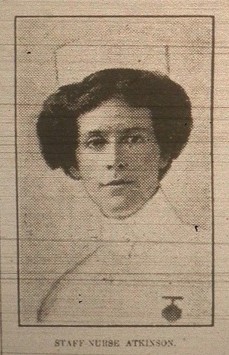
Around October 1914 Blanche took up an appointment as a staff nurse at Kareenya Private Hospital on St. George’s Terrace in Perth. Here she met a nurse by the name of Miss Proudfoot (possibly Isabel Proudfoot, whose sister Bessie became a nurse in the Australian Army Nursing Service). By now the Great War had broken out, and the two decided to volunteer for service with the Queen Alexandra’s Imperial Military Nursing Reserve (QAIMNSR) in London. On 8 May 1915 Miss Proudfoot sailed from Fremantle to Adelaide on the Indarra, with Blanche following on the Katoomba on 15 May. They met up in Adelaide and on 20 May departed for London via Durban on the SS Beltana.
WAR SERVICE
On 14 July, while still aboard the Beltana, Blanche filled out her application form for service with the QAIMNSR. She understated her age by a few years and listed her address in London as 3 Kensington Garden Square, Bayswater. Presumably Miss Proudfoot filled out her application form too.
The Beltana arrived in London on 22 July and Blanche immediately submitted her form. She was interviewed on 23 July and informed on the same day that she had been accepted. She signed an acceptance form on 28 July and was attached as a staff nurse to the Brockenhurst Military Hospital in the New Forest, Hampshire, effective 2 August.
Miss Proudfoot, meanwhile, appears not to have joined the QAIMNSR after all. If Blanche’s friend was indeed Isabel Proudfoot, she instead married Ernest Walter sometime between July and September that year and eventually returned to Australia.
Blanche arrived at Brockenhurst on the appointed day. The village was not far from the port of Southampton and connected to it by rail, so was ideally situated to receive casualties from France. The hospital was situated close to the village and was formally known as the Lady Hardinge Hospital for Wounded Indian Soldiers. It had been established soon after the outbreak of war to treat men from the 3rd (Lahore) and 7th (Meerut) Divisions of the Indian Army Corps, which had been fighting in France and Flanders with the British Expeditionary Force.
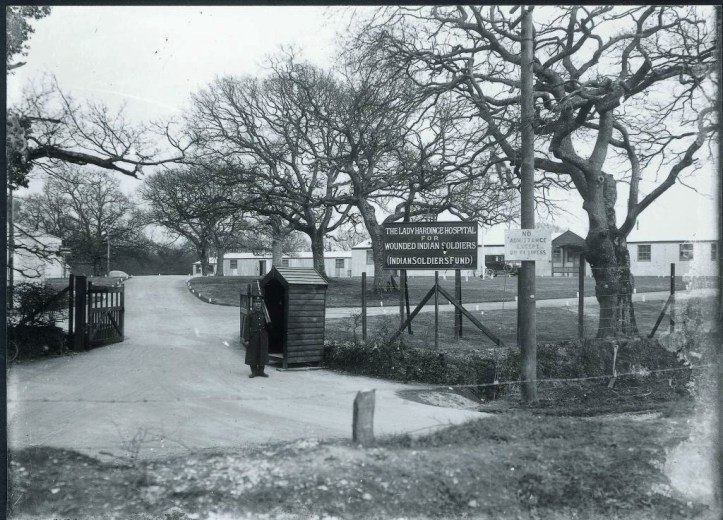
The hospital originally had 20 wards, each of 25 beds, plus annexes, with separate wards for the officers. Each nurse had charge of 50 beds and was supported in her supervision by two English orderlies and a number of Indian servants. Within months, however, overcrowding had become a problem. It was so overcrowded at times that the wounded had to be accommodated on mattresses on the floor. Tented and galvanised accommodation units with a total capacity of 500 beds erected in 1915 took some of the pressure off.
Blanche had arrived at the height of summer, but as the weeks passed, the cooler weather came. The hospital had poor heating and became very cold. Between October and December Blanche was working night duty. She “caught a chill,” as she later stated, and in November developed a cough. When she had joined the QAIMNSR she had been quite well. Ominously, among the patients she was nursing at that time were those with ‘tubercule of the lungs’ – a precursory indicator of tuberculosis.
Further challenges facing Blanche (and the other staff) were inadequate food and medical supplies and an unreasonably large workload. Nonetheless, she carried on, but all the while her health was deteriorating.
ILLNESS
On 21 March 1916 Blanche was admitted to Brockenhurst Military Hospital as a patient, suffering from a severe cough and chest trouble. She was found to have a large cavity in her left lung, a smaller cavity in her right, and tubercular deposits over various parts of both lungs – in short, she had tuberculosis. She was assessed as permanently unfit for service on 28 March and her appointment was terminated the following day. Thereafter she remained at Brockenhurst as a free patient.
At this stage Blanche was too ill to be moved to a sanatorium, but within the hospital all precautions were being taken against the spread of the tuberculosis bacterium. On 11 April a cable was sent home to her mother advising her of Blanche’s illness.
By 28 May it was found that Blanche’s condition had improved to the extent that she was now in a fit state to be transferred to a sanatorium, and in June she was moved to the Royal Victoria Hospital outside Netley, a village immediately southeast of Southampton.
On 3 June Blanche was awarded the Royal Red Cross (Second Class) for her devotion to duty as demonstrated during her seven months’ service at Brockenhurst. The Royal Red Cross was instituted as a decoration by Queen Victoria in 1883. It was awarded to nurses who had shown special devotion while caring for the sick and wounded of the Army and Navy. In November 1915 the decoration was expanded to two classes: First Class, or Member (RRC), and Second Class, or Associate (ARRC). Unfortunately, Blanche’s name is recorded incorrectly in the London Gazette of 3 June as “Miss N. Atkinson.”
Blanche was too ill to attend an investiture ceremony in the presence of King George V, so instead the decoration was sent to Netley on 24 June. At the same time a letter was received by Lieutenant-General Sir Alfred Keogh, Director-General (British) Army Medical Services, from the King’s private secretary, as printed in the Adelaide Chronicle on 23 December 1916. It read as follows:
The King and Queen are so sorry to hear that Miss Atkinson is laid up in Netley Hospital and so is unable to receive at the hands of his Majesty the Royal Red Cross decoration awarded to her for devoted service, in the execution of which she unfortunately contracted her present illness. The King hopes you will be able to send someone to Netley – perhaps Miss Belcher – to hand this decoration to Miss Atkinson, and to tell her how much their Majesties sympathise with her and truly wish her a speedy restoration to health.
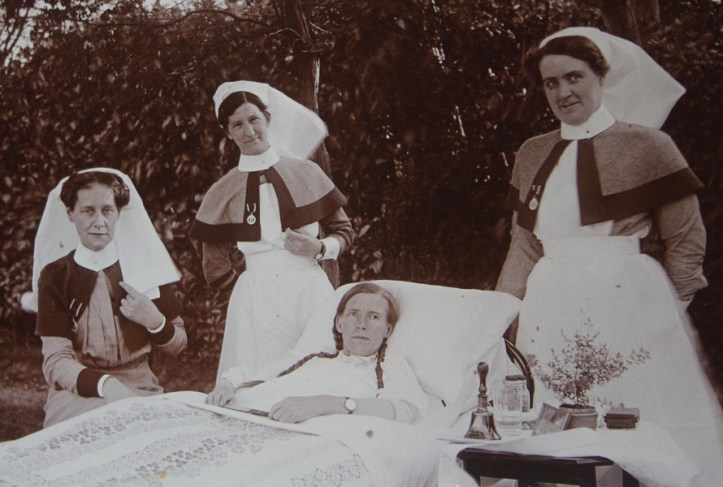
Blanche was presented with the decoration and the letter as she lay on her bed outdoors.
RETURN HOME
By August Blanche was well enough to return home. On 8 August she departed Southampton on the SS Marathon accompanied by Sister Griffiths (possibly Phoebe Margaret Griffiths, who had worked at Netley) and arrived in Melbourne on 23 September. She entrained for Adelaide on the Melbourne express with a contingent of returned soldiers and alighted at Mt. Lofty in the Adelaide Hills on 26 September. She was home.
Blanche returned to Crafers to stay with her mother but did not recover from her illness. She died on 9 December 1916, aged 37 years. She was buried in the Stirling East Cemetery (now the Stirling District Cemetery).
In memory of Blanche.
SOURCES
- Adelaide AZ (website), ‘David Bottrill’s ‘Uncle Harry’ column creates 1894 Sunbeam Society for thousands of South Australian children.’
- Ancestry Library Edition.
- Find a Grave, ‘Sister Blanche “Alice” Atkinson, R.R.C.’
- Glenunga International High School via Virtual War Memorial Australia, ‘Atkinson, Blanche.’
- Great War Forum, ‘Australian QAIMNS & QAIMNSR list updated,’ (‘Indunna’, 15 November 2011).
- Mount Lofty Historical Society, ‘Crafers Institute & Library’ (text by Chris Chardon).
- The National Archives (UK), Blanche Atkinson, reference WO 399/220.
- The National Archives (UK), ‘War Office: Registers of Recipients of the Royal Red Cross.’
- Owen, G., ‘Brockenhurst: A First World War Hospital Village 1914,’ New Forest Knowledge (website).
- South Australian Red Cross Information Bureau 1916–1919, ‘Blanche Atkinson.’
- Unit Histories (website), Queen Alexandra’s Imperial Military Nursing Service (QAIMNS) Officers 1939-1945 (including Territorial Army Nursing Service), ‘Griffiths, Phoebe Margaret.’
SOURCES: NEWSPAPERS, JOURNALS, GAZETTES
- Adelaide Observer (20 Jun 1896, p. 35), ‘Children’s Column. Uncle Harry’s Letter.’
- Adelaide Observer (26 Jun 1897, p. 35), ‘Children’s Column.’
- The Advertiser (Adelaide, 19 Apr 1913, p. 21), ‘Personal.’
- The British Journal of Nursing (no. 1,405, vol. 54, 6 Mar 1915), ‘The Lady Hardinge Hospital, Brockenhurst’ (pp. 185–87).
- Chronicle (Adelaide, 23 Dec 1916, p. 15), ‘Obituary.’
- The Daily News (Perth, 11 May 1915, p. 3), ‘Mainly About People.’
- The Daily News (Perth, 15 May 1915, p. 5), ‘Shipping.’
- Evening Journal (Adelaide, 6 Apr 1895, p. 6), ‘Enrolments.’
- Evening Journal (Adelaide, 25 June 1898, p. 6), ‘The Children. Uncle Harry’s Letter. No. CCVII. Monday, June 20.’
- Evening Journal (Adelaide, 13 Nov 1907, p. 1), ‘Executive Appointment.’
- The Express and Telegraph (Adelaide, 26 Dec 1893, p. 4), ‘Family Notices.’
- London Gazette (3 June 1916, p. 5601).
- The Mount Barker Courier and Onkaparinga and Gumeracha Advertiser (26 Dec 1902, p. 2), ‘General News.’
- The Mount Barker Courier and Onkaparinga and Gumeracha Advertiser (25 Apr 1913, p. 2), ‘Obituary.’
- The Mount Barker Courier and Onkaparinga and Gumeracha Advertiser (24 Apr 1947, p. 1), ‘A Jewel Casket.’
- Recorder (Port Pirie, 13 Oct 1939, p. 3), ‘Fine Old Piriean Gone.’
- The Register (Adelaide, 27 Sept 1916, p. eight), ‘Home Again.’
- South Australian Register (Adelaide, 26 May 1855, p. 3), ‘The Punjab.’
- South Australian Register (Adelaide, 18 Aug 1882, p. 8), ‘Advertising.’
 australianwarnurses.org