AANS │ Sister Group 1 │ Second World War │ Malaya
EARLY LIFE
Bessie Wilmott was born on 24 May 1913 in Perth. She was the daughter of Clarice Thompson (1887–1919), from Sandhurst (Bendigo) in Victoria, and John Henry Wilmott (1884–1957). John was born in Liverpool, England, then lived in Wales before migrating to Australia as an unassisted passenger around 1905. In 1906 he was charged with stealing fruit and sentenced to seven days’ hard labour. He later became a photographer, as his father had been, and worked at Denis Dease’s well-known Lafayette Studio, at 81 Barrack Street in central Perth.
Clarice and John were married in Perth in 1912 and afterwards lived at 6 Gardner Street in the suburb of Como. Bessie was born in 1913, followed by John Henry (Jack) in 1914 and Richard Grenville (Dick) in 1917.
On 20 September 1919 Clarice Wilmott died. She was only 31 years old. At the time seven-year-old Bessie and six-year-old Jack were attending the Como School, which had opened in 1916 in the Anglican Church Hall (located possibly where St. Augustine’s is today). In 1921 they transferred to the newly opened Como State School, located closer to home, and in 1925 were part of the school’s sports team that won the Orgill Shield interschool sports competition.
Meanwhile, on 2 July 1923 John Wilmott had become married for a second time, to Lilian Millard, formerly a photographic retoucher, at St. John’s Church in West Perth. In September 1924 John moved from Lafayette Studio to Milton Studio in Brennan Arcade, and a month later was charged with having stolen £145 over a period of time from Denis Dease, the owner of Lafayette. He was fined £20 and ordered to make restitution. He claimed that Clarice’s death had caused him to drink, which had led to the embezzlement.
In 1931 John was married for a third time, to Ethel May Casey. Ethel’s former husband, Albert Richard Booth Casey, the father of her children Edna and Richard, had died on 28 January 1929 at Perth Hospital. At this point John largely disappears from the record – and seemingly from his children’s lives.
NURSING
In time, Bessie decided to become a nurse, and in 1936 began her training at Perth Hospital. There she met another new trainee by the name of Letitia Anne Metzke, known as Anne. Anne and Bessie became best friends. Bessie also met a final-year trainee by the name of Peggy Farmaner. Peggy would later share Bessie’s tragic fate.
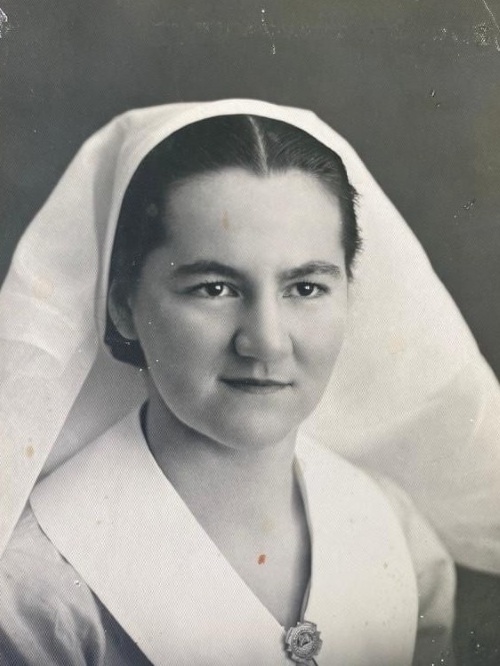
Bessie’s training progressed well. She spent time on the medical ward, on the surgical ward, and at the Shenton Park Infectious Diseases Hospital in Subiaco. She was well regarded; at one point a senior staff report noted that she “does her work very well and is kind to her patients.”
Bessie finished her training at the end of 1938 and on 21 February 1939 became registered in general nursing. Later that year, when war broke out in Europe, she and Anne Metzke decided to volunteer for duty with the Australian Army Nursing Service (AANS).
When a 90-year-old Anne Metzke was interviewed in 2004, she was asked why she and Bessie had volunteered. She recalled that they had talked it over and decided that it was “the thing to do … The boys were all joining up and we were qualified, and we were young … we just made up our minds that we’d do this.”
The two friends sent off their enrolment forms and were interviewed by the principal matron, whose approval they needed. Anne had her medical on 4 June 1940. Bessie had hers two days later. So did Peggy Farmaner: she had volunteered too.
ENLISTMENT
Of the three nurses, Anne was called up first. She enlisted on 22 July 1940 and was appointed as a staff nurse to the 2/7th Australian General Hospital (AGH), a medical unit of the Second Australian Imperial Force (2nd AIF). She was set to serve overseas.
In the meantime, Anne was detached to the 10th General Hospital (GH), based at ‘Lucknow,’ a private hospital situated on the Stirling Highway in Claremont, Perth. The army had taken over Lucknow on a short-term basis pending the building of a new military hospital, which in time would become the 110th AGH in the suburb of Hollywood.
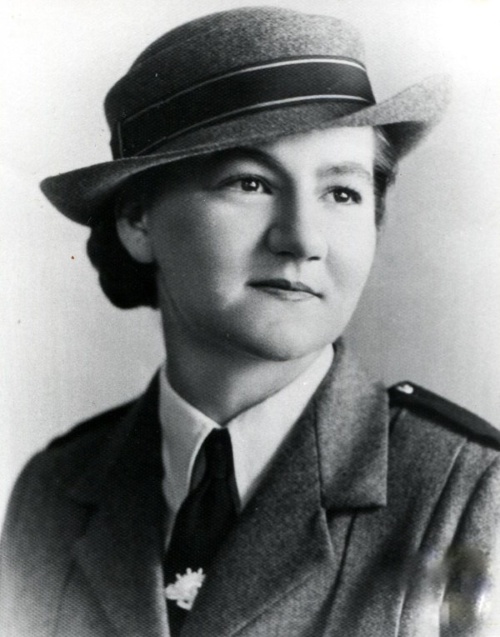
Soon Bessie and Peggy were called up too and enlisted together on 14 August. Peggy was attached to the 10th GH as a staff nurse and posted to Lucknow. Bessie was also attached to the 10th GH as a staff nurse but was posted to the camp dressing station at Northam Army Camp. She joined Anne and Peggy briefly at Lucknow on 29 October before being detached two days later to the camp dressing station on Rottnest Island.
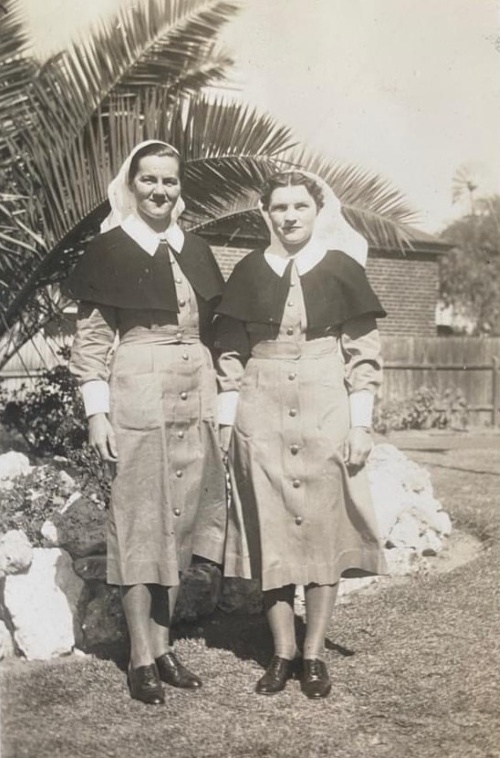
On 12 November Peggy joined Bessie at the camp dressing station on Rottnest Island. On that same day each was appointed to the 2/4th Casualty Clearing Station (CCS), a 2nd AIF unit being raised in Hobart under the command of Col. Tom Hamilton for service in Malaya. However, at this stage neither nurse had any inkling of this. Bessie returned to Lucknow on 15 November, leaving Peggy at Rottnest.
EMBARKATION
On 10 February 1941 Bessie and Anne departed Lucknow and travelled by bus to Fremantle Harbour, where they met Peggy. All three expected to embark together for the Middle East. Anchored in Gage Roads (Fremantle’s outer harbour) were the Queen Mary and the Aquitania, both too large to enter the inner harbour. In the inner harbour, tied up and ready for embarkation, were the Nieuw Amsterdam and the Mauretania.
The four ships comprised convoy US 9 and had departed Sydney on 4 February (with the Mauretania joining two days later out of Melbourne). The Aquitania and the Mauretania were carrying thousands of Australian troops to Bombay, from where they would transship to the Middle East. The Nieuw Amsterdam was carrying thousands of New Zealand troops, who would do likewise.
The Queen Mary, on the other hand, was carrying thousands of troops of the 22nd Brigade, 8th Division to Malaya for garrison duties. Travelling with them were several medical units, including the 2/4th CCS, the 2/10th AGH, and the 2/9th Field Ambulance.
While the three nurses were standing on the wharf, Bessie and Peggy were told by the principal matron that they would not be going with Anne and the other nurses on the Aquitania to the Middle East, but rather on the Queen Mary to Singapore. Anne recalled during her interview that Peggy had then begun to cry. “I remember poor little Peggy, the tears were streaming down her face,” she said, “because we weren’t all going together, we were all pretty choked up about it. Anyhow, we eventually, we went out to the Aquitania, and they went to the Queen Mary, and we parted company somewhere out in the ocean … the Queen Mary left us and went off to Singapore [and] we never ever saw them again.”
The QUEEN MARY
Bessie and Peggy were ferried out to the Queen Mary and met their six 2/4th CCS nursing colleagues. Sisters Irene Drummond and Mavis Hannah were from South Australia, as were Staff Nurses Millie Dorsch, Elaine Balfour Ogilvy and Mina Raymont, although Mina had enlisted in Hobart, where she had been working. Staff Nurse Shirley Gardam was Tasmanian. The 2/10th AGH, by far the larger of the two units, had 43 AANS nurses attached. The unit would be based in a civilian hospital in Malacca and was tasked with providing full medical services to the 22nd Brigade.
On 12 February the convoy sailed out of Fremantle. Four days later, the Queen Mary was detached southwest of the Sunda Strait and proceeded to Singapore escorted by HMS Durban. The other three ships continued to Bombay.
On board the ship, Bessie, Peggy and the other 2/4th CCS nurses worked in the dressing station the unit had established on the sixteenth deck, treating minor injuries and ailments. More serious cases were sent to the hospital the 2/10th AGH had set up in one of the smoking rooms and on the lower deck of the ship. During their free time, the nurses had access to a range of facilities, including a cinema and a swimming pool. They were invited to concerts and could attend nightly cabarets.
On 18 February the Queen Mary arrived at Sembawang Naval Base, on the north coast of Singapore Island, just across the Strait of Johor from the Malay Peninsula. The Sembawang Naval Base had been built by the British government during the 1920s and 30s with the assistance of the Australian and New Zealand governments. Opened in 1938, the base was meant to play a significant role in the British Empire’s strategic defences against external threats in the Far East, particularly from Japan.
PORT DICKSON
The nurses disembarked and were taken to adjacent railway sidings. They gave their names and addresses, were issued with rations, and then entrained for the Malay Peninsula. The 2/10th AGH nurses alighted at Tampin, from where they were driven to the Colonial Service Hospital in Malacca. The 2/4th CCS nurses, apart from Mina, were not yet required by their unit and had been detached to the 2/9th Field Ambulance. They alighted at Seremban, further up the line from Tampin, and were driven to Port Dickson, where the 2/9th Field Ambulance would be based. The other staff of the 2/4th CCS continued to Kuala Lumpur and subsequently moved south to Kajang, where they established a hospital in a high school. After a week at Kajang, Mina joined her AANS colleagues at Port Dickson.
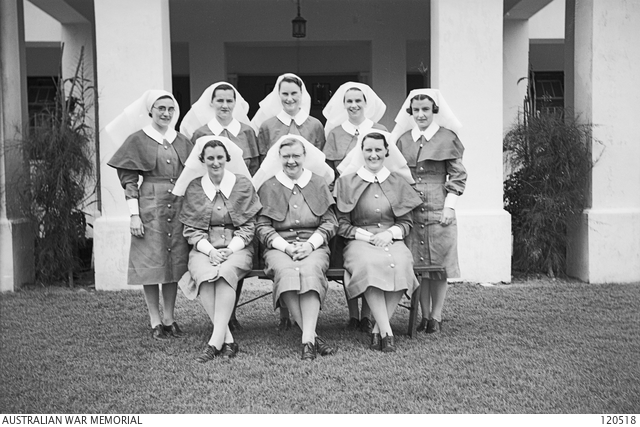
At Port Dickson the nurses established a 50-bed dressing station for the thousands of personnel of the 22nd Brigade, whose three battalions, the 2/18th, 2/19th and 2/20th, were based in the Port Dickson–Seremban area. The dressing station served as a first-aid post, where brigade personnel could receive attention in the event of minor injury or tropical ailment. In more serious cases, they would be transported to the 2/4th CCS at Kajang or the 2/10th AGH at Malacca.
According to Bessie’s colleague Mavis Hannah, the 2/4th CCS nurses had a marvellous time at Port Dickson. They had plenty to do, were keen in their work, and did not mind long hours. They enjoyed the services of cooks and domestic helpers and were even attempting to learn Malay.
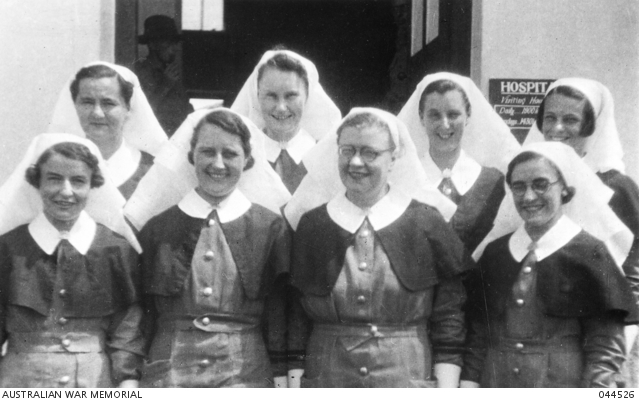
After six months with the 2/9th Field Ambulance, Bessie and Peggy joined their 2/4th CCS colleagues at Kajang on 20 August, around the time that the 2/18th, 2/19th and 2/20th battalions were deploying to the east coast of the Malay Peninsula. Six days before her return, on 14 August, Bessie was promoted to the rank of Sister Group 1.
SINGAPORE LEAVE
Bessie, together with Elaine Balfour Ogilvy, Mina Raymont and Mavis Hannah, were granted leave from 11–16 September and travelled to Singapore Island. Singapore was an exciting destination. One could visit Raffles, or even stay there; the European-only Singapore Swimming Club, with all its facilities; the Singapore Botanic Gardens, with their resident monkeys; or the beautiful Chinese Garden. Going out for dinner was de rigueur and might be followed by dancing or a cabaret or perhaps the cinema. And, of course, the shopping was marvellous.
On 15 September, while Bessie and the others were still on the island, another Australian medical unit, the 2/13th AGH, arrived in Singapore on the AHS Wanganella. Among the unit’s personnel were 49 AANS nurses, at least seven of them Western Australians – Sisters Eloise Bales and Vima Bates, and Staff Nurses Sara Baldwin-Wiseman, Alma Beard, Iole Harper, Minnie Hodgson and Gertrude McManus. Alma Beard and Iole Harper had trained at Perth Hospital at the same time as Bessie, so likely knew her. Minnie Hodgson had also trained there, but a few years earlier. The 2/13th AGH was based at St. Patrick’s School in Katong, on the south coast of the island. The school was meant to be a temporary home while the unit waited to move into its permanent digs, a psychiatric hospital in Tampoi, southern Johor, which had been leased from the Sultan of Johor.
ON THE MOVE
Bessie, Elaine, Mina and Mavis returned to Kajang on 16 September. Three days later Irene Drummond, who had been promoted to the rank of Matron on 5 August, was reassigned to the newly arrived 2/13th AGH to take charge of the nursing staff. Matron Drummond was replaced as sister in charge of the 2/4th CCS nurses by Sister Kathleen Kinsella, from Melbourne, who had arrived on the Wanganella with the 2/13th AGH.
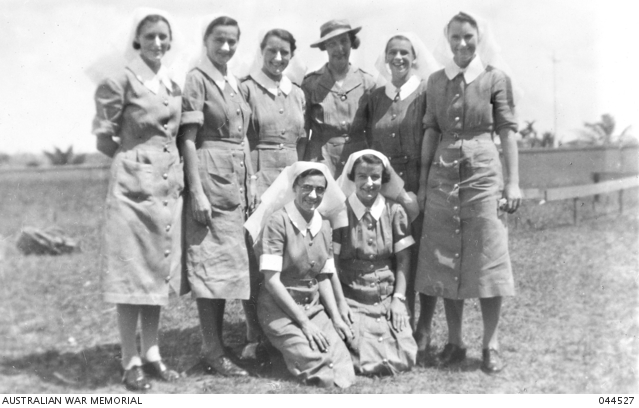
Soon after, the 2/4th CCS itself moved into the psychiatric hospital in Tampoi and established a small hospital of 150–200 beds. The unit was then able to take Australian casualties from the Alexandra Military Hospital, the principal British military hospital in Malaya. In accordance with the terms of the lease agreement with the Sultan, the psychiatric patients were able to remain on site in a separate building within the rambling, single-story complex.
The eight 2/4th CCS nurses were then posted upcountry again. Kath Kinsella, Mavis Hannah and two others were sent to the CDS at Segamat, while Elaine Balfour Ogilvy and the remaining three went to Batu Pahat. We do not know which group Bessie was with. In the meantime, the nursing tasks at Tampoi were undertaken by the unit’s orderlies.
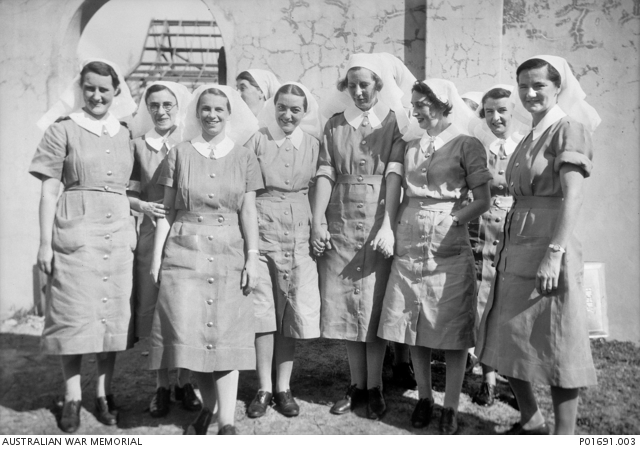
On 23 November the hospital at Tampoi was taken over by the 2/13th AGH. In an extraordinary logistical feat, 100 tons of equipment had been moved from Katong to Tampoi in just three days. The nurses and other staff of the 2/13th AGH rapidly improved the hospital and expanded its capacity to more than 1,000 beds.
The 2/4th CCS meanwhile had moved north to the town of Kluang, in central Johor. The unit set up on the edge of the aerodrome next to a civilian hospital, whose operating theatre it made use of. It was wise to move to Kluang, since in the event of war with Japan, casualties could readily be transported from Segamat, Batu Pahat, Mersing and Muar. They could then be sent on by road or rail to the 2/13th AGH at Tampoi.
All the signs in the international arena pointed to imminent war with Japan. At the end of November, Commonwealth forces in Malaya were advanced to the second degree of readiness, which meant that leave was cancelled, and units had to be ready to move at a few hours’ notice to their areas of deployment. Then, on 4 December, the codeword ‘Raffles’ was given, indicating advancement to the first degree of readiness. War was coming. In preparation for an attack, Kluang’s town lights were ‘browned’ out each night and then blacked out each time a practice air-raid siren sounded.
On Saturday 6 December, the four 2/4th CCS nurses posted to the CDS at Segamat returned to Kluang with Maj. Ted Fisher, one of the unit’s physicians. Upon being told that they might not be staying long, they were undaunted: according to commanding officer Col. Tom Hamilton in his book Soldier Surgeon in Malaya, Kath Kinsella remarked that it was “high time we ceased being pampered and got down to hard work” (Hamilton, p. 9).
INVASION
Two days later war came. Soon after midnight on 8 December, a force of some 5,000 troops of the Imperial Japanese Army launched an amphibious assault at Kota Bharu on the Malay Peninsula’s northern coast. At around 4.00 am, 17 Japanese bombers attacked Singapore Island. Singapore city had been caught “lit up like a gin palace,” with many people killed in the crowded streets, even at such an early hour (Hamilton, p. 10). Manila, Guam and Pearl Harbour had also been bombed, and Hong Kong invaded. The Pacific War had begun.
On the morning of the invasion, the other four 2/4th CCS nurses arrived back at Kluang from Batu Pahat with Major Sydney Krantz, one of the unit’s three surgeons. That afternoon the main elements of the 2/4th CCS moved from the aerodrome to the Mengkibol Estate, a rubber plantation five kilometres to the west of Kluang whose owners were away in India. In anticipation of Japanese hostilities, the site had been earmarked by Col. Hamilton.
At nightfall, Bessie, Peggy and their six colleagues arrived at Mengkibol and were assigned quarters in a comfortable, two-storey brick bungalow. They had with them “their Chinese amahs, chickens, cook-boy and assistant” (Hamilton, p. 13). Col. Hamilton speaks glowingly of the 2/4th CCS nurses:
Everyone liked the nurses. They were representative of the best of our young nation’s womanhood. Their average age was thirty, and being glamourous had few attractions for them. They were keen to get on with the job for which they had enlisted. From the first day they joined us aboard the Queen Mary, they picked up the esprit de corps of the unit to an astonishing degree … During the coming weeks of the retreat down the Peninsula they were to prove their worth many times over in the grim work of succouring the wounded lads, with whom they had laughed and danced in the peaceful training period before [Japan] struck (Hamilton, pp. 13–14).
In the days that followed, the task of preparing a tented casualty clearing station for the reception of large numbers of wounded was well underway. Over eighty tents had been erected under the cover of long avenues of rubber trees, with a central road dubbed ‘Kinsella Avenue’ in honour of Kath dividing the surgical section from the medical and resuscitation tents. Meanwhile, the unit’s former site at Kluang aerodrome was bombed by Japanese forces, along with the civil hospital. Fortunately, the doctor in charge had moved his patients out of harm’s way two days earlier.
All the while, Japanese infantry, backed by mechanized units and substantial sea and air power, were surging down the Malay Peninsula in three lines at a steady pace of 15 kilometres a day, forcing severely outgunned British and Indian troops to retreat southwards. The illusion that had held for so long – that Malaya was well defended – was shattered.
Christmas Day arrived at Mengkibol, providing Bessie and the others some respite from concern at the worsening situation. Comfort Fund parcels (and beer) were distributed in the morning, and at 1.00 pm everyone free of routine duties sat down for an excellent dinner of pork and poultry. “The tables were gay,” writes Col. Hamilton, “with frangipani and orchids that the nursing sisters had gathered from the bungalow garden” (Hamilton, p. 26).
RETREAT SOUTHWARDS
In late December, Col. Alfred Derham, officer in charge of the 8th Division’s medical units in Malaya, decided that the 2/10th AGH, lying in the direct path of the coastal prong of the Japanese advance, should be relocated to Singapore Island. On 6 January 1942, as part of the relocation plan, 20 nurses from the 2/10th AGH were detached to the 2/4th CCS and arrived at Mengkibol the following day. When Col. Hamilton enquired whether they would be accompanied by the “usual collection of Chinese amahs and cooks,” he was told that their “amahs and cooks [had] bolted into the blue” (Hamilton, p. 34). The 2/10th AGH nurses arrived the next day in ambulances and exchanged greeting with Bessie and co.
On 14 January Japanese forces met Australian 8th Division troops for the first time. The Australians scored a tactical victory near the town of Gemas when they ambushed hundreds of Japanese soldiers on bicycles and on foot, but then fought a bloodier battle the next day. That night the 2/4th CCS received convoys of surgical cases for the first time. 165 casualties were admitted, 35 operations carried out and 73 cases evacuated to the 2/13th AGH.
On 19 January, with no Commonwealth troops remaining between the 2/4th CCS and Japanese positions, Col. Hamilton was ordered to send the nurses to Singapore Island and to move the unit to its fallback position at Fraser Estate rubber plantation, near Kulai in southern Johor. Accordingly, that night, Bessie and her seven colleagues were detached to the 2/10th AGH, which had completed its move to Singapore Island and was now based at Oldham Hall, part of the Anglo-Chinese School on Barker Road, with nearby Manor House used for surgery. The nurses arrived early the next day.
While the nurses were at Oldham Hall, the 2/4th CCS continued to retreat southwards. After four days at Fraser Estate, on 25 January the unit relocated to an old psychiatric hospital in Johor Bahru (not to be confused with the nearby Tampoi psychiatric hospital), then on 28 January crossed the Causeway to Singapore Island and moved into the Bukit Panjang English School. In the two weeks since the 8th Division’s entry into combat on 14 January, 1,600 casualties had been treated by the 2/4th CCS.
Bessie and the others rejoined their unit at Bukit Panjang on 30 January. Col. Hamilton had driven over personally to Oldham Hall to tell them. They were “thrilled at the idea of coming back to the casualty clearing station [and] made haste to pack their belongings” (Hamilton, p. 139). When they arrived at Bukit Panjang the orderlies greeted them with cheers. While at Oldham Hall, Col. Hamilton noted the high pressure at which the 2/10th AGH was working. “Extra tents had been erected,” he writes, “to take the overflow of sick from the old school buildings where it was scarcely possible to squeeze between the crowded beds” (Hamilton, p, 139).
FORTRESS SINGAPORE
That night, after the final Commonwealth units crossed onto Singapore Island from the peninsula, the Causeway linking the two was blown up. The whole of the Malay Peninsula was now in Japanese hands. It had taken just seven weeks for the Imperial Japanese Army to reach Johor Strait.
The following day, 31 January, Bessie said goodbye once again to four of her colleagues. Mavis Hannah, Shirley Gardam, Millie Dorsch and Mina Raymont had been posted to the 2/13th AGH at Katong at the request of Col. J. G. (Glyn) White, second in command to Col. Derham.
After the blowing up of the Causeway, military admissions to the 2/4th CCS, apart from bomb-blast casualties, were confined mainly to cases of exhaustion and sickness, and there was some respite for the staff (Hamilton, p. 153). However, there were plenty of other things to worry about. Despite its ideal situation in other respects, the Bukit Panjang English School was located close to an area of oil tanks and factories, which became targets for Japanese bombers. Some of the bombs fell close enough to the school to cause real alarm. In addition, flak from British ack-ack shells kept dropping on the school.
On 4 February a new and disturbing problem emerged for the 2/4th CCS. Japanese artillery had begun to range in on Australian artillery batteries situated close to the school, and stray shells caused a number of casualties. That afternoon Col. Hamilton sent Bessie, Peggy, Kath and Elaine back to Oldham Hall, and two days later, on 6 February, the unit relocated once again, this time to the Swiss Rifle Club, around five kilometres southeast of the school. This time, the nurses did not return.
On the night of 8 February Japanese troops began to cross Johor Strait. By the morning they had established a beachhead on the northwestern corner of Singapore island, despite strong opposition from Australian troops. Within a week, ‘Fortress’ Singapore would fall.
Meanwhile, at Oldham Hall, Bessie, Peggy, Kath and Elaine, together with their 2/10th AGH colleagues, worked under increasingly difficult conditions. There were continual air raids, and shells fell in and around the hospital area. After the Japanese landing, casualties poured in, operating theatres worked around the clock, and the wards became so overcrowded that men were lying on mattresses on the floor while others waited outside.
EVACUATION
Reports of Japanese atrocities in Hong Kong and elsewhere had been circulating for some time, and already in January, Col. Derham had asked General H. Gordon Bennett to evacuate the AANS nurses. Bennett had refused, citing the damaging effect on morale. Derham then instructed Col. Glyn White to send as many nurses as he could with Australian casualties leaving Singapore.
Naturally the nurses did not want to leave their patients; it was a betrayal of their nursing ethos, and they protested strongly. Ultimately, they had no choice, and on 10 February six nurses drawn from the 2/10th AGH embarked with 300 wounded on the makeshift hospital ship Wusueh. The following day a further 60 AANS nurses, drawn from both AGHs, boarded the Empire Star with more than 2,000 evacuees, mainly British army and naval personnel, and set out for Batavia.
On 12 February 65 AANS nurses remained in Singapore, but they too had to go. Late in the afternoon, a convoy of ambulances arrived at Oldham Hall. Bessie reluctantly took leave of the wounded soldiers in her care and then climbed into the waiting ambulances with Peggy, Kath, Elaine and their 2/10th AGH colleagues. They were driven along side streets through Singapore city to St. Andrew’s Cathedral, where they waited to rendezvous with the remaining 2/4th CCS and 2/13th AGH nurses. Once assembled, the nurses continued through the ruined city to Keppel Harbour. When the ambulances could go no further, the nurses got out and walked the remaining few hundred metres. At the wharves there was chaos, as hundreds of people attempted to board any vessel that would take them.
The VYNER BROOKE
Eventually a tug took Bessie and the others to a small coastal steamer, the Vyner Brooke, onetime pleasure craft of Charles Vyner Brooke, a British colonial potentate. On board there were as many as 200 people – women, children, old and infirm men. The ship got underway as darkness fell, leaving behind an unforgettable scene. Singapore was ablaze, and thick black smoke billowed high behind the city.
That night the Vyner Brooke made little progress and spent much of Friday hiding among the hundreds of small islands that line the passage between Singapore and Batavia, the ship’s destination. By the morning of 14 February, Capt. Borton was approaching the entrance to Bangka Strait. To the right lay Sumatra; to the left, Bangka Island. Suddenly, at around 11.00 am, a Japanese plane swooped over and flew off again. Then, at about 2.00 pm, six bombers were seen approaching. The nurses donned their life belts and tin helmets and took up their positions lying on the deck of the ship. The planes grouped in two formations of three and flew towards them. By now Capt. Borton had begun evasive manoeuvres. The ship zig-zagged and the bombs missed. The planes soon regrouped, however, flew in again and scored three direct hits. One struck the forward deck, killing a gun crew. Another entered the ship’s funnel and exploded in the engine room. A third tore a hole in the side of the ship. With a dreadful noise of smashing glass and timber, the Vyner Brooke shuddered and came to a standstill. It was lying 15 kilometres from Bangka Island.
The nurses hurried about the deck, carrying out the plan they had worked out the previous day. They helped the women and children, the oldest people, the wounded, and their own injured colleagues into the three viable lifeboats, which were then lowered into the sea. One capsized upon entry into the water. Greatcoats and rugs were thrown down to the remaining two, which got away as the ship began to list alarmingly to starboard. After a final search of the ship it was the nurses’ turn to evacuate. They removed their shoes and their tin helmets and entered the water any way they could. Some jumped from the railing on the portside, others practically stepped into the water on the listing starboard side, others slid down ropes or climbed down ladders.
One way or another, Bessie entered the water. She was known to be a strong swimmer – as a child she had swum in the Swan River – and may have joined Peggy and Elaine as they held onto a grabrope behind one of the lifeboats. Regardless of how she got there, sometime on Saturday night Bessie came ashore on Bangka Island.
BANGKA ISLAND
Once ashore, Bessie joined a group of people around a bonfire that had been lit on the beach, most likely by one of the passengers in the first lifeboat to get away. This was the boat in which Matron Drummond had escaped the sinking ship. Those in the first lifeboat were soon joined by the passengers in the second lifeboat, among whom were Vivian Bullwinkel and a number of badly injured nurses. During the night and across Sunday more people joined, including British sailors and soldiers, many injured, whose ship had also been sunk in the vicinity of Bangka Island.
By Monday morning more than 100 people were on the beach, including 22 of the 65 AANS nurses. With no viable alternative, a decision was made to surrender en masse to Japanese authorities, and a deputation left for the nearest large town, Muntok, to negotiate this. A short while later all the civilian women and children of the group followed behind – save one, Mrs Betteridge, a British woman whose husband lay among the injured on the beach.
Around mid-morning the deputation returned with a number of Japanese soldiers. The soldiers separated the survivors into three groups and proceeded to shoot or bayonet them in cold blood.
Bessie and 20 colleagues died on Bangka Island on Monday 16 February 1942. They were shot while standing in the sea, facing away from the shore. Vivian Bullwinkel was the only nurse to survive.
Twelve nurses were lost at sea following the attack on the Vyner Brooke. Twenty-one died on Bangka Island. Thirty-two were taken prisoner by the Japanese, of whom eight later died. Of the 65 who had left Singapore, 24 came home, arriving in Fremantle on 18 October 1945.
IN MEMORIAM
On 16 February 2008, in Kings Park, Perth, memorial plaques were unveiled in honour of each of the West Australian Vyner Brooke nurses who were lost at sea or who died on Bangka Island. Bessie’s plaque was dedicated by her second cousin. It lies next to one dedicated to Peggy.
In memory of Bessie.
SOURCES
- Ancestry.
- Arthurson, L., ‘The Story of the 13th Australian General Hospital, 8th Division AIF, Malaya,’ as reproduced by Peter Winstanley on the website Prisoners of War of the Japanese 1942–1945.
- Hamilton, T. (1957), Soldier Surgeon in Malaya, Angus & Robertson.
- Hobbs, Maj. A. F., 2/4th CCS, Diary, presented by Peter Winstanley on the website Prisoners of War of the Japanese 1942–1945.
- Honour Avenues Group Kings Park, ‘Sister Nursing Corps Bessie Wilmott.’
- National Archives of Australia.
- National Library of Australia, Oral History Program, ‘Mavis Hannah interviewed by Amy McGrath,’ interview conducted at Grove Hill House, Dedham, Colchester on 13 July 1981, transcript and audio.
- University of NSW Canberra, Australians at War Film Archive, ‘Letitia Leach (Anne) – Transcript of interview, 7 July 2004.’
SOURCES: NEWSPAPERS
- The Daily News (Perth, 30 Oct 1924, p. 2), ‘A City Arrest.’
- The Daily News (Perth, 17 Nov 1924, p. eight), ‘Stole £145.’
- The Daily News (Perth, 1 Jan 1938, p. 12), ‘Coming-Of-Age Celebrated.’
- The Daily News (Perth, 23 Jan 1941, p. 2), ‘Good-looking Army Nurses.’
- Kalgoorlie Miner (7 Jan 1904, p. 6), ‘Boulder Mechanics’ Institute.’
- Sunday Times (Perth, 10 Aug 1924, p. 18), ‘A Como Camera Man.’
- The Swan and Canning Leader (Victoria Park, 13 Dec 1929, p. eight), ‘Orange Blossoms.’
- The West Australian (Perth, 25 Dec 1907, p. 2), ‘City Police Court.’
- The West Australian (Perth, 17 Aug 1918, p.10), ‘Perth Police Court.’
- The West Australian (Perth, 14 Jul 1923, p. 1), ‘Family Notices.’
- The West Australian (Perth, 1 Oct 1924, p. 2), ‘Advertising.’
- The West Australian (Perth, 7 Sep 1936, p. 10), ‘Dance at Nedlands.’
- The West Australian (Perth, 5 Dec 1939, p. 1), ‘Family Notices.’
- The West Australian (Perth, 8 Feb 1941, p. 14), ‘Nurses Entertained.’
- The West Australian (Perth, 2 Dec 1942, p. 1), ‘Family Notices.’
 australianwarnurses.org