AANS │ Staff Nurse │ First World War │ Egypt & India
AMY’S PARENTS
Amelia Veda O’Grady, known as Amy, was born c. 1876 in the town of Chewton in the Mount Alexander goldfields of central Victoria. She was the daughter of Ellen Egan (c. 1837–1877) and Daniel O’Grady (c. 1822–1899).
Ellen Egan was born in Rathcabban in County Tipperary, Ireland. After her father died in 1849, she migrated to Victoria with her mother, Ann Molloy, and her siblings – Michael, Mary, Martin, Margaret, Ann and Honora – aboard the Harry Lorrequer, arriving at Port Phillip on 14 March 1851.
Daniel O’Grady was also born in Ireland. He arrived in Melbourne in 1852 and headed to the Mount Alexander goldfields, settling at Forest Creek (which became known as Chewton in 1856). He acquired miners’ rights and in 1856 was prospecting at Fryerstown, near Talbot. He acquired land at Chewton and for a time took the position of engine driver at Argus Flat. He later worked on the toll gate between Chewton and Elphinstone.
Daniel met Ellen, and on 23 October 1859 the two were married in Castlemaine, the largest town of the Mount Alexander goldfields. They began their family the following year with the birth Catherine Donella. Then came Mary Ann in 1862, Margaret Teresa in 1863, Ellen Loretta (known as Nellie) in 1865, Eliza in 1866, Sarah in 1868, Letitia (known as Lettie) in 1872, James Henry in 1874 and finally Amy around 1876 (curiously, her birth appears not to have been registered).
FAMILY TRAGEDY
In the early 1870s Daniel had been granted a licence to sell liquor from a bar on the Melbourne Road between Chewton and Elphinstone. On 2 November 1877 Ellen O’Grady was working at the bar when a man came in whom she accused of taking silver from the till. After she called Daniel, the man came at her with a knife and was then involved in a struggle with Daniel, who tied him up with the help of neighbours. He was then arrested but when the case went to court, he was let go.
Just a few weeks after this unfortunate incident, Daniel’s licence to sell liquor was renewed. A few weeks after that, on 24 December, Ellen O’Grady died. Two days later her funeral cortege departed from the O’Grady household on Elphinstone Road for Chewton Cemetery, where she was buried. Her cause of death remains unknown.
Daniel was left with eight children, four of whom were not yet 10. He struggled on, no doubt with the help of the older girls, and by 1881 had taken to farming. On 28 April that year he came across the body of a man on the Melbourne Road at the junction between Chewton and Elphinstone. The man had apparently fallen from his buggy and dashed his head on the road. His name was James McPhail. He was the grandfather of Irene McPhail, who would one day become a member of the Australian Army Nursing Service.
Over the coming years, it would appear that the difficulties of Daniel’s life were such that he increasingly turned to drinking. In February 1889 it was reported that a man named Daniel O’Grady, miner, 67 years old, was found lying in Lyttleton Street, Castlemaine, in a helpless state, with no visible means of support. He told the police that he had sought support from a priest, but when he had money, he spent it on drink.
Ten years later, on 27 March 1899, Daniel died in Richmond, a working-class inner suburb of Melbourne. His remains were brought to Elphinstone to the house of his daughter and son-in-law, Mary Ann and Joseph Archer. He was buried on 29 March at Chewton Cemetery. Despite his travails, he had retained his renown in the district. His funeral was widely attended; the hearse and two mourning carriages were followed by about 40 private and public vehicles. The members of the Hibernian Society were the pallbearers at Mary Ann’s house and at the cemetery, and the burial service was read by the Rev. Father Dolan.
NURSING
Amy was around 23 years old when her father died and may already have decided one day to become a nurse. She realised this in 1902, when she was taken on as a probationer at the Melbourne Hospital, then on Lonsdale Street in central Melbourne. She finished her training and gained her certificate in 1905, and in October that year became registered with the Royal Victorian Trained Nurses’ Association. At the time, her residential address was 35 Mathoura Road in Toorak.
In April 1908 Amy travelled to London on the Persic. (For some reason, her age is stated on the manifest as 20.) In London she undertook Central Midwives Board–approved obstetrics training at Queen Charlotte’s Maternity Hospital on Marylebone Road. After her return to Australia sometime later, she attained her certificate in massage.
THE GREAT WAR
We lose sight of Amy until August 1915, when her stated address was 263 Canning Street in North Carlton, her sister Mary Ann’s house. By now the Great War had been raging for a year, and tens of thousands of Australian men had volunteered to fight in the hills of the Gallipoli Peninsula in Ottoman Turkey. Hundreds of Australian women had volunteered to nurse the thousands of casualties among them.
Amy wanted to volunteer too. On 10 August she filled out her candidates’ application form for enrolment in the Australian Army Nursing Service (AANS). As a nurse of 13 years’ experience, with certificates in general nursing, obstetrics and massage, she was an ideal candidate.
Amy was accepted for service and allotted to No. 10 Australian General Hospital (AGH) as a staff nurse. On 24 August she and 17 other nurses attached to the unit embarked on the RMS Morea at Port Melbourne for what they believed was service in England.
The Morea had departed Sydney three days earlier with 26 nurses of No. 10 AGH. Six more boarded in Adelaide, making a total of 50. The ship was also carrying 10 medical officers, eight masseuses (physiotherapists), and 500 AIF reinforcements.
Among Amy’s new colleagues was Staff Nurse Kate Power. Kate was from County Kilkenny in Ireland and had arrived in Melbourne only in the last couple of years. She had been working at St. Vincent’s Hospital in Fitzroy and may have felt an affinity with her older colleague by dint of Amy’s connection to Ireland and their shared Catholicism.
EGYPT
After bypassing Fremantle and stopping at Colombo and possibly Aden, on 21 September the Morea arrived at Port Tewfik, the port of Suez, in Egypt. The 50 nurses were now told that they would not after all be going to England but would instead remain in Egypt as reinforcements for Nos. 1 and 2 AGHs in Cairo. For reasons unknown No. 10 AGH had been disbanded before it had had the opportunity to serve anywhere.
Nos. 1 and 2 AGHs had arrived in Egypt in January 1915 on HMAT Kyarra to provide medical services to the 20,000-strong first Australian expeditionary force, which had arrived the previous month. No. 1 AGH, the larger of the two units, established its hospital in the grand Palace Hotel, in Heliopolis, 12 kilometres northeastern of central Cairo. No. 2 AGH took over Mena House, a luxurious hotel situated close to the Pyramids of Giza, southwest of central Cairo.
As patient numbers increased, No. 1 AGH expanded beyond the Heliopolis Palace Hotel into nearby buildings. At first these functioned as overflow wards of the hotel and were administered from there. Once it became clear that the Gallipoli campaign would result in huge numbers of casualties, the overflow wards were transformed into well-equipped auxiliary hospitals that continued to be administered from the Heliopolis Palace Hotel. Then in mid-August, with the failed August Offensive underway, they were made independent commands but were still staffed through No. 1 AGH. No. 2 AGH, meanwhile, had moved into the Ghezireh Palace Hotel in central Cairo, retaining Mena House as an overflow hospital. Mena House was later mothballed but in early August, ahead of the August Offensive, it reopened as a convalescent depot.
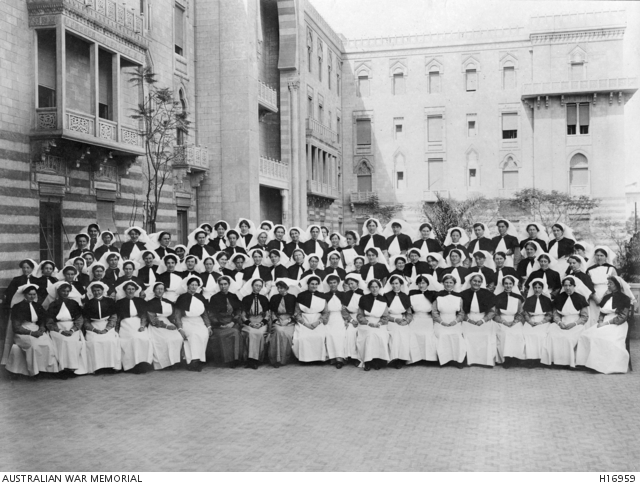
The 50 nurses disembarked from the Morea and entrained for Cairo, a journey that took between six and 10 hours. Upon arrival they were distributed between the two units, and Amy and Kate both ended up attached to No. 1 AGH. Kate was posted to No. 4 Auxiliary Hospital in Abbassia, a specialist infectious hospital, but we do not know to which of the auxiliary hospitals Amy was posted.
Wherever she was posted, the likelihood is that Amy was nursing sick patients, not those wounded in battle. In August, hundreds of Australian casualties of the August Offensive had passed through No.1 AGH, but now disease and illness were the main cause of hospitalisation among the Australian troops. In fact, as Arthur Butler wrote in the official history of the Australian Army Medical Services in the Great War, “The history of the [Gallipoli] campaign, after August 9th, is almost entirely concerned with disease and its effects. The retreat from Gallipoli (it may almost be said) is embodied as distinctly, if less dramatically, in the sick wastage of September, October, and November as in the actual strategic ‘evacuation’ of the Peninsula” (Butler, p. 341). By the beginning of October Egypt was full of men suffering from infectious diseases such as dysentery, enteric, diarrhoea, influenza, typhoid, mumps, measles, scarlet fever, cerebro-spinal fever, as well as various venereal diseases. There were also many patients suffering from various non-infectious diseases that were grouped into three main classes, namely “neuroses,” “disorders of the heart” and “rheumatic.”
CHOUBRA INFECTIOUS HOSPITAL, CAIRO
In December 1915 Australian and New Zealand troops were evacuated from the Gallipoli Peninsula and were subsequently reorganised as I Anzac Corps and II Anzac Corps. While the latter remained for the time being in Egypt, I Anzac Corps under Lt. Gen. Sir William Birdwood was transferred to France in March and April 1916. Nos. 1 and 2 AGHs travelled with it.
However, many nurses remained in Egypt, including Amy and Kate, who were both taken off strength of No. 1 AGH. On 1 March Amy was attached to Military Infectious Diseases Hospital in Choubra, nine kilometres north of central Cairo, while on 12 March Kate was attached to No. 3 AGH, which had been transferred to Egypt from the island of Lemnos in mid-January 1916 and was based at Abbassia, about halfway between central Cairo and Heliopolis.
The Choubra Military Infectious Diseases Hospital was an Austrian hospital until taken over by Australian authorities on 6 August 1915. Two weeks after that it was taken over in turn by the Royal Army Medical Corps (RAMC) but retained its Australian nursing staff.
On 8 February 1916 Maud Kellett arrived from No. 2 AGH to take charge of the nursing staff. In her 1919 report to the Assistant Collator of Medical War History, Matron Kellett described the hospital in some detail. (NB. The original transcription of Matron Kellett’s report contains typographical errors and unusual grammar and punctuation, which have been preserved here.)
The word Choubra seemed to strike terror to my heart, thought it was away in the desert somewhere, so you can imagine my surprise when I arrived to find a most up-to-date building, surrounded by a beautiful garden. It was practically a new hospital, and had only been built in 1912, and commandeered at the beginning of the war. It was in pre-war days, a semi-private Austro-Hungarian hospital, and I understand staffed by German Nurses. Anyhow, it was a most conveniently fitted up hospital for about 400 beds. The medical and male personell, was R.A.M.C. The Nursing staff, Australian 35 Sisters and myself.
We took only infectious cases, such as, Diphtheria, Typhoid, Cerebro-Spinal-Meningitis, Mumps, Measles and Dysentry. As they were all acute cases, and the weather getting very much hotter, the Nurses found the work most trying. They had a whole day off a week, every second half-day, and the next, a long day on, which meant they went on duty at 7am. and off 8pm. but when the work of the ward allowed it, each Sister, on her long day, was allowed an hour and a half rest, some time during the day.
The Sisters were billeted in a furnished house, some short distance away, which had been lent to the Authorities by a wealthy Egyptian, we paying our Arab servant ourselves. I had no worry about the messing arrangments, as we had a caterer who provided his own staff etc, and charged us 2/6 per diem, just the ordinary messing allowance given us. It was a very good mess indeed.
As the patients were all infectious, they were not allowed to roam about Cairo, as those from other hospitals, and were only allowed out under the escort of a Sister.
The Red Cross very kindly sent us a car twice a week, so ten were thus taken out every week. There was also a small car attached to the hospital, which the Sisters could use from 2-4pm. either for themselves or to take their patients out.
Matron Kellett left Choubra on 7 July 1916 to travel to England in charge of a contingent of 45 nurses. Soon after, Amy left for India.
TO INDIA
Two months earlier, the Australian Government, on the recommendation of Maj. Gen. Richard Fetherston, the director general of medical services in Australia, had cabled India offering the services of 50 nurses deemed surplus to requirements in Cairo. The offer was gratefully accepted.
At first, volunteers were called for, but as few nurses came forward the majority was chosen. Amy was one of the 50; whether a volunteer or not, we do not know. The nurses were given to understand that they would be treating sick and wounded British and Indian troops invalided from Mesopotamia (modern Iraq), where they were fighting Ottoman forces, and expected to serve together as a complete staff.
On 12 July 1916 the contingent departed Cairo for Suez on the 8.00 pm train. They arrived the next day at around 1.00 pm to find their ship, the Neuralia, lying at anchor opposite the railway terminus in Port Tewfik. After having tea on the train, the nurses embarked and at 7:30 am the following morning, 14 July, departed for India under the charge of Sister Emily Hoadley, a veteran of the Second Boer War.
BOMBAY
The Neuralia arrived in Bombay on 23 July. The nurses disembarked and proceeded to the grand Taj Mahal Hotel, which had been converted into a 600-bed military hospital. Here they were to be billetted while waiting to be posted. After settling in, the nurses spent time sightseeing. Some visited Victoria Gardens, the Bazaar, the Museum and the Cathedral. Others drove to the Hanging Gardens on Malabar Hill, passing the Parsi Tower of Silence en route, and to Bandra Point, around 30 kilometres north of Bombay.
Some of the nurses were temporarily detailed for duty at the Taj Mahal Hotel. Staff Nurse Gladys Moreton, from Brim in northwestern Victoria, was one of them. She found the work irritating, as she made clear in a letter home dated 28 July:
It is very heavy work. We do not have any orderlies, only dark boys and they do not understand us, so consequently we do everything ourselves. The wards are very pretty but have to be kept just so. The poor boys that come in off the ships almost every day … would break your heart. We thought we had sick boys in Egypt, but these are worse (quoted in Harris, p. 150).
At the end of July, the Australian nurses learned that instead of serving together, they were to be split up and posted in groups of three or four or even individually to ‘station’ or garrison hospitals in Sialkot, Lahore, Multan, Peshawar, Quetta and elsewhere – where, instead of looking after casualties of the Mesopotamian offensive, they would treat the sick and injured of the local garrison. In time this elicited a certain resentment, since it was not considered war nursing.
THE FINAL DAYS
Meanwhile, Kate Power was on her way to India. After being struck off strength of the 3rd AGH, on 11 July she had been temporarily attached to No. 15 General Hospital in Alexandria before being detailed for duty aboard HMHS Devanha on 21 July. The following day she had departed for Bombay.
Kate arrived in Bombay around 1 August and, together with other nurses from the Devanha, was billetted at the Taj Mahal Hotel. By then the 50 nurses were ready to set off for their station hospitals. On 2 August a group of 11 departed Bombay on the 5.00 pm train. Among them was Staff Nurse Evelyn Davies, from Healesville in Victoria, who was going to Peshawar with one other nurse. On 3 August Gladys Moreton departed.
We do not know where Amy was to have been posted but can assume that she never left Bombay. She had contracted cholera. She was admitted to the section of the Colaba Military Hospital in southern Bombay known as the ‘Sisters’ Isolation Hospital.’ Tragically, another nurse also became ill with cholera – Kate Power. She too was admitted to Colaba.
“WHERE THE AUSTRALIANS REST”
On 12 August 1916 Amy died at Colaba. Kate died the following day. They were buried at Sewri Cemetery in the north of the city. Between 1955 and 1960 most of the war graves were moved from Sewri to Kirkee War Cemetery in Pune, today known as Khadki War Cemetery.
EPILOGUE
On Sunday 21 April 1929, a ceremony was held to bless renovations carried out at St. John the Evangelist Church in Richmond, Tasmania, one of the two oldest Catholic places of worship in Australia. Richmond’s parish priest, the Rev. Donald Shaw, had decided to renovate the church to commemorate the centenary of the Catholic Relief Act in Britain. Among the improvements made was the replacement of the old plain windows with beautiful stained-glass windows. One of the windows has an (erroneous) legend at the bottom, which reads as follows:
To the memory of SISTER H. V. O’GRADY
Died on Active Service Aug. 12th., 1915.
The parish priest, Donald Shaw, was Amy’s nephew, the son of her sister Nellie.
In memory of Amy.
SOURCES: OTHER
- Ancestry Library Edition.
- Australian War Memorial, Evelyn Davies letters, AWM2017.6.224.
- Australian War Memorial, Official History, 1914–18 War, Records of A.G. Butler, Historian of Australian Army Medical Services AWM41 988 – [Nurses Narratives] Matron A. Kellett.
- Brodie, N. (2020), ‘Window gleaner,’ Forty South Tasmania, 24 and 27 Nov 2020.
- Burke, E. K. (ed., 1927), With Horse and Morse in Mesopotamia, Arthur McQuitty & Co.
- Butler, A. G. (1938), Official History of the Australian Army Medical Services, 1914–1918, Vol. I – Gallipoli, Palestine and New Guinea , Part I – The Gallipoli Campaign, Chap. XVI – The Disease Debacle at Gallipoli (pp. 341–73), Australian War Memorial.
- Butler, A. G. (1938), Official History of the Australian Army Medical Services, 1914–1918, Vol. I – Gallipoli, Palestine and New Guinea , Part I – The Gallipoli Campaign, Chap. XVIII Egypt: August to December (pp. 399–427), Australian War Memorial.
- Butler, A. G. (1943), Official History of the Australian Army Medical Services, 1914–1918, Vol. III – Special Problems and Services, Section III – The Technical Specialties, Chap. XI – The Australian Army Nursing Service (pp. 527–89), Australian War Memorial.
- Harris, K. (2011), More than Bombs and Bandages: Australian Army Nurses at Work in World War I, Big Sky Publishing.
- National Archives of Australia.
- Public Record Office Victoria, Assisted passenger lists (1839–1871), VPRS 14.
- Public Record Office Victoria, Outwards passenger lists (1852–1923), VPRS 948.
- Public Record Office Victoria, Royal Victorian Trained Nurses’ Association Nurses Register (VPRS 16407/P0001), No. 2, nos. 713–1,465, 29 Sept 1903–22 Feb 1910.
- Victorian Register of Births, Deaths and Marriages.
SOURCES: NEWSPAPERS
- The Argus (Melbourne, 30 Mar 1899, p. 6), ‘Castlemaine.’
- The Kyneton Observer (Vic., 30 Apr 1881, p. 2), ‘No Title.’
- The Mercury (Hobart, 22 Apr 1929, p. 3), ‘Church Column St. John’s Church, Richmond.’
- Mount Alexander Mail (Vic., 8 Jun 1865, p. 3), ‘Advertising.’
- Mount Alexander Mail (Vic., 27 Mar 1874, p. 2), ‘Items of News.’
- Mount Alexander Mail (Vic., 8 Nov 1877, p. 2), ‘Chewton Police Court.’
- Mount Alexander Mail (Vic., 20 Dec 1877, p. 3), ‘Chewton Police Court.’
- Mount Alexander Mail (Vic., 25 Dec 1877, p. 3), ‘Family Notices.’
- Mount Alexander Mail (Vic., 28 Mar 1899, p. 2), ‘Items of News.’
- Mount Alexander Mail (Vic., 30 Mar 1899, p. 2), ‘Items of News.’
 australianwarnurses.org