AANS │ Lieutenant │ Second World War │ 2/3rd Australian Hospital Ship Centaur
FAMILY BACKGROUND
Alice Margaret O’Donnell was born on 16 June 1901 in Myrtleford in northeastern Victoria. She was the daughter of Letitia Ann (Lettie) Puzey (1870–1953) and Sidney James (Sid) O’Donnell (1868–1954).
Lettie was born in Bealiba, central Victoria. As an infant she came to Myrtleford, where her parents ran the Cricketer’s Arms Hotel. As an adult she was thoroughly community minded. She was a member of various Ladies’ Auxiliaries and of the Church of England Ladies’ Guild, and for a time was president of the local branch of the Australian Women’s National League.
Sid was born at Merriang, just outside Myrtleford. He was a farmer and then became an auctioneer and real estate agent. In his younger days he was a keen cricketer and footballer.
EARLY LIFE
Lettie and Sid were married in 1898 and lived in Myrtleford. In 1900 their first child, Ken, was born. Alice was born next, then Madge in 1903, Ian in 1905, Bryan in 1907, Sidney in 1910 and finally Pat in 1916.
The children attended Myrtleford State School. On 28 March 1914, at a prize-giving ceremony that followed a school concert, Alice was awarded a prize for progress in 7th Grade and Ian for progress in 4th Grade, while Ken was presented with a silver medal for his success at the recent High School examinations.
Alice gained her Merit Certificate at the end of 1914 and then spent one more year at Myrtleford State School.
Alice was a talented musician and played the organ at St. Paul’s Church of England in Myrtleford. On 29 November 1916 she accompanied the choir at the dedication of a stained-glass window to the memory of local lad Norman Rothery, who had been killed in action at Lone Pine exactly a year earlier. Norman Rothery was the brother of nurse Elizabeth Rothery, who was at that time serving in India with the Australian Army Nursing Service (AANS).
Sometime after finishing school, Alice joined the staff of the E.S.A. Bank (‘English, Scottish & Australian Bank Limited’ – now Esanda, part of ANZ Bank) and worked in Sydney and Melbourne.
NURSING
In the later 1920s Alice decided to become a nurse, and by 1928 had begun her training at Melbourne Hospital. After finishing her training in April 1931 and becoming registered in September, Alice was appointed Theatre Sister at Melbourne Hospital and remained in that position for several years. Over that time, she established an excellent record as a bright and capable nurse. After resigning from Melbourne Hospital, she moved to the Freemason’s Hospital in East Melbourne, where she was appointed Floor Sister. Later she became Theatre Sister to notable Melbourne surgeon Sir Alan Newton, who had previously worked at Melbourne Hospital.
By now war had broken out in Europe, and following Germany’s invasion of France and the Low Countries in May 1940, the number of Australians wanting to volunteer surged dramatically. All five of Alice’s brothers joined the Second Australian Imperial Forces (2nd AIF) and served overseas. Ian and Pat O’Donnell were both captured by Japanese forces and imprisoned in Formosa (Taiwan); Ian was afterwards awarded an OBE.
ENLISTMENT
On 13 January 1942 Alice volunteered for service too. She enlisted in the Australian Military Forces (AMF) for home service with the AANS and was attached to the 115th Heidelberg Military Hospital at the rank of staff nurse.
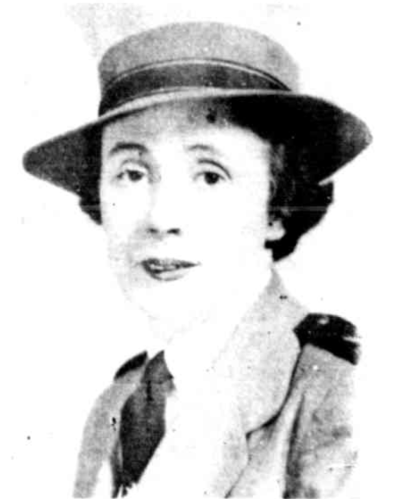
During leave periods, Alice returned home to Myrtleford. She continued to play the organ at St. Paul’s Anglican Church whenever she had an opportunity.
On 29 October, after nearly 10 months in the AMF and having been promoted to the rank of sister, Alice enlisted in the 2nd AIF. She remained at Heidelberg for the next four months. On 13 March 1943 she was attached to the Australian hospital ship Centaur and entrained for Sydney.
AHS CENTAUR
The Centaur had been built in Scotland in 1924 and arrived in Australia later that year to ply a route between Fremantle and Singapore. In 1940 the ship was placed under the control of the British Admiralty but continued its normal operations. At the start of 1943, following a request for a ship capable of serving in shallow southeast Asian waters as a hospital ship, the Centaur was loaned to the Australian government. It was refitted in Melbourne and designated 2/3rd Australian Hospital Ship Centaur, joining 2/1st AHS Manunda and 2/2nd AHS Wanganella. The Centaur would carry a comprehensive staff of medical personnel, including 12 AANS nurses.
Alice duly arrived in Sydney and on 17 March joined her new nursing colleagues aboard the Centaur, which had left Melbourne five days earlier on a trial run. Matron Anne Jewell (originally from Western Australia) was in charge, with Sister Mary McFarlane (South Australia) next senior. Then there were Sisters Margaret Adams, Eileen Rutherford and Jenny Walker from Victoria, Cynthia Haultain, Eva King, Myrle Moston, Nell Savage and Edna Shaw from New South Wales (though Cynthia was born in India), and Joyce Wyllie from Queensland (born in Melbourne). Margaret Adams, Cynthia Haultain, Eva King, Mary McFarlane, Eileen Rutherford, Nell Savage and Jenny Walker had all previously served together under Matron Jewell on the 1st Netherlands Military Hospital Ship Oranje.
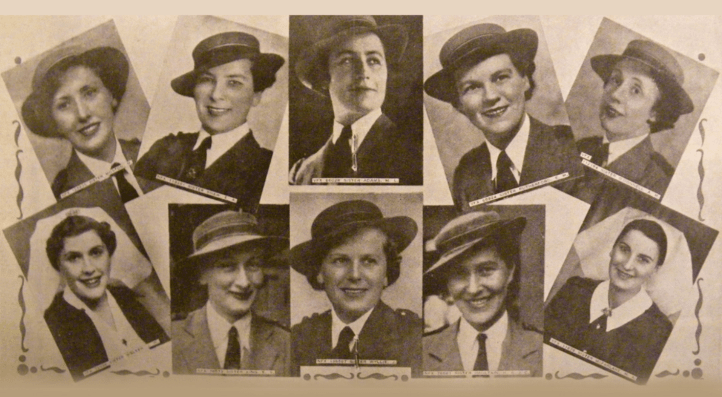
Continuing its trial period, the Centaur sailed out of Sydney Harbour on the morning of 21 March and reached Brisbane two days later. It continued to Townsville, collected Australian casualties repatriated from New Guinea, and carried them back to Brisbane. The ship then sailed north to Port Moresby, picked up more Australian wounded, and returned to Brisbane. With certain adjustments and improvements en route, the Centaur had passed its test.
THE FINAL VOYAGE
On the morning of 12 May the Centaur set out from Sydney tasked with delivering 193 members of the 2/12th Field Ambulance to Port Moresby and then returning with Australian casualties.
By the evening of 13 May, the Centaur had reached the northern New South Wales coast. Alice and her colleagues were celebrating Matron Anne Jewell’s birthday. A special dinner menu had been prepared, which included a cake that the nurses had bought in Sydney. They finished the evening at around 10.00 pm and retired to their cabins.
That night the weather was clear and visibility excellent. The Centaur was travelling unescorted and was fully illuminated and marked with the Red Cross. Suddenly, at 4.10 am, while most of the 332 people on board were asleep, a Japanese torpedo slammed into the ship’s port side, near the engine room and an oil tank, setting off a massive explosion. Fire raced through the ship and water rushed in through a gaping hole in the hull. There was no time to launch the lifeboats. The Centaur capsized and sank within three minutes.
Eleven of the nurses died that day, including Alice. Nell Savage survived. Altogether 268 people lost their lives, including 178 members of the 2/12th Field Ambulance. The survivors clambered onto rafts and bits of wreckage and floated on the sea for 34 hours.
IN MEMORIAM
On 14 May every year until their deaths, Lettie and Sid O’Donnell placed a notice in the newspaper in memory of Alice. Here is one from 1950:
O’DONNELL – In loving memory of our daughter, Sister Alice Margaret O’Donnell, who lost her life on the hospital ship, ‘Centaur,’ May 14, 1943. A life made beautiful by kindly deeds.
– Inserted by her mother and father.
In memory of Alice.
Sources
- Ancestry Library Edition.
- Department of Veterans’ Affairs, Anzac Portal, ‘The Sinking of the Centaur.’
- Goodman, R. (1992), Hospitals Ships, Boolarong Publications.
- Milligan, C. and Foley, J. (1993), Australian Hospital Ship Centaur: The Myth of Immunity, Nairana Publications.
- National Archives of Australia.
- Walker, A. B. (1961), Australia in the War of 1939–1945, Series 5 – Medical, Vol. IV – Medical Services of the Royal Australian Navy and Royal Australian Air Force with a section on women in the Army Medical Services, Part III – Women in the Army Medical Services, Chap. 36 – The Australian Army Nursing Service (pp. 428–76), Australian War Memorial.
SOURCES: NEWSPAPERS
- The Australasian (Melbourne, 29 May 1943, p. 18), ‘Nurse’s Bravery in Hospital Ship.’
- The Argus (Melbourne, 19 May 1943, p. 3), ‘Personal Details of Victorians.’
- The Herald (Melbourne, 19 May 1943, p. 3), ‘12 Centaur Survivors In Melbourne.’
- Myrtleford Mail and Whorouly Witness (Vic., 2 Apr 1914, p. 9), ‘State School Concert.’
- Myrtleford Mail and Whorouly Witness (Vic., 7 Dec 1916, p. 8), ‘Dedication of Memorial Window.’
- Myrtleford Times and Ovens Valley Advertiser (Vic., 26 May 1943, p. 3), ‘Obituary.’
- Myrtleford Times and Ovens Valley Advertiser (Vic., 16 Jun 1954, p. eight), ‘Obituary.’
- Myrtleford Times and Ovens Valley Advertiser (Vic., 23 Sep 1953, p. 3), ‘Mrs. Letitia Ann O’Donnell.’
- Table Talk (Melbourne, 15 Aug 1929, p. 59), ‘Family Notices.’
 australianwarnurses.org