AANS │ Lieutenant │ Second World War │ Malaya │ 2/10th Australian General Hospital
FAMILY BACKGROUND
Irene Ada Singleton was born on 21 June 1908 in Caulfield, Melbourne. She was the daughter of Mary Critchley Davis (1874–1933) and Robert George Douglas Singleton (1875–1948).
Mary Davis, who was known as Pauline or Paulie, was born in Maffra, in Victoria’s Gippsland region, and grew up on the family property, ‘Riversdale.’ Her father was the Hon. George Martley Davis MLA.
Robert Singleton was born in Victoria, trained at Dookie Agricultural College, and spent 11 years working in Japan as a manager for Singleton, Benda and Co., merchants.
Pauline and Robert were married on 25 October 1904 at St Mary’s Church in Caulfield. After their wedding Pauline accompanied Robert back to Japan, where they resided for the next three years and had their first two children, Valerie Mary (1905–1987) and Douglas Bruce (1906–1942).
In due course the Singletons returned to Australia and lived in Caulfield, where Irene was born in 1908. In 1909 Robert purchased a 997-acre property known as ‘Ravenswood.’ It was situated close to Riversdale in the area known as Riverslea. Ravenswood was situated on the western frontage of the Macalister River, around six kilometres from Maffra. It was formerly part of the Mewburn Park Estate, one of the most famous grazing and fattening properties in Gippsland. The entire property save for 70 acres was worked by four tenant farmers.
CHILDHOOD
When Irene was two her younger sister, Parthenia Dorothy (Pat) (1910–1971), was born, followed four years later by her twin brothers, Reginald Douglas (1914–1999) and Kenneth Douglas (1914–1942).
If it is possible to gauge a child’s contentedness from her letters, then Irene had a happy childhood. In 1916 she sent a series of delightful letters to ‘Patience’ of the ‘Young Folk’s Page’ in the Australasian newspaper, some (or all) of which were published.
This one appeared on 22 April:
Dear Patience, – This is the first time I have written to you. I am seven years old. I had a lovely holiday. We went down in the motor-car to Melbourne. I went to the pantomime and the Zoo. I stayed in Melbourne a month. I have twin brothers. We have a lot of vegetables in our garden. Love from Irene.
Letters from Irene’s brother Douglas and her sister Valerie were published that day too. In his, Douglas mentions that he has a governess and goes to school at home, so it seems likely that Irene and the other siblings were schooled at home by the governess too. Irene (and the others presumably) did attend Sunday School, however. Later, the twins, Ken and Reg, went to Riverslea State School.
Another of Irene’s letters was published on 17 June:
Dear Patience, – Please, would you give me some names of books? I have read ‘Alice in Wonderland,’ by Louis Carrol [sic]; and ‘Through the Looking Glass’ and ‘He, She, and It.’ I went down to Seaspray for three days, and bathed every day. One day my auntie came to see us. She has a little baby girl and a bigger one, two years old. She also has a little boy. We are making a playhouse, so would you please, give me a name for it? I won a doll, and would you, please, give me a name for it? From your loving friend, Irene.
All three Singleton girls went to Toorak College in Frankston (zoned today as Mount Eliza). Irene attended from 1926, when she was in Form Intermediate I, to 1928. The boys completed their secondary schooling at Caulfield Grammar School.
YOUNG ADULTHOOD
After finishing secondary school, Irene, like many young women of her socio-economic milieu, enjoyed a busy social life. In February 1929 she was a guest at a jolly farewell dance held at the Alcove in Sale for her friend Nell Webster. Nell was getting married in Melbourne and would then live in Fiji with her husband. The young people danced in the pretty ballroom while the older people played bridge, and then everyone enjoyed supper. Irene’s brother Douglas was there as well. In April that year, on Easter Monday evening, Irene attended the ball held annually to coincide with the Maffra Easter tennis fixture. At the end of October she attended an Old Toorak Collegians’ Association annual reunion, held at the college.
In October 1930 Irene’s sister Valerie married Leonard Armstrong Fell, of Metung. Irene was bridesmaid, and she and the other bridesmaid, Leonard’s sister Elinor, were dressed alike in Saxe (or delphinium) blue georgette, long flared skirts, high waists, with stitched belts. They wore pink tulle caps mounted on a ribbon band of camelias with long strings of pearls to match and carried bouquets of pink carnations and sweet peas.
NURSING
Irene had been working as secretary to Bishop Cranswick, Bishop of Gippsland, based at St. Paul’s Cathedral in Sale, but decided upon a career in nursing and started training at Melbourne Hospital in 1932.
In 1933 occurred the first of the many tragedies that would befall the Singleton family over the next 12 years, when Pauline Singleton died on 8 June at Ravenswood. She had only just turned 59. Her death followed shortly after that of her brother, William Davis, of Caulfield. Among the many beautiful floral tributes which covered her coffin at the private funeral service was a cross and a card conveying the sympathy of the scholars of Riverslea State School, in which Pauline had taken such great interest.
Irene passed her final nursing examination in March 1936 and finished her training at Royal Melbourne Hospital (as it was known by then) in June. In August she embarked on a motor tour of New South Wales and Queensland with her brother Douglas. In Southport they visited Mr and Mrs H. G. R. Swan, while in Brisbane Irene stayed at the historic house ‘Montpelier,’ at Kangaroo Point. On the way back to Victoria they were due to stop at Tamworth, Narrabri and Walgett.
After her return to Victoria, on 9 October Irene gained her registration in general nursing. Sometime later she trained in midwifery at the Women’s Hospital, although it appears that she never became registered.
ENLISTMENT
Following the outbreak of war in Europe in 1939, thousands of Australians were called up for home service with the Militia, while others volunteered for overseas service with an expeditionary force, the 2nd Australian Imperial Force (AIF). Four of Irene’s siblings joined the war effort. Ken enlisted in the 2nd AIF in June 1940, followed by Douglas in July, while Reg apparently volunteered or was called up for home service in November 1943. Irene’s sister Pat joined the Women’s Auxiliary Australian Air Force sometime after March 1941.
Irene herself joined the Australian Army Nursing Service (AANS) in June 1940 and was posted to the Caulfield Military Hospital as a staff nurse. In August she filled out her attestation form for service with the 2nd AIF and awaited her call up. It came early the next year. On 11 January 1941, at the Australian Army Medical Corps depot on William Street in Melbourne, she was appointed to the 2nd AIF and attached to the 2/10th Australian General Hospital (AGH), a new medical unit being formed for service in Malaya. She was one of around 16 Victorian nurses attached to the unit that day; at the time, none of them had any idea that they were bound for Malaya. They more likely thought that they would be going to the Middle East.
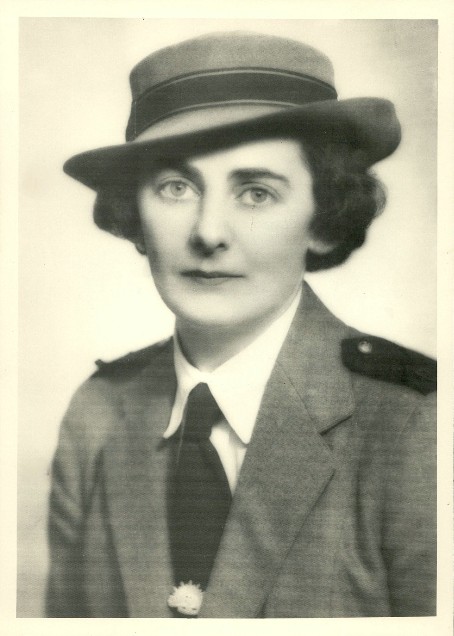
Among the other Victorians was a nurse by the name of Ruby Freeman. Ruby, who was also known as Dot, would soon become great friends with Irene – or Rene, as she was known. They differed in some key respects. Rene had enjoyed a stable, thoroughly middle-class upbringing in a well-respected, well-connected family. Dot’s upbringing might fairly be described as turbulent and marked by social dislocation. Her mother died when she was two and her first stepmother died when she was 13. Three of her stepsiblings died before the age of seven and another lived out of home. Nonetheless, Rene and Dot clearly hit it off and once posted overseas became almost inseparable.
QUEEN MARY
The Victorian recruits were granted leave without pay until 23 January, followed by pre-embarkation leave. On 2 February they boarded a train in Melbourne and arrived in Sydney the next day. They proceeded to Darling Harbour and were taken by ferry to the Queen Mary, which was lying at anchor at Bradley’s Point.
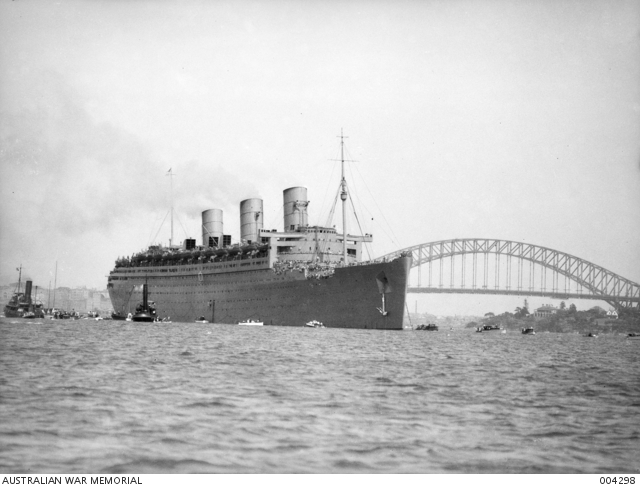
The Queen Mary was due to carry approximately 5,750 troops of the 22nd Brigade of the 8th Division, 2nd AIF to Malaya following a British request for Australian reinforcements to join British and Indian troops in garrison duties. Accompanying the troops were the 2/10th AGH, the 2/4th Casualty Clearing Station (CCS), with eight AANS nurses attached, and several smaller medical units.
Once aboard, Rene, Dot and the other Victorians, together with their new Queensland and New South Wales 2/10th AGH colleagues, established an emergency hospital, to cope with sickness and accidents during the voyage. The ship’s smoking room was converted into a ward, and an operating theatre was set up on a lower deck.
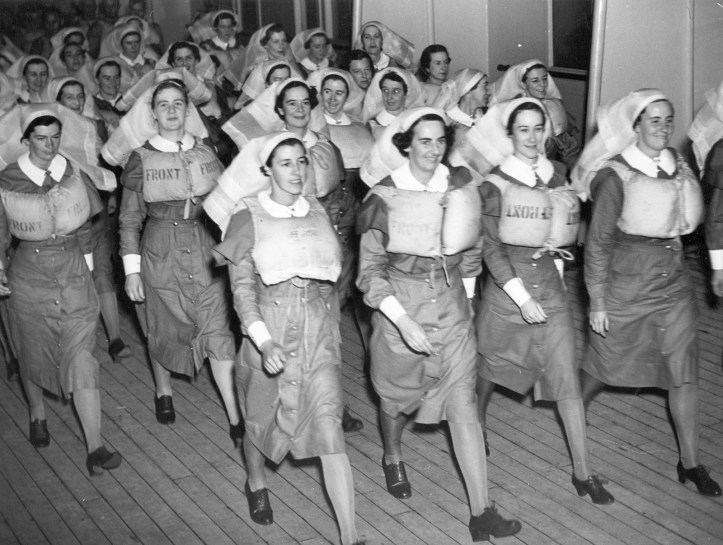
By 4 February the troops had finished embarking, and, to the strains of ‘The Māori’s Farewell,’ the Queen Mary weighed anchor and sailed away. It travelled in convoy with ships carrying troops for the Middle East until 16 February, when the Queen Mary took a sharp turn to the right and steamed off to Singapore.
MALAYA
Two days later, on 18 February, the Queen Mary arrived at Sembawang Naval Base on the north coast of Singapore Island. The nurses disembarked, and Rene, Dot and their 2/10th AGH colleagues boarded a train for Malacca, on the west coast of the Malay Peninsula, where their hospital was to be based. They arrived early in the morning and immediately went to bed.
The nurses awoke to find themselves in a wing of the Colonial Service Hospital. The hospital consisted of several blocks, each of five storeys; instead of glass windows, shutters were installed, the better to let in sea breezes. Before long they had the hospital in full working order.
Rene grew accustomed to the heat and humidity and began to feel at home. In April it was reported in the Gippsland Times social pages that “Miss Rene Singleton (Maffra) is enjoying life in Malaya at the present time.” Of course, she was kept busy looking after the thousands of troops of the 22nd Brigade, but still had plenty of time for shopping, golf and tennis, swimming, dinner and dancing, Sampan picnics and chicken-suppers on the beach.
Rene was granted leave from 23 to 25 May and took it with Dot Freeman and one or two others. The nurses always took leave in groups, and three-day leave periods were timed to fall over weekends, with the nurses often travelling to Singapore.
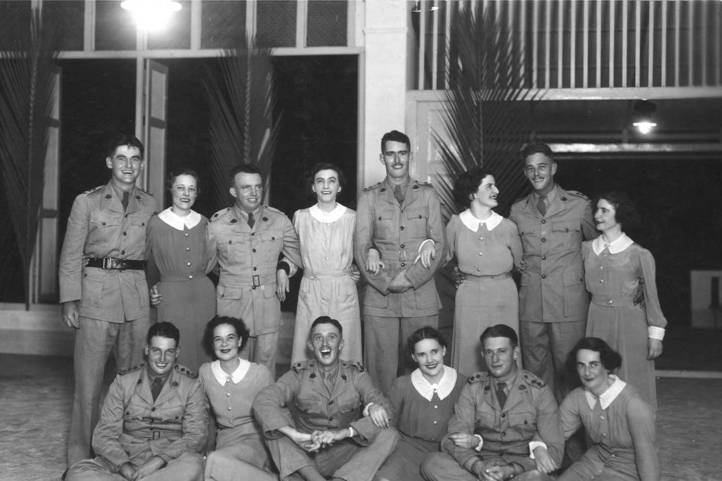
More leave followed from 14 to 18 July, this time without Dot, who had been admitted to hospital with tonsillitis. On 19 July, the day after her return, Rene was detached to the 2/9th Field Ambulance. Along with Caroline Ennis, who had also been detached, she travelled north to Port Dickson. Here the 2/9th Field Ambulance had established a 50-bed dressing station, which served as a first-aid post for the thousands of 22nd Brigade troops in the event of minor injury or tropical ailment. More serious cases would be transported to the 2/4th CCS, which was based at Kajang, or to Rene’s own 2/10th AGH.
Rene returned to Malacca on 22 August. From 1 to 8 October, she was granted a whole week’s leave, which she took once again with Dot. They may have visited Kuala Lumpur, the capital of the Federated Malay States, with its eclectic colonial architecture and relatively kind climate, or perhaps they travelled farther afield to Frazer’s Hill, a typical colonial hill station. More leave followed from 15 to 19 November, once again with Dot.
INVASION
For 10 months Rene had carried out her work and enjoyed her time off. All that changed on 8 December, when soon after midnight a force of some 5,000 troops of the Imperial Japanese Army launched an amphibious assault at Kota Bharu on the Malay Peninsula’s northern coast. Four hours later, 17 Japanese bombers attacked Singapore Island.
Over the next nine weeks, Japanese infantry, backed by mechanized units and substantial sea and air power, surged down the Malay Peninsula in three lines of attack at a steady pace of 15 kilometres a day, forcing severely outgunned British and Indian troops to retreat southwards. The illusion that had held for so long – that Malaya was well defended – was shattered.
By mid-January 1942 the 2/10th AGH was forced to relocate to Singapore Island, and by the end of January all Commonwealth troops and medical units had followed suit. When Japanese forces crossed Johor Strait on the night of 8 February, the end was nigh.
Soon a decision was made to evacuate Rene and her AANS colleagues. On 10 February six nurses departed aboard the hospital ship Wusueh. The following day a further 60 nurses sailed on the Empire Star with more than 2,000 evacuees. Finally, on Thursday 12 February, the 65 remaining AANS nurses had sadly, reluctantly to go too.
THE VYNER BROOKE
Late in the afternoon, Rene, Dot and their colleagues converged on St. Andrew’s Cathedral in Singapore city and from there proceeded to Keppel Harbour. At the chaotic wharves they were taken out by tug to a small coastal steamer, the Vyner Brooke, and with as many as 150 others slipped away as evening fell.
That night the Vyner Brooke made little progress and spent much of Friday hiding among small islands. By the morning of Saturday 14 February, Captain Borton was approaching the entrance to Bangka Strait. At about 2.00 pm, six bombers were seen approaching. Borton began evasive manoeuvres but ultimately to no avail. After three direct strikes, the Vyner Brooke shuddered, came to a standstill and began to list. It was 15 kilometres from Bangka Island.
Matron Dot Paschke’s organisation of those aboard the ship after the bombing was masterly. Together with Matron Irene Drummond of the 2/13th AGH, she helped direct injured passengers into the three viable lifeboats, and only then did she allow the nurses to evacuate. Wearing their lifebelts, they jumped overboard or slid down ropes.
BANGKA ISLAND
Rene found herself in the water, perhaps with Dot; many of the nurses did manage to find their friends among the floating wreckage, dead bodies and oil. She may have found a raft or piece of the ship to cling to, or she may simply have floated in her lifebelt. One way or another, Rene reached the shore of Bangka Island. Twelve of her colleagues did not, including Matron Paschke.
Once ashore, Rene was taken by Japanese soldiers, who had invaded Bangka Island during the night, to a place of internment in the nearby town of Muntok. There she was reunited with other surviving passengers of the Vyner Brooke, including many of her own nursing colleagues. There were in addition hundreds of survivors of other ships sunk by the Japanese navy and air force in Bangka Strait.
Soon the nurses, who now numbered 31, were taken with the other internees to a site on the edge of town, and here Vivian Bullwinkel of the 2/13th AGH joined them. She had survived a beach massacre of service personnel, merchant sailors, civilians – and 21 of the nurses’ own colleagues.
Of the 65 AANS nurses who had set out from Singapore on that fateful day, only 32 were still alive.
PRISONERS OF JAPAN
Under these tragic circumstances, the surviving nurses, together with hundreds of civilian men, women and children, began a three-and-a-half-year period of captivity. On 2 March, they were all shipped across Bangka Strait to Sumatra and up the Musi River to Palembang. After spending a night in a school on the outskirts of town, they were marched to a camp in the Bukit Besar (‘Big Hill’) district of Palembang, where they were held in houses formerly owned by the Dutch colonial residents.
The internees spent a month at Bukit Besar. During this time, the nurses endured the attentions of a group of Japanese officers who opened a ‘club’ in one of the houses and tried to press the nurses into service as comfort women. At one point the officers threatened to withdraw rations if they did not comply. It was a traumatising experience for the nurses, and it was only through their own resourcefulness that they managed to avoid the worst. The Japanese officers were later sanctioned by higher authorities but high anxiety about a recurrence of the demand persisted for some time.
IRENELAAN
On 1 April the women were separated from the men and marched off to a new camp two kilometres away from Bukit Besar. The men were taken to their own camp. The women’s camp became known among the nurses as ‘Irenelaan’ (Irene Avenue, after the daughter of Princess Juliana of the Netherlands), the name of one of two streets on which the houses of the camp were located, the other being ‘Bernhardlaan.’
There were some four hundred women and children at Irenelaan, crammed into houses formerly occupied by Dutch residents. Rene, Dot and the other 2/10th AGH nurses were at No. 9 Irenelaan and the 2/13th AGH and 2/4th CCS nurses were next door at No. 7.
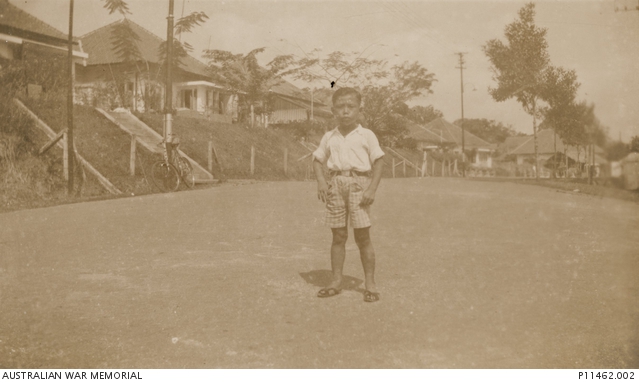
By mid-1942, the nurses had settled down to a daily routine. Each house appointed a captain, who spoke on behalf of the others to guards or officials and represented the house at community meetings. Pearl Mittelheuser was appointed captain of the 2/10th AGH nurses and Jean Ashton captain of 2/13th AGH and 2/4th CCS nurses.
The nurses also appointed ‘housekeepers,’ who in squads of two would wash the tiled floor throughout the house, wash the front and back porches, and scrape and clean the drain that runs alongside the house using a wide and heavy hoe called a chungkal, making an unholy din doing it – especially Rene, according to Betty Jeffrey of the 2/10th AGH in her book White Coolies. “She revels in it and has us all screaming at her as she goes past,” she wrote (Jeffrey, p. 42).
At around this time, Rene took part in an amusing play put on for the benefit of the 15 English women who lived in a garage opposite No. 9. The English women liked to amuse themselves by staging funny little plays, which the Australian nurses enjoyed watching. When it was time for the nurses to reciprocate, Rene, Dot, Betty Jeffrey and ‘Mickey’ Syer “turned on a scene from the midwifery section of a large public hospital,” as Betty Jeffrey wrote (Jeffrey, p. 48). She continued:
Apparently it amused everybody. Three anxious fathers sat in the ‘Visitors’ Waiting Room.’ Mr Romano (Dot dressed as an Italian) was the hit of the night; Rene, in working clothes and her chungkal, was poor nervous Mr Laceybottom worrying about his firstborn; and I was Mr Dionne. Mickey was the demented nurse trying to do her best for all concerned. It was quite fun.
When interviewed more than 50 years later, her 2/10th AGH colleague Pat Gunther recalled that Rene “had the most superb sense of humour of anybody I’ve ever known and a wonderful sense of ridiculous and she was such a nice person.”
While Rene was making the best of things at Irenelaan, 10,000 kilometres away in Egypt, her brothers Douglas and Kenneth Singleton were fighting in the Battle of El Alamein. Both lost their lives. Douglas died in action on 10 July, while Kenneth succumbed to his wounds on 25 July. Perhaps it was a blessing that Rene would never know that her brothers had perished.
On New Year’s Eve 1942 Rene, Betty Jeffrey and some of the other nurses of No. 9 were invited to a party in the English women’s garage. Betty described the occasion in White Coolies (pp. 62–63):
Miss Glasgow was hostess, and we had a terribly funny evening, playing some hunting game which is the noisiest I’ve ever known. Rene Singleton was in her element representing a rooster; we simply had to shut her up in the end as the guard came along and snorted something at us. After this party we went next door and joined the other Australian girls and played another amusing game organized by Jean Ashton. Just before midnight we had supper, then twelve o’clock came and went. We sang ‘Auld Lang Syne,’ wished each other a happier New Year, then went home to bed.
All this time, the nurses’ families in Australia had had no idea what had happened to them. In August 1942, the families had been informed that their daughters were “missing” – that was all. Then, in March 1943, Japanese authorities broadcast the names of the AANS nurses held captive in Sumatra and at the same time the nurses were permitted to write home for the first (and only) time. On 21 February 1944 the Gippsland Times reported that Rene’s father had received a letter from her – the lettercard posted 11 months earlier. Rene had asked for cotton to mend garments.
‘ATAP CAMP’
The months passed by, and in September 1943 the internees were moved again, this time to the ‘Atap Camp’ or ‘Men’s Camp’ at Puncak Sekuning, around two kilometres away from Irenelaan. Here Rene, Dot, Betty Jeffrey and Mickey Syer began a bakery business, which they called ‘Australian Bakeries Limited.’ Betty wrote that they worked in twos, “comparing and sampling and helping each other to fulfil orders round the camp” (Jeffrey, p. 101).
In mid-October 1944, Rene and the others were moved in stages back across Bangka Strait to a new camp established at Muntok on Bangka Island.
MUNTOK
Although Muntok camp was brand-new and spotless, with big airy buildings that caught the sea breeze, it did not take the nurses long to discover, as Elizabeth Simons of the 2/13th AGH noted in While History Passed, that it was in fact “as near hell as we were likely to get” (Simons, p. 84). Malaria and beriberi became so widespread that little notice was taken of them, and “Bangka fever,” whose symptoms were “awful fever, raging temperatures, and unconsciousness, followed by skin actions” (Jeffrey, p. 140), began to take hold.
Already weakened by chronic undernourishment, and without the medicines that might have saved their lives, the internees started to die, with the oldest and youngest most vulnerable. “When people die,” wrote Betty Jeffrey, “the women have to carry them out of the camp to a small … cemetery in the jungle not far from here. We have a special corner for the people from this camp. Our working squads have to dig the graves with chungkals … The cemetery is in a very pretty spot on the hillside, with a profusion of wild jungle flowers everywhere (Jeffrey, p. 144). Two wooden crosses marked the graves with inscriptions burnt on them.
Christmas 1944 was barely celebrated.
THE END
On 8 February 1945 the first of the AANS nurses died. After being unwell for many months, Mina Raymont of the 2/4th CCS had suffered an attack of malaria, possibly of the deadly cerebral kind, and was desperately ill for 36 hours. She lost consciousness and never recovered.
The following day the other nurses gave Mina a military funeral in their tattered and oil-stained uniforms. As they carried her coffin out of the camp, the Japanese guards stood up and removed their caps. The cortege marched down the path to the cemetery in the jungle and lowered Mina’s coffin into a prepared grave. Val Smith of the 2/13th AGH read verses from the Book of Revelation, and then the nurses sang the second and third verses of ‘Jerusalem the Golden.’
Twelve days later, on 20 February, Rene died. “Dear old Rene Singleton,” Betty wrote, “died today of beriberi after being in hospital for some weeks. We are all terribly sad; everyone liked Rene so much. She was always the life of the party at our worst moments” (Jeffrey, p. 151).
In While History Passed (p. 70), Elizabeth Simons recalled how touched she had been by a little birthday present from Rene and Dot Freeman:
Little presents we would have scorned to give in other days were very precious, Rita’s portraits, for instance, were very popular and a small camp-made powder puff came my way in 1942 from Dorothy Freeman and Rene Singleton. Right then I had no powder to use it with, but I will always treasure that little thing, embroidered with a spray of blue flowers and my initial, in memory of two girls we buried in Sumatra.
Later in her book Elizabeth Simons wrote of Rene’s tragic death (p. 89):
‘Rene’ Singleton, 2/10th Australian General Hospital, a Victorian, will always be remembered for her dry humour. Emaciated, almost beyond recognition save for her deep blue eyes, poor Rene was always hungry – on the day she died she kept asking for ‘more breakfast please!’
AFTERMATH
Over the next six months, the nurses lost six more colleagues, Blanche Hempsted, Shirley Gardam, Gladys Hughes, Winnie Davis, Dot Freeman and Pearl Mittelheuser. Dot had been ill for some time with malaria, dysentery and beriberi and died quite suddenly.
A month and a day after Emperor Hirohito announced Japan’s surrender on 15 August, the 24 surviving nurses were flown to Singapore and freedom. At St. Patrick’s School, now the home of the 2/14th AGH, they were interviewed by Australian journalists, and news of their rescue, and of the deaths of 41 of their comrades, was wired home. On 24 September 1945, the Gippsland Times reported that
After a long period of tense anxiety as to her fate or whereabouts, Mr. R. G. Singleton, of ‘Ravenswood,’ Maffra, has been officially informed that his daughter, Sister Irene Singleton, died of illness at Sumatra on February 20th of this year whilst a prisoner of war in the hands of the Japanese. This is the third loss in the interests of the Nation that Mr. R. G. Singleton has sustained. Two sons, Kenneth and Douglas, were previously killed in action against the Japanese, whilst son-in-law, Major Leonard Fell, of Metung, was a prisoner of war, being released a few months ago.
In memoriam
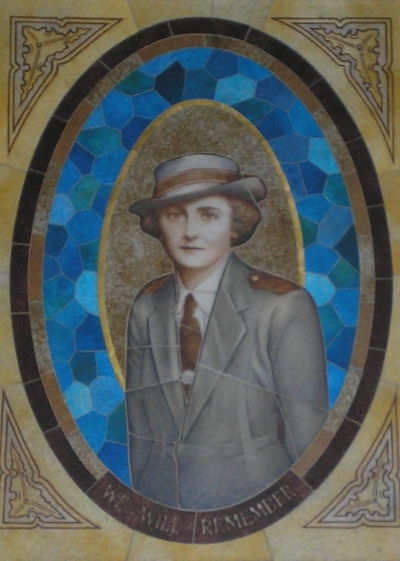
Nearly two years later, on 27 July 1947, a memorial service was held outside the Maffra Memorial Hall (which today houses Maffra Library) to mark the dedication of a plaque of opus sectile mosaic erected in memory of Rene on the hall’s honour board. At the end of the service, former matron in chief of the AANS Annie Sage gave a fine speech. She stated that Rene had given all that one could give and had fulfilled her mission on earth. “Through her memory,” she said, “we should not lose sense of values and forget the deeds of those who passed on.” She then unveiled the plaque, whose simple inscription reads:
Irene A. Singleton (A.A.N.S.), who gave her life on service at Muntok, Bangka Island, Sumatra, 20th February 1945 – We Will Remember.
We will remember.
SOURCES
- Anonymous, ‘Malaya,’ in Wellesley-Smith, A. and Shaw, E. L., eds. (1944), Lest We Forget, Australian Army Nursing Service.
- Ashton, J. (2003), Jean’s Diary: A POW Diary 1942–1945, published by Jill Ashton.
- Jeffrey, B. (1954), White Coolies, Angus and Robertson.
- Simons, J. E. (1954), While History Passed, Heinemann.
- University of NSW, Canberra, Australians at War Film Archive, ‘Janet Darling (Pat) – Transcript of interview 2 May 2003.’
Sources: Newspapers
- The Argus (Melbourne, 9 Sep 1942, p. 3), ‘Two Sons Killed, Daughter Missing.’
- The Argus (Melbourne, 20 Oct 1945, p. 6), ‘Died While POW.’
- The Australasian (Melbourne, 1 Feb 1913, p. 8), ‘Progressive Farming at Maffra.’
- The Australasian (Melbourne, 22 Apr 1916, p. 45), ‘The Young Folk.’
- The Australasian (Melbourne, 17 Jun 1916, p. 45), ‘The Young Folk.’
- The Australasian (Melbourne, 12 Aug 1916, p. 48), ‘The Young Folk.’
- The Australasian (Melbourne, 4 Nov 1916, p. 49), ‘The Young Folk.’
- Gippsland Times (Vic., 15 Jun 1933, p. 6), ‘Obituary.’
- Gippsland Times (28 Apr 1941, p. 2), ‘Jottings of Jill.’
- Gippsland Times (24 Sep 1945, p. 1), ‘Died on Service.’
- Gippsland Times (Vic., 12 Apr 1948, p. 3), ‘Jottings of Jill.’
- The Maffra Spectator (17 Feb 1913, p. 3), ‘Ravenswood.’
- The Maffra Spectator (22 Nov 1920, p. 4), ‘Maffra Show.’
- Table Talk (Melbourne, 21 Feb 1929, p. 47), ‘Farewell Dance at Sale.’
 australianwarnurses.org