The First 25 AANS Nurses
On 1 November 1914, 29 Australian nurses sailed from Albany, Western Australia with a combined Australian Imperial Force–New Zealand Expeditionary Force convoy of 38 transport ships carrying 30,000 Anzacs to Egypt.
Twenty-five of those nurses were members of the Australian Army Nursing Service (AANS). They travelled in seven ships, which had departed from their respective states for Albany.
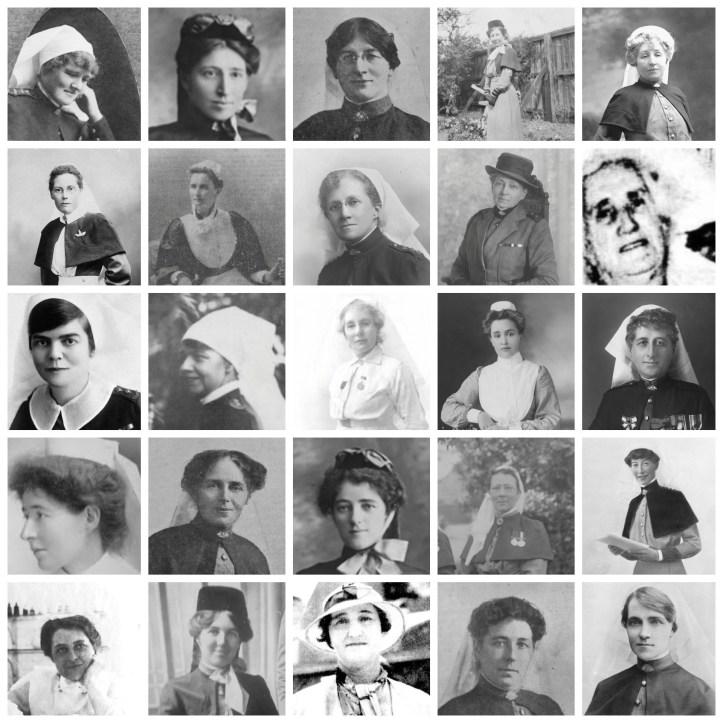
Aboard the Omrah out of Brisbane were:
- Sister Bertha Mary Williams ARRC (1878–1943)
- Sister Constance Mabel Keys RRC (1886–1964)
- Sister Eunice Muriel Harriett Paten ARRC (1883–1973)
- Sister Julia Mary Hart RRC (1885–1969)
Aboard the Euripides, Sydney, were:
- Principal Matron Ellen Julia (Nellie) Gould RRC (1860–1941)
- Sister Julia Bligh Johnston ARRC (1861–1940)
- Sister Adelaide Maude Kellett CBE RRC (1873–1945)
- Sister Jean Nellie Miles Walker RRC (1878–1918)
- Sister Alice Joan Twynam RRC (1882–1967)
- Sister Penelope Frater (1869–1939)
Aboard the Argyllshire, Sydney:
- Sister Mary Anne (Bessie) Pocock ARRC (1863–1946)
- Sister Clementina Hay Marshall ARRC (1879–1968)
Aboard the Shropshire, Melbourne:
- Matron Mary McKenzie Finlay RRC (1870–1923)
- Sister Evelyn Augusta Conyers CBE RRC and Bar FNM (1870–1944)
- Sister Ethel Sarah Davidson CBE RRC (1872–1939)
Benalla, Melbourne:
- Matron Jessie McHardy White MBE RRC (1870-1957)
- Sister Jane McRobie Lempriere (1872–1950)
- Sister Hilda Theresa Riddervold Samsing (1871–1957)
- Sister Alice Elizabeth Barrett Kitchin (1873–1950)
Ascanius, Adelaide:
- Matron Margaret Graham RRC (1860–1942)
- Sister Annie Heath (1880–1953)
- Sister Tessa Eleanor Rogers (1885–1969)
- Sister Louise Ellen Crosby White (1882–1962)
Geelong, Hobart:
- Sister Alice Gordon King (1886–1977)
- Sister Janet Ella Radcliff (1883–1922)
Upon arrival in Egypt in early December, most of the 25 were posted to Mena House, a luxury hotel lying in the shadow of the Pyramids, close to the main Australian army camp. When the nurses arrived, Mena House was a British hospital but soon became No. 2 Australian General Hospital.
The Lady Birds
The other four nurses of the convoy departed Melbourne on the Orvieto as members of Dr. Frederic Bird’s self-financed medical team. They were:
- Sister Doris Marion Green (1889–1973)
- Sister Minnie Maud McNab RRC (1879–1961)
- Sister Muriel Alice Robertson ARRC (1880–1951)
- Sister Louisa Adelaide (Adelaide) Hartrick ARRC (1883–1944)
On arrival in Egypt the four nurses joined their AANS peers at Mena House. On 22 January 1915 they joined the Queen Alexandra’s Imperial Military Nursing Service Reserve (QAIMNSR) and were posted to the Citadel Military Hospital in eastern Cairo. Then on 12 April all four departed Alexandria aboard the hospital ship Sicilia, which carried wounded soldiers from the Gallipoli Peninsula to the island of Lemnos. AANS nurse Elsie Gibson, also aboard the Sicilia, called them the Lady Birds.
The Nurses of the Australian Naval and Military Expeditionary Force
The 29 nurses who travelled with the first convoy were not the first Australian nurses to serve in the Great War. On 30 August 1914 the hospital ship Grantala had departed Sydney with seven nurses from the Royal Prince Alfred Hospital on board. They were:
- Matron Sarah Melanie De Mestre ARRC (1877–1961)
- Sister Rosa Angela Kirkcaldie CBE (1887–1972)
- Sister Rachel Clouston (1888–1965)
- Sister Florence Elizabeth (Betha) McMillan (1882–1943)
- Sister Bertha Ellen Burtinshaw (1888–1983)
- Sister Constance Margaret Neale (1885–1972)
- Sister Stella Lillian Colless (1883–1976)
The Grantala was sailing to Rabaul as part of the Australian Naval and Military Expeditionary Force (ANMEF), which was the first Australian military unit raised for overseas service and had been tasked with destroying German wireless communications on the island of New Britain. The ship arrived on 13 September and the nurses began to treat the ANMEF and German casualties of a battle that had taken place two days earlier.
After remaining in the southwest Pacific until mid-December, the Grantala arrived back in Sydney on 22 December, following which the majority of its medical staff were de-mobilised. Sarah De Mestre, Rachel Clouston, Betha McMillan, Constance Neale and Stella Colless subsequently joined the AANS, Rosa Kirkcaldie joined the QAIMNSR, and Bertha Burtinshaw married and became ineligible for further military service.
Lady Dudley’s Australian Voluntary Hospital
Sister Bess McGregor was in England furthering her nursing career when Britain declared war on Germany in August 1914. She joined Lady Dudley’s Australian Voluntary Hospital (AVH), an independent field hospital established by Rachel Ward, Lady Dudley, the estranged wife of William Ward, 2nd Earl of Dudley, a former governor-general of Australia. On 29 August the AVH sailed under the command of Lieutenant Colonel William L’Estrange Eames from Southampton to Le Havre in France on the yacht Greta. On board with Bess were doctors, a dentist, a bacteriologist, 14 other nurses with Matron Ida Mary Greaves, and around 25 orderlies – Australian and New Zealand medical students who had been studying in Britain when war broke out.
Upon landing in Le Havre, the AVH travelled to the Customs House, where nurses of the Queen Alexandra’s Imperial Military Nursing Service (QAIMNS) had established themselves. The Australian unit immediately relieved the British nurses for the night, giving them the luxury of a whole night’s rest. Wounded soldiers were arriving in great numbers, and Bess and her colleagues had plenty of work to do. However, the town was under German bombardment and the inhabitants were beginning to evacuate, and on 2 September both the QAIMNS nurses and the AVH departed Le Havre boarded the Asturias for St. Nazaire, near the mouth of the Loire in Brittany.
At St. Nazaire the AVH utilised a private hospital and an adjoining school to treat officers and severe cases, and set up tents at their camp for men with minor injuries. Soon Bess and the other nurses, alongside the unit’s surgeons and orderlies, were working under tremendous pressure dealing with the hundreds of mainly British casualties that resulted from the fighting around Mons, the majority of whom had become infected with tetanus and gas gangrene.
Within weeks the German offensive had been checked and defensive lines established, and the pressure on the hospital eased. At the end of October the AVH received orders to move – and Boulogne, 550 kilometres to the north in Normandy, was to be the new base. A train was put at the unit’s disposal, and on Thursday 29 October, after a three-day journey, Bess and the others arrived at Wimereux, just outside Boulogne.
Early on Friday morning the AVH took possession of the Grand Hotel du Golf et Cosmopolite and the staff were instructed to prepare for the imminent arrival of wounded soldiers from the fighting at Ypres. They had barely had time to clean the building and set up the beds before the first casualties began to arrive. “They kept on arriving,” wrote the Australian author Katharine Susannah Prichard in 1915, “a continuous, slow stream of khaki-covered cars, with a red cross blazed across them. They came over the brow of the hill, and filed past the hospital from 10 in the morning until after four in the afternoon” (quoted in Den Hartog).
For the next 10 days Bess and her colleagues treated hundreds of wounded British soldiers and German prisoners. During this time stretchers filled the corridors of the hospital and the nurses barely went outside the building. Eventually the rush was over, and thereafter the work proceeded unevenly. A week at fever pitch, during which the nurses and orderlies might be obliged to work for 30 hours without rest, would be followed by a fortnight’s lull.
The AVH maintained its hospital at Wimereux until June 1916, at which time it was absorbed into the British Army as No. 32 Stationary Hospital. However, around two months earlier, in April 1916, Bess had left the AVH to return to England. There she joined the British Red Cross and was sent to Corfu to help nurse the survivors of Serbia’s Great Retreat.
Mrs. St. Clair Stobart’s Women’s Imperial Service League
Sister Claire Evelyn Trestrail (1887–1960), Sister Catherine (Kit) Tully (1874–1957) and Sister Caroline Ellen (Carrie) Wilson (1879–1974) were also working in England in August 1914. They joined other nurses and doctors in a hospital unit of Mrs. Mabel St. Clair Stobart’s Women’s Imperial Service League and travelled to Antwerp in Belgium, arriving on 22 September. The three Australians helped to establish a hospital in the Berchem Concert Hall and, on 8 October, under heavy German artillery bombardment, worked tirelessly with the rest of the unit to move 130 French and Belgian patients to safety in the building’s cellars. They eventually got their patients and themselves safely away. In 1915 the three joined the QAIMNSR.
 australianwarnurses.org