THE VYNER BROOKE Is Attacked
On the evening of Thursday 12 February 1942, the last 65 Australian Army Nursing Service (AANS) nurses in Singapore were evacuated on the SS Vyner Brooke with around 200 other people fleeing the city. Two days later, at around 2.00 pm, the ship was attacked by Japanese aircraft near the entrance to the Bangka Strait.
The planes, grouped in two formations of three, flew towards the Vyner Brooke. The ship weaved, and the bombs missed. The planes regrouped and flew in again, this time scoring three direct hits. The first bomb exploded amidships, and the Vyner Brooke lifted and rocked with a vast roar. The next went down the funnel and exploded in the engine room. The third bomb tore a hole in the hull, dealing the ship a last, fatal blow. With a dreadful noise of smashing glass and timber, it shuddered and came to a standstill, 15 kilometres from Bangka Island.
In the Sea
After the first explosion, the nurses threw themselves into action. They hurried about the deck administering first aid to wounded passengers, including their own colleagues, and, as the Vyner Brooke began to list to starboard, helped them to board the three remaining lifeboats.
Matron Irene Drummond of the 2/13th AGH entered the first lifeboat and, together with Matron Dot Paschke of the 2/10th AGH, supervised its loading with wounded and elderly passengers. Several of their own nurses who were unable to swim were taken on, along with a number of crew members, including Lieutenant Bill Sedgeman, the first officer of the Vyner Brooke. The lifeboat was stocked with first aid supplies and lowered into the roiling sea. It got safely away.
The second lifeboat was filled with elderly passengers and mothers with children. Injured nurses Sisters Joan Wight and Florence Casson of the 2/13th AGH were helped into the boat too, as were 2/10th AGH nurses Sisters Clare Halligan and Kath Neuss. Joan Wight was particularly badly injured. The lifeboat was lowered into the water and, like the first boat, got safely away. Sometime later Staff Nurse Vivian Bullwinkel of the 2/13th AGH and Jimmy Miller, the second officer of the Vyner Brooke, managed to reach it and hang on.
The increasingly alarming list of the Vyner Brooke caused the third lifeboat to judder and sway as it was being lowered. It crashed awkwardly into the water and a number of its passengers jumped out and swam, for fear that the ship might fall onto them.
Meanwhile, the other nurses, having done all they could for the surviving passengers, abandoned ship. They removed their shoes and tin helmets and entered the water. Some jumped from the portside railing, being careful to hold onto their lifebelts, while others practically stepped down from the starboard side. Some slid down ropes or climbed down ladders. Their lifebelts kept them afloat as they swirled around in the sea, which was thick with oil, wreckage and dead bodies.
Once in the water, some of the nurses managed to clamber onto rafts or grab onto passing flotsam. Others caught hold of the ropes trailing behind the first two lifeboats or simply floated in their lifebelts. The Vyner Brooke settled lower and lower in the water and then slipped out of sight. It had taken less than half an hour to sink.
Twelve of the nurses died in the attack or were subsequently lost at sea. Over the next 18 hours, their 53 colleagues washed up in a wide arc around the town of Muntok in the northwestern part of Bangka Island.
BANGKA ISLAND
On Saturday night Matron Drummond’s lifeboat came ashore, and the passengers got out and built a bonfire. The second lifeboat washed up sometime later, only two to three kilometres distant. The passengers had seen the bonfire, and now Vivian Bullwinkel, Jimmy Miller, and two others set off to investigate.
Vivian and Jimmy reached the bonfire and, having sought assistance for the injured nurses, returned to their party with volunteers. By the early hours of Sunday 15 February, Vivian’s group had joined Matron Drummond and the others around the bonfire. Soon more people arrived, the survivors of other bombed ships.
During Sunday the survivors learned that Bangka Island had come under Japanese occupation. Lieutenant Sedgeman proposed surrendering to Japanese authorities but agreed to wait until the following morning before deciding. The rest of the day passed uneventfully.
Early in the morning of Monday 16 February, another lifeboat and several life rafts came ashore carrying British soldiers and sailors. There were now perhaps 100 people on the beach, many of whom were injured. Among them were 22 Australian nurses. The group agreed to surrender, and a deputation left for Muntok to negotiate this. A short while later, most of the civilian women and children followed behind.
Around mid-morning the deputation returned with a squad of Japanese soldiers. The soldiers separated the survivors into three groups: the officers and NCOs, the servicemen and male civilians, and the nurses and remaining civilian women. They took the two groups of men around a nearby headland and shot and bayoneted them. Three managed to escape death, of whom two survived the war.
The soldiers returned to the women and ordered them to line up on the beach with their faces to the sea. Those who were injured were helped to stand up. The women were ordered forward, and they began to walk into the water.
The soldiers opened fire. Twenty-one of the 22 nurses died, along with the civilian women. Vivian Bullwinkel survived. Two weeks later she joined the remaining 31 nurses in captivity. When they came home in October 1945, only 24 were still alive.
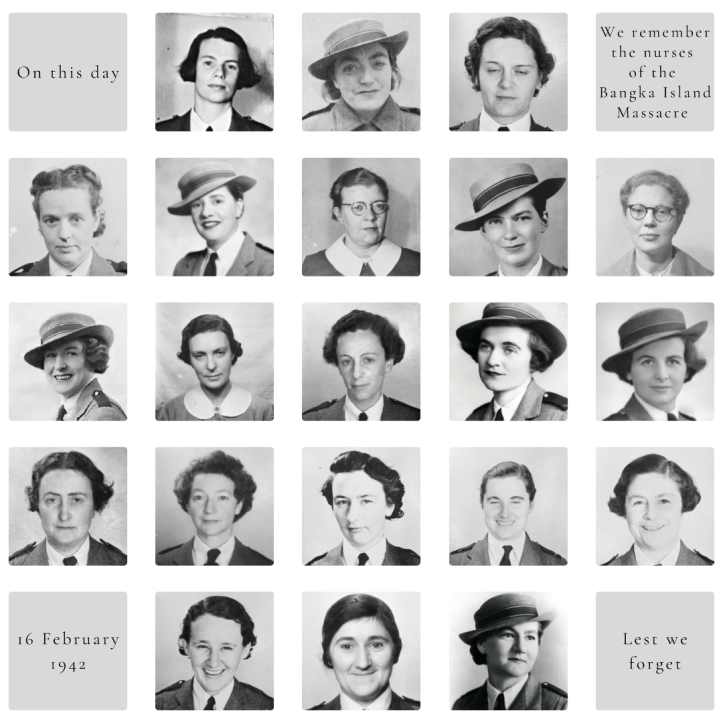
THOSE WHO DIED ON BANGKA ISLAND
- Sister Elaine Balfour Ogilvy (2/4th CCS, SA)
- Staff Nurse Alma Beard (2/13th AGH, WA)
- Staff Nurse Joyce Bridge (2/13th AGH, NSW)
- Sister Florence Casson (2/13th AGH, VIC/SA)
- Sister Beth Cuthbertson (2/10th AGH, VIC)
- Matron Irene Drummond (2/4th CCS and 2/13th AGH, SA)
- Sister Gwendoline ‘Buddy’ Elmes (2/10th AGH, VIC)
- Staff Nurse Lorna Fairweather (2/13th AGH, SA)
- Sister Peggy Farmaner (2/4th CCS, WA)
- Sister Clarice Halligan (2/10th AGH, VIC)
- Staff Nurse Nancy Harris (2/13th AGH, NSW)
- Staff Nurse Minnie Hodgson (2/13th AGH, WA)
- Sister Nell Keats (2/10th AGH, SA)
- Staff Nurse Jenny Kerr (2/13th AGH, NSW)
- Sister Ellie McGlade (2/13th AGH, NSW)
- Sister Kath Neuss (2/10th AGH, VIC/NSW)
- Staff Nurse Florence Salmon (2/10th AGH, NSW)
- Sister Jean Stewart (2/10th AGH, QLD)
- Staff Nurse Mona Tait (2/13th AGH, NSW)
- Sister Joan Wight (2/13th AGH, VIC)
- Sister Bessie Wilmott (2/4th CCS, WA)
We will not forget them.
SOURCES
- Angell, B. (2003), A Woman’s War: The Exceptional Life of Wilma Oram Young AM, New Holland Publishers.
- Ashton, J. (2003), Jean’s Diary: A POW Diary 1942–1945, published by Jill Ashton.
- Darling (née Gunther), P. (2001), Portrait of a Nurse, published by Don Wall.
- Jeffrey, B. (1954), White Coolies, Angus & Robertson Publishers.
- Shaw, I. W. (2010), On Radji Beach, Pan Macmillan Australia.
- Simons, J. E. (1954), While History Passed, William Heinemann Ltd.
 australianwarnurses.org