ESCAPE FROM SINGAPORE
On 12 February 1942, the small coastal steamer Vyner Brooke slipped out of Keppel Harbour in Singapore carrying 200 civilian and military evacuees. On board were 65 nurses of the Australian Army Nursing Service (AANS). Two days later the ship was strafed and bombed by Japanese aircraft while entering Bangka Strait and sank within 30 minutes. Twelve of the nurses died during the attack or later at sea. The other 53 were washed ashore on Bangka Island. Twenty-one were murdered by Japanese soldiers. The remaining 32 became prisoners of the Japanese and were interned in camps on Bangka Island and Sumatra with hundreds of civilian women and children.
On 24 August 1945 the Japanese camp guards announced that the war was over. By then eight of the nurses had died of malnutrition and disease – the final one only six days earlier.
Although conditions then improved dramatically, the nurses remained prisoners.
Finally, on 16 September, the remaining 24 nurses were helped aboard a Douglas C-47 Dakota in the south Sumatran jungle and flown to freedom. This is the story of their rescue.
MAJOR GIDEON JACOBS
In early August 1945, Temporary Major Gideon Francois Jacobs, a 23-year-old South African seconded by the British Royal Marines from the South African Union Defence Force, was flown from Ceylon to the Netherlands East Indies and parachuted into the northern Sumatra jungle northwest of the city of Medan. With him were Sergeant Albert ‘Happy’ Plesman, the 22-year-old son of the founder of Dutch airline KLM; a 25-year-old multilingual Chinese Javanese fixer named Lie Tjie Tjoeng; and two Australian radio operators, Sergeant Earlsford Bates from Thornbury in Melbourne and Sergeant Roy Gillam from Claremont in Perth. They had radio equipment, weapons, ammunition and food supplies.
Major Jacobs’s team, codenamed ‘Arrest,’ was working for Force 136, the special operations division of Lord Louis Mountbatten’s Southeast Asia Command (SEAC), which was based in Ceylon. It was one of several special operations teams inserted into Sumatra ahead of a devastating blow against Japan that was anticipated to lead to its surrender – the dropping of the atomic bombs on Hiroshima and Nagasaki. Plesman and Tjoeng had been seconded from Korps Insulinde, a Dutch special operations unit based, like Force 136, in Ceylon, while Gillam and Bates had been seconded from the 2nd Australian Imperial Force.
WAITING FOR JAPAN TO SURRENDER
Jacobs’s instructions were to lie low in the jungle within reach of Medan until instructed by SEAC headquarters to come out of hiding. He must then act quickly and decisively to contact senior Japanese officials in Medan, assert his authority as Mountbatten’s representative on Sumatra, and establish the whereabouts of all prisoner-of-war and internment camps on the island. Finally, Jacobs was required to report on Japanese attitudes to their dramatic change of fortune and their willingness to cooperate. His timing and diplomatic deftness were critical, as Allied landings on Sumatra would not be possible before October, and he would need to convince Japanese authorities, with 80,000 fully armed soldiers and still in complete control of the island, to keep law and order on the Allies’ behalf in the interim. It was an enormous task.
On 15 August Emperor Hirohito announced Japan’s surrender. Soon after, Major Jacobs received instructions to proceed with all speed to Medan. Within days the team had established contact with Japanese senior officers and had also met two internees from a camp in Rantauprapat, south of Medan, who had been brought to Jacobs by the chief Red Cross representative in Sumatra. Jacobs learned of the dire conditions under which they had been living for the past three-and-a-half years and decided to accompany them back to their camp with Plesman, Tjoeng and a small party of Japanese officials. Gillam and Bates remained in Medan.
THE HORROR OF THE CAMPS
At Rantauprapat there were two camps, one for women and children and the other for men. Jacobs was horrified by what he saw. Some of the internees were weak with hunger, others were on the point of dying. The conditions exceeded his worst fears and left him aghast at the sadistic cruelty with which the Japanese authorities had run the camps.
Upon returning to Medan, Jacobs requested information about other camps on Sumatra and learned that thousands of people were being held, mainly Dutch and Asian, although large numbers of British, including Australian prisoners of war and internees, were concentrated in the southern areas of the island around Palembang. He demanded to see every camp on the island, starting with the camp at Fort de Kock (Bukittinggi) in central Sumatra, where Jacobs knew Japanese Army Headquarters in Sumatra was based.
At Fort de Kock, Major Jacobs gained the cooperation of General Tanabe, the officer in charge of all Japanese troops on the island, who provided him with a plane, an interpreter, Sodi, and a senior liaison officer, Col. Yoshida, to accompany his team. He was now able to move around Sumatra more or less freely.
After seeing the camp at Fort de Kock, Jacobs and his team drove to a camp at nearby Padang, where signs of an emerging Indonesian Republic were evident. They flew to Pekanbaru, where the camps were among the worst they would see. They drove to camps at Bangkinang and Logas and flew back to Medan.
By now it was the beginning of September, and Jacobs’s reports to SEAC headquarters about the conditions in the camps had borne fruit. Giant Liberators had commenced airdrops of food, medicines and personnel, including doctors, into the camps. Meanwhile, in the newspapers of Britain and Australia, stories of the horrors of the Sumatran camps were beginning to appear.
REPORTS OF A MASSACRE
From Medan, Major Jacobs and his team flew to Palembang in the island’s south. While organising the internees at one of the camps into panels to collect information about war crimes, he came across a statement from a certain Robert Seddon of the British Royal Marines, who told of how he had come across the bodies of 24 nurses on Banka Island. Seddon’s ship, the Yin Ping, had been sunk in Bangka Strait. As he was being carried by the current into shore, he heard firing and the screams of women. He washed up exhausted and was kicked in the face and stabbed by Japanese soldiers and left for dead. He crawled up the beach and made his way into the jungle but returned the following day and found the nurses. He was later taken prisoner and subsequently learned that the nurses he had seen had belonged to a larger group whose ship had been bombed in Bangka Strait.
Upon reading this shocking story, Jacobs began to look for corroborative reports. He found an account by Ernest Lloyd, a stoker in the Royal Navy. Lloyd had been among a large group of shipwreck survivors on Bangka Island, whose numbers included Australian nurses, when Japanese soldiers came upon them, divided them, and began to shoot them. He was shot four times but managed to get away. After spending days in the jungle, he returned to the beach and found the bodies of some of the nurses. After he was captured and interned, he heard that one of the nurses, Sister Bullwinkel, had survived and was brought to Sumatra as a prisoner of war.
WHERE WERE THE AUSTRALIAN NURSES?
If the Australian nurses killed on Bangka Island had belonged to a larger group of nurses, Jacobs began to wonder, what had become of the others? He had already seen all of the camps reported by the Japanese officials in Medan. He became suspicious that some were being kept from him. He and his team then went through the Palembang camps and methodically talked to everyone who might be able to give them more information. They picked up several reports about women prisoners, including Australian nurses from a sunken ship, who had been imprisoned on Bangka and later moved to the interior of Sumatra.
Jacobs confronted his Japanese liaison officer, Yoshida, about this, who, after prevaricating, came up with a cock-and-bull story that a mistake had been made and there was still one camp that had not been shown to Jacobs at Lubuklinggau, near the town of Lahat, 250 kilometres west of Palembang. Around 11 September, Jacobs and his team flew to Lahat, then drove to Lubuklinggau. Some kilometres out of town they came to the Belalau rubber plantation, where two camps were located, a women’s camp and a men’s camp.
The women’s camp, in a deplorable state, was home to more than 500 women and children. Scores of internees had died of malnutrition and raging disease since the beginning of the year. While Jacobs went over to the administrative offices to contact the camp committee, Sergeants Gillam and Bates went into the camp to look for the Australian nurses. Not long afterwards, Bates returned to Jacobs, highly excited. He and Gillam had found the nurses. Of 32 who had been imprisoned three and a half years previously, 24 were still alive.
AT LUBUKLINGGAU
Betty Jeffrey, who was a staff nurse with the 2/10th Australian General Hospital (AGH) in Malaya when the Japanese invaded, recorded the meeting in her secret diary, which she later published as White Coolies:
11th September 1945. Cheers and more cheers. We have been discovered by two young Australian paratroops who visited our camp today and came straight past everybody until they landed on the doorstep of our Hut 13. Viv [Bullwinkel], who is usually unmoved, and very quiet, came rushing in, face positively crimson, and panted, ‘Australians are here!’ They were about five yards behind her. To see that rising sun badge on a beret again! It did us more good than anything we have experienced so far.
One fellow said he was ‘Bates, from Thornbury’ and the other said he was ‘Gillam, from Perth,’ and the first thing we noticed, after their youth, was their very white teeth. We made these boys sit on our bali bali and then we fired our hundreds of questions.
We told them we had heard that ‘the King of America’ was dead – this from a Chinese when we were out water-carrying one day. Did it mean Mr. Roosevelt had died? Who won the war? Who won the football final in Melbourne? Will we be home for the Melbourne Cup? Is the Royal Family OK? Is the Queen Mary still afloat? We were interested in this because most of us had sailed to Singapore in her in 1941. The answer came pat. ‘Yes, they both are.’ How and where are the 8th Division prisoners? Who is Prime Minister of Australia? Is Mr. Churchill still Prime Minister of England? What are the latest songs? Australia could not have sent two men better equipped with all the answers. They told us of ‘swoon’ men, and that Bing Crosby was the No. 1 film star in Hollywood. Our remarks here were choice; we thought Bing was on the way out before we were ever taken prisoner. They told us of cold permanent waves, and we all thought we had better have one of those as soon as we could. They spoke of huge aeroplanes, ‘Liberators,’ ‘Boomerangs,’ ‘Mosquitoes,’ ‘B24’s.’ We are hopelessly out of date and we can’t think when we shall catch up with all the news of the last four years.
These two boys also told us of a bomb dropped on a Japanese city which killed thousands of people and reduced the place to a shambles. We were horrified to think one bomb could do that. They then said another similar bomb had been dropped on another Japanese city that did the same thing. What amazing progress has been made while we have been Rip Van Winkles! (Jeffrey, pp. 191–92).
Having spoken at some length to Sister Nesta James of the 2/10th AGH, the senior sister among the 24 nurses, Jacobs radioed a message to Ceylon advising that he had found the Australians:
Have encountered among 250 repeat 250 British female internees in Loeboek Linggau Camp Sister Nesta James and 23 other surviving members of Australian Army Nursing Services remnants of contingent A.A.N.S. evacuated from Malaya in Vyner Brooke stop in view their precarious health suggest you endeavour arrange air transport direct to Australia from here soonest stop am collecting particulars massacre of members A.A.N.S. on Banka Island for later transmission (Jacobs, p. 136).
He requested that the message be relayed to the Australian ambassador in India and to Army Headquarters in Melbourne. It is not certain that it ever was.
As it happened, Jacobs’s team was not the first to find the women’s camp. Around 7 September members of a Korps Insulinde team codenamed ‘Aspect’ arrived at the camp. The team, comprising Sargeant-Major C. B. Hakkenberg, Sub Lieutenant C. C. Wilhelm, Sergeant J. L. van Hasselt, and Chinese Indonesian operative Ou Chee Suet, had, like Jacobs’s team, been dropped into Sumatra to search for internment camps and report their locations to Ceylon. The paratroopers’ arrival, which, for the nurses, signified that the war was truly over, was recorded by Betty Jeffrey:
7 September 1945. … 3 p.m. The Allies have arrived!!! Two very young Dutch soldiers and a Chinese military man arrived today as advance guard to the Army of Occupation. They had been dropped by parachute, a few days ago and were most impressed with our camp apparently, their first English words being, ‘What a bloody mess!’
They said they had never seen such awful conditions, and were amazed that anyone could live like this. It is not easy. Those men will be staying at Loebok Linggau, twelve miles away, and with their radio will report to their Headquarters in Colombo” (Jeffrey, p. 190).
At least two members of team ‘Aspect’ remained in the vicinity of the Belalau camps for the next nine days.
On 13 September two Liberators from the Cocos Islands flew over and dropped food parcels containing bread, boiled sweets, powdered milk, cheese, powdered egg and Vegemite. They also contained toothbrushes and nail files, and copies of the SEAC Times, the official newspaper of SEAC.
ENTER LENNARD AND DUNSTAN
Thanks to the efforts of Jacobs, Hakkenberg and their respective team members, the location of the nurses had become known, and it would surely not be long now before they were rescued. In the end, however, it took the determined efforts of two Singapore-based Australian war correspondents to expedite their rescue.
Haydon Lennard, a radio journalist who worked for the Australian Broadcasting Commission (ABC), and A. E. Dunstan, a newspaper journalist who filed copy for various Australian newspapers, had heard stories from rescued prisoners of war that Australian nurses had been seen going down the Musi River in Sumatra towards Palembang. They decided to try to find them.
Lennard had been interested in the fate of the Vyner Brooke nurses throughout the war. Around 13 September he appealed to the Repatriation of Allied Prisoners of War and Internees Organisation (RAPWI) to fly into Sumatra to find them but was told that the nurses’ whereabouts were “undefinitely established.” On 14 September he sent a wire to Australia marked “important attention Dixon Molesworth” (presumably B. H. Molesworth, Director of Talks at the ABC, and M. F. Dixon, Chief News Editor of the ABC). The wire comprised two schedules, A and B, which listed the names and numbers respectively of the 32 interned nurses and the 33 deceased nurses. If the lists had been provided to him by RAPWI, it is not clear why Jacobs’s wireless message to SEAC headquarters, in which he referred to 24 surviving nurses, had seemingly not got through – perhaps the timing was out by a day or two.
Lennard then offered to make a special trip to Sumatra with Dunstan to find the surviving nurses. The two correspondents persuaded the RAAF to provide an aircraft for their use and asked Squadron Leader Fred Madsen of 36 Squadron to fly them from Singapore to Palembang. Madsen agreed but in view of the small airstrip at Palembang could only carry six passengers in addition to himself and Flying Officer Ken Brown of the RAAF. Dunstan therefore could not go. The six-member party would be composed of Lennard; Sister Beryl Chandler of the RAAF’s Medical Air Evacuation Transport Unit, who knew several of the nurses from her days at Brisbane General Hospital; Major Harry Windsor and his medical orderly Private Frederick William Prott, both of the 2/14th AGH in Singapore; Lieutenant Colonel Hayes of the Royal Army Medical Corps; and Major Jackie Clough of RAPWI.
FLIGHT TO SUMATRA
The plane left Singapore on the morning of 15 September and landed without incident two hours later at Palembang. After questioning Japanese officers, Lennard and Ken Brown established that the authorities in Lahat, 220 kilometres southwest of Palembang, knew of the Australian nurses’ whereabouts and set out in a car placed at their disposal.
While Lennard and Brown were driving to Lahat, Beryl Chandler, Harry Windsor and Private Prott set about visiting internment camps and hospitals in Palembang, possibly with Lt. Col. Hayes and Major Clough, and assembled a group of 30 sick prisoners of war. The 30 men returned to Singapore with Fred Madsen, who was flying without his co-pilot – quite a feat.
Haydon Lennard and Ken Brown arrived in Lahat later that day and interrogated a group of Japanese officers. Upon learning that the nurses were at Belalau rubber plantation near Lubuklinggau, 150 kilometres to the west of Lahat, the Australians requested that a special train and a fleet of cars be placed at their disposal. After a conference of nearly five hours the Japanese officers agreed to this. Importantly, it was determined that the airstrip at Lahat could more or less accommodate a Douglas C-47 Dakota. Brown arranged for the details of the plan to be phoned through to Palembang, where Beryl Chandler and Harry Windsor, who were staying at the same hotel that housed Japanese army headquarters, were eagerly awaiting news. Ken Brown then telephoned the women’s camp at Belalau.
AN UNEXPECTED PHONE CALL
At around 10.00 pm on the night of 15 September, Sister Nesta James was called to the telephone. The nurses with her were incredulous. “What phone?” wrote Betty Jeffrey. “Where is the telephone? It did sound ridiculous, way out there in the rubber” (Jeffrey, p. 196). Sister James was taken to the guardhouse and there she spoke to Ken Brown. He told her that the nurses and the most gravely ill of the women and children were to be ready by 4.00 am the next morning, at which time they would be collected in cars and driven to Lubuklinggau. From there they would entrain for Lahat, drive to the airstrip, and fly to Singapore. Hardly believing what was happening, the Australian nurses rushed to prepare for their early-morning evacuation.
At the appointed time the nurses and civilian internees left their huts and walked to the guardhouse in pitch darkness and pouring rain. They found a motley convoy of open trucks waiting for them and climbed in. They were joined by those brought from the camp hospital. Haydon Lennard arrived, after departing Lahat on the special train at around 2.00 am and then commandeering a truck at Lubuklinggau railway terminal, and soon after the convoy set off. The nurses, women and children were accompanied by two of the Dutch paratroopers from team ‘Aspect.’ The 20-kilometre journey to the terminal took three hours after one of the vehicles broke down. In the meantime, Ken Brown had arrived at Belalau with the cars, having left Lahat at around midnight, and the last of the patients from the camp hospital were loaded in. Then he and Lennard set off for the railway terminal too.
The train departed Lubuklinggau at 8.00 am with 62 internees safely on board – the 24 nurses and 38 women and children. Some of the women were in a dreadful state, and there were five critical cases – all children, including an orphan who had been picked out of the sea. As the train travelled along a muddy jungle track in heavy rain, Lennard realised that his and Brown’s request to have one of the carriages outfitted with mattresses, pillows and sheets had proved most fortunate. Nevertheless, even the stretcher cases would have walked to the terminal had there been no transport, so overjoyed were the women at their freedom.
ONE STEP CLOSER TO FREEDOM
When the train arrived at Lahat at midday, the 62 women and children were told that only one plane with a capacity of 30 would be flying in from Singapore and had not yet been sighted. For the next hour or so they remained on board consuming bully beef, tinned milk, fruit, rice and very sweet coffee supplied by obsequious Japanese officers. Eventually the 24 nurses, the five critical cases and one other internee were driven to the airstrip, while the other 32 women and children were taken to a Dutch hospital, where they would spend the night before being airlifted the following day.
At the airstrip the nurses waited nervously in the shade of an atap roof until, at around 4.00 pm, a speck of silver appeared in the sky. Soon, Fred Madsen’s Dakota came in over the hills and made a perfect landing.
Earlier that day, having received a signal from Lennard and Brown, Madsen had belatedly departed Singapore for Palembang after being delayed by a flat tyre. With him was a party composed of A. E. Dunstan, Colonel Annie Sage, matron-in-chief of the AANS, and Lieutenant Jean Floyd of the 2/14th AGH. Beryl Chandler and Harry Windsor joined the group in Palembang, and Madsen flew on to Lahat. On board, Dunstan spoke to Jean Floyd, who expressed excitement at the prospect of a reunion with the nurses with whom she had worked at the 2/10th AGH before the fall of Singapore.
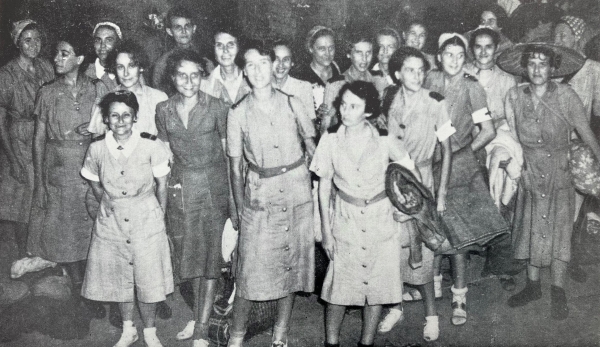
The Dakota came to a standstill, and Harry Windsor jumped out and ran towards the dishevelled group. The nurses were unrecognisable in the remains of their old grey uniforms, and Major Windsor struggled to distinguish them from the civilian internees. He asked where the Australian nurses were, to which they laughed and replied, “We’re here” (Darling, p. 93). Meanwhile, Colonel Sage, Lieutenant Floyd and Sister Chandler had emerged from the plane, and several of the nurses had dropped their tiny parcels of belongings and rushed up to Jean Floyd to hug and kiss her.
The nurses’ attention turned to Colonel Sage. Some of the nurses recognised her, but others did not. When one of them asked her who she was, she replied, “I am the mother of you all.” Colonel Sage then asked where the rest of the nurses were, having expected 32. Elizabeth Simons of the 2/13th AGH writes that the nurses’ “silence gave the answer before we found words to tell of the eight over whose graves in Muntok and Loeboek Linggau we had erected those rough crosses” (Simons, p. 119).
After this bittersweet meeting the nurses and civilian internees were helped aboard the Dakota, and Fred Madsen, joined once again by Ken Brown, took off for Singapore. Haydon Lennard and Beryl Chandler flew on the plane with the nurses, while A. E. Dunstan, Colonel Sage, Harry Windsor and Jean Floyd stayed behind in Lahat to look after the 32 remaining civilian internees. They were joined by Sergeant J. L. van Hasselt of ‘Aspect’ and a British special operations captain (who may in fact have been Major Clough). That night Dunstan and van Hasselt travelled by truck and train to Lubuklinggau and returned to Lahat the following day with 30 more sick internees.
RETURN TO SINGAPORE
The Australian nurses were now on their way to Singapore – and freedom. During the flight, when Beryl Chandler was checking her list of missing nurses against those on board, she asked one of them what her name was. The nurse answered that she was Joyce Tweddell, with whom Beryl had worked at Brisbane General Hospital. Joyce was unrecognisable.
Before long, the Dakota was flying over Palembang. Elizabeth Simons caught a fleeting glimpse of ‘Irenelaan,’ the camp in which the nurses had been interned for 17 months between April 1942 and September 1943. Later, as the plane approached Singapore Island in the fading light, the nurses tried to identify familiar landmarks. Instead, they saw ruins.
Soon Fred Madsen and Ken Brown landed the Dakota at Kallang airport. The nurses were met at the airport by a gaggle of photographers and war correspondents, who took countless photographs and peppered them with questions, and by Red Cross personnel, who gave them tea and biscuits, soap, and cigarettes. Finally, the nurses climbed into waiting ambulances and were driven to St. Patrick’s School, the former base of the 2/13th AGH and now occupied by the 2/14th AGH. It must have been strange indeed for Elizabeth Simons, Vivian Bullwinkel and the other 2/13th AGH nurses to return after three-and-a-half years.
The painfully thin women were helped up the steps of St. Patrick’s School by orderlies and were given a magnificent reception by the staff. Like Jean Floyd, some of the nurses had served with the returnees prior to the fall of Singapore. Several ex-prisoner-of-war patients became hysterical at the sight of the nurses and started shouting, “Give us guns. Let us at these b–s.” The staff managed to calm the infuriated men down, and the exhausted nurses were taken to their rooms, where food and warm baths awaited them. Eventually they were assisted to bed.
Later that night, Hayden Lennard wired the nurses’ story through to Australia, emphasising the massacre on Bangka Island. A. E. Dunstan filed his copy too, and the following day, 17 September, the story was on the front pages of newspapers all around the country. That same day correspondents and photographers were granted further access to the nurses at St. Patrick’s School and spent an hour with them.
The nurses recuperated at St. Patrick’s School for nearly three weeks. They were visited by a steady stream of ex-prisoners of war, received quantities of mail, and ate exceedingly well. They attended a concert featuring Gracie Fields, and on the night of 2 October they gave a sherry party to the staff of the 2/14th AGH, to which they also invited Ken Brown, Haydon Lennard and Fred Madsen. On 5 October the 24 nurses embarked on the AHS Manunda for Australia. They arrived in Fremantle on 18 October. They were home.
The 24 Nurses
- Captain Jean Ashton (2/13th AGH)
- Captain Pat Blake (2/10th AGH)
- Captain Jessie Blanch (2/10th AGH)
- Lieutenant Vivian Bullwinkel (2/13th AGH)
- Lieutenant Veronica Clancy (2/13th AGH)
- Captain Cecilia Delforce (2/10th AGH)
- Captain Jess Doyle (2/10th AGH)
- Captain Jenny Greer (2/10th AGH)
- Captain Pat Gunther (2/10th AGH)
- Captain Mavis Hannah (2/4th CCS)
- Lieutenant Iole Harper (2/13th AGH)
- Captain Nesta James (2/10th AGH)
- Lieutenant Betty Jeffrey (2/10th AGH)
- Lieutenant Violet McElnea (2/13th AGH)
- Lieutenant Sylvia Muir (2/13th AGH)
- Captain Wilma Oram (2/13th AGH)
- Lieutenant Chris Oxley (2/10th AGH)
- Lieutenant Eileen Short (2/13th AGH)
- Captain Jessie Elizabeth Simons (2/13th AGH)
- Lieutenant Valrie Smith (2/13th AGH)
- Lieutenant Ada Syer (2/10th AGH)
- Lieutenant Florence Trotter (2/10th AGH)
- Lieutenant Joyce Tweddell (2/10th AGH)
- Lieutenant Beryl Woodbridge (2/10th AGH)
SOURCES
- Australian War Memorial, ‘Beryl Maddock ‘Flying Sister,’’ Penny Hyde (4 July 2011).
- Colijn, H. (1996), Song of Survival, Millennium Books.
- Darling (née Gunther), P. (2001), Portrait of a Nurse, published by Don Wall.
- De Man, J. Th. A. (1987), Opdracht Sumatra: het Korps Insulinde 1942-1946 [Mission Sumatra: the Insulinde Corps 1942-1946], De Haan.
- Henning, P. (2013), Veils and Tin Hats: A history of Tasmanian nurses during the Second World War.
- Jacobs, G. F. (1965, 1982), Prelude to the Monsoon: Assignment in Sumatra, University of Pennsylvania Press.
- Jeffrey, B. (1954), White Coolies, Angus & Robertson Publishers.
- Kenny, C. (1986), Captives, University of Queensland Press.
- National Archives of Australia, numerous military records.
- National Archives of Australia (SP300/3, 637), ‘Radio talk presented by ABC war correspondent Haydon Lennard. Release of nurses & civilian internees Sumatra (including Sister Vivian Bullwinkel).’
- Reid, A. (1979), The Blood of the People: Revolution and the End of Traditional Rule in Northern Sumatra, Oxford University Press.
- Simons, J. E. (1954), While History Passed, William Heinemann Ltd.
- South African Military History Society, ‘Some South Africans who served in Special Forces during WW2.’
SOURCES: NEWSPAPERS
- The Argus (Melbourne, 17 Sept 1945, p. 1), ‘Camp Horrors in Sumatra: Search for Nurses.’
- The Australian Women’s Weekly (6 Oct 1945, p. 17), ‘Nurses’ Terrible Years in Sumatra Prison Camps.’
- The Cessnock Eagle and South Maitland Recorder (18 Sep 1945, p. 3), ‘Horrible Treatment of Nurses.’
- The Courier-Mail (Brisbane, 18 Sept 1945, p. 1), ‘2 Australians Freed Nurses.’
- The Daily Telegraph (Sydney, 14 Sept 1945, p. 4), ‘Leaving Today from Singapore.’
- The Daily Telegraph (Sydney, 18 Sept 1945, p. 3), ‘Nurses “Like Skeletons” – Rage as AIF See Survivors of Massacre.’
- The Daily Telegraph (Sydney, 20 Sept 1945, p. 3), ‘Human Suffering in Sumatra “Almost Incredible.”’
- The Longreach Leader (Qld., Oct 1945, p. eight), ‘Women’s World.’
- The Sun (Sydney, 13 Sept 1945, p. 1), ‘Thousands Die in Sumatra.’
- The Telegraph (Brisbane, 29 Oct 1945, p. 3), ‘Q’ld. Nurse Stayed at Jap Hotel.’
- Tweed Daily (Murwillumbah, 18 Sept 1945, p. 1), ‘Australian Nurses Murdered by Japanese.’
 australianwarnurses.org